INFECTIOUS MYELOPATHY
DR.SARATH MENON.R, MD(Med.),DNB(Med.),MNAMS
DM RESIDENT,
DEPT. OF NEUROSCIENCES
AIMS,KOCHI.
INTRODUCTION
 Infections and secondary inflammatory changes
play an important role
 Direct neuronal invasion
 Molecular mimicry
 Myelopathy- spinal cord dysfunction of any
etiology ,intrinsic or extrinsic
PRESENTATION
 Acute transverse myelitis
 Acute flaccid paralysis- AHC, motor roots
APPROACH
 History & physical examinations
 Tempo of illness
 Exposure
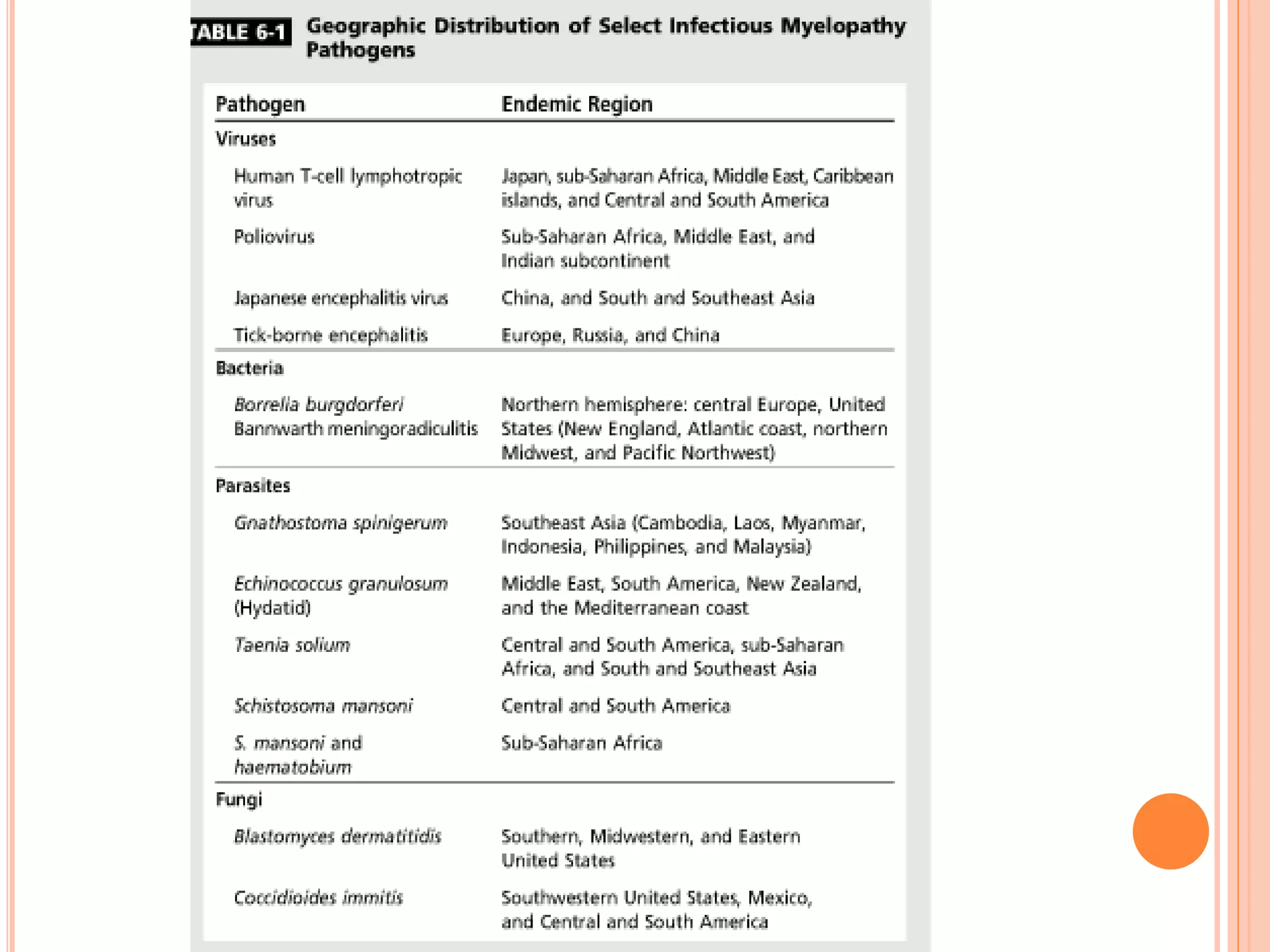
 Demographic- endemicity
 Host immune status
 Ancillary test
 Diagnosis & Rx
PARAINFECTIOUS ETIOLOGY
 30 -60% infective myelopathy preceeded by
systemic infectious process
 Molecular mimicry-
cross reactivity with host antigen in spinal cord
 Usually 2-4 wks after infection
 Dx- CSF IgG index,OCB
Serology & specific antigen in csf /serum
 Rx-
Iv steroid
Refractory cases- IVIG,cyclophosphamide or
rituximab.
CAUSATIVE AGENTS
 Viral
 Bacterial
 Parasitic
 Fungal
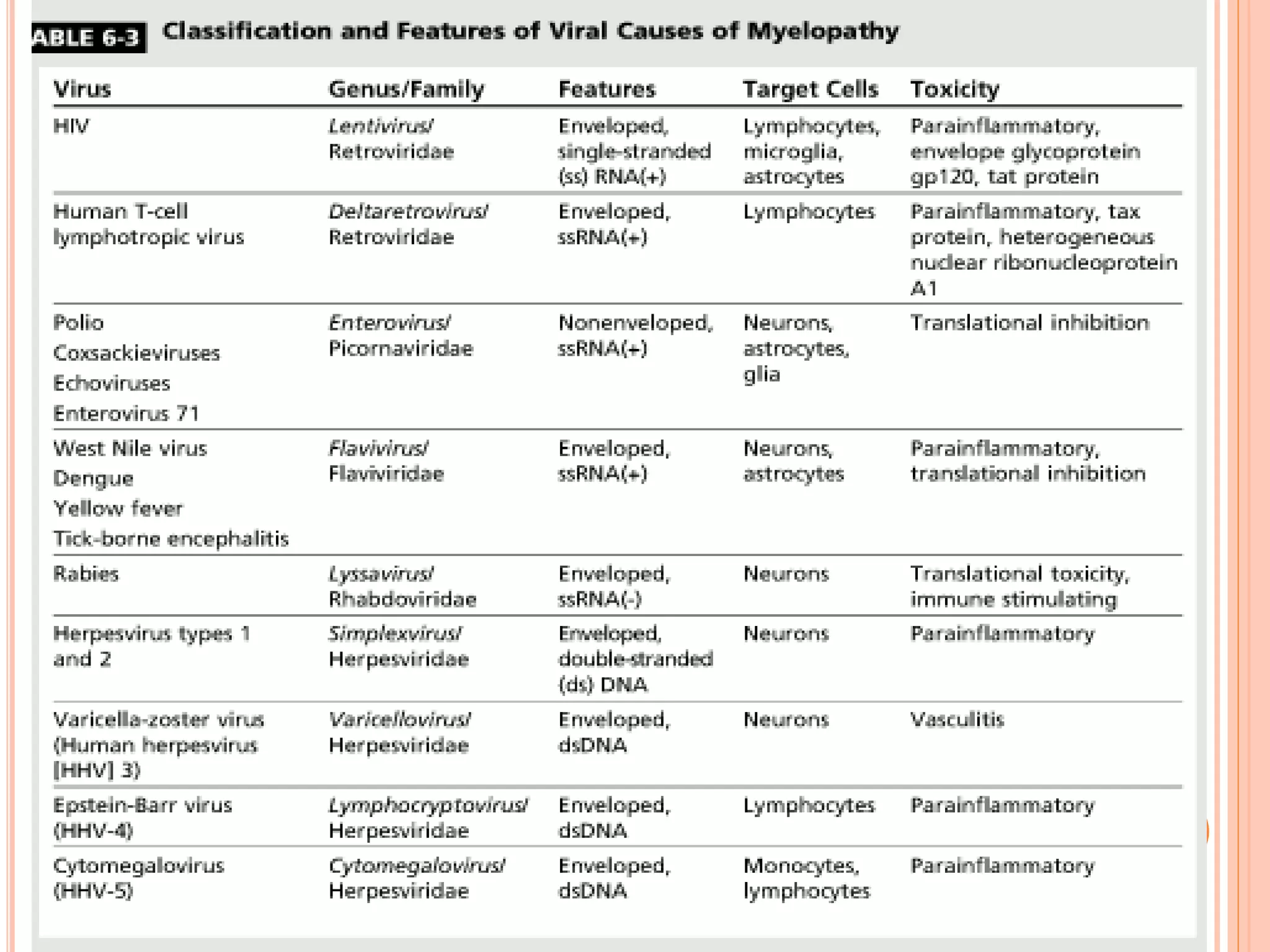
RETRO VIRUSES- HIV
 CNS – lymphocytes,microglia
 Crosses BBB
 Neurotoxicity by viral proteins
 Chronic pro inflammatory state
 CD4 < 200- HIV – vacuolar myelopathy
HIV –VACUOLAR MYELOPATHY
 Slow progressive,painless myelopathy
 LL weakness,gait difficulties,spasticity,erectile
dysfunction,mild paresthesia
 Urge incontinence,urgency- later
 Impaired proprioception
 LL disproportionately affected.
 Diagnosis of exclusion in HIV + pts.
 Acute presentation,spinal level ,prominent pain ,UL
prominently involved- alternate diagnosis
 D/D- oppurtunistic infection,neoplasms,VB12 def.
 Imaging-
Usually normal.
Spinal cord atrophy
Findings similar SACD
 Microscopy-
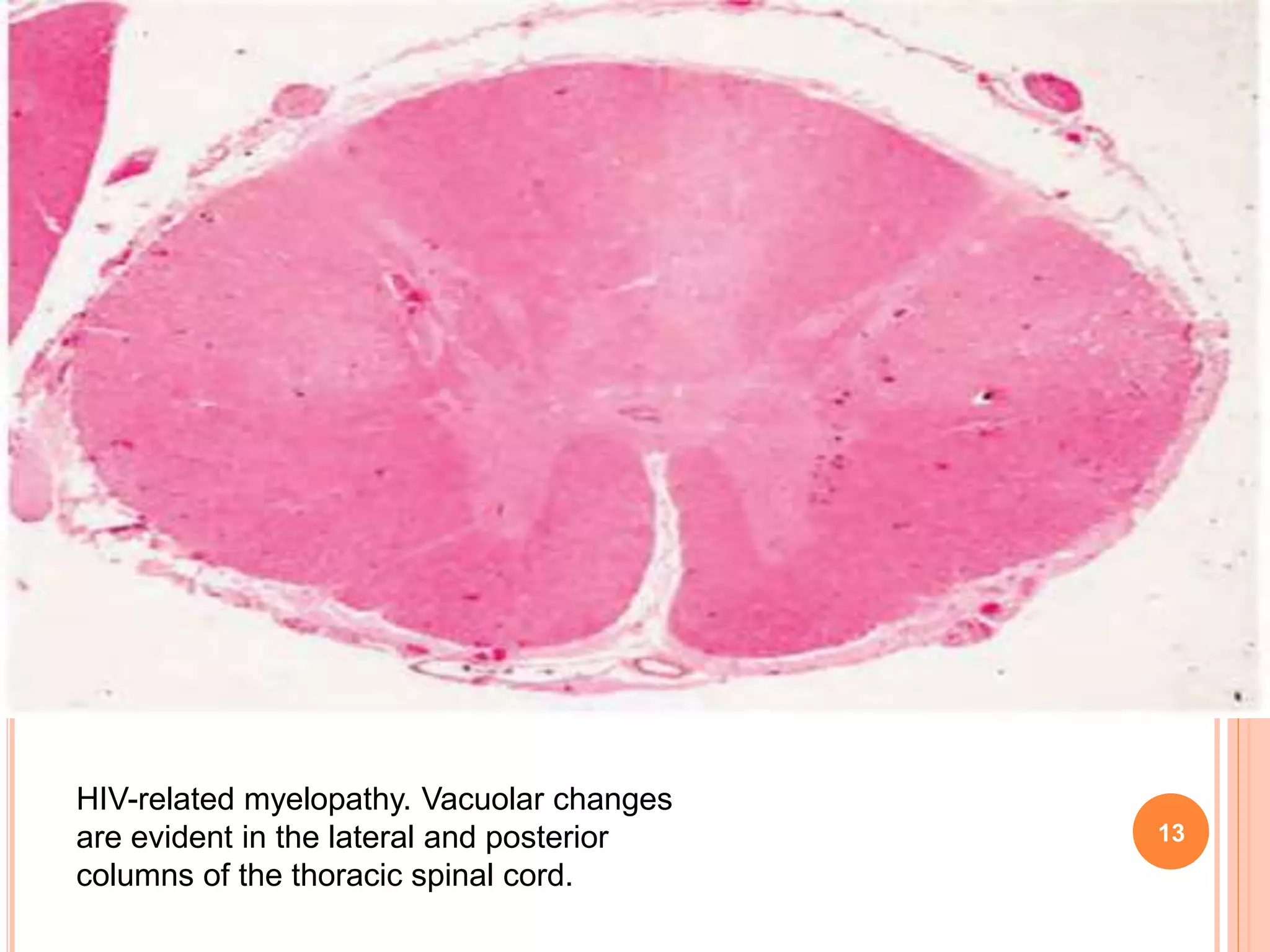
spongy,vacuolation of myelin
lipid laden macrophages
 Rx-
HAART reduced incidence
No response to ART,B12 or IVIG,steroids
13
HIV-related myelopathy. Vacuolar changes
are evident in the lateral and posterior
columns of the thoracic spinal cord.
HTLV-1 (HAM/TSP)
 4% HTLV-1 will develop
 Female predominance
 CD8 + Tcell neurotoxicity or molecular mimicry
 Clinical features
- insidious ,slow progression
- LL spasticity
- prominent bladder/bowel involvement
- UL weakness insignificant
 Diagnosis
- Clinical,demographic,serology
- csf- lymphocytic pleocytosis,OCB+
Confirmation- Western blot
PCR- peripheral blood- distinction & viral load
Imaging
-Focal T2 Hyperintensity in lower cervical cord
-contrast enhancement+
- close d/d to MS
- cervical/thoracic cord atrophy
TREATMENT
 No effective clinical trials to date.
 Steroids
 INF-alpha, cyclosporine,azathioprine- effective
early – limited evidence
 HAART
ENTEROVIRUSES
 Ubiquitous RNA virus
 Produce acute flaccid paralysis
 Poliovirus
- AHC affection
- Subsaharan Africa,middle east,Indian subcontinent
- Fever,menigismus,asymmetric flaccid paralysis of LL
proximal > distal over 2 days
- Post polio syndrome
- Slow progressive recrudescence
- Severity of initial disease
ENTEROVIRUS 71- EV 71
 AFP similar to polio
 Asia –pacific
 Children
 Fever ,rash – paralysis over 3-5 days
 Mri= T2 hyperintensity in lower brainstem,cerebellum
 CSF- lymphocytic pleocytosis
 No specific rx
 IVIG -tried
FLAVIVIRUS- WEST NILE VIRUS
 Polio-like paralysis
 Mosquito vector
 Fever—myelitis—over 2-8 days
 Flaccid paralysis, respiratory,bladder +
 Risk factor
Age > 50 yrs,immunosuppression
WNV – directly affect AHC
21
West Nile virus encephalomyelitis.
A, Crosssection
of the cervical spinal cord showing
anterior horn–predominant inflammatory
infiltrate (arrows).
.
B, Higher magnification shows
destruction of anterior horn neurons with
perivascular
lymphocytic cuffing seen at lower right;
arrow indicates a
remaining neuron
 Diagnosis
-peripheral leukocytosis,thrombocytopenia,transaminitis
CSF- PMN /mononclear pleocytosis,elev.protein,sug-nl
- IgM –sensitive/specific
- serology
-Spinal cord imaging-normal
- Rx
- Supportive,no specific
- anecdotal- steroids
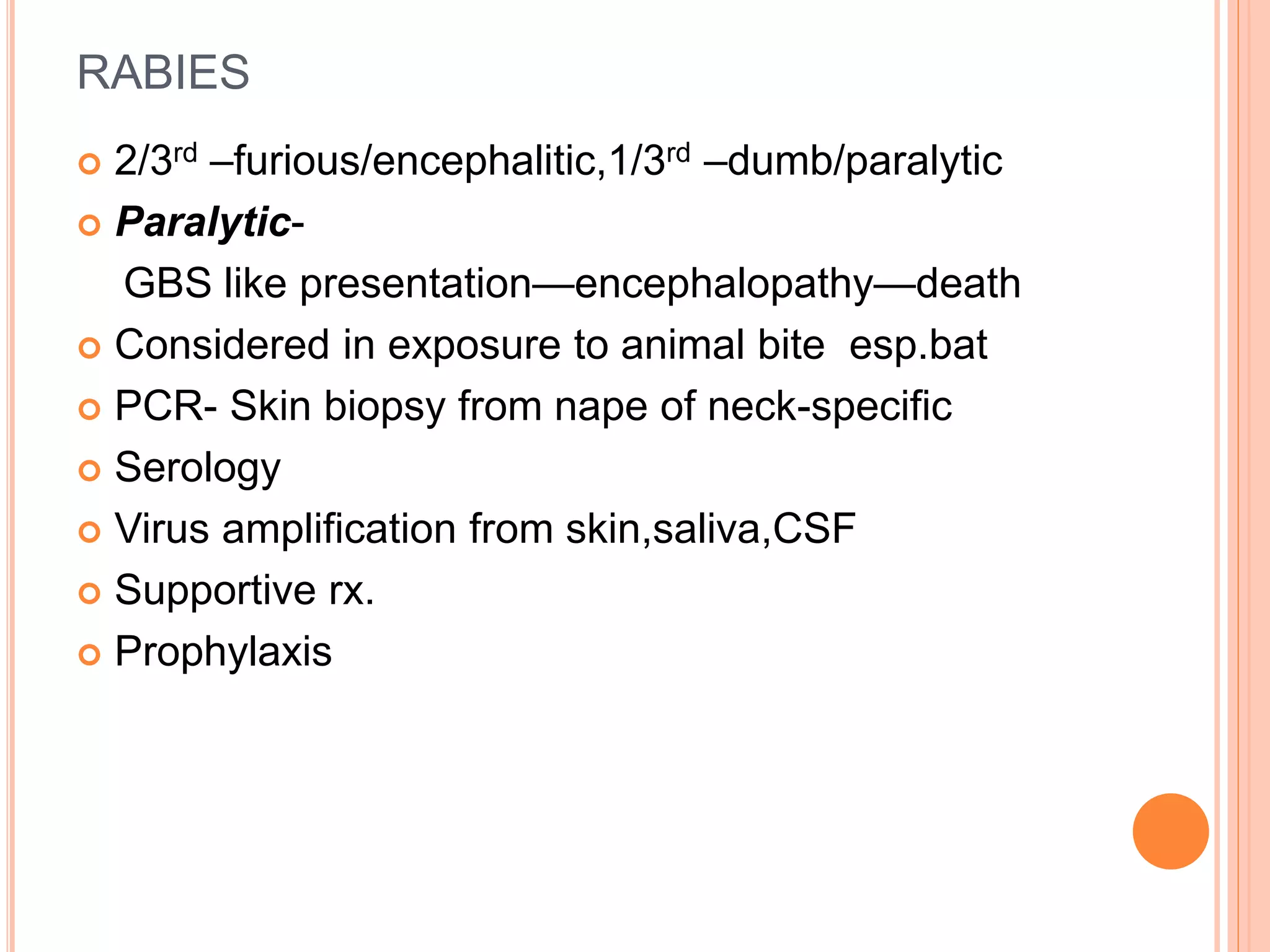
RABIES
 2/3rd –furious/encephalitic,1/3rd –dumb/paralytic
 Paralytic-
GBS like presentation—encephalopathy—death
 Considered in exposure to animal bite esp.bat
 PCR- Skin biopsy from nape of neck-specific
 Serology
 Virus amplification from skin,saliva,CSF
 Supportive rx.
 Prophylaxis
HERPES VIRUSES-HSV1&2
 HSV1 &2 – myelitis
 HSV-2 related myelitis-adults
 Elsberg syndrome-reactivation of HSV-2
inflammation in dorsal roots + spinal cord = radiculomyelitis
 C/f :
- subacute lower extremity weakness may ascend
- Numbness or tingling in lumbosacral dermatome
- Urinary retention
Acute necrotising myelopathy- severe form seen in
immunocompromised
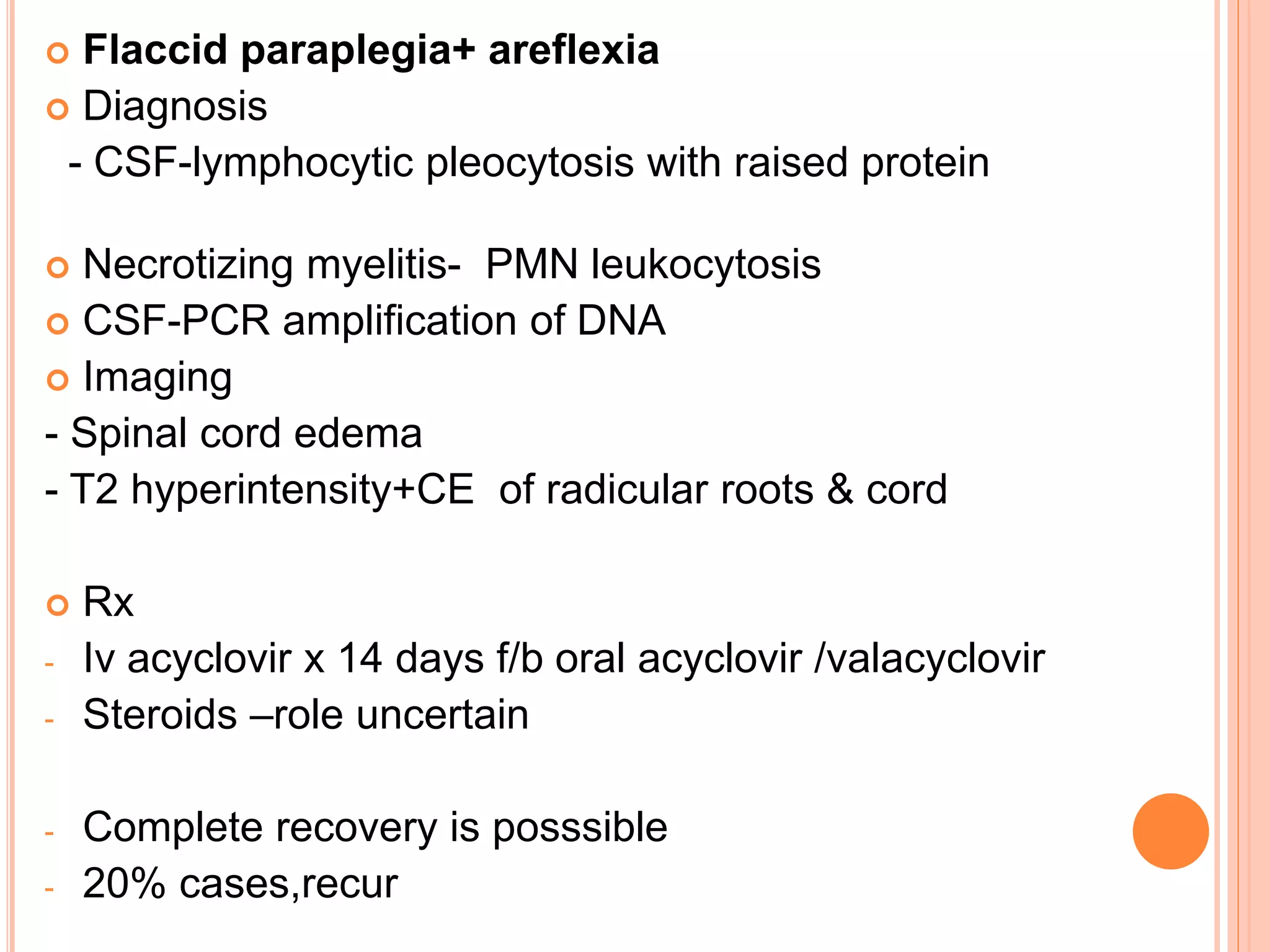
 Flaccid paraplegia+ areflexia
 Diagnosis
- CSF-lymphocytic pleocytosis with raised protein
 Necrotizing myelitis- PMN leukocytosis
 CSF-PCR amplification of DNA
 Imaging
- Spinal cord edema
- T2 hyperintensity+CE of radicular roots & cord
 Rx
- Iv acyclovir x 14 days f/b oral acyclovir /valacyclovir
- Steroids –role uncertain
- Complete recovery is posssible
- 20% cases,recur
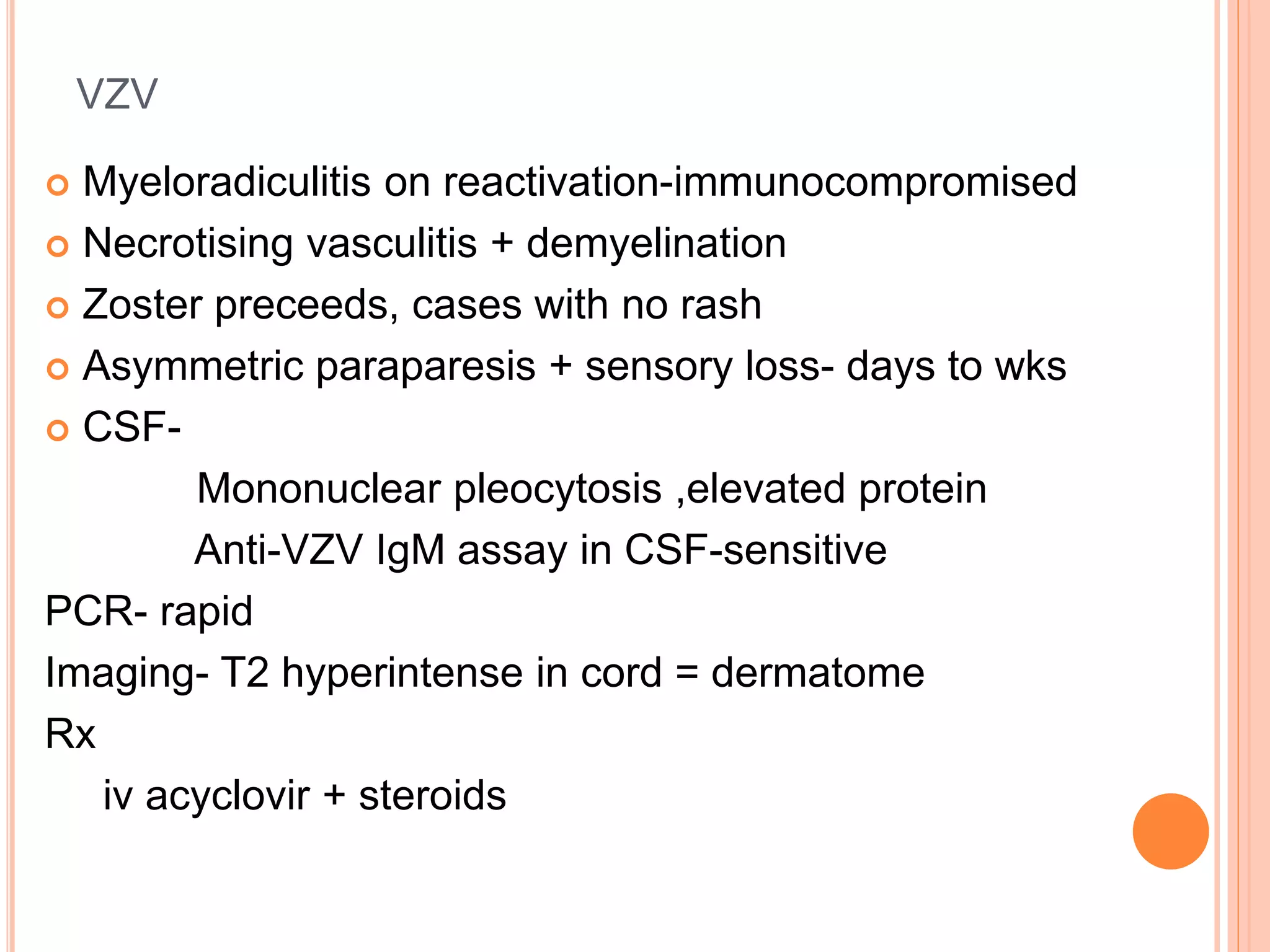
VZV
 Myeloradiculitis on reactivation-immunocompromised
 Necrotising vasculitis + demyelination
 Zoster preceeds, cases with no rash
 Asymmetric paraparesis + sensory loss- days to wks
 CSF-
Mononuclear pleocytosis ,elevated protein
Anti-VZV IgM assay in CSF-sensitive
PCR- rapid
Imaging- T2 hyperintense in cord = dermatome
Rx
iv acyclovir + steroids
CMV
 Imunocompromised- HIV – CD4<100cells/microL
 Lumbosacral polyradiculomyelitis-
supf.meningitis-> nerve roots & spinal cord
 Necrotizing myelitis
 Imaging-
cord edema+root edema+ CE
meningeal thickening+clumping of roots
CSF-
PMN pleocytosis+elev.protein+ low sugar
Rx
IV ganciclovir+ foscarnet
Poor prognosis
EBV
 Children / young adults
 Immunocompromised –transplant
 Spectrum – aseptic meningitis
meningoencephalitis
cranial/peripheral neuritis
GBS & myelitis
Myelitis- 2-3 weeks after primary infection
flaccid paraparesis,sensory level,bladder+
CSF-
mononuclear pleocytosis,elev.protein,sugar-nl
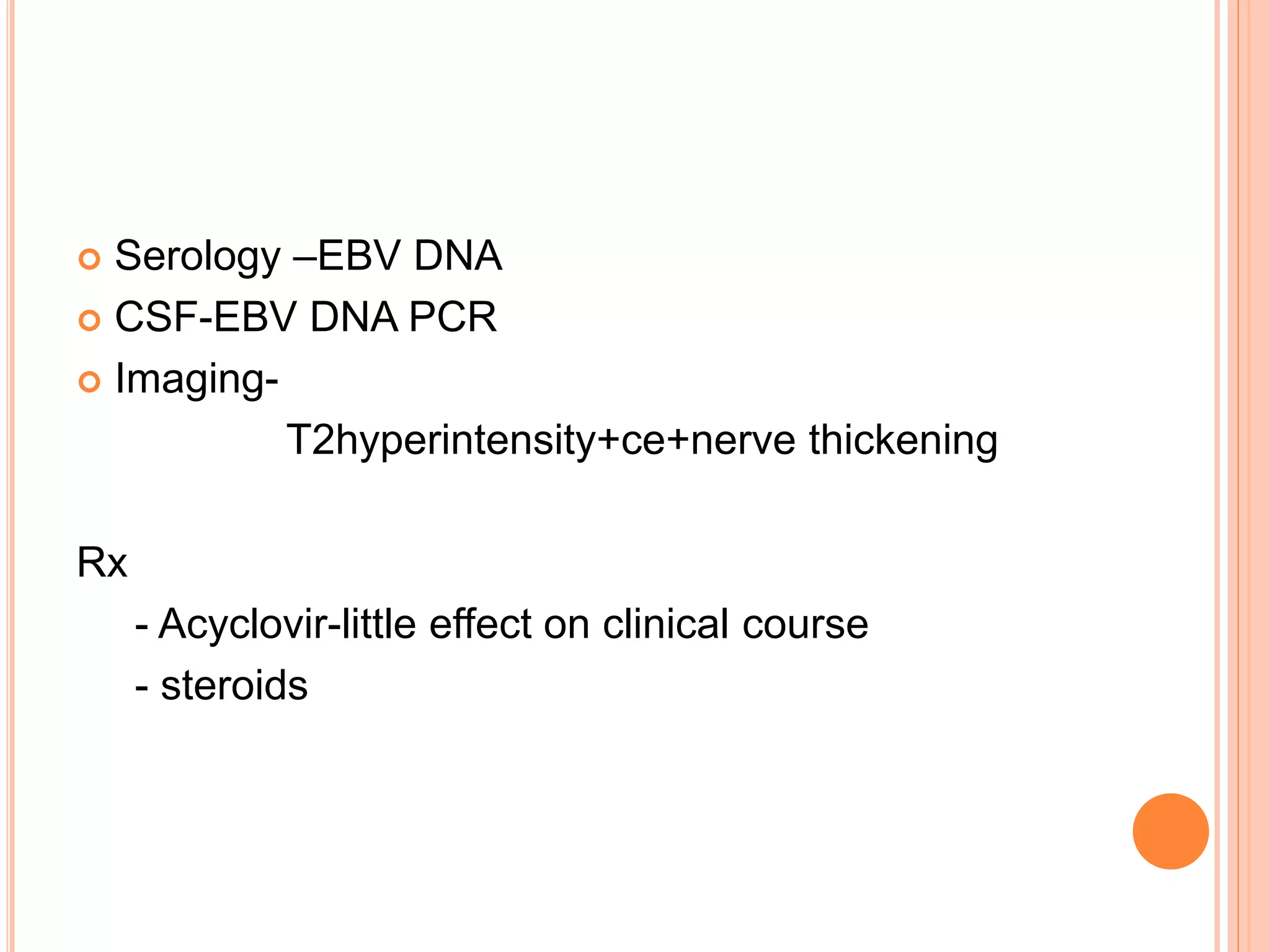
 Serology –EBV DNA
 CSF-EBV DNA PCR
 Imaging-
T2hyperintensity+ce+nerve thickening
Rx
- Acyclovir-little effect on clinical course
- steroids
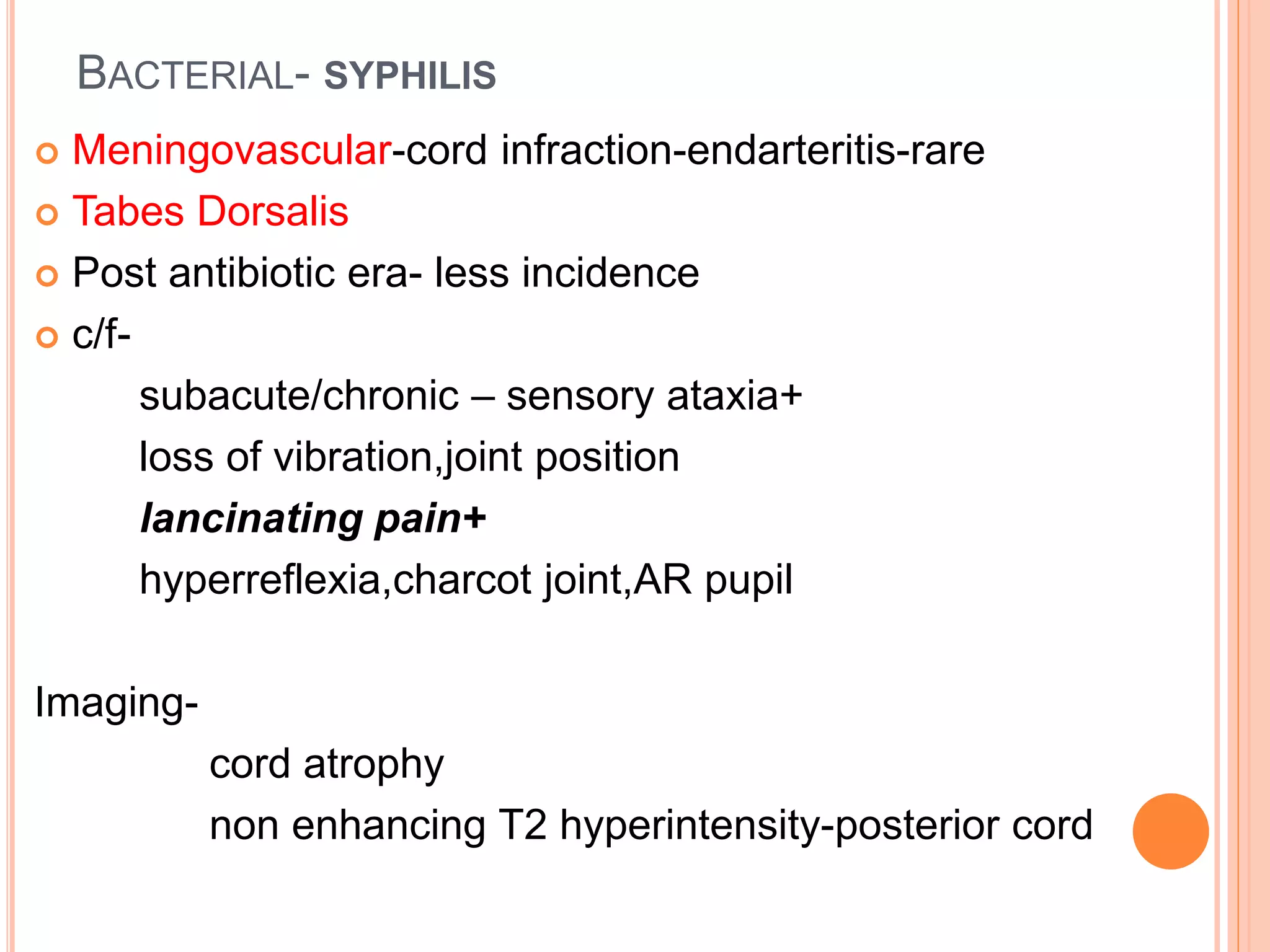
BACTERIAL- SYPHILIS
 Meningovascular-cord infraction-endarteritis-rare
 Tabes Dorsalis
 Post antibiotic era- less incidence
 c/f-
subacute/chronic – sensory ataxia+
loss of vibration,joint position
lancinating pain+
hyperreflexia,charcot joint,AR pupil
Imaging-
cord atrophy
non enhancing T2 hyperintensity-posterior cord
SYPHILIS-OTHER FORMS OF MYELOPATHY
 Hypertrophic pachymeningitis
 Spinal cord Gumma
 AHC
 Syingomelia
 Aortic aneurysm –sec AHC
 Charcot vertebra-cord compression
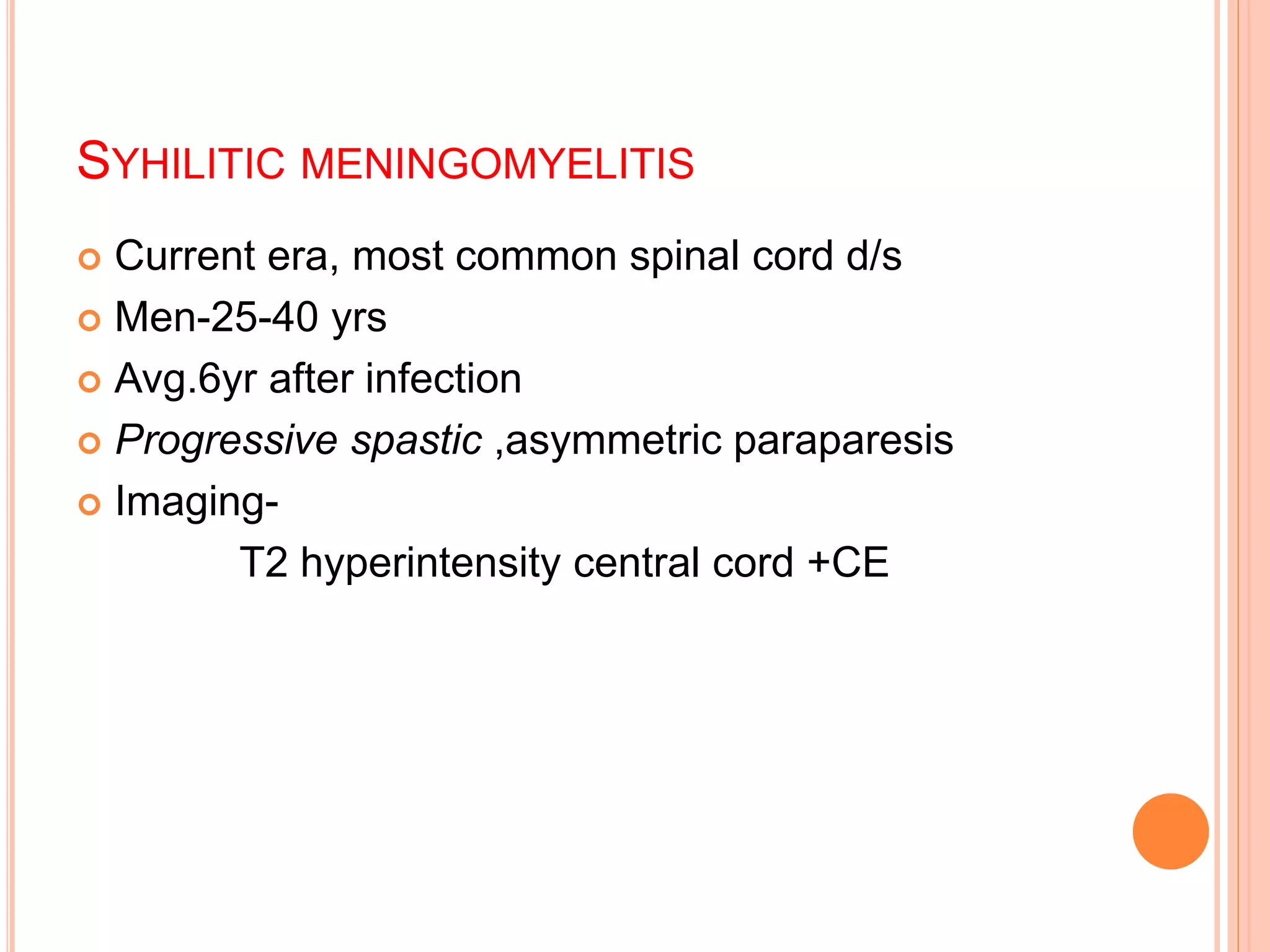
SYHILITIC MENINGOMYELITIS
 Current era, most common spinal cord d/s
 Men-25-40 yrs
 Avg.6yr after infection
 Progressive spastic ,asymmetric paraparesis
 Imaging-
T2 hyperintensity central cord +CE
DIAGNOSIS & RX
 Peripheral serology+ CSF evaluation
 VDRL & RPR- sensitive in early
 TP-FAB- specific
 CSF- mild inflammatory
- VDRL,FAB
Rx
Inj.Penicillin aqueous -12-24 mu q4h x 10-14 days
Jarisch-Herxheimer reaction
(iv steriods-premptively)
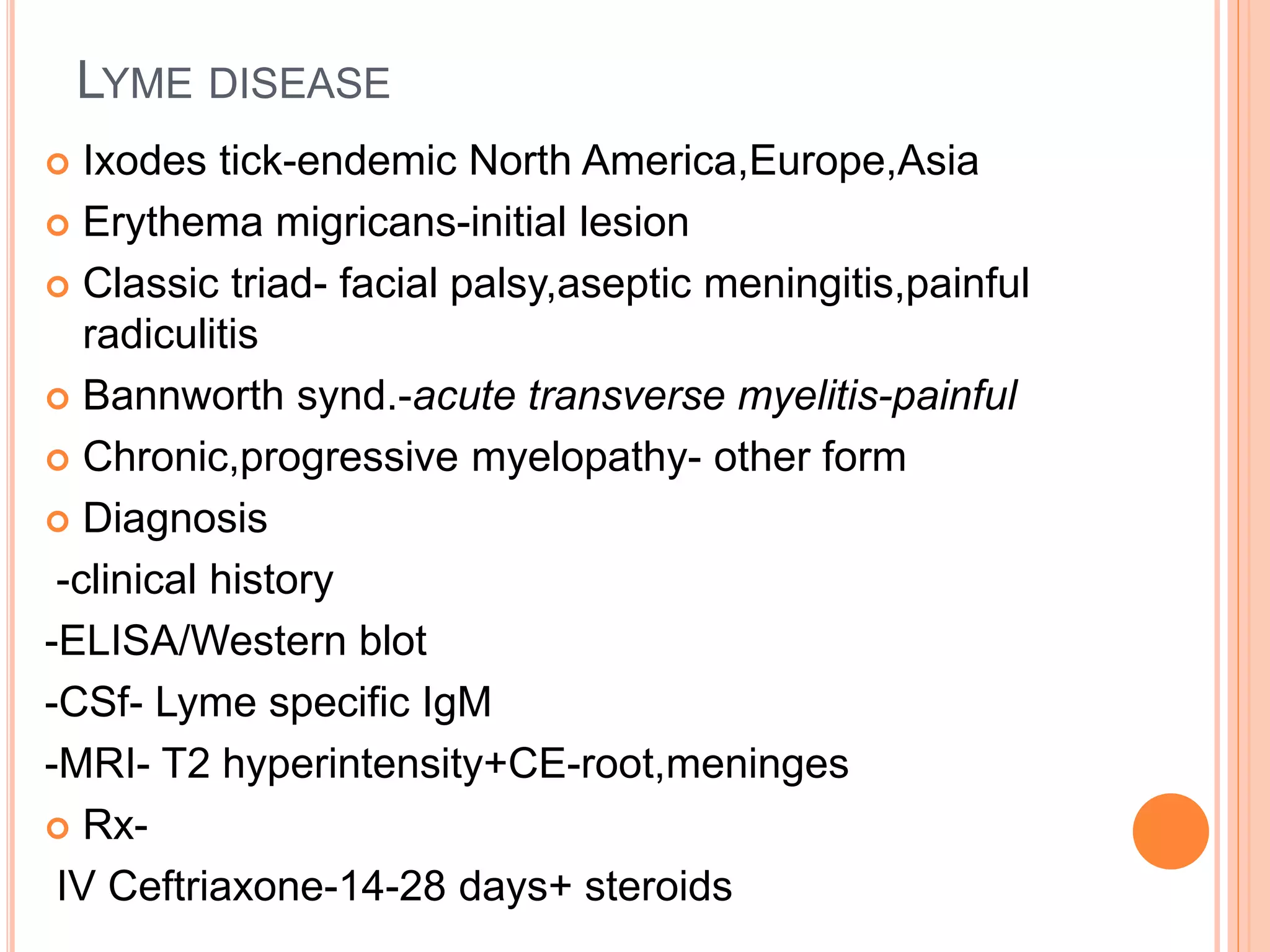
LYME DISEASE
 Ixodes tick-endemic North America,Europe,Asia
 Erythema migricans-initial lesion
 Classic triad- facial palsy,aseptic meningitis,painful
radiculitis
 Bannworth synd.-acute transverse myelitis-painful
 Chronic,progressive myelopathy- other form
 Diagnosis
-clinical history
-ELISA/Western blot
-CSf- Lyme specific IgM
-MRI- T2 hyperintensity+CE-root,meninges
 Rx-
IV Ceftriaxone-14-28 days+ steroids
TUBERCULOSIS
 MC myelopathy- Pott’s disease
 Vertebral venous system
 Anterior segment of thoracic & lumbar spine-collapse
 Other forms-
- intramedullary/intradural tuberculomas-
(S/A myelopathic symptoms).
- granulomatous myeloradiculitis-
(rapid progressive rad.pain,paresthesia,flaccid
weakness,babinski+ ,bladder+)
- spinal artery vasculitis+ cord infarction
- ADEM
- Cord compression- vertebre,granulating tissue
DIAGNOSIS
 CSF- lymphocytic pleocytosis,low sugar,very high protein
AFB,TB cultures
 Mantaux test- + in 40%
 MRI (Pott’s)–T1 hypo +T2 hyper +CE
Vertebre collapse+ cord compression
 Granulomatous myeloradiculitis-
CE+ meningeal thickening +spinal roots
 Tuberculomas-
CE+ T1 hypointense ring +T2 hyperintense central
RX
 2 month HRZE/S+ 7-10 Month HR
 Vertebral disease- surgical option
 Lumbar disease-better prognosis
PYOGENIC BACTERIA
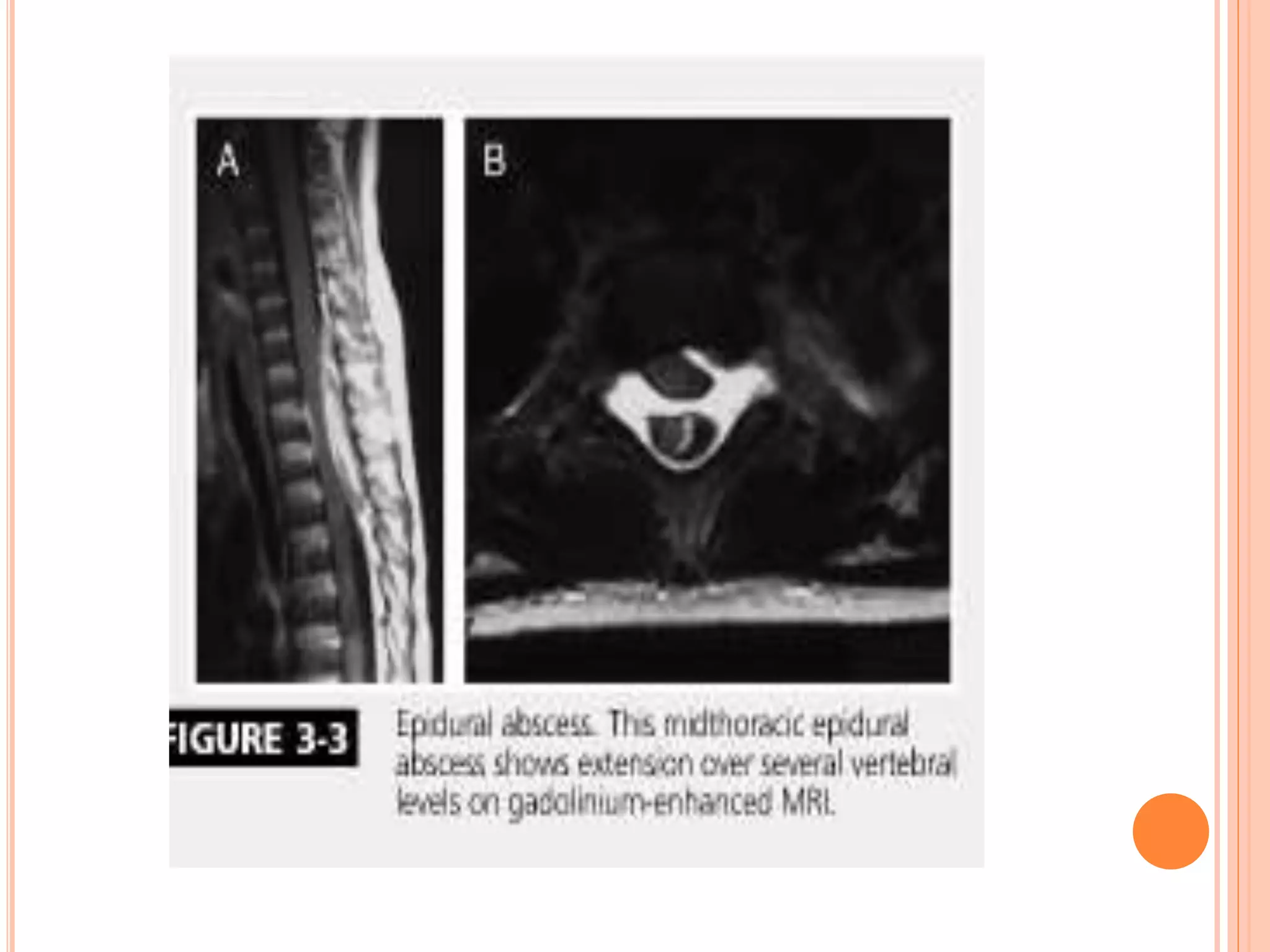
 Vertebral osteomyelitis- collapse+ epidural abscess
 Intramedullary abscess- hematogenous seeding+
 Epidural abscess
- osteomyelitis- hematogenous
- Local soft tissue,viscera,instrumentation ant.epidural
- Direct seeding- post.epidural
- Risk factors+
- Thoracic +
 C/F-
- Focal back pain+ muscle spasms
- Fever
- MC- S.aureus > Streptococcus > GNB
Diagnosis-
ESR,CRP
Blood culture-+ 60%
Imaging
LP –contraindicated
Rx
- Drainage
- Iv antibiotics
OTHER BACTERIAL MYELOPATHY
 Bartonella- myelitis & Brown –Sequard syndrome
 Whipple disease-
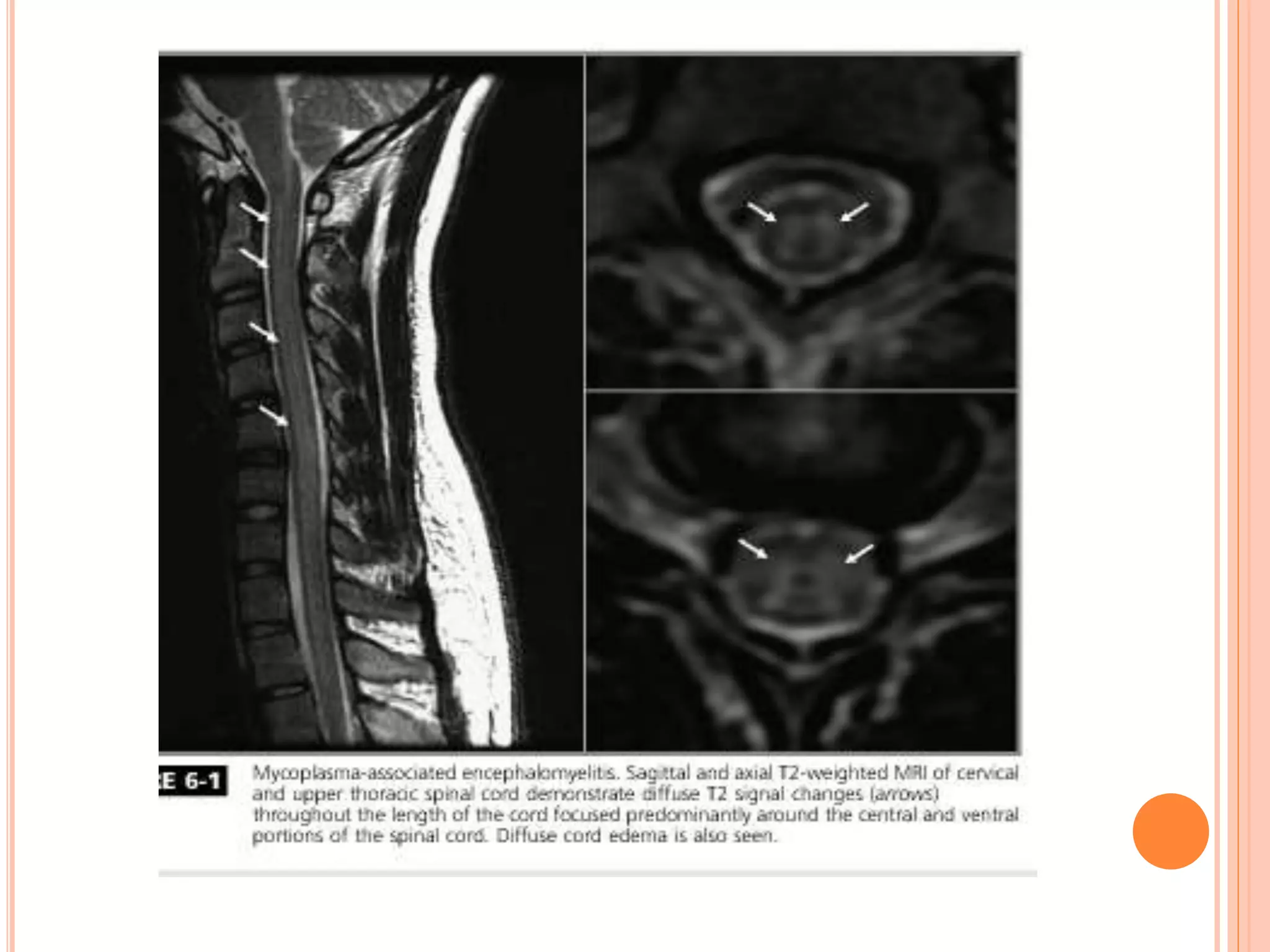
 Parainfectious-
Mycoplasma
Pertussis
PARASITIC MYELOPATHIES
 Schistosomiasis
 Central America & Africa
 Retrograde migration of eggs ffrom portal system to
epidural venous plexus
 Subacute- low back ache- paraparesis-sensory level-
bladder/bowel++
 T11 –L1 & Cauda equina
 MRI-
-Cord enlargement
- intramedullary T2 hyperintensity
- lower thoracolumbar cord,conus,cauda CE
DIAGNOSIS
 3 features
-Lower spinal cord or cauda
-Evidence of infection(ova in stool/urine,rectal
biopsy,serology)
-Exclusion of other causes
 Peripheral Serology- ELISA,IF
 CSF tests specific- Monoclonal antibodies or PCR
 Tissue biopsy- gold standard
(avoided in CNS disease).
RX
 Praziquantel
 Concurrent steroids
 Rarely, decompression- medically refractory
OTHER PARASITES
 Toxoplasma gondii-
-Advanced HIV
-Parenchymal + spinal cord mass lesions
-Peripheral IgG+
- CSF-PCR(spf)
 Rx-
pyrimethamine + sulfadiazine /clindamycin
folinic acid
NEUROCYSTICERCOSIS
 1.2 %-5.8% cases involve spinal cord
 Subarachnoid
 Subarachnoid cysts migrate from basal cisterns
 75% cases – intracranial NC
 Csf- high proten + eosinophilia
 Rx
- albendazole + steroids
- rarely,decompression.
HYDATID CYST-ECHINOCOCCUS
 Spinal rare
 Vertebrae,extradural or paraspinal
 Cysts in other sites+
 Large- mass effect,bony destruction,inflammatory
response
 Imaging-cysts
 Serology
 Rx-
albendazole
surgical
Recurrence- norm
OTHER PARASITES
 Gnathostoma spinigerum
 Angiostrongylus cantonensis
FUNGAL CAUSES
 Immunocompromised
 Aspergillus,cryptococcus
 Spinal myelopathy
- epidural abscess
- c/c arachnoiditis
- intramedullary granulomas
- frank myelitis
- vasculitis + cord infarction.
APPROACH
 Clinical –
- Onset- Acute vs Subacute Vs Chronic
- Progression
- Painful vs painless
- Sensory level
- Bladder/Bowel+
 CSF analysis
 Imaging
ACUTE FLACCID PARALYSIS
 Polio
 Enteroviruses
 West NileV
Leukomyelitis-(Acute)
 Herpes
 CMV
 Borellia- rare
 EBV
 Rabies
LEUKOMYELITIS (SUBACUTE-CHRONIC)
 Treponema
 Mycoplasma
 Tuberculosis
 HIV/HTLV-1
Thank you

Infectious myelopathy

  • 1.
    INFECTIOUS MYELOPATHY DR.SARATH MENON.R,MD(Med.),DNB(Med.),MNAMS DM RESIDENT, DEPT. OF NEUROSCIENCES AIMS,KOCHI.
  • 2.
    INTRODUCTION  Infections andsecondary inflammatory changes play an important role  Direct neuronal invasion  Molecular mimicry  Myelopathy- spinal cord dysfunction of any etiology ,intrinsic or extrinsic
  • 3.
    PRESENTATION  Acute transversemyelitis  Acute flaccid paralysis- AHC, motor roots
  • 4.
    APPROACH  History &physical examinations  Tempo of illness  Exposure  Demographic- endemicity  Host immune status  Ancillary test  Diagnosis & Rx
  • 6.
    PARAINFECTIOUS ETIOLOGY  30-60% infective myelopathy preceeded by systemic infectious process  Molecular mimicry- cross reactivity with host antigen in spinal cord  Usually 2-4 wks after infection  Dx- CSF IgG index,OCB Serology & specific antigen in csf /serum  Rx- Iv steroid Refractory cases- IVIG,cyclophosphamide or rituximab.
  • 7.
    CAUSATIVE AGENTS  Viral Bacterial  Parasitic  Fungal
  • 9.
    RETRO VIRUSES- HIV CNS – lymphocytes,microglia  Crosses BBB  Neurotoxicity by viral proteins  Chronic pro inflammatory state  CD4 < 200- HIV – vacuolar myelopathy
  • 10.
    HIV –VACUOLAR MYELOPATHY Slow progressive,painless myelopathy  LL weakness,gait difficulties,spasticity,erectile dysfunction,mild paresthesia  Urge incontinence,urgency- later  Impaired proprioception  LL disproportionately affected.  Diagnosis of exclusion in HIV + pts.  Acute presentation,spinal level ,prominent pain ,UL prominently involved- alternate diagnosis  D/D- oppurtunistic infection,neoplasms,VB12 def.
  • 11.
     Imaging- Usually normal. Spinalcord atrophy Findings similar SACD  Microscopy- spongy,vacuolation of myelin lipid laden macrophages  Rx- HAART reduced incidence No response to ART,B12 or IVIG,steroids
  • 13.
    13 HIV-related myelopathy. Vacuolarchanges are evident in the lateral and posterior columns of the thoracic spinal cord.
  • 15.
    HTLV-1 (HAM/TSP)  4%HTLV-1 will develop  Female predominance  CD8 + Tcell neurotoxicity or molecular mimicry  Clinical features - insidious ,slow progression - LL spasticity - prominent bladder/bowel involvement - UL weakness insignificant
  • 16.
     Diagnosis - Clinical,demographic,serology -csf- lymphocytic pleocytosis,OCB+ Confirmation- Western blot PCR- peripheral blood- distinction & viral load Imaging -Focal T2 Hyperintensity in lower cervical cord -contrast enhancement+ - close d/d to MS - cervical/thoracic cord atrophy
  • 17.
    TREATMENT  No effectiveclinical trials to date.  Steroids  INF-alpha, cyclosporine,azathioprine- effective early – limited evidence  HAART
  • 18.
    ENTEROVIRUSES  Ubiquitous RNAvirus  Produce acute flaccid paralysis  Poliovirus - AHC affection - Subsaharan Africa,middle east,Indian subcontinent - Fever,menigismus,asymmetric flaccid paralysis of LL proximal > distal over 2 days - Post polio syndrome - Slow progressive recrudescence - Severity of initial disease
  • 19.
    ENTEROVIRUS 71- EV71  AFP similar to polio  Asia –pacific  Children  Fever ,rash – paralysis over 3-5 days  Mri= T2 hyperintensity in lower brainstem,cerebellum  CSF- lymphocytic pleocytosis  No specific rx  IVIG -tried
  • 20.
    FLAVIVIRUS- WEST NILEVIRUS  Polio-like paralysis  Mosquito vector  Fever—myelitis—over 2-8 days  Flaccid paralysis, respiratory,bladder +  Risk factor Age > 50 yrs,immunosuppression WNV – directly affect AHC
  • 21.
    21 West Nile virusencephalomyelitis. A, Crosssection of the cervical spinal cord showing anterior horn–predominant inflammatory infiltrate (arrows). . B, Higher magnification shows destruction of anterior horn neurons with perivascular lymphocytic cuffing seen at lower right; arrow indicates a remaining neuron
  • 22.
     Diagnosis -peripheral leukocytosis,thrombocytopenia,transaminitis CSF-PMN /mononclear pleocytosis,elev.protein,sug-nl - IgM –sensitive/specific - serology -Spinal cord imaging-normal - Rx - Supportive,no specific - anecdotal- steroids
  • 23.
    RABIES  2/3rd –furious/encephalitic,1/3rd–dumb/paralytic  Paralytic- GBS like presentation—encephalopathy—death  Considered in exposure to animal bite esp.bat  PCR- Skin biopsy from nape of neck-specific  Serology  Virus amplification from skin,saliva,CSF  Supportive rx.  Prophylaxis
  • 24.
    HERPES VIRUSES-HSV1&2  HSV1&2 – myelitis  HSV-2 related myelitis-adults  Elsberg syndrome-reactivation of HSV-2 inflammation in dorsal roots + spinal cord = radiculomyelitis  C/f : - subacute lower extremity weakness may ascend - Numbness or tingling in lumbosacral dermatome - Urinary retention Acute necrotising myelopathy- severe form seen in immunocompromised
  • 25.
     Flaccid paraplegia+areflexia  Diagnosis - CSF-lymphocytic pleocytosis with raised protein  Necrotizing myelitis- PMN leukocytosis  CSF-PCR amplification of DNA  Imaging - Spinal cord edema - T2 hyperintensity+CE of radicular roots & cord  Rx - Iv acyclovir x 14 days f/b oral acyclovir /valacyclovir - Steroids –role uncertain - Complete recovery is posssible - 20% cases,recur
  • 26.
    VZV  Myeloradiculitis onreactivation-immunocompromised  Necrotising vasculitis + demyelination  Zoster preceeds, cases with no rash  Asymmetric paraparesis + sensory loss- days to wks  CSF- Mononuclear pleocytosis ,elevated protein Anti-VZV IgM assay in CSF-sensitive PCR- rapid Imaging- T2 hyperintense in cord = dermatome Rx iv acyclovir + steroids
  • 27.
    CMV  Imunocompromised- HIV– CD4<100cells/microL  Lumbosacral polyradiculomyelitis- supf.meningitis-> nerve roots & spinal cord  Necrotizing myelitis  Imaging- cord edema+root edema+ CE meningeal thickening+clumping of roots CSF- PMN pleocytosis+elev.protein+ low sugar Rx IV ganciclovir+ foscarnet Poor prognosis
  • 28.
    EBV  Children /young adults  Immunocompromised –transplant  Spectrum – aseptic meningitis meningoencephalitis cranial/peripheral neuritis GBS & myelitis Myelitis- 2-3 weeks after primary infection flaccid paraparesis,sensory level,bladder+ CSF- mononuclear pleocytosis,elev.protein,sugar-nl
  • 29.
     Serology –EBVDNA  CSF-EBV DNA PCR  Imaging- T2hyperintensity+ce+nerve thickening Rx - Acyclovir-little effect on clinical course - steroids
  • 31.
    BACTERIAL- SYPHILIS  Meningovascular-cordinfraction-endarteritis-rare  Tabes Dorsalis  Post antibiotic era- less incidence  c/f- subacute/chronic – sensory ataxia+ loss of vibration,joint position lancinating pain+ hyperreflexia,charcot joint,AR pupil Imaging- cord atrophy non enhancing T2 hyperintensity-posterior cord
  • 32.
    SYPHILIS-OTHER FORMS OFMYELOPATHY  Hypertrophic pachymeningitis  Spinal cord Gumma  AHC  Syingomelia  Aortic aneurysm –sec AHC  Charcot vertebra-cord compression
  • 33.
    SYHILITIC MENINGOMYELITIS  Currentera, most common spinal cord d/s  Men-25-40 yrs  Avg.6yr after infection  Progressive spastic ,asymmetric paraparesis  Imaging- T2 hyperintensity central cord +CE
  • 34.
    DIAGNOSIS & RX Peripheral serology+ CSF evaluation  VDRL & RPR- sensitive in early  TP-FAB- specific  CSF- mild inflammatory - VDRL,FAB Rx Inj.Penicillin aqueous -12-24 mu q4h x 10-14 days Jarisch-Herxheimer reaction (iv steriods-premptively)
  • 35.
    LYME DISEASE  Ixodestick-endemic North America,Europe,Asia  Erythema migricans-initial lesion  Classic triad- facial palsy,aseptic meningitis,painful radiculitis  Bannworth synd.-acute transverse myelitis-painful  Chronic,progressive myelopathy- other form  Diagnosis -clinical history -ELISA/Western blot -CSf- Lyme specific IgM -MRI- T2 hyperintensity+CE-root,meninges  Rx- IV Ceftriaxone-14-28 days+ steroids
  • 36.
    TUBERCULOSIS  MC myelopathy-Pott’s disease  Vertebral venous system  Anterior segment of thoracic & lumbar spine-collapse  Other forms- - intramedullary/intradural tuberculomas- (S/A myelopathic symptoms). - granulomatous myeloradiculitis- (rapid progressive rad.pain,paresthesia,flaccid weakness,babinski+ ,bladder+) - spinal artery vasculitis+ cord infarction - ADEM - Cord compression- vertebre,granulating tissue
  • 37.
    DIAGNOSIS  CSF- lymphocyticpleocytosis,low sugar,very high protein AFB,TB cultures  Mantaux test- + in 40%  MRI (Pott’s)–T1 hypo +T2 hyper +CE Vertebre collapse+ cord compression  Granulomatous myeloradiculitis- CE+ meningeal thickening +spinal roots  Tuberculomas- CE+ T1 hypointense ring +T2 hyperintense central
  • 38.
    RX  2 monthHRZE/S+ 7-10 Month HR  Vertebral disease- surgical option  Lumbar disease-better prognosis
  • 39.
    PYOGENIC BACTERIA  Vertebralosteomyelitis- collapse+ epidural abscess  Intramedullary abscess- hematogenous seeding+  Epidural abscess - osteomyelitis- hematogenous - Local soft tissue,viscera,instrumentation ant.epidural - Direct seeding- post.epidural - Risk factors+ - Thoracic +
  • 40.
     C/F- - Focalback pain+ muscle spasms - Fever - MC- S.aureus > Streptococcus > GNB Diagnosis- ESR,CRP Blood culture-+ 60% Imaging LP –contraindicated Rx - Drainage - Iv antibiotics
  • 42.
    OTHER BACTERIAL MYELOPATHY Bartonella- myelitis & Brown –Sequard syndrome  Whipple disease-  Parainfectious- Mycoplasma Pertussis
  • 44.
    PARASITIC MYELOPATHIES  Schistosomiasis Central America & Africa  Retrograde migration of eggs ffrom portal system to epidural venous plexus  Subacute- low back ache- paraparesis-sensory level- bladder/bowel++  T11 –L1 & Cauda equina  MRI- -Cord enlargement - intramedullary T2 hyperintensity - lower thoracolumbar cord,conus,cauda CE
  • 45.
    DIAGNOSIS  3 features -Lowerspinal cord or cauda -Evidence of infection(ova in stool/urine,rectal biopsy,serology) -Exclusion of other causes  Peripheral Serology- ELISA,IF  CSF tests specific- Monoclonal antibodies or PCR  Tissue biopsy- gold standard (avoided in CNS disease).
  • 46.
    RX  Praziquantel  Concurrentsteroids  Rarely, decompression- medically refractory
  • 47.
    OTHER PARASITES  Toxoplasmagondii- -Advanced HIV -Parenchymal + spinal cord mass lesions -Peripheral IgG+ - CSF-PCR(spf)  Rx- pyrimethamine + sulfadiazine /clindamycin folinic acid
  • 48.
    NEUROCYSTICERCOSIS  1.2 %-5.8%cases involve spinal cord  Subarachnoid  Subarachnoid cysts migrate from basal cisterns  75% cases – intracranial NC  Csf- high proten + eosinophilia  Rx - albendazole + steroids - rarely,decompression.
  • 49.
    HYDATID CYST-ECHINOCOCCUS  Spinalrare  Vertebrae,extradural or paraspinal  Cysts in other sites+  Large- mass effect,bony destruction,inflammatory response  Imaging-cysts  Serology  Rx- albendazole surgical Recurrence- norm
  • 50.
    OTHER PARASITES  Gnathostomaspinigerum  Angiostrongylus cantonensis
  • 51.
    FUNGAL CAUSES  Immunocompromised Aspergillus,cryptococcus  Spinal myelopathy - epidural abscess - c/c arachnoiditis - intramedullary granulomas - frank myelitis - vasculitis + cord infarction.
  • 54.
    APPROACH  Clinical – -Onset- Acute vs Subacute Vs Chronic - Progression - Painful vs painless - Sensory level - Bladder/Bowel+  CSF analysis  Imaging
  • 55.
    ACUTE FLACCID PARALYSIS Polio  Enteroviruses  West NileV Leukomyelitis-(Acute)  Herpes  CMV  Borellia- rare  EBV  Rabies
  • 56.
    LEUKOMYELITIS (SUBACUTE-CHRONIC)  Treponema Mycoplasma  Tuberculosis  HIV/HTLV-1
  • 59.