Climate Regions
What is Climate?
 Weather is the day-to-day changes in
  atmospheric conditions
 Climate is long-term weather conditions
 Temperature and precipitation are the most
  important expressions of climate
What aspects of the environment are
influenced by climate?
     Vegetation
     Animal life
     Soils
     Landforms
     Water resources
Ecosystems
 What is an ecosystem?
 An area of interaction between plants,
  animals,and their environment
 Unique ecosystems evolve as a result of
  differing climate conditions
 Climatology studies the climate regions that
  have evolved in response to different moisture
  and temperature conditions
What is the Impact of Climate Upon
 People’s Lives?
 Regions of climatic handicap have few
  people
     deserts, rainforests, polar regions
 Climate influences agriculture - the choice of
  crops grown and animals raised
 Tourism and recreation
 Water resources
 Climate and disease
Does Climate Affect Temperament?
 Aristotle - the nations in cold places are full of
  spirit but deficient in intelligence and skill
 Jean Bodin - Northern peoples physically vigorous
  but mentally slow
      Hot South - lazy, but politically passive and satisfied
       living under despots
      Temperate zone - ideal mix of intelligence and
       industry favoring monarchy
 Buckle - Mild, moist British climate favors the
  steady work and perseverance of the English
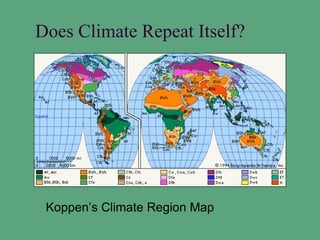
Does Climate Repeat Itself?


 Koppen’s Climate Region Map
Can we make any generalizations?
 Latitude
      Single most important factor-Why?
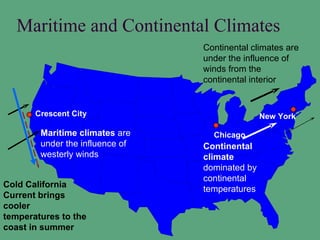
 Maritime      versus continental locations
 Windward coasts have cooler summers and warmer
 winters
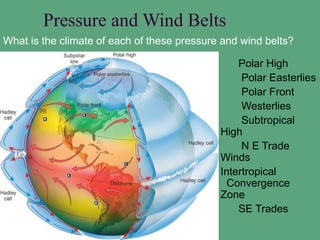
 Precipitation      related to pressure and
  wind belts
 High pressure – dry, Converging winds - rainy
 Mountains       have different climates
      Mountains are cooler than lowlands
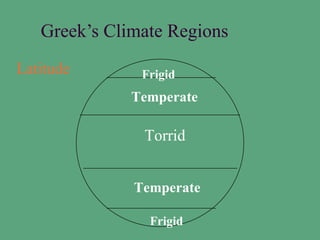
Greek’s Climate Regions
Latitude       Frigid
              Temperate

               Torrid


              Temperate

                Frigid
Maritime and Continental Climates
                                 Continental climates are
                                 under the influence of
                                 winds from the
                                 continental interior


       Crescent City                            New York

        Maritime climates are      Chicago
        under the influence of   Continental
        westerly winds           climate
                                 dominated by
                                 continental
Cold California
                                 temperatures
Current brings
cooler
temperatures to the
coast in summer
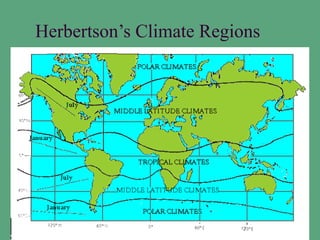
Herbertson’s Climate Regions
Herbertson’s Regions
v Isotherms   reflect influence of land and
  sea
v Polar climates cooler than 50 F in the
  warmest month
v Tropical climates warmer than 65 F all
  year - winterless
v Middle latitude climates are
  changeable
Pressure and Wind Belts
What is the climate of each of these pressure and wind belts?

                                                Polar High
                                                 Polar Easterlies
                                                 Polar Front
                                                 Westerlies
                                                 Subtropical
                                             High
                                                 N E Trade
                                             Winds
                                            Intertropical
                                               Convergence
                                             Zone
                                                SE Trades
What happens to all these pressure
and wind belts?

 They shift north and south with the overhead
  sun
 Do they shift as far north and south as the
  Tropics of Cancer and Capricorn?
 No, about 5º N and 5º S
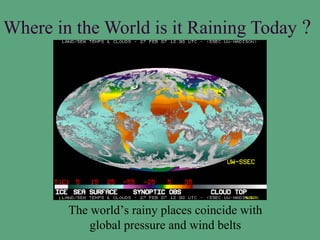
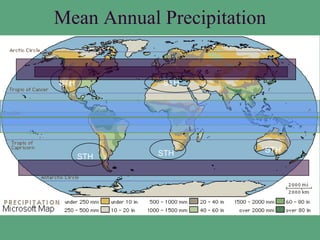
Where in the World is it Raining Today ?


        The world’s rainy places coincide with
            global pressure and wind belts
Three Major Rain Belts
 The Northern Hemisphere Polar Front
     Midlatitude Cyclonic Storms - low pressure
 The Intertropical Convergence Zone (ITCZ)
     Trade winds converge along the equatorial low
     Convectional lifting produces cumulus clouds
 The Southern Hemisphere Polar Front
     Midlatitude Cyclonic Storms - low pressure
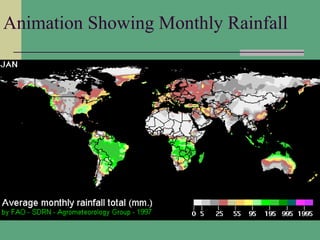
Animation Showing Monthly Rainfall
Mean Annual Precipitation


STH         STH


            STH         STH
      STH
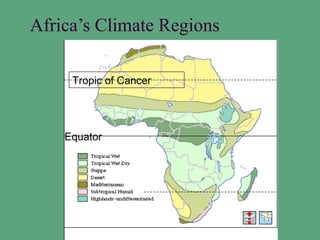
Africa’s Climate Regions

     Tropic of Cancer


    Equator
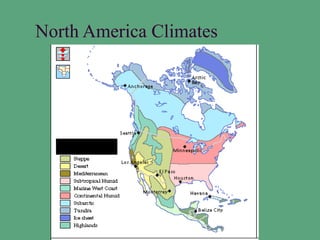
North America Climates
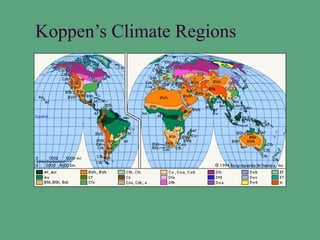
Koppen’s Climate Classification
 Most widely used map of climate regions
 Empirical-quantitative approach that uses climate
  statistics compiled over 30 years
 Designed with plants in mind
 Each climate is defined according to set values of
  mean monthly precipitation and mean monthy
  temperature
Koppen’s Climate Regions
Koppen Classification

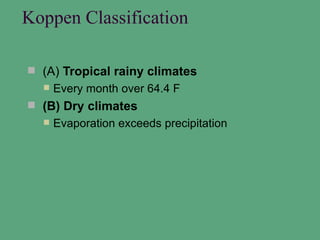
 (A) Tropical rainy climates
     Every month over 64.4 F
 (B) Dry climates
     Evaporation exceeds precipitation
Koppen Classification

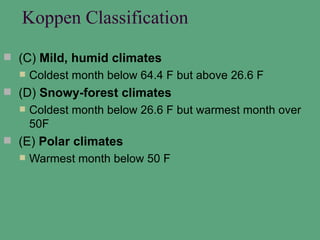
 (C) Mild, humid climates
     Coldest month below 64.4 F but above 26.6 F
 (D) Snowy-forest climates
     Coldest month below 26.6 F but warmest month over
      50F
 (E) Polar climates
     Warmest month below 50 F
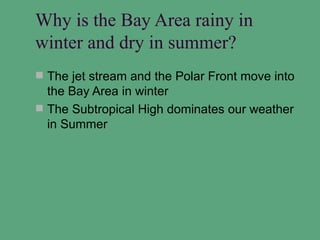
Why is the Bay Area rainy in
winter and dry in summer?
 The jet stream and the Polar Front move into
  the Bay Area in winter
 The Subtropical High dominates our weather
  in Summer
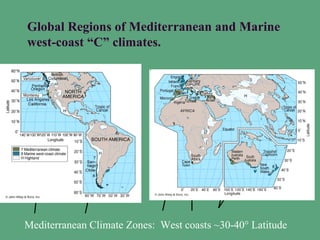
Global Regions of Mediterranean and Marine
west-coast “C” climates.


Mediterranean Climate Zones: West coasts ~30-40° Latitude
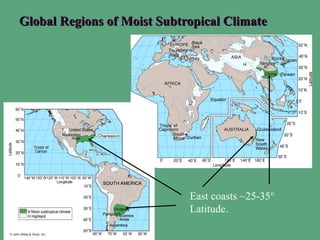
Global Regions of Moist Subtropical Climate


                             East coasts ~25-35°
                             Latitude.
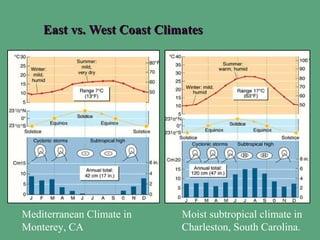
East vs. West Coast Climates


Mediterranean Climate in    Moist subtropical climate in
Monterey, CA                Charleston, South Carolina.
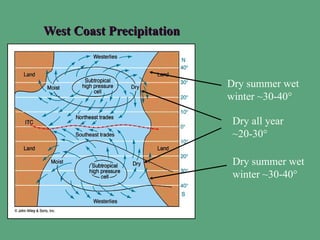
West Coast Precipitation


                           Dry summer wet
                           winter ~30-40°

                            Dry all year
                            ~20-30°

                            Dry summer wet
                            winter ~30-40°
Reality Check
 Most climates between the
    tropics of Cancer and           Does the U.S. have any A
    Capricorn are:                   (tropical moist) climates?
   Which major climate group is    Does the U.S. have a BWh (hot
    not in the Southern              desert)?
    hemisphere?                     What major climate group
   Which major group forms the      dominates Canada and
    cold summer climates of the      Russia?
    Arctic?                         What climate makes up most of
   Which climates are dry?          Western Europe?
   What climate dominates          What climate is not classified
    Australia?                       using Koppen?
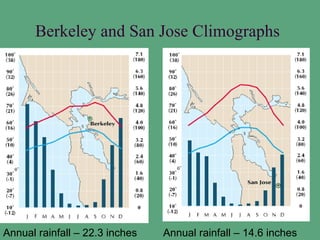
Berkeley and San Jose Climographs


Annual rainfall – 22.3 inches   Annual rainfall – 14.6 inches
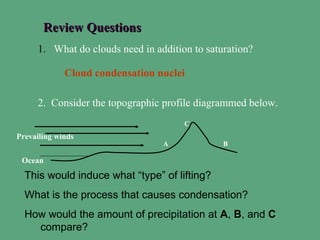
Review Questions
     1. What do clouds need in addition to saturation?

             Cloud condensation nuclei

     2. Consider the topographic profile diagrammed below.
                                      C
Prevailing winds
                                 A             B

 Ocean
  This would induce what “type” of lifting?
  What is the process that causes condensation?
  How would the amount of precipitation at A, B, and C
    compare?
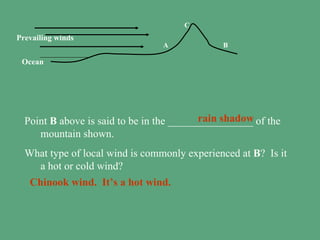
C
Prevailing winds
                                 A             B

 Ocean


                                           rain shadow
  Point B above is said to be in the ________________ of the
     mountain shown.
  What type of local wind is commonly experienced at B? Is it
    a hot or cold wind?
   Chinook wind. It’s a hot wind.
What is the cause of the seasons?
 Tilt of earth’s axis as it orbits the sun
 Revolution
 Parallelism

Climate regions

  • 1.
  • 2.
    What is Climate? Weather is the day-to-day changes in atmospheric conditions  Climate is long-term weather conditions  Temperature and precipitation are the most important expressions of climate
  • 3.
    What aspects ofthe environment are influenced by climate?  Vegetation  Animal life  Soils  Landforms  Water resources
  • 4.
    Ecosystems  What isan ecosystem?  An area of interaction between plants, animals,and their environment  Unique ecosystems evolve as a result of differing climate conditions  Climatology studies the climate regions that have evolved in response to different moisture and temperature conditions
  • 5.
    What is theImpact of Climate Upon People’s Lives?  Regions of climatic handicap have few people  deserts, rainforests, polar regions  Climate influences agriculture - the choice of crops grown and animals raised  Tourism and recreation  Water resources  Climate and disease
  • 6.
    Does Climate AffectTemperament?  Aristotle - the nations in cold places are full of spirit but deficient in intelligence and skill  Jean Bodin - Northern peoples physically vigorous but mentally slow  Hot South - lazy, but politically passive and satisfied living under despots  Temperate zone - ideal mix of intelligence and industry favoring monarchy  Buckle - Mild, moist British climate favors the steady work and perseverance of the English
  • 7.
    Does Climate RepeatItself? Koppen’s Climate Region Map
  • 8.
    Can we makeany generalizations?  Latitude  Single most important factor-Why?  Maritime versus continental locations  Windward coasts have cooler summers and warmer winters  Precipitation related to pressure and wind belts  High pressure – dry, Converging winds - rainy  Mountains have different climates  Mountains are cooler than lowlands
  • 9.
    Greek’s Climate Regions Latitude Frigid Temperate Torrid Temperate Frigid
  • 10.
    Maritime and ContinentalClimates Continental climates are under the influence of winds from the continental interior Crescent City New York Maritime climates are Chicago under the influence of Continental westerly winds climate dominated by continental Cold California temperatures Current brings cooler temperatures to the coast in summer
  • 11.
  • 12.
    Herbertson’s Regions v Isotherms reflect influence of land and sea v Polar climates cooler than 50 F in the warmest month v Tropical climates warmer than 65 F all year - winterless v Middle latitude climates are changeable
  • 13.
    Pressure and WindBelts What is the climate of each of these pressure and wind belts?  Polar High  Polar Easterlies  Polar Front  Westerlies  Subtropical High  N E Trade Winds  Intertropical Convergence Zone  SE Trades
  • 14.
    What happens toall these pressure and wind belts?  They shift north and south with the overhead sun  Do they shift as far north and south as the Tropics of Cancer and Capricorn?  No, about 5º N and 5º S
  • 15.
    Where in theWorld is it Raining Today ? The world’s rainy places coincide with global pressure and wind belts
  • 16.
    Three Major RainBelts  The Northern Hemisphere Polar Front  Midlatitude Cyclonic Storms - low pressure  The Intertropical Convergence Zone (ITCZ)  Trade winds converge along the equatorial low  Convectional lifting produces cumulus clouds  The Southern Hemisphere Polar Front  Midlatitude Cyclonic Storms - low pressure
  • 17.
  • 18.
  • 19.
    Africa’s Climate Regions Tropic of Cancer Equator
  • 20.
  • 21.
    Koppen’s Climate Classification Most widely used map of climate regions  Empirical-quantitative approach that uses climate statistics compiled over 30 years  Designed with plants in mind  Each climate is defined according to set values of mean monthly precipitation and mean monthy temperature
  • 22.
  • 23.
    Koppen Classification  (A)Tropical rainy climates  Every month over 64.4 F  (B) Dry climates  Evaporation exceeds precipitation
  • 24.
    Koppen Classification  (C)Mild, humid climates  Coldest month below 64.4 F but above 26.6 F  (D) Snowy-forest climates  Coldest month below 26.6 F but warmest month over 50F  (E) Polar climates  Warmest month below 50 F
  • 25.
    Why is theBay Area rainy in winter and dry in summer?  The jet stream and the Polar Front move into the Bay Area in winter  The Subtropical High dominates our weather in Summer
  • 26.
    Global Regions ofMediterranean and Marine west-coast “C” climates. Mediterranean Climate Zones: West coasts ~30-40° Latitude
  • 27.
    Global Regions ofMoist Subtropical Climate East coasts ~25-35° Latitude.
  • 28.
    East vs. WestCoast Climates Mediterranean Climate in Moist subtropical climate in Monterey, CA Charleston, South Carolina.
  • 29.
    West Coast Precipitation Dry summer wet winter ~30-40° Dry all year ~20-30° Dry summer wet winter ~30-40°
  • 30.
    Reality Check  Mostclimates between the tropics of Cancer and  Does the U.S. have any A Capricorn are: (tropical moist) climates?  Which major climate group is  Does the U.S. have a BWh (hot not in the Southern desert)? hemisphere?  What major climate group  Which major group forms the dominates Canada and cold summer climates of the Russia? Arctic?  What climate makes up most of  Which climates are dry? Western Europe?  What climate dominates  What climate is not classified Australia? using Koppen?
  • 31.
    Berkeley and SanJose Climographs Annual rainfall – 22.3 inches Annual rainfall – 14.6 inches
  • 32.
    Review Questions 1. What do clouds need in addition to saturation? Cloud condensation nuclei 2. Consider the topographic profile diagrammed below. C Prevailing winds A B Ocean This would induce what “type” of lifting? What is the process that causes condensation? How would the amount of precipitation at A, B, and C compare?
  • 33.
    C Prevailing winds A B Ocean rain shadow Point B above is said to be in the ________________ of the mountain shown. What type of local wind is commonly experienced at B? Is it a hot or cold wind? Chinook wind. It’s a hot wind.
  • 34.
    What is thecause of the seasons?  Tilt of earth’s axis as it orbits the sun  Revolution  Parallelism

Editor's Notes

  • #24 How many climate groups use temperature as a basis for classification? A, C, D, and E. B uses evaporation over precipitation. WHIch climate is not in the southern hemisphere?
  • #25 How many climate groups use temperature as a basis for classification? A, C, D, and E. B uses evaporation over precipitation. WHIch climate is not in the southern hemisphere?
  • #33 To be presented 11/5/02