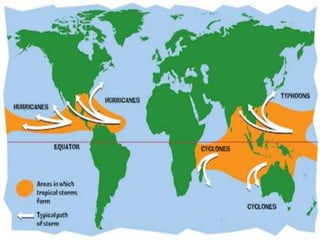
If the storm occurs in the Atlantic Ocean
and North-east Pacific, it's called a
hurricane.
If the exact same type of storm occurs in
the North-west Pacific, this is a typhoon.
And if we find those same storms in the
South Pacific and Indian Ocean, these are
called tropical cyclones.
cyclone
• Cyclone is a rapidly rotating storm
system characterized by a low pressure
center, a closed low level atmospheric
circulation, strong wind and a spiral
arrangement of thunder storms and heavy
rain
What are cyclones?
Where do they occur?
When do they occur?
How do they form?
How do they occur?
Three stages:
1. Formation and initial development
2. Maturing
3. Modification and decay
How do they occur?
To form a cyclone, warm, moist air over the ocean
rises upward .
As this air moves up and away from the ocean
surface, it leaves is less air near the surface.
 So basically as the warm air rises, it causes an
area of lower air pressure below.
Air from surrounding areas with higher air
pressure pushes in to the low pressure area.
Then this new “cool” air becomes warm and
moist and rises, too. And the cycle continues…
• As the warmed, moist air rises and cools the
water in the air forms clouds
• As the cycle continues, more air rises up and
cloud becomes thick
• Condensation then releases the latent heat of
energy stored in the water vapour ( power for
cyclone)
• The whole system of clouds and wind spins and
grows, fed by the ocean’s heat and water evaporating
from the ocean surface
• The system spins due to the coriolis effect
The Coriolis effect makes storms swirl clockwise in the
Southern hemisphere and counter clockwise in the
Northern Hemisphere.
• As the storm system rotates faster and faster, an eye
forms in the centre.
– It is very calm and clear, with very low air pressure. Higher
pressure air from above flows down into the eye.
• When the winds in the rotating storm reach 39 mph
(63 kmph), the storm is called a “tropical storm”.
• And when the wind speeds reach 74 mph (119 kmph),
the storm is officially a “tropical cyclone” or
hurricane.
• Tropical cyclones usually weaken when they hit land,
because they are no longer being “fed” by the energy
from the warm ocean waters.
• However, they often move far inland, dumping many
centimeters of rain and causing lots of wind damage
before they die out completely
Types of cyclone
Tropical cyclone
Extra tropical cyclone ( temperate cyclone)
Polar lows or artic hurricanes
Polar cyclones
Mesocyclones
Tropical cyclones
• Occur over tropical ocean regions.
• Hurricanes and typhoons are types of tropical
cyclones.
• Major tropical-cyclone basins are
– North Atlantic (including the Caribbean),
– Eastern Pacific
– Western Pacific
– North Indian Ocean
– Southwest Indian Ocean
– Southern Pacific
– Australian region
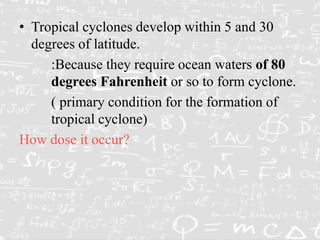
• Tropical cyclones develop within 5 and 30
degrees of latitude.
:Because they require ocean waters of 80
degrees Fahrenheit or so to form cyclone.
( primary condition for the formation of
tropical cyclone)
How dose it occur?
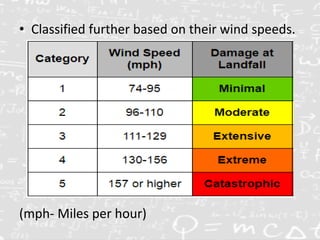
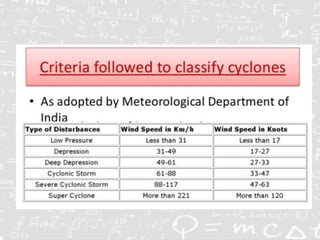
• Classified further based on their wind speeds.
(mph- Miles per hour)
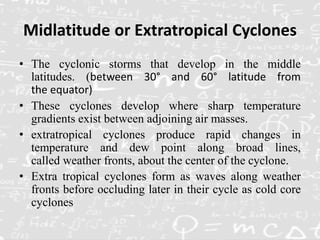
Midlatitude or Extratropical Cyclones
• The cyclonic storms that develop in the middle
latitudes. (between 30° and 60° latitude from
the equator)
• These cyclones develop where sharp temperature
gradients exist between adjoining air masses.
• extratropical cyclones produce rapid changes in
temperature and dew point along broad lines,
called weather fronts, about the center of the cyclone.
• Extra tropical cyclones form as waves along weather
fronts before occluding later in their cycle as cold core
cyclones
• The winds are generally weaker.
Formed by:
 Cyclogenisis:
development of cyclonic circulation in atmosphere.
 Extra tropical transistion:
 process by which a tropical cyclone upon encountering
with a baroclinic environment and reduced sea surface
transforms into an extra tropical cyclone
Polar cyclones
• Polar cyclones are 1000 to 2000 km wide in
which the air is moving in a spiral counter
clockwise in Northern hemisphere.
• Occur in Polar Regions like Greenland, Siberia
and Artic ,Antarctica and northern canada.
• Usually stronger in winter months.
• Damages are usually minimal, as they occur in
areas that aren't very populated
Polar Lows or Arctic Hurricanes
• Forms over Arctic and Antarctic seas.
• Sparked by frigid air moving over somewhat
warmer ocean waters.
• Their energy source – heat transfer from
water to air and latent heat released by cloud
condensation.
• Often form quickly, sometimes in less than 24
hours, and can be difficult to forecast.
Mesocyclone
• Is when part of a thunderstorm cloud starts to
spin, which may eventually lead to a tornado.
• Tornadoes all come from thunderstorm clouds,
but not all thunderstorm clouds make
tornadoes.
• Rotating “wall clouds” may descend from
mesocyclones and ultimately form a funnel
cloud, which, if it contacts the ground,
becomes a tornado.
How mesocyclone and Tornado
forms?
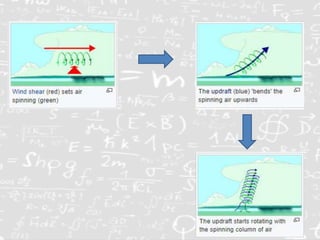
 Primary requirement - A wind shear, where wind blows
faster in one spot than another (A blanket of air is
flowing over another one).
 This sets up a rolling vortex, a horizontally rotating mass
of air (like the way a wave breaks when it gets to a
beach)
 This spinning vortex in the middle is called a
mesocyclone.
An updraft then lifts that vortex, which then
spins vertically.( Updraft happens when moist
air moves upwards)
Rotating “wall clouds” may descend and
ultimately form a funnel cloud, which, if it
contacts the ground, becomes a tornado
• More cyclone occur in bay of Bengal than in
Arabian sea and the ratio is 4:1
• Indian Ocean is one of six major cyclone prone
regions of the world
• There are two definite seasons of tropical
cyclones in the North Indian Ocean. One is
from May to June and the other from mid-
September to mid-December
Impacts of cyclone
Impact mainly depends upon:
intensity
its size
its location
Classified into three:
• Primary hazard : involves destructive winds,
debris and storm surge.
• Secondary hazards: include flooding and fires.
• Tertiary hazards: include spikes in prices of food
and other necessities, as well as long term hazards
like water-borne diseases.
Upon landfall
The most significant effects of a tropical cyclone
occur when they cross coastlines,
making landfall (destroys ships and lives)
1. Strong winds
2. Storm surge
3. Heavy rainfal
4. Tornados
Effects on natural resources
• Geomorphology:
– reshape the geology near the coast by eroding sand
from the beach as well as offshore, rearranging
coral, and changing dune configuration onshore
• Coastal ridges
– erode undersea sands, shell deposits, break off
corals from shore reefs, and carry all this detritus
landwards in a rolling wave of material that is
deposited onshore
• Limestone cave
– When tropical cyclones cross land, thin layers of calcium
carbonate of 'light' composition (i.e. unusual isotopic ratio
of Oxygen-18 and Oxygen-16) are deposited onto
limestone caves up to 300 kilometres (190 mi) from the
cyclone's path
• Landscapes

cyclone

  • 2.
    If the stormoccurs in the Atlantic Ocean and North-east Pacific, it's called a hurricane. If the exact same type of storm occurs in the North-west Pacific, this is a typhoon. And if we find those same storms in the South Pacific and Indian Ocean, these are called tropical cyclones.
  • 3.
    cyclone • Cyclone isa rapidly rotating storm system characterized by a low pressure center, a closed low level atmospheric circulation, strong wind and a spiral arrangement of thunder storms and heavy rain
  • 4.
    What are cyclones? Wheredo they occur? When do they occur? How do they form?
  • 5.
    How do theyoccur? Three stages: 1. Formation and initial development 2. Maturing 3. Modification and decay
  • 6.
    How do theyoccur? To form a cyclone, warm, moist air over the ocean rises upward . As this air moves up and away from the ocean surface, it leaves is less air near the surface.  So basically as the warm air rises, it causes an area of lower air pressure below. Air from surrounding areas with higher air pressure pushes in to the low pressure area. Then this new “cool” air becomes warm and moist and rises, too. And the cycle continues…
  • 8.
    • As thewarmed, moist air rises and cools the water in the air forms clouds • As the cycle continues, more air rises up and cloud becomes thick • Condensation then releases the latent heat of energy stored in the water vapour ( power for cyclone)
  • 9.
    • The wholesystem of clouds and wind spins and grows, fed by the ocean’s heat and water evaporating from the ocean surface • The system spins due to the coriolis effect The Coriolis effect makes storms swirl clockwise in the Southern hemisphere and counter clockwise in the Northern Hemisphere. • As the storm system rotates faster and faster, an eye forms in the centre. – It is very calm and clear, with very low air pressure. Higher pressure air from above flows down into the eye.
  • 10.
    • When thewinds in the rotating storm reach 39 mph (63 kmph), the storm is called a “tropical storm”. • And when the wind speeds reach 74 mph (119 kmph), the storm is officially a “tropical cyclone” or hurricane. • Tropical cyclones usually weaken when they hit land, because they are no longer being “fed” by the energy from the warm ocean waters. • However, they often move far inland, dumping many centimeters of rain and causing lots of wind damage before they die out completely
  • 12.
    Types of cyclone Tropicalcyclone Extra tropical cyclone ( temperate cyclone) Polar lows or artic hurricanes Polar cyclones Mesocyclones
  • 13.
    Tropical cyclones • Occurover tropical ocean regions. • Hurricanes and typhoons are types of tropical cyclones. • Major tropical-cyclone basins are – North Atlantic (including the Caribbean), – Eastern Pacific – Western Pacific – North Indian Ocean – Southwest Indian Ocean – Southern Pacific – Australian region
  • 14.
    • Tropical cyclonesdevelop within 5 and 30 degrees of latitude. :Because they require ocean waters of 80 degrees Fahrenheit or so to form cyclone. ( primary condition for the formation of tropical cyclone) How dose it occur?
  • 16.
    • Classified furtherbased on their wind speeds. (mph- Miles per hour)
  • 17.
    Midlatitude or ExtratropicalCyclones • The cyclonic storms that develop in the middle latitudes. (between 30° and 60° latitude from the equator) • These cyclones develop where sharp temperature gradients exist between adjoining air masses. • extratropical cyclones produce rapid changes in temperature and dew point along broad lines, called weather fronts, about the center of the cyclone. • Extra tropical cyclones form as waves along weather fronts before occluding later in their cycle as cold core cyclones
  • 18.
    • The windsare generally weaker. Formed by:  Cyclogenisis: development of cyclonic circulation in atmosphere.  Extra tropical transistion:  process by which a tropical cyclone upon encountering with a baroclinic environment and reduced sea surface transforms into an extra tropical cyclone
  • 19.
    Polar cyclones • Polarcyclones are 1000 to 2000 km wide in which the air is moving in a spiral counter clockwise in Northern hemisphere. • Occur in Polar Regions like Greenland, Siberia and Artic ,Antarctica and northern canada. • Usually stronger in winter months. • Damages are usually minimal, as they occur in areas that aren't very populated
  • 20.
    Polar Lows orArctic Hurricanes • Forms over Arctic and Antarctic seas. • Sparked by frigid air moving over somewhat warmer ocean waters. • Their energy source – heat transfer from water to air and latent heat released by cloud condensation. • Often form quickly, sometimes in less than 24 hours, and can be difficult to forecast.
  • 21.
    Mesocyclone • Is whenpart of a thunderstorm cloud starts to spin, which may eventually lead to a tornado. • Tornadoes all come from thunderstorm clouds, but not all thunderstorm clouds make tornadoes. • Rotating “wall clouds” may descend from mesocyclones and ultimately form a funnel cloud, which, if it contacts the ground, becomes a tornado.
  • 23.
    How mesocyclone andTornado forms?  Primary requirement - A wind shear, where wind blows faster in one spot than another (A blanket of air is flowing over another one).  This sets up a rolling vortex, a horizontally rotating mass of air (like the way a wave breaks when it gets to a beach)  This spinning vortex in the middle is called a mesocyclone.
  • 24.
    An updraft thenlifts that vortex, which then spins vertically.( Updraft happens when moist air moves upwards) Rotating “wall clouds” may descend and ultimately form a funnel cloud, which, if it contacts the ground, becomes a tornado
  • 28.
    • More cycloneoccur in bay of Bengal than in Arabian sea and the ratio is 4:1 • Indian Ocean is one of six major cyclone prone regions of the world • There are two definite seasons of tropical cyclones in the North Indian Ocean. One is from May to June and the other from mid- September to mid-December
  • 30.
    Impacts of cyclone Impactmainly depends upon: intensity its size its location
  • 31.
    Classified into three: •Primary hazard : involves destructive winds, debris and storm surge. • Secondary hazards: include flooding and fires. • Tertiary hazards: include spikes in prices of food and other necessities, as well as long term hazards like water-borne diseases.
  • 32.
    Upon landfall The mostsignificant effects of a tropical cyclone occur when they cross coastlines, making landfall (destroys ships and lives) 1. Strong winds 2. Storm surge 3. Heavy rainfal 4. Tornados
  • 33.
    Effects on naturalresources • Geomorphology: – reshape the geology near the coast by eroding sand from the beach as well as offshore, rearranging coral, and changing dune configuration onshore • Coastal ridges – erode undersea sands, shell deposits, break off corals from shore reefs, and carry all this detritus landwards in a rolling wave of material that is deposited onshore
  • 34.
    • Limestone cave –When tropical cyclones cross land, thin layers of calcium carbonate of 'light' composition (i.e. unusual isotopic ratio of Oxygen-18 and Oxygen-16) are deposited onto limestone caves up to 300 kilometres (190 mi) from the cyclone's path • Landscapes