UNIT 5
20/01/2015 10:22DavidProfeSoc
1
Weather and Climates
1º ESO
Social Sciences
Introduction
20/01/2015 10:22DavidProfeSoc
4
 The weather and climate are affected by
atmospheric phenomena (temperature, humidity,
precipitation, atmospheric pressure and wind).
 Weather and climate are different:
 The weather describes the atmospheric conditions
in a particular time.
 Climate refers to atmospheric conditions that exist
in a region over a long period of time.
1.
Atmosphere
20/01/2015 10:22DavidProfeSoc
6
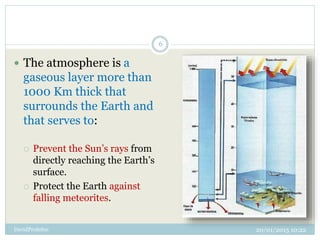
 The atmosphere is a
gaseous layer more than
1000 Km thick that
surrounds the Earth and
that serves to:
 Prevent the Sun’s rays from
directly reaching the Earth’s
surface.
 Protect the Earth against
falling meteorites.
Ozone layer
20/01/2015 10:22DavidProfeSoc
7
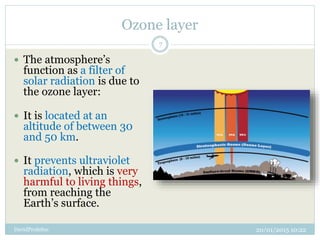
 The atmosphere’s
function as a filter of
solar radiation is due to
the ozone layer:
 It is located at an
altitude of between 30
and 50 km.
 It prevents ultraviolet
radiation, which is very
harmful to living things,
from reaching the
Earth’s surface.
20/01/2015 10:22DavidProfeSoc
8
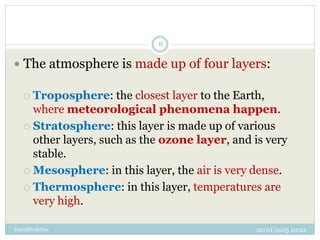
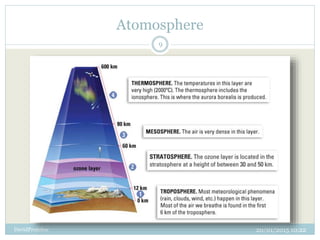
 The atmosphere is made up of four layers:
 Troposphere: the closest layer to the Earth,
where meteorological phenomena happen.
 Stratosphere: this layer is made up of various
other layers, such as the ozone layer, and is very
stable.
 Mesosphere: in this layer, the air is very dense.
 Thermosphere: in this layer, temperatures are
very high.
Atomosphere
20/01/2015 10:22DavidProfeSoc
9
2.
Temperature
Atmospheric Temperature
20/01/2015 10:22
11
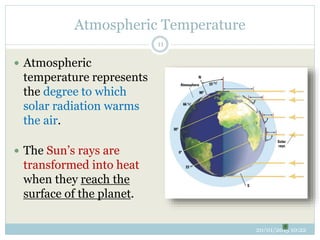
 Atmospheric
temperature represents
the degree to which
solar radiation warms
the air.
 The Sun’s rays are
transformed into heat
when they reach the
surface of the planet.
Thermometers and Isotherms
20/01/2015 10:22
12
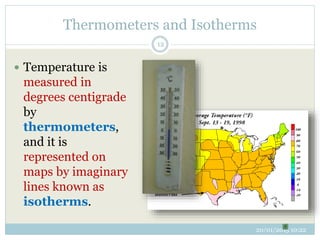
 Temperature is
measured in
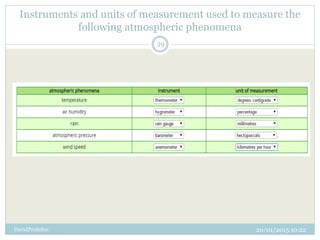
degrees centigrade
by
thermometers,
and it is
represented on
maps by imaginary
lines known as
isotherms.
Factors
20/01/2015 10:22DavidProfeSoc
13
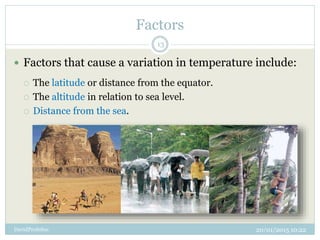
 Factors that cause a variation in temperature include:
 The latitude or distance from the equator.
 The altitude in relation to sea level.
 Distance from the sea.
Latitude
20/01/2015 10:22DavidProfeSoc
14
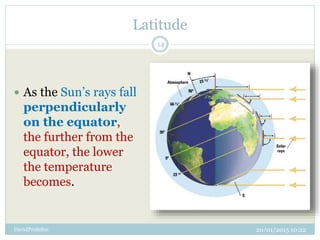
 As the Sun’s rays fall
perpendicularly
on the equator,
the further from the
equator, the lower
the temperature
becomes.
Altitude
20/01/2015 10:22DavidProfeSoc
15
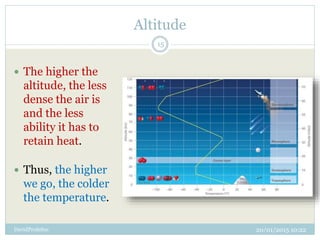
 The higher the
altitude, the less
dense the air is
and the less
ability it has to
retain heat.
 Thus, the higher
we go, the colder
the temperature.
Distance from the sea
20/01/2015 10:22DavidProfeSoc
16
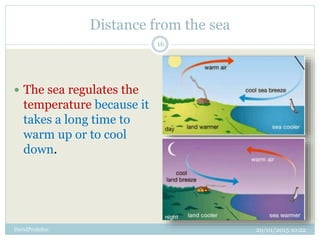
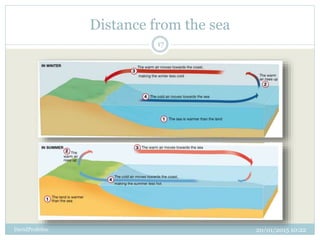
 The sea regulates the
temperature because it
takes a long time to
warm up or to cool
down.
Distance from the sea
20/01/2015 10:22DavidProfeSoc
17
3.
Air Humidity and Precipitation
Humidity
20/01/2015 10:22DavidProfeSoc
19
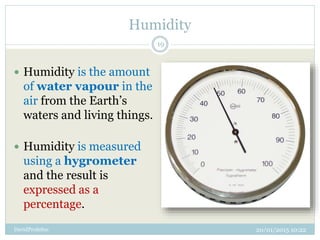
 Humidity is the amount
of water vapour in the
air from the Earth’s
waters and living things.
 Humidity is measured
using a hygrometer
and the result is
expressed as a
percentage.
Relative Humidity
20/01/2015 10:22DavidProfeSoc
20
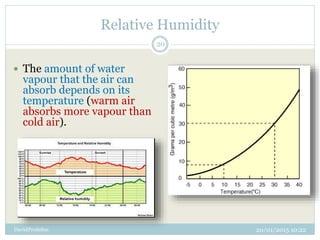
 The amount of water
vapour that the air can
absorb depends on its
temperature (warm air
absorbs more vapour than
cold air).
Precipitation
20/01/2015 10:22DavidProfeSoc
21
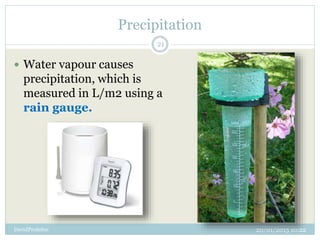
 Water vapour causes
precipitation, which is
measured in L/m2 using a
rain gauge.
20/01/2015 10:22DavidProfeSoc
22
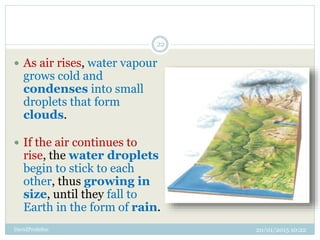
 As air rises, water vapour
grows cold and
condenses into small
droplets that form
clouds.
 If the air continues to
rise, the water droplets
begin to stick to each
other, thus growing in
size, until they fall to
Earth in the form of rain.
20/01/2015 10:22DavidProfeSoc
23
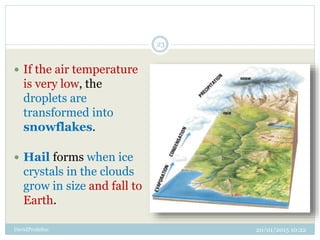
 If the air temperature
is very low, the
droplets are
transformed into
snowflakes.
 Hail forms when ice
crystals in the clouds
grow in size and fall to
Earth.
4.
Atmospheric Pressure
and Wind
Atmospheric Pressure
20/01/2015 10:22DavidProfeSoc
25
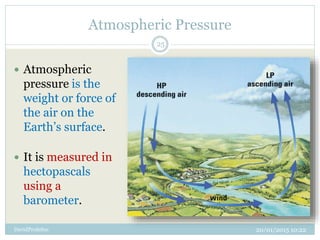
 Atmospheric
pressure is the
weight or force of
the air on the
Earth’s surface.
 It is measured in
hectopascals
using a
barometer.
20/01/2015 10:22DavidProfeSoc
26
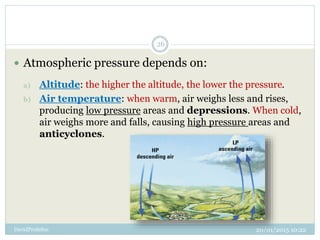
 Atmospheric pressure depends on:
a) Altitude: the higher the altitude, the lower the pressure.
b) Air temperature: when warm, air weighs less and rises,
producing low pressure areas and depressions. When cold,
air weighs more and falls, causing high pressure areas and
anticyclones.
20/01/2015 10:22DavidProfeSoc
27
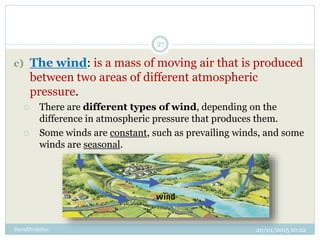
c) The wind: is a mass of moving air that is produced
between two areas of different atmospheric
pressure.
 There are different types of wind, depending on the
difference in atmospheric pressure that produces them.
 Some winds are constant, such as prevailing winds, and some
winds are seasonal.
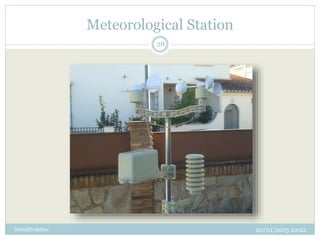
Meteorological Station
20/01/2015 10:22DavidProfeSoc
28
Instruments and units of measurement used to measure the
following atmospheric phenomena
20/01/2015 10:22DavidProfeSoc
29

Weather & Climate

Editor's Notes

  • #7 http://almez.pntic.mec.es
  • #8 http://aura.gsfc.nasa.gov/images/1368218980203.jpg
  • #13 Foto termómetro: Davidprofesoc (Casa Paco y Kiki) http://www.bigelow.org/virtual/handson/usa_temps.gif
  • #16 http://2012books.lardbucket.org/books/principles-of-general-chemistry-v1.0m/section_07/84656db9833b291483e7f5d457a41c62.jpg
  • #18 https://aee9680ace1b6e32ff9c2dbfd0a0193441d785a6.googledrive.com
  • #20 http://www.casaclima.com/
  • #21 http://blog.restek.com/ meted.ucar.edu
  • #22 https://c1.staticflickr.com http://images.thefuntimesguide.com