UNIT 3
CLIMATE AND LIVING BEINGS
THE ATMOSPHERE
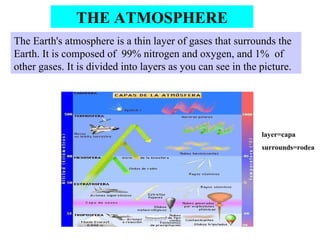
The Earth's atmosphere is a thin layer of gases that surrounds the
Earth. It is composed of 99% nitrogen and oxygen, and 1% of
other gases. It is divided into layers as you can see in the picture.
layer=capa
surrounds=rodea
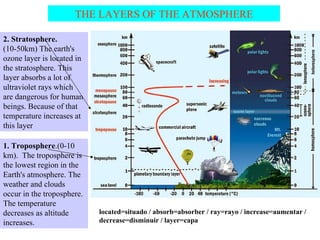
1. Troposphere.(0-10
km). The troposphere is
the lowest region in the
Earth's atmosphere. The
weather and clouds
occur in the troposphere.
The temperature
decreases as altitude
increases.
2. Stratosphere.
(10-50km) The earth's
ozone layer is located in
the stratosphere. This
layer absorbs a lot of
ultraviolet rays which
are dangerous for human
beings. Because of that
temperature increases at
this layer
THE LAYERS OF THE ATMOSPHERE
located=situado / absorb=absorber / ray=rayo / increase=aumentar /
decrease=disminuir / layer=capa
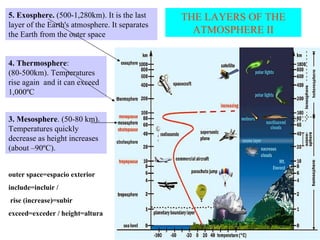
3. Mesosphere. (50-80 km).
Temperatures quickly
decrease as height increases
(about –90ºC).
4. Thermosphere:
(80-500km). Temperatures
rise again and it can exceed
1,000ºC
5. Exosphere. (500-1,280km). It is the last
layer of the Earth's atmosphere. It separates
the Earth from the outer space
THE LAYERS OF THE
ATMOSPHERE II
outer space=espacio exterior
include=incluir /
rise (increase)=subir
exceed=exceder / height=altura
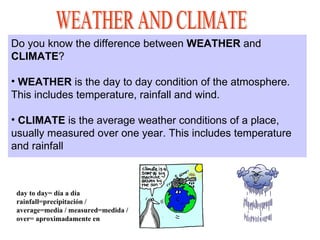
Do you know the difference between WEATHER and
CLIMATE?
• WEATHER is the day to day condition of the atmosphere.
This includes temperature, rainfall and wind.
• CLIMATE is the average weather conditions of a place,
usually measured over one year. This includes temperature
and rainfall
day to day= día a día
rainfall=precipitación /
average=media / measured=medida /
over= aproximadamente en
WHAT FACTORS AFFECT CLIMATE?
There are 4 factors which affect temperature. These are summarised
below:
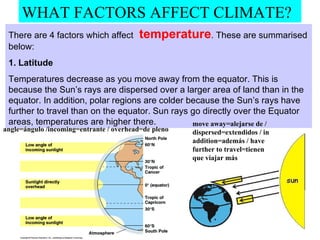
1. Latitude
Temperatures decrease as you move away from the equator. This is
because the Sun’s rays are dispersed over a larger area of land than in the
equator. In addition, polar regions are colder because the Sun’s rays have
further to travel than on the equator. Sun rays go directly over the Equator
areas, temperatures are higher there. move away=alejarse de /
dispersed=extendidos / in
addition=además / have
further to travel=tienen
que viajar más
angle=ángulo /incoming=entrante / overhead=de pleno
3. Altitude
Temperatures decrease
with height. The air is
less dense and cannot
hold heat as easily.
Temperatures rise 6ºC
every 1,000 m high.
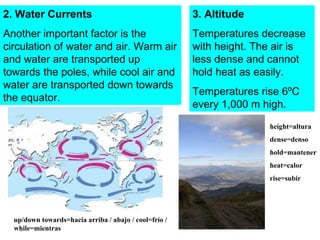
2. Water Currents
Another important factor is the
circulation of water and air. Warm air
and water are transported up
towards the poles, while cool air and
water are transported down towards
the equator.
up/down towards=hacia arriba / abajo / cool=frío /
while=mientras
height=altura
dense=denso
hold=mantener
heat=calor
rise=subir
4. Distance from the sea
Land heats and cools faster than the sea. Coastal areas have
a lower temperature than inland areas. On the coast winters
are mild and summers are cool. In inland areas temperatures
are high in the summer and cold in the winter.
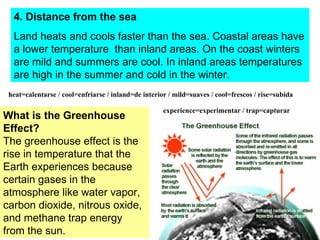
What is the Greenhouse
Effect?
The greenhouse effect is the
rise in temperature that the
Earth experiences because
certain gases in the
atmosphere like water vapor,
carbon dioxide, nitrous oxide,
and methane trap energy
from the sun.
heat=calentarse / cool=enfriarse / inland=de interior / mild=suaves / cool=frescos / rise=subida
experience=experimentar / trap=capturar
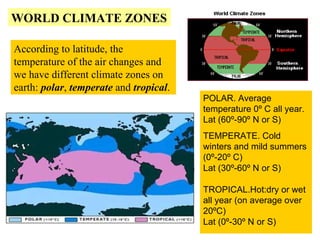
WORLD CLIMATE ZONES
According to latitude, the
temperature of the air changes and
we have different climate zones on
earth: polar, temperate and tropical.
POLAR. Average
temperature 0º C all year.
Lat (60º-90º N or S)
TEMPERATE. Cold
winters and mild summers
(0º-20º C)
Lat (30º-60º N or S)
TROPICAL.Hot:dry or wet
all year (on average over
20ºC)
Lat (0º-30º N or S)
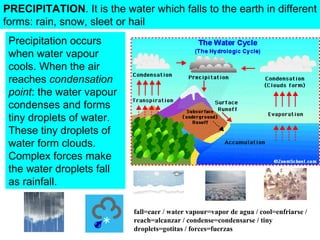
PRECIPITATION. It is the water which falls to the earth in different
forms: rain, snow, sleet or hail
Precipitation occurs
when water vapour
cools. When the air
reaches condensation
point: the water vapour
condenses and forms
tiny droplets of water.
These tiny droplets of
water form clouds.
Complex forces make
the water droplets fall
as rainfall.
fall=caer / water vapour=vapor de agua / cool=enfriarse /
reach=alcanzar / condense=condensarse / tiny
droplets=gotitas / forces=fuerzas
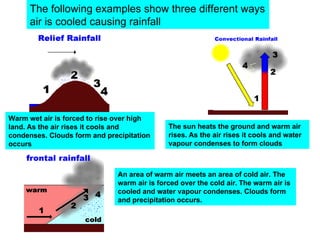
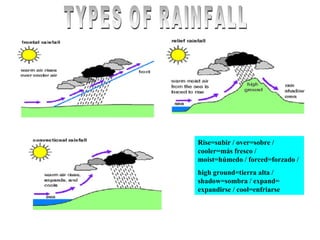
The following examples show three different ways
air is cooled causing rainfall
Warm wet air is forced to rise over high
land. As the air rises it cools and
condenses. Clouds form and precipitation
occurs
The sun heats the ground and warm air
rises. As the air rises it cools and water
vapour condenses to form clouds
An area of warm air meets an area of cold air. The
warm air is forced over the cold air. The warm air is
cooled and water vapour condenses. Clouds form
and precipitation occurs.
Rise=subir / over=sobre /
cooler=más fresco /
moist=húmedo / forced=forzado /
high ground=tierra alta /
shadow=sombra / expand=
expandirse / cool=enfriarse
ATMOSPHERIC PRESSURE
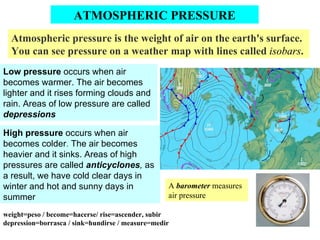
Atmospheric pressure is the weight of air on the earth's surface.
You can see pressure on a weather map with lines called isobars.
Low pressure occurs when air
becomes warmer. The air becomes
lighter and it rises forming clouds and
rain. Areas of low pressure are called
depressions
High pressure occurs when air
becomes colder. The air becomes
heavier and it sinks. Areas of high
pressures are called anticyclones, as
a result, we have cold clear days in
winter and hot and sunny days in
summer
weight=peso / become=hacerse/ rise=ascender, subir
depression=borrasca / sink=hundirse / measure=medir
A barometer measures
air pressure
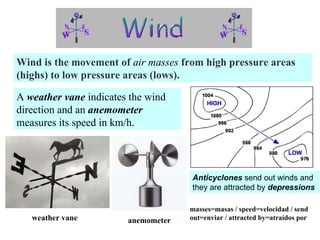
Wind is the movement of air masses from high pressure areas
(highs) to low pressure areas (lows).
A weather vane indicates the wind
direction and an anemometer
measures its speed in km/h.
weather vane anemometer
Anticyclones send out winds and
they are attracted by depressions
masses=masas / speed=velocidad / send
out=enviar / attracted by=atraídos por
ATMOSPHERIC PHENOMENA
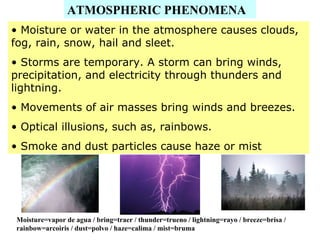
• Moisture or water in the atmosphere causes clouds,
fog, rain, snow, hail and sleet.
• Storms are temporary. A storm can bring winds,
precipitation, and electricity through thunders and
lightning.
• Movements of air masses bring winds and breezes.
• Optical illusions, such as, rainbows.
• Smoke and dust particles cause haze or mist
Moisture=vapor de agua / bring=traer / thunder=trueno / lightning=rayo / breeze=brisa /
rainbow=arcoiris / dust=polvo / haze=calima / mist=bruma
WEATHER HAZARDS AND CATASTROPHIES
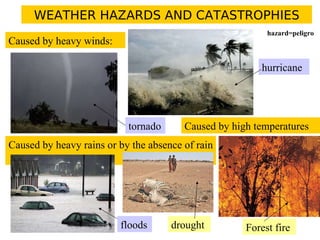
Caused by heavy winds:
tornado
hurricane
Caused by heavy rains or by the absence of rain
floods drought
Caused by high temperatures
Forest fire
hazard=peligro
wet=húmedo / dry=seco / cool=fresco / highlands=alta montaña
There are 3 main areas of climate, and 11 areas within the three
regions. The three main climates areas are tropical, temperate
and polar.
TROPICAL OR WARM CLIMATES
• Tropical rainforest (Ecuatorial). High temperatures all year, on
average 25ºC. Abundant rainfalls all year, on average, 1,500 mm.
Examples: Singapore, Bélem (Brazil)
• Tropical monsoon climate (Tropical lluvioso). Most common in
southern Asia and West Africa, results from the monsoon winds.
Average temperature over 20ºC all year, abundant precipitation: a bit
less than 1,500 mm a year.
• Tropical dry climate (Tropical seco). Temperatures are mild in
winter and warm in summer, on average 18ºC. Scarce precipitation,
on average, 250 mm a year. Examples: Veracruz (Mexico), Darwin
(Australia)
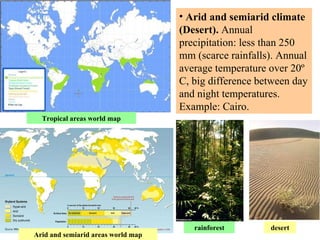
• Arid and semiarid climate
(Desert). Annual
precipitation: less than 250
mm (scarce rainfalls). Annual
average temperature over 20º
C, big difference between day
and night temperatures.
Example: Cairo.
Tropical areas world map
Arid and semiarid areas world map
rainforest desert
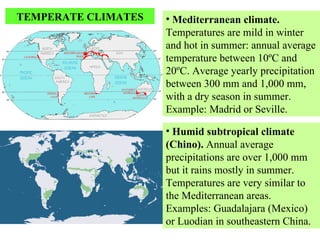
• Mediterranean climate.
Temperatures are mild in winter
and hot in summer: annual average
temperature between 10ºC and
20ºC. Average yearly precipitation
between 300 mm and 1,000 mm,
with a dry season in summer.
Example: Madrid or Seville.
• Humid subtropical climate
(Chino). Annual average
precipitations are over 1,000 mm
but it rains mostly in summer.
Temperatures are very similar to
the Mediterranean areas.
Examples: Guadalajara (Mexico)
or Luodian in southeastern China.
TEMPERATE CLIMATES
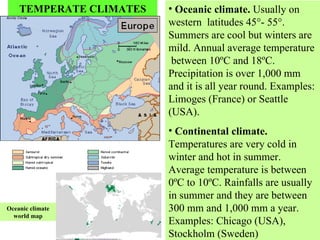
TEMPERATE CLIMATES • Oceanic climate. Usually on
western latitudes 45°- 55°.
Summers are cool but winters are
mild. Annual average temperature
between 10ºC and 18ºC.
Precipitation is over 1,000 mm
and it is all year round. Examples:
Limoges (France) or Seattle
(USA).
• Continental climate.
Temperatures are very cold in
winter and hot in summer.
Average temperature is between
0ºC to 10ºC. Rainfalls are usually
in summer and they are between
300 mm and 1,000 mm a year.
Examples: Chicago (USA),
Stockholm (Sweden)
Oceanic climate
world map
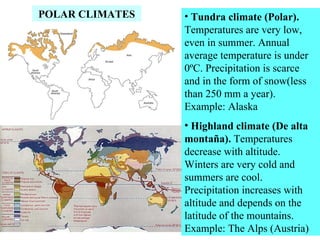
POLAR CLIMATES • Tundra climate (Polar).
Temperatures are very low,
even in summer. Annual
average temperature is under
0ºC. Precipitation is scarce
and in the form of snow(less
than 250 mm a year).
Example: Alaska
• Highland climate (De alta
montaña). Temperatures
decrease with altitude.
Winters are very cold and
summers are cool.
Precipitation increases with
altitude and depends on the
latitude of the mountains.
Example: The Alps (Austria)
NATURAL ENVIRONMENT: PHYSICAL FACTORS
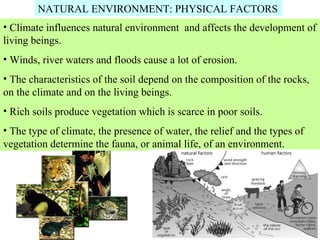
• Climate influences natural environment and affects the development of
living beings.
• Winds, river waters and floods cause a lot of erosion.
• The characteristics of the soil depend on the composition of the rocks,
on the climate and on the living beings.
• Rich soils produce vegetation which is scarce in poor soils.
• The type of climate, the presence of water, the relief and the types of
vegetation determine the fauna, or animal life, of an environment.

Unit3 climateandlivingbeings-ppt-110306065855-phpapp02

  • 1.
    UNIT 3 CLIMATE ANDLIVING BEINGS
  • 2.
    THE ATMOSPHERE The Earth'satmosphere is a thin layer of gases that surrounds the Earth. It is composed of 99% nitrogen and oxygen, and 1% of other gases. It is divided into layers as you can see in the picture. layer=capa surrounds=rodea
  • 3.
    1. Troposphere.(0-10 km). Thetroposphere is the lowest region in the Earth's atmosphere. The weather and clouds occur in the troposphere. The temperature decreases as altitude increases. 2. Stratosphere. (10-50km) The earth's ozone layer is located in the stratosphere. This layer absorbs a lot of ultraviolet rays which are dangerous for human beings. Because of that temperature increases at this layer THE LAYERS OF THE ATMOSPHERE located=situado / absorb=absorber / ray=rayo / increase=aumentar / decrease=disminuir / layer=capa
  • 4.
    3. Mesosphere. (50-80km). Temperatures quickly decrease as height increases (about –90ºC). 4. Thermosphere: (80-500km). Temperatures rise again and it can exceed 1,000ºC 5. Exosphere. (500-1,280km). It is the last layer of the Earth's atmosphere. It separates the Earth from the outer space THE LAYERS OF THE ATMOSPHERE II outer space=espacio exterior include=incluir / rise (increase)=subir exceed=exceder / height=altura
  • 5.
    Do you knowthe difference between WEATHER and CLIMATE? • WEATHER is the day to day condition of the atmosphere. This includes temperature, rainfall and wind. • CLIMATE is the average weather conditions of a place, usually measured over one year. This includes temperature and rainfall day to day= día a día rainfall=precipitación / average=media / measured=medida / over= aproximadamente en
  • 6.
    WHAT FACTORS AFFECTCLIMATE? There are 4 factors which affect temperature. These are summarised below: 1. Latitude Temperatures decrease as you move away from the equator. This is because the Sun’s rays are dispersed over a larger area of land than in the equator. In addition, polar regions are colder because the Sun’s rays have further to travel than on the equator. Sun rays go directly over the Equator areas, temperatures are higher there. move away=alejarse de / dispersed=extendidos / in addition=además / have further to travel=tienen que viajar más angle=ángulo /incoming=entrante / overhead=de pleno
  • 7.
    3. Altitude Temperatures decrease withheight. The air is less dense and cannot hold heat as easily. Temperatures rise 6ºC every 1,000 m high. 2. Water Currents Another important factor is the circulation of water and air. Warm air and water are transported up towards the poles, while cool air and water are transported down towards the equator. up/down towards=hacia arriba / abajo / cool=frío / while=mientras height=altura dense=denso hold=mantener heat=calor rise=subir
  • 8.
    4. Distance fromthe sea Land heats and cools faster than the sea. Coastal areas have a lower temperature than inland areas. On the coast winters are mild and summers are cool. In inland areas temperatures are high in the summer and cold in the winter. What is the Greenhouse Effect? The greenhouse effect is the rise in temperature that the Earth experiences because certain gases in the atmosphere like water vapor, carbon dioxide, nitrous oxide, and methane trap energy from the sun. heat=calentarse / cool=enfriarse / inland=de interior / mild=suaves / cool=frescos / rise=subida experience=experimentar / trap=capturar
  • 9.
    WORLD CLIMATE ZONES Accordingto latitude, the temperature of the air changes and we have different climate zones on earth: polar, temperate and tropical. POLAR. Average temperature 0º C all year. Lat (60º-90º N or S) TEMPERATE. Cold winters and mild summers (0º-20º C) Lat (30º-60º N or S) TROPICAL.Hot:dry or wet all year (on average over 20ºC) Lat (0º-30º N or S)
  • 10.
    PRECIPITATION. It isthe water which falls to the earth in different forms: rain, snow, sleet or hail Precipitation occurs when water vapour cools. When the air reaches condensation point: the water vapour condenses and forms tiny droplets of water. These tiny droplets of water form clouds. Complex forces make the water droplets fall as rainfall. fall=caer / water vapour=vapor de agua / cool=enfriarse / reach=alcanzar / condense=condensarse / tiny droplets=gotitas / forces=fuerzas
  • 11.
    The following examplesshow three different ways air is cooled causing rainfall Warm wet air is forced to rise over high land. As the air rises it cools and condenses. Clouds form and precipitation occurs The sun heats the ground and warm air rises. As the air rises it cools and water vapour condenses to form clouds An area of warm air meets an area of cold air. The warm air is forced over the cold air. The warm air is cooled and water vapour condenses. Clouds form and precipitation occurs.
  • 12.
    Rise=subir / over=sobre/ cooler=más fresco / moist=húmedo / forced=forzado / high ground=tierra alta / shadow=sombra / expand= expandirse / cool=enfriarse
  • 13.
    ATMOSPHERIC PRESSURE Atmospheric pressureis the weight of air on the earth's surface. You can see pressure on a weather map with lines called isobars. Low pressure occurs when air becomes warmer. The air becomes lighter and it rises forming clouds and rain. Areas of low pressure are called depressions High pressure occurs when air becomes colder. The air becomes heavier and it sinks. Areas of high pressures are called anticyclones, as a result, we have cold clear days in winter and hot and sunny days in summer weight=peso / become=hacerse/ rise=ascender, subir depression=borrasca / sink=hundirse / measure=medir A barometer measures air pressure
  • 14.
    Wind is themovement of air masses from high pressure areas (highs) to low pressure areas (lows). A weather vane indicates the wind direction and an anemometer measures its speed in km/h. weather vane anemometer Anticyclones send out winds and they are attracted by depressions masses=masas / speed=velocidad / send out=enviar / attracted by=atraídos por
  • 15.
    ATMOSPHERIC PHENOMENA • Moistureor water in the atmosphere causes clouds, fog, rain, snow, hail and sleet. • Storms are temporary. A storm can bring winds, precipitation, and electricity through thunders and lightning. • Movements of air masses bring winds and breezes. • Optical illusions, such as, rainbows. • Smoke and dust particles cause haze or mist Moisture=vapor de agua / bring=traer / thunder=trueno / lightning=rayo / breeze=brisa / rainbow=arcoiris / dust=polvo / haze=calima / mist=bruma
  • 16.
    WEATHER HAZARDS ANDCATASTROPHIES Caused by heavy winds: tornado hurricane Caused by heavy rains or by the absence of rain floods drought Caused by high temperatures Forest fire hazard=peligro
  • 17.
    wet=húmedo / dry=seco/ cool=fresco / highlands=alta montaña
  • 18.
    There are 3main areas of climate, and 11 areas within the three regions. The three main climates areas are tropical, temperate and polar. TROPICAL OR WARM CLIMATES • Tropical rainforest (Ecuatorial). High temperatures all year, on average 25ºC. Abundant rainfalls all year, on average, 1,500 mm. Examples: Singapore, Bélem (Brazil) • Tropical monsoon climate (Tropical lluvioso). Most common in southern Asia and West Africa, results from the monsoon winds. Average temperature over 20ºC all year, abundant precipitation: a bit less than 1,500 mm a year. • Tropical dry climate (Tropical seco). Temperatures are mild in winter and warm in summer, on average 18ºC. Scarce precipitation, on average, 250 mm a year. Examples: Veracruz (Mexico), Darwin (Australia)
  • 19.
    • Arid andsemiarid climate (Desert). Annual precipitation: less than 250 mm (scarce rainfalls). Annual average temperature over 20º C, big difference between day and night temperatures. Example: Cairo. Tropical areas world map Arid and semiarid areas world map rainforest desert
  • 20.
    • Mediterranean climate. Temperaturesare mild in winter and hot in summer: annual average temperature between 10ºC and 20ºC. Average yearly precipitation between 300 mm and 1,000 mm, with a dry season in summer. Example: Madrid or Seville. • Humid subtropical climate (Chino). Annual average precipitations are over 1,000 mm but it rains mostly in summer. Temperatures are very similar to the Mediterranean areas. Examples: Guadalajara (Mexico) or Luodian in southeastern China. TEMPERATE CLIMATES
  • 21.
    TEMPERATE CLIMATES •Oceanic climate. Usually on western latitudes 45°- 55°. Summers are cool but winters are mild. Annual average temperature between 10ºC and 18ºC. Precipitation is over 1,000 mm and it is all year round. Examples: Limoges (France) or Seattle (USA). • Continental climate. Temperatures are very cold in winter and hot in summer. Average temperature is between 0ºC to 10ºC. Rainfalls are usually in summer and they are between 300 mm and 1,000 mm a year. Examples: Chicago (USA), Stockholm (Sweden) Oceanic climate world map
  • 22.
    POLAR CLIMATES •Tundra climate (Polar). Temperatures are very low, even in summer. Annual average temperature is under 0ºC. Precipitation is scarce and in the form of snow(less than 250 mm a year). Example: Alaska • Highland climate (De alta montaña). Temperatures decrease with altitude. Winters are very cold and summers are cool. Precipitation increases with altitude and depends on the latitude of the mountains. Example: The Alps (Austria)
  • 23.
    NATURAL ENVIRONMENT: PHYSICALFACTORS • Climate influences natural environment and affects the development of living beings. • Winds, river waters and floods cause a lot of erosion. • The characteristics of the soil depend on the composition of the rocks, on the climate and on the living beings. • Rich soils produce vegetation which is scarce in poor soils. • The type of climate, the presence of water, the relief and the types of vegetation determine the fauna, or animal life, of an environment.