Downscaling and its limitation on
climate change impact assessments


          Sepo Hachigonta
              University of Cape Town
                    South Africa


               “Building Food Security
          in the Face of Climate change”
          4 the May 2010 , ICRAF, Nairobi
(1 − a)Sπr2 = 4πr2εσT4
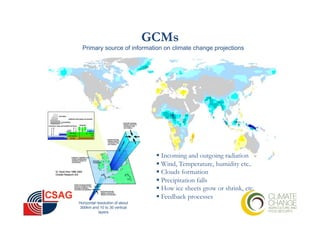
GCMs
  Primary source of information on climate change projections


                                    Incoming and outgoing radiation
                                    Wind, Temperature, humidity etc..
                                    Clouds formation
                                    Precipitation falls
                                    How ice sheets grow or shrink, etc.
                                    Feedback processes
Horizontal resolution of about
 300km and 10 to 30 vertical
            layers
GCMs
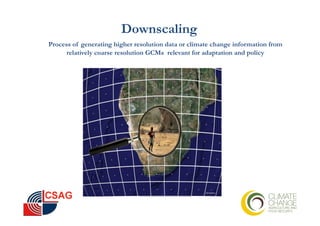
Downscaling
Process of generating higher resolution data or climate change information from
      relatively coarse resolution GCMs relevant for adaptation and policy
Two main stream methodologies	
  

Dynamic downscaling / Regional Climate Models (RCMs)
     (e.g. RegCM, high resolution PRECIS)

Statistical /Empirical downscaling
   •  Weather typing (SOMD – University of Cape Town)
   •  Linear (and nonlinear) regression (SDSM – Rob Wilby)
   •  Artificial Neural Networks
   •  Weather generators
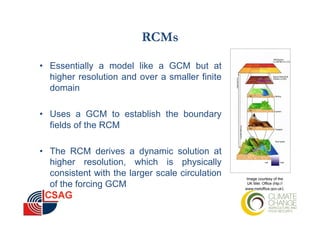
RCMs

•  Essentially a model like a GCM but at
   higher resolution and over a smaller finite
   domain

•  Uses a GCM to establish the boundary
   fields of the RCM

•  The RCM derives a dynamic solution at
   higher resolution, which is physically
   consistent with the larger scale circulation   Image courtesy of the
   of the forcing GCM                              UK Met. Office (htp://
                                                  www.metoffice.gov.uk).
RCMs
Pros:
•  Accounts for sub-GCM grid scale forcing (e.g. topography)
•  Information is derived from physically based models
•  Better representation of some weather extremes as
   compared to GCMs

Cons:
•  Expensive to run RCMs as compared to statistical
   downscaling over a large region
•  Its dependence on GCM predictors
•  It is a spatially smoothed product compared to station
   scale
Statistical downscaling
•  Involves the development of quantitative relationships between large
   scale atmospheric variables (predictors) and local surface variables
   (predictands)

                         Example: SOMD
•  A Self Organising Map (SOM) is used to recognise commonly
   occurring patterns within multi-dimensional data sets

•  Identify modes of circulation over a particular region with each
   circulation mode being associated with an observed precipitation
   probability density function (PDF)
Calculate probability of rainfall for each
            synoptic pattern
Statistical downscaling

Pros:
•  Efficient and cheap computation requirements
•  Its ability to provide point resolution climatic variables
   from GCM outputs
•  Its ability to directly incorporate observations

Cons:
•  High dependence on the predictors
•  Vulnerability to non-stationarity of the cross scale
   relationships
Climate data and impact assessment

    Downscaling does NOT seek to reproduce the real world
  observation , but rather generate a realistic time evolution
  that:

•  At seasonal and inter-annual scales should match relative
   magnitude of the temporal evolution of the forcing

•  At daily time scales should match the statistics of the daily
   events (e.g. frequency of events, etc)
Climate data and impact assessment	
  
     FACT : There will only be one time evolution into the
             future, but many possible evolutions

Limitations include:
•  Imperfect ability to model our knowledge into accurate
   mathematical equations: e.g. physics, knowledge gaps
   etc…
•  Data formatting techniques (e.g. different spatial
   resolution of systems)
Climate data and impact assessment	
  

•  Imperfect observation data
Data type
Provincial, Catchment, Station, Gridded
Spatially    average
          station yields over
          each region and then
          compare to observed
          data.
Station
Data estimation and uncertainty
          Penman Montieth
FACT: Society cannot wait for perfect
   models (GCMs and impact) and methods	
  
•  We need to make choices today based on the best current
   scientific information

•  We need to characterize baseline observational climate as
   best as possible

•  We need to use as many models as possible

•  We need to downscale or upscale where possible
Thank you

Downscaling and its limitation on climate change impact assessments

  • 1.
    Downscaling and itslimitation on climate change impact assessments Sepo Hachigonta University of Cape Town South Africa “Building Food Security in the Face of Climate change” 4 the May 2010 , ICRAF, Nairobi
  • 2.
    (1 − a)Sπr2= 4πr2εσT4
  • 3.
    GCMs Primarysource of information on climate change projections   Incoming and outgoing radiation   Wind, Temperature, humidity etc..   Clouds formation   Precipitation falls   How ice sheets grow or shrink, etc.   Feedback processes Horizontal resolution of about 300km and 10 to 30 vertical layers
  • 5.
  • 6.
    Downscaling Process of generatinghigher resolution data or climate change information from relatively coarse resolution GCMs relevant for adaptation and policy
  • 8.
    Two main streammethodologies   Dynamic downscaling / Regional Climate Models (RCMs) (e.g. RegCM, high resolution PRECIS) Statistical /Empirical downscaling •  Weather typing (SOMD – University of Cape Town) •  Linear (and nonlinear) regression (SDSM – Rob Wilby) •  Artificial Neural Networks •  Weather generators
  • 9.
    RCMs •  Essentially amodel like a GCM but at higher resolution and over a smaller finite domain •  Uses a GCM to establish the boundary fields of the RCM •  The RCM derives a dynamic solution at higher resolution, which is physically consistent with the larger scale circulation Image courtesy of the of the forcing GCM UK Met. Office (htp:// www.metoffice.gov.uk).
  • 10.
    RCMs Pros: •  Accounts forsub-GCM grid scale forcing (e.g. topography) •  Information is derived from physically based models •  Better representation of some weather extremes as compared to GCMs Cons: •  Expensive to run RCMs as compared to statistical downscaling over a large region •  Its dependence on GCM predictors •  It is a spatially smoothed product compared to station scale
  • 11.
    Statistical downscaling •  Involvesthe development of quantitative relationships between large scale atmospheric variables (predictors) and local surface variables (predictands) Example: SOMD •  A Self Organising Map (SOM) is used to recognise commonly occurring patterns within multi-dimensional data sets •  Identify modes of circulation over a particular region with each circulation mode being associated with an observed precipitation probability density function (PDF)
  • 12.
    Calculate probability ofrainfall for each synoptic pattern
  • 13.
    Statistical downscaling Pros: •  Efficientand cheap computation requirements •  Its ability to provide point resolution climatic variables from GCM outputs •  Its ability to directly incorporate observations Cons: •  High dependence on the predictors •  Vulnerability to non-stationarity of the cross scale relationships
  • 14.
    Climate data andimpact assessment Downscaling does NOT seek to reproduce the real world observation , but rather generate a realistic time evolution that: •  At seasonal and inter-annual scales should match relative magnitude of the temporal evolution of the forcing •  At daily time scales should match the statistics of the daily events (e.g. frequency of events, etc)
  • 15.
    Climate data andimpact assessment   FACT : There will only be one time evolution into the future, but many possible evolutions Limitations include: •  Imperfect ability to model our knowledge into accurate mathematical equations: e.g. physics, knowledge gaps etc… •  Data formatting techniques (e.g. different spatial resolution of systems)
  • 16.
    Climate data andimpact assessment   •  Imperfect observation data
  • 17.
  • 18.
    Spatially average station yields over each region and then compare to observed data. Station
  • 19.
    Data estimation anduncertainty Penman Montieth
  • 20.
    FACT: Society cannotwait for perfect models (GCMs and impact) and methods   •  We need to make choices today based on the best current scientific information •  We need to characterize baseline observational climate as best as possible •  We need to use as many models as possible •  We need to downscale or upscale where possible
  • 21.