SOLAR RADIATION, HEAT BALANCE
AND TEMPERATURE
INTRODUCTION
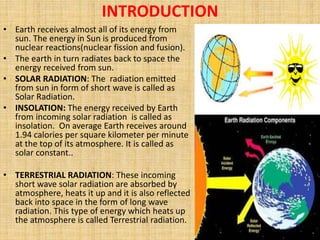
• Earth receives almost all of its energy from
sun. The energy in Sun is produced from
nuclear reactions(nuclear fission and fusion).
• The earth in turn radiates back to space the
energy received from sun.
• SOLAR RADIATION: The radiation emitted
from sun in form of short wave is called as
Solar Radiation.
• INSOLATION: The energy received by Earth
from incoming solar radiation is called as
insolation. On average Earth receives around
1.94 calories per square kilometer per minute
at the top of its atmosphere. It is called as
solar constant..
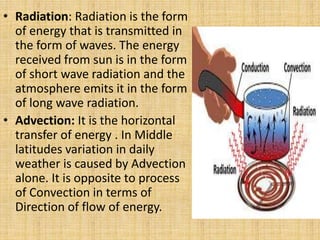
• TERRESTRIAL RADIATION: These incoming
short wave solar radiation are absorbed by
atmosphere, heats it up and it is also reflected
back into space in the form of long wave
radiation. This type of energy which heats up
the atmosphere is called Terrestrial radiation.
PROCESSES INVOLVED IN HEATING OF
ATMOSPHERE
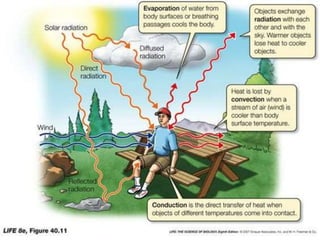
• 1. Convection: The transfer of heat
through rising of warm air and sinking
of cold air is called Convection. These
currents of moving air is called as
Convection Currents.
• 2. Conduction: Conduction is transfer
of heat when between two bodies of
unequal temperature are contact with
one another. The flow of energy is from
warmer to cooler body. The transfer
continues until both bodies maintain
the same temperature. The air gets
heated and slowly and it heats the
upper layer of atmosphere. This
process is called Conduction.
• Radiation: Radiation is the form
of energy that is transmitted in
the form of waves. The energy
received from sun is in the form
of short wave radiation and the
atmosphere emits it in the form
of long wave radiation.
• Advection: It is the horizontal
transfer of energy . In Middle
latitudes variation in daily
weather is caused by Advection
alone. It is opposite to process
of Convection in terms of
Direction of flow of energy.
FACTORS RESPONSIBLE FOR DIFFERENCE OF
INSOLATION AT SURFACE OF EARTH
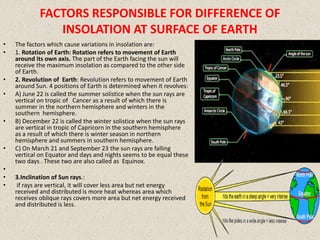
• The factors which cause variations in insolation are:
• 1. Rotation of Earth: Rotation refers to movement of Earth
around its own axis. The part of the Earth facing the sun will
receive the maximum insolation as compared to the other side
of Earth.
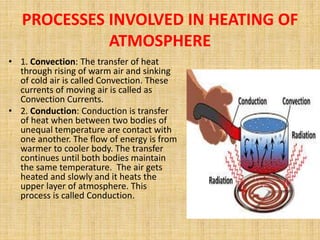
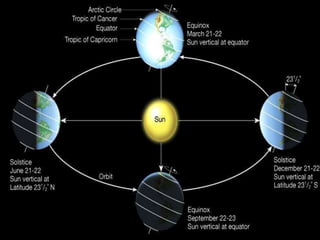
• 2. Revolution of Earth: Revolution refers to movement of Earth
around Sun. 4 positions of Earth is determined when it revolves:
• A) June 22 is called the summer solistice when the sun rays are
vertical on tropic of Cancer as a result of which there is
summer in the northern hemisphere and winters in the
southern hemisphere.
• B) December 22 is called the winter solistice when the sun rays
are vertical in tropic of Capricorn in the southern hemisphere
as a result of which there is winter season in northern
hemisphere and summers in southern hemisphere.
• C) On March 21 and September 23 the sun rays are falling
vertical on Equator and days and nights seems to be equal these
two days . These two are also called as Equinox.
•
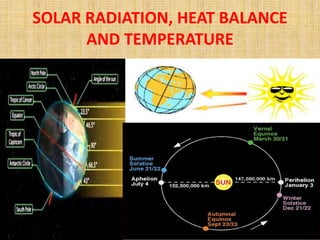
• 3.Inclination of Sun rays.:
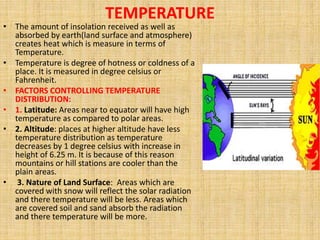
• if rays are vertical, it will cover less area but net energy
received and distributed is more heat whereas area which
receives oblique rays covers more area but net energy received
and distributed is less.
• 3.Length of day( Longer the day,
greater is the insolation. Example
days are longer and nights are
shorter during summer therefore
more insolation is received during
summer seaon.
• in winters days are shorter and
nights are longer and therfore less
insolation is received in this season.
• 4. Latitude of Place: Places at high
latitudes like polar areas receive less
insolation. Middle latitudes receive
high insolation.
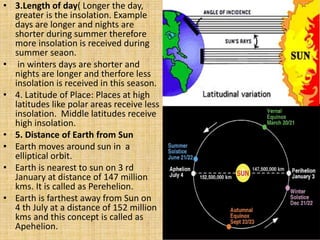
• 5. Distance of Earth from Sun
• Earth moves around sun in a
elliptical orbit.
• Earth is nearest to sun on 3 rd
January at distance of 147 million
kms. It is called as Perehelion.
• Earth is farthest away from Sun on
4 th July at a distance of 152 million
kms and this concept is called as
Apehelion.
• 6. Impact of Land and Water: Specific capacity of
water is 5 times more that land. It means that if
same energy if provided to water as well as land ,
land will get heated as well as cool easily as
compared to water. Water in turn takes five times
more energy to heat as well as cool down.
• Therefore areas on the earth surface where portion
of land is more will get heated more and will
generate more insolation.
• Areas with less portion of land will have less
insolation.
HEAT BUDGET OF EARTH.
• The Earth as a whole does not accumulate or lose heat. It only
maintains its temperature. This can only happen if amount of
heat received in the form of insolation equals to amount of
heat lost by the Earth.
• Considering that 100 units are received as insolation from
sun.
• While passing through atmosphere some energy is absorbed,
some is reflected and some is scattered.
• INCOMING RADIATION/SHORT WAVE RADIATION
• out of 100 units,
• 35 units are reflected back(27 units by clouds, 2 snow ice
covered areas of earth and 6 units are scattered into space)
• 2.Remaining 65 units are absorbed by earth surface (51 units
by earth and 14 units by atmosphere).
• Therefore around 65 units are received by earth as incoming
insolation..
• TERRESTRIAL RADIATION/LONG WAVE RADIATION
1. 17 units are reflected back to space by earth surface.
2. 48 units are again reflected to space by atmosphere.
3. 4. total units reflected are 17 units +48 units =65
units.
• Thus the amount of heat received by earth in form of
incoming insolation i.e. 65 units is equal to the
amount of units reflected by earth surface as well as
atmosphere..
• This is called as heat budget or heat balance of earth.
• The reflected amount of radiation is called albedo of
Earth.
TEMPERATURE
• The amount of insolation received as well as
absorbed by earth(land surface and atmosphere)
creates heat which is measure in terms of
Temperature.
• Temperature is degree of hotness or coldness of a
place. It is measured in degree celsius or
Fahrenheit.
• FACTORS CONTROLLING TEMPERATURE
DISTRIBUTION:
• 1. Latitude: Areas near to equator will have high
temperature as compared to polar areas.
• 2. Altitude: places at higher altitude have less
temperature distribution as temperature
decreases by 1 degree celsius with increase in
height of 6.25 m. It is because of this reason
mountains or hill stations are cooler than the
plain areas.
• 3. Nature of Land Surface: Areas which are
covered with snow will reflect the solar radiation
and there temperature will be less. Areas which
are covered soil and sand absorb the radiation
and there temperature will be more.
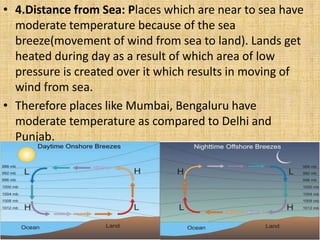
• 4.Distance from Sea: Places which are near to sea have
moderate temperature because of the sea
breeze(movement of wind from sea to land). Lands get
heated during day as a result of which area of low
pressure is created over it which results in moving of
wind from sea.
• Therefore places like Mumbai, Bengaluru have
moderate temperature as compared to Delhi and
Punjab.
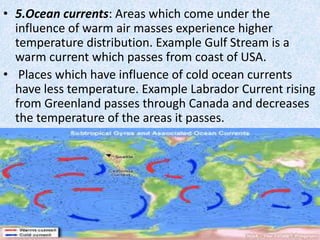
• 5.Ocean currents: Areas which come under the
influence of warm air masses experience higher
temperature distribution. Example Gulf Stream is a
warm current which passes from coast of USA.
• Places which have influence of cold ocean currents
have less temperature. Example Labrador Current rising
from Greenland passes through Canada and decreases
the temperature of the areas it passes.
• 6. Prevailing Winds: Some times prevailing
winds increase or decrease the temperature of
the region from which it passes. Example:
a)Sirocco is a warm wind blowing from Sahara
Desert and raises the temperature there.
• b)Chinook is warm wind moving down from
Rockies mountain of North America and
increases the temperature of the area it
passes.
• C) Loo is warm wind blowing in the areas of
Punjab and Haryana and increases its
temperature.
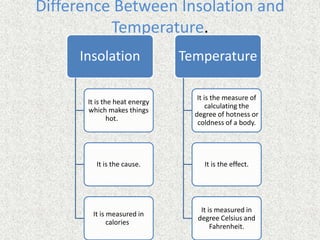
Difference Between Insolation and
Temperature.
Insolation
It is the heat energy
which makes things
hot.
It is the cause.
It is measured in
calories
Temperature
It is the measure of
calculating the
degree of hotness or
coldness of a body.
It is the effect.
It is measured in
degree Celsius and
Fahrenheit.
DISTRIBUTION OF TEMPERATURE
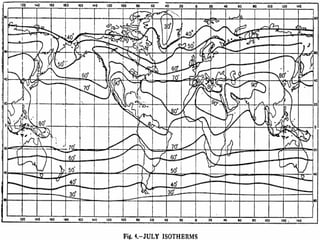
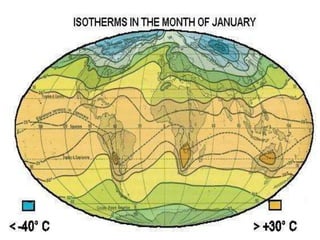
• Temperature distribution is shown with help of Isotherms.
• Isotherms are line joining places with equal temperature. Close
spacing between isotherms indicate raid change whereas wide
spacing means slow change.
• In month of January, as the temperature is low over
landmasses with high pressure conditions and pressure seems
to be low in oceans. In northern hemisphere, isotherms bend
equatorward while crossing landmass and poleward crossing
oceans. In southern hemisphere, the conditions turns to be
reverse.
• In month of July, as the temperature is high over landmasses
with low pressure conditions and high pressure conditions
prevail over ocean body.. In northern hemisphere, isotherms
bend equatorward while crossing oceans and poleward
crossing landmass. In southern hemisphere, the conditions
turns to be reverse.
Inversion of temperature
• With increase in height, the temperature decreases with
height which is called NORMAL LASE RATE.
• In some situations, temperature increases with increases in
height. This change in temperature which increases with
height is called Inversion of Temperature.
• Conditions in which temperature inversion occurs:
• 1.Long nights: air touching surface cold, but upper layers of
atmosphere are still warm. Long nights help in inversion of
temperature.
• 2.Clear Sky: Clouds help in reflecting the radiations. If sky is
clear during night, it will create conditions of inversion of
temperature.
• 3.Dry air: Moist air has capacity to absorb radiation and
obstructs temperature inversion whereas dry air does not
absorb radiation and promotes temperature inversion.

SOLAR RADIATION,HEAT AND TEMPERATURE

  • 1.
    SOLAR RADIATION, HEATBALANCE AND TEMPERATURE
  • 2.
    INTRODUCTION • Earth receivesalmost all of its energy from sun. The energy in Sun is produced from nuclear reactions(nuclear fission and fusion). • The earth in turn radiates back to space the energy received from sun. • SOLAR RADIATION: The radiation emitted from sun in form of short wave is called as Solar Radiation. • INSOLATION: The energy received by Earth from incoming solar radiation is called as insolation. On average Earth receives around 1.94 calories per square kilometer per minute at the top of its atmosphere. It is called as solar constant.. • TERRESTRIAL RADIATION: These incoming short wave solar radiation are absorbed by atmosphere, heats it up and it is also reflected back into space in the form of long wave radiation. This type of energy which heats up the atmosphere is called Terrestrial radiation.
  • 3.
    PROCESSES INVOLVED INHEATING OF ATMOSPHERE • 1. Convection: The transfer of heat through rising of warm air and sinking of cold air is called Convection. These currents of moving air is called as Convection Currents. • 2. Conduction: Conduction is transfer of heat when between two bodies of unequal temperature are contact with one another. The flow of energy is from warmer to cooler body. The transfer continues until both bodies maintain the same temperature. The air gets heated and slowly and it heats the upper layer of atmosphere. This process is called Conduction.
  • 4.
    • Radiation: Radiationis the form of energy that is transmitted in the form of waves. The energy received from sun is in the form of short wave radiation and the atmosphere emits it in the form of long wave radiation. • Advection: It is the horizontal transfer of energy . In Middle latitudes variation in daily weather is caused by Advection alone. It is opposite to process of Convection in terms of Direction of flow of energy.
  • 6.
    FACTORS RESPONSIBLE FORDIFFERENCE OF INSOLATION AT SURFACE OF EARTH • The factors which cause variations in insolation are: • 1. Rotation of Earth: Rotation refers to movement of Earth around its own axis. The part of the Earth facing the sun will receive the maximum insolation as compared to the other side of Earth. • 2. Revolution of Earth: Revolution refers to movement of Earth around Sun. 4 positions of Earth is determined when it revolves: • A) June 22 is called the summer solistice when the sun rays are vertical on tropic of Cancer as a result of which there is summer in the northern hemisphere and winters in the southern hemisphere. • B) December 22 is called the winter solistice when the sun rays are vertical in tropic of Capricorn in the southern hemisphere as a result of which there is winter season in northern hemisphere and summers in southern hemisphere. • C) On March 21 and September 23 the sun rays are falling vertical on Equator and days and nights seems to be equal these two days . These two are also called as Equinox. • • 3.Inclination of Sun rays.: • if rays are vertical, it will cover less area but net energy received and distributed is more heat whereas area which receives oblique rays covers more area but net energy received and distributed is less.
  • 8.
    • 3.Length ofday( Longer the day, greater is the insolation. Example days are longer and nights are shorter during summer therefore more insolation is received during summer seaon. • in winters days are shorter and nights are longer and therfore less insolation is received in this season. • 4. Latitude of Place: Places at high latitudes like polar areas receive less insolation. Middle latitudes receive high insolation. • 5. Distance of Earth from Sun • Earth moves around sun in a elliptical orbit. • Earth is nearest to sun on 3 rd January at distance of 147 million kms. It is called as Perehelion. • Earth is farthest away from Sun on 4 th July at a distance of 152 million kms and this concept is called as Apehelion.
  • 9.
    • 6. Impactof Land and Water: Specific capacity of water is 5 times more that land. It means that if same energy if provided to water as well as land , land will get heated as well as cool easily as compared to water. Water in turn takes five times more energy to heat as well as cool down. • Therefore areas on the earth surface where portion of land is more will get heated more and will generate more insolation. • Areas with less portion of land will have less insolation.
  • 10.
    HEAT BUDGET OFEARTH. • The Earth as a whole does not accumulate or lose heat. It only maintains its temperature. This can only happen if amount of heat received in the form of insolation equals to amount of heat lost by the Earth. • Considering that 100 units are received as insolation from sun. • While passing through atmosphere some energy is absorbed, some is reflected and some is scattered. • INCOMING RADIATION/SHORT WAVE RADIATION • out of 100 units, • 35 units are reflected back(27 units by clouds, 2 snow ice covered areas of earth and 6 units are scattered into space) • 2.Remaining 65 units are absorbed by earth surface (51 units by earth and 14 units by atmosphere). • Therefore around 65 units are received by earth as incoming insolation..
  • 11.
    • TERRESTRIAL RADIATION/LONGWAVE RADIATION 1. 17 units are reflected back to space by earth surface. 2. 48 units are again reflected to space by atmosphere. 3. 4. total units reflected are 17 units +48 units =65 units. • Thus the amount of heat received by earth in form of incoming insolation i.e. 65 units is equal to the amount of units reflected by earth surface as well as atmosphere.. • This is called as heat budget or heat balance of earth. • The reflected amount of radiation is called albedo of Earth.
  • 12.
    TEMPERATURE • The amountof insolation received as well as absorbed by earth(land surface and atmosphere) creates heat which is measure in terms of Temperature. • Temperature is degree of hotness or coldness of a place. It is measured in degree celsius or Fahrenheit. • FACTORS CONTROLLING TEMPERATURE DISTRIBUTION: • 1. Latitude: Areas near to equator will have high temperature as compared to polar areas. • 2. Altitude: places at higher altitude have less temperature distribution as temperature decreases by 1 degree celsius with increase in height of 6.25 m. It is because of this reason mountains or hill stations are cooler than the plain areas. • 3. Nature of Land Surface: Areas which are covered with snow will reflect the solar radiation and there temperature will be less. Areas which are covered soil and sand absorb the radiation and there temperature will be more.
  • 13.
    • 4.Distance fromSea: Places which are near to sea have moderate temperature because of the sea breeze(movement of wind from sea to land). Lands get heated during day as a result of which area of low pressure is created over it which results in moving of wind from sea. • Therefore places like Mumbai, Bengaluru have moderate temperature as compared to Delhi and Punjab.
  • 14.
    • 5.Ocean currents:Areas which come under the influence of warm air masses experience higher temperature distribution. Example Gulf Stream is a warm current which passes from coast of USA. • Places which have influence of cold ocean currents have less temperature. Example Labrador Current rising from Greenland passes through Canada and decreases the temperature of the areas it passes.
  • 15.
    • 6. PrevailingWinds: Some times prevailing winds increase or decrease the temperature of the region from which it passes. Example: a)Sirocco is a warm wind blowing from Sahara Desert and raises the temperature there. • b)Chinook is warm wind moving down from Rockies mountain of North America and increases the temperature of the area it passes. • C) Loo is warm wind blowing in the areas of Punjab and Haryana and increases its temperature.
  • 16.
    Difference Between Insolationand Temperature. Insolation It is the heat energy which makes things hot. It is the cause. It is measured in calories Temperature It is the measure of calculating the degree of hotness or coldness of a body. It is the effect. It is measured in degree Celsius and Fahrenheit.
  • 17.
    DISTRIBUTION OF TEMPERATURE •Temperature distribution is shown with help of Isotherms. • Isotherms are line joining places with equal temperature. Close spacing between isotherms indicate raid change whereas wide spacing means slow change. • In month of January, as the temperature is low over landmasses with high pressure conditions and pressure seems to be low in oceans. In northern hemisphere, isotherms bend equatorward while crossing landmass and poleward crossing oceans. In southern hemisphere, the conditions turns to be reverse. • In month of July, as the temperature is high over landmasses with low pressure conditions and high pressure conditions prevail over ocean body.. In northern hemisphere, isotherms bend equatorward while crossing oceans and poleward crossing landmass. In southern hemisphere, the conditions turns to be reverse.
  • 20.
    Inversion of temperature •With increase in height, the temperature decreases with height which is called NORMAL LASE RATE. • In some situations, temperature increases with increases in height. This change in temperature which increases with height is called Inversion of Temperature. • Conditions in which temperature inversion occurs: • 1.Long nights: air touching surface cold, but upper layers of atmosphere are still warm. Long nights help in inversion of temperature. • 2.Clear Sky: Clouds help in reflecting the radiations. If sky is clear during night, it will create conditions of inversion of temperature. • 3.Dry air: Moist air has capacity to absorb radiation and obstructs temperature inversion whereas dry air does not absorb radiation and promotes temperature inversion.