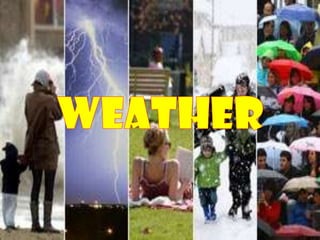
weather
 Refers to the conditions of the atmosphere,
temperature, pressure and humidity of a place for a
short period of time.
 generally refers to day-to-day temperature and
precipitation activity, whereas climate is the term for the
average atmospheric conditions over longer periods of
time
e.g.
       Too rainfall
       Wind direction and strength
       Cloud cover and;
       sunshine
climate
 Is the average state of the atmosphere
over a long period of time.

 the weather averaged over a long period.

 The standard      averaging   period   is
30 years.
season
 A season is a subdivision of the year,
marked by changes in weather, ecology, and
hours of daylight. Seasons result from the
yearly revolution of the Earth around
the Sun and the tilt of the Earth’s
axis relative to the plane of revolution.
"Climate is what you
expect, weather is what
        you get."
The main elements of the atmosphere that
determine weather and climate at a given
place are:

 Temperature
 Precipitation (including humidity and
clouds)
 Air pressure
 Winds storms and;
 visibility
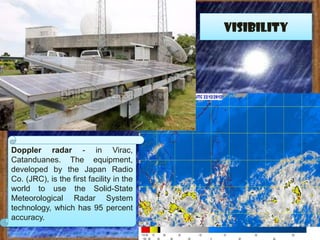
visibility


Doppler radar - in Virac,
Catanduanes. The equipment,
developed by the Japan Radio
Co. (JRC), is the first facility in the
world to use the Solid-State
Meteorological Radar System
technology, which has 95 percent
accuracy.
Factors interacting to cause weather are:

 Heat energy
 Air pressure
 Winds and;
 Moisture
How are typhoons formed?

 Typhoons start off as tropical thunderstorms. The
strong winds pull in moisture from the oceans. The
thunderstorms convert the moisture into heat. The heat
causes more air to flow to the center of the storm which
causes more evaporation. All the heat and air flow
toward the eye creating the typhoon.
Difference between
   weather and
      climate
Weather differs from climate due to:

 Latitude – determines the angle at which
the sun’s rays strike the earth’s surface and
their effectiveness;
 Distribution of lands and water;
 Winds;
 Altitude;
 Mountain barriers;
 Big semi-permanent high and low
pressure centers; ocean currents; and
 Different kinds of storms.
Combinations of these factors in
   different intensities change
temperature that makes weather
     different from climate.
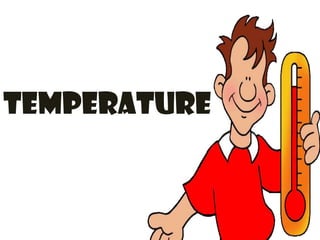
temperature
temperature
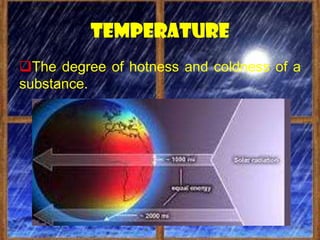
The degree of hotness and coldness of a
substance.
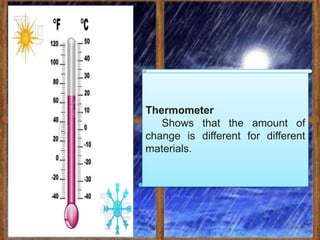
Thermometer
   Shows that the amount of
change is different for different
materials.
 Temperature is the most important
element of weather because weather
changes are brought about by the change in
temperature of the different parts of the
atmosphere.
 Temperatures in the continental climates
differ according to where air masses that
blow come from.
   Large & dry continents = deserts
   Mountains = cooler climates
o Climates in the cities are warmer than
open countries.
Water vapor
 Water vapor in the air is humidity.
 Comes from the evaporation of:
   Oceans;
   Rivers;
   Lakes;
   Soil;
   Plants; and
   Animals.
 Warm air can hold more moisture than an
equal volume of cold air. Why?
Relative humidity
 The amount of moisture in the air or
 the percentage of the moisture the
 air can holds a definite temperature
Relative humidity
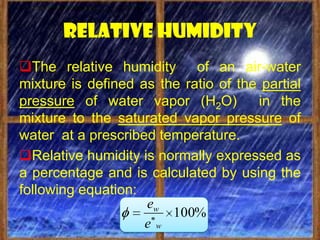
The relative humidity of an air-water
mixture is defined as the ratio of the partial
pressure of water vapor (H2O)         in the
mixture to the saturated vapor pressure of
water at a prescribed temperature.
Relative humidity is normally expressed as
a percentage and is calculated by using the
following equation:
                    ew
                        100%
                    ew
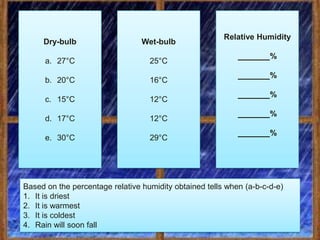
Relative Humidity
     Dry-bulb                    Wet-bulb
                                                                     %
      a. 27°C                      25°C
                                                                     %
      b. 20°C                      16°C
                                                                     %
      c. 15°C                      12°C
                                                                     %
      d. 17°C                      12°C
                                                                     %
      e. 30°C                      29°C


Based on the percentage relative humidity obtained tells when (a-b-c-d-e)
1. It is driest
2. It is warmest
3. It is coldest
4. Rain will soon fall
 Air moves either horizontally as wind or
vertically as currents.
 Winds and currents transfer heat from the
equator to the poles.
 Heat comes directly from the earth and
indirectly from the sun.
 Air has weight.
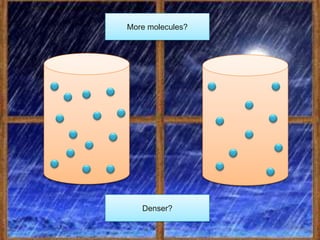
More molecules?


Cold Air
 1cm3                        Warm air
                              1cm3


              Denser?
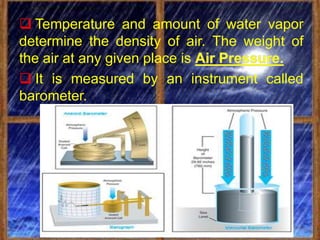
 Temperature and amount of water vapor
determine the density of air. The weight of
the air at any given place is
 It is measured by an instrument called
barometer.
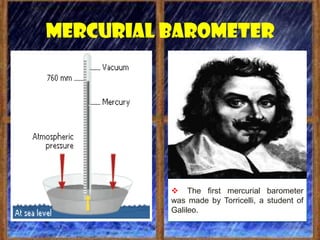
Mercurial barometer


           The first mercurial barometer
          was made by Torricelli, a student of
          Galileo.
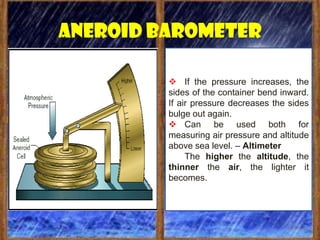
Aneroid barometer

          If the pressure increases, the
         sides of the container bend inward.
         If air pressure decreases the sides
         bulge out again.
          Can be used both for
         measuring air pressure and altitude
         above sea level. – Altimeter
              The higher the altitude, the
         thinner the air, the lighter it
         becomes.
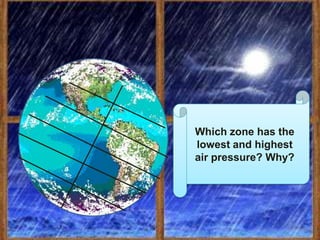
Which zone has the
lowest and highest
air pressure? Why?
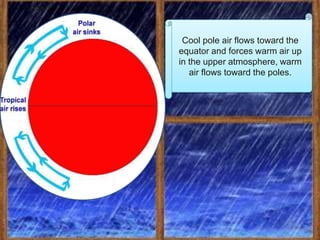
Cool pole air flows toward the
equator and forces warm air up
in the upper atmosphere, warm
   air flows toward the poles.
Air pressure is determined by:
 Altitude
   - the higher you go, the lower the air
   pressure, as the amount of air molecules
   decreases.
 Temperature
   - cold air has more air molecules than hot air
 Water vapor
   Temperature and amount of water vapor
determine the density of the air.
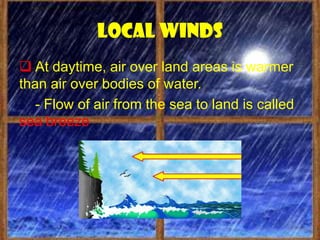
Local winds
Local winds
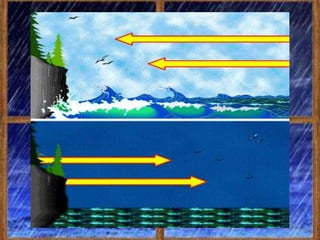
 At daytime, air over land areas is warmer
than air over bodies of water.
   - Flow of air from the sea to land is called
sea breeze
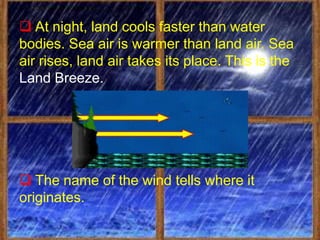
 At night, land cools faster than water
bodies. Sea air is warmer than land air. Sea
air rises, land air takes its place. This is the
Land Breeze.


 The name of the wind tells where it
originates.
 Huge land and sea breezes are called monsoons.
–seasonal winds.

 Northeast monsoon
   October – February
   Winds blows from cooler continent to warmer
  ocean.
   It comes from northern Asia and blows toward
  the Pacific Ocean.
   Cold season – Philippines – cool, dry season
  to the northern.
   Winter season – north temperate and polar
  areas.
   “Hanging Amihan”
 Southwest monsoon
  Winds blows from cooler ocean to
 warmer continent.
  It comes from the Pacific Ocean and
 brings rainy and typhoon season to the
 Philippines.
  Oceans winds bring in warm, moist air,
 therefore heavy rains and warm
 temperatures over the land
  “Hanging Habagat”
Major wind
systems of the
    earth
Factors affecting the winds in the earth
are:
The earth’s rotation, Pressure belts,
Differences in topography and In the heating
of air masses over land and water.


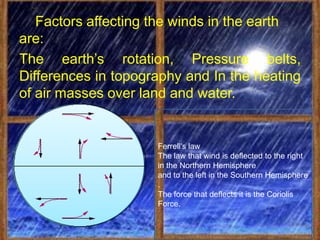
                     Ferrell's law
                     The law that wind is deflected to the right
                     in the Northern Hemisphere
                     and to the left in the Southern Hemisphere
                     .
                     The force that deflects it is the Coriolis
                     Force.
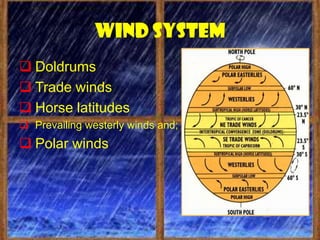
Wind system
 Doldrums
 Trade winds
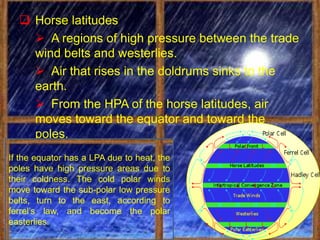
 Horse latitudes
 Prevailing westerly winds and;
 Polar winds
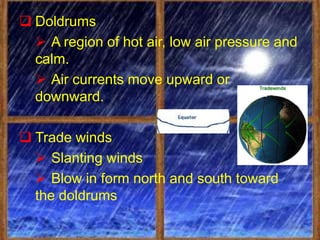
 Doldrums
   A region of hot air, low air pressure and
  calm.
   Air currents move upward or
  downward.

 Trade winds
   Slanting winds
   Blow in form north and south toward
  the doldrums
 Horse latitudes
     A regions of high pressure between the trade
    wind belts and westerlies.
     Air that rises in the doldrums sinks to the
    earth.
     From the HPA of the horse latitudes, air
    moves toward the equator and toward the
    poles.
If the equator has a LPA due to heat, the
poles have high pressure areas due to
their coldness. The cold polar winds
move toward the sub-polar low pressure
belts, turn to the east, according to
ferrel’s law, and become the polar
easterlies.
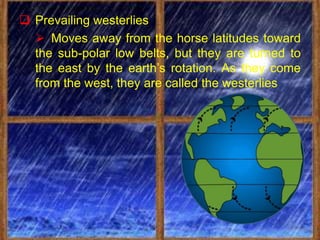
 Prevailing westerlies
   Moves away from the horse latitudes toward
  the sub-polar low belts, but they are turned to
  the east by the earth’s rotation. As they come
  from the west, they are called the westerlies
Weather and climate

Weather and climate

  • 3.
    weather  Refers tothe conditions of the atmosphere, temperature, pressure and humidity of a place for a short period of time.  generally refers to day-to-day temperature and precipitation activity, whereas climate is the term for the average atmospheric conditions over longer periods of time e.g. Too rainfall Wind direction and strength Cloud cover and; sunshine
  • 5.
    climate  Is theaverage state of the atmosphere over a long period of time.  the weather averaged over a long period.  The standard averaging period is 30 years.
  • 7.
    season  A seasonis a subdivision of the year, marked by changes in weather, ecology, and hours of daylight. Seasons result from the yearly revolution of the Earth around the Sun and the tilt of the Earth’s axis relative to the plane of revolution.
  • 8.
    "Climate is whatyou expect, weather is what you get."
  • 9.
    The main elementsof the atmosphere that determine weather and climate at a given place are:  Temperature  Precipitation (including humidity and clouds)  Air pressure  Winds storms and;  visibility
  • 10.
    visibility Doppler radar -in Virac, Catanduanes. The equipment, developed by the Japan Radio Co. (JRC), is the first facility in the world to use the Solid-State Meteorological Radar System technology, which has 95 percent accuracy.
  • 11.
    Factors interacting tocause weather are:  Heat energy  Air pressure  Winds and;  Moisture
  • 12.
    How are typhoonsformed?  Typhoons start off as tropical thunderstorms. The strong winds pull in moisture from the oceans. The thunderstorms convert the moisture into heat. The heat causes more air to flow to the center of the storm which causes more evaporation. All the heat and air flow toward the eye creating the typhoon.
  • 13.
    Difference between weather and climate
  • 14.
    Weather differs fromclimate due to:  Latitude – determines the angle at which the sun’s rays strike the earth’s surface and their effectiveness;  Distribution of lands and water;  Winds;  Altitude;  Mountain barriers;  Big semi-permanent high and low pressure centers; ocean currents; and  Different kinds of storms.
  • 15.
    Combinations of thesefactors in different intensities change temperature that makes weather different from climate.
  • 16.
  • 17.
    temperature The degree ofhotness and coldness of a substance.
  • 18.
    Thermometer Shows that the amount of change is different for different materials.
  • 19.
     Temperature isthe most important element of weather because weather changes are brought about by the change in temperature of the different parts of the atmosphere.  Temperatures in the continental climates differ according to where air masses that blow come from. Large & dry continents = deserts Mountains = cooler climates o Climates in the cities are warmer than open countries.
  • 20.
  • 21.
     Water vaporin the air is humidity.  Comes from the evaporation of:  Oceans;  Rivers;  Lakes;  Soil;  Plants; and  Animals.  Warm air can hold more moisture than an equal volume of cold air. Why?
  • 22.
    Relative humidity Theamount of moisture in the air or the percentage of the moisture the air can holds a definite temperature
  • 23.
    Relative humidity The relativehumidity of an air-water mixture is defined as the ratio of the partial pressure of water vapor (H2O) in the mixture to the saturated vapor pressure of water at a prescribed temperature. Relative humidity is normally expressed as a percentage and is calculated by using the following equation: ew 100% ew
  • 24.
    Relative Humidity Dry-bulb Wet-bulb % a. 27°C 25°C % b. 20°C 16°C % c. 15°C 12°C % d. 17°C 12°C % e. 30°C 29°C Based on the percentage relative humidity obtained tells when (a-b-c-d-e) 1. It is driest 2. It is warmest 3. It is coldest 4. Rain will soon fall
  • 26.
     Air moveseither horizontally as wind or vertically as currents.  Winds and currents transfer heat from the equator to the poles.  Heat comes directly from the earth and indirectly from the sun.  Air has weight.
  • 27.
    More molecules? Cold Air 1cm3 Warm air 1cm3 Denser?
  • 28.
     Temperature andamount of water vapor determine the density of air. The weight of the air at any given place is  It is measured by an instrument called barometer.
  • 29.
    Mercurial barometer  The first mercurial barometer was made by Torricelli, a student of Galileo.
  • 30.
    Aneroid barometer  If the pressure increases, the sides of the container bend inward. If air pressure decreases the sides bulge out again.  Can be used both for measuring air pressure and altitude above sea level. – Altimeter The higher the altitude, the thinner the air, the lighter it becomes.
  • 31.
    Which zone hasthe lowest and highest air pressure? Why?
  • 32.
    Cool pole airflows toward the equator and forces warm air up in the upper atmosphere, warm air flows toward the poles.
  • 33.
    Air pressure isdetermined by:  Altitude - the higher you go, the lower the air pressure, as the amount of air molecules decreases.  Temperature - cold air has more air molecules than hot air  Water vapor Temperature and amount of water vapor determine the density of the air.
  • 34.
  • 36.
    Local winds  Atdaytime, air over land areas is warmer than air over bodies of water. - Flow of air from the sea to land is called sea breeze
  • 37.
     At night,land cools faster than water bodies. Sea air is warmer than land air. Sea air rises, land air takes its place. This is the Land Breeze.  The name of the wind tells where it originates.
  • 38.
     Huge landand sea breezes are called monsoons. –seasonal winds.  Northeast monsoon  October – February  Winds blows from cooler continent to warmer ocean.  It comes from northern Asia and blows toward the Pacific Ocean.  Cold season – Philippines – cool, dry season to the northern.  Winter season – north temperate and polar areas.  “Hanging Amihan”
  • 39.
     Southwest monsoon  Winds blows from cooler ocean to warmer continent.  It comes from the Pacific Ocean and brings rainy and typhoon season to the Philippines.  Oceans winds bring in warm, moist air, therefore heavy rains and warm temperatures over the land  “Hanging Habagat”
  • 40.
  • 41.
    Factors affecting thewinds in the earth are: The earth’s rotation, Pressure belts, Differences in topography and In the heating of air masses over land and water. Ferrell's law The law that wind is deflected to the right in the Northern Hemisphere and to the left in the Southern Hemisphere . The force that deflects it is the Coriolis Force.
  • 42.
    Wind system  Doldrums Trade winds  Horse latitudes  Prevailing westerly winds and;  Polar winds
  • 43.
     Doldrums  A region of hot air, low air pressure and calm.  Air currents move upward or downward.  Trade winds  Slanting winds  Blow in form north and south toward the doldrums
  • 44.
     Horse latitudes  A regions of high pressure between the trade wind belts and westerlies.  Air that rises in the doldrums sinks to the earth.  From the HPA of the horse latitudes, air moves toward the equator and toward the poles. If the equator has a LPA due to heat, the poles have high pressure areas due to their coldness. The cold polar winds move toward the sub-polar low pressure belts, turn to the east, according to ferrel’s law, and become the polar easterlies.
  • 45.
     Prevailing westerlies  Moves away from the horse latitudes toward the sub-polar low belts, but they are turned to the east by the earth’s rotation. As they come from the west, they are called the westerlies