Prof.R.S.KOLHE
Prof. R.S. KOLHE
ME (HEAT POWER)
BE (MECHANICAL)
WELCOME TO
Heating, Ventilation, Air
Conditioning and Refrigeration
Engineering
Lecture No 01
Topics to be covered
• Basics of HVAC
• Vapour compression cycle (VCR)
• Performance of VCR
• Representation of VCR on P-H and T-S plane
BASICS OF HVAC
• H- Heating
• V- Ventilation
• AC- Air-conditioning
• HEATING : Designing the system for low
temperature climate ( cold climate)
• VENTILATION: It is the fresh air penetrated form
outside. It is a process of replacing air in
conditioning space by fresh air having high indoor
quality .
• REFRIGERATION : It is process of removing heat
from body or space so that its temperature first
reduce and then maintained at a temperature less
than surrounding.
• AIR CONDITIONING : Air-conditioning is the process
of treating air so as to control its temperature,
humidity, cleanliness( air quality) and distribution to
meet the requirements of the condition space.
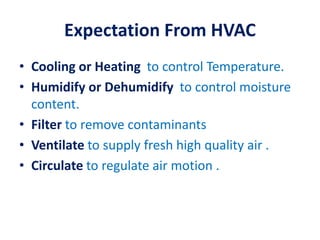
Expectation From HVAC
• Cooling or Heating to control Temperature.
• Humidify or Dehumidify to control moisture
content.
• Filter to remove contaminants
• Ventilate to supply fresh high quality air .
• Circulate to regulate air motion .
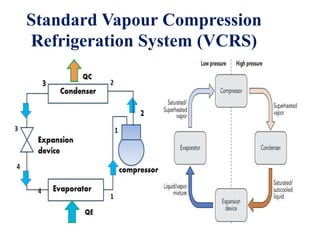
Vapour Compression Cycle
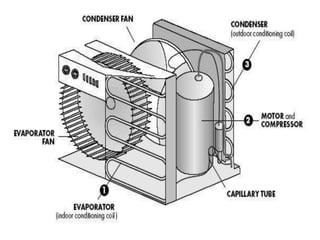
• Compressor
• Condenser
• Expansion device
• Evaporator
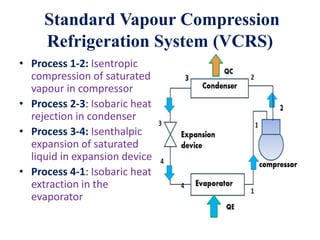
Standard Vapour Compression
Refrigeration System (VCRS)
• Process 1-2: Isentropic
compression of saturated
vapour in compressor
• Process 2-3: Isobaric heat
rejection in condenser
• Process 3-4: Isenthalpic
expansion of saturated
liquid in expansion device
• Process 4-1: Isobaric heat
extraction in the
evaporator
Standard Vapour Compression
Refrigeration System (VCRS)
Pressure – Enthalpy (P-H) Diagram
T-v diagram for the heating process of water at a)
constant pressure and b) different pressure.
Pressure - Enthalpy Chart
Pressure – Enthalpy (P-H) Diagram
TEMP- ENTROPY (T-S) Diagram
PERFORMANCE OF VCC
• Refrigeration Effect= h1-h4
• Refrigeration capacity = m(h1-h4)
• Compressor work= (h2-h1)
• COP = (RE/WC)
COP =(h1-h4)/ (h2-h1))
• Heat Rejected in condenser: h2-h3
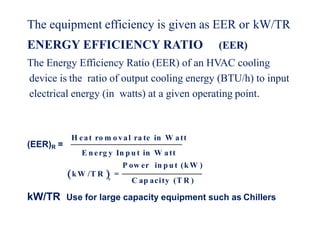
The equipment efficiency is given as EER or kW/TR
ENERGY EFFICIENCY RATIO (EER)
The Energy Efficiency Ratio (EER) of an HVAC cooling
device is the ratio of output cooling energy (BTU/h) to input
electrical energy (in watts) at a given operating point.
(EER)R =
kW/TR Use for large capacity equipment such as Chillers
H eat ro m o val ra te in W att
E n erg y In p u t in W att
R
kW /T R  =
P ow er in p u t (kW )
C ap acity (T R )
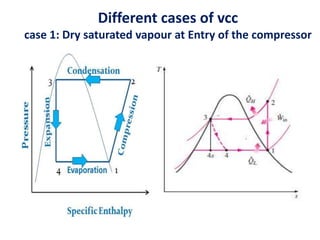
Different cases of vcc
case 1: Dry saturated vapour at Entry of the compressor
CASE 2: Refrigerant is Wet at Compressor Entry
• P-H Diagram • T-S Diagram
Case 3: Sub cooling or undercooling
Case 4: superheated vapour before compression
Have a good day
Thank you

Vapour Compression Cycle: Types and Numerical Analysis

  • 1.
    Prof.R.S.KOLHE Prof. R.S. KOLHE ME(HEAT POWER) BE (MECHANICAL) WELCOME TO Heating, Ventilation, Air Conditioning and Refrigeration Engineering
  • 2.
    Lecture No 01 Topicsto be covered • Basics of HVAC • Vapour compression cycle (VCR) • Performance of VCR • Representation of VCR on P-H and T-S plane
  • 3.
    BASICS OF HVAC •H- Heating • V- Ventilation • AC- Air-conditioning
  • 4.
    • HEATING :Designing the system for low temperature climate ( cold climate) • VENTILATION: It is the fresh air penetrated form outside. It is a process of replacing air in conditioning space by fresh air having high indoor quality . • REFRIGERATION : It is process of removing heat from body or space so that its temperature first reduce and then maintained at a temperature less than surrounding. • AIR CONDITIONING : Air-conditioning is the process of treating air so as to control its temperature, humidity, cleanliness( air quality) and distribution to meet the requirements of the condition space.
  • 5.
    Expectation From HVAC •Cooling or Heating to control Temperature. • Humidify or Dehumidify to control moisture content. • Filter to remove contaminants • Ventilate to supply fresh high quality air . • Circulate to regulate air motion .
  • 6.
    Vapour Compression Cycle •Compressor • Condenser • Expansion device • Evaporator
  • 7.
    Standard Vapour Compression RefrigerationSystem (VCRS) • Process 1-2: Isentropic compression of saturated vapour in compressor • Process 2-3: Isobaric heat rejection in condenser • Process 3-4: Isenthalpic expansion of saturated liquid in expansion device • Process 4-1: Isobaric heat extraction in the evaporator
  • 8.
  • 10.
    Pressure – Enthalpy(P-H) Diagram
  • 11.
    T-v diagram forthe heating process of water at a) constant pressure and b) different pressure.
  • 12.
  • 13.
    Pressure – Enthalpy(P-H) Diagram
  • 14.
  • 15.
    PERFORMANCE OF VCC •Refrigeration Effect= h1-h4 • Refrigeration capacity = m(h1-h4) • Compressor work= (h2-h1) • COP = (RE/WC) COP =(h1-h4)/ (h2-h1)) • Heat Rejected in condenser: h2-h3
  • 16.
    The equipment efficiencyis given as EER or kW/TR ENERGY EFFICIENCY RATIO (EER) The Energy Efficiency Ratio (EER) of an HVAC cooling device is the ratio of output cooling energy (BTU/h) to input electrical energy (in watts) at a given operating point. (EER)R = kW/TR Use for large capacity equipment such as Chillers H eat ro m o val ra te in W att E n erg y In p u t in W att R kW /T R  = P ow er in p u t (kW ) C ap acity (T R )
  • 17.
    Different cases ofvcc case 1: Dry saturated vapour at Entry of the compressor
  • 18.
    CASE 2: Refrigerantis Wet at Compressor Entry • P-H Diagram • T-S Diagram
  • 19.
    Case 3: Subcooling or undercooling
  • 20.
    Case 4: superheatedvapour before compression
  • 21.
    Have a goodday Thank you