REFRIGERATION & AIR
CONDITIONING
SIMPLE VAPOR COMPRESSION
REFRIGERATION SYSTEM
1
Outlin
e
 What a Vapor Compression Refrigeration System is ?
 Why its needed ?
 Mechanism of Simple Vapor Compression Refrigeration System
 Different Vapor Compression Refrigeration System
 Factors affecting COP of Vapor Compression Refrigeration System
 Advantages
 Disadvantages
2
What a VCR System
is ?
3
Its improved refrigeration cycle which uses fluid instead of air as working
substance.
These systems belong to the general class of vapor cycles, wherein the working
refrigerant undergoes phase change at least during one process. The working
substance is circulated in the system in which it alternatively evaporates and
condenses; thus it undergoes a phase change.
Refrigeration is obtained as the refrigerant evaporates at low temperatures.
The input to the system is in the form of mechanical energy required to run the
compressor. Hence these systems are also called as mechanical refrigeration
systems.
Why its
needed ?
4
In Carnot refrigeration system,
◦ Isothermal heat rejection process
requires slow piston movement
◦ Reversible adiabatic ( Isentropic )
process requires faster piston
movements
Above both are not possible.
For generating maximum
possible COP, Carnot cycle
can be referred as an ideal.
Also, working substance; air/gas is only compressible whereas
vapor is compressible as well as it can change phase during different process.
Phase change of fluid during evaporation process requires large amount of heat,
hence if temperature of fluid is reduced then refrigeration effect can be increased.
Also, isothermal vaporization allows extraction of heat without
raising temperature of fluid very high.
Mechanism of Simple
VCRS
5
Assumptions for ideal vapor-compression cycle are ;
◦ Irreversibility within the evaporator, condenser and compressor are ignored
◦ no frictional pressure drops
◦ refrigerant flows at constant pressure through the two heat exchangers (evaporator and
condenser)
◦ heat losses to the surroundings are ignored
◦ compression process is isentropic
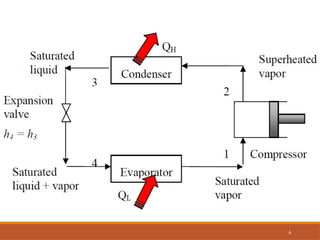
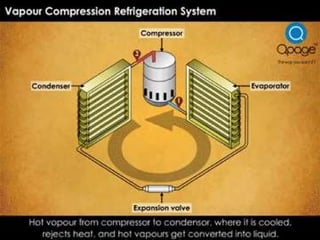
Main components are;
◦ Compressor
◦ Condenser
◦ Expansion Devices
◦ Evaporator
6
7
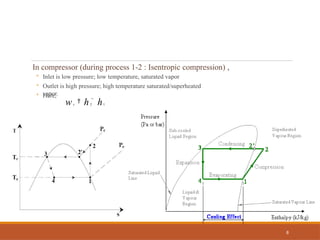
In compressor (during process 1-2 : Isentropic compression) ,
◦ Inlet is low pressure; low temperature, saturated vapor
◦ Outlet is high pressure; high temperature saturated/superheated
vapor.
◦ Here,
wc
 h2
 h1
8
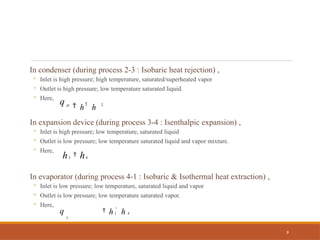
In condenser (during process 2-3 : Isobaric heat rejection) ,
◦ Inlet is high pressure; high temperature, saturated/superheated vapor
◦ Outlet is high pressure; low temperature saturated liquid.
◦ Here,
9
In expansion device (during process 3-4 : Isenthalpic expansion) ,
◦ Inlet is high pressure; low temperature, saturated liquid
◦ Outlet is low pressure; low temperature saturated liquid and vapor mixture.
◦ Here,
q H 3 2
 h  h
3 4
h  h
In evaporator (during process 4-1 : Isobaric & Isothermal heat extraction) ,
◦ Inlet is low pressure; low temperature, saturated liquid and vapor
◦ Outlet is low pressure; low temperature saturated vapor.
◦ Here,
q  h 1
 h 4
L
Different Vapor Compression Refrigeration
System
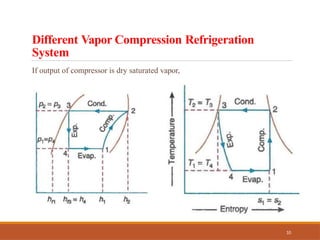
If output of compressor is dry saturated vapor,
10
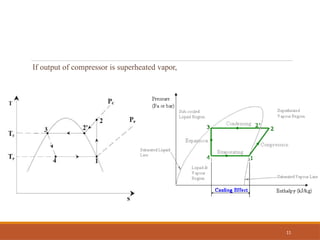
If output of compressor is superheated vapor,
11
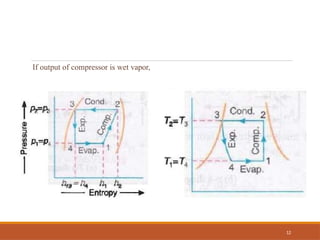
If output of compressor is wet vapor,
12
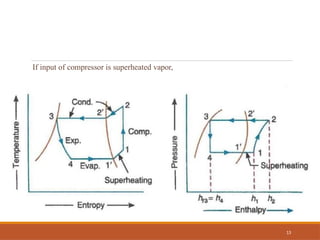
If input of compressor is superheated vapor,
13
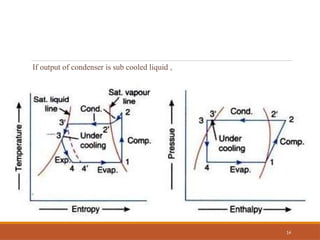
If output of condenser is sub cooled liquid ,
14
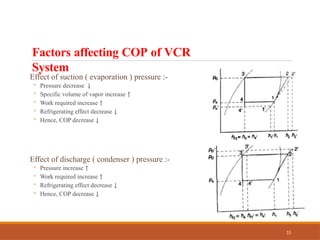
Factors affecting COP of VCR
System
Effect of suction ( evaporation ) pressure :-
◦ Pressure decrease ↓
◦ Specific volume of vapor increase ↑
◦ Work required increase ↑
◦ Refrigerating effect decrease ↓
◦ Hence, COP decrease ↓
Effect of discharge ( condenser ) pressure :-
◦ Pressure increase ↑
◦ Work required increase ↑
◦ Refrigerating effect decrease ↓
◦ Hence, COP decrease ↓
15
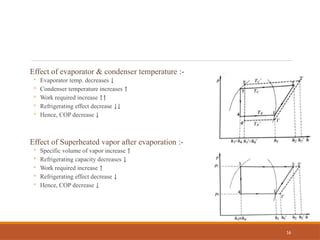
Effect of evaporator & condenser temperature :-
◦ Evaporator temp. decreases ↓
◦ Condenser temperature increases ↑
◦ Work required increase ↑↑
◦ Refrigerating effect decrease ↓↓
◦ Hence, COP decrease ↓
Effect of Superheated vapor after evaporation :-
◦ Specific volume of vapor increase ↑
◦ Refrigerating capacity decreases ↓
◦ Work required increase ↑
◦ Refrigerating effect decrease ↓
◦ Hence, COP decrease ↓
16
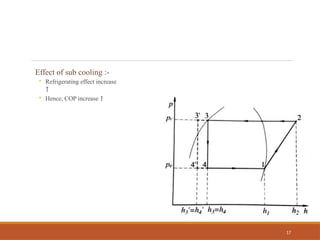
Effect of sub cooling :-
◦ Refrigerating effect increase
↑
◦ Hence, COP increase ↑
17
Advantages
18
Smaller size for capacity of refrigeration
Less running cost.
Large range of temperatures available.
High COP.
Less complex in design & operation.
Disadvantages
19
High initial cost.
Leakage of refrigerant.

Refrigeartion - Refrigeration and Heat Pump Systems

  • 1.
    REFRIGERATION & AIR CONDITIONING SIMPLEVAPOR COMPRESSION REFRIGERATION SYSTEM 1
  • 2.
    Outlin e  What aVapor Compression Refrigeration System is ?  Why its needed ?  Mechanism of Simple Vapor Compression Refrigeration System  Different Vapor Compression Refrigeration System  Factors affecting COP of Vapor Compression Refrigeration System  Advantages  Disadvantages 2
  • 3.
    What a VCRSystem is ? 3 Its improved refrigeration cycle which uses fluid instead of air as working substance. These systems belong to the general class of vapor cycles, wherein the working refrigerant undergoes phase change at least during one process. The working substance is circulated in the system in which it alternatively evaporates and condenses; thus it undergoes a phase change. Refrigeration is obtained as the refrigerant evaporates at low temperatures. The input to the system is in the form of mechanical energy required to run the compressor. Hence these systems are also called as mechanical refrigeration systems.
  • 4.
    Why its needed ? 4 InCarnot refrigeration system, ◦ Isothermal heat rejection process requires slow piston movement ◦ Reversible adiabatic ( Isentropic ) process requires faster piston movements Above both are not possible. For generating maximum possible COP, Carnot cycle can be referred as an ideal. Also, working substance; air/gas is only compressible whereas vapor is compressible as well as it can change phase during different process. Phase change of fluid during evaporation process requires large amount of heat, hence if temperature of fluid is reduced then refrigeration effect can be increased. Also, isothermal vaporization allows extraction of heat without raising temperature of fluid very high.
  • 5.
    Mechanism of Simple VCRS 5 Assumptionsfor ideal vapor-compression cycle are ; ◦ Irreversibility within the evaporator, condenser and compressor are ignored ◦ no frictional pressure drops ◦ refrigerant flows at constant pressure through the two heat exchangers (evaporator and condenser) ◦ heat losses to the surroundings are ignored ◦ compression process is isentropic Main components are; ◦ Compressor ◦ Condenser ◦ Expansion Devices ◦ Evaporator
  • 6.
  • 7.
  • 8.
    In compressor (duringprocess 1-2 : Isentropic compression) , ◦ Inlet is low pressure; low temperature, saturated vapor ◦ Outlet is high pressure; high temperature saturated/superheated vapor. ◦ Here, wc  h2  h1 8
  • 9.
    In condenser (duringprocess 2-3 : Isobaric heat rejection) , ◦ Inlet is high pressure; high temperature, saturated/superheated vapor ◦ Outlet is high pressure; low temperature saturated liquid. ◦ Here, 9 In expansion device (during process 3-4 : Isenthalpic expansion) , ◦ Inlet is high pressure; low temperature, saturated liquid ◦ Outlet is low pressure; low temperature saturated liquid and vapor mixture. ◦ Here, q H 3 2  h  h 3 4 h  h In evaporator (during process 4-1 : Isobaric & Isothermal heat extraction) , ◦ Inlet is low pressure; low temperature, saturated liquid and vapor ◦ Outlet is low pressure; low temperature saturated vapor. ◦ Here, q  h 1  h 4 L
  • 10.
    Different Vapor CompressionRefrigeration System If output of compressor is dry saturated vapor, 10
  • 11.
    If output ofcompressor is superheated vapor, 11
  • 12.
    If output ofcompressor is wet vapor, 12
  • 13.
    If input ofcompressor is superheated vapor, 13
  • 14.
    If output ofcondenser is sub cooled liquid , 14
  • 15.
    Factors affecting COPof VCR System Effect of suction ( evaporation ) pressure :- ◦ Pressure decrease ↓ ◦ Specific volume of vapor increase ↑ ◦ Work required increase ↑ ◦ Refrigerating effect decrease ↓ ◦ Hence, COP decrease ↓ Effect of discharge ( condenser ) pressure :- ◦ Pressure increase ↑ ◦ Work required increase ↑ ◦ Refrigerating effect decrease ↓ ◦ Hence, COP decrease ↓ 15
  • 16.
    Effect of evaporator& condenser temperature :- ◦ Evaporator temp. decreases ↓ ◦ Condenser temperature increases ↑ ◦ Work required increase ↑↑ ◦ Refrigerating effect decrease ↓↓ ◦ Hence, COP decrease ↓ Effect of Superheated vapor after evaporation :- ◦ Specific volume of vapor increase ↑ ◦ Refrigerating capacity decreases ↓ ◦ Work required increase ↑ ◦ Refrigerating effect decrease ↓ ◦ Hence, COP decrease ↓ 16
  • 17.
    Effect of subcooling :- ◦ Refrigerating effect increase ↑ ◦ Hence, COP increase ↑ 17
  • 18.
    Advantages 18 Smaller size forcapacity of refrigeration Less running cost. Large range of temperatures available. High COP. Less complex in design & operation.
  • 19.