Refrigerant compressors
Akshay Kr Mishra- 100106039
Sharda University
4TH YR. MECHANICAL
What is a refrigerant compressor?
• A machine that is used to compress the vapor
refrigerant from the evaporator and to raise
its pressure so that the corresponding
saturation temperature is higher than that of
cooling medium.
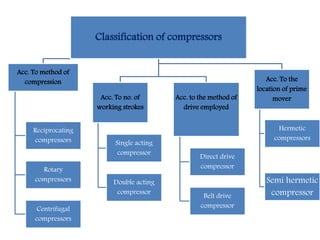
Classification of compressors
Acc. To method of
compression
Reciprocating
compressors
Rotary
compressors
Centrifugal
compressors
Acc. To no. of
working strokes
Single acting
compressor
Double acting
compressor
Acc. to the method of
drive employed
Direct drive
compressor
Belt drive
compressor
Acc. To the
location of prime
mover
Hermetic
compressors
Semi hermetic
compressor
Reciprocating Compressors
• A reciprocating
compressor or piston
compressor is a positive-
displacement compressor that
uses pistons driven by
a crankshaft to deliver gases at
high pressure.
• Applications include oil
refineries, gas
pipelines, chemical
plants, and refrigeration plants.
• Compressors 1-50 HP are
reciprocating.
Rotary Compressors
• Rotary compressors are positive displacement compressors.
• They are commonly used to replace piston compressors
where large volumes of high pressure air are needed,
either for large industrial applications or to operate high-
power air tools such as jackhammers.
• Rotary screw compressors use two meshing helical screws,
known as rotors, to compress the gas.
• Gas enters at the suction side and moves through the
threads as the screws rotate. The meshing rotors force the
gas through the compressor, and the gas exits at the end of
the screws.
Applications :
Typically, they are used to supply compressed
air for general industrial applications. Trailer
mounted diesel powered units are often seen at
construction sites, and are used to power air
operated construction machinery.
Centrifugal Compressors
• It is a dynamic High Speed
compressor which depends on transfer
of energy from a rotating impeller to
the air.
• They achieve a pressure rise by
adding kinetic energy/velocity to a
continuous flow of fluid through the
rotor or impeller. This kinetic energy is
then converted to an increase
in potential energy/static pressure by
slowing the flow through a diffuse
• These types of compressors are also
designed for higher capacity because
flow through the compressor is
continuous.
Direct Drive Compressors
• A direct drive compressor is an
compressor that can be hooked
right to a product that needs
air without having to fill an air
tank first.
• They are also usually self
lubricating which means that
no oil is usually required.
• They tend to draw low
amperage and can handle
pressures around 110psi.
• provide compactness and
minimum drive maintenance.
Compressors can be flange
mounted or direct-coupled to
the power source.
.
Belt Drive compressors
• They are most commonly
used with electric motors
and internal combustion
engines.
• V-Belt drives provide
great flexibility in
matching compressor
load to power source
load and speed at
minimum cost. Belts
must be properly
shielded for safety.
Advantages & Disadvantages for Belt Drive
• Advantages:
1. Belt drives are easier to install.
2. Absorb minor misalignments.
3. Relatively cheaper than direct drives.
Disadvantages:
1. Induces higher loads on compressor bearings and support system. Reduces life
by approx. 6-8 times.
2. May need additional drive supports to handle bending loads.
3. Requires relatively more frequent checks and maintenance.
4. Has lower transmission efficiencies.
• P.S. For direct drives just flip the pros & cons for the belt drives. Realistically, belt
drives are used for relatively smaller units and lower HPs, while direct drives are
used for larger units and higher HPs.
Hermetic compressors
• A hermetic or sealed compressor is one
in which both compressor and motor
are confined in a single outer welded
steel shell.
• The motor and compressor are directly
coupled on the same shaft, with the
motor inside the refrigeration circuit.
Thus the need for a shaft seal with the
consequent refrigerant leakage
problem was eliminated.
• Hermetic compressors are ideal for
small refrigeration systems, where
continuous maintenance (replenishing
refrigerant and oil charge etc) cannot
be ensured. Hence they are widely
used in domestic refrigerators, room
air conditioners etc.
• With reference to the above figure, One can see
the cooper windings inside the outer shell and
also the refrigerant connections (copper pipes).
• Since, the motor is in the refrigerant circuit, the
efficiency of hermetic compressor based systems
is lower as the heat dissipated by the motor and
compressor becomes a part of the system load.
• Since the complete system is kept in a welded
steel shell, the hermetic compressors are not
meant for servicing. A variation of hermetic
compressor is a semi-hermetic compressor, in
which the bolted construction offers limited
serviceability.
Advantages and Disadvantages
Advantages:
1. Leakage of refrigerant removed
2. Less noisy and compact.
3. Lubrication is simple as the motor and
compressor operate in a sealed space with the
lubricating oil.
Disadvantages:
1. Maintenance is not easy coz the moving parts
are inaccessible.
2. A separate pump is reqd. for evacuation and
charging of refrigerant.
Semi Hermetic compressors
• A semi hermetic compressor is a sealed
mechanical device that is used to regulate gas
pressure by varying the volume of the gas.
• The way a semi hermetic compressor works is
that a motor is energized by current then in
turn rotates a crankshaft, during the down
stroke, a piston creates low pressure between
the cylinder head and the piston and during the
upstroke the compressed gas force a high
pressure on the outside system.
Advantages
• Due to the semi-hermetic design such compressors are very compact and
occupy less space compared to open type machines thus saving expensive
building and plant room costs.
• The foot print and weight of a semi-hermetic machine is 70% of that of the
corresponding open type machine. These compressors are hence easier to
handle and do not require heavy foundations like open type machines.
• The common problem of refrigerant leakage through the shaft seal is not
face with the semi-hermetic compressor because the motor is directly
mounted on the compressor crankshaft.
• Semi-hermetic compressors do not require any pulleys and belts and have
no alignment problems and no wear and tear problem of the d rive
elements.
• Such compressors are also quieter and produce less vibration compared to
the open type. This reason alone makes them the ideal choice for roof-top
applications.
Thank you

Refrigerant compressors

  • 1.
    Refrigerant compressors Akshay KrMishra- 100106039 Sharda University 4TH YR. MECHANICAL
  • 2.
    What is arefrigerant compressor? • A machine that is used to compress the vapor refrigerant from the evaporator and to raise its pressure so that the corresponding saturation temperature is higher than that of cooling medium.
  • 3.
    Classification of compressors Acc.To method of compression Reciprocating compressors Rotary compressors Centrifugal compressors Acc. To no. of working strokes Single acting compressor Double acting compressor Acc. to the method of drive employed Direct drive compressor Belt drive compressor Acc. To the location of prime mover Hermetic compressors Semi hermetic compressor
  • 4.
    Reciprocating Compressors • Areciprocating compressor or piston compressor is a positive- displacement compressor that uses pistons driven by a crankshaft to deliver gases at high pressure. • Applications include oil refineries, gas pipelines, chemical plants, and refrigeration plants. • Compressors 1-50 HP are reciprocating.
  • 5.
    Rotary Compressors • Rotarycompressors are positive displacement compressors. • They are commonly used to replace piston compressors where large volumes of high pressure air are needed, either for large industrial applications or to operate high- power air tools such as jackhammers. • Rotary screw compressors use two meshing helical screws, known as rotors, to compress the gas. • Gas enters at the suction side and moves through the threads as the screws rotate. The meshing rotors force the gas through the compressor, and the gas exits at the end of the screws.
  • 6.
    Applications : Typically, theyare used to supply compressed air for general industrial applications. Trailer mounted diesel powered units are often seen at construction sites, and are used to power air operated construction machinery.
  • 7.
    Centrifugal Compressors • Itis a dynamic High Speed compressor which depends on transfer of energy from a rotating impeller to the air. • They achieve a pressure rise by adding kinetic energy/velocity to a continuous flow of fluid through the rotor or impeller. This kinetic energy is then converted to an increase in potential energy/static pressure by slowing the flow through a diffuse • These types of compressors are also designed for higher capacity because flow through the compressor is continuous.
  • 8.
    Direct Drive Compressors •A direct drive compressor is an compressor that can be hooked right to a product that needs air without having to fill an air tank first. • They are also usually self lubricating which means that no oil is usually required. • They tend to draw low amperage and can handle pressures around 110psi. • provide compactness and minimum drive maintenance. Compressors can be flange mounted or direct-coupled to the power source. .
  • 9.
    Belt Drive compressors •They are most commonly used with electric motors and internal combustion engines. • V-Belt drives provide great flexibility in matching compressor load to power source load and speed at minimum cost. Belts must be properly shielded for safety.
  • 10.
    Advantages & Disadvantagesfor Belt Drive • Advantages: 1. Belt drives are easier to install. 2. Absorb minor misalignments. 3. Relatively cheaper than direct drives. Disadvantages: 1. Induces higher loads on compressor bearings and support system. Reduces life by approx. 6-8 times. 2. May need additional drive supports to handle bending loads. 3. Requires relatively more frequent checks and maintenance. 4. Has lower transmission efficiencies. • P.S. For direct drives just flip the pros & cons for the belt drives. Realistically, belt drives are used for relatively smaller units and lower HPs, while direct drives are used for larger units and higher HPs.
  • 11.
    Hermetic compressors • Ahermetic or sealed compressor is one in which both compressor and motor are confined in a single outer welded steel shell. • The motor and compressor are directly coupled on the same shaft, with the motor inside the refrigeration circuit. Thus the need for a shaft seal with the consequent refrigerant leakage problem was eliminated. • Hermetic compressors are ideal for small refrigeration systems, where continuous maintenance (replenishing refrigerant and oil charge etc) cannot be ensured. Hence they are widely used in domestic refrigerators, room air conditioners etc.
  • 12.
    • With referenceto the above figure, One can see the cooper windings inside the outer shell and also the refrigerant connections (copper pipes). • Since, the motor is in the refrigerant circuit, the efficiency of hermetic compressor based systems is lower as the heat dissipated by the motor and compressor becomes a part of the system load. • Since the complete system is kept in a welded steel shell, the hermetic compressors are not meant for servicing. A variation of hermetic compressor is a semi-hermetic compressor, in which the bolted construction offers limited serviceability.
  • 13.
    Advantages and Disadvantages Advantages: 1.Leakage of refrigerant removed 2. Less noisy and compact. 3. Lubrication is simple as the motor and compressor operate in a sealed space with the lubricating oil. Disadvantages: 1. Maintenance is not easy coz the moving parts are inaccessible. 2. A separate pump is reqd. for evacuation and charging of refrigerant.
  • 14.
    Semi Hermetic compressors •A semi hermetic compressor is a sealed mechanical device that is used to regulate gas pressure by varying the volume of the gas. • The way a semi hermetic compressor works is that a motor is energized by current then in turn rotates a crankshaft, during the down stroke, a piston creates low pressure between the cylinder head and the piston and during the upstroke the compressed gas force a high pressure on the outside system.
  • 15.
    Advantages • Due tothe semi-hermetic design such compressors are very compact and occupy less space compared to open type machines thus saving expensive building and plant room costs. • The foot print and weight of a semi-hermetic machine is 70% of that of the corresponding open type machine. These compressors are hence easier to handle and do not require heavy foundations like open type machines. • The common problem of refrigerant leakage through the shaft seal is not face with the semi-hermetic compressor because the motor is directly mounted on the compressor crankshaft. • Semi-hermetic compressors do not require any pulleys and belts and have no alignment problems and no wear and tear problem of the d rive elements. • Such compressors are also quieter and produce less vibration compared to the open type. This reason alone makes them the ideal choice for roof-top applications.
  • 16.