Welcome To
Heating, Ventilation, Air Conditioning
and Refrigeration Engineering
• Topic : Thermal Design of Refrigeration System
Components
Evaporators
PROF. R.S. KOLHE
ME (HEAT POWER)
BE (MECHANICAL)
Evaporators
• The evaporator is an important device used in the low pressure side of a
refrigeration system.
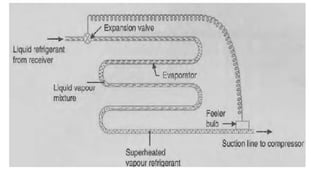
• The liquid refrigerant from the expansion valve enters into the evaporator
where it boils and changes into vapour.
• The function of an evaporator is to absorb heat from the surrounding location
or medium which is to be cooled, by means of a refrigerant.
• The temperature of the boiling refrigerant in the evaporator must always be
less than that of the surrounding medium so that the heat flows to the
refrigerant.
• The evaporator becomes cold and remains cold due to the following two
reasons :
1. The temperature of the evaporator coil is low due to the low temperature of
the refrigerant inside the coil.
2. The low temperature of the refrigerant remains unchanged because any heat it
absorbs is converted to latent heat as boiling proceeds
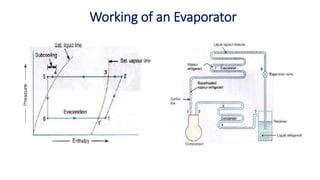
Working of an Evaporator
Factors Affecting the Heat Transfer Capacity of an
Evaporator
1. Material.
2. Temperature difference
3. Velocity of refrigerant
4. Thickness of the evaporator coil wall.
5. Contact surface area.
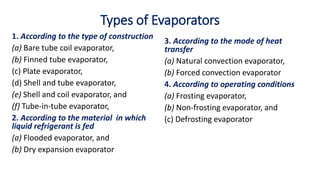
Types of Evaporators
1. According to the type of construction
(a) Bare tube coil evaporator,
(b) Finned tube evaporator,
(c) Plate evaporator,
(d) Shell and tube evaporator,
(e) Shell and coil evaporator, and
(f) Tube-in-tube evaporator,
2. According to the material in which
liquid refrigerant is fed
(a) Flooded evaporator, and
(b) Dry expansion evaporator
3. According to the mode of heat
transfer
(a) Natural convection evaporator,
(b) Forced convection evaporator
4. According to operating conditions
(a) Frosting evaporator,
(b) Non-frosting evaporator, and
(c) Defrosting evaporator
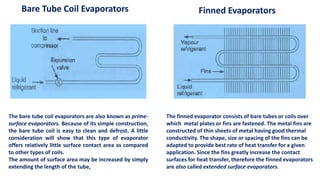
Bare Tube Coil Evaporators
The bare tube coil evaporators are also known as prime-
surface evaporators. Because of its simple construction,
the bare tube coil is easy to clean and defrost. A little
consideration will show that this type of evaporator
offers relatively little surface contact area as compared
to other types of coils.
The amount of surface area may be increased by simply
extending the length of the tube,
Finned Evaporators
The finned evaporator consists of bare tubes or coils over
which metal plates or fins are fastened. The metal fins are
constructed of thin sheets of metal having good thermal
conductivity. The shape, size or spacing of the fins can be
adapted to provide best rate of heat transfer for a given
application. Since the fins greatly increase the contact
surfaces for heat transfer, therefore the finned evaporators
are also called extended surface evaporators.
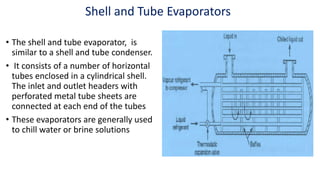
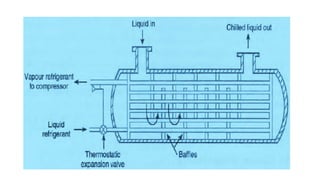
Shell and Tube Evaporators
• The shell and tube evaporator, is
similar to a shell and tube condenser.
• It consists of a number of horizontal
tubes enclosed in a cylindrical shell.
The inlet and outlet headers with
perforated metal tube sheets are
connected at each end of the tubes
• These evaporators are generally used
to chill water or brine solutions
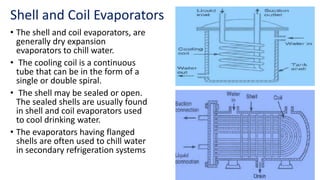
Shell and Coil Evaporators
• The shell and coil evaporators, are
generally dry expansion
evaporators to chill water.
• The cooling coil is a continuous
tube that can be in the form of a
single or double spiral.
• The shell may be sealed or open.
The sealed shells are usually found
in shell and coil evaporators used
to cool drinking water.
• The evaporators having flanged
shells are often used to chill water
in secondary refrigeration systems
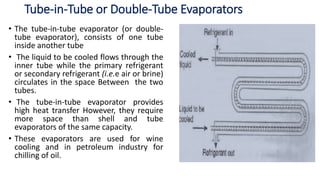
Tube-in-Tube or Double-Tube Evaporators
• The tube-in-tube evaporator (or double-
tube evaporator), consists of one tube
inside another tube
• The liquid to be cooled flows through the
inner tube while the primary refrigerant
or secondary refrigerant (i.e.e air or brine)
circulates in the space Between the two
tubes.
• The tube-in-tube evaporator provides
high heat transfer However, they require
more space than shell and tube
evaporators of the same capacity.
• These evaporators are used for wine
cooling and in petroleum industry for
chilling of oil.
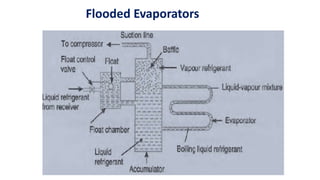
Flooded Evaporators
• The advantage of the flooded evaporator is that the whole surface of the
evaporator coil is in contact with the liquid refrigerant under all the load
conditions. Thus, it gives high heat transfer rates (i.e. more efficient
cooling) than a dry expansion evaporator of the same size.
• However, the flooded evaporator is more expensive to operate because it
requires more refrigerant charge.
• The flooded evaporators have many industrial applications, especially in
the chemical and food processing industries.
• These evaporators used in comfort and process air cooling installations
may be of the bare coil type or finned type. Another type of the flooded
evaporator is the plate evaporator which is found in cold storage boxes and
freezers.
Dry expansion evaporator
• In dry expansion evaporators, the liquid refrigerant from the receiver is fed by
the expansion valve to the evaporator coil.
• The expansion valve controls the rate of flow of liquid refrigerant in such a way
that all the liquid refrigerant is vaporized by the time it reaches at the end of the
evaporator coils or the suction line to the compressor.
• The vapour is also superheated to a limited extent. It may be noted that in a dry
expansion system, the refrigerant does not recirculate within the evaporator as
in flooded type evaporator.
• The rate at which the liquid refrigerant is fed to the evaporator generally
depends upon the rate of vaporisation and increases or decreases as the load
on the evaporator increases or decreases
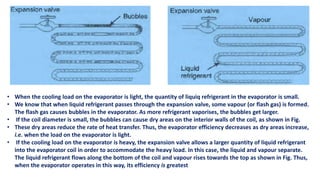
• When the cooling load on the evaporator is light, the quantity of liquiq refrigerant in the evaporator is small.
• We know that when liquid refrigerant passes through the expansion valve, some vapour (or flash gas) is formed.
The flash gas causes bubbles in the evaporator. As more refrigerant vaporises, the bubbles get larger.
• If the coil diameter is small, the bubbles can cause dry areas on the interior walls of the coil, as shown in Fig.
• These dry areas reduce the rate of heat transfer. Thus, the evaporator efficiency decreases as dry areas increase,
i.e. when the load on the evaporator is light.
• If the cooling load on the evaporator is heavy, the expansion valve allows a larger quantity of liquid refrigerant
into the evaporator coil in order to accommodate the heavy load. In this case, the liquid and vapour separate.
The liquid refrigerant flows along the bottom of the coil and vapour rises towards the top as shown in Fig. Thus,
when the evaporator operates in this way, its efficiency is greatest
References
1) REFRIGERATION AND AIR CONDITIONING BY R.S.KHURMI
Have a Good Day
21

Evaporators: Types and Numerical Solutions

  • 1.
    Welcome To Heating, Ventilation,Air Conditioning and Refrigeration Engineering • Topic : Thermal Design of Refrigeration System Components Evaporators PROF. R.S. KOLHE ME (HEAT POWER) BE (MECHANICAL)
  • 2.
    Evaporators • The evaporatoris an important device used in the low pressure side of a refrigeration system. • The liquid refrigerant from the expansion valve enters into the evaporator where it boils and changes into vapour. • The function of an evaporator is to absorb heat from the surrounding location or medium which is to be cooled, by means of a refrigerant. • The temperature of the boiling refrigerant in the evaporator must always be less than that of the surrounding medium so that the heat flows to the refrigerant. • The evaporator becomes cold and remains cold due to the following two reasons : 1. The temperature of the evaporator coil is low due to the low temperature of the refrigerant inside the coil. 2. The low temperature of the refrigerant remains unchanged because any heat it absorbs is converted to latent heat as boiling proceeds
  • 3.
    Working of anEvaporator
  • 4.
    Factors Affecting theHeat Transfer Capacity of an Evaporator 1. Material. 2. Temperature difference 3. Velocity of refrigerant 4. Thickness of the evaporator coil wall. 5. Contact surface area.
  • 5.
    Types of Evaporators 1.According to the type of construction (a) Bare tube coil evaporator, (b) Finned tube evaporator, (c) Plate evaporator, (d) Shell and tube evaporator, (e) Shell and coil evaporator, and (f) Tube-in-tube evaporator, 2. According to the material in which liquid refrigerant is fed (a) Flooded evaporator, and (b) Dry expansion evaporator 3. According to the mode of heat transfer (a) Natural convection evaporator, (b) Forced convection evaporator 4. According to operating conditions (a) Frosting evaporator, (b) Non-frosting evaporator, and (c) Defrosting evaporator
  • 6.
    Bare Tube CoilEvaporators The bare tube coil evaporators are also known as prime- surface evaporators. Because of its simple construction, the bare tube coil is easy to clean and defrost. A little consideration will show that this type of evaporator offers relatively little surface contact area as compared to other types of coils. The amount of surface area may be increased by simply extending the length of the tube, Finned Evaporators The finned evaporator consists of bare tubes or coils over which metal plates or fins are fastened. The metal fins are constructed of thin sheets of metal having good thermal conductivity. The shape, size or spacing of the fins can be adapted to provide best rate of heat transfer for a given application. Since the fins greatly increase the contact surfaces for heat transfer, therefore the finned evaporators are also called extended surface evaporators.
  • 7.
    Shell and TubeEvaporators • The shell and tube evaporator, is similar to a shell and tube condenser. • It consists of a number of horizontal tubes enclosed in a cylindrical shell. The inlet and outlet headers with perforated metal tube sheets are connected at each end of the tubes • These evaporators are generally used to chill water or brine solutions
  • 8.
    Shell and CoilEvaporators • The shell and coil evaporators, are generally dry expansion evaporators to chill water. • The cooling coil is a continuous tube that can be in the form of a single or double spiral. • The shell may be sealed or open. The sealed shells are usually found in shell and coil evaporators used to cool drinking water. • The evaporators having flanged shells are often used to chill water in secondary refrigeration systems
  • 9.
    Tube-in-Tube or Double-TubeEvaporators • The tube-in-tube evaporator (or double- tube evaporator), consists of one tube inside another tube • The liquid to be cooled flows through the inner tube while the primary refrigerant or secondary refrigerant (i.e.e air or brine) circulates in the space Between the two tubes. • The tube-in-tube evaporator provides high heat transfer However, they require more space than shell and tube evaporators of the same capacity. • These evaporators are used for wine cooling and in petroleum industry for chilling of oil.
  • 10.
  • 11.
    • The advantageof the flooded evaporator is that the whole surface of the evaporator coil is in contact with the liquid refrigerant under all the load conditions. Thus, it gives high heat transfer rates (i.e. more efficient cooling) than a dry expansion evaporator of the same size. • However, the flooded evaporator is more expensive to operate because it requires more refrigerant charge. • The flooded evaporators have many industrial applications, especially in the chemical and food processing industries. • These evaporators used in comfort and process air cooling installations may be of the bare coil type or finned type. Another type of the flooded evaporator is the plate evaporator which is found in cold storage boxes and freezers.
  • 12.
    Dry expansion evaporator •In dry expansion evaporators, the liquid refrigerant from the receiver is fed by the expansion valve to the evaporator coil. • The expansion valve controls the rate of flow of liquid refrigerant in such a way that all the liquid refrigerant is vaporized by the time it reaches at the end of the evaporator coils or the suction line to the compressor. • The vapour is also superheated to a limited extent. It may be noted that in a dry expansion system, the refrigerant does not recirculate within the evaporator as in flooded type evaporator. • The rate at which the liquid refrigerant is fed to the evaporator generally depends upon the rate of vaporisation and increases or decreases as the load on the evaporator increases or decreases
  • 14.
    • When thecooling load on the evaporator is light, the quantity of liquiq refrigerant in the evaporator is small. • We know that when liquid refrigerant passes through the expansion valve, some vapour (or flash gas) is formed. The flash gas causes bubbles in the evaporator. As more refrigerant vaporises, the bubbles get larger. • If the coil diameter is small, the bubbles can cause dry areas on the interior walls of the coil, as shown in Fig. • These dry areas reduce the rate of heat transfer. Thus, the evaporator efficiency decreases as dry areas increase, i.e. when the load on the evaporator is light. • If the cooling load on the evaporator is heavy, the expansion valve allows a larger quantity of liquid refrigerant into the evaporator coil in order to accommodate the heavy load. In this case, the liquid and vapour separate. The liquid refrigerant flows along the bottom of the coil and vapour rises towards the top as shown in Fig. Thus, when the evaporator operates in this way, its efficiency is greatest
  • 20.
    References 1) REFRIGERATION ANDAIR CONDITIONING BY R.S.KHURMI
  • 21.