Department of Mechanical Engineering
ME 322 – Mechanical Engineering
Thermodynamics
Lecture 29
The Vapor Compression Refrigeration
(VCR) Cycle
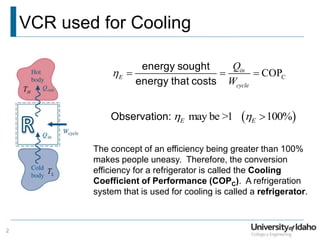
VCR used for Cooling
C
COP
in
E
cycle
Q
W
   
energy sought
energy that costs
The concept of an efficiency being greater than 100%
makes people uneasy. Therefore, the conversion
efficiency for a refrigerator is called the Cooling
Coefficient of Performance (COPC). A refrigeration
system that is used for cooling is called a refrigerator.
Observation:  
may be >1 100%
E E
  
H
T
L
T
2
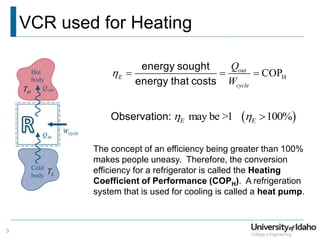
VCR used for Heating
H
COP
out
E
cycle
Q
W
   
energy sought
energy that costs
The concept of an efficiency being greater than 100%
makes people uneasy. Therefore, the conversion
efficiency for a refrigerator is called the Heating
Coefficient of Performance (COPH). A refrigeration
system that is used for cooling is called a heat pump.
Observation:  
may be >1 100%
E E
  
H
T
L
T
3
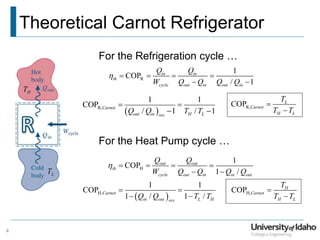
Theoretical Carnot Refrigerator
R
1
COP
/ 1
in in
th
cycle out in out in
Q Q
W Q Q Q Q
    
 
For the Refrigeration cycle …
 
H
H, H,
1
COP
1 /
1 1
COP COP
1 / 1 /
out out
th
cycle out in in out
H
Carnot Carnot
in out L H H L
rev
Q Q
W Q Q Q Q
T
Q Q T T T T
    
 
  
  
For the Heat Pump cycle …
H
T
L
T
 
R,
1 1
COP
/ 1 / 1
Carnot
out in H L
rev
Q Q T T
 
 
R,
COP L
Carnot
H L
T
T T


4
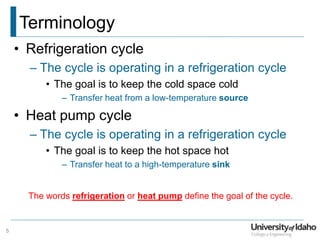
Terminology
• Refrigeration cycle
– The cycle is operating in a refrigeration cycle
• The goal is to keep the cold space cold
– Transfer heat from a low-temperature source
• Heat pump cycle
– The cycle is operating in a refrigeration cycle
• The goal is to keep the hot space hot
– Transfer heat to a high-temperature sink
The words refrigeration or heat pump define the goal of the cycle.
5
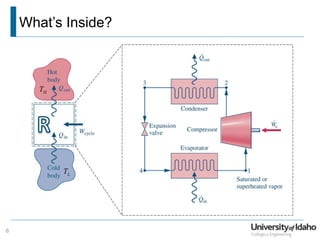
What’s Inside?
6
H
T
L
T
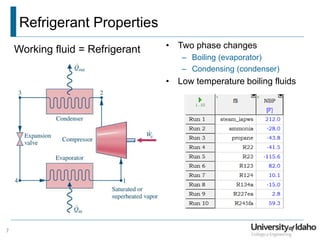
Refrigerant Properties
• Two phase changes
– Boiling (evaporator)
– Condensing (condenser)
• Low temperature boiling fluids
Working fluid = Refrigerant
7
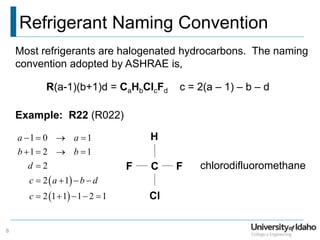
Refrigerant Naming Convention
Most refrigerants are halogenated hydrocarbons. The naming
convention adopted by ASHRAE is,
R(a-1)(b+1)d = CaHbClcFd c = 2(a – 1) – b – d
 
 
1 0 1
1 2 1
2
2 1
2 1 1 1 2 1
a a
b b
d
c a b d
c
   
   

   
    
Example: R22 (R022)
C
H
F
Cl
F chlorodifluoromethane
8
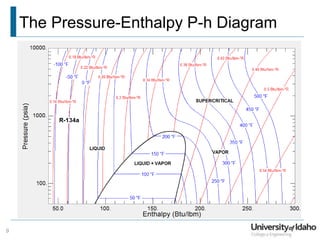
The Pressure-Enthalpy P-h Diagram
9
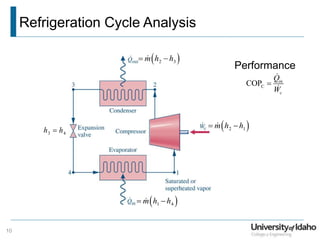
Refrigeration Cycle Analysis
 
2 1
m h h
 
 
2 3
m h h
 
 
1 4
m h h
 
3 4
h h

Performance
C
COP in
c
Q
W

10
P
h
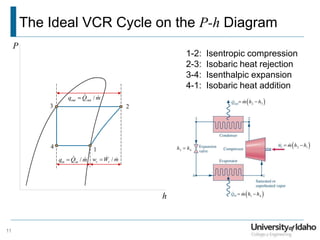
The Ideal VCR Cycle on the P-h Diagram
 
2 1
m h h
 
 
2 3
m h h
 
 
1 4
m h h
 
3 4
h h

1
2
3
4
1-2: Isentropic compression
2-3: Isobaric heat rejection
3-4: Isenthalpic expansion
4-1: Isobaric heat addition
/
in in
q Q m
 /
c c
w W m

/
out out
q Q m

11
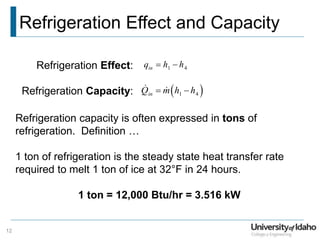
Refrigeration Effect and Capacity
1 4
in
q h h
 
Refrigeration Effect:
Refrigeration Capacity:  
1 4
in
Q m h h
 
Refrigeration capacity is often expressed in tons of
refrigeration. Definition …
1 ton of refrigeration is the steady state heat transfer rate
required to melt 1 ton of ice at 32°F in 24 hours.
1 ton = 12,000 Btu/hr = 3.516 kW
12
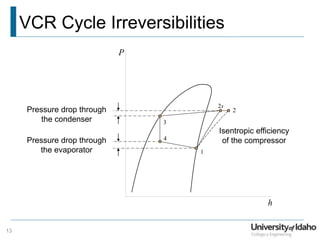
VCR Cycle Irreversibilities
P
h
1
2
2s
3
4
Isentropic efficiency
of the compressor
Pressure drop through
the condenser
Pressure drop through
the evaporator
13
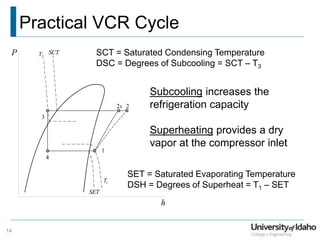
Practical VCR Cycle
P
h
1
2
2s
3
4
3
T SCT
1
T
SET
SCT = Saturated Condensing Temperature
DSC = Degrees of Subcooling = SCT – T3
SET = Saturated Evaporating Temperature
DSH = Degrees of Superheat = T1 – SET
Subcooling increases the
refrigeration capacity
Superheating provides a dry
vapor at the compressor inlet
14

L29 - Vapor Compression Refrigeration.pptx

  • 1.
    Department of MechanicalEngineering ME 322 – Mechanical Engineering Thermodynamics Lecture 29 The Vapor Compression Refrigeration (VCR) Cycle
  • 2.
    VCR used forCooling C COP in E cycle Q W     energy sought energy that costs The concept of an efficiency being greater than 100% makes people uneasy. Therefore, the conversion efficiency for a refrigerator is called the Cooling Coefficient of Performance (COPC). A refrigeration system that is used for cooling is called a refrigerator. Observation:   may be >1 100% E E    H T L T 2
  • 3.
    VCR used forHeating H COP out E cycle Q W     energy sought energy that costs The concept of an efficiency being greater than 100% makes people uneasy. Therefore, the conversion efficiency for a refrigerator is called the Heating Coefficient of Performance (COPH). A refrigeration system that is used for cooling is called a heat pump. Observation:   may be >1 100% E E    H T L T 3
  • 4.
    Theoretical Carnot Refrigerator R 1 COP /1 in in th cycle out in out in Q Q W Q Q Q Q        For the Refrigeration cycle …   H H, H, 1 COP 1 / 1 1 COP COP 1 / 1 / out out th cycle out in in out H Carnot Carnot in out L H H L rev Q Q W Q Q Q Q T Q Q T T T T              For the Heat Pump cycle … H T L T   R, 1 1 COP / 1 / 1 Carnot out in H L rev Q Q T T     R, COP L Carnot H L T T T   4
  • 5.
    Terminology • Refrigeration cycle –The cycle is operating in a refrigeration cycle • The goal is to keep the cold space cold – Transfer heat from a low-temperature source • Heat pump cycle – The cycle is operating in a refrigeration cycle • The goal is to keep the hot space hot – Transfer heat to a high-temperature sink The words refrigeration or heat pump define the goal of the cycle. 5
  • 6.
  • 7.
    Refrigerant Properties • Twophase changes – Boiling (evaporator) – Condensing (condenser) • Low temperature boiling fluids Working fluid = Refrigerant 7
  • 8.
    Refrigerant Naming Convention Mostrefrigerants are halogenated hydrocarbons. The naming convention adopted by ASHRAE is, R(a-1)(b+1)d = CaHbClcFd c = 2(a – 1) – b – d     1 0 1 1 2 1 2 2 1 2 1 1 1 2 1 a a b b d c a b d c                   Example: R22 (R022) C H F Cl F chlorodifluoromethane 8
  • 9.
  • 10.
    Refrigeration Cycle Analysis  2 1 m h h     2 3 m h h     1 4 m h h   3 4 h h  Performance C COP in c Q W  10
  • 11.
    P h The Ideal VCRCycle on the P-h Diagram   2 1 m h h     2 3 m h h     1 4 m h h   3 4 h h  1 2 3 4 1-2: Isentropic compression 2-3: Isobaric heat rejection 3-4: Isenthalpic expansion 4-1: Isobaric heat addition / in in q Q m  / c c w W m  / out out q Q m  11
  • 12.
    Refrigeration Effect andCapacity 1 4 in q h h   Refrigeration Effect: Refrigeration Capacity:   1 4 in Q m h h   Refrigeration capacity is often expressed in tons of refrigeration. Definition … 1 ton of refrigeration is the steady state heat transfer rate required to melt 1 ton of ice at 32°F in 24 hours. 1 ton = 12,000 Btu/hr = 3.516 kW 12
  • 13.
    VCR Cycle Irreversibilities P h 1 2 2s 3 4 Isentropicefficiency of the compressor Pressure drop through the condenser Pressure drop through the evaporator 13
  • 14.
    Practical VCR Cycle P h 1 2 2s 3 4 3 TSCT 1 T SET SCT = Saturated Condensing Temperature DSC = Degrees of Subcooling = SCT – T3 SET = Saturated Evaporating Temperature DSH = Degrees of Superheat = T1 – SET Subcooling increases the refrigeration capacity Superheating provides a dry vapor at the compressor inlet 14