Unit-2: Simple Vapour
Compression Refrigeration Cycle
Prepared By:
Ankur Sachdeva
Assistant Professor, ME
Introduction to VCRS
• As mentioned in the previous chapter, in a typical gas
cycle, the working fluid (a gas) does not undergo phase
change, consequently the operating cycle will be away
from the vapour dome.
• In gas cycles, heat rejection and refrigeration take place
as the gas undergoes sensible cooling and heating.
• In a vapour cycle the working fluid undergoes phase
change and refrigeration effect is due to the
vaporization of refrigerant liquid.
• If the refrigerant is a pure substance then its
temperature remains constant during the phase
change processes
Ankur Sachdeva, Assistant Professor, ME
Introduction to VCRS
• Vapour compression refrigeration systems are the most
commonly used among all refrigeration systems.
• As the name implies, these systems belong to the general
class of vapour cycles, wherein the working fluid
(refrigerant) undergoes phase change at least during one
process.
• In a vapour compression refrigeration system, refrigeration
is obtained as the refrigerant evaporates at low
temperatures.
• The input to the system is in the form of mechanical
energy required to run the compressor.
• Hence these systems are also called as mechanical
refrigeration systems.
Ankur Sachdeva, Assistant Professor, ME
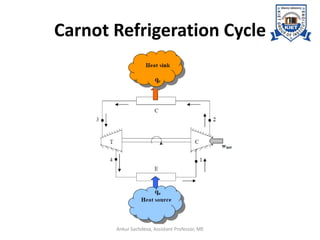
Carnot Refrigeration Cycle
Ankur Sachdeva, Assistant Professor, ME
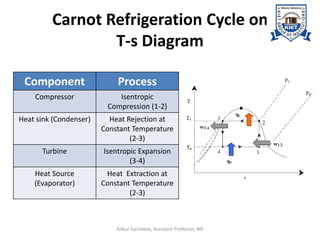
Carnot Refrigeration Cycle on
T-s Diagram
Component Process
Compressor Isentropic
Compression (1-2)
Heat sink (Condenser) Heat Rejection at
Constant Temperature
(2-3)
Turbine Isentropic Expansion
(3-4)
Heat Source
(Evaporator)
Heat Extraction at
Constant Temperature
(2-3)
Ankur Sachdeva, Assistant Professor, ME
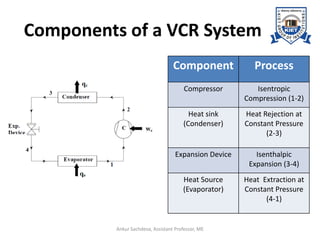
Components of a VCR System
Component Process
Compressor Isentropic
Compression (1-2)
Heat sink
(Condenser)
Heat Rejection at
Constant Pressure
(2-3)
Expansion Device Isenthalpic
Expansion (3-4)
Heat Source
(Evaporator)
Heat Extraction at
Constant Pressure
(4-1)
Ankur Sachdeva, Assistant Professor, ME
Low and High Pressure Sides
(VCR System)
Ankur Sachdeva, Assistant Professor, ME
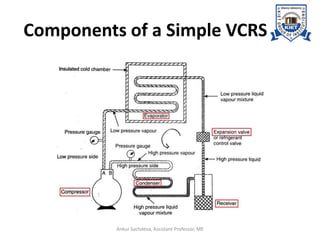
Components of a Simple VCRS
Ankur Sachdeva, Assistant Professor, ME
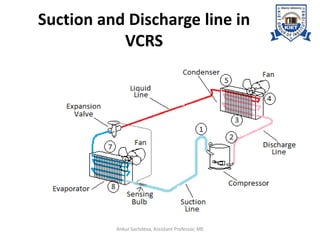
Suction and Discharge line in
VCRS
Ankur Sachdeva, Assistant Professor, ME
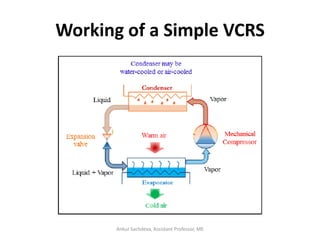
Working of a Simple VCRS
Ankur Sachdeva, Assistant Professor, ME
Pressure-Enthalpy (P-h) chart
Ankur Sachdeva, Assistant Professor, ME
Simple VCRS on
Pressure-Enthalpy Chart
Ankur Sachdeva, Assistant Professor, ME
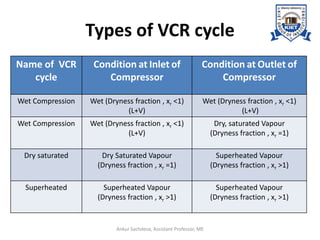
Types of VCR cycle
Name of VCR
cycle
Condition at Inlet of
Compressor
Condition at Outlet of
Compressor
Wet Compression Wet (Dryness fraction , xr <1)
(L+V)
Wet (Dryness fraction , xr <1)
(L+V)
Wet Compression Wet (Dryness fraction , xr <1)
(L+V)
Dry, saturated Vapour
(Dryness fraction , xr =1)
Dry saturated Dry Saturated Vapour
(Dryness fraction , xr =1)
Superheated Vapour
(Dryness fraction , xr >1)
Superheated Superheated Vapour
(Dryness fraction , xr >1)
Superheated Vapour
(Dryness fraction , xr >1)
Ankur Sachdeva, Assistant Professor, ME
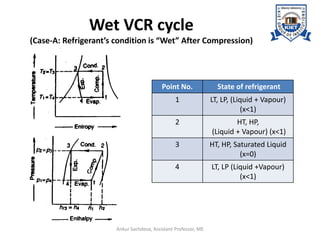
Wet VCR cycle
(Case-A: Refrigerant’s condition is “Wet” After Compression)
Point No. State of refrigerant
1 LT, LP, (Liquid + Vapour)
(x<1)
2 HT, HP,
(Liquid + Vapour) (x<1)
3 HT, HP, Saturated Liquid
(x=0)
4 LT, LP (Liquid +Vapour)
(x<1)
Ankur Sachdeva, Assistant Professor, ME
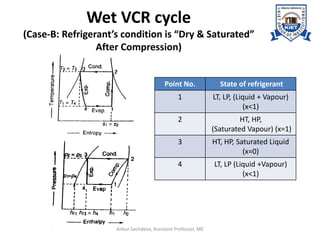
Wet VCR cycle
(Case-B: Refrigerant’s condition is “Dry & Saturated”
After Compression)
Point No. State of refrigerant
1 LT, LP, (Liquid + Vapour)
(x<1)
2 HT, HP,
(Saturated Vapour) (x=1)
3 HT, HP, Saturated Liquid
(x=0)
4 LT, LP (Liquid +Vapour)
(x<1)
Ankur Sachdeva, Assistant Professor, ME
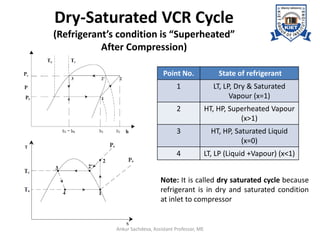
Dry-Saturated VCR Cycle
(Refrigerant’s condition is “Superheated”
After Compression)
Point No. State of refrigerant
1 LT, LP, Dry & Saturated
Vapour (x=1)
2 HT, HP, Superheated Vapour
(x>1)
3 HT, HP, Saturated Liquid
(x=0)
4 LT, LP (Liquid +Vapour) (x<1)
Note: It is called dry saturated cycle because
refrigerant is in dry and saturated condition
at inlet to compressor
Ankur Sachdeva, Assistant Professor, ME
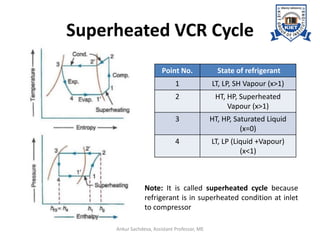
Superheated VCR Cycle
Point No. State of refrigerant
1 LT, LP, SH Vapour (x>1)
2 HT, HP, Superheated
Vapour (x>1)
3 HT, HP, Saturated Liquid
(x=0)
4 LT, LP (Liquid +Vapour)
(x<1)
Note: It is called superheated cycle because
refrigerant is in superheated condition at inlet
to compressor
Ankur Sachdeva, Assistant Professor, ME
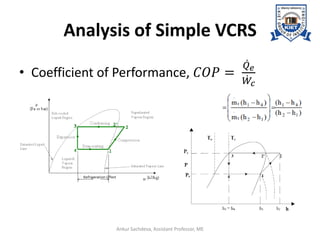
Analysis of Simple VCRS
Ankur Sachdeva, Assistant Professor, ME
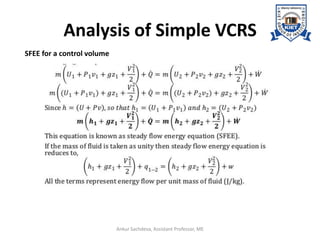
SFEE for a control volume
Analysis of Simple VCRS
• Compressor
– Neglecting the changes in K.E and P.E., Q = 0
• Work done by compressor (kW)
• Condenser
• Neglecting the changes in K.E and P.E., W = 0
– Heat Rejected in condenser
Ankur Sachdeva, Assistant Professor, ME
Analysis of Simple VCRS
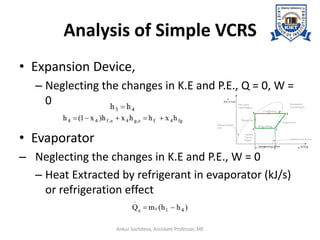
• Expansion Device,
– Neglecting the changes in K.E and P.E., Q = 0, W =
0
• Evaporator
– Neglecting the changes in K.E and P.E., W = 0
– Heat Extracted by refrigerant in evaporator (kJ/s)
or refrigeration effect
Ankur Sachdeva, Assistant Professor, ME
Analysis of Simple VCRS
• Coefficient of Performance, 𝐶𝑂𝑃 =
𝑄𝑒
𝑊𝑐
Ankur Sachdeva, Assistant Professor, ME
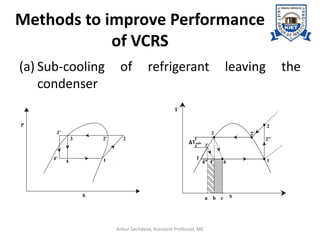
Methods to improve Performance
of VCRS
(a) Sub-cooling of refrigerant leaving the
condenser
Ankur Sachdeva, Assistant Professor, ME
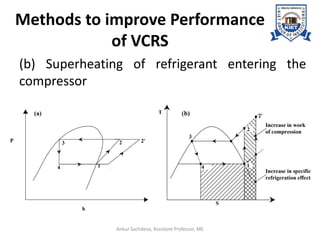
Methods to improve Performance
of VCRS
(b) Superheating of refrigerant entering the
compressor
Ankur Sachdeva, Assistant Professor, ME
Liquid-Suction Heat Exchanger
(LSHX)
Ankur Sachdeva, Assistant Professor, ME
Liquid-Suction Heat
Exchanger (LSHX)
Ankur Sachdeva, Assistant Professor, ME
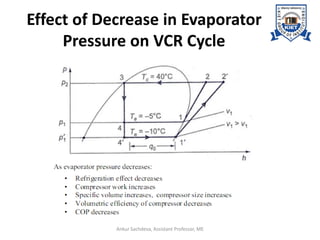
Effect of Decrease in Evaporator
Pressure on VCR Cycle
Ankur Sachdeva, Assistant Professor, ME
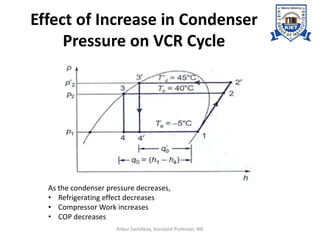
Effect of Increase in Condenser
Pressure on VCR Cycle
Ankur Sachdeva, Assistant Professor, ME
As the condenser pressure decreases,
• Refrigerating effect decreases
• Compressor Work increases
• COP decreases
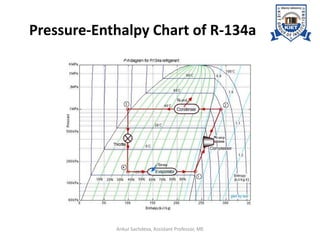
Pressure-Enthalpy Chart of R-134a
Ankur Sachdeva, Assistant Professor, ME
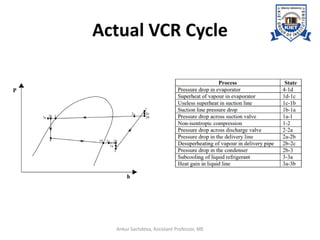
Actual VCR Cycle
Ankur Sachdeva, Assistant Professor, ME
Actual VCR Cycle
Ankur Sachdeva, Assistant Professor, ME

Performance Enhancement of a simple VCR Cycle

  • 1.
    Unit-2: Simple Vapour CompressionRefrigeration Cycle Prepared By: Ankur Sachdeva Assistant Professor, ME
  • 2.
    Introduction to VCRS •As mentioned in the previous chapter, in a typical gas cycle, the working fluid (a gas) does not undergo phase change, consequently the operating cycle will be away from the vapour dome. • In gas cycles, heat rejection and refrigeration take place as the gas undergoes sensible cooling and heating. • In a vapour cycle the working fluid undergoes phase change and refrigeration effect is due to the vaporization of refrigerant liquid. • If the refrigerant is a pure substance then its temperature remains constant during the phase change processes Ankur Sachdeva, Assistant Professor, ME
  • 3.
    Introduction to VCRS •Vapour compression refrigeration systems are the most commonly used among all refrigeration systems. • As the name implies, these systems belong to the general class of vapour cycles, wherein the working fluid (refrigerant) undergoes phase change at least during one process. • In a vapour compression refrigeration system, refrigeration is obtained as the refrigerant evaporates at low temperatures. • The input to the system is in the form of mechanical energy required to run the compressor. • Hence these systems are also called as mechanical refrigeration systems. Ankur Sachdeva, Assistant Professor, ME
  • 4.
    Carnot Refrigeration Cycle AnkurSachdeva, Assistant Professor, ME
  • 5.
    Carnot Refrigeration Cycleon T-s Diagram Component Process Compressor Isentropic Compression (1-2) Heat sink (Condenser) Heat Rejection at Constant Temperature (2-3) Turbine Isentropic Expansion (3-4) Heat Source (Evaporator) Heat Extraction at Constant Temperature (2-3) Ankur Sachdeva, Assistant Professor, ME
  • 6.
    Components of aVCR System Component Process Compressor Isentropic Compression (1-2) Heat sink (Condenser) Heat Rejection at Constant Pressure (2-3) Expansion Device Isenthalpic Expansion (3-4) Heat Source (Evaporator) Heat Extraction at Constant Pressure (4-1) Ankur Sachdeva, Assistant Professor, ME
  • 7.
    Low and HighPressure Sides (VCR System) Ankur Sachdeva, Assistant Professor, ME
  • 8.
    Components of aSimple VCRS Ankur Sachdeva, Assistant Professor, ME
  • 9.
    Suction and Dischargeline in VCRS Ankur Sachdeva, Assistant Professor, ME
  • 10.
    Working of aSimple VCRS Ankur Sachdeva, Assistant Professor, ME
  • 11.
    Pressure-Enthalpy (P-h) chart AnkurSachdeva, Assistant Professor, ME
  • 12.
    Simple VCRS on Pressure-EnthalpyChart Ankur Sachdeva, Assistant Professor, ME
  • 13.
    Types of VCRcycle Name of VCR cycle Condition at Inlet of Compressor Condition at Outlet of Compressor Wet Compression Wet (Dryness fraction , xr <1) (L+V) Wet (Dryness fraction , xr <1) (L+V) Wet Compression Wet (Dryness fraction , xr <1) (L+V) Dry, saturated Vapour (Dryness fraction , xr =1) Dry saturated Dry Saturated Vapour (Dryness fraction , xr =1) Superheated Vapour (Dryness fraction , xr >1) Superheated Superheated Vapour (Dryness fraction , xr >1) Superheated Vapour (Dryness fraction , xr >1) Ankur Sachdeva, Assistant Professor, ME
  • 14.
    Wet VCR cycle (Case-A:Refrigerant’s condition is “Wet” After Compression) Point No. State of refrigerant 1 LT, LP, (Liquid + Vapour) (x<1) 2 HT, HP, (Liquid + Vapour) (x<1) 3 HT, HP, Saturated Liquid (x=0) 4 LT, LP (Liquid +Vapour) (x<1) Ankur Sachdeva, Assistant Professor, ME
  • 15.
    Wet VCR cycle (Case-B:Refrigerant’s condition is “Dry & Saturated” After Compression) Point No. State of refrigerant 1 LT, LP, (Liquid + Vapour) (x<1) 2 HT, HP, (Saturated Vapour) (x=1) 3 HT, HP, Saturated Liquid (x=0) 4 LT, LP (Liquid +Vapour) (x<1) Ankur Sachdeva, Assistant Professor, ME
  • 16.
    Dry-Saturated VCR Cycle (Refrigerant’scondition is “Superheated” After Compression) Point No. State of refrigerant 1 LT, LP, Dry & Saturated Vapour (x=1) 2 HT, HP, Superheated Vapour (x>1) 3 HT, HP, Saturated Liquid (x=0) 4 LT, LP (Liquid +Vapour) (x<1) Note: It is called dry saturated cycle because refrigerant is in dry and saturated condition at inlet to compressor Ankur Sachdeva, Assistant Professor, ME
  • 17.
    Superheated VCR Cycle PointNo. State of refrigerant 1 LT, LP, SH Vapour (x>1) 2 HT, HP, Superheated Vapour (x>1) 3 HT, HP, Saturated Liquid (x=0) 4 LT, LP (Liquid +Vapour) (x<1) Note: It is called superheated cycle because refrigerant is in superheated condition at inlet to compressor Ankur Sachdeva, Assistant Professor, ME
  • 18.
    Analysis of SimpleVCRS Ankur Sachdeva, Assistant Professor, ME SFEE for a control volume
  • 19.
    Analysis of SimpleVCRS • Compressor – Neglecting the changes in K.E and P.E., Q = 0 • Work done by compressor (kW) • Condenser • Neglecting the changes in K.E and P.E., W = 0 – Heat Rejected in condenser Ankur Sachdeva, Assistant Professor, ME
  • 20.
    Analysis of SimpleVCRS • Expansion Device, – Neglecting the changes in K.E and P.E., Q = 0, W = 0 • Evaporator – Neglecting the changes in K.E and P.E., W = 0 – Heat Extracted by refrigerant in evaporator (kJ/s) or refrigeration effect Ankur Sachdeva, Assistant Professor, ME
  • 21.
    Analysis of SimpleVCRS • Coefficient of Performance, 𝐶𝑂𝑃 = 𝑄𝑒 𝑊𝑐 Ankur Sachdeva, Assistant Professor, ME
  • 22.
    Methods to improvePerformance of VCRS (a) Sub-cooling of refrigerant leaving the condenser Ankur Sachdeva, Assistant Professor, ME
  • 23.
    Methods to improvePerformance of VCRS (b) Superheating of refrigerant entering the compressor Ankur Sachdeva, Assistant Professor, ME
  • 24.
    Liquid-Suction Heat Exchanger (LSHX) AnkurSachdeva, Assistant Professor, ME
  • 25.
    Liquid-Suction Heat Exchanger (LSHX) AnkurSachdeva, Assistant Professor, ME
  • 26.
    Effect of Decreasein Evaporator Pressure on VCR Cycle Ankur Sachdeva, Assistant Professor, ME
  • 27.
    Effect of Increasein Condenser Pressure on VCR Cycle Ankur Sachdeva, Assistant Professor, ME As the condenser pressure decreases, • Refrigerating effect decreases • Compressor Work increases • COP decreases
  • 28.
    Pressure-Enthalpy Chart ofR-134a Ankur Sachdeva, Assistant Professor, ME
  • 29.
    Actual VCR Cycle AnkurSachdeva, Assistant Professor, ME
  • 30.
    Actual VCR Cycle AnkurSachdeva, Assistant Professor, ME