VAPOUR COMPRESSION CYCLE
R & AC
Hashim Hasnain Hadi
13ME36
6TH Semester
B.E Mechanical
Prepared By :-
OBJECTIVES:
 Introduction of refrigeration
 Strengthen the knowledge about refrigeration
cycles
 Study the basics of an ideal refrigeration cycle
VAPOR-COMPRESSION REFRIGERATION CYCLE
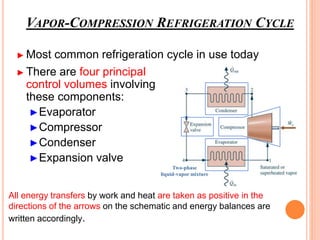
► There are four principal
control volumes involving
these components:
►Evaporator
►Compressor
►Condenser
►Expansion valve
► Most common refrigeration cycle in use today
All energy transfers by work and heat are taken as positive in the
directions of the arrows on the schematic and energy balances are
written accordingly.
Two-phase
liquid-vapor mixture
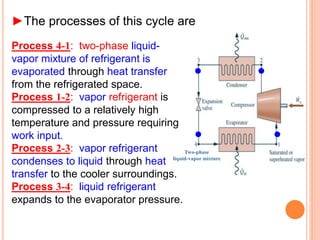
Process 4-1: two-phase liquid-
vapor mixture of refrigerant is
evaporated through heat transfer
from the refrigerated space.
Process 1-2: vapor refrigerant is
compressed to a relatively high
temperature and pressure requiring
work input.
Process 2-3: vapor refrigerant
condenses to liquid through heat
transfer to the cooler surroundings.
Process 3-4: liquid refrigerant
expands to the evaporator pressure.
►The processes of this cycle are
Two-phase
liquid-vapor mixture
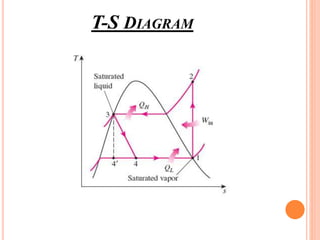
T-S DIAGRAM
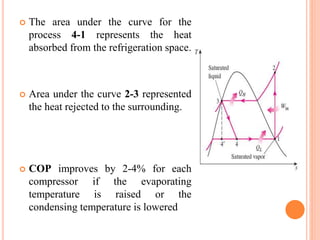
 The area under the curve for the
process 4-1 represents the heat
absorbed from the refrigeration space.
 Area under the curve 2-3 represented
the heat rejected to the surrounding.
 COP improves by 2-4% for each
compressor if the evaporating
temperature is raised or the
condensing temperature is lowered
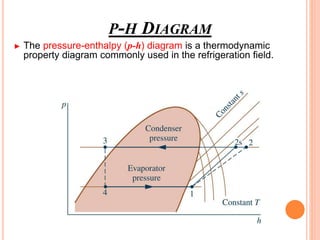
P-H DIAGRAM
► The pressure-enthalpy (p-h) diagram is a thermodynamic
property diagram commonly used in the refrigeration field.
vapour compression cycle

vapour compression cycle

  • 2.
    VAPOUR COMPRESSION CYCLE R& AC Hashim Hasnain Hadi 13ME36 6TH Semester B.E Mechanical Prepared By :-
  • 3.
    OBJECTIVES:  Introduction ofrefrigeration  Strengthen the knowledge about refrigeration cycles  Study the basics of an ideal refrigeration cycle
  • 4.
    VAPOR-COMPRESSION REFRIGERATION CYCLE ►There are four principal control volumes involving these components: ►Evaporator ►Compressor ►Condenser ►Expansion valve ► Most common refrigeration cycle in use today All energy transfers by work and heat are taken as positive in the directions of the arrows on the schematic and energy balances are written accordingly. Two-phase liquid-vapor mixture
  • 5.
    Process 4-1: two-phaseliquid- vapor mixture of refrigerant is evaporated through heat transfer from the refrigerated space. Process 1-2: vapor refrigerant is compressed to a relatively high temperature and pressure requiring work input. Process 2-3: vapor refrigerant condenses to liquid through heat transfer to the cooler surroundings. Process 3-4: liquid refrigerant expands to the evaporator pressure. ►The processes of this cycle are Two-phase liquid-vapor mixture
  • 6.
  • 7.
     The areaunder the curve for the process 4-1 represents the heat absorbed from the refrigeration space.  Area under the curve 2-3 represented the heat rejected to the surrounding.  COP improves by 2-4% for each compressor if the evaporating temperature is raised or the condensing temperature is lowered
  • 8.
    P-H DIAGRAM ► Thepressure-enthalpy (p-h) diagram is a thermodynamic property diagram commonly used in the refrigeration field.

Editor's Notes