This document presents a study on the design and experimental investigation of a lab-based vapor compression refrigeration system using R-134a as refrigerant. It discusses the system's main components, working principles, and results from calculations involving different lengths of capillary tubes, highlighting the coefficient of performance for each setup. The findings suggest that the system is simple to maintain and suitable for educational purposes in mechanical engineering.
![International Journal of Trend in Scientific Research and Development (IJTSRD)
Volume 3 Issue 6, October 2019 Available Online: www.ijtsrd.com e-ISSN: 2456 – 6470
@ IJTSRD | Unique Paper ID – IJTSRD29213 | Volume – 3 | Issue – 6 | September - October 2019 Page 693
Design Calculation of Lab Based Vapour Compression System
Ko Ko1, Khin Maung Than1, Aye Aye San2
1Assistant Lecturer, Mechanical Department, Technological University, Meiktila, Myanmar
2Lecturer, EI Department, Myanmar Aerospace Engineering University, Meiktila, Myanmar
ABSTRACT
This paper deals with experimental investigationtocalculatethevalueofmain
components of vapor compression refrigeration system and experimental
results by using three different length of the capillary tube. At present, there
are many types of refrigeration systems but the most widely used is vapor
compression refrigeration system. This system is mainly used in air-
conditioning in buildings, electronic materials, automobile air-conditioners,
freezers, household refrigerators and even in supermarkets. This lab based
refrigeration system is used R-134a because it canbe replacedsuccessfullyfor
R-12 refrigerant and useful for many applications now. Moreover, it can be
handling safely and has no damage effect to ozone layer.
KEYWORDS: main components, capillarytube, refrigerationsystems, R-134a, R-12
How to cite this paper: Ko Ko | Khin
Maung Than | Aye Aye San "Design
Calculation of Lab Based Vapour
Compression
System" Published
in International
Journal of Trend in
Scientific Research
and Development
(ijtsrd), ISSN: 2456-
6470, Volume-3 |
Issue-6, October 2019, pp.693-696, URL:
https://www.ijtsrd.com/papers/ijtsrd29
213.pdf
Copyright © 2019 by author(s) and
International Journal of Trend in
Scientific Research and Development
Journal. This is an Open Access article
distributed under
the terms of the
Creative Commons
Attribution License (CC BY 4.0)
(http://creativecommons.org/licenses/b
y/4.0)
1. INTRODUCTION
Refrigeration means the process of removing heat from a
space to another by reducing the temperature undercontrol
condition. In this process, refrigerant is used. There are
many refrigeration systems which are used for various
applications.Amongthem,vapourcompressionrefrigeration
system (VCRS) is one of the most important of refrigeration
system and now used for all general purposes of
refrigeration such as industrial purposesespeciallyforsmall
domestic and commercial applications [1]. Some of the
advantages of VCRS are:
A. Size is small.
B. Running cost is low.
C. Refrigeration temperature can get easily as
D. required.
E. COP is high.
But one of the drawbacks of VCRS is that its initial cost is
high. VCRS consists mainly of four components. They are
compressor, condenser, evaporator and expansion device.
Each of these components should:
A. Adapt to the application
B. Be the right size for the work
C. Function as needed with other components [2].
2. TYPE OF REFRIGERATION SYSTEMS
Refrigeration effect can be achieved by direct or indirect
contact of the cooling with a cooling medium such as ice.
Based on the working principle, common types of
refrigeration systems are:
Vapor Compression refrigeration
Vapor absorption refrigeration
Gas throttling refrigeration
Steam jet refrigeration
Vortex tube refrigeration
Thermo acoustic refrigeration
Magnetic refrigeration
Liquefaction of natural gases [3].
3. MAIN COMPONENTS OF VAPOR COMPRESSION
REFRIGERATION SYSTEM
For this lab based refrigerationsystem,fourtypesofessential
components are; compressor, condenser, evaporator and
expansion device or metering device.
Figure1. Mechanism of Simple Vapor Compression
Refrigeration System
IJTSRD29213](https://image.slidesharecdn.com/122designcalculationoflabbasedvapourcompressionsystem-191120092030/85/Design-Calculation-of-Lab-Based-Vapour-Compression-System-1-320.jpg)
![International Journal of Trend in Scientific Research and Development (IJTSRD)
Volume 3 Issue 6, October 2019 Available Online: www.ijtsrd.com e-ISSN: 2456 – 6470
@ IJTSRD | Unique Paper ID – IJTSRD29213 | Volume – 3 | Issue – 6 | September - October 2019 Page 693
Design Calculation of Lab Based Vapour Compression System
Ko Ko1, Khin Maung Than1, Aye Aye San2
1Assistant Lecturer, Mechanical Department, Technological University, Meiktila, Myanmar
2Lecturer, EI Department, Myanmar Aerospace Engineering University, Meiktila, Myanmar
ABSTRACT
This paper deals with experimental investigationtocalculatethevalueofmain
components of vapor compression refrigeration system and experimental
results by using three different length of the capillary tube. At present, there
are many types of refrigeration systems but the most widely used is vapor
compression refrigeration system. This system is mainly used in air-
conditioning in buildings, electronic materials, automobile air-conditioners,
freezers, household refrigerators and even in supermarkets. This lab based
refrigeration system is used R-134a because it canbe replacedsuccessfullyfor
R-12 refrigerant and useful for many applications now. Moreover, it can be
handling safely and has no damage effect to ozone layer.
KEYWORDS: main components, capillarytube, refrigerationsystems, R-134a, R-12
How to cite this paper: Ko Ko | Khin
Maung Than | Aye Aye San "Design
Calculation of Lab Based Vapour
Compression
System" Published
in International
Journal of Trend in
Scientific Research
and Development
(ijtsrd), ISSN: 2456-
6470, Volume-3 |
Issue-6, October 2019, pp.693-696, URL:
https://www.ijtsrd.com/papers/ijtsrd29
213.pdf
Copyright © 2019 by author(s) and
International Journal of Trend in
Scientific Research and Development
Journal. This is an Open Access article
distributed under
the terms of the
Creative Commons
Attribution License (CC BY 4.0)
(http://creativecommons.org/licenses/b
y/4.0)
1. INTRODUCTION
Refrigeration means the process of removing heat from a
space to another by reducing the temperature undercontrol
condition. In this process, refrigerant is used. There are
many refrigeration systems which are used for various
applications.Amongthem,vapourcompressionrefrigeration
system (VCRS) is one of the most important of refrigeration
system and now used for all general purposes of
refrigeration such as industrial purposesespeciallyforsmall
domestic and commercial applications [1]. Some of the
advantages of VCRS are:
A. Size is small.
B. Running cost is low.
C. Refrigeration temperature can get easily as
D. required.
E. COP is high.
But one of the drawbacks of VCRS is that its initial cost is
high. VCRS consists mainly of four components. They are
compressor, condenser, evaporator and expansion device.
Each of these components should:
A. Adapt to the application
B. Be the right size for the work
C. Function as needed with other components [2].
2. TYPE OF REFRIGERATION SYSTEMS
Refrigeration effect can be achieved by direct or indirect
contact of the cooling with a cooling medium such as ice.
Based on the working principle, common types of
refrigeration systems are:
Vapor Compression refrigeration
Vapor absorption refrigeration
Gas throttling refrigeration
Steam jet refrigeration
Vortex tube refrigeration
Thermo acoustic refrigeration
Magnetic refrigeration
Liquefaction of natural gases [3].
3. MAIN COMPONENTS OF VAPOR COMPRESSION
REFRIGERATION SYSTEM
For this lab based refrigerationsystem,fourtypesofessential
components are; compressor, condenser, evaporator and
expansion device or metering device.
Figure1. Mechanism of Simple Vapor Compression
Refrigeration System
IJTSRD29213](https://image.slidesharecdn.com/122designcalculationoflabbasedvapourcompressionsystem-191120092030/75/Design-Calculation-of-Lab-Based-Vapour-Compression-System-1-2048.jpg)
![International Journal of Trend in Scientific Research and Development (IJTSRD) @ www.ijtsrd.com eISSN: 2456-6470
@ IJTSRD | Unique Paper ID – IJTSRD29213 | Volume – 3 | Issue – 6 | September - October 2019 Page 694
A. Compressor
The low pressure and temperature vapor refrigerant of the
evaporator is passed through an inlet valve to the
compressor where it is compressed at high temperatureand
high pressure. This high temperature and pressure
refrigerant is sent to the condenser through an outlet or
relief valve. In this experiment, hermetic type reciprocating
compressor is used because it has less noise and not need
much space.
B. Condenser
The condenser has copper tubes in which the vapor
refrigerant of high pressure and temperature is cooled.
Although the refrigerant passes through the condenser, it
releases the latent heat of water or air to the surrounding
condensation environment. Condenser must have good
airflow while operation is running.
C. Evaporator
It consists of tubing that vaporizes the low pressure, low
temperature liquid vapor coolant and converts it to low
pressure and low temperature refrigerant vapor. After
evaporation, the liquid coolant absorbs its latent heat of
vaporization of the cooling medium.
D. Expansion device
The purpose of the expansion device or throttle valve is to
allow the liquid refrigerant under high pressure and
temperature to pass at a controlled rate as its pressure and
temperature are reduced. When refrigerant has passed, it is
evaporated and the residue is vaporized in the evaporator at
low temperature and pressure [4,5].
4. WORKING PROCESS IN A VAPOR COMPRESSION
REFRIGERATION SYSTEM
In a vapor compression refrigeration system, there are four
major thermal processes taking place, namely; compression,
condensation, expansion and evaporation. In all practical
applications, VCRC is actually lower than the ideal cycle
because of several factors such as friction losses, heat
exchanges between parts of the system and pressure dropin
the suction and discharge lines.
4.1. Pressure-Enthalpy Diagram
Figure2. Pressure-Enthalpy Diagram for a Typical
Refrigeration Cycle
Process 1-2
At first, VCRS is start from the compressor. In accordance
with state point 1, the refrigerant in the form of a mixture of
liquid and vapor enters the compressor, where isentropic
compression is carried out. The compression process
increases the refrigerant temperature fromthelowerlimitto
the upper limit. Work is introduced into the system and after
compression the vapor becomes wet or saturated, but does
not superheated.
Process 2-3
In the form of vapor, the refrigerant enters the condenser at
state 2, and the heat is removedunderconstantpressureand
temperature. Once it exits the condenser, the refrigerant is
saturated with liquid at point 3.
Process 3-4
The refrigerant at point 3 of the state entering theexpansion
cylinder expands isentropically, and the temperature at the
end of the expansion process drops to be lower. The work is
obtained in the process of expansion.
Process 4-1
The liquid refrigerant in state point 4 removes heat at a
constant pressure and temperature from the space or
material that is introduced into the evaporator and cooled,
thereby producing a refrigeration effect [6].
4.2. Pressure-Entropy Diagram
Figure3. Pressure-Entropy Diagram for a Typical
Refrigeration Cycle
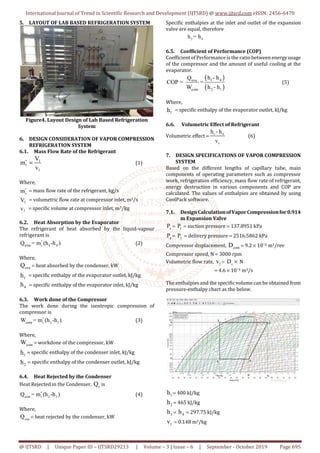
In the T-s diagram, QH and QL are heat flows and Win is the
work input to the compressor. The rate of work input to the
compressor is mainly the power required to operate the
refrigeration system. Power may be required to driveoneor
more fans, but the power is low compared to compressor
consumption. QH is the high temperature heat that the
condenser rejects to the surroundings. QL is the low
temperature heat absorbed from the space cooled by the
evaporator [7].](https://image.slidesharecdn.com/122designcalculationoflabbasedvapourcompressionsystem-191120092030/85/Design-Calculation-of-Lab-Based-Vapour-Compression-System-2-320.jpg)
![International Journal of Trend in Scientific Research and Development (IJTSRD) @ www.ijtsrd.com eISSN: 2456-6470
@ IJTSRD | Unique Paper ID – IJTSRD29213 | Volume – 3 | Issue – 6 | September - October 2019 Page 696
Table4.1 Result datas for capillary tube length 0.914 m
No. Description Symbols Values Units
1 Mass flow rate
•
r
m 0.003 Kg/s
2
Power input to the
compressor com
W 0.195 kW
3
Heat absorption
by the evaporator eva
Q 0.306 kW
4
Heat rejected by
the condenser con
Q 0.501 kW
5
Coefficient of
performance
COP 1.569 -
6 Volumetric effect - 690.878 kJ/m3
7.2. Design Calculation of Vapour Compression for
1.524 m Expansion Valve
a
P = 1
P = suction pressure = 96.5265 kPa
d
P = 2
P = delivery pressure = 2413.1648 kPa
The enthalpies and the specific volume can be obtained from
pressure – enthalpy chart as the below.
1h = 390.14 kJ/kg
2h = 464.875 kJ/kg
3h = 4h = 306.35 kJ/kg
1v = 0.22 m3/kg
Table 4.2 Result datas for capillary tube length 1.524 m
No. Description Symbols Values Units
1 Mass flow rate
•
r
m 0.002 Kg/s
2
Power input to the
compressor com
W 0.149 kW
3
Heat absorption by
the evaporator eva
Q 0.167 kW
4
Heat rejected by the
condenser con
Q 0.317 kW
5
Coefficient of
performance
COP 1.121 -
6 Volumetric effect - 380.864 kJ/m3
7.3. Design Calculation of Vapour Compression for
2.134 m of Expansion Valve
a
P = 1
P = suction pressure = 110.3157 kPa
d
P = 2
P = delivery pressure = 2585.5337 kPa
The enthalpies and the specific volume can be obtained from
pressure – enthalpy chart as the below.
1h = 396.705 kJ/kg
2h = 462.5 kJ/kg
3h = 4h = 287.5 kJ/kg
1v = 0.2 m3/kg
Table.3 Result datas for capillary tube length 2.134 m
No. Description Symbols Values Units
1 Mass flow rate
•
r
m 0.0023 Kg/s
2
Power input to the
compressor com
W 0.151 kW
3
Heat absorption by
the evaporator eva
Q 0.251 kW
4
Heat rejected by the
condenser con
Q 0.403 kW
5
Coefficient of
performance
COP 1.662 -
6 Volumetric effect - 546.02 kJ/m3
By the comparison of three result tables, the best coefficient
of performance is at capillary tube length of 0.914 m. The
operatingcondition is not good for morethanfifteenminutes
and the compressor does not operate suddenly. If the length
of the capillary tube is 2.134 m and the operating time is
more than thirty minutes, thesuctionpressureanddischarge
pressure are in an unsteady state. By the comparisonofthree
running condition, 2.134 m long of capillary tube is the best.
8. CONCLUSION
This lab based refrigeration system is simple and easy to
maintain. It can be used for laboratory experiments of basic
refrigeration processes and principles of each component. It
is fairly inexpensive so suitable for mechanical engineering
students. Other researcher should test this system with
different capacity of main components and refrigerants.
RRFERENCES
[1] http://www.engineering.myindialist.com/2009/vapor-
compression-refrigeration/ #.XYjRrX8VTIV
[2] A. R. Trott and T. Welch: "Refrigeration and Air-
Conditioning", Third Edition, (2000)
[3] Shan Wang: "Handbook of AirConditioning Systemand
Refrigeration", (2000)
[4] R. S. Khurmi and J. K. Gupta, "A Textbook of
Refrigeration and Air Conditioning", Revised Edition
[5] William C. Whitman, William M. Johnson, John A.
Tomczyk, Eugene Silberstein: "Refrigeration & Air
Conditioning Technology", Seventh Edition, (2013)
[6] https://www.brighthubengineering.com/hvac/35435-
principles-of-the-vapor-compression-refrigeration-
system/
[7] https://www.brighthubengineering.com/hvac/35435-
principles-of-the-vapor-compression-refrigeration-
system/](https://image.slidesharecdn.com/122designcalculationoflabbasedvapourcompressionsystem-191120092030/85/Design-Calculation-of-Lab-Based-Vapour-Compression-System-4-320.jpg)


