CAREER POINT UNIVE
MAJOR ASSIGNMENT
Vapours Compression Refrigeration Cycle
Table of Content
• Refrigeration
• Refrigerant
• Vapour compression cycle
• Effect
• Cop
• Merit
• Demerit
• Advantage
• By studying of research paper
Refrigeration
• Refrigeration is the process of producing of lower temperature
compare to the surrounding temperature to maintain the
lower temperature.
• For example : vapour compression cycle, vapour absorption
cycle, gas refrigeration cycle.
Refrigerant
• Refrigerant are the substance which are used for producing
lower temperature .for example ammonia,water,air,R-12,R-
22,R-134.
Refrigeration effect: It is the amount of heat which is to be
extracted from the storage space in order to maintain lower
temperature is called desire effect of refrigeration system.
V c cycle
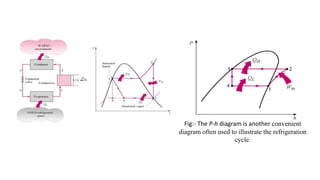
Vapour compression Refrigeration System:
There are four component in Vapour compression cycle.
1. Compressor:- Compresses the refrigerant to high pressure and temperature
from low pressure and temperature.
2. Condenser:- The latent heat of refrigerant is removed by circulating water or
atmospheric air.
3. Expansion Valve:- In the throttle valve where the pressure is reduced at a
controlled rate.
4. Evaporator:- A liquid-Vapour mixture refrigerant then enters the evaporator
at low pressure where the latent heat of evaporation is converted into vapour and
the cycle repeats.
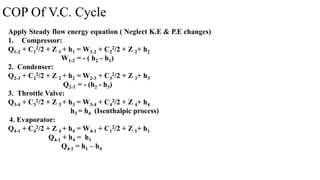
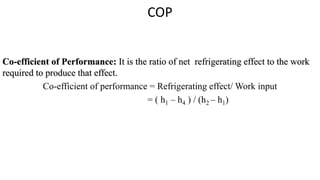
Fig:- The P-h diagram is another convenient
diagram often used to illustrate the refrigeration
cycle.
COP Of V.C. Cycle
Apply Steady flow energy equation ( Neglect K.E & P.E changes)
1. Compressor:
Q1-2 + C1
2/2 + Z 1 + h1 = W1-2 + C2
2/2 + Z 2+ h2
W1-2 = - ( h2 – h1)
2. Condenser:
Q2-3 + C2
2/2 + Z 2 + h2 = W2-3 + C3
2/2 + Z 3+ h3
Q2-3 = - (h2 - h3)
3. Throttle Valve:
Q3-4 + C3
2/2 + Z 3 + h3 = W3-4 + C4
2/2 + Z 4+ h4
h3 = h4 (Isenthalpic process)
4. Evaporator:
Q4-1 + C4
2/2 + Z 4 + h4 = W4-1 + C1
2/2 + Z 1+ h1
Q4-1 + h4 = h1
Q4-1 = h1 – h4
COP
Co-efficient of Performance: It is the ratio of net refrigerating effect to the work
required to produce that effect.
Co-efficient of performance = Refrigerating effect/ Work input
= ( h1 – h4 ) / (h2 – h1)
Effects of variation of properties on the performance
of Vapour compression cycle:
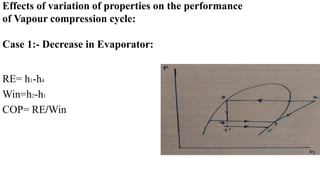
Case 1:- Decrease in Evaporator:
RE= h1-h4
Win=h2-h1
COP= RE/Win
Effect
Reduction in Refrigeration effects
Increase in work input
Decrease in COP
Decrease in volumetric efficiency due to increase in pressure
ratio.
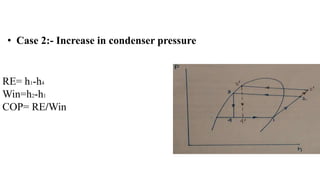
RE= h1-h4
Win=h2-h1
COP= RE/Win
• Case 2:- Increase in condenser pressure
Effect
Reduction in Refrigeration effects
Increase in work input
Decrease in COP
Decrease in volumetric efficiency due to increase in pressure
ratio.
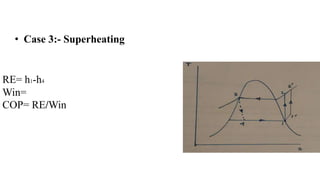
RE= h1-h4
Win=
COP= RE/Win
• Case 3:- Superheating
Effect
Increase in Refrigeration effect
Increase in work input due to temperature at the inlet to
compressor increase.
COP may increase or decrease depending on the refrigerant. In
case of R- 12 superheating result in increase in COP where as in
case of NH3 superheating results in decrease in COP.
MERIT
• Cop is high.
• Size of evaporator is small.
• Evaporator temperature adjustment is small.
• Easily available .
• It is used for small places like shops.
Demerit
• Initial cost is high.
• Inflammability
• Leakage
• Toxicity
Advantages
• Lot of heat can be removed (lot of thermal energy to change
liquid to vapors).
• heat transfer rate become high(temperature of working fluid
much lower than what is being cooled).
Studying by research paper
• By getting result of R134a is a best refrigerant among all
refrigerant.
• Because COP is lower as compare to other refrigerant
• That’s why R-134 is a eco-friendly in nature .
Conclusion
• At finally we conclude that v c cycle is work on high grade
energy and it is where used there is small space
• It is used for making environment cool
rac k10998 ppt

rac k10998 ppt

  • 1.
    CAREER POINT UNIVE MAJORASSIGNMENT Vapours Compression Refrigeration Cycle
  • 2.
    Table of Content •Refrigeration • Refrigerant • Vapour compression cycle • Effect • Cop • Merit • Demerit • Advantage • By studying of research paper
  • 3.
    Refrigeration • Refrigeration isthe process of producing of lower temperature compare to the surrounding temperature to maintain the lower temperature. • For example : vapour compression cycle, vapour absorption cycle, gas refrigeration cycle.
  • 4.
    Refrigerant • Refrigerant arethe substance which are used for producing lower temperature .for example ammonia,water,air,R-12,R- 22,R-134. Refrigeration effect: It is the amount of heat which is to be extracted from the storage space in order to maintain lower temperature is called desire effect of refrigeration system.
  • 5.
    V c cycle Vapourcompression Refrigeration System: There are four component in Vapour compression cycle. 1. Compressor:- Compresses the refrigerant to high pressure and temperature from low pressure and temperature. 2. Condenser:- The latent heat of refrigerant is removed by circulating water or atmospheric air. 3. Expansion Valve:- In the throttle valve where the pressure is reduced at a controlled rate. 4. Evaporator:- A liquid-Vapour mixture refrigerant then enters the evaporator at low pressure where the latent heat of evaporation is converted into vapour and the cycle repeats.
  • 6.
    Fig:- The P-hdiagram is another convenient diagram often used to illustrate the refrigeration cycle.
  • 7.
    COP Of V.C.Cycle Apply Steady flow energy equation ( Neglect K.E & P.E changes) 1. Compressor: Q1-2 + C1 2/2 + Z 1 + h1 = W1-2 + C2 2/2 + Z 2+ h2 W1-2 = - ( h2 – h1) 2. Condenser: Q2-3 + C2 2/2 + Z 2 + h2 = W2-3 + C3 2/2 + Z 3+ h3 Q2-3 = - (h2 - h3) 3. Throttle Valve: Q3-4 + C3 2/2 + Z 3 + h3 = W3-4 + C4 2/2 + Z 4+ h4 h3 = h4 (Isenthalpic process) 4. Evaporator: Q4-1 + C4 2/2 + Z 4 + h4 = W4-1 + C1 2/2 + Z 1+ h1 Q4-1 + h4 = h1 Q4-1 = h1 – h4
  • 8.
    COP Co-efficient of Performance:It is the ratio of net refrigerating effect to the work required to produce that effect. Co-efficient of performance = Refrigerating effect/ Work input = ( h1 – h4 ) / (h2 – h1)
  • 9.
    Effects of variationof properties on the performance of Vapour compression cycle: Case 1:- Decrease in Evaporator: RE= h1-h4 Win=h2-h1 COP= RE/Win
  • 10.
    Effect Reduction in Refrigerationeffects Increase in work input Decrease in COP Decrease in volumetric efficiency due to increase in pressure ratio.
  • 11.
    RE= h1-h4 Win=h2-h1 COP= RE/Win •Case 2:- Increase in condenser pressure
  • 12.
    Effect Reduction in Refrigerationeffects Increase in work input Decrease in COP Decrease in volumetric efficiency due to increase in pressure ratio.
  • 13.
    RE= h1-h4 Win= COP= RE/Win •Case 3:- Superheating
  • 14.
    Effect Increase in Refrigerationeffect Increase in work input due to temperature at the inlet to compressor increase. COP may increase or decrease depending on the refrigerant. In case of R- 12 superheating result in increase in COP where as in case of NH3 superheating results in decrease in COP.
  • 15.
    MERIT • Cop ishigh. • Size of evaporator is small. • Evaporator temperature adjustment is small. • Easily available . • It is used for small places like shops.
  • 16.
    Demerit • Initial costis high. • Inflammability • Leakage • Toxicity
  • 17.
    Advantages • Lot ofheat can be removed (lot of thermal energy to change liquid to vapors). • heat transfer rate become high(temperature of working fluid much lower than what is being cooled).
  • 18.
    Studying by researchpaper • By getting result of R134a is a best refrigerant among all refrigerant. • Because COP is lower as compare to other refrigerant • That’s why R-134 is a eco-friendly in nature .
  • 19.
    Conclusion • At finallywe conclude that v c cycle is work on high grade energy and it is where used there is small space • It is used for making environment cool