Refrigerant
Prof R.S.KOLHE
ME ( Heat power)
S.R.E.S.C.O.E KOPARGAON
What is a Refrigerant?
“Refrigerant is the fluid used for heat transfer
in a refrigerating system that absorbs heat
during evaporation from the region of low
temperature and pressure, and releases heat
during condensation at a region of higher
temperature and pressure.”
Classification Refrigerants
• Primary refrigerants
• Secondary refrigerants
• Primary refrigerants
• These are the refrigerants which cool the substance or space directly by absorbing
latent heat.
• It absorbs heat during evaporation in the evaporator and releases heat energy
during condensation in condensor.
• It is also known as direct expansion system
• Esg. Ammonia, Freon, SO2, Co2 etc.
• These fluids provide refrigeration by undergoing a phase change process in the
evaporator.
• Secondary Refrigerants
• In refrigeration plant a secondary coolant is used as cooling medium which absorb
heat from refrigerated space and transfer to primary refrigerant in evaporator.
Secondary refrigerants are also known under the name brines or antifreezes
Classification Of Primary Refrigerant
•Halo-carbon Refrigerant
•Azeotrope Refrigerant
•Inorganic Refrigerant
•Hydro-carbon Refrigerant
Halocarbon Refrigerants
• Halocarbon Refrigerant are all synthetically produced and were developed as the Freon
family of refrigerants.
They are fluorocarbons of methane and ethane series.
They contain 1 or more of these halogens (chlorine, bromine, fluorine)
Non toxic, non-flammable, non-explosive, non- corrosive, non-irritant to human body and
eyes.
Odourless, colourless
Will not react with food product stored in the refrigerated space.
Will not react with lubricating oil.
Has excellent thermodynamic properties
Only disadvantage is ozone layer is damaged.
Examples :
• CFC’s : R11, R12, R113, R114, R115
• HCFC’s : R22, R123
• HFC’s : R134a, R404a, R407C, R410a
FREON 12 (Dichloro-difluro methane –ccl2F2)
 Mostly used in domestic and commercial refrigerants (in ice cream
cabinets, display cabinets, deep freezer)
 It is very widely used, colourless gas with mild odour
 Heavier than air
 Does not dissolve in water, moisture content should not exceed 0.0025%
by weigh
 Refrigerating effect per unit volume of ammonia is about 1.5 times that
of Freon-12
 It does not react with ferrous metals, aluminium, phosphor bronze
 It attacks copper, copper alloys, zinc and bronze and dissolves in water
 It does not react with lubricating oils in the absence of moisture, but
oxidizes them in the presence of water vapour
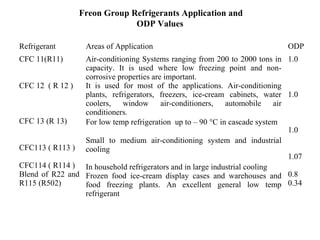
Freon Group Refrigerants Application and
ODP Values
Refrigerant Areas of Application ODP
CFC 11(R11)
CFC 12 ( R 12 )
CFC 13 (R 13)
CFC113 ( R113 )
CFC114 ( R114 )
Blend of R22 and
R115 (R502)
Air-conditioning Systems ranging from 200 to 2000 tons in
capacity. It is used where low freezing point and non-
corrosive properties are important.
It is used for most of the applications. Air-conditioning
plants, refrigerators, freezers, ice-cream cabinets, water
coolers, window air-conditioners, automobile air
conditioners.
For low temp refrigeration up to – 90 °C in cascade system
Small to medium air-conditioning system and industrial
cooling
In household refrigerators and in large industrial cooling
Frozen food ice-cream display cases and warehouses and
food freezing plants. An excellent general low temp
refrigerant
1.0
1.0
1.0
1.07
0.8
0.34
Inorganic Refrigerants
Inorganic refrigerant were exclusively used before the
introduction of halocarbon. These refrigerant are still in
use due to there inherent thermodynamic and physical
properties.
•Carbon Dioxide
•Water
•Ammonia
•Air
•Sulphur dioxide
Ammonia (NH3) R-717
 Used for commercial purposes. Mainly in cold stored and ice plants.
 The boiling temperature of NH3 at atmospheric pressure is -33 ºc
and melting point from solid is -78ºC The low boiling points makes
it possible to have refrigeration considerably below 0ºC without
using pressure below atmospheric in the evaporator.
 Its latent heat of vaporization at -15ºC is 1315 k/kg
 It is colorless gas with a sharp pungent smell
 Has good thermodynamic properties
 It is neutral to all metals, highly soluble in oil.
 Volatile and non toxic but in higher conc.
Sulphur Dioxide (So2)
Previously used in household refrigerators
Toxic, non-explosive and non-flammable, non-corrosive
Irritant to human body
Non mixable with oil
Has pungent odour and low latent heat value
Azeotrope Refrigerants
• This group of refrigerants consist of mixture of different
refrigerants which can not separated under pressure and
temperature and have fixed thermodynamic properties.
• A stable mixture of two or several refrigerants whose
vapour and liquid phases retain identical compositions
over a wide range of temperatures.
• Azeotropic mixtures are designated by 500 series
•Examples : R-500 :( 73.8% R12 and 26.2% R152)
R-502 : (8.8% R22 and 51.2% R115)
R-503 : (40.1% R23 and 59.9% R13)
Zeotropic Refrigerants
• A zeotropic mixture is one whose composition in liquid
phase differs to that in vapour phase. Zeotropic refrigerants
therefore do not boil at constant temperatures unlike
azeotropic refrigerants.
• zeotropic refrigerants (e.g. non-azeotropic mixtures) are
designated by 400 series.
• Examples :R404a : R125 /R143a /R134a (44%,52%,4%)
R407c : R32/R125/R134a (23%, 25%, 52%)
R410a : R32/R125 (50%, 50%)
R413a : R600a/ R218/R134a (3%, 9%, 88%)
Hydrocarbons
•Most of the hydrocarbon refrigerant are successfully
used in industrial and commercial installation . They
possess satisfactory thermodynamic properties but are
highly flammable and explosive.
•Growing use in very small commercial systems like
car air-conditioning system
•Examples: R170, Ethane, C2H6
R290 , Propane C3H3
R600, Butane, C4H10
R600a, Isobutane, C4H10
Blends of the above Gases
Secondary Refrigerant
• The refrigerants are brine which is used as intermediate fluid between
evaporator and the substance or space to be cooled. They cool the
substance and the space by absorbing their sensible heat. Also called
indirect expansion system.
• Eg. Brine solution made of calcium chloride or sodium chloride
Water cannot be used as secondary refrigerant because at 0 ºC itself it
will become ice and circulation is not possible
In brine solution CaCl2 is much preferred, it is very costly
Substances that take away heat from the medium to be cooled and give
it to the boiling refrigerant are called secondary refrigerants
They do not change their physical condition
 Cheap and harmless, chemically neutral to metals and packing material
 Should have a low freezing point and large heat capacity
 Choice of brine depends on temperature to which a material is to be cooled and
industrial process in which it is to be used
 The calcium chloride brine has eutectic temperature of -55 at salt℃
concentration of 30% by mass
 The sodium chloride brine has eutectic temperature of -21.1 at salt℃
concentration of 23% by mass
 NaCl is used when it is desired to have direct contact between brine and product.
 Freezing point of brine depends on its concentration
 Cheapest secondary refrigerants are water and air but their application is limited.
Since, water has a high freezing point (00C) and air has a low heat capacity.
Designation of refrigerants:
• Since a large number of refrigerants have been developed
over the years for a wide variety of applications, a numbering
system has been adopted to designate various refrigerants.
From the number one can get some useful information about
the type of refrigerant, its chemical composition, molecular
weight etc. All the refrigerants are designated by R followed
by a unique number.
i) Fully saturated, halogenated
compounds:
• These refrigerants are derivatives of alkanes (Cn
H2n+2
) such as methane
(CH4
), ethane (C2
H6
). These refrigerants are designated by R XYZ, where:
• X+1 indicates the number of Carbon (C) atoms
• Y-1 indicates number of Hydrogen (H) atoms,
• Z indicates number of Fluorine (F) atoms
• The balance indicates the number of Chlorine atoms.
• Only 2 digits indicates that the value of X is zero.
• Ex: R 22
• X = 0 No. of Carbon atoms = 0+1 = 1 derivative of methane (CH⇒ ⇒ 4
)
• Y = 2 No. of Hydrogen atoms = 2-1 = 1⇒
• Z = 2 No. of Fluorine atoms = 2⇒
• The balance = 4 – no. of (H+F) atoms = 4-1-2 = 1 No. of Chlorine⇒
atoms = 1
• ∴The chemical formula of R 22 = CHClF2
i) Fully saturated, halogenated
compounds:
• Similarly it can be shown that the chemical formula of:
• R12 = CCl2
F2
• R134a = C2
H2
F4
(derivative of ethane)
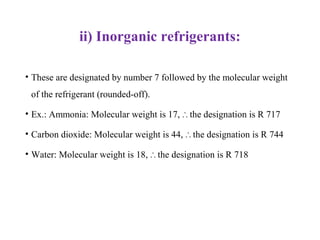
ii) Inorganic refrigerants:
• These are designated by number 7 followed by the molecular weight
of the refrigerant (rounded-off).
• Ex.: Ammonia: Molecular weight is 17, the designation is R 717∴
• Carbon dioxide: Molecular weight is 44, the designation is R 744∴
• Water: Molecular weight is 18, the designation is R 718∴
Physical characteristics of refrigerants
 Boiling and condensing temperature and pressures
 Freezing temperature
 Critical temperature
 Discharge temperature
 Latent heat of vapourisation
 Specific heat
 Density
 Viscosity
Thermodynamic Properties Of Refrigerant
Boiling and condensing temperature and pressures
The boiling temp of refrigerant at atmospheric pressure should be low.
The evaporator and condensing temperatures determine the pressures
The maximum condensing temperature is largely affected by climatic condition
It is desirable to select a refrigerant whose saturation pressure (at min. operating
temperature) is a few pounds above atmospheric pressure.
If the boiling temperature of of the refrigerant is high at atmospheric pressure then
compressor has to operate at high vacuums.
Both evaporator and condenser pressure should be positive and it should be near to
atmospheric pressure.
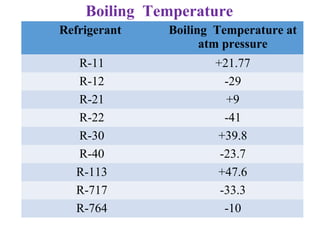
Boiling Temperature
Refrigerant Boiling Temperature at
atm pressure
R-11 +21.77
R-12 -29
R-21 +9
R-22 -41
R-30 +39.8
R-40 -23.7
R-113 +47.6
R-717 -33.3
R-764 -10
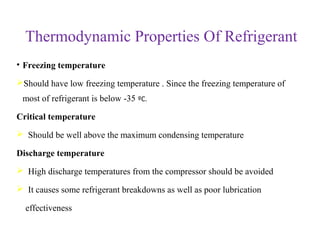
Thermodynamic Properties Of Refrigerant
• Freezing temperature
Should have low freezing temperature . Since the freezing temperature of
most of refrigerant is below -35 ºC.
Critical temperature
 Should be well above the maximum condensing temperature
Discharge temperature
 High discharge temperatures from the compressor should be avoided
 It causes some refrigerant breakdowns as well as poor lubrication
effectiveness
Freezing Temperature
Refrigerant Freezing Temperature
R-11 -111
R-12 -157.5
R-21 -135
R-22 -160
R-30 -96.9
R-40 -97.5
R-113 -35
R-717 -77.8
R-764 -75.6
 Evaporator and condenser pressure
Latent heat of vaporization
 Heat which converts the refrigerant from the liquid state to vapour
 It should have a higher value
Density
 Low vapour density refrigerants are preferred
Viscosity
 Low viscosity of the liquid refrigerant is desired to reduce the pressure
drop in the lines
Coefficient of performance and power
requirements
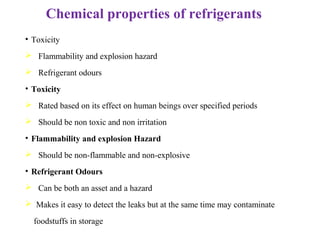
Chemical properties of refrigerants
• Toxicity
 Flammability and explosion hazard
 Refrigerant odours
• Toxicity
 Rated based on its effect on human beings over specified periods
 Should be non toxic and non irritation
• Flammability and explosion Hazard
 Should be non-flammable and non-explosive
• Refrigerant Odours
 Can be both an asset and a hazard
 Makes it easy to detect the leaks but at the same time may contaminate
foodstuffs in storage
Chemical properties
 Should be non-flammable
 Should be non-explosive
 Should be not-toxic
 Should not react with lubricating oil
 Should not react with moisture
 Should not contaminate the food materials kept inside the refrigerating
system
Environmental and safety properties
• At present the environment friendliness of the refrigerant is a
major factor in deciding the usefulness of a particular
refrigerant. The important environmental and safety properties
are:
• a) Ozone Depletion Potential (ODP): According to the Montreal
protocol, the ODP of refrigerants should be zero, i.e., they
should be non-ozone depleting substances. Refrigerants having
non-zero ODP have either already been phased-out (e.g. R 11,
R 12) or will be phased-out in near-future(e.g. R22). Since ODP
depends mainly on the presence of chlorine or bromine in the
molecules, refrigerants having either chlorine (i.e., CFCs and
HCFCs) or bromine cannot be used under the new regulations
Environmental Effects of Refrigerants
Global warming :
Refrigerants directly contributing to global warming when
released to the atmosphere
Indirect contribution based on the energy consumption of
among others the compressors ( CO2produced by power
stations )
Environmental and safety properties
• b) Global Warming Potential (GWP): Refrigerants should
have as low a GWP value as possible to minimize the
problem of global warming. Refrigerants with zero ODP but
a high value of GWP (e.g. R134a) are likely to be regulated
in future.
• c) Total Equivalent Warming Index (TEWI): The factor
TEWI considers both direct (due to release into atmosphere)
and indirect (through energy consumption) contributions of
refrigerants to global warming. Naturally, refrigerants with
as a low a value of TEWI are preferable from global
warming point of view.
Environmental and safety properties
• d) Toxicity: Ideally, refrigerants used in a refrigeration system should be non-
toxic. Toxicity is a relative term, which becomes meaningful only when the
degree of concentration and time of exposure required to produce harmful effects
are specified. Some fluids are toxic even in small concentrations. Some fluids are
mildly toxic, i.e., they are dangerous only when the concentration is large and
duration of exposure is long. In general the degree of hazard depends on:
• - Amount of refrigerant used vs total space
• - Type of occupancy
• - Presence of open flames
• - Odor of refrigerant, and
• - Maintenance condition
Environmental and safety
properties
• e) Flammability: The refrigerants should preferably be non-
flammable and non-explosive. For flammable refrigerants
special precautions should be taken to avoid accidents.
• f) Chemical stability: The refrigerants should be chemically
stable as long as they are inside the refrigeration system.
• g) Compatibility with common materials of construction
(both metals and non-metals)
• h) Miscibility with lubricating oils: Oil separators have to be
used if the refrigerant is not miscible with lubricating oil (e.g.
ammonia). Refrigerants that are completely miscible with
oils are easier to handle(R12).
Environmental and safety
properties
• Ease of leak detection: In the event of leakage of refrigerant from the
system, it should be easy to detect the leaks.
Ozone Depletion
The health and environmental concerns
caused by the breakdown of the ozone
layer include:
•Increase in skin cancers
•Suppression of the human immune
response system
•Increase in cataracts
•Damage to crops
•Damage to aquatic organisms
•Increase in global warming
References1) REFRIGERATION AND AIR CONDITIONING BY R.S.KHURMI

Refrigerants

  • 1.
    Refrigerant Prof R.S.KOLHE ME (Heat power) S.R.E.S.C.O.E KOPARGAON
  • 2.
    What is aRefrigerant? “Refrigerant is the fluid used for heat transfer in a refrigerating system that absorbs heat during evaporation from the region of low temperature and pressure, and releases heat during condensation at a region of higher temperature and pressure.”
  • 3.
    Classification Refrigerants • Primaryrefrigerants • Secondary refrigerants • Primary refrigerants • These are the refrigerants which cool the substance or space directly by absorbing latent heat. • It absorbs heat during evaporation in the evaporator and releases heat energy during condensation in condensor. • It is also known as direct expansion system • Esg. Ammonia, Freon, SO2, Co2 etc. • These fluids provide refrigeration by undergoing a phase change process in the evaporator. • Secondary Refrigerants • In refrigeration plant a secondary coolant is used as cooling medium which absorb heat from refrigerated space and transfer to primary refrigerant in evaporator. Secondary refrigerants are also known under the name brines or antifreezes
  • 4.
    Classification Of PrimaryRefrigerant •Halo-carbon Refrigerant •Azeotrope Refrigerant •Inorganic Refrigerant •Hydro-carbon Refrigerant
  • 5.
    Halocarbon Refrigerants • HalocarbonRefrigerant are all synthetically produced and were developed as the Freon family of refrigerants. They are fluorocarbons of methane and ethane series. They contain 1 or more of these halogens (chlorine, bromine, fluorine) Non toxic, non-flammable, non-explosive, non- corrosive, non-irritant to human body and eyes. Odourless, colourless Will not react with food product stored in the refrigerated space. Will not react with lubricating oil. Has excellent thermodynamic properties Only disadvantage is ozone layer is damaged. Examples : • CFC’s : R11, R12, R113, R114, R115 • HCFC’s : R22, R123 • HFC’s : R134a, R404a, R407C, R410a
  • 6.
    FREON 12 (Dichloro-difluromethane –ccl2F2)  Mostly used in domestic and commercial refrigerants (in ice cream cabinets, display cabinets, deep freezer)  It is very widely used, colourless gas with mild odour  Heavier than air  Does not dissolve in water, moisture content should not exceed 0.0025% by weigh  Refrigerating effect per unit volume of ammonia is about 1.5 times that of Freon-12  It does not react with ferrous metals, aluminium, phosphor bronze  It attacks copper, copper alloys, zinc and bronze and dissolves in water  It does not react with lubricating oils in the absence of moisture, but oxidizes them in the presence of water vapour
  • 7.
    Freon Group RefrigerantsApplication and ODP Values Refrigerant Areas of Application ODP CFC 11(R11) CFC 12 ( R 12 ) CFC 13 (R 13) CFC113 ( R113 ) CFC114 ( R114 ) Blend of R22 and R115 (R502) Air-conditioning Systems ranging from 200 to 2000 tons in capacity. It is used where low freezing point and non- corrosive properties are important. It is used for most of the applications. Air-conditioning plants, refrigerators, freezers, ice-cream cabinets, water coolers, window air-conditioners, automobile air conditioners. For low temp refrigeration up to – 90 °C in cascade system Small to medium air-conditioning system and industrial cooling In household refrigerators and in large industrial cooling Frozen food ice-cream display cases and warehouses and food freezing plants. An excellent general low temp refrigerant 1.0 1.0 1.0 1.07 0.8 0.34
  • 8.
    Inorganic Refrigerants Inorganic refrigerantwere exclusively used before the introduction of halocarbon. These refrigerant are still in use due to there inherent thermodynamic and physical properties. •Carbon Dioxide •Water •Ammonia •Air •Sulphur dioxide
  • 9.
    Ammonia (NH3) R-717 Used for commercial purposes. Mainly in cold stored and ice plants.  The boiling temperature of NH3 at atmospheric pressure is -33 ºc and melting point from solid is -78ºC The low boiling points makes it possible to have refrigeration considerably below 0ºC without using pressure below atmospheric in the evaporator.  Its latent heat of vaporization at -15ºC is 1315 k/kg  It is colorless gas with a sharp pungent smell  Has good thermodynamic properties  It is neutral to all metals, highly soluble in oil.  Volatile and non toxic but in higher conc.
  • 10.
    Sulphur Dioxide (So2) Previouslyused in household refrigerators Toxic, non-explosive and non-flammable, non-corrosive Irritant to human body Non mixable with oil Has pungent odour and low latent heat value
  • 11.
    Azeotrope Refrigerants • Thisgroup of refrigerants consist of mixture of different refrigerants which can not separated under pressure and temperature and have fixed thermodynamic properties. • A stable mixture of two or several refrigerants whose vapour and liquid phases retain identical compositions over a wide range of temperatures. • Azeotropic mixtures are designated by 500 series •Examples : R-500 :( 73.8% R12 and 26.2% R152) R-502 : (8.8% R22 and 51.2% R115) R-503 : (40.1% R23 and 59.9% R13)
  • 12.
    Zeotropic Refrigerants • Azeotropic mixture is one whose composition in liquid phase differs to that in vapour phase. Zeotropic refrigerants therefore do not boil at constant temperatures unlike azeotropic refrigerants. • zeotropic refrigerants (e.g. non-azeotropic mixtures) are designated by 400 series. • Examples :R404a : R125 /R143a /R134a (44%,52%,4%) R407c : R32/R125/R134a (23%, 25%, 52%) R410a : R32/R125 (50%, 50%) R413a : R600a/ R218/R134a (3%, 9%, 88%)
  • 13.
    Hydrocarbons •Most of thehydrocarbon refrigerant are successfully used in industrial and commercial installation . They possess satisfactory thermodynamic properties but are highly flammable and explosive. •Growing use in very small commercial systems like car air-conditioning system •Examples: R170, Ethane, C2H6 R290 , Propane C3H3 R600, Butane, C4H10 R600a, Isobutane, C4H10 Blends of the above Gases
  • 14.
    Secondary Refrigerant • Therefrigerants are brine which is used as intermediate fluid between evaporator and the substance or space to be cooled. They cool the substance and the space by absorbing their sensible heat. Also called indirect expansion system. • Eg. Brine solution made of calcium chloride or sodium chloride Water cannot be used as secondary refrigerant because at 0 ºC itself it will become ice and circulation is not possible In brine solution CaCl2 is much preferred, it is very costly Substances that take away heat from the medium to be cooled and give it to the boiling refrigerant are called secondary refrigerants They do not change their physical condition
  • 15.
     Cheap andharmless, chemically neutral to metals and packing material  Should have a low freezing point and large heat capacity  Choice of brine depends on temperature to which a material is to be cooled and industrial process in which it is to be used  The calcium chloride brine has eutectic temperature of -55 at salt℃ concentration of 30% by mass  The sodium chloride brine has eutectic temperature of -21.1 at salt℃ concentration of 23% by mass  NaCl is used when it is desired to have direct contact between brine and product.  Freezing point of brine depends on its concentration  Cheapest secondary refrigerants are water and air but their application is limited. Since, water has a high freezing point (00C) and air has a low heat capacity.
  • 16.
    Designation of refrigerants: •Since a large number of refrigerants have been developed over the years for a wide variety of applications, a numbering system has been adopted to designate various refrigerants. From the number one can get some useful information about the type of refrigerant, its chemical composition, molecular weight etc. All the refrigerants are designated by R followed by a unique number.
  • 17.
    i) Fully saturated,halogenated compounds: • These refrigerants are derivatives of alkanes (Cn H2n+2 ) such as methane (CH4 ), ethane (C2 H6 ). These refrigerants are designated by R XYZ, where: • X+1 indicates the number of Carbon (C) atoms • Y-1 indicates number of Hydrogen (H) atoms, • Z indicates number of Fluorine (F) atoms • The balance indicates the number of Chlorine atoms. • Only 2 digits indicates that the value of X is zero. • Ex: R 22 • X = 0 No. of Carbon atoms = 0+1 = 1 derivative of methane (CH⇒ ⇒ 4 ) • Y = 2 No. of Hydrogen atoms = 2-1 = 1⇒ • Z = 2 No. of Fluorine atoms = 2⇒ • The balance = 4 – no. of (H+F) atoms = 4-1-2 = 1 No. of Chlorine⇒ atoms = 1 • ∴The chemical formula of R 22 = CHClF2
  • 18.
    i) Fully saturated,halogenated compounds: • Similarly it can be shown that the chemical formula of: • R12 = CCl2 F2 • R134a = C2 H2 F4 (derivative of ethane)
  • 19.
    ii) Inorganic refrigerants: •These are designated by number 7 followed by the molecular weight of the refrigerant (rounded-off). • Ex.: Ammonia: Molecular weight is 17, the designation is R 717∴ • Carbon dioxide: Molecular weight is 44, the designation is R 744∴ • Water: Molecular weight is 18, the designation is R 718∴
  • 20.
    Physical characteristics ofrefrigerants  Boiling and condensing temperature and pressures  Freezing temperature  Critical temperature  Discharge temperature  Latent heat of vapourisation  Specific heat  Density  Viscosity
  • 21.
    Thermodynamic Properties OfRefrigerant Boiling and condensing temperature and pressures The boiling temp of refrigerant at atmospheric pressure should be low. The evaporator and condensing temperatures determine the pressures The maximum condensing temperature is largely affected by climatic condition It is desirable to select a refrigerant whose saturation pressure (at min. operating temperature) is a few pounds above atmospheric pressure. If the boiling temperature of of the refrigerant is high at atmospheric pressure then compressor has to operate at high vacuums. Both evaporator and condenser pressure should be positive and it should be near to atmospheric pressure.
  • 22.
    Boiling Temperature Refrigerant BoilingTemperature at atm pressure R-11 +21.77 R-12 -29 R-21 +9 R-22 -41 R-30 +39.8 R-40 -23.7 R-113 +47.6 R-717 -33.3 R-764 -10
  • 23.
    Thermodynamic Properties OfRefrigerant • Freezing temperature Should have low freezing temperature . Since the freezing temperature of most of refrigerant is below -35 ºC. Critical temperature  Should be well above the maximum condensing temperature Discharge temperature  High discharge temperatures from the compressor should be avoided  It causes some refrigerant breakdowns as well as poor lubrication effectiveness
  • 24.
    Freezing Temperature Refrigerant FreezingTemperature R-11 -111 R-12 -157.5 R-21 -135 R-22 -160 R-30 -96.9 R-40 -97.5 R-113 -35 R-717 -77.8 R-764 -75.6
  • 25.
     Evaporator andcondenser pressure Latent heat of vaporization  Heat which converts the refrigerant from the liquid state to vapour  It should have a higher value Density  Low vapour density refrigerants are preferred Viscosity  Low viscosity of the liquid refrigerant is desired to reduce the pressure drop in the lines
  • 26.
    Coefficient of performanceand power requirements
  • 27.
    Chemical properties ofrefrigerants • Toxicity  Flammability and explosion hazard  Refrigerant odours • Toxicity  Rated based on its effect on human beings over specified periods  Should be non toxic and non irritation • Flammability and explosion Hazard  Should be non-flammable and non-explosive • Refrigerant Odours  Can be both an asset and a hazard  Makes it easy to detect the leaks but at the same time may contaminate foodstuffs in storage
  • 28.
    Chemical properties  Shouldbe non-flammable  Should be non-explosive  Should be not-toxic  Should not react with lubricating oil  Should not react with moisture  Should not contaminate the food materials kept inside the refrigerating system
  • 29.
    Environmental and safetyproperties • At present the environment friendliness of the refrigerant is a major factor in deciding the usefulness of a particular refrigerant. The important environmental and safety properties are: • a) Ozone Depletion Potential (ODP): According to the Montreal protocol, the ODP of refrigerants should be zero, i.e., they should be non-ozone depleting substances. Refrigerants having non-zero ODP have either already been phased-out (e.g. R 11, R 12) or will be phased-out in near-future(e.g. R22). Since ODP depends mainly on the presence of chlorine or bromine in the molecules, refrigerants having either chlorine (i.e., CFCs and HCFCs) or bromine cannot be used under the new regulations
  • 30.
    Environmental Effects ofRefrigerants Global warming : Refrigerants directly contributing to global warming when released to the atmosphere Indirect contribution based on the energy consumption of among others the compressors ( CO2produced by power stations )
  • 31.
    Environmental and safetyproperties • b) Global Warming Potential (GWP): Refrigerants should have as low a GWP value as possible to minimize the problem of global warming. Refrigerants with zero ODP but a high value of GWP (e.g. R134a) are likely to be regulated in future. • c) Total Equivalent Warming Index (TEWI): The factor TEWI considers both direct (due to release into atmosphere) and indirect (through energy consumption) contributions of refrigerants to global warming. Naturally, refrigerants with as a low a value of TEWI are preferable from global warming point of view.
  • 32.
    Environmental and safetyproperties • d) Toxicity: Ideally, refrigerants used in a refrigeration system should be non- toxic. Toxicity is a relative term, which becomes meaningful only when the degree of concentration and time of exposure required to produce harmful effects are specified. Some fluids are toxic even in small concentrations. Some fluids are mildly toxic, i.e., they are dangerous only when the concentration is large and duration of exposure is long. In general the degree of hazard depends on: • - Amount of refrigerant used vs total space • - Type of occupancy • - Presence of open flames • - Odor of refrigerant, and • - Maintenance condition
  • 33.
    Environmental and safety properties •e) Flammability: The refrigerants should preferably be non- flammable and non-explosive. For flammable refrigerants special precautions should be taken to avoid accidents. • f) Chemical stability: The refrigerants should be chemically stable as long as they are inside the refrigeration system. • g) Compatibility with common materials of construction (both metals and non-metals) • h) Miscibility with lubricating oils: Oil separators have to be used if the refrigerant is not miscible with lubricating oil (e.g. ammonia). Refrigerants that are completely miscible with oils are easier to handle(R12).
  • 34.
    Environmental and safety properties •Ease of leak detection: In the event of leakage of refrigerant from the system, it should be easy to detect the leaks.
  • 35.
    Ozone Depletion The healthand environmental concerns caused by the breakdown of the ozone layer include: •Increase in skin cancers •Suppression of the human immune response system •Increase in cataracts •Damage to crops •Damage to aquatic organisms •Increase in global warming
  • 36.
    References1) REFRIGERATION ANDAIR CONDITIONING BY R.S.KHURMI

Editor's Notes

  • #13 The fact that zeotropic refrigerants do not boil and condense and condense at constant temperature, can present an advantage. This phenomenon known as temperature glide is used to match the pressure drop in heat in heat exchangers thereby increasing their efficiency. This in turn results in an improved COP of the refrigeration cycle.