VALUE ENGINEERING
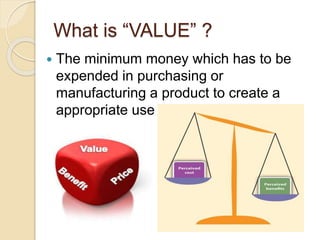
What is “VALUE” ?
 The minimum money which has to be
expended in purchasing or
manufacturing a product to create a
appropriate use of esteem factors.
VALUE ENGINEERING
 Value engineering is a total of
management which approaches the
question of saving cost from the point
of view of ‘value’.
 Requires co-operation of all functional
departments.
 In large organisations, there are value
engineering teams having full time
jobs.
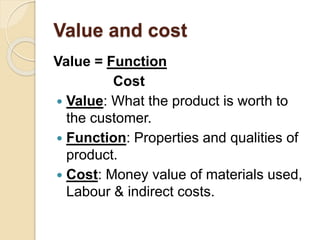
Value and cost
Value = Function
Cost
 Value: What the product is worth to
the customer.
 Function: Properties and qualities of
product.
 Cost: Money value of materials used,
Labour & indirect costs.
Suggestion schemes
 Suggestion scheme facilitates the
work of value engineering team.
 The scheme helps in the changes of
value engineering and makes it
implementation easier.
Requirement of a product
 Use.
 Esteem.
It is essential to be considered how
much to be added in order to sell the
part.
The reasonable price of a product can
be obtained by comparing with a
comparative product.
VALUE ENGINEERING
APPROACH
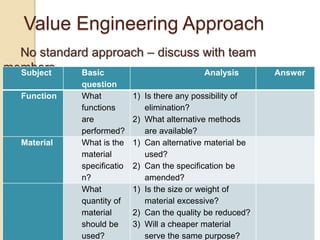
Value Engineering Approach
No standard approach – discuss with team
members.Subject Basic
question
Analysis Answer
Function What
functions
are
performed?
1) Is there any possibility of
elimination?
2) What alternative methods
are available?
Material What is the
material
specificatio
n?
1) Can alternative material be
used?
2) Can the specification be
amended?
What
quantity of
material
should be
used?
1) Is the size or weight of
material excessive?
2) Can the quality be reduced?
3) Will a cheaper material
serve the same purpose?
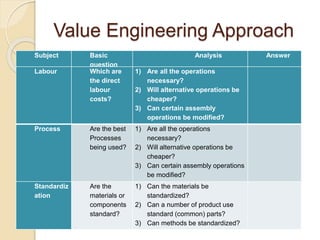
Value Engineering Approach
Subject Basic
question
Analysis Answer
Labour Which are
the direct
labour
costs?
1) Are all the operations
necessary?
2) Will alternative operations be
cheaper?
3) Can certain assembly
operations be modified?
Process Are the best
Processes
being used?
1) Are all the operations
necessary?
2) Will alternative operations be
cheaper?
3) Can certain assembly operations
be modified?
Standardiz
ation
Are the
materials or
components
standard?
1) Can the materials be
standardized?
2) Can a number of product use
standard (common) parts?
3) Can methods be standardized?
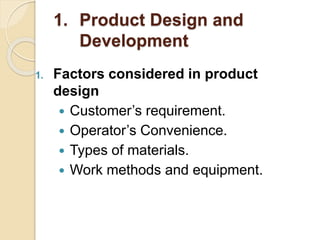
1. Product Design and
Development
1. Factors considered in product
design
 Customer’s requirement.
 Operator’s Convenience.
 Types of materials.
 Work methods and equipment.
2. Design.
3. Planning.
4. Specialized function.
5. Visible in long run.
1. Product Design and
Development
 Overall quality and performance.
 Work together to reduce cost.
 Latest developments.
 Service function.
 Desired objective.
2. Application of Value
Engineering
1. Elimination of undesirable features.
2. The main purpose is to improve
quality and to reduce unit costs.
 Reduce cost and prices.
 Reduction of undesirable
materials.
3. Benefits.
3. Simplification of Product
VALUE ENGINEERING CAN BE
APPLIED TO ANY MANUFACTURING,
HERE IS AN EXAMPLE OF TRACTOR
MANUFACTURING
FIRM IN THE FOLLOWING AREAS
1.TRACTOR DESIGN
make the design simple
 easy to use
 reduce COMPLICATED / expensive parts.
2.TRACTORS RAW MATERIAL / PARTS
PROCUREMENT
 establish the demand planning system [
reduce the fluctuations in production]
 establish the inventories of raw materials [
reduce the cost of stock holding]
-establish the economic order quantity
3. TRACTORS PRODUCTION PLANNING
 establish an effective / efficient production
planning system [ cost savings]
4.TRACTORS PRODUCTION
 establish a lean production [ cost effective]
5. TRACTORS TOTAL QUALITY
ASSURANCE.
• set up quality assurance system to reduce
quality problems/ rejections
[ cost savings ]
6.TRACTORS FINISHED GOOD
INVENTORY
• match the finished stock inventory to
market demand / sales requirements]
[ cost saving In stock holding ]
7.TRACTORS CUSTOMER SERVICE
• provide effective customer order
processing/order service/
timely despatch to customers.
[ adds value to customers / reduces
distribution cost]
8.TRACTORS AFTER SALES SERVICE
 offer warranty/ after sales service to
customers
[ adds value to the product and increases
sales ]
Value engineering

Value engineering

  • 1.
  • 2.
    What is “VALUE”?  The minimum money which has to be expended in purchasing or manufacturing a product to create a appropriate use of esteem factors.
  • 3.
    VALUE ENGINEERING  Valueengineering is a total of management which approaches the question of saving cost from the point of view of ‘value’.  Requires co-operation of all functional departments.  In large organisations, there are value engineering teams having full time jobs.
  • 4.
    Value and cost Value= Function Cost  Value: What the product is worth to the customer.  Function: Properties and qualities of product.  Cost: Money value of materials used, Labour & indirect costs.
  • 5.
    Suggestion schemes  Suggestionscheme facilitates the work of value engineering team.  The scheme helps in the changes of value engineering and makes it implementation easier.
  • 6.
    Requirement of aproduct  Use.  Esteem. It is essential to be considered how much to be added in order to sell the part. The reasonable price of a product can be obtained by comparing with a comparative product.
  • 7.
  • 8.
    Value Engineering Approach Nostandard approach – discuss with team members.Subject Basic question Analysis Answer Function What functions are performed? 1) Is there any possibility of elimination? 2) What alternative methods are available? Material What is the material specificatio n? 1) Can alternative material be used? 2) Can the specification be amended? What quantity of material should be used? 1) Is the size or weight of material excessive? 2) Can the quality be reduced? 3) Will a cheaper material serve the same purpose?
  • 9.
    Value Engineering Approach SubjectBasic question Analysis Answer Labour Which are the direct labour costs? 1) Are all the operations necessary? 2) Will alternative operations be cheaper? 3) Can certain assembly operations be modified? Process Are the best Processes being used? 1) Are all the operations necessary? 2) Will alternative operations be cheaper? 3) Can certain assembly operations be modified? Standardiz ation Are the materials or components standard? 1) Can the materials be standardized? 2) Can a number of product use standard (common) parts? 3) Can methods be standardized?
  • 11.
    1. Product Designand Development 1. Factors considered in product design  Customer’s requirement.  Operator’s Convenience.  Types of materials.  Work methods and equipment.
  • 12.
    2. Design. 3. Planning. 4.Specialized function. 5. Visible in long run. 1. Product Design and Development
  • 13.
     Overall qualityand performance.  Work together to reduce cost.  Latest developments.  Service function.  Desired objective. 2. Application of Value Engineering
  • 14.
    1. Elimination ofundesirable features. 2. The main purpose is to improve quality and to reduce unit costs.  Reduce cost and prices.  Reduction of undesirable materials. 3. Benefits. 3. Simplification of Product
  • 15.
    VALUE ENGINEERING CANBE APPLIED TO ANY MANUFACTURING, HERE IS AN EXAMPLE OF TRACTOR MANUFACTURING FIRM IN THE FOLLOWING AREAS 1.TRACTOR DESIGN make the design simple  easy to use  reduce COMPLICATED / expensive parts.
  • 16.
    2.TRACTORS RAW MATERIAL/ PARTS PROCUREMENT  establish the demand planning system [ reduce the fluctuations in production]  establish the inventories of raw materials [ reduce the cost of stock holding] -establish the economic order quantity
  • 17.
    3. TRACTORS PRODUCTIONPLANNING  establish an effective / efficient production planning system [ cost savings] 4.TRACTORS PRODUCTION  establish a lean production [ cost effective] 5. TRACTORS TOTAL QUALITY ASSURANCE. • set up quality assurance system to reduce quality problems/ rejections [ cost savings ]
  • 18.
    6.TRACTORS FINISHED GOOD INVENTORY •match the finished stock inventory to market demand / sales requirements] [ cost saving In stock holding ] 7.TRACTORS CUSTOMER SERVICE • provide effective customer order processing/order service/ timely despatch to customers. [ adds value to customers / reduces distribution cost]
  • 19.
    8.TRACTORS AFTER SALESSERVICE  offer warranty/ after sales service to customers [ adds value to the product and increases sales ]