Value Engineering and Value
Analysis
Overview
• What is Value Engineering?
• How is VE Applied?
• When is it used?
• What is Function Analys is and FAST?
Definitions
🔜Value Engineering:-is a technique applied
to identifying optimum value solutions
during new product development.
🔜Value analysis:- is a technique applied to
improving existing products, processesor
services.
🔜The objective is usually to reduce cost,
but may equally or simultaneously be to
improve performance or quality.
-LDMiles
The Key Points of VA /VE
• Applying formal workplans.
• A team approach.
• Specific definition of functions.
• The simultaneous look at functions and costs.
• Control of the analysis process.
• Quantifiable results
What is VE?
Value is the relationship between the defined
function the customer requires and the costs
incurred to provide that function.
– Cost Value
– Use Value
– Esteem Value
– Exchange Value
Value Engineering
🔜Value Engineering is:
• Reliability
• Maintainability
• Producibility
• Human Factors
• Parts Availability
• CycleTime
• Quality
• Weight Reduction
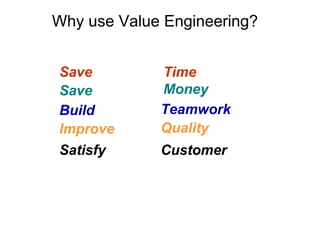
Why use Value Engineering?
Save Time
Save Money
Build Teamwork
Improve Quality
Satisfy Customer
When is VE used?
• Existing part/product cost is high
• Existing technology is complex/old
though simpler means are available
• There is a need to release a cheaper
product by cutting down some of the existing
feature
• The existing customer demands a minimal
increment in product features that are in
use
• There is a need to cutdown the manufacturing
cycle time/cost
When isVE used
• Value Engineering:-is used to determine the best
design alternatives for Projects, Processes,
Products, or Services
• Value Engineering is used to reduce cost on existing
Projects, Processes, Products, or Services.
• Value Engineering is used to improve quality,
increase reliability and availability, and customer
satisfaction .
• Value Engineering is also used to improve
organizational performance.
• Value Engineering is a powerful tool used to identify
problems and develop recommended solutions.
Benefits of VE
• Decreasing costs
• Increasing profits
• Improving quality
• Expanding marketshare
• Saving time
• Solving problems
• Using resources more effectively
VE’s Weaknesses
⮞Successful VE results are dependent on the
of information brought to the VE workshop for
evaluation.
⮞VE is not time oriented ,but product oriented.
Thus,improvements in production activities are
not readily recognized.
⮞There are many misunderstandings and biases
against VE that have been built up overtime due to
misuse of the methodology.
“It cheapens the product without improving it.”
“VE is only used for costreduction.”
Value Engineering Research
Questions and Check Sheet
1.Can it be eliminated without impairing
function or reliability?
2. Does it cost more than its worth?
3.Does it do more than is required? Are there
unnecessary features?
4.Is there something better with which to do
the job?
Value Engineering Research
Questions and Check Sheet
5.Can it be made by a less costly method?
6.Can a standard item or specialty product be
used?
7.Could a less costly manufacturing technique
be used?
8. Should different tooling be used?
9.Can some one else provide it at less
cost without affecting dependability?
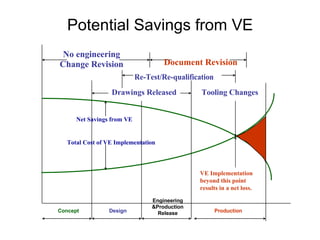
Potential Savings from VE
No engineering
Change Revision Document Revision
Re-Test/Re-qualification
Drawings Released Tooling Changes
Net Savings from VE
Total Cost of VE Implementation
VE Implementation
beyond this point
results in a net loss.
Concept Design
Engineering
&Production
Release Production
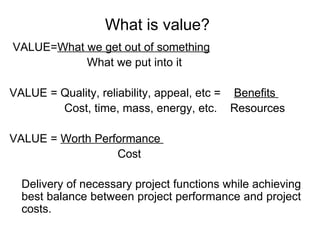
What is value?
VALUE=What we get out of something
What we put into it
VALUE = Quality, reliability, appeal, etc = Benefits
Cost, time, mass, energy, etc. Resources
VALUE = Worth Performance
Cost
Delivery of necessary project functions while achieving
best balance between project performance and project
costs.
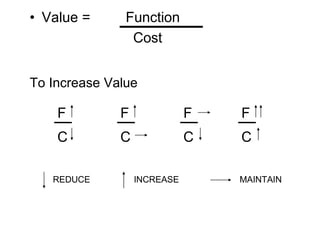
• Value = Function
Cost
To Increase Value
F F F F
C C C C
REDUCE INCREASE MAINTAIN
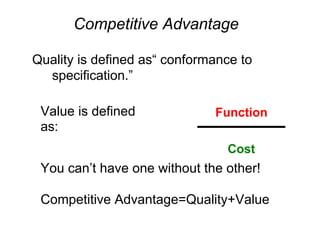
Competitive Advantage
Quality is defined as“ conformance to
specification.”
Value is defined
as:
Function
Cost
You can’t have one without the other!
Competitive Advantage=Quality+Value
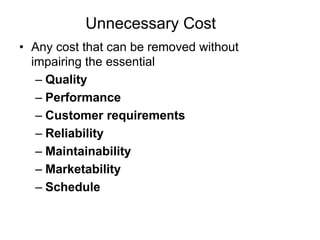
Unnecessary Cost
• Any cost that can be removed without
impairing the essential
– Quality
– Performance
– Customer requirements
– Reliability
– Maintainability
– Marketability
– Schedule
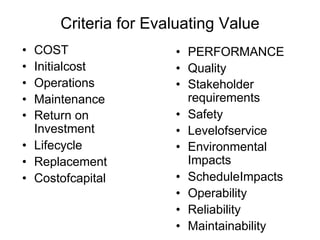
Criteria for Evaluating Value
• COST
• Initialcost
• Operations
• Maintenance
• Return on
Investment
• Lifecycle
• Replacement
• Costofcapital
• PERFORMANCE
• Quality
• Stakeholder
requirements
• Safety
• Levelofservice
• Environmental
Impacts
• ScheduleImpacts
• Operability
• Reliability
• Maintainability
Analysis Phase
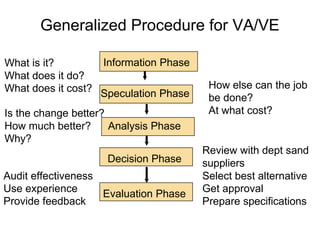
Generalized Procedure for VA/VE
What is it?
What does it do?
What does it cost?
Is the change better?
How much better?
Why?
Audit effectiveness
Use experience
Provide feedback
How else can the job
be done?
At what cost?
Review with dept sand
suppliers
Select best alternative
Get approval
Prepare specifications
Evaluation Phase
Decision Phase
Speculation Phase
Information Phase
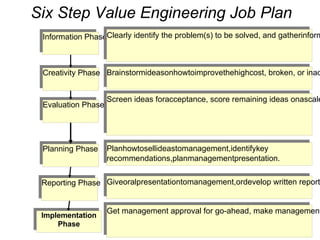
Implementation
Phase
Reporting Phase
Planning Phase
Evaluation Phase
Creativity Phase
Information Phase
Screen ideas foracceptance, score remaining ideas onascale
Brainstormideasonhowtoimprovethehighcost, broken, or inad
Clearly identify the problem(s) to be solved, and gatherinform
Planhowtosellideastomanagement,identifykey
recommendations,planmanagementpresentation.
Giveoralpresentationtomanagement,ordevelop written report
Get management approval for go-ahead, make management
Six Step Value Engineering Job Plan
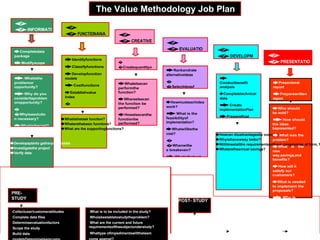
🡆Whatisthetask function?
🡆Whatarethebasic functions?
🡆What are the supportingfunctions?
🡆Developaplanto gatherprojectdata
🡆Investigatethe project
🡆Verify data
🡆Howcan disadvantagesbe overcome?
🡆Whyisthenewway better?
🡆Willitmeetallthe requirementswithout compromise of form, f
🡆Whataretheannual savings?
POST- STUDY
The Value Methodology Job Plan
🡆Who should
be sold?
🡆How should
the ideas
bepresented?
🡆What was the
problem?
🡆What is the
new
way,savings,and
benefits?
🡆How will it
satisfy our
customers?
🡆What is needed
to implement the
proposals?
🡆Who is
responsiblefor
implementingthe
change?
What is to be included in the study?
Whoisbestabletostudytheproblem?
What are the current and future
requirementsofthesubjectunderstudy?
Whattype ofimpedimentswilltheteam
-Collectuser/customerattitudes
Complete data files
Determineevaluationfactors
Scope the study
Build data
PRE-
STUDY
🡆Howmusteachidea
work?
🡆What is the
feasibilityof
implementation?
🡆Whatwillbethe
cost?
�
�Whenwillw
e breakeven?
🡆Whatisthebest
🡆Whatelsecan
performthe
function?
🡆Whereelsecan
the function be
performed?
🡆Howelsecanthe
functionbe
performed?
🡆Presentoral
report
🡆Preparewritten
report
🡆-
Conductbenefit
analysis
🡆Completetechnical
data
🡆Create
implementationPlan
🡆Preparefinal
🡆-Whatisthe
problemor
opportunity?
🡆Why do you
consideritaproblem
oropportunity?
�
�Whyisasolutio
n necessary?
🡆Whatisthecost?
🡆Rankandrate
alternativeideas
�
�Selectideasf
�
�Createquantityo
🡆Identifyfunctions
🡆Classifyfunctions
🡆Developfunction
models
🡆Costfunctions
🡆Establishvalue
index
�
�Selectfunctionsfo
�
�PRESENTATIO
NPHASE
🡆Completedata
package
🡆Modifyscope
�
�DEVELOPM
�
�EVALUATIO
�
�CREATIVE
�
�FUNCTIONANA
�
�INFORMATI
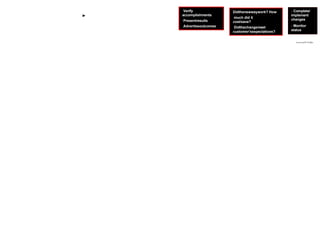
Verify
accomplishments
Presentresults
Advertiseoutcomes
Didthenewwaywork? How
much did it
cost/save?
Didthechangemeet
customer’sexpectations?
- Complete/
implement
changes
- Monitor
status
PropertyofOSCVEOffice
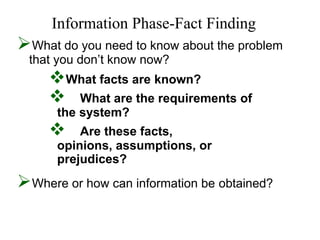
Information Phase-Fact Finding
What do you need to know about the problem
that you don’t know now?
What facts are known?
 What are the requirements of
the system?
 Are these facts,
opinions, assumptions, or
prejudices?
Where or how can information be obtained?
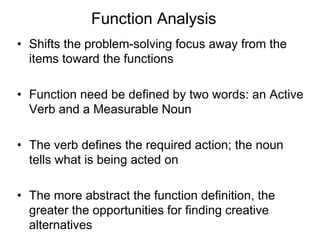
Function Analysis
• Shifts the problem-solving focus away from the
items toward the functions
• Function need be defined by two words: an Active
Verb and a Measurable Noun
• The verb defines the required action; the noun
tells what is being acted on
• The more abstract the function definition, the
greater the opportunities for finding creative
alternatives
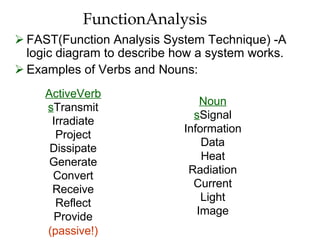
FunctionAnalysis
 FAST(Function Analysis System Technique) -A
logic diagram to describe how a system works.
 Examples of Verbs and Nouns:
ActiveVerb
sTransmit
Irradiate
Project
Dissipate
Generate
Convert
Receive
Reflect
Provide
(passive!)
Noun
sSignal
Information
Data
Heat
Radiation
Current
Light
Image
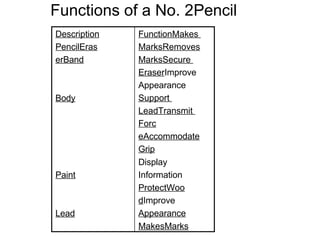
Functions of a No. 2Pencil
Description
PencilEras
erBand
Body
Paint
Lead
FunctionMakes
MarksRemoves
MarksSecure
EraserImprove
Appearance
Support
LeadTransmit
Forc
eAccommodate
Grip
Display
Information
ProtectWoo
dImprove
Appearance
MakesMarks
FAST Example
Functional Analysis System Technique
(FAST) Diagram
1.List Desired Outcome and Requirements
of Customer in Verb Singular Noun Form
Mouse FreeLiving Area=Eliminate Mice
FASTDiagram
2.List Products and Services that satisfy
Desired Outcome (Q4).These Products or
services answer WHAT is desired of the
system.
• Use Cat
• CreateVirus
• KillMice
• EliminateFood
FASTDiagram
• 3. List all functions in Verb Noun format and
processes that would satisfy or produce
each product or service in the previous step.
• Generate all functions, basic,
secondary, support without regard to
relationship.
KillMice
• Trap Mice
• ElectrocuteMice
• Shoot Mice
• GasMice
• DrownMice
• Use Snake
• PoisonMice
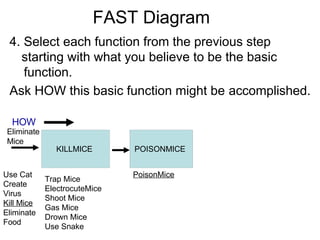
FAST Diagram
4. Select each function from the previous step
starting with what you believe to be the basic
function.
Ask HOW this basic function might be accomplished.
HOW
Eliminate
Mice
Use Cat
Create
Virus
Kill Mice
Eliminate
Food
Trap Mice
ElectrocuteMice
Shoot Mice
Gas Mice
Drown Mice
Use Snake
PoisonMice
POISONMICE
KILLMICE
•Spra
yPoison
•Injec
tPoison
•Stepo
nPoison
•Ea
tPoison
•Shoo
tPoison
POISONMICE
KILLMICE
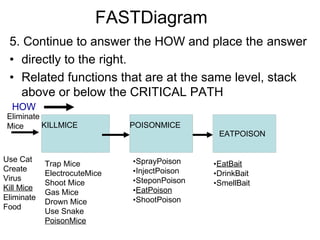
FASTDiagram
5. Continue to answer the HOW and place the answer
• directly to the right.
• Related functions that are at the same level, stack
above or below the CRITICAL PATH
HOW
Eliminate
Mice
Use Cat
Create
Virus
Kill Mice
Eliminate
Food
Trap Mice
ElectrocuteMice
Shoot Mice
Gas Mice
Drown Mice
Use Snake
PoisonMice
•SprayPoison
•InjectPoison
•SteponPoison
•EatPoison
•ShootPoison
•EatBait
•DrinkBait
•SmellBait
EATPOISON
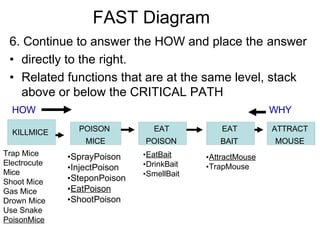
FAST Diagram
6. Continue to answer the HOW and place the answer
• directly to the right.
• Related functions that are at the same level, stack
above or below the CRITICAL PATH
HOW WHY
KILLMICE POISON
MICE
EAT
POISON
EAT
BAIT
ATTRACT
MOUSE
Trap Mice
Electrocute
Mice
Shoot Mice
Gas Mice
Drown Mice
Use Snake
PoisonMice
•SprayPoison
•InjectPoison
•SteponPoison
•EatPoison
•ShootPoison
•EatBait
•DrinkBait
•SmellBait
•AttractMouse
•TrapMouse
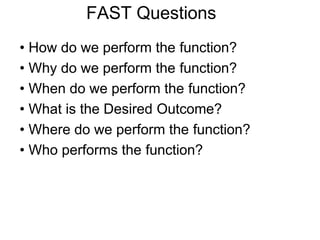
FAST Questions
• How do we perform the function?
• Why do we perform the function?
• When do we perform the function?
• What is the Desired Outcome?
• Where do we perform the function?
• Who performs the function?
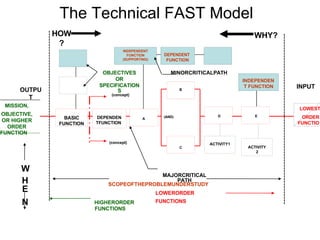
The Technical FAST Model
HOW
?
WHY?
INDEPENDENT
FUNCTION
(SUPPORTING)
DEPENDENT
FUNCTION
OUTPU
T
OBJECTIVES
OR
SPECIFICATION
S
(concept)
MINORCRITICALPATH
B
INDEPENDEN
T FUNCTION INPUT
MISSION,
LOWEST
OBJECTIVE,
OR HIGHER
ORDER
BASIC
FUNCTION
DEPENDEN
TFUNCTION
A
(AND) D E ORDER
FUNCTIO
FUNCTION
(concept) ACTIVITY1
C ACTIVITY
2
W
MAJORCRITICAL
PATH
SCOPEOFTHEPROBLEMUNDERSTUDY
E LOWERORDER
N HIGHERORDER
FUNCTIONS
FUNCTIONS
H
GENERATE
LIGHT
PROJECT
IMAGE
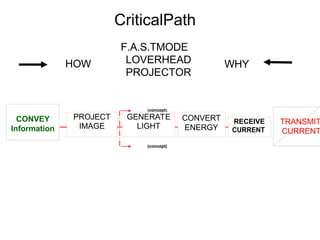
CriticalPath
HOW
F.A.S.TMODE
LOVERHEAD
PROJECTOR
WHY
(concept)
TRANSMIT
CURRENT
(concept)
RECEIVE
CURRENT
CONVERT
ENERGY
CONVEY
Information
FOCUS
IMAGE
SUPPORT
IMAGE
DISSIPATE
HEAT
GENERATE
LIGHT
PROJECT
IMAGE
RECEIVE
CURRENT
CONVERT
ENERGY
TRANSMIT CURRENT
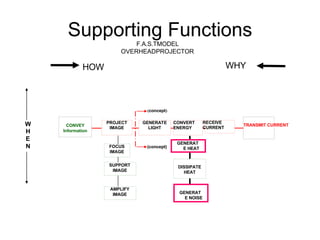
Supporting Functions
F.A.S.TMODEL
OVERHEADPROJECTOR
HOW WHY
(concept)
W
H
E
N (concept)
AMPLIFY
IMAGE GENERAT
E NOISE
GENERAT
E HEAT
CONVEY
Information
FOCUS
IMAGE
SUPPORT
IMAGE
DISSIPATE
HEAT
GENERATE
LIGHT
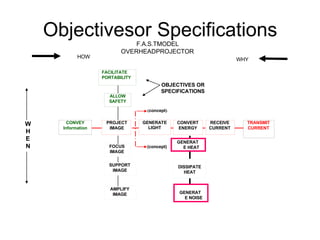
Objectivesor Specifications
F.A.S.TMODEL
HOW
OVERHEADPROJECTOR
WHY
OBJECTIVES OR
SPECIFICATIONS
(concept)
W
H
E
N (concept)
AMPLIFY
IMAGE GENERAT
E NOISE
GENERAT
E HEAT
TRANSMIT
CURRENT
RECEIVE
CURRENT
CONVERT
ENERGY
PROJECT
IMAGE
CONVEY
Information
ALLOW
SAFETY
FACILITATE
PORTABILITY
FOCUS
IMAGE
PROJECT
IMAGE
CONVEY
Information
ALLOW SAFETY
TRANSMIT
CURRENT
RECEIVE
CURRENT
FACILITATE PORTABILITY
GENERATE
LIGHT
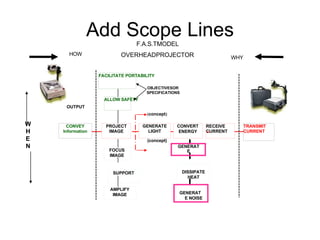
Add Scope Lines
F.A.S.TMODEL
HOW
OUTPUT
W
H
E
N
OVERHEADPROJECTOR
OBJECTIVESOR
SPECIFICATIONS
(concept)
(concept)
WHY
INPUT
SUPPORT DISSIPATE
HEAT
AMPLIFY
IMAGE GENERAT
E NOISE
GENERAT
E
HEAT
CONVERT
ENERGY
FOCUS
IMAGE
GENERAT
E
HEAT
FACILITATE PORTABILITY
PROJECT
IMAGE
CONVEY
Information
ALLOW SAFETY
TRANSMIT
CURRENT
RECEIVE
CURRENT
GENERATE
LIGHT
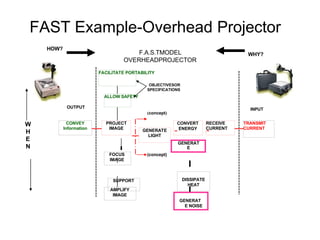
FAST Example-Overhead Projector
HOW?
F.A.S.TMODEL
OVERHEADPROJECTOR
OBJECTIVESOR
SPECIFICATIONS
WHY?
OUTPUT
W
H
E
N
(concept)
(concept)
INPUT
SUPPORT DISSIPATE
HEAT
AMPLIFY
IMAGE
GENERAT
E NOISE
CONVERT
ENERGY
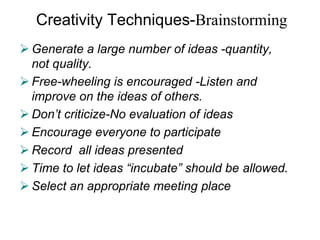
Creativity Techniques-Brainstorming
 Generate a large number of ideas -quantity,
not quality.
 Free-wheeling is encouraged -Listen and
improve on the ideas of others.
 Don’t criticize-No evaluation of ideas
 Encourage everyone to participate
 Record all ideas presented
 Time to let ideas “incubate” should be allowed.
 Select an appropriate meeting place
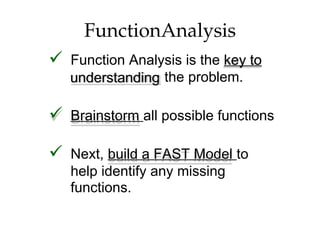
understanding
FunctionAnalysis
 Function Analysis is the key to
the problem.
 Brainstorm all possible functions
 Next, build a FAST Model to
help identify any missing
functions.
Other tools that can work with VE
 Activity Based Costing (ABC)
 Cost Function Matrix
 Failure Modes and Effects Analysis (FMEA)
 Risk Analysis Tools
 Other traditional quality tools such as pareto
analysis, is hakawa diagrams, scatter
diagrams, etc.
Function analysis is the key to understanding
▶
the system and what it does. Function analysis
enables you to analyze the problem from a
system perspective.
The Planning & Reporting Phases
• Planning
What is recommended?
Who has to approve it?
What is the implementation plan?
Are mockups or prototypes required to verify
final decisions?
What are the cost, schedule, and deliverables?
ROI?
ACTION PLAN GUIDELINES
⮞“What needs to be done?”
Identify the actions needed to “solidify”
▶
the proposals.
⮞“Who should be assigned the action?”
Assign a team
▶ member.
Assign a completion date for the
▶ action.
⮞“When should the task be completed?”
Plan regular team status
▶ meetings.
Anticipate 4-6 weeks to complete the actions.
Implementation Planning
⮞Ideas must be planned and managed to
ensureimplementation.
⮞Proposed actions should be managed likea
project with specific end products ,defined start
and end dates, and funding limits.
The Planning & Reporting Phase
• Reporting
Give oral presentation.
Support it with written executive brief.
Be clear,concise,and positive.
Anticipate road blocks
Analysis of Each Component
• Can any part be eliminated without impairing
the operation of the complete unit?
• Can the design of the part be simplified to
reduce its basic cost?
• Can the design of the part be changed to permit
the use of simplified or less costly production
methods?
• Can less expensive but equally satisfactory
materials be used in the part?
• Design simplifications frequently are more
apparent than is possible under the original
design
The Value Engineering Checklist
1. Can the item be eliminated?
2. If the item is not standard, can a standard item
be used?
3. If it is a standard item, does it completely fit the
application, or is it a misfit?
4. Does the item have greater capacity than
required?
5. Can the weight be reduced?
6. Is there a similar item in inventory that could be
substituted?
7. Are closer tolerances specified than are
necessary?
TheValueEngineeringChecklist
8. Can you make the item less expensively in
your plant? If you are making it now, can you
buy it for less?
9. Can cost of packaging be reduced?
10.Are suppliers contributing suggestions to
reduce cost?
Concluding Remarks
• The design stage provides the
greatest opportunity to reduce costs
REMEMBER!
Value Analysis:-
▶ is a continuous process

Value_engineering_in process engineering

  • 1.
    Value Engineering andValue Analysis
  • 2.
    Overview • What isValue Engineering? • How is VE Applied? • When is it used? • What is Function Analys is and FAST?
  • 3.
    Definitions 🔜Value Engineering:-is atechnique applied to identifying optimum value solutions during new product development. 🔜Value analysis:- is a technique applied to improving existing products, processesor services. 🔜The objective is usually to reduce cost, but may equally or simultaneously be to improve performance or quality. -LDMiles
  • 4.
    The Key Pointsof VA /VE • Applying formal workplans. • A team approach. • Specific definition of functions. • The simultaneous look at functions and costs. • Control of the analysis process. • Quantifiable results
  • 5.
    What is VE? Valueis the relationship between the defined function the customer requires and the costs incurred to provide that function. – Cost Value – Use Value – Esteem Value – Exchange Value
  • 6.
    Value Engineering 🔜Value Engineeringis: • Reliability • Maintainability • Producibility • Human Factors • Parts Availability • CycleTime • Quality • Weight Reduction
  • 7.
    Why use ValueEngineering? Save Time Save Money Build Teamwork Improve Quality Satisfy Customer
  • 8.
    When is VEused? • Existing part/product cost is high • Existing technology is complex/old though simpler means are available • There is a need to release a cheaper product by cutting down some of the existing feature • The existing customer demands a minimal increment in product features that are in use • There is a need to cutdown the manufacturing cycle time/cost
  • 9.
    When isVE used •Value Engineering:-is used to determine the best design alternatives for Projects, Processes, Products, or Services • Value Engineering is used to reduce cost on existing Projects, Processes, Products, or Services. • Value Engineering is used to improve quality, increase reliability and availability, and customer satisfaction . • Value Engineering is also used to improve organizational performance. • Value Engineering is a powerful tool used to identify problems and develop recommended solutions.
  • 10.
    Benefits of VE •Decreasing costs • Increasing profits • Improving quality • Expanding marketshare • Saving time • Solving problems • Using resources more effectively
  • 11.
    VE’s Weaknesses ⮞Successful VEresults are dependent on the of information brought to the VE workshop for evaluation. ⮞VE is not time oriented ,but product oriented. Thus,improvements in production activities are not readily recognized. ⮞There are many misunderstandings and biases against VE that have been built up overtime due to misuse of the methodology. “It cheapens the product without improving it.” “VE is only used for costreduction.”
  • 12.
    Value Engineering Research Questionsand Check Sheet 1.Can it be eliminated without impairing function or reliability? 2. Does it cost more than its worth? 3.Does it do more than is required? Are there unnecessary features? 4.Is there something better with which to do the job?
  • 13.
    Value Engineering Research Questionsand Check Sheet 5.Can it be made by a less costly method? 6.Can a standard item or specialty product be used? 7.Could a less costly manufacturing technique be used? 8. Should different tooling be used? 9.Can some one else provide it at less cost without affecting dependability?
  • 14.
    Potential Savings fromVE No engineering Change Revision Document Revision Re-Test/Re-qualification Drawings Released Tooling Changes Net Savings from VE Total Cost of VE Implementation VE Implementation beyond this point results in a net loss. Concept Design Engineering &Production Release Production
  • 15.
    What is value? VALUE=Whatwe get out of something What we put into it VALUE = Quality, reliability, appeal, etc = Benefits Cost, time, mass, energy, etc. Resources VALUE = Worth Performance Cost Delivery of necessary project functions while achieving best balance between project performance and project costs.
  • 16.
    • Value =Function Cost To Increase Value F F F F C C C C REDUCE INCREASE MAINTAIN
  • 17.
    Competitive Advantage Quality isdefined as“ conformance to specification.” Value is defined as: Function Cost You can’t have one without the other! Competitive Advantage=Quality+Value
  • 18.
    Unnecessary Cost • Anycost that can be removed without impairing the essential – Quality – Performance – Customer requirements – Reliability – Maintainability – Marketability – Schedule
  • 19.
    Criteria for EvaluatingValue • COST • Initialcost • Operations • Maintenance • Return on Investment • Lifecycle • Replacement • Costofcapital • PERFORMANCE • Quality • Stakeholder requirements • Safety • Levelofservice • Environmental Impacts • ScheduleImpacts • Operability • Reliability • Maintainability
  • 20.
    Analysis Phase Generalized Procedurefor VA/VE What is it? What does it do? What does it cost? Is the change better? How much better? Why? Audit effectiveness Use experience Provide feedback How else can the job be done? At what cost? Review with dept sand suppliers Select best alternative Get approval Prepare specifications Evaluation Phase Decision Phase Speculation Phase Information Phase
  • 21.
    Implementation Phase Reporting Phase Planning Phase EvaluationPhase Creativity Phase Information Phase Screen ideas foracceptance, score remaining ideas onascale Brainstormideasonhowtoimprovethehighcost, broken, or inad Clearly identify the problem(s) to be solved, and gatherinform Planhowtosellideastomanagement,identifykey recommendations,planmanagementpresentation. Giveoralpresentationtomanagement,ordevelop written report Get management approval for go-ahead, make management Six Step Value Engineering Job Plan
  • 22.
    🡆Whatisthetask function? 🡆Whatarethebasic functions? 🡆Whatare the supportingfunctions? 🡆Developaplanto gatherprojectdata 🡆Investigatethe project 🡆Verify data 🡆Howcan disadvantagesbe overcome? 🡆Whyisthenewway better? 🡆Willitmeetallthe requirementswithout compromise of form, f 🡆Whataretheannual savings? POST- STUDY The Value Methodology Job Plan 🡆Who should be sold? 🡆How should the ideas bepresented? 🡆What was the problem? 🡆What is the new way,savings,and benefits? 🡆How will it satisfy our customers? 🡆What is needed to implement the proposals? 🡆Who is responsiblefor implementingthe change? What is to be included in the study? Whoisbestabletostudytheproblem? What are the current and future requirementsofthesubjectunderstudy? Whattype ofimpedimentswilltheteam -Collectuser/customerattitudes Complete data files Determineevaluationfactors Scope the study Build data PRE- STUDY 🡆Howmusteachidea work? 🡆What is the feasibilityof implementation? 🡆Whatwillbethe cost? � �Whenwillw e breakeven? 🡆Whatisthebest 🡆Whatelsecan performthe function? 🡆Whereelsecan the function be performed? 🡆Howelsecanthe functionbe performed? 🡆Presentoral report 🡆Preparewritten report 🡆- Conductbenefit analysis 🡆Completetechnical data 🡆Create implementationPlan 🡆Preparefinal 🡆-Whatisthe problemor opportunity? 🡆Why do you consideritaproblem oropportunity? � �Whyisasolutio n necessary? 🡆Whatisthecost? 🡆Rankandrate alternativeideas � �Selectideasf � �Createquantityo 🡆Identifyfunctions 🡆Classifyfunctions 🡆Developfunction models 🡆Costfunctions 🡆Establishvalue index � �Selectfunctionsfo � �PRESENTATIO NPHASE 🡆Completedata package 🡆Modifyscope � �DEVELOPM � �EVALUATIO � �CREATIVE � �FUNCTIONANA � �INFORMATI
  • 23.
    Verify accomplishments Presentresults Advertiseoutcomes Didthenewwaywork? How much didit cost/save? Didthechangemeet customer’sexpectations? - Complete/ implement changes - Monitor status PropertyofOSCVEOffice
  • 24.
    Information Phase-Fact Finding Whatdo you need to know about the problem that you don’t know now? What facts are known?  What are the requirements of the system?  Are these facts, opinions, assumptions, or prejudices? Where or how can information be obtained?
  • 25.
    Function Analysis • Shiftsthe problem-solving focus away from the items toward the functions • Function need be defined by two words: an Active Verb and a Measurable Noun • The verb defines the required action; the noun tells what is being acted on • The more abstract the function definition, the greater the opportunities for finding creative alternatives
  • 26.
    FunctionAnalysis  FAST(Function AnalysisSystem Technique) -A logic diagram to describe how a system works.  Examples of Verbs and Nouns: ActiveVerb sTransmit Irradiate Project Dissipate Generate Convert Receive Reflect Provide (passive!) Noun sSignal Information Data Heat Radiation Current Light Image
  • 27.
    Functions of aNo. 2Pencil Description PencilEras erBand Body Paint Lead FunctionMakes MarksRemoves MarksSecure EraserImprove Appearance Support LeadTransmit Forc eAccommodate Grip Display Information ProtectWoo dImprove Appearance MakesMarks
  • 28.
    FAST Example Functional AnalysisSystem Technique (FAST) Diagram 1.List Desired Outcome and Requirements of Customer in Verb Singular Noun Form Mouse FreeLiving Area=Eliminate Mice
  • 29.
    FASTDiagram 2.List Products andServices that satisfy Desired Outcome (Q4).These Products or services answer WHAT is desired of the system. • Use Cat • CreateVirus • KillMice • EliminateFood
  • 30.
    FASTDiagram • 3. Listall functions in Verb Noun format and processes that would satisfy or produce each product or service in the previous step. • Generate all functions, basic, secondary, support without regard to relationship. KillMice • Trap Mice • ElectrocuteMice • Shoot Mice • GasMice • DrownMice • Use Snake
  • 31.
  • 32.
    FAST Diagram 4. Selecteach function from the previous step starting with what you believe to be the basic function. Ask HOW this basic function might be accomplished. HOW Eliminate Mice Use Cat Create Virus Kill Mice Eliminate Food Trap Mice ElectrocuteMice Shoot Mice Gas Mice Drown Mice Use Snake PoisonMice POISONMICE KILLMICE
  • 33.
  • 34.
    POISONMICE KILLMICE FASTDiagram 5. Continue toanswer the HOW and place the answer • directly to the right. • Related functions that are at the same level, stack above or below the CRITICAL PATH HOW Eliminate Mice Use Cat Create Virus Kill Mice Eliminate Food Trap Mice ElectrocuteMice Shoot Mice Gas Mice Drown Mice Use Snake PoisonMice •SprayPoison •InjectPoison •SteponPoison •EatPoison •ShootPoison •EatBait •DrinkBait •SmellBait EATPOISON
  • 35.
    FAST Diagram 6. Continueto answer the HOW and place the answer • directly to the right. • Related functions that are at the same level, stack above or below the CRITICAL PATH HOW WHY KILLMICE POISON MICE EAT POISON EAT BAIT ATTRACT MOUSE Trap Mice Electrocute Mice Shoot Mice Gas Mice Drown Mice Use Snake PoisonMice •SprayPoison •InjectPoison •SteponPoison •EatPoison •ShootPoison •EatBait •DrinkBait •SmellBait •AttractMouse •TrapMouse
  • 36.
    FAST Questions • Howdo we perform the function? • Why do we perform the function? • When do we perform the function? • What is the Desired Outcome? • Where do we perform the function? • Who performs the function?
  • 37.
    The Technical FASTModel HOW ? WHY? INDEPENDENT FUNCTION (SUPPORTING) DEPENDENT FUNCTION OUTPU T OBJECTIVES OR SPECIFICATION S (concept) MINORCRITICALPATH B INDEPENDEN T FUNCTION INPUT MISSION, LOWEST OBJECTIVE, OR HIGHER ORDER BASIC FUNCTION DEPENDEN TFUNCTION A (AND) D E ORDER FUNCTIO FUNCTION (concept) ACTIVITY1 C ACTIVITY 2 W MAJORCRITICAL PATH SCOPEOFTHEPROBLEMUNDERSTUDY E LOWERORDER N HIGHERORDER FUNCTIONS FUNCTIONS H
  • 38.
  • 39.
  • 40.
    FOCUS IMAGE SUPPORT IMAGE DISSIPATE HEAT GENERATE LIGHT Objectivesor Specifications F.A.S.TMODEL HOW OVERHEADPROJECTOR WHY OBJECTIVES OR SPECIFICATIONS (concept) W H E N(concept) AMPLIFY IMAGE GENERAT E NOISE GENERAT E HEAT TRANSMIT CURRENT RECEIVE CURRENT CONVERT ENERGY PROJECT IMAGE CONVEY Information ALLOW SAFETY FACILITATE PORTABILITY
  • 41.
    FOCUS IMAGE PROJECT IMAGE CONVEY Information ALLOW SAFETY TRANSMIT CURRENT RECEIVE CURRENT FACILITATE PORTABILITY GENERATE LIGHT AddScope Lines F.A.S.TMODEL HOW OUTPUT W H E N OVERHEADPROJECTOR OBJECTIVESOR SPECIFICATIONS (concept) (concept) WHY INPUT SUPPORT DISSIPATE HEAT AMPLIFY IMAGE GENERAT E NOISE GENERAT E HEAT CONVERT ENERGY
  • 42.
    FOCUS IMAGE GENERAT E HEAT FACILITATE PORTABILITY PROJECT IMAGE CONVEY Information ALLOW SAFETY TRANSMIT CURRENT RECEIVE CURRENT GENERATE LIGHT FASTExample-Overhead Projector HOW? F.A.S.TMODEL OVERHEADPROJECTOR OBJECTIVESOR SPECIFICATIONS WHY? OUTPUT W H E N (concept) (concept) INPUT SUPPORT DISSIPATE HEAT AMPLIFY IMAGE GENERAT E NOISE CONVERT ENERGY
  • 43.
    Creativity Techniques-Brainstorming  Generatea large number of ideas -quantity, not quality.  Free-wheeling is encouraged -Listen and improve on the ideas of others.  Don’t criticize-No evaluation of ideas  Encourage everyone to participate  Record all ideas presented  Time to let ideas “incubate” should be allowed.  Select an appropriate meeting place
  • 44.
    understanding FunctionAnalysis  Function Analysisis the key to the problem.  Brainstorm all possible functions  Next, build a FAST Model to help identify any missing functions.
  • 45.
    Other tools thatcan work with VE  Activity Based Costing (ABC)  Cost Function Matrix  Failure Modes and Effects Analysis (FMEA)  Risk Analysis Tools  Other traditional quality tools such as pareto analysis, is hakawa diagrams, scatter diagrams, etc. Function analysis is the key to understanding ▶ the system and what it does. Function analysis enables you to analyze the problem from a system perspective.
  • 46.
    The Planning &Reporting Phases • Planning What is recommended? Who has to approve it? What is the implementation plan? Are mockups or prototypes required to verify final decisions? What are the cost, schedule, and deliverables? ROI?
  • 47.
    ACTION PLAN GUIDELINES ⮞“Whatneeds to be done?” Identify the actions needed to “solidify” ▶ the proposals. ⮞“Who should be assigned the action?” Assign a team ▶ member. Assign a completion date for the ▶ action. ⮞“When should the task be completed?” Plan regular team status ▶ meetings. Anticipate 4-6 weeks to complete the actions.
  • 48.
    Implementation Planning ⮞Ideas mustbe planned and managed to ensureimplementation. ⮞Proposed actions should be managed likea project with specific end products ,defined start and end dates, and funding limits.
  • 49.
    The Planning &Reporting Phase • Reporting Give oral presentation. Support it with written executive brief. Be clear,concise,and positive. Anticipate road blocks
  • 50.
    Analysis of EachComponent • Can any part be eliminated without impairing the operation of the complete unit? • Can the design of the part be simplified to reduce its basic cost? • Can the design of the part be changed to permit the use of simplified or less costly production methods? • Can less expensive but equally satisfactory materials be used in the part? • Design simplifications frequently are more apparent than is possible under the original design
  • 51.
    The Value EngineeringChecklist 1. Can the item be eliminated? 2. If the item is not standard, can a standard item be used? 3. If it is a standard item, does it completely fit the application, or is it a misfit? 4. Does the item have greater capacity than required? 5. Can the weight be reduced? 6. Is there a similar item in inventory that could be substituted? 7. Are closer tolerances specified than are necessary?
  • 52.
    TheValueEngineeringChecklist 8. Can youmake the item less expensively in your plant? If you are making it now, can you buy it for less? 9. Can cost of packaging be reduced? 10.Are suppliers contributing suggestions to reduce cost?
  • 53.
    Concluding Remarks • Thedesign stage provides the greatest opportunity to reduce costs
  • 54.