Value Analysis and Value
Engineering
By – Ravishankar K
SRESCOE
Value Analysis and Value Engineering
• Value Analysis is a technique that allows to increase
the value of a product or a service systematically,
eliminating all the functions that do not add any value
or benefit to the product.
• A product or process exists to fulfill a need.
• This need or set of needs is termed as a function, that
the product or process satisfies.
• For instance, knife exists to fulfill the need of cutting
and hence to cut is the function of knife.
2
What is meant by term Value?
• Value is a function of ‘Desired Performance’
and ‘Cost’.
• Expressed as Desired Performance (P) ÷ Overall
Costs (C)
• Desired performance is expressed by the term
worth which is defined as the lowest cost to
achieve the Use (work) function and Aesthetic
(sell) function.
3
How do define VA & VE
• Very often the two terms Value Analysis and Value
Engineering are used synonymously.
• However, difference between them will be clear from
the way they originated.
How VA originated?
• During the Second World War, U.S. government
reserved certain materials from armament industry.
• Therefore, General Electric Company found itself in fix
as many of their regularly used materials suddenly
became unavailable due to reservation.
4
• A purchase executive of the company, Lawrence D.
Miles made many substitutions in place of original
materials.
• Surprisingly, the results showed that substituted
materials did not affect the quality but brought costs
down.
• Later Larry developed a step by step approach for this
exercise and named the technique as Value Analysis.
 Thus it is a step by step approach to identify the
functions of a product, process, system or service; to
establish a monetary value for that function and then
provide the desired function at an overall minimum
cost without affecting any of the existing parameters
like Quality, Maintainability, Productivity, Safety and
other Performance Characteristics.
5
• In the year 1954, U.S. Navy Bureau of Ships adopted
same technique in their effort at ‘cost avoidance’
during the design stage and saved million of dollars .
• They named this technique as Value Engineering.
Value Engineering is where the value of all
components used in construction of a product from
design to final delivery stage are completely analyzed
and pursued.
• Thus, Value Engineering indicates application at
design stage whereas Value Analysis is the
application on the product that is into
manufacturing.
6
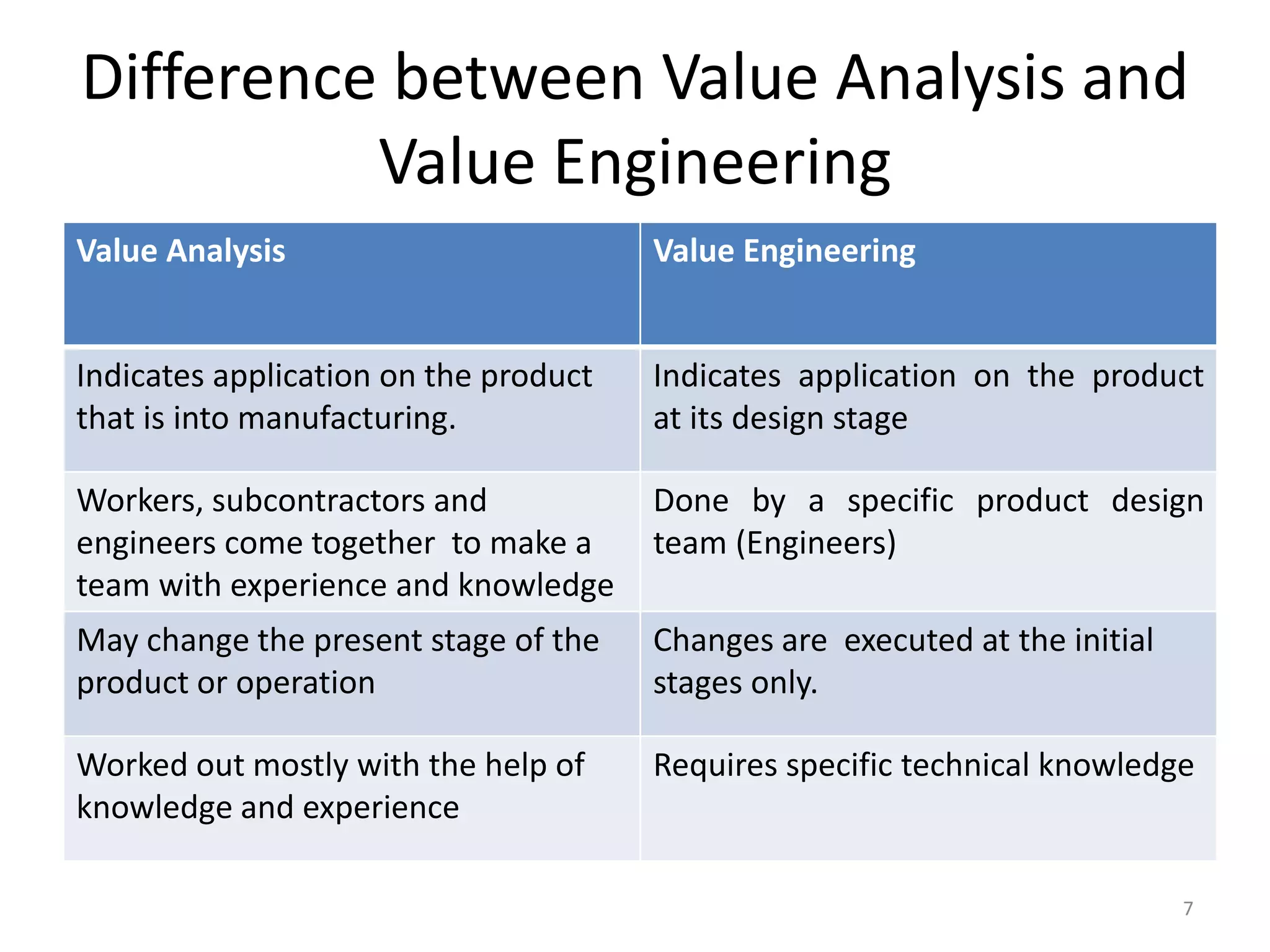
Difference between Value Analysis and
Value Engineering
7
Value Analysis Value Engineering
Indicates application on the product
that is into manufacturing.
Indicates application on the product
at its design stage
Workers, subcontractors and
engineers come together to make a
team with experience and knowledge
Done by a specific product design
team (Engineers)
May change the present stage of the
product or operation
Changes are executed at the initial
stages only.
Worked out mostly with the help of
knowledge and experience
Requires specific technical knowledge
What is the meaning of overall costs?
For a manufacturer/ producer
• Overall cost is summation of all elements of the
costs required to produce or service such as
labour, material, overhead etc.
For a consumer
• Overall cost is the monetary sum (price) for
which the product or service is purchased in the
market.
8
The Value of the a function V= P/C can be increased by
four methods.
(1) Decrease the cost while ensuring the same level of
performance.
• Reduce the thickness of wooden drums in case of
packing of telephone cables.
• Earlier CDs and DVDs were sold at above Rs 100/-
Moser Baer introduced the same at almost half the
price.
(2) Enhance the performance at the same cost
• Providing a supplement of Mumbai Mirror along with
the copy of The Times of India at no extra cost.
9
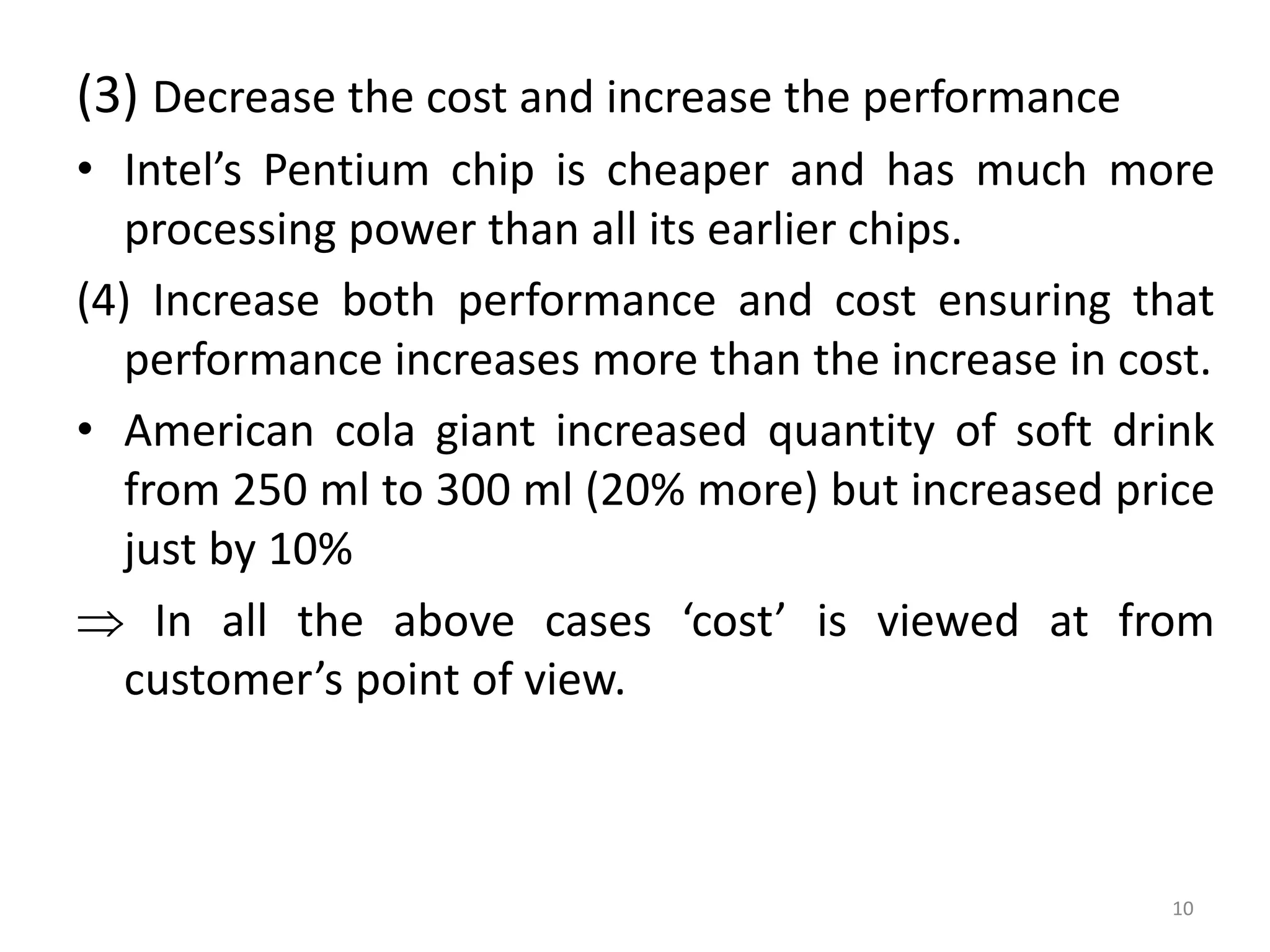
(3) Decrease the cost and increase the performance
• Intel’s Pentium chip is cheaper and has much more
processing power than all its earlier chips.
(4) Increase both performance and cost ensuring that
performance increases more than the increase in cost.
• American cola giant increased quantity of soft drink
from 250 ml to 300 ml (20% more) but increased price
just by 10%
 In all the above cases ‘cost’ is viewed at from
customer’s point of view.
10
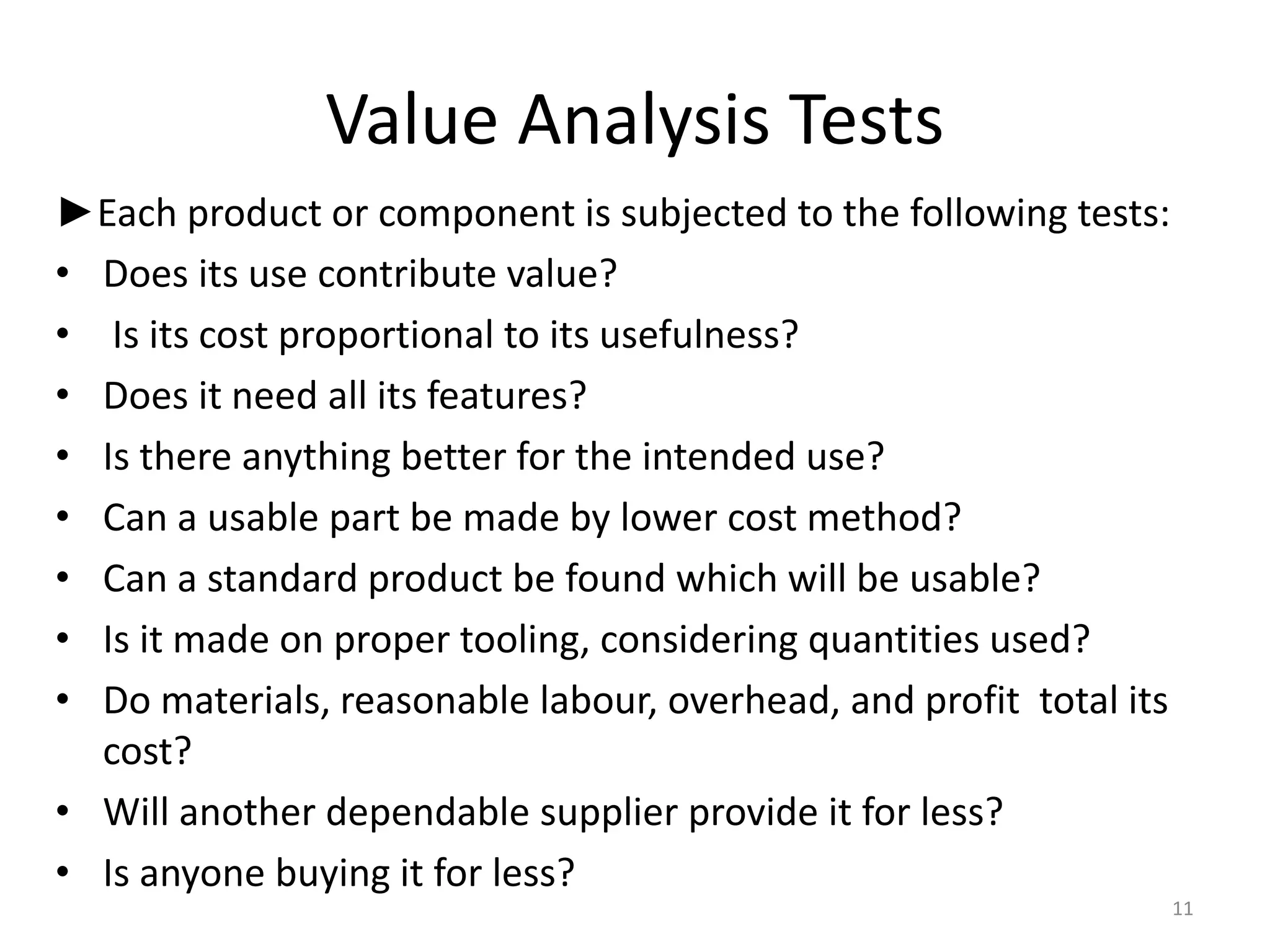
Value Analysis Tests
►Each product or component is subjected to the following tests:
• Does its use contribute value?
• Is its cost proportional to its usefulness?
• Does it need all its features?
• Is there anything better for the intended use?
• Can a usable part be made by lower cost method?
• Can a standard product be found which will be usable?
• Is it made on proper tooling, considering quantities used?
• Do materials, reasonable labour, overhead, and profit total its
cost?
• Will another dependable supplier provide it for less?
• Is anyone buying it for less?
11
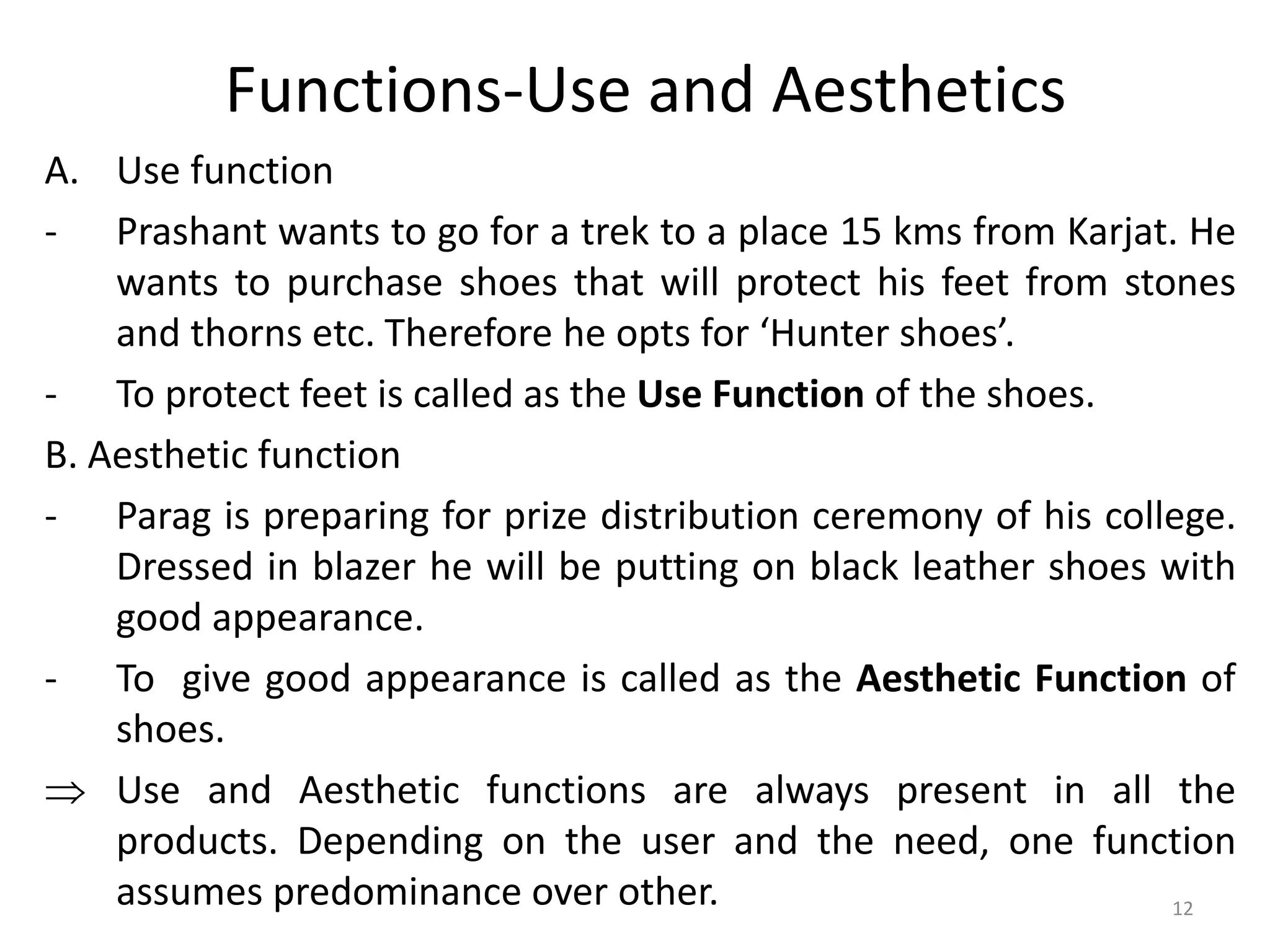
Functions-Use and Aesthetics
A. Use function
- Prashant wants to go for a trek to a place 15 kms from Karjat. He
wants to purchase shoes that will protect his feet from stones
and thorns etc. Therefore he opts for ‘Hunter shoes’.
- To protect feet is called as the Use Function of the shoes.
B. Aesthetic function
- Parag is preparing for prize distribution ceremony of his college.
Dressed in blazer he will be putting on black leather shoes with
good appearance.
- To give good appearance is called as the Aesthetic Function of
shoes.
 Use and Aesthetic functions are always present in all the
products. Depending on the user and the need, one function
assumes predominance over other. 12
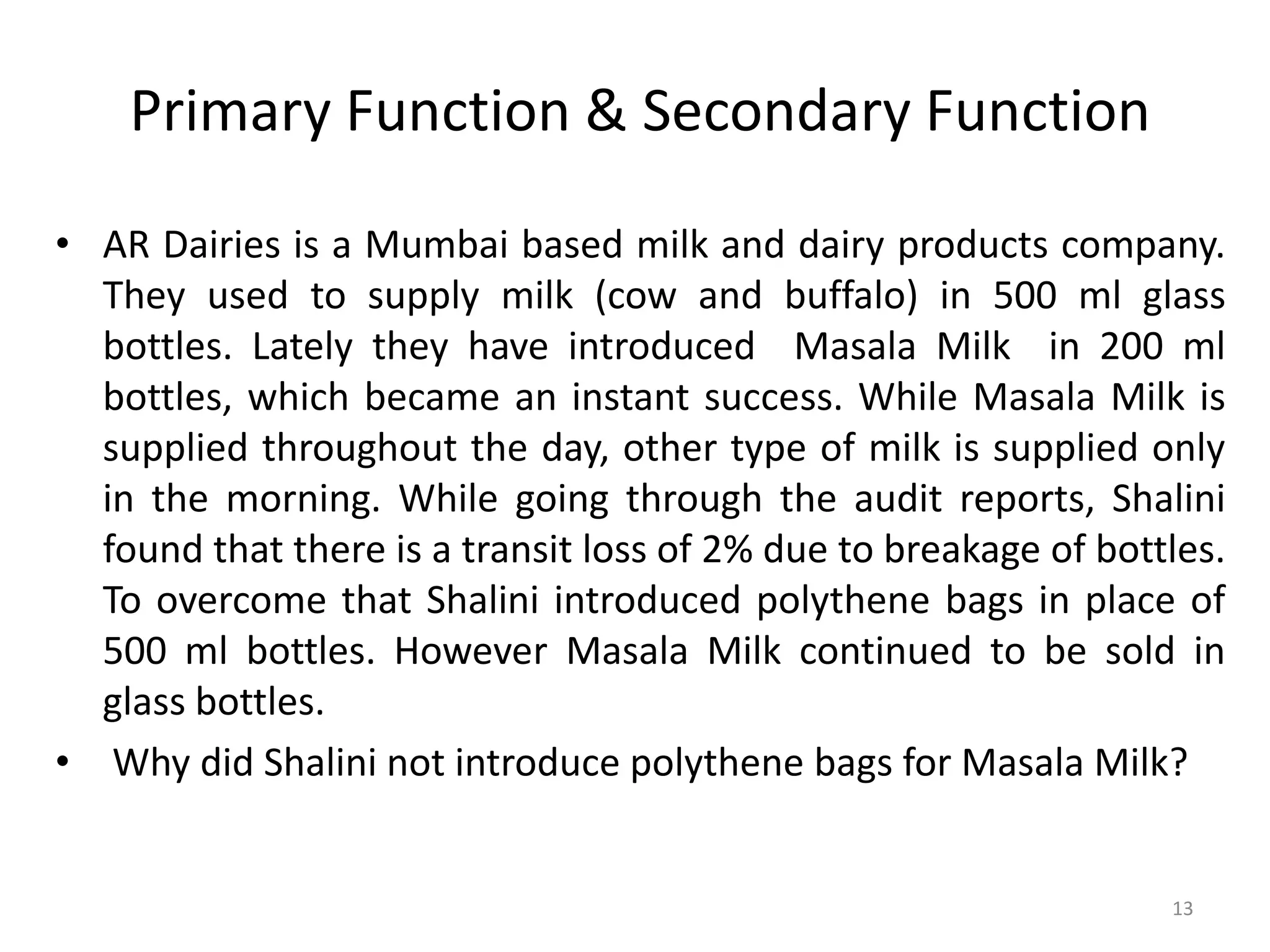
Primary Function & Secondary Function
• AR Dairies is a Mumbai based milk and dairy products company.
They used to supply milk (cow and buffalo) in 500 ml glass
bottles. Lately they have introduced Masala Milk in 200 ml
bottles, which became an instant success. While Masala Milk is
supplied throughout the day, other type of milk is supplied only
in the morning. While going through the audit reports, Shalini
found that there is a transit loss of 2% due to breakage of bottles.
To overcome that Shalini introduced polythene bags in place of
500 ml bottles. However Masala Milk continued to be sold in
glass bottles.
• Why did Shalini not introduce polythene bags for Masala Milk?
13
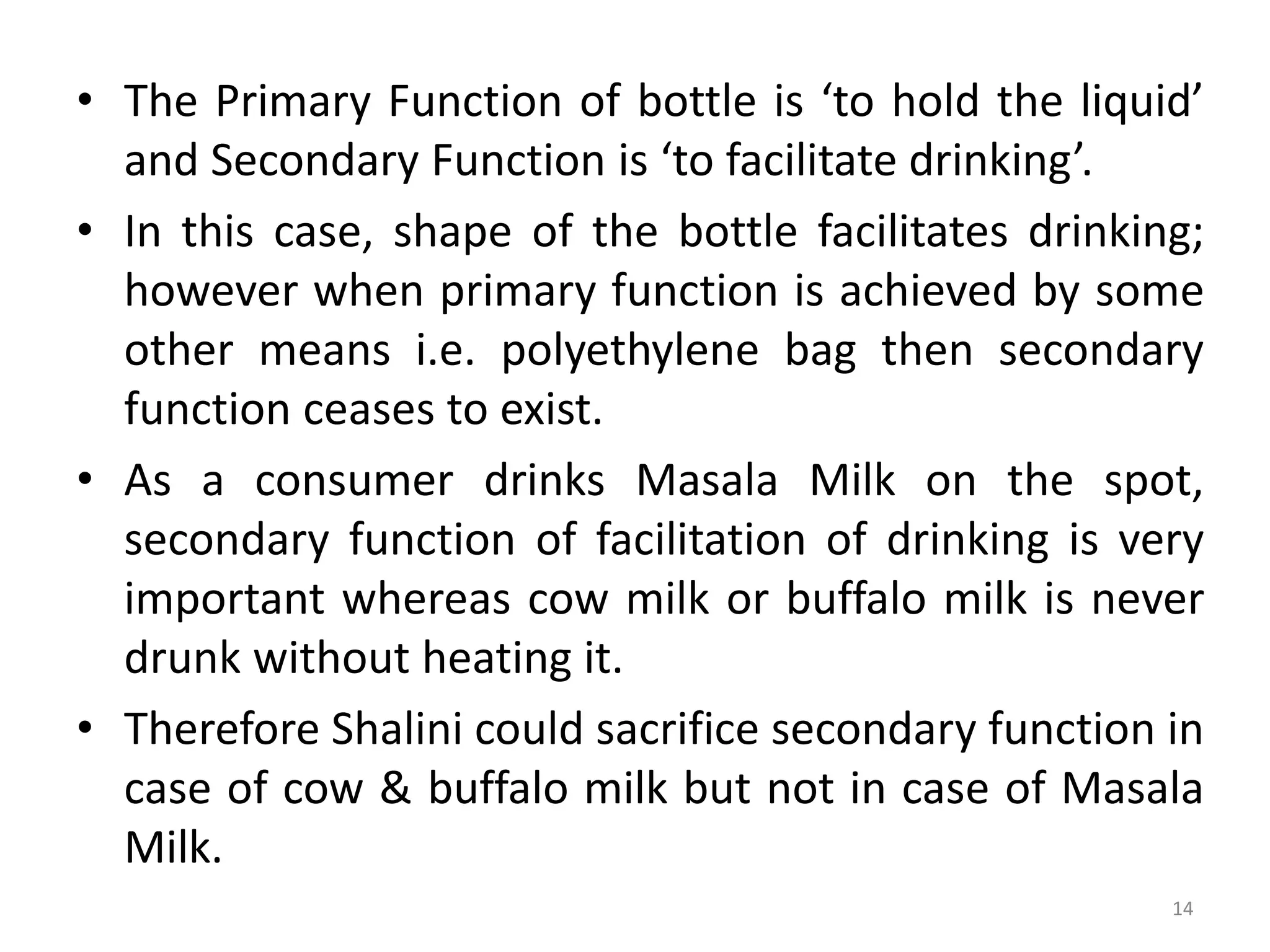
• The Primary Function of bottle is ‘to hold the liquid’
and Secondary Function is ‘to facilitate drinking’.
• In this case, shape of the bottle facilitates drinking;
however when primary function is achieved by some
other means i.e. polyethylene bag then secondary
function ceases to exist.
• As a consumer drinks Masala Milk on the spot,
secondary function of facilitation of drinking is very
important whereas cow milk or buffalo milk is never
drunk without heating it.
• Therefore Shalini could sacrifice secondary function in
case of cow & buffalo milk but not in case of Masala
Milk.
14
Higher Order & Lower Order Function
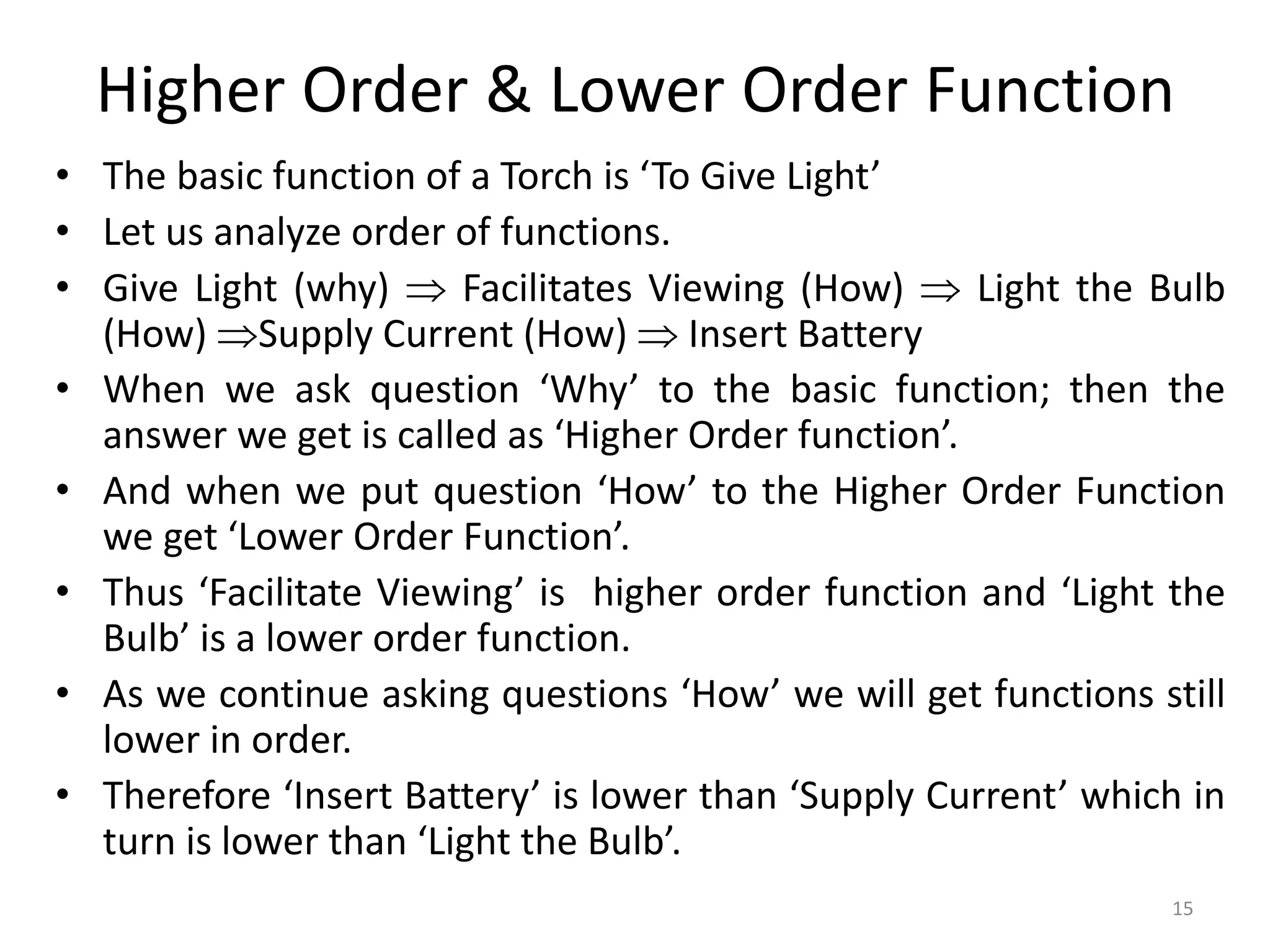
• The basic function of a Torch is ‘To Give Light’
• Let us analyze order of functions.
• Give Light (why)  Facilitates Viewing (How)  Light the Bulb
(How) Supply Current (How)  Insert Battery
• When we ask question ‘Why’ to the basic function; then the
answer we get is called as ‘Higher Order function’.
• And when we put question ‘How’ to the Higher Order Function
we get ‘Lower Order Function’.
• Thus ‘Facilitate Viewing’ is higher order function and ‘Light the
Bulb’ is a lower order function.
• As we continue asking questions ‘How’ we will get functions still
lower in order.
• Therefore ‘Insert Battery’ is lower than ‘Supply Current’ which in
turn is lower than ‘Light the Bulb’.
15
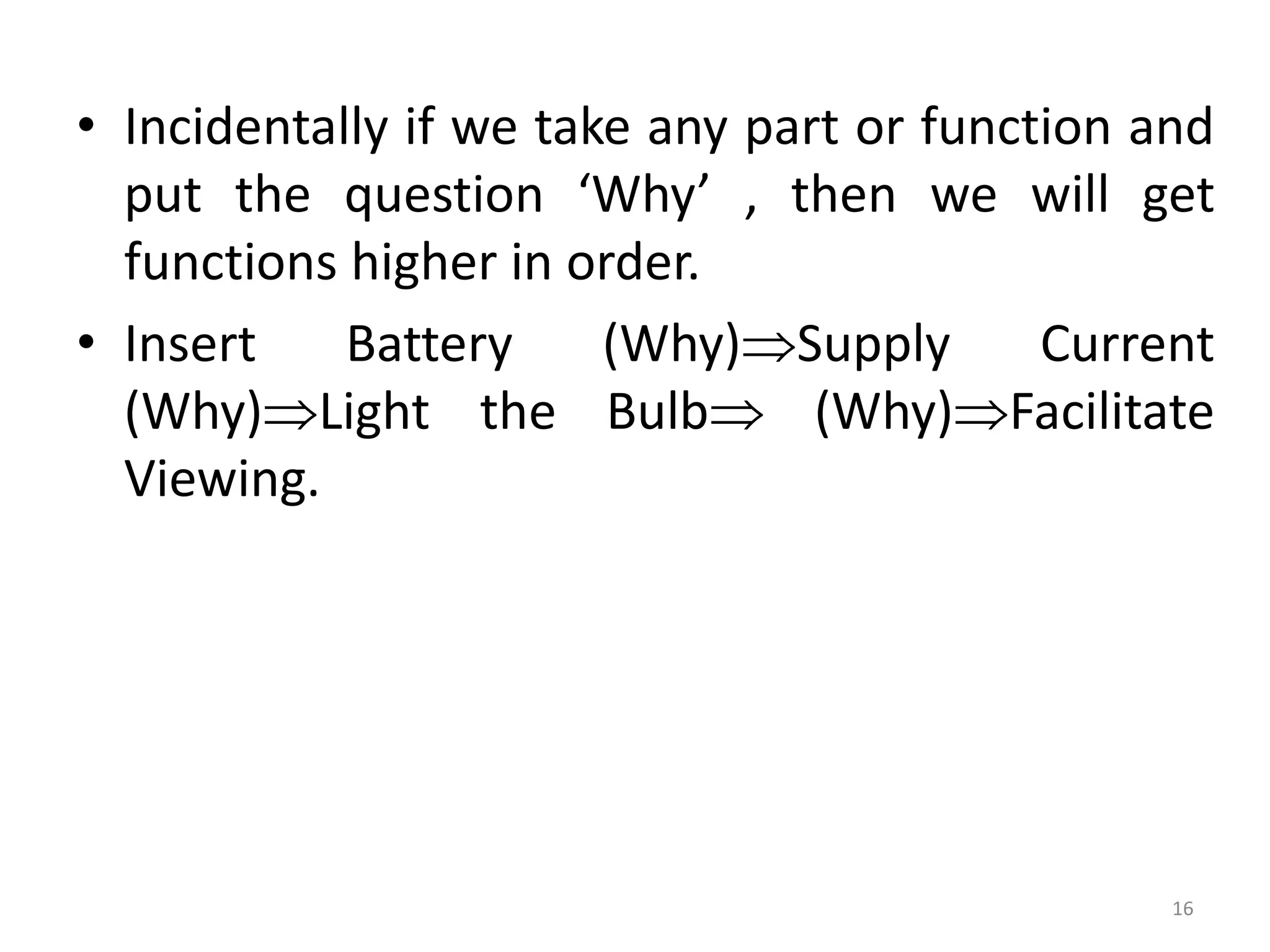
• Incidentally if we take any part or function and
put the question ‘Why’ , then we will get
functions higher in order.
• Insert Battery (Why)Supply Current
(Why)Light the Bulb (Why)Facilitate
Viewing.
16
Summary of Functions
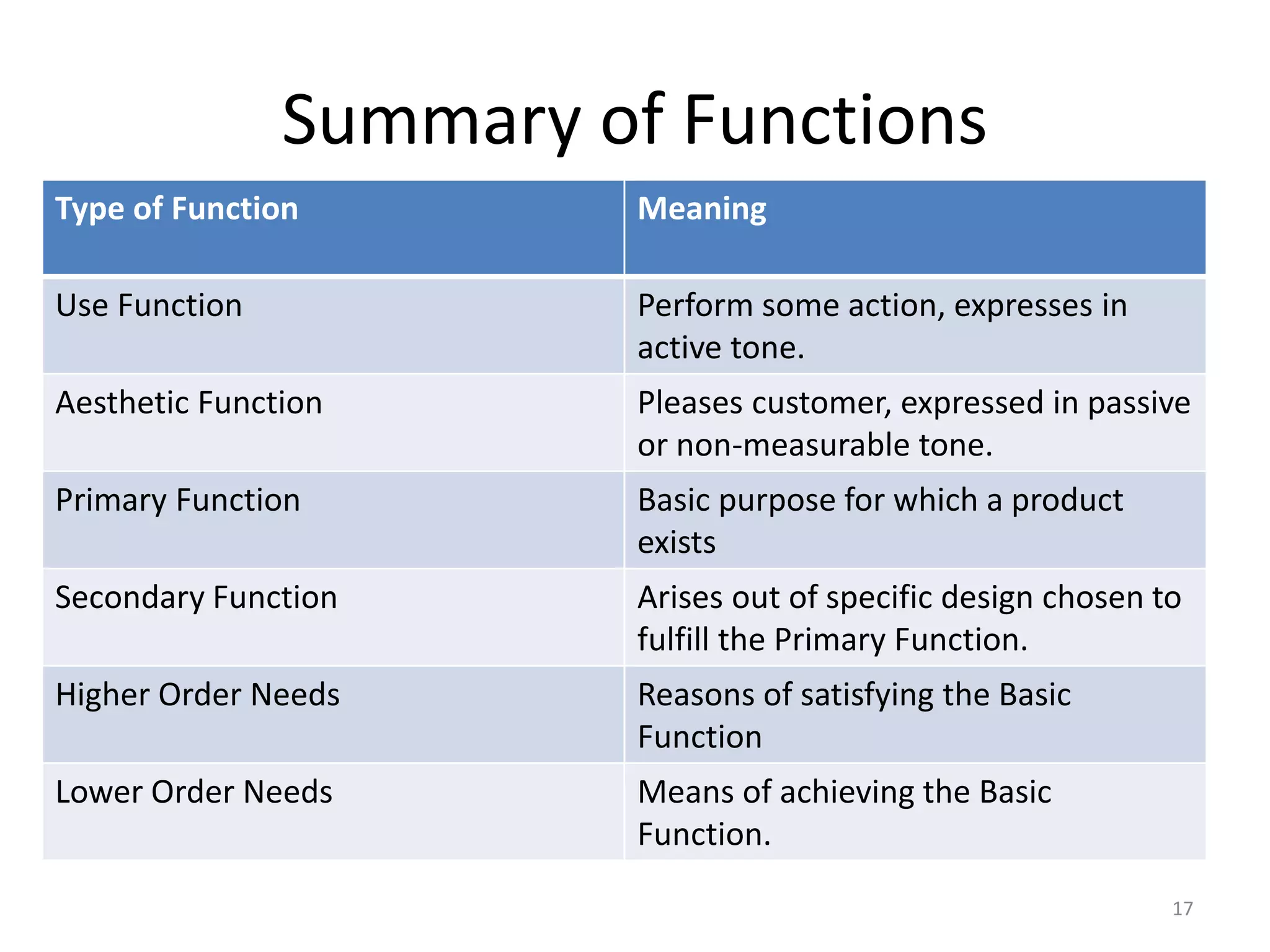
Type of Function Meaning
Use Function Perform some action, expresses in
active tone.
Aesthetic Function Pleases customer, expressed in passive
or non-measurable tone.
Primary Function Basic purpose for which a product
exists
Secondary Function Arises out of specific design chosen to
fulfill the Primary Function.
Higher Order Needs Reasons of satisfying the Basic
Function
Lower Order Needs Means of achieving the Basic
Function.
17
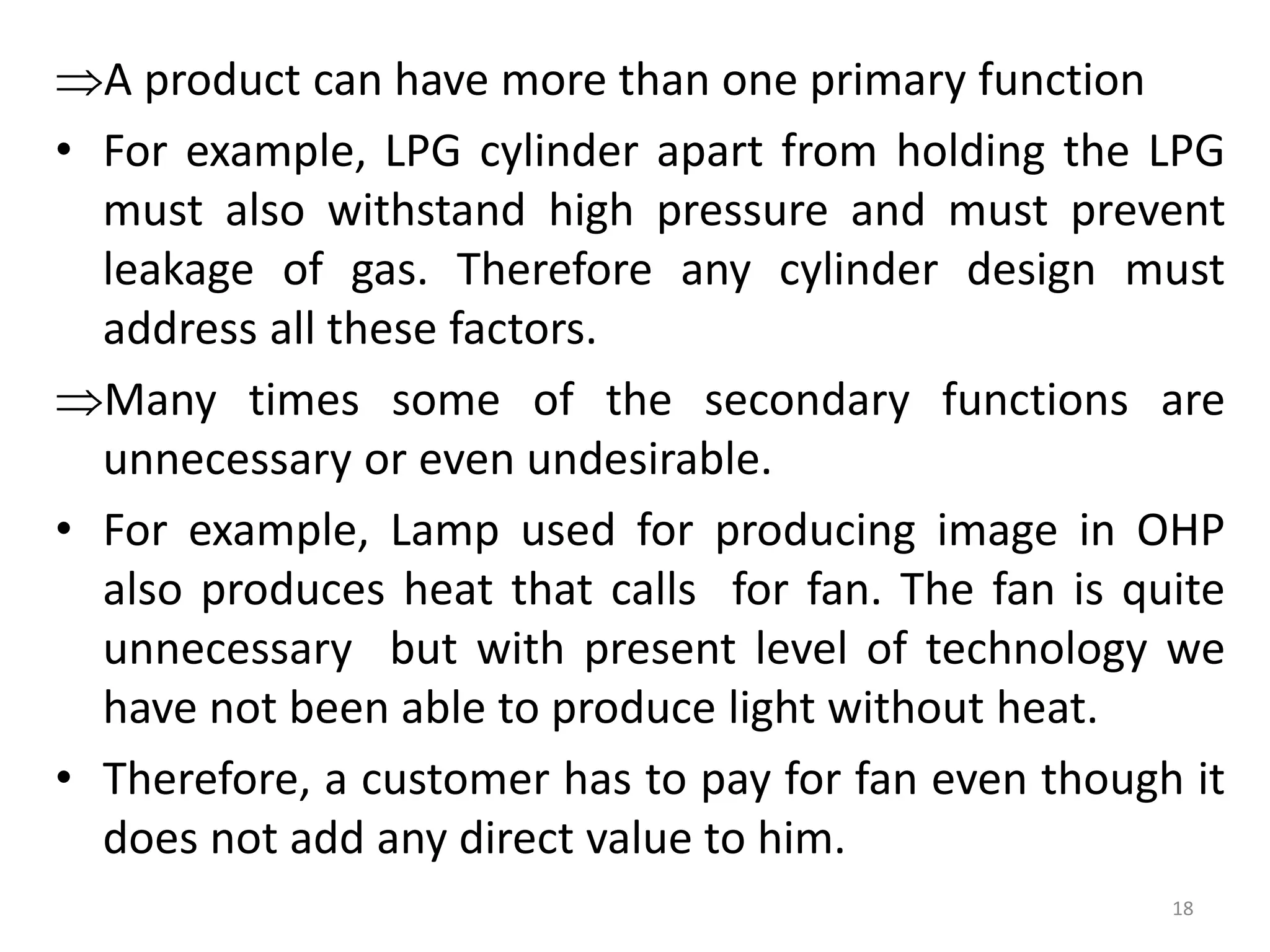
A product can have more than one primary function
• For example, LPG cylinder apart from holding the LPG
must also withstand high pressure and must prevent
leakage of gas. Therefore any cylinder design must
address all these factors.
Many times some of the secondary functions are
unnecessary or even undesirable.
• For example, Lamp used for producing image in OHP
also produces heat that calls for fan. The fan is quite
unnecessary but with present level of technology we
have not been able to produce light without heat.
• Therefore, a customer has to pay for fan even though it
does not add any direct value to him.
18
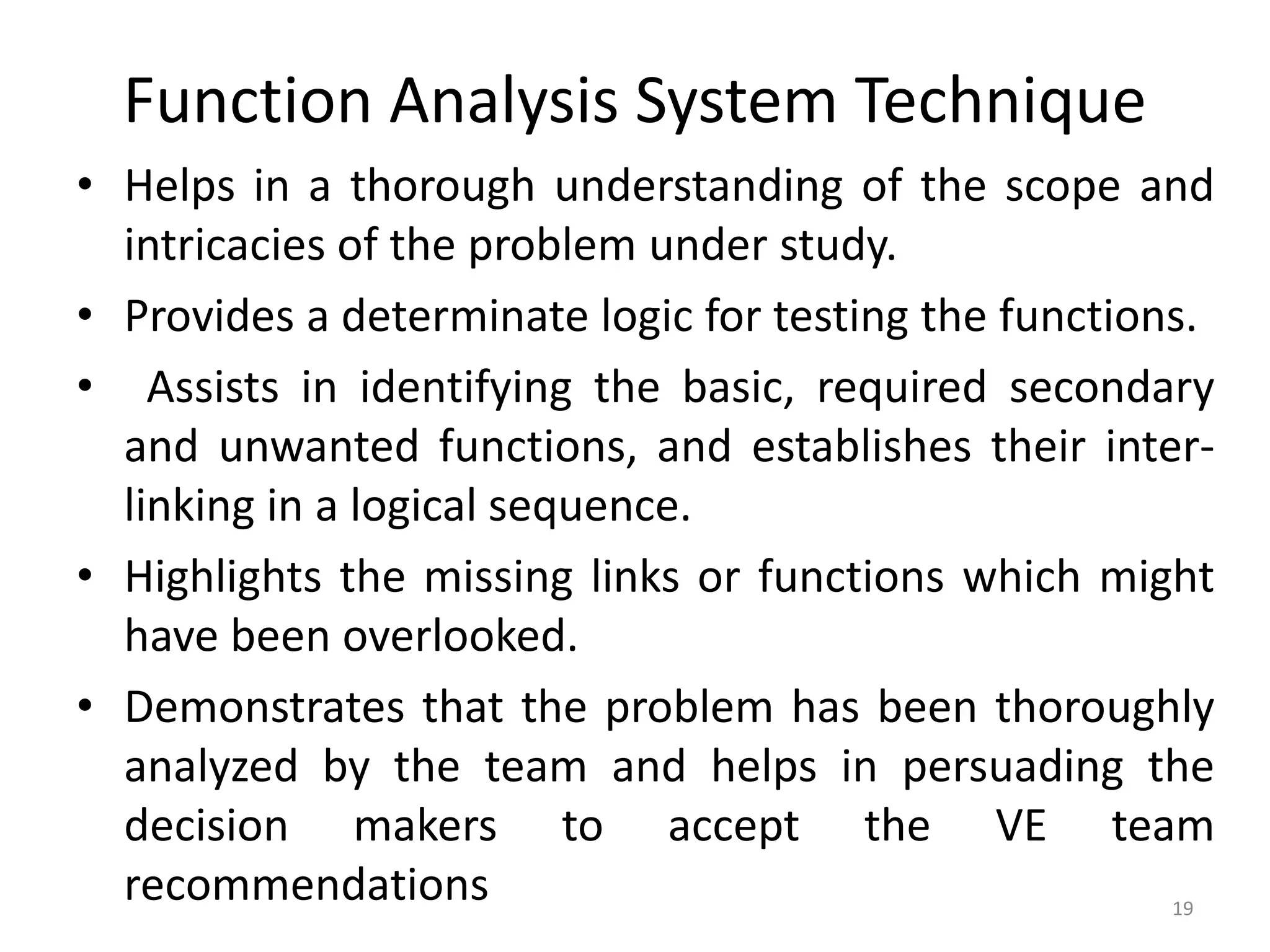
Function Analysis System Technique
• Helps in a thorough understanding of the scope and
intricacies of the problem under study.
• Provides a determinate logic for testing the functions.
• Assists in identifying the basic, required secondary
and unwanted functions, and establishes their inter-
linking in a logical sequence.
• Highlights the missing links or functions which might
have been overlooked.
• Demonstrates that the problem has been thoroughly
analyzed by the team and helps in persuading the
decision makers to accept the VE team
recommendations 19
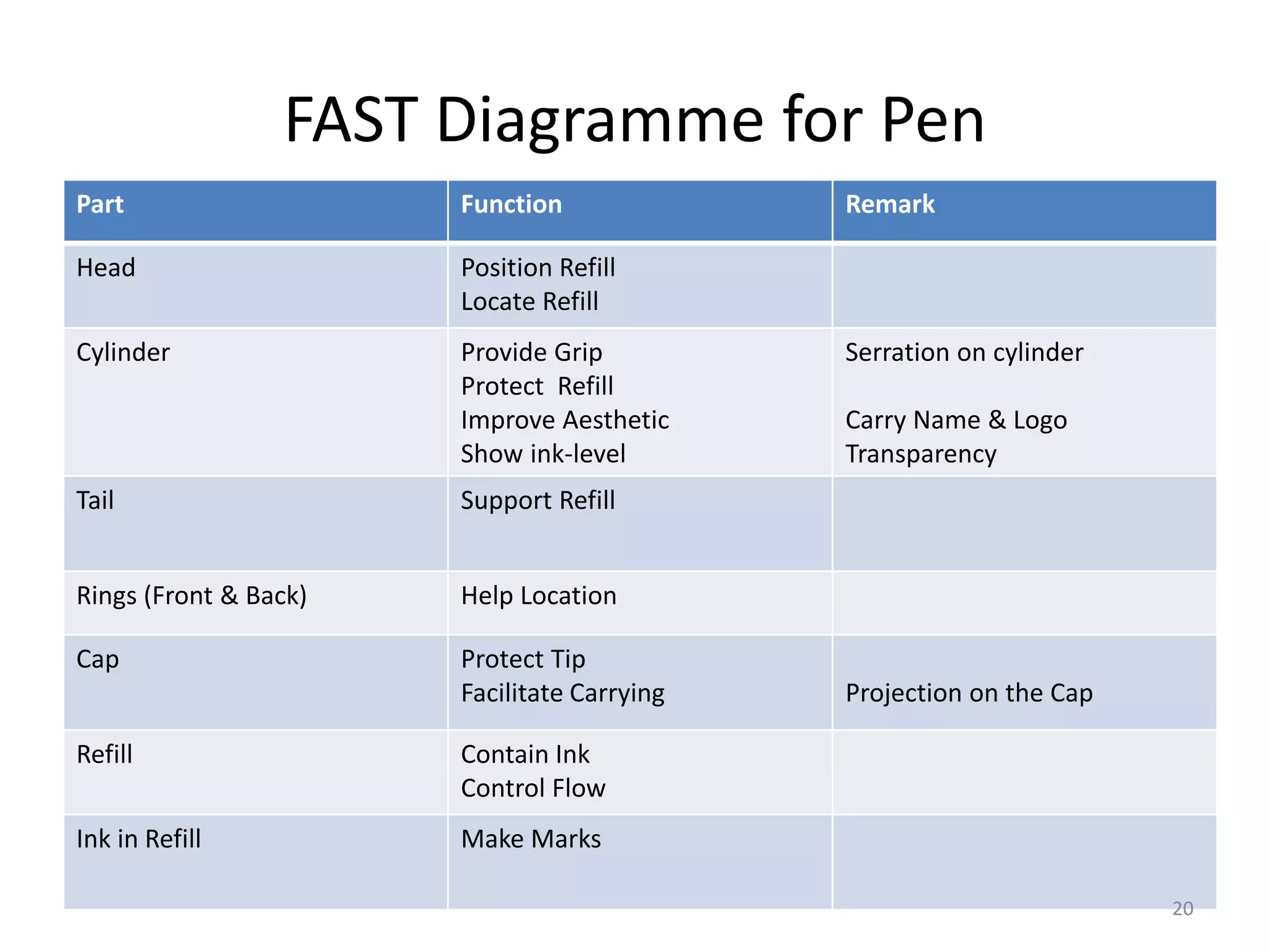
FAST Diagramme for Pen
Part Function Remark
Head Position Refill
Locate Refill
Cylinder Provide Grip
Protect Refill
Improve Aesthetic
Show ink-level
Serration on cylinder
Carry Name & Logo
Transparency
Tail Support Refill
Rings (Front & Back) Help Location
Cap Protect Tip
Facilitate Carrying Projection on the Cap
Refill Contain Ink
Control Flow
Ink in Refill Make Marks
20
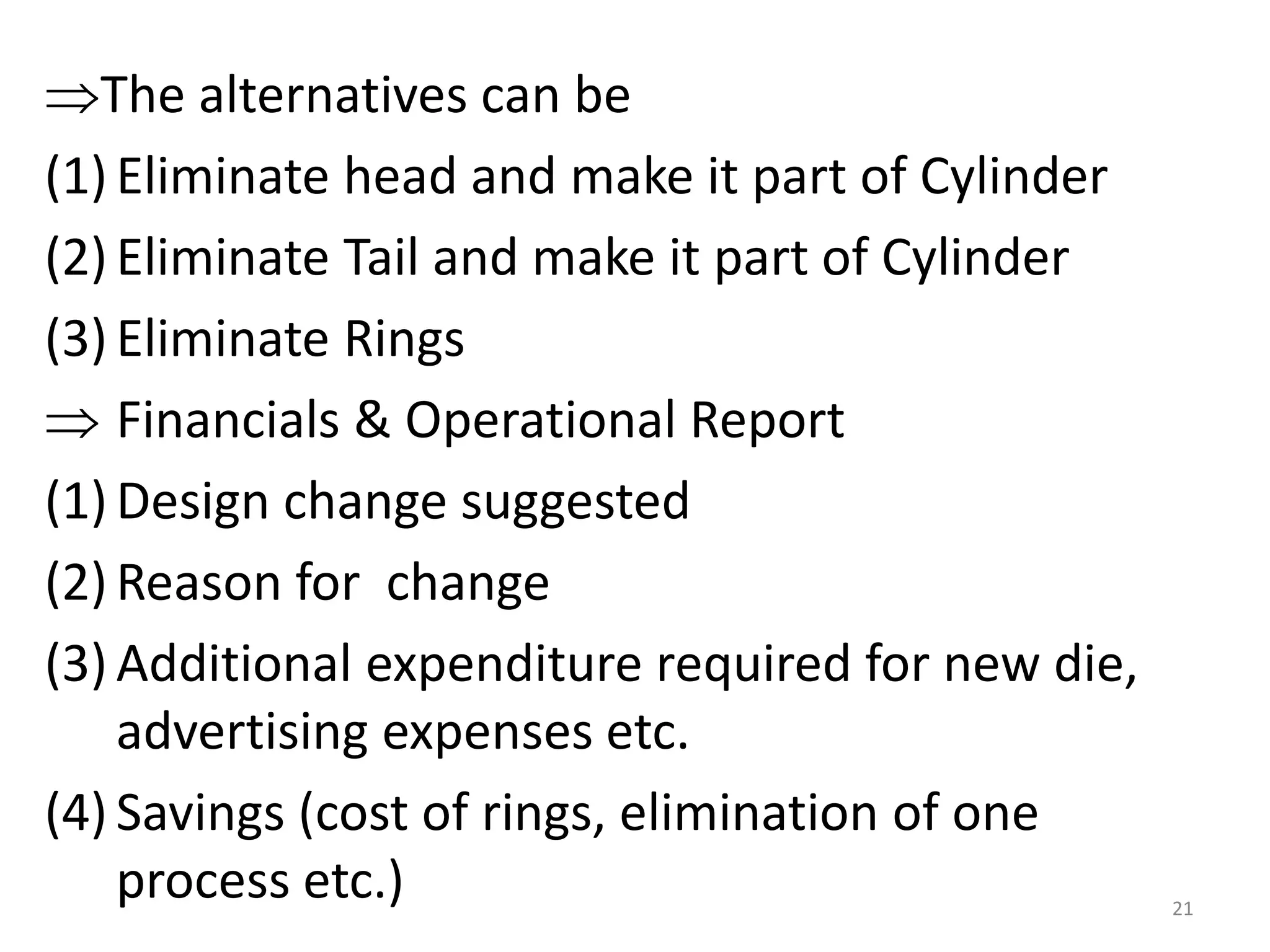
The alternatives can be
(1) Eliminate head and make it part of Cylinder
(2) Eliminate Tail and make it part of Cylinder
(3) Eliminate Rings
 Financials & Operational Report
(1) Design change suggested
(2) Reason for change
(3) Additional expenditure required for new die,
advertising expenses etc.
(4) Savings (cost of rings, elimination of one
process etc.) 21
Principles of Value Analysis
• Do not use a part that does not contribute to the value of the
product.
• Do not use a part whose cost is not proportional to its function/
usefulness.
• Do not provide any features to the component or finished
product that are not absolutely required.
• Accept change if part of required quality is made by a process
costing less than the alternative process.
• Use standardized parts wherever possible.
• Use proper manufacturing methods taking into account the
quantities.
• Use the material best suited for the purpose.
• Purchase the part instead of in-house manufacturing if suitable
supplier can provide the part of good quality at a reasonable
price.
22
When to Apply Value Analysis?
• Products are losing their market share and
there is a decline in sales.
• Products are priced higher than competition in
a price sensitive market or product cost is >
sales price of competition.
• New designs to be undertaken.
• Rising manufacturing costs.
23
Reasons for Unnecessary Costs
• Lack of relevant information leads to wrong
decisions which increase costs.
• Wrong beliefs in accepting opinions.
• Lack of ideas.
24
Strategic Steps In Value Analysis
• Determine function and cost of each element
in finished product.
• Consider alternatives that fulfill functions.
• Select best alternative which includes
standardized materials and standardized
dimensions.
• Strategic choice of make products or
subcontract.
• Modify design to reduce costs.
25
Value Analysis Procedure
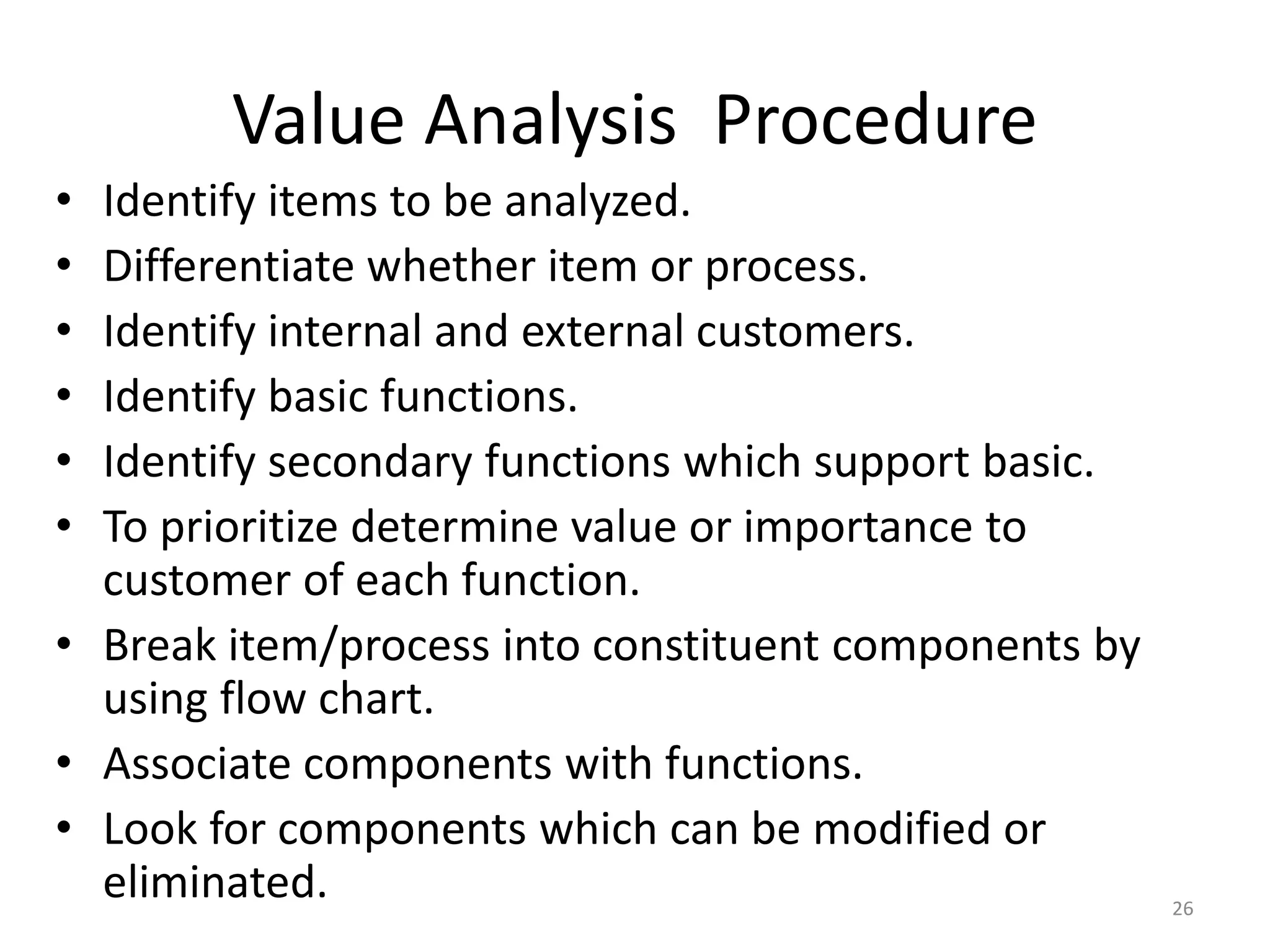
• Identify items to be analyzed.
• Differentiate whether item or process.
• Identify internal and external customers.
• Identify basic functions.
• Identify secondary functions which support basic.
• To prioritize determine value or importance to
customer of each function.
• Break item/process into constituent components by
using flow chart.
• Associate components with functions.
• Look for components which can be modified or
eliminated. 26
Options in Value Analyses/Value
Engineering
• Modify
• Integrate
• Substitute
• Simplify
27
When to Use Value Analysis/Value
Engineering
• Aim is to evaluate real value of
Product/process
• Focus is on saving costs
• Aim is on increasing value of process/product.
28
Benefits of Value Engineering
• Cost reduction /elimination techniques.
• Balances costs and performance
• Prevents overdesign of product (Customer
Function Deployment)
• Increases profits and reduces costs.
• Increases customer satisfaction
29
Examples of Value Analysis
• Modify-Motor car engines have been modified
to run on LPG/CNG
• Integrate-Air conditioner and heater integrated
into one unit.
• Substitute-In-house wiring has been changed
from copper to aluminum or coke bottles
changed from Glass to Plastic.
• Simplify-Application software simplified by being
made modular. Earlier all modules were
bundled or an equipment made modular which
simplifies transportation and maintenance
30
THANK YOU
31

Value analysis and value engineering

  • 1.
    Value Analysis andValue Engineering By – Ravishankar K SRESCOE
  • 2.
    Value Analysis andValue Engineering • Value Analysis is a technique that allows to increase the value of a product or a service systematically, eliminating all the functions that do not add any value or benefit to the product. • A product or process exists to fulfill a need. • This need or set of needs is termed as a function, that the product or process satisfies. • For instance, knife exists to fulfill the need of cutting and hence to cut is the function of knife. 2
  • 3.
    What is meantby term Value? • Value is a function of ‘Desired Performance’ and ‘Cost’. • Expressed as Desired Performance (P) ÷ Overall Costs (C) • Desired performance is expressed by the term worth which is defined as the lowest cost to achieve the Use (work) function and Aesthetic (sell) function. 3
  • 4.
    How do defineVA & VE • Very often the two terms Value Analysis and Value Engineering are used synonymously. • However, difference between them will be clear from the way they originated. How VA originated? • During the Second World War, U.S. government reserved certain materials from armament industry. • Therefore, General Electric Company found itself in fix as many of their regularly used materials suddenly became unavailable due to reservation. 4
  • 5.
    • A purchaseexecutive of the company, Lawrence D. Miles made many substitutions in place of original materials. • Surprisingly, the results showed that substituted materials did not affect the quality but brought costs down. • Later Larry developed a step by step approach for this exercise and named the technique as Value Analysis.  Thus it is a step by step approach to identify the functions of a product, process, system or service; to establish a monetary value for that function and then provide the desired function at an overall minimum cost without affecting any of the existing parameters like Quality, Maintainability, Productivity, Safety and other Performance Characteristics. 5
  • 6.
    • In theyear 1954, U.S. Navy Bureau of Ships adopted same technique in their effort at ‘cost avoidance’ during the design stage and saved million of dollars . • They named this technique as Value Engineering. Value Engineering is where the value of all components used in construction of a product from design to final delivery stage are completely analyzed and pursued. • Thus, Value Engineering indicates application at design stage whereas Value Analysis is the application on the product that is into manufacturing. 6
  • 7.
    Difference between ValueAnalysis and Value Engineering 7 Value Analysis Value Engineering Indicates application on the product that is into manufacturing. Indicates application on the product at its design stage Workers, subcontractors and engineers come together to make a team with experience and knowledge Done by a specific product design team (Engineers) May change the present stage of the product or operation Changes are executed at the initial stages only. Worked out mostly with the help of knowledge and experience Requires specific technical knowledge
  • 8.
    What is themeaning of overall costs? For a manufacturer/ producer • Overall cost is summation of all elements of the costs required to produce or service such as labour, material, overhead etc. For a consumer • Overall cost is the monetary sum (price) for which the product or service is purchased in the market. 8
  • 9.
    The Value ofthe a function V= P/C can be increased by four methods. (1) Decrease the cost while ensuring the same level of performance. • Reduce the thickness of wooden drums in case of packing of telephone cables. • Earlier CDs and DVDs were sold at above Rs 100/- Moser Baer introduced the same at almost half the price. (2) Enhance the performance at the same cost • Providing a supplement of Mumbai Mirror along with the copy of The Times of India at no extra cost. 9
  • 10.
    (3) Decrease thecost and increase the performance • Intel’s Pentium chip is cheaper and has much more processing power than all its earlier chips. (4) Increase both performance and cost ensuring that performance increases more than the increase in cost. • American cola giant increased quantity of soft drink from 250 ml to 300 ml (20% more) but increased price just by 10%  In all the above cases ‘cost’ is viewed at from customer’s point of view. 10
  • 11.
    Value Analysis Tests ►Eachproduct or component is subjected to the following tests: • Does its use contribute value? • Is its cost proportional to its usefulness? • Does it need all its features? • Is there anything better for the intended use? • Can a usable part be made by lower cost method? • Can a standard product be found which will be usable? • Is it made on proper tooling, considering quantities used? • Do materials, reasonable labour, overhead, and profit total its cost? • Will another dependable supplier provide it for less? • Is anyone buying it for less? 11
  • 12.
    Functions-Use and Aesthetics A.Use function - Prashant wants to go for a trek to a place 15 kms from Karjat. He wants to purchase shoes that will protect his feet from stones and thorns etc. Therefore he opts for ‘Hunter shoes’. - To protect feet is called as the Use Function of the shoes. B. Aesthetic function - Parag is preparing for prize distribution ceremony of his college. Dressed in blazer he will be putting on black leather shoes with good appearance. - To give good appearance is called as the Aesthetic Function of shoes.  Use and Aesthetic functions are always present in all the products. Depending on the user and the need, one function assumes predominance over other. 12
  • 13.
    Primary Function &Secondary Function • AR Dairies is a Mumbai based milk and dairy products company. They used to supply milk (cow and buffalo) in 500 ml glass bottles. Lately they have introduced Masala Milk in 200 ml bottles, which became an instant success. While Masala Milk is supplied throughout the day, other type of milk is supplied only in the morning. While going through the audit reports, Shalini found that there is a transit loss of 2% due to breakage of bottles. To overcome that Shalini introduced polythene bags in place of 500 ml bottles. However Masala Milk continued to be sold in glass bottles. • Why did Shalini not introduce polythene bags for Masala Milk? 13
  • 14.
    • The PrimaryFunction of bottle is ‘to hold the liquid’ and Secondary Function is ‘to facilitate drinking’. • In this case, shape of the bottle facilitates drinking; however when primary function is achieved by some other means i.e. polyethylene bag then secondary function ceases to exist. • As a consumer drinks Masala Milk on the spot, secondary function of facilitation of drinking is very important whereas cow milk or buffalo milk is never drunk without heating it. • Therefore Shalini could sacrifice secondary function in case of cow & buffalo milk but not in case of Masala Milk. 14
  • 15.
    Higher Order &Lower Order Function • The basic function of a Torch is ‘To Give Light’ • Let us analyze order of functions. • Give Light (why)  Facilitates Viewing (How)  Light the Bulb (How) Supply Current (How)  Insert Battery • When we ask question ‘Why’ to the basic function; then the answer we get is called as ‘Higher Order function’. • And when we put question ‘How’ to the Higher Order Function we get ‘Lower Order Function’. • Thus ‘Facilitate Viewing’ is higher order function and ‘Light the Bulb’ is a lower order function. • As we continue asking questions ‘How’ we will get functions still lower in order. • Therefore ‘Insert Battery’ is lower than ‘Supply Current’ which in turn is lower than ‘Light the Bulb’. 15
  • 16.
    • Incidentally ifwe take any part or function and put the question ‘Why’ , then we will get functions higher in order. • Insert Battery (Why)Supply Current (Why)Light the Bulb (Why)Facilitate Viewing. 16
  • 17.
    Summary of Functions Typeof Function Meaning Use Function Perform some action, expresses in active tone. Aesthetic Function Pleases customer, expressed in passive or non-measurable tone. Primary Function Basic purpose for which a product exists Secondary Function Arises out of specific design chosen to fulfill the Primary Function. Higher Order Needs Reasons of satisfying the Basic Function Lower Order Needs Means of achieving the Basic Function. 17
  • 18.
    A product canhave more than one primary function • For example, LPG cylinder apart from holding the LPG must also withstand high pressure and must prevent leakage of gas. Therefore any cylinder design must address all these factors. Many times some of the secondary functions are unnecessary or even undesirable. • For example, Lamp used for producing image in OHP also produces heat that calls for fan. The fan is quite unnecessary but with present level of technology we have not been able to produce light without heat. • Therefore, a customer has to pay for fan even though it does not add any direct value to him. 18
  • 19.
    Function Analysis SystemTechnique • Helps in a thorough understanding of the scope and intricacies of the problem under study. • Provides a determinate logic for testing the functions. • Assists in identifying the basic, required secondary and unwanted functions, and establishes their inter- linking in a logical sequence. • Highlights the missing links or functions which might have been overlooked. • Demonstrates that the problem has been thoroughly analyzed by the team and helps in persuading the decision makers to accept the VE team recommendations 19
  • 20.
    FAST Diagramme forPen Part Function Remark Head Position Refill Locate Refill Cylinder Provide Grip Protect Refill Improve Aesthetic Show ink-level Serration on cylinder Carry Name & Logo Transparency Tail Support Refill Rings (Front & Back) Help Location Cap Protect Tip Facilitate Carrying Projection on the Cap Refill Contain Ink Control Flow Ink in Refill Make Marks 20
  • 21.
    The alternatives canbe (1) Eliminate head and make it part of Cylinder (2) Eliminate Tail and make it part of Cylinder (3) Eliminate Rings  Financials & Operational Report (1) Design change suggested (2) Reason for change (3) Additional expenditure required for new die, advertising expenses etc. (4) Savings (cost of rings, elimination of one process etc.) 21
  • 22.
    Principles of ValueAnalysis • Do not use a part that does not contribute to the value of the product. • Do not use a part whose cost is not proportional to its function/ usefulness. • Do not provide any features to the component or finished product that are not absolutely required. • Accept change if part of required quality is made by a process costing less than the alternative process. • Use standardized parts wherever possible. • Use proper manufacturing methods taking into account the quantities. • Use the material best suited for the purpose. • Purchase the part instead of in-house manufacturing if suitable supplier can provide the part of good quality at a reasonable price. 22
  • 23.
    When to ApplyValue Analysis? • Products are losing their market share and there is a decline in sales. • Products are priced higher than competition in a price sensitive market or product cost is > sales price of competition. • New designs to be undertaken. • Rising manufacturing costs. 23
  • 24.
    Reasons for UnnecessaryCosts • Lack of relevant information leads to wrong decisions which increase costs. • Wrong beliefs in accepting opinions. • Lack of ideas. 24
  • 25.
    Strategic Steps InValue Analysis • Determine function and cost of each element in finished product. • Consider alternatives that fulfill functions. • Select best alternative which includes standardized materials and standardized dimensions. • Strategic choice of make products or subcontract. • Modify design to reduce costs. 25
  • 26.
    Value Analysis Procedure •Identify items to be analyzed. • Differentiate whether item or process. • Identify internal and external customers. • Identify basic functions. • Identify secondary functions which support basic. • To prioritize determine value or importance to customer of each function. • Break item/process into constituent components by using flow chart. • Associate components with functions. • Look for components which can be modified or eliminated. 26
  • 27.
    Options in ValueAnalyses/Value Engineering • Modify • Integrate • Substitute • Simplify 27
  • 28.
    When to UseValue Analysis/Value Engineering • Aim is to evaluate real value of Product/process • Focus is on saving costs • Aim is on increasing value of process/product. 28
  • 29.
    Benefits of ValueEngineering • Cost reduction /elimination techniques. • Balances costs and performance • Prevents overdesign of product (Customer Function Deployment) • Increases profits and reduces costs. • Increases customer satisfaction 29
  • 30.
    Examples of ValueAnalysis • Modify-Motor car engines have been modified to run on LPG/CNG • Integrate-Air conditioner and heater integrated into one unit. • Substitute-In-house wiring has been changed from copper to aluminum or coke bottles changed from Glass to Plastic. • Simplify-Application software simplified by being made modular. Earlier all modules were bundled or an equipment made modular which simplifies transportation and maintenance 30
  • 31.