 History
 Value Concept
 What is Value Engineering?
 Implementation of VE in our project
 Principle and Purpose of VE
 Case Study
 Conclusion
Outline
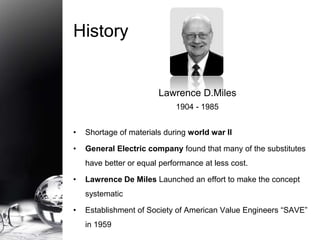
Lawrence D.Miles
1904 - 1985
• Shortage of materials during world war II
• General Electric company found that many of the substitutes
have better or equal performance at less cost.
• Lawrence De Miles Launched an effort to make the concept
systematic
• Establishment of Society of American Value Engineers “SAVE”
in 1959
History
• Value is the lowest price you must pay to provide a reliable
function or service (L. D. Miles)
• “The ratio of Function to Cost”
What is Value?
Value =
Worth
Cost
=
Function(Utility)
Cost
Why do Projects have “Unnecessary” Costs?
1. Low Time for Designing
2. Lack of information
3. Lack of Ideas
4. Negative Prejudice
5. Lack Of Experience
6. Weaknesses in human relations
7. Multi Concept
…
Waste Cost
What is Value Engineering?
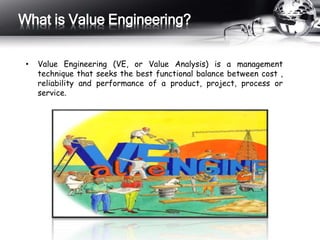
• Value Engineering (VE, or Value Analysis) is a management
technique that seeks the best functional balance between cost ,
reliability and performance of a product, project, process or
service.
Implementation
• How is a Value Engineering Study Conducted?
The Job Plan
Value engineering is often done by systematically following
a multi-stage job plan. Larry Miles' original system was a
six-step procedure which he called the "value analysis job
plan."
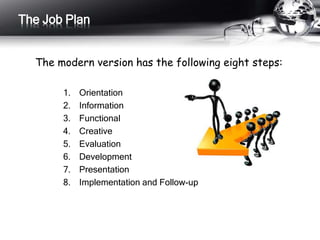
The modern version has the following eight steps:
1. Orientation
2. Information
3. Functional
4. Creative
5. Evaluation
6. Development
7. Presentation
8. Implementation and Follow-up
The Job Plan
 Identify issues
 Prioritize Issues
 Drafts scopes and objective
 Establish evaluation factors
 Determine Study Team
 Collect Data
 Prepare for value study
 ...
The Job Plan
1. Orientation Phase
 Further familiarization of the project by the team; all team
members participate in determine the true needs of the project.
 Areas of high cost or low worth are identified.
The Job Plan
2. Information Phase
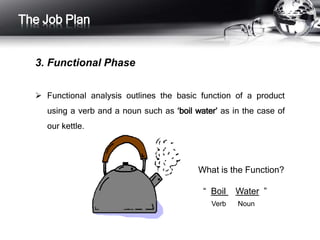
 Functional analysis outlines the basic function of a product
using a verb and a noun such as ‘boil water’ as in the case of
our kettle.
The Job Plan
3. Functional Phase
What is the Function?
“ Boil Water ”
Verb Noun
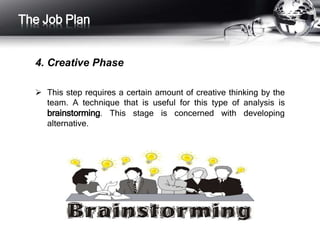
 This step requires a certain amount of creative thinking by the
team. A technique that is useful for this type of analysis is
brainstorming. This stage is concerned with developing
alternative.
The Job Plan
4. Creative Phase
 In this phase of the workshop, the VA team
judges the ideas developed during the creative
phase.
 The VA team ranks the ideas.
 Ideas found to be irrelevant or not worthy of
additional study are disregarded.
 Those ideas that represent the greatest potential
for cost savings and improvements are selected
for development.
The Job Plan
5. Evaluation Phase
 The team develops the selected ideas into
alternatives (or proposals) with a sufficient
level of documentation to allow decision
makers to determine if the alternative should
be implemented.
The Job Plan
6. Development Phase
1. The presentation phase is actually
presenting the best alternative (or
alternatives) to those who have the
authority to implement the proposed
solutions that are acceptable.
The Job Plan
7. Presentation Phase
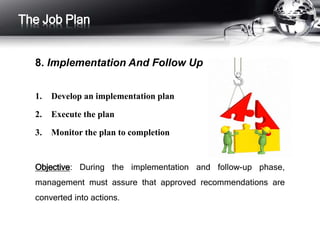
1. Develop an implementation plan
2. Execute the plan
3. Monitor the plan to completion
Objective: During the implementation and follow-up phase,
management must assure that approved recommendations are
converted into actions.
The Job Plan
8. Implementation And Follow Up
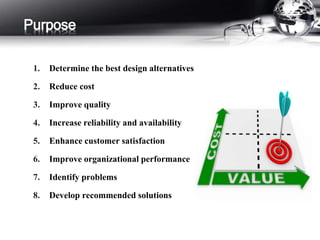
1. Determine the best design alternatives
2. Reduce cost
3. Improve quality
4. Increase reliability and availability
5. Enhance customer satisfaction
6. Improve organizational performance
7. Identify problems
8. Develop recommended solutions
Purpose
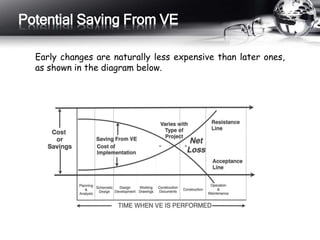
Potential Saving From VE
Early changes are naturally less expensive than later ones,
as shown in the diagram below.
Value Engineering principles:
Principles
Systematic method for evaluating product performance
and value
The use of multi-functional teams
Focus on a simplified product
1
2
3
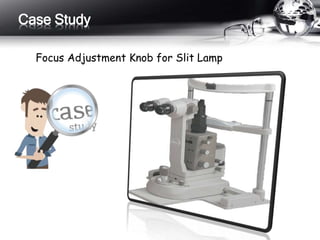
Focus Adjustment Knob for Slit Lamp
Case Study
Introduce the Product
• In this presentation we have considered a medical instrument
manufacturing company, Aadarsh Instruments, located in Ambala.
• This firm is producing different types of microscopes which they
export to various countries around the globe.
• One of their model SL250 have a component named Focus
Adjustment Knob for Slit Lamp in microscope. This microscope has
found application in the field of eye inspection.
Case Study
1. Product selection plan
2. Gather information of product
3. Functional analysis
4. Creativity Worksheet
5. Evaluation sheet
6. Cost analysis
7. Result
Case Study
The steps used for this purpose are as follows:
1. Plan For Product Selection
• This Product is used to adjust the focus of lens for magnification
purpose.
• The present specifications of this part and its material used are
costlier than the average industry cost.
• Value of this product can be increased by maintaining its functions
and reducing its cost or keeping the cost constant and increasing
the functionality of the product.
Case Study
2. Obtain Product Information
i. Material – Aluminum Bronze Alloy
ii. Diameter of base plate –30 mm
iii. Thickness of plate--3 mm
iv. Cost of the scrap is – 293 rupee/Kg
v. Pieces Produced annually – 8000
vi. Process used – C.N.C. indexing milling
vii. Cycle time—2.5 min
viii. Anodizing—2/min
ix. Material cost—65 gm
x. Total Present cost – 29.99 rupee /piece
*{1$=56 rupee}*
Case Study
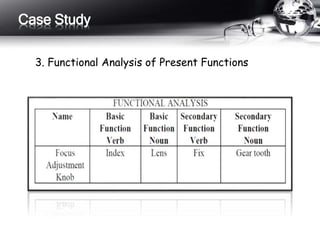
3. Functional Analysis of Present Functions
Case Study
4. Develop Alternate Design Or Methods
During brainstorming these ideas were listed:
i. Change design
ii. Change material
iii. Use plastic
iv. Make it lighter
v. Change the production process
vi. Use nylon indexing unit
Case Study
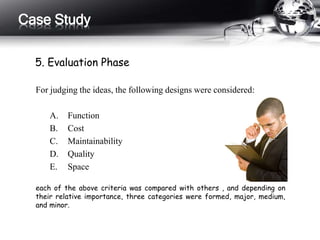
5. Evaluation Phase
For judging the ideas, the following designs were considered:
A. Function
B. Cost
C. Maintainability
D. Quality
E. Space
each of the above criteria was compared with others , and depending on
their relative importance, three categories were formed, major, medium,
and minor.
Case Study
5. Evaluation Phase
For judging the ideas, the following designs were considered:
A. Function
B. Cost
C. Maintainability
D. Quality
E. Space
each of the above criteria was compared with others , and depending on
their relative importance, three categories were formed, major, medium,
and minor.
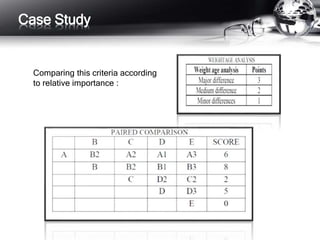
Case Study
Comparing this criteria according
to relative importance :
Case Study
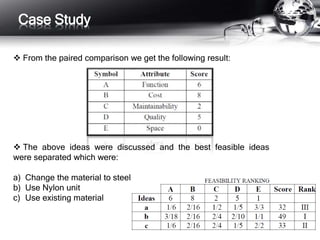
 From the paired comparison we get the following result:
Case Study
 The above ideas were discussed and the best feasible ideas
were separated which were:
a) Change the material to steel
b) Use Nylon unit
c) Use existing material
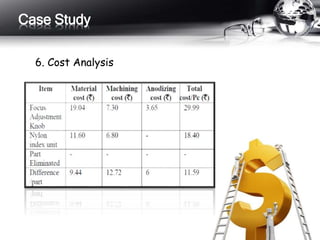
6. Cost Analysis
Case Study
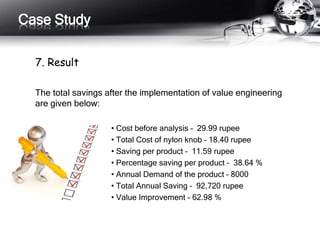
7. Result
The total savings after the implementation of value engineering
are given below:
• Cost before analysis – 29.99 rupee
• Total Cost of nylon knob – 18.40 rupee
• Saving per product – 11.59 rupee
• Percentage saving per product – 38.64 %
• Annual Demand of the product – 8000
• Total Annual Saving – 92,720 rupee
• Value Improvement - 62.98 %
Case Study
Three goals that we're looking at value engineering:
1. Identify additional functions that aren’t
attractive to customers.
2. Add attractive functions for customers.
3. Saving because of the elimination of
redundant functions.
Conclusion

value engineering--conversion- Copy.pdf

  • 1.
     History  ValueConcept  What is Value Engineering?  Implementation of VE in our project  Principle and Purpose of VE  Case Study  Conclusion Outline
  • 2.
    Lawrence D.Miles 1904 -1985 • Shortage of materials during world war II • General Electric company found that many of the substitutes have better or equal performance at less cost. • Lawrence De Miles Launched an effort to make the concept systematic • Establishment of Society of American Value Engineers “SAVE” in 1959 History
  • 3.
    • Value isthe lowest price you must pay to provide a reliable function or service (L. D. Miles) • “The ratio of Function to Cost” What is Value? Value = Worth Cost = Function(Utility) Cost
  • 4.
    Why do Projectshave “Unnecessary” Costs? 1. Low Time for Designing 2. Lack of information 3. Lack of Ideas 4. Negative Prejudice 5. Lack Of Experience 6. Weaknesses in human relations 7. Multi Concept … Waste Cost
  • 5.
    What is ValueEngineering?
  • 6.
    What is ValueEngineering? • Value Engineering (VE, or Value Analysis) is a management technique that seeks the best functional balance between cost , reliability and performance of a product, project, process or service.
  • 7.
    Implementation • How isa Value Engineering Study Conducted?
  • 8.
    The Job Plan Valueengineering is often done by systematically following a multi-stage job plan. Larry Miles' original system was a six-step procedure which he called the "value analysis job plan."
  • 9.
    The modern versionhas the following eight steps: 1. Orientation 2. Information 3. Functional 4. Creative 5. Evaluation 6. Development 7. Presentation 8. Implementation and Follow-up The Job Plan
  • 10.
     Identify issues Prioritize Issues  Drafts scopes and objective  Establish evaluation factors  Determine Study Team  Collect Data  Prepare for value study  ... The Job Plan 1. Orientation Phase
  • 11.
     Further familiarizationof the project by the team; all team members participate in determine the true needs of the project.  Areas of high cost or low worth are identified. The Job Plan 2. Information Phase
  • 12.
     Functional analysisoutlines the basic function of a product using a verb and a noun such as ‘boil water’ as in the case of our kettle. The Job Plan 3. Functional Phase What is the Function? “ Boil Water ” Verb Noun
  • 13.
     This steprequires a certain amount of creative thinking by the team. A technique that is useful for this type of analysis is brainstorming. This stage is concerned with developing alternative. The Job Plan 4. Creative Phase
  • 14.
     In thisphase of the workshop, the VA team judges the ideas developed during the creative phase.  The VA team ranks the ideas.  Ideas found to be irrelevant or not worthy of additional study are disregarded.  Those ideas that represent the greatest potential for cost savings and improvements are selected for development. The Job Plan 5. Evaluation Phase
  • 15.
     The teamdevelops the selected ideas into alternatives (or proposals) with a sufficient level of documentation to allow decision makers to determine if the alternative should be implemented. The Job Plan 6. Development Phase
  • 16.
    1. The presentationphase is actually presenting the best alternative (or alternatives) to those who have the authority to implement the proposed solutions that are acceptable. The Job Plan 7. Presentation Phase
  • 17.
    1. Develop animplementation plan 2. Execute the plan 3. Monitor the plan to completion Objective: During the implementation and follow-up phase, management must assure that approved recommendations are converted into actions. The Job Plan 8. Implementation And Follow Up
  • 18.
    1. Determine thebest design alternatives 2. Reduce cost 3. Improve quality 4. Increase reliability and availability 5. Enhance customer satisfaction 6. Improve organizational performance 7. Identify problems 8. Develop recommended solutions Purpose
  • 19.
    Potential Saving FromVE Early changes are naturally less expensive than later ones, as shown in the diagram below.
  • 20.
    Value Engineering principles: Principles Systematicmethod for evaluating product performance and value The use of multi-functional teams Focus on a simplified product 1 2 3
  • 21.
    Focus Adjustment Knobfor Slit Lamp Case Study
  • 22.
    Introduce the Product •In this presentation we have considered a medical instrument manufacturing company, Aadarsh Instruments, located in Ambala. • This firm is producing different types of microscopes which they export to various countries around the globe. • One of their model SL250 have a component named Focus Adjustment Knob for Slit Lamp in microscope. This microscope has found application in the field of eye inspection. Case Study
  • 23.
    1. Product selectionplan 2. Gather information of product 3. Functional analysis 4. Creativity Worksheet 5. Evaluation sheet 6. Cost analysis 7. Result Case Study The steps used for this purpose are as follows:
  • 24.
    1. Plan ForProduct Selection • This Product is used to adjust the focus of lens for magnification purpose. • The present specifications of this part and its material used are costlier than the average industry cost. • Value of this product can be increased by maintaining its functions and reducing its cost or keeping the cost constant and increasing the functionality of the product. Case Study
  • 25.
    2. Obtain ProductInformation i. Material – Aluminum Bronze Alloy ii. Diameter of base plate –30 mm iii. Thickness of plate--3 mm iv. Cost of the scrap is – 293 rupee/Kg v. Pieces Produced annually – 8000 vi. Process used – C.N.C. indexing milling vii. Cycle time—2.5 min viii. Anodizing—2/min ix. Material cost—65 gm x. Total Present cost – 29.99 rupee /piece *{1$=56 rupee}* Case Study
  • 26.
    3. Functional Analysisof Present Functions Case Study
  • 27.
    4. Develop AlternateDesign Or Methods During brainstorming these ideas were listed: i. Change design ii. Change material iii. Use plastic iv. Make it lighter v. Change the production process vi. Use nylon indexing unit Case Study
  • 28.
    5. Evaluation Phase Forjudging the ideas, the following designs were considered: A. Function B. Cost C. Maintainability D. Quality E. Space each of the above criteria was compared with others , and depending on their relative importance, three categories were formed, major, medium, and minor. Case Study
  • 29.
    5. Evaluation Phase Forjudging the ideas, the following designs were considered: A. Function B. Cost C. Maintainability D. Quality E. Space each of the above criteria was compared with others , and depending on their relative importance, three categories were formed, major, medium, and minor. Case Study
  • 30.
    Comparing this criteriaaccording to relative importance : Case Study
  • 31.
     From thepaired comparison we get the following result: Case Study  The above ideas were discussed and the best feasible ideas were separated which were: a) Change the material to steel b) Use Nylon unit c) Use existing material
  • 32.
  • 33.
    7. Result The totalsavings after the implementation of value engineering are given below: • Cost before analysis – 29.99 rupee • Total Cost of nylon knob – 18.40 rupee • Saving per product – 11.59 rupee • Percentage saving per product – 38.64 % • Annual Demand of the product – 8000 • Total Annual Saving – 92,720 rupee • Value Improvement - 62.98 % Case Study
  • 34.
    Three goals thatwe're looking at value engineering: 1. Identify additional functions that aren’t attractive to customers. 2. Add attractive functions for customers. 3. Saving because of the elimination of redundant functions. Conclusion