5-1
Chapter 5
New Product
Development
5-2
Key Concepts
• The Design Process
» The Investigation or Concept Formation Phase
» The Development Phase
» The Production Phase
» Value Engineering Vis-à-vis Value Analysis
• Engineering Change Management
• How to Expand Supply Management's
Contributions
» Design or Project Teams
» Materials Engineers
» Co-location
• Buyers Supply Management Professionals Who
Interface Successfully with Engineers
5-3
Overview
• Four Key Issues
» Early supply management and supplier
involvement
» Design and development process of new
products
» Approaches to increasing supply
management’s role in the new product
development process
» Description of supply management
professionals who interface successfully with
engineers
5-4
The Design Process
• The Investigation or Concept Formation
Phase
• The Development Phase
• The Production Phase
• Value Engineering Vis-à-vis Value
Analysis
5-5
Investigation Phase
• Defining the New Product
• Statement of Objectives
• Key Technology
• Development of Alternatives
» Suitability
» Produceaibility
» Component availability
» Customer acceptability
Figure 5-1,
Upper Half
Define new product
Set objectives: price, cost, performance,
market availability, quality, & reliability
Develop alternative conceptual solutions
Study make-or-
buy implicationsOutsource
Consider
Outsourcing
Is a key technology
involved?
Yes
No
No
Yes
5-6
Investigation Phase Continued
• Development of
Alternatives
» Make-or-Buy and
Outsourcing
Analysis
» Select
Components,
Technologies, and
Supplies
» Stress Testing and
Failure Analysis
Select components, technology, and
suppliers for most attractive
alternative concepts
Stress analysis
Failure analysis
Meet
objectives?
To development phase
Yes
No
Decision is to
make the product
Reconsider
Outsourcing
Figure 5-1,
Lower Half
5-7
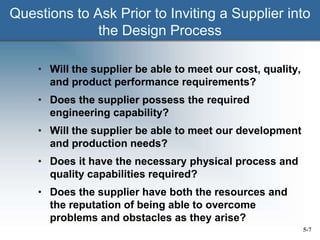
Questions to Ask Prior to Inviting a Supplier into
the Design Process
• Will the supplier be able to meet our cost, quality,
and product performance requirements?
• Does the supplier possess the required
engineering capability?
• Will the supplier be able to meet our development
and production needs?
• Does it have the necessary physical process and
quality capabilities required?
• Does the supplier have both the resources and
the reputation of being able to overcome
problems and obstacles as they arise?
5-8
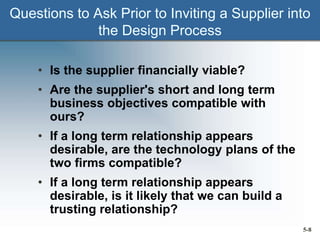
Questions to Ask Prior to Inviting a Supplier into
the Design Process
• Is the supplier financially viable?
• Are the supplier's short and long term
business objectives compatible with
ours?
• If a long term relationship appears
desirable, are the technology plans of the
two firms compatible?
• If a long term relationship appears
desirable, is it likely that we can build a
trusting relationship?
5-9
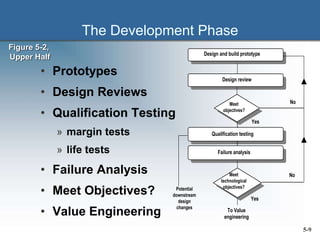
The Development Phase
• Prototypes
• Design Reviews
• Qualification Testing
» margin tests
» life tests
• Failure Analysis
• Meet Objectives?
• Value Engineering
Design and build prototype
Design review
Qualification testing
Failure analysis
To Value
engineering
Potential
downstream
design
changes
Meet
objectives?
Meet
technological
objectives?
No
Yes
No
Yes
Figure 5-2,
Upper Half
5-10
The Development Phase
• Design Analysis
• The Value
Engineering
Checklist
• Viability Qualification
testing
Value engineer
Design
changes
To production phase
Yes
After
technological
objectives
have been
met?
Financial
review
No Cancel or
Redesign
Yes
Figure 5-2,
Lower Half
5-11
Value Engineering
• Value engineering is a systematic study of
every element of cost in a material, item of
equipment, service or construction project
to ensure that every element of cost fulfills
a necessary function and at the lowest
possible total cost
• Value engineering is focused on the
design stage
5-12
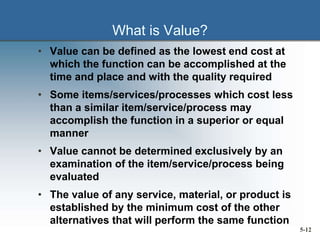
What is Value?
• Value can be defined as the lowest end cost at
which the function can be accomplished at the
time and place and with the quality required
• Some items/services/processes which cost less
than a similar item/service/process may
accomplish the function in a superior or equal
manner
• Value cannot be determined exclusively by an
examination of the item/service/process being
evaluated
• The value of any service, material, or product is
established by the minimum cost of the other
alternatives that will perform the same function
5-13
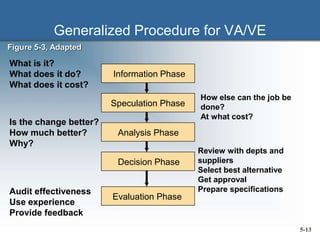
Generalized Procedure for VA/VE
Information Phase
Analysis Phase
Decision Phase
Speculation Phase
Evaluation Phase
What is it?
What does it do?
What does it cost?
How else can the job be
done?
At what cost?
Is the change better?
How much better?
Why?
Review with depts and
suppliers
Select best alternative
Get approval
Prepare specificationsAudit effectiveness
Use experience
Provide feedback
Figure 5-3, Adapted
5-14
Analysis of Each Component
• Can any part be eliminated without impairing the
operation of the complete unit?
• Can the design of the part be simplified to reduce
its basic cost?
• Can the design of the part be changed to permit
the use of simplified or less costly production
methods?
• Can less expensive but equally satisfactory
materials be used in the part?
• Design simplifications frequently are more
apparent than is possible under the original
design
5-15
The Value Engineering Checklist
1. Can the item be eliminated?
2. If the item is not standard, can a standard item
be used?
3. If it is a standard item, does it completely fit the
application, or is it a misfit?
4. Does the item have greater capacity than
required?
5. Can the weight be reduced?
6. Is there a similar item in inventory that could be
substituted?
7. Are closer tolerances specified than are
necessary?
5-16
The Value Engineering Checklist
8. Is unnecessary machining performed on the
item?
9. Are unnecessarily fine finishes specified?
10. Is "commercial quality" specified?
11. Can you make the item less expensively in your
plant? If you are making it now, can you buy it
for less?
12. Is the item properly classified for shipping
purposes to obtain lowest transportation rates?
13. Can cost of packaging be reduced?
14. Are suppliers contributing suggestions to
reduce cost?
5-17
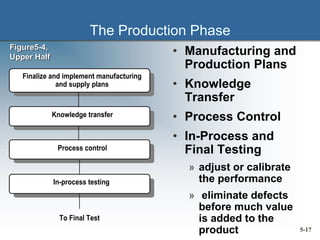
The Production Phase
• Manufacturing and
Production Plans
• Knowledge
Transfer
• Process Control
• In-Process and
Final Testing
» adjust or calibrate
the performance
» eliminate defects
before much value
is added to the
product
Finalize and implement manufacturing
and supply plans
Knowledge transfer
Process control
In-process testing
To Final Test
Figure5-4,
Upper Half
5-18
Production Phase Continued
Failure analysis
Purchased
components?
Supplier fault
Yes
Meet
objectives?
Equipment or
procedures?
Yes
Final test
Ship
Return
to Dev.
No
Yes
No
Revise
Manuf.
Plan
Figure 5-4,
Lower Half
5-19
Engineering Change Management
• Material control involvement:
» provide input on the purchased materials
implications of a proposed change,
» discuss the timing of proposed changes in
order to minimize costs associated with
unusable incoming materials,
» to be aware of forthcoming changes so that
appropriate action can be taken with affected
suppliers.
5-20
How to Expand Supply Management’s
Contributions
• Design or Project Teams
• Materials Engineers
» materials engineering and
» supply management activities of sourcing,
pricing, and negotiating
• Co-Location (Harley-Davidson)
» Faster to market,
» reduced total cost,
» improved quality
5-21
Supply Management Professionals Who Interface
Successfully with Engineers
• Early Supply Management Involvement is part of the
culture and policy of the firm
» Formerly called Early Purchasing Involvement (EPI)
» Often requires policy development from upper management to
ensure initial involvement
• Engineers view Supply Management involvement as an
asset, not a nuisance
» Supply Managers must acquire skills and knowledge
» Learn how to read engineering drawings
» Learn technical terms
» Meet with supplier’s sales personnel to review technical
information about products
» Visit suppliers
5-22
Concluding Remarks
• The design stage provides the greatest
opportunity to reduce costs the life cycle
costs of products
• Supply management and the firm's
suppliers have major contributions to
make during this process
• Analysis of adding value is not limited to a
firm’s services and products, supply
managers themselves must add value to
the design process in order to become a
viable and lasting member of the design
team

Chapter 5 New Product Development

  • 1.
  • 2.
    5-2 Key Concepts • TheDesign Process » The Investigation or Concept Formation Phase » The Development Phase » The Production Phase » Value Engineering Vis-à-vis Value Analysis • Engineering Change Management • How to Expand Supply Management's Contributions » Design or Project Teams » Materials Engineers » Co-location • Buyers Supply Management Professionals Who Interface Successfully with Engineers
  • 3.
    5-3 Overview • Four KeyIssues » Early supply management and supplier involvement » Design and development process of new products » Approaches to increasing supply management’s role in the new product development process » Description of supply management professionals who interface successfully with engineers
  • 4.
    5-4 The Design Process •The Investigation or Concept Formation Phase • The Development Phase • The Production Phase • Value Engineering Vis-à-vis Value Analysis
  • 5.
    5-5 Investigation Phase • Definingthe New Product • Statement of Objectives • Key Technology • Development of Alternatives » Suitability » Produceaibility » Component availability » Customer acceptability Figure 5-1, Upper Half Define new product Set objectives: price, cost, performance, market availability, quality, & reliability Develop alternative conceptual solutions Study make-or- buy implicationsOutsource Consider Outsourcing Is a key technology involved? Yes No No Yes
  • 6.
    5-6 Investigation Phase Continued •Development of Alternatives » Make-or-Buy and Outsourcing Analysis » Select Components, Technologies, and Supplies » Stress Testing and Failure Analysis Select components, technology, and suppliers for most attractive alternative concepts Stress analysis Failure analysis Meet objectives? To development phase Yes No Decision is to make the product Reconsider Outsourcing Figure 5-1, Lower Half
  • 7.
    5-7 Questions to AskPrior to Inviting a Supplier into the Design Process • Will the supplier be able to meet our cost, quality, and product performance requirements? • Does the supplier possess the required engineering capability? • Will the supplier be able to meet our development and production needs? • Does it have the necessary physical process and quality capabilities required? • Does the supplier have both the resources and the reputation of being able to overcome problems and obstacles as they arise?
  • 8.
    5-8 Questions to AskPrior to Inviting a Supplier into the Design Process • Is the supplier financially viable? • Are the supplier's short and long term business objectives compatible with ours? • If a long term relationship appears desirable, are the technology plans of the two firms compatible? • If a long term relationship appears desirable, is it likely that we can build a trusting relationship?
  • 9.
    5-9 The Development Phase •Prototypes • Design Reviews • Qualification Testing » margin tests » life tests • Failure Analysis • Meet Objectives? • Value Engineering Design and build prototype Design review Qualification testing Failure analysis To Value engineering Potential downstream design changes Meet objectives? Meet technological objectives? No Yes No Yes Figure 5-2, Upper Half
  • 10.
    5-10 The Development Phase •Design Analysis • The Value Engineering Checklist • Viability Qualification testing Value engineer Design changes To production phase Yes After technological objectives have been met? Financial review No Cancel or Redesign Yes Figure 5-2, Lower Half
  • 11.
    5-11 Value Engineering • Valueengineering is a systematic study of every element of cost in a material, item of equipment, service or construction project to ensure that every element of cost fulfills a necessary function and at the lowest possible total cost • Value engineering is focused on the design stage
  • 12.
    5-12 What is Value? •Value can be defined as the lowest end cost at which the function can be accomplished at the time and place and with the quality required • Some items/services/processes which cost less than a similar item/service/process may accomplish the function in a superior or equal manner • Value cannot be determined exclusively by an examination of the item/service/process being evaluated • The value of any service, material, or product is established by the minimum cost of the other alternatives that will perform the same function
  • 13.
    5-13 Generalized Procedure forVA/VE Information Phase Analysis Phase Decision Phase Speculation Phase Evaluation Phase What is it? What does it do? What does it cost? How else can the job be done? At what cost? Is the change better? How much better? Why? Review with depts and suppliers Select best alternative Get approval Prepare specificationsAudit effectiveness Use experience Provide feedback Figure 5-3, Adapted
  • 14.
    5-14 Analysis of EachComponent • Can any part be eliminated without impairing the operation of the complete unit? • Can the design of the part be simplified to reduce its basic cost? • Can the design of the part be changed to permit the use of simplified or less costly production methods? • Can less expensive but equally satisfactory materials be used in the part? • Design simplifications frequently are more apparent than is possible under the original design
  • 15.
    5-15 The Value EngineeringChecklist 1. Can the item be eliminated? 2. If the item is not standard, can a standard item be used? 3. If it is a standard item, does it completely fit the application, or is it a misfit? 4. Does the item have greater capacity than required? 5. Can the weight be reduced? 6. Is there a similar item in inventory that could be substituted? 7. Are closer tolerances specified than are necessary?
  • 16.
    5-16 The Value EngineeringChecklist 8. Is unnecessary machining performed on the item? 9. Are unnecessarily fine finishes specified? 10. Is "commercial quality" specified? 11. Can you make the item less expensively in your plant? If you are making it now, can you buy it for less? 12. Is the item properly classified for shipping purposes to obtain lowest transportation rates? 13. Can cost of packaging be reduced? 14. Are suppliers contributing suggestions to reduce cost?
  • 17.
    5-17 The Production Phase •Manufacturing and Production Plans • Knowledge Transfer • Process Control • In-Process and Final Testing » adjust or calibrate the performance » eliminate defects before much value is added to the product Finalize and implement manufacturing and supply plans Knowledge transfer Process control In-process testing To Final Test Figure5-4, Upper Half
  • 18.
    5-18 Production Phase Continued Failureanalysis Purchased components? Supplier fault Yes Meet objectives? Equipment or procedures? Yes Final test Ship Return to Dev. No Yes No Revise Manuf. Plan Figure 5-4, Lower Half
  • 19.
    5-19 Engineering Change Management •Material control involvement: » provide input on the purchased materials implications of a proposed change, » discuss the timing of proposed changes in order to minimize costs associated with unusable incoming materials, » to be aware of forthcoming changes so that appropriate action can be taken with affected suppliers.
  • 20.
    5-20 How to ExpandSupply Management’s Contributions • Design or Project Teams • Materials Engineers » materials engineering and » supply management activities of sourcing, pricing, and negotiating • Co-Location (Harley-Davidson) » Faster to market, » reduced total cost, » improved quality
  • 21.
    5-21 Supply Management ProfessionalsWho Interface Successfully with Engineers • Early Supply Management Involvement is part of the culture and policy of the firm » Formerly called Early Purchasing Involvement (EPI) » Often requires policy development from upper management to ensure initial involvement • Engineers view Supply Management involvement as an asset, not a nuisance » Supply Managers must acquire skills and knowledge » Learn how to read engineering drawings » Learn technical terms » Meet with supplier’s sales personnel to review technical information about products » Visit suppliers
  • 22.
    5-22 Concluding Remarks • Thedesign stage provides the greatest opportunity to reduce costs the life cycle costs of products • Supply management and the firm's suppliers have major contributions to make during this process • Analysis of adding value is not limited to a firm’s services and products, supply managers themselves must add value to the design process in order to become a viable and lasting member of the design team