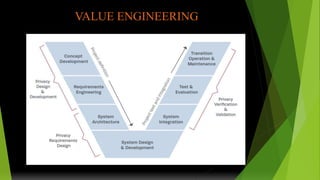
VALUE ENGINEERING
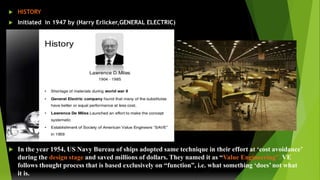
 HISTORY
 Initiated in 1947 by (Harry Erlicker,GENERAL ELECTRIC)
 In the year 1954, US Navy Bureau of ships adopted same technique in their effort at ‘cost avoidance’
during the design stage and saved millions of dollars. They named it as “Value Engineering”. VE
follows thought process that is based exclusively on “function”, i.e. what something ‘does’ not what
it is.
Why use Value Engineering?
Save Time
Save Money
Build Teamwork
Improve Quality
Satisfy Customer
What is Value?
 Something is held to deserve, Importance ,Worth, Usefulness of something
Value in “Value Engineering "is
 It is the ratio of function to the cost
 Value can therefore increased either by increasing the cost or by decreasing the cost.
 It is also called as the lowest price you must pay to provide a reliable function or service
Understanding the Use vs Esteem value
Use Value: The total cost for producing the product
Esteem value: An Additional premium price which the product can attract because of it’s
intrinsic attractiveness to purchases.
Value Engineering focus on Use value
Understanding of Function:
By understanding the Value and the Function we have provide this function to the
customer with the Possible cost.
How and Why type of questions helps to identify the function
Use function and Aesthetic function
-Performs some action, expresses in active tone
-Pleases customer, expressed in passive or non-measurable tone
Basic function and secondary function
-Basic purpose for which a product exists
- Arises out of specific design chosen to fulfill the primary function
Higher order and secondary function
Reason of satisfying the basic function
Means of achieving the basic function
So what is VALUE ENGINEERING
 Is a cost reduction?
 An item elimination?
 Or an function deletion?
 By using cheaper material?
 By low cost processing?
Value Engineering
 construction of a product from design to final delivery stage are completely analyzed
and pursued to achieve the desired function at the lowest overall cost consistent with
performance.
 Without compromising with it’s Quality,Performance,Efficiency.
The society of American Value
The systematic application for recognized techniques which identify the function of
product or service, establish the monetary value for that function and provide the
necessary function reliability at the lowest cost.
Terms used to describe “Value Engineering ”
 value Methodology
This is the “official” term used by SAVE International. It describes the overall body
of knowledge.
 Value Analysis „
This was the first term used when the process was originally developed for
manufacturing
 Value Engineering
The term The term “engineering” was used to identify the process as it is applied to
design and construction „
 Value Management
This less commonly used term refers to its application to business processes
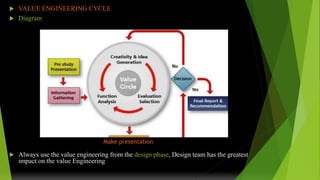
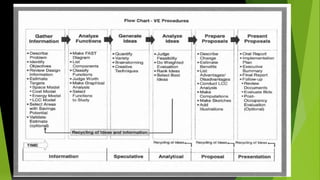
 VALUE ENGINEERING CYCLE
 Diagram
 Always use the value engineering from the design phase, Design team has the greatest
impact on the value Engineering
Make presentation
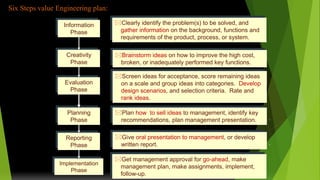
Information
Phase
Creativity
Phase
Evaluation
Phase
Planning
Phase
Reporting
Phase
Implementation
Phase
Clearly identify the problem(s) to be solved, and
gather information on the background, functions and
requirements of the product, process, or system.
Brainstorm ideas on how to improve the high cost,
broken, or inadequately performed key functions.
Screen ideas for acceptance, score remaining ideas
on a scale and group ideas into categories. Develop
design scenarios, and selection criteria. Rate and
rank ideas.
Plan how to sell ideas to management, identify key
recommendations, plan management presentation.
Give oral presentation to management, or develop
written report.
Get management approval for go-ahead, make
management plan, make assignments, implement,
follow-up.
Six Steps value Engineering plan:
Value engineering vs cost cutting
 VE is to find the lowest cost way to perform the desired function rather than the lowest
cost way of producing the product. Value Engineering challenges the very specification,
Design requirement .
When we use Value Engineering
 Existing part/product cost is high
 Existing technology is complex/old though simpler means are available
 There is a need to release a cheaper product by cutting down some of the
existing feature
 There is a need to cut down the manufacturing cycle time/cost
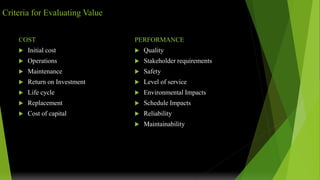
Criteria for Evaluating Value
COST
 Initial cost
 Operations
 Maintenance
 Return on Investment
 Life cycle
 Replacement
 Cost of capital
PERFORMANCE
 Quality
 Stakeholder requirements
 Safety
 Level of service
 Environmental Impacts
 Schedule Impacts
 Reliability
 Maintainability
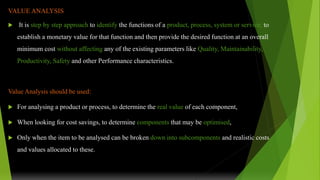
VALUE ANALYSIS
 It is step by step approach to identify the functions of a product, process, system or service; to
establish a monetary value for that function and then provide the desired function at an overall
minimum cost without affecting any of the existing parameters like Quality, Maintainability,
Productivity, Safety and other Performance characteristics.
Value Analysis should be used:
 For analysing a product or process, to determine the real value of each component,
 When looking for cost savings, to determine components that may be optimised,
 Only when the item to be analysed can be broken down into subcomponents and realistic costs
and values allocated to these.
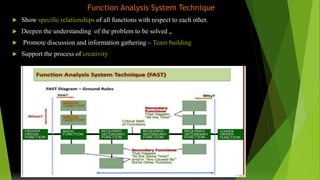
Function Analysis System Technique
 Show specific relationships of all functions with respect to each other.
 Deepen the understanding of the problem to be solved „
 Promote discussion and information gathering – Team building
 Support the process of creativity
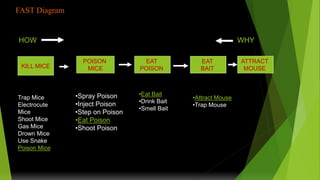
FAST Diagram
KILL MICE
POISON
MICE
•Spray Poison
•Inject Poison
•Step on Poison
•Eat Poison
•Shoot Poison
HOW
EAT
POISON
EAT
BAIT
ATTRACT
MOUSE
WHY
•Attract Mouse
•Trap Mouse
•Eat Bait
•Drink Bait
•Smell Bait
Trap Mice
Electrocute
Mice
Shoot Mice
Gas Mice
Drown Mice
Use Snake
Poison Mice
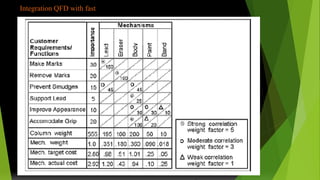
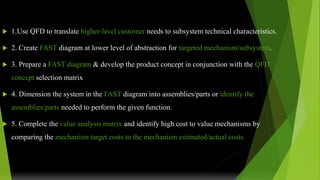
Integration QFD with fast
 1.Use QFD to translate higher-level customer needs to subsystem technical characteristics.
 2. Create FAST diagram at lower level of abstraction for targeted mechanism/subsystem.
 3. Prepare a FAST diagram & develop the product concept in conjunction with the QFD
concept selection matrix
 4. Dimension the system in the FAST diagram into assemblies/parts or identify the
assemblies/parts needed to perform the given function.
 5. Complete the value analysis matrix and identify high cost to value mechanisms by
comparing the mechanism target costs to the mechanism estimated/actual costs.
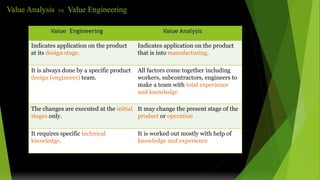
Value Analysis vs Value Engineering
Value Engineering Value Analysis
Indicates application on the product
at its design stage.
Indicates application on the product
that is into manufacturing.
It is always done by a specific product
design (engineers) team.
All factors come together including
workers, subcontractors, engineers to
make a team with total experience
and knowledge
The changes are executed at the initial
stages only.
It may change the present stage of the
product or operation
It requires specific technical
knowledge.
It is worked out mostly with help of
knowledge and experience
Chaitanya chenna

Value engineering and Analysis

  • 1.
  • 2.
     HISTORY  Initiatedin 1947 by (Harry Erlicker,GENERAL ELECTRIC)  In the year 1954, US Navy Bureau of ships adopted same technique in their effort at ‘cost avoidance’ during the design stage and saved millions of dollars. They named it as “Value Engineering”. VE follows thought process that is based exclusively on “function”, i.e. what something ‘does’ not what it is.
  • 3.
    Why use ValueEngineering? Save Time Save Money Build Teamwork Improve Quality Satisfy Customer
  • 4.
    What is Value? Something is held to deserve, Importance ,Worth, Usefulness of something Value in “Value Engineering "is  It is the ratio of function to the cost  Value can therefore increased either by increasing the cost or by decreasing the cost.  It is also called as the lowest price you must pay to provide a reliable function or service Understanding the Use vs Esteem value Use Value: The total cost for producing the product Esteem value: An Additional premium price which the product can attract because of it’s intrinsic attractiveness to purchases. Value Engineering focus on Use value
  • 5.
    Understanding of Function: Byunderstanding the Value and the Function we have provide this function to the customer with the Possible cost. How and Why type of questions helps to identify the function Use function and Aesthetic function -Performs some action, expresses in active tone -Pleases customer, expressed in passive or non-measurable tone Basic function and secondary function -Basic purpose for which a product exists - Arises out of specific design chosen to fulfill the primary function Higher order and secondary function Reason of satisfying the basic function Means of achieving the basic function
  • 6.
    So what isVALUE ENGINEERING  Is a cost reduction?  An item elimination?  Or an function deletion?  By using cheaper material?  By low cost processing?
  • 7.
    Value Engineering  constructionof a product from design to final delivery stage are completely analyzed and pursued to achieve the desired function at the lowest overall cost consistent with performance.  Without compromising with it’s Quality,Performance,Efficiency. The society of American Value The systematic application for recognized techniques which identify the function of product or service, establish the monetary value for that function and provide the necessary function reliability at the lowest cost.
  • 8.
    Terms used todescribe “Value Engineering ”  value Methodology This is the “official” term used by SAVE International. It describes the overall body of knowledge.  Value Analysis „ This was the first term used when the process was originally developed for manufacturing  Value Engineering The term The term “engineering” was used to identify the process as it is applied to design and construction „  Value Management This less commonly used term refers to its application to business processes
  • 9.
     VALUE ENGINEERINGCYCLE  Diagram  Always use the value engineering from the design phase, Design team has the greatest impact on the value Engineering Make presentation
  • 11.
    Information Phase Creativity Phase Evaluation Phase Planning Phase Reporting Phase Implementation Phase Clearly identify theproblem(s) to be solved, and gather information on the background, functions and requirements of the product, process, or system. Brainstorm ideas on how to improve the high cost, broken, or inadequately performed key functions. Screen ideas for acceptance, score remaining ideas on a scale and group ideas into categories. Develop design scenarios, and selection criteria. Rate and rank ideas. Plan how to sell ideas to management, identify key recommendations, plan management presentation. Give oral presentation to management, or develop written report. Get management approval for go-ahead, make management plan, make assignments, implement, follow-up. Six Steps value Engineering plan:
  • 12.
    Value engineering vscost cutting  VE is to find the lowest cost way to perform the desired function rather than the lowest cost way of producing the product. Value Engineering challenges the very specification, Design requirement .
  • 13.
    When we useValue Engineering  Existing part/product cost is high  Existing technology is complex/old though simpler means are available  There is a need to release a cheaper product by cutting down some of the existing feature  There is a need to cut down the manufacturing cycle time/cost
  • 14.
    Criteria for EvaluatingValue COST  Initial cost  Operations  Maintenance  Return on Investment  Life cycle  Replacement  Cost of capital PERFORMANCE  Quality  Stakeholder requirements  Safety  Level of service  Environmental Impacts  Schedule Impacts  Reliability  Maintainability
  • 15.
    VALUE ANALYSIS  Itis step by step approach to identify the functions of a product, process, system or service; to establish a monetary value for that function and then provide the desired function at an overall minimum cost without affecting any of the existing parameters like Quality, Maintainability, Productivity, Safety and other Performance characteristics. Value Analysis should be used:  For analysing a product or process, to determine the real value of each component,  When looking for cost savings, to determine components that may be optimised,  Only when the item to be analysed can be broken down into subcomponents and realistic costs and values allocated to these.
  • 16.
    Function Analysis SystemTechnique  Show specific relationships of all functions with respect to each other.  Deepen the understanding of the problem to be solved „  Promote discussion and information gathering – Team building  Support the process of creativity
  • 17.
    FAST Diagram KILL MICE POISON MICE •SprayPoison •Inject Poison •Step on Poison •Eat Poison •Shoot Poison HOW EAT POISON EAT BAIT ATTRACT MOUSE WHY •Attract Mouse •Trap Mouse •Eat Bait •Drink Bait •Smell Bait Trap Mice Electrocute Mice Shoot Mice Gas Mice Drown Mice Use Snake Poison Mice
  • 18.
  • 19.
     1.Use QFDto translate higher-level customer needs to subsystem technical characteristics.  2. Create FAST diagram at lower level of abstraction for targeted mechanism/subsystem.  3. Prepare a FAST diagram & develop the product concept in conjunction with the QFD concept selection matrix  4. Dimension the system in the FAST diagram into assemblies/parts or identify the assemblies/parts needed to perform the given function.  5. Complete the value analysis matrix and identify high cost to value mechanisms by comparing the mechanism target costs to the mechanism estimated/actual costs.
  • 20.
    Value Analysis vsValue Engineering Value Engineering Value Analysis Indicates application on the product at its design stage. Indicates application on the product that is into manufacturing. It is always done by a specific product design (engineers) team. All factors come together including workers, subcontractors, engineers to make a team with total experience and knowledge The changes are executed at the initial stages only. It may change the present stage of the product or operation It requires specific technical knowledge. It is worked out mostly with help of knowledge and experience
  • 22.