 HIMANGI THATTEY
OVERVIEW
 Concept of Value Analysis
 Scope of Value Analysis
 Concept of Value Engineering
 When is it used?
 Some Thoughts on VE
 Competitive Advantage
 Steps in Value Engineering
 Benefits of value engineering
 How and when is VE applied?
(ValueEngineering)
2
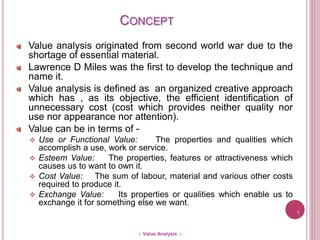
Value analysis originated from second world war due to the
shortage of essential material.
Lawrence D Miles was the first to develop the technique and
name it.
Value analysis is defined as an organized creative approach
which has , as its objective, the efficient identification of
unnecessary cost (cost which provides neither quality nor
use nor appearance nor attention).
Value can be in terms of -
 Use or Functional Value: The properties and qualities which
accomplish a use, work or service.
 Esteem Value: The properties, features or attractiveness which
causes us to want to own it.
 Cost Value: The sum of labour, material and various other costs
required to produce it.
 Exchange Value: Its properties or qualities which enable us to
exchange it for something else we want.
3
-: Value Analysis :-
CONCEPT
Based on these classifications, value is defined as "the minimum money which
has to be expended in purchasing or manufacturing a product to create the
appropriate use or esteem factors".
We could now define value analysis as "an organized creative approach which
has as its objective—the achievement of the value of the product". Value
analysis aims at reducing the cost value to the value of the product.
It should be borne in mind that:
 Value is not inherent in a product, it is a relative term, and value can change
with time and place.
 It can be measured only by comparison with other products which perform
the same function.
 Value is the relationship between what someone wants and what he is
willing to pay for it.
 In fact, the heart of value analysis technique is the functional approach. It
relates to cost of function whereas others relate cost to product.
Function
Value= —————
Cost
4
SCOPE OF VALUE ANALYSIS
1. Organized cost reduction analysis by which accountants
analyze costs in products or procedure, the ranking of their
elements in a descending order of magnitude and in informed
challenge to each, starting with the most important.
2. Development as practiced in many firms where it follows
the realization of a design and combining through the
specifications to remove costs by substituting standards and
relaxing tolerances and finishes.
3. Purchasing analysis which systematically searches for
cheaper bought-out components or services, probably by
seeking alternatives or a fresh basis for price negotiation.
4. Method study - The part of work study that studies and
analyses work of any kind in a disciplined manner that leads to
improvement in. methods.
5
Value Engineering (VE) is an intensive, interdisciplinary
problem solving activity that focuses on improving the
value of the functions that are required to accomplish the
goal, or objective of any product, process, service, or
organization.
 VALUE METHODOLOGY
“The systematic application of recognized techniques
which identify the functions of the product or service,
establish the worth of those functions, and provide the
necessary functions to meet the required performance at
the lowest overall cost.”
CONCEPT OF Value Engineering
(ValueEngineering)
6
 Value engineering is the process by which a
company analyses the individual components
of cost within a product or service in order to
determine whether it can re-engineer the
product's cost base in order to improve the
value to the customer.
 The start point for value engineering is to
understand the relationship between each
individual cost component and the value to
the customer associated with each individual
component of cost.
7
(ValueEngineering)
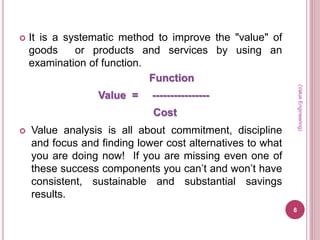
 It is a systematic method to improve the "value" of
goods or products and services by using an
examination of function.
Function
Value = ----------------
Cost
 Value analysis is all about commitment, discipline
and focus and finding lower cost alternatives to what
you are doing now! If you are missing even one of
these success components you can’t and won’t have
consistent, sustainable and substantial savings
results.
8
(ValueEngineering)
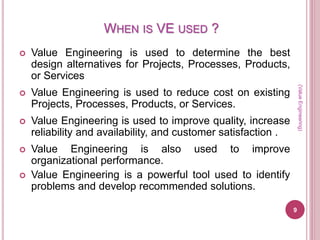
WHEN IS VE USED ?
 Value Engineering is used to determine the best
design alternatives for Projects, Processes, Products,
or Services
 Value Engineering is used to reduce cost on existing
Projects, Processes, Products, or Services.
 Value Engineering is used to improve quality, increase
reliability and availability, and customer satisfaction .
 Value Engineering is also used to improve
organizational performance.
 Value Engineering is a powerful tool used to identify
problems and develop recommended solutions.
(ValueEngineering)
9
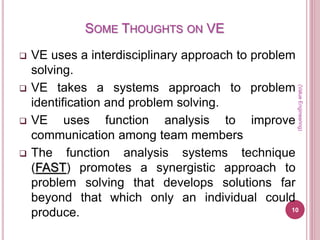
SOME THOUGHTS ON VE
 VE uses a interdisciplinary approach to problem
solving.
 VE takes a systems approach to problem
identification and problem solving.
 VE uses function analysis to improve
communication among team members
 The function analysis systems technique
(FAST) promotes a synergistic approach to
problem solving that develops solutions far
beyond that which only an individual could
produce.
(ValueEngineering)
10
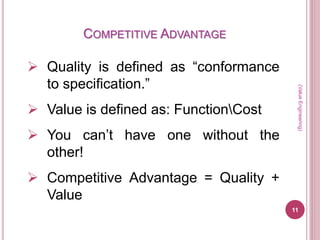
COMPETITIVE ADVANTAGE
 Quality is defined as “conformance
to specification.”
 Value is defined as: FunctionCost
 You can’t have one without the
other!
 Competitive Advantage = Quality +
Value
(ValueEngineering)
11
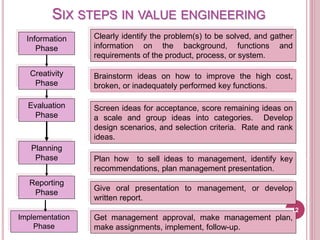
SIX STEPS IN VALUE ENGINEERING
Information
Phase
Creativity
Phase
Evaluation
Phase
Planning
Phase
Reporting
Phase
Implementation
Phase
Clearly identify the problem(s) to be solved, and gather
information on the background, functions and
requirements of the product, process, or system.
Brainstorm ideas on how to improve the high cost,
broken, or inadequately performed key functions.
Screen ideas for acceptance, score remaining ideas on
a scale and group ideas into categories. Develop
design scenarios, and selection criteria. Rate and rank
ideas.
Plan how to sell ideas to management, identify key
recommendations, plan management presentation.
Give oral presentation to management, or develop
written report.
Get management approval, make management plan,
make assignments, implement, follow-up.
12
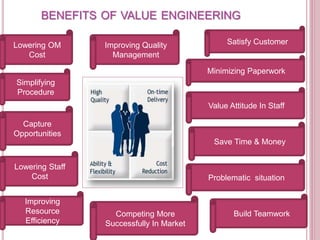
BENEFITS OF VALUE ENGINEERING
Lowering OM
Cost
Improving Quality
Management
Improving
Resource
Efficiency
Simplifying
Procedure
Minimizing Paperwork
Lowering Staff
Cost Problematic situation
Capture
Opportunities
Value Attitude In Staff
Competing More
Successfully In Market
Satisfy Customer
Build Teamwork
Save Time & Money
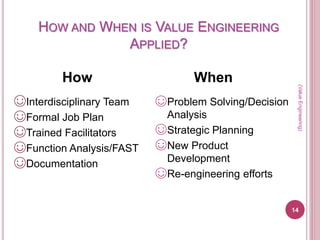
HOW AND WHEN IS VALUE ENGINEERING
APPLIED?
☺Interdisciplinary Team
☺Formal Job Plan
☺Trained Facilitators
☺Function Analysis/FAST
☺Documentation
☺Problem Solving/Decision
Analysis
☺Strategic Planning
☺New Product
Development
☺Re-engineering efforts
How When
(ValueEngineering)
14
WEBLIOGRAPHY
 neoppt.com
 strategicvalueanalysis.com
 apps.develebridge.net
 ignou.com
(ValueEngineering)
15

Value Analysis & Value Engineering

  • 1.
  • 2.
    OVERVIEW  Concept ofValue Analysis  Scope of Value Analysis  Concept of Value Engineering  When is it used?  Some Thoughts on VE  Competitive Advantage  Steps in Value Engineering  Benefits of value engineering  How and when is VE applied? (ValueEngineering) 2
  • 3.
    Value analysis originatedfrom second world war due to the shortage of essential material. Lawrence D Miles was the first to develop the technique and name it. Value analysis is defined as an organized creative approach which has , as its objective, the efficient identification of unnecessary cost (cost which provides neither quality nor use nor appearance nor attention). Value can be in terms of -  Use or Functional Value: The properties and qualities which accomplish a use, work or service.  Esteem Value: The properties, features or attractiveness which causes us to want to own it.  Cost Value: The sum of labour, material and various other costs required to produce it.  Exchange Value: Its properties or qualities which enable us to exchange it for something else we want. 3 -: Value Analysis :- CONCEPT
  • 4.
    Based on theseclassifications, value is defined as "the minimum money which has to be expended in purchasing or manufacturing a product to create the appropriate use or esteem factors". We could now define value analysis as "an organized creative approach which has as its objective—the achievement of the value of the product". Value analysis aims at reducing the cost value to the value of the product. It should be borne in mind that:  Value is not inherent in a product, it is a relative term, and value can change with time and place.  It can be measured only by comparison with other products which perform the same function.  Value is the relationship between what someone wants and what he is willing to pay for it.  In fact, the heart of value analysis technique is the functional approach. It relates to cost of function whereas others relate cost to product. Function Value= ————— Cost 4
  • 5.
    SCOPE OF VALUEANALYSIS 1. Organized cost reduction analysis by which accountants analyze costs in products or procedure, the ranking of their elements in a descending order of magnitude and in informed challenge to each, starting with the most important. 2. Development as practiced in many firms where it follows the realization of a design and combining through the specifications to remove costs by substituting standards and relaxing tolerances and finishes. 3. Purchasing analysis which systematically searches for cheaper bought-out components or services, probably by seeking alternatives or a fresh basis for price negotiation. 4. Method study - The part of work study that studies and analyses work of any kind in a disciplined manner that leads to improvement in. methods. 5
  • 6.
    Value Engineering (VE)is an intensive, interdisciplinary problem solving activity that focuses on improving the value of the functions that are required to accomplish the goal, or objective of any product, process, service, or organization.  VALUE METHODOLOGY “The systematic application of recognized techniques which identify the functions of the product or service, establish the worth of those functions, and provide the necessary functions to meet the required performance at the lowest overall cost.” CONCEPT OF Value Engineering (ValueEngineering) 6
  • 7.
     Value engineeringis the process by which a company analyses the individual components of cost within a product or service in order to determine whether it can re-engineer the product's cost base in order to improve the value to the customer.  The start point for value engineering is to understand the relationship between each individual cost component and the value to the customer associated with each individual component of cost. 7 (ValueEngineering)
  • 8.
     It isa systematic method to improve the "value" of goods or products and services by using an examination of function. Function Value = ---------------- Cost  Value analysis is all about commitment, discipline and focus and finding lower cost alternatives to what you are doing now! If you are missing even one of these success components you can’t and won’t have consistent, sustainable and substantial savings results. 8 (ValueEngineering)
  • 9.
    WHEN IS VEUSED ?  Value Engineering is used to determine the best design alternatives for Projects, Processes, Products, or Services  Value Engineering is used to reduce cost on existing Projects, Processes, Products, or Services.  Value Engineering is used to improve quality, increase reliability and availability, and customer satisfaction .  Value Engineering is also used to improve organizational performance.  Value Engineering is a powerful tool used to identify problems and develop recommended solutions. (ValueEngineering) 9
  • 10.
    SOME THOUGHTS ONVE  VE uses a interdisciplinary approach to problem solving.  VE takes a systems approach to problem identification and problem solving.  VE uses function analysis to improve communication among team members  The function analysis systems technique (FAST) promotes a synergistic approach to problem solving that develops solutions far beyond that which only an individual could produce. (ValueEngineering) 10
  • 11.
    COMPETITIVE ADVANTAGE  Qualityis defined as “conformance to specification.”  Value is defined as: FunctionCost  You can’t have one without the other!  Competitive Advantage = Quality + Value (ValueEngineering) 11
  • 12.
    SIX STEPS INVALUE ENGINEERING Information Phase Creativity Phase Evaluation Phase Planning Phase Reporting Phase Implementation Phase Clearly identify the problem(s) to be solved, and gather information on the background, functions and requirements of the product, process, or system. Brainstorm ideas on how to improve the high cost, broken, or inadequately performed key functions. Screen ideas for acceptance, score remaining ideas on a scale and group ideas into categories. Develop design scenarios, and selection criteria. Rate and rank ideas. Plan how to sell ideas to management, identify key recommendations, plan management presentation. Give oral presentation to management, or develop written report. Get management approval, make management plan, make assignments, implement, follow-up. 12
  • 13.
    BENEFITS OF VALUEENGINEERING Lowering OM Cost Improving Quality Management Improving Resource Efficiency Simplifying Procedure Minimizing Paperwork Lowering Staff Cost Problematic situation Capture Opportunities Value Attitude In Staff Competing More Successfully In Market Satisfy Customer Build Teamwork Save Time & Money
  • 14.
    HOW AND WHENIS VALUE ENGINEERING APPLIED? ☺Interdisciplinary Team ☺Formal Job Plan ☺Trained Facilitators ☺Function Analysis/FAST ☺Documentation ☺Problem Solving/Decision Analysis ☺Strategic Planning ☺New Product Development ☺Re-engineering efforts How When (ValueEngineering) 14
  • 15.
    WEBLIOGRAPHY  neoppt.com  strategicvalueanalysis.com apps.develebridge.net  ignou.com (ValueEngineering) 15