A Seminar by
Mohan Kumar G.
1st Sem., M.Tech. (M.E.M.),
S.J.C.E., Mysore.
14-12-2015
Overview
 Brief History
 Definition
 Difference b/w Value Analysis & Value Engg.
 What is Value?
 What is Function?
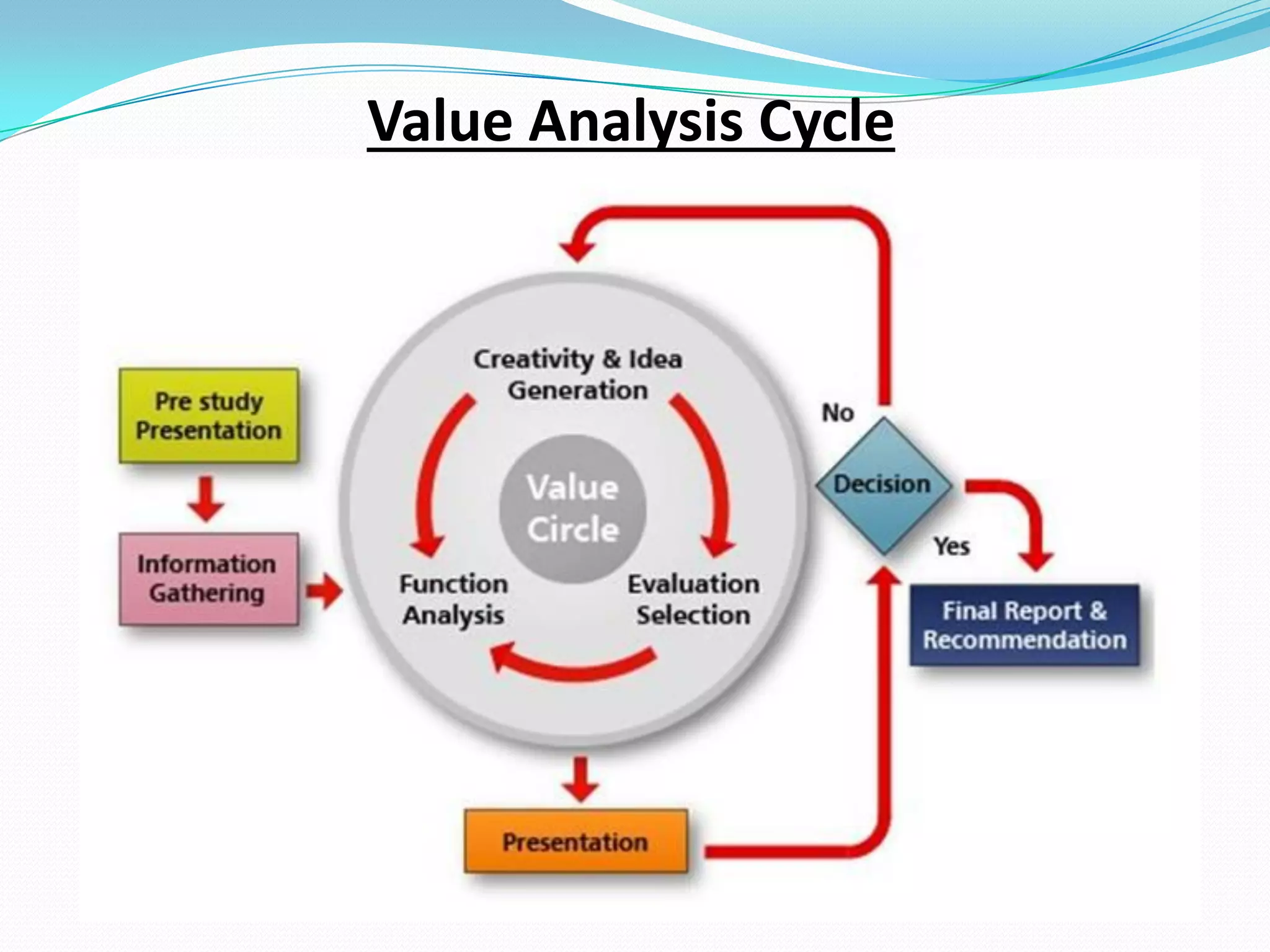
 Value Analysis Cycle
 Examples of Value Engineering
 Benefits of Value Analysis
 Case Problem for you
 References
Brief History
Value Analysis began at General Electric Co., in
U.S.A., during World War II (1939-1945). Because of
the war, there were shortages of skilled labour, raw
materials, and component parts.
Lawrence D. Miles, Jerry Leftow, and Harry
Erlicher at G.E. looked for acceptable substitutes. They
noticed that these substitutions often reduced costs,
improved the product, or both. What started out as an
accident of necessity was turned into a systematic
process. They called their technique “Value Analysis".
Lawrence D. Miles, is known as the father of the
Value Analysis / Value Engineering concept.
Definition
Value Analysis is “An Organized, Creative, Cost
Search technique for Analyzing the Function of a
Product with the purpose of Value Enhancement
without compromising with it's Quality, Reliability,
Performance and Efficiency."
"Value analysis is a philosophy implemented by the use
of specific set of techniques, and a group of learned
skills. It is an organized creative approach which has as
it's purpose the efficient identification of unnecessary
cost, i.e., cost which provides neither quality, nor use,
nor appearance, nor customer features." - L.D. Miles
Value Analysis (VA) is the application of creative
techniques for increasing the Value and Functions to
an already Existing Product / Services to minimize
the Cost of that Product. This is like a Post-mortem
analysis, done after the fact, so a Remedial Process.
Value Engineering (VE) is the application of creative
techniques for increasing the Value and Functions for
New Products at the design stage itself, to minimize
the Cost of the Product. This is done before the fact at
pre-manufacturing stages such as concept
development and design, so a Preventive Process.
Difference between VA and VE
What is VALUE ?
"Value is the lowest price you must pay to provide a reliable
function or service."
- Lawrence D. Miles
"Money is of no Value; It cannot spend itself. All depends on
the skill of the spender.”
- Ralph Waldo Emerson
Use Value, Esteem Value and Market Value
Ex:- 1) Tie Clip
(holds tie, keeps tie out of soup while having dinner)
2) Car (travelling is the primary function)
How to Increase Value ?
Value Analysis is a systematic method to improve
the “Value" of goods or products and services by using
an examination of Function. Value is the ratio of
Function to Cost.
Value can therefore be increased by either
improving the Function or reducing the Cost. It is a
primary tenet of value engineering that basic functions
be preserved and not be reduced as a consequence of
pursuing value improvements.
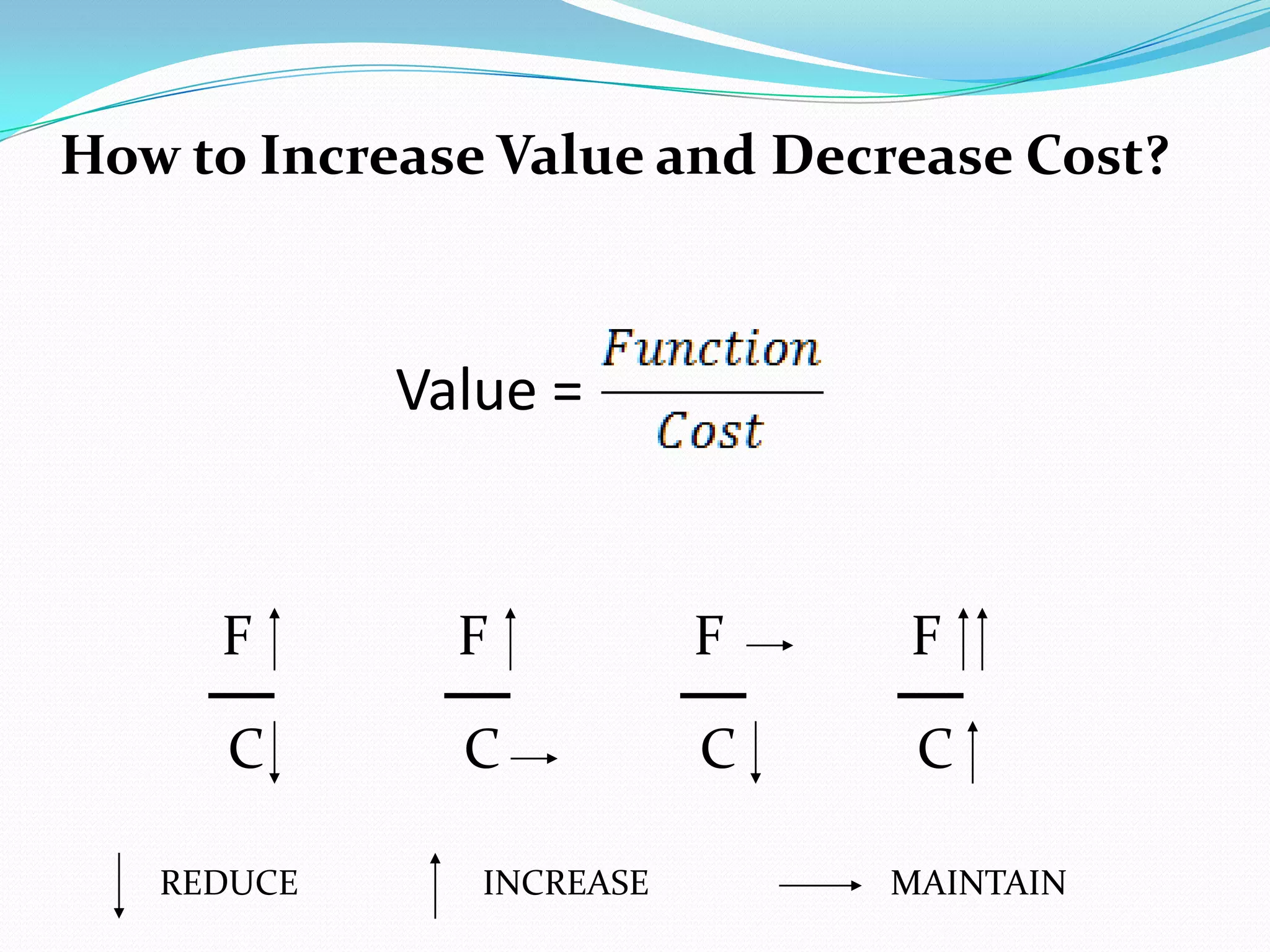
How to Increase Value and Decrease Cost?
F
C
F
C
F
C
F
C
REDUCE INCREASE MAINTAIN
Value =
Let us go deeper into “Value”
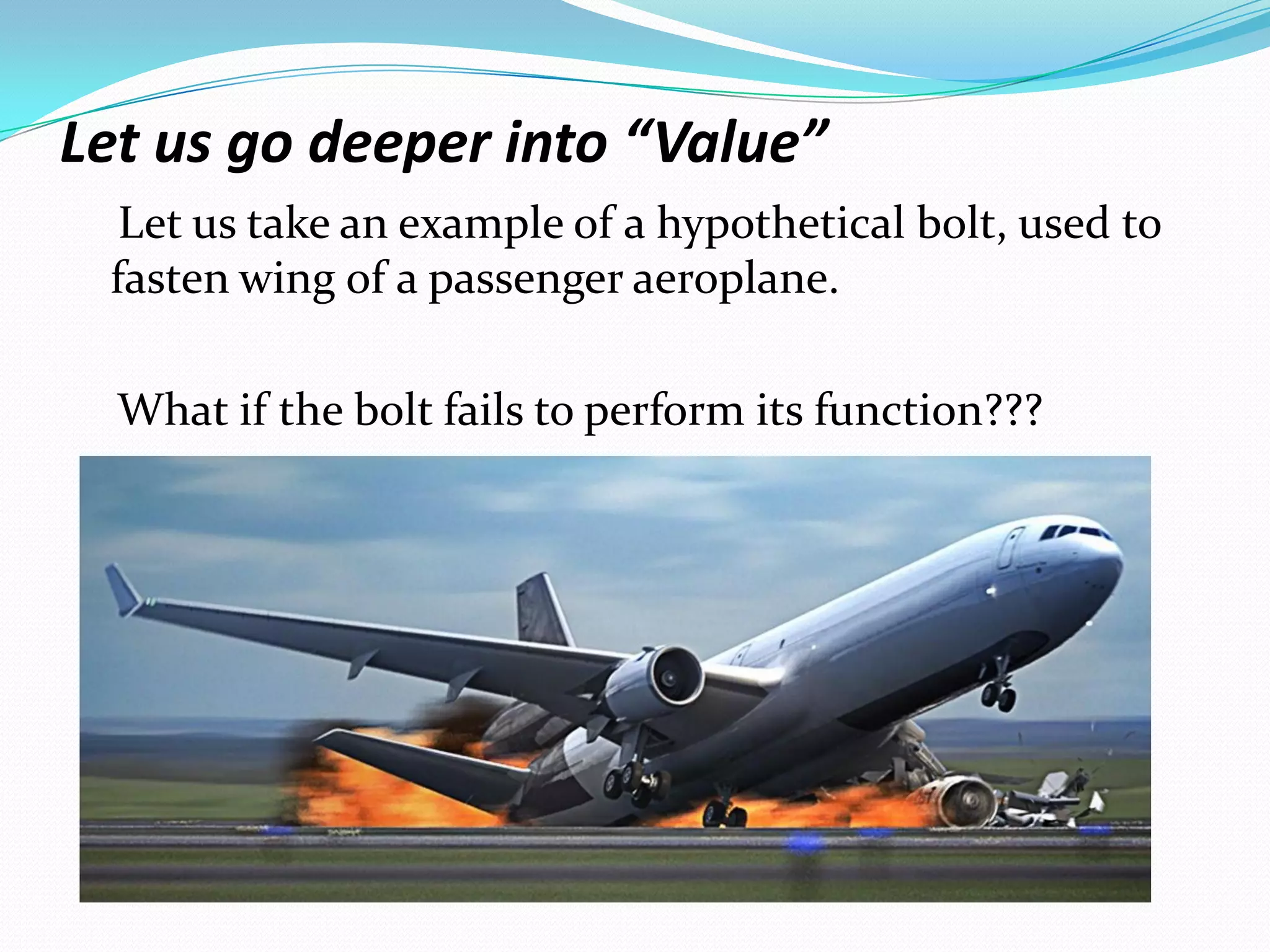
Let us take an example of a hypothetical bolt, used to
fasten wing of a passenger aeroplane.
What if the bolt fails to perform its function???
Now tell me, what is the value of that Bolt?
NO.
The Value of that Bolt is ZERO.
Why?
Because that bolt was designed and manufactured to
function reliably. It had to perform the function of
holding the wing, but it has not performed its function
reliably. So we can say the Value of that bolt is zero.
So, Value is the performance of the designed Function
at the minimal possible cost.
What is FUNCTION ?
Basic Function and Secondary Function
Example of a Pencil.
Why do we use a pencil? What are its Basic Functions
and Secondary Functions?
To get the answers, let us do brainstorming and ask
WHY and HOW type of questions, so that we will be
identifying many Functions of a Pencil.
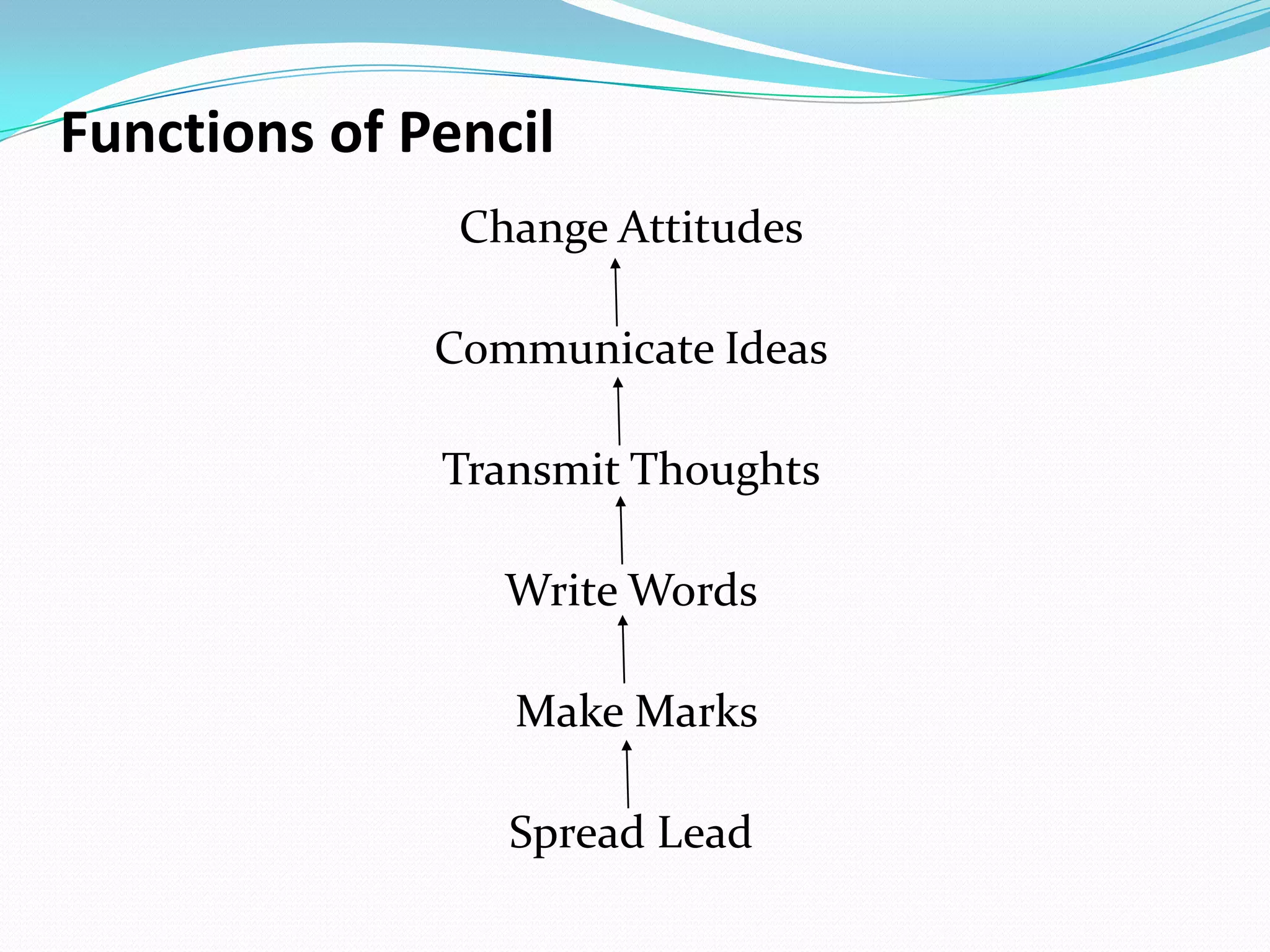
Functions of Pencil
Change Attitudes
Communicate Ideas
Transmit Thoughts
Write Words
Make Marks
Spread Lead
Then, What is Value Engineering ?
Is it cost reduction?
Is it item elimination?
Is it function deletion?
Is it use of cheaper material?
Is it use of lower cost process?
Answer to all these questions are NO!!!
Value Engineering is much more than this...
Value Analysis Cycle
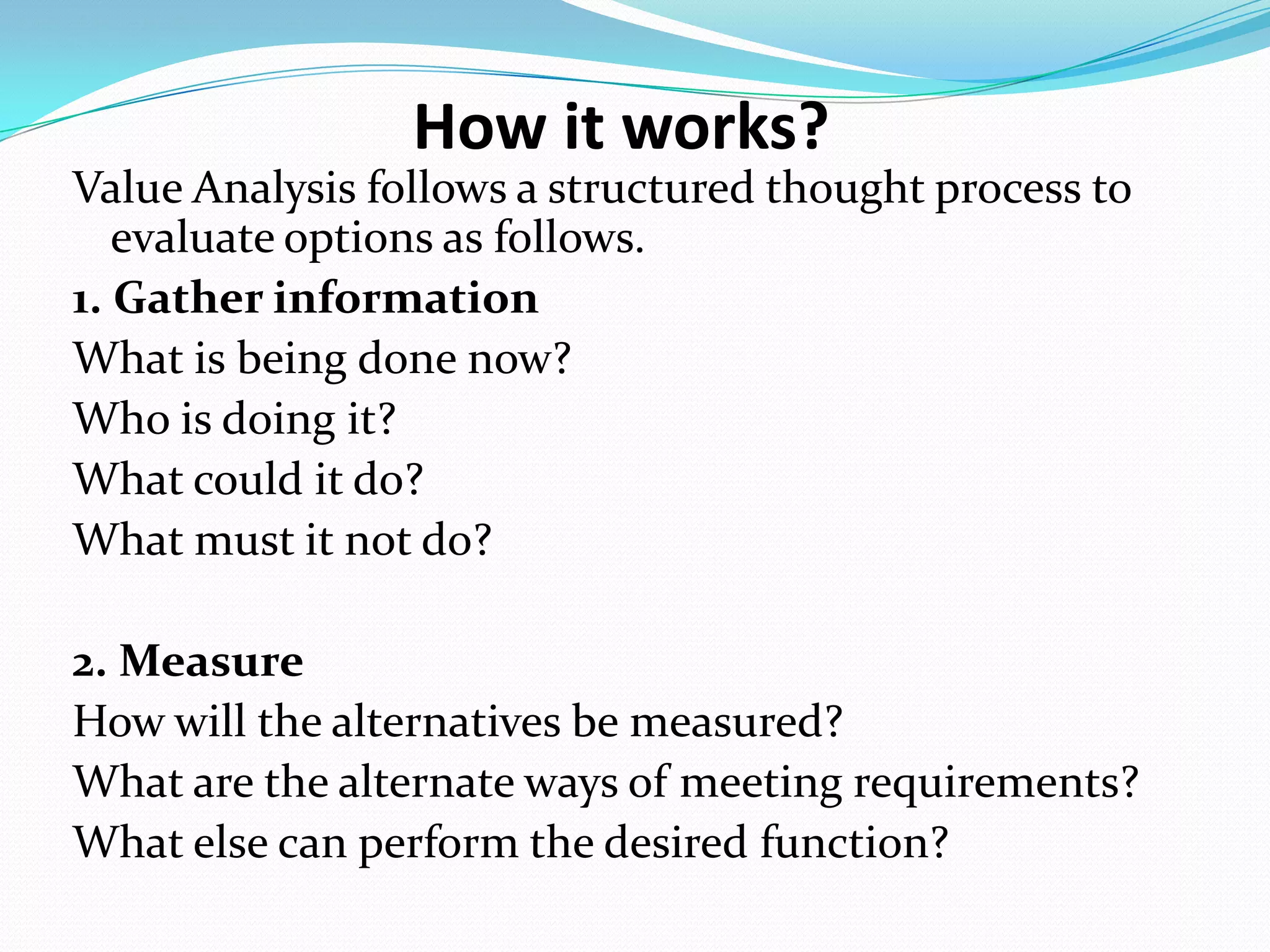
How it works?
Value Analysis follows a structured thought process to
evaluate options as follows.
1. Gather information
What is being done now?
Who is doing it?
What could it do?
What must it not do?
2. Measure
How will the alternatives be measured?
What are the alternate ways of meeting requirements?
What else can perform the desired function?
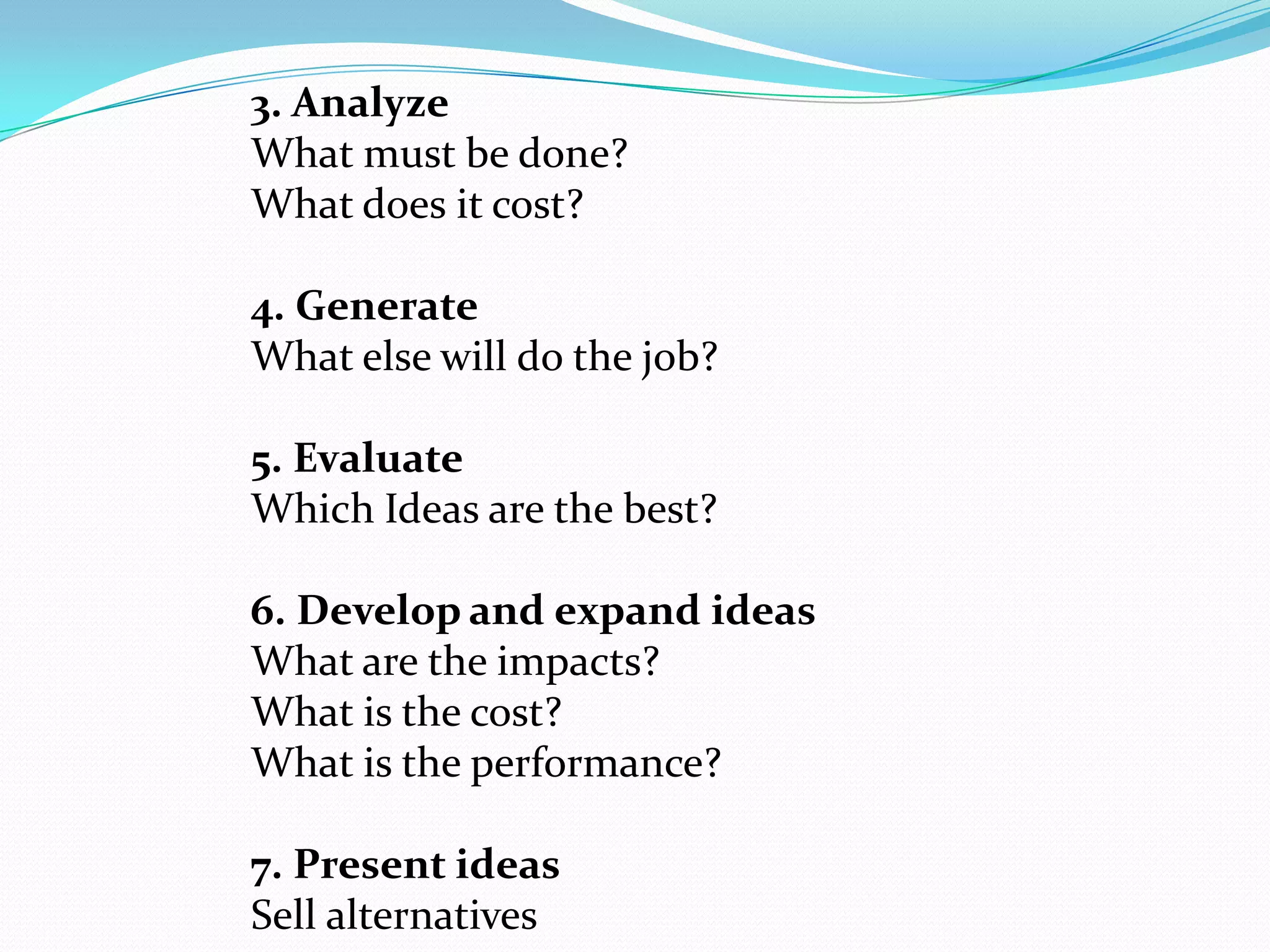
3. Analyze
What must be done?
What does it cost?
4. Generate
What else will do the job?
5. Evaluate
Which Ideas are the best?
6. Develop and expand ideas
What are the impacts?
What is the cost?
What is the performance?
7. Present ideas
Sell alternatives
Examples of Value Engineering
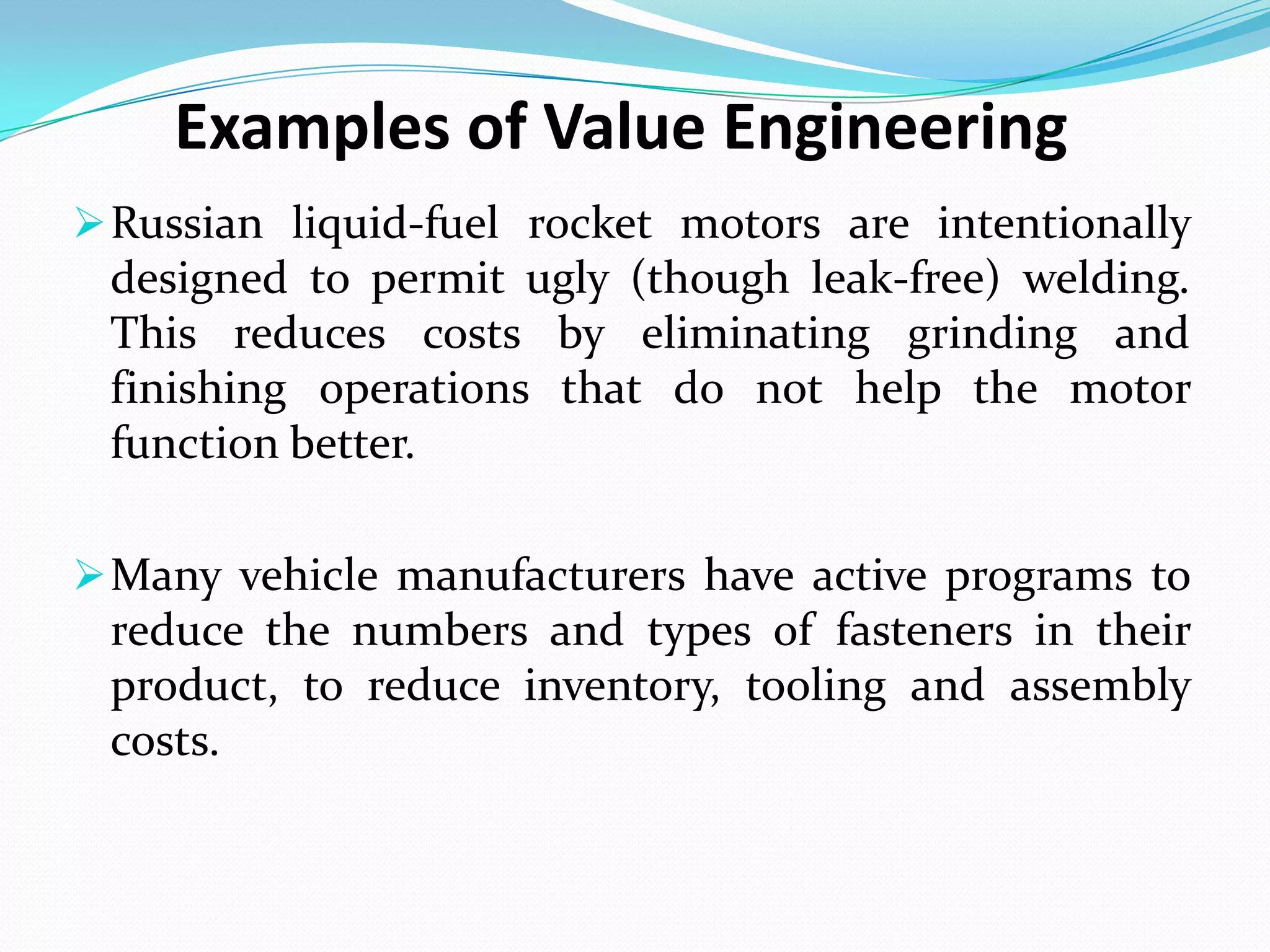
Russian liquid-fuel rocket motors are intentionally
designed to permit ugly (though leak-free) welding.
This reduces costs by eliminating grinding and
finishing operations that do not help the motor
function better.
Many vehicle manufacturers have active programs to
reduce the numbers and types of fasteners in their
product, to reduce inventory, tooling and assembly
costs.
Benefits of Value Analysis
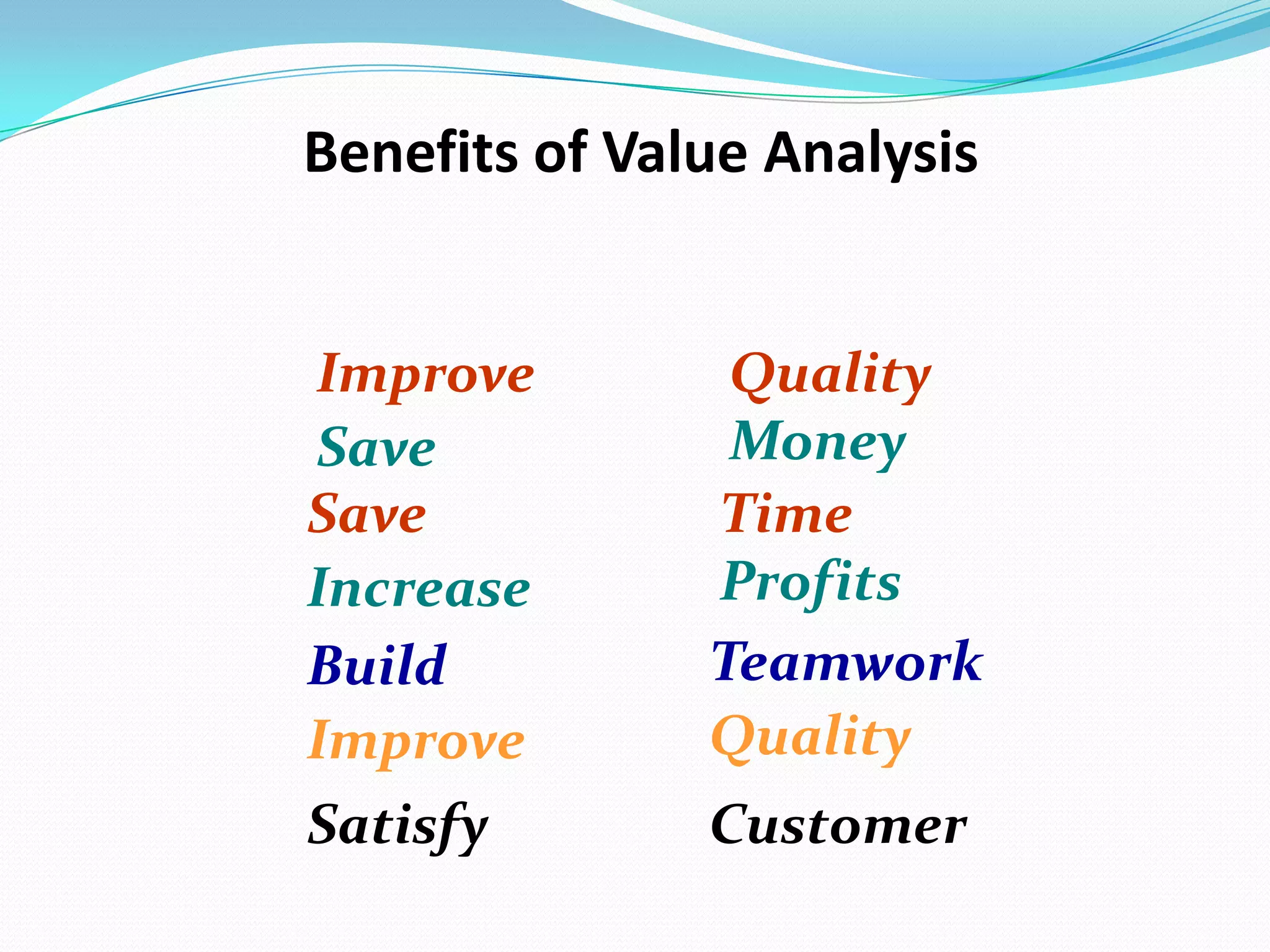
Save Time
Increase Profits
Build Teamwork
Improve Quality
Satisfy Customer
Improve Quality
Save Money
Case Problem for You to Think…
Air Cool Electrics Ltd., manufactures ceiling fans.
Since this is a standardized product and also faces
hectic competition, the company aims to reduce the
price of the product, by Value Analysis approach.
Think and help them to carry out Value Analysis.
Clue:- Motor housing
Blades
Supporting Rod
Bolt and Nut as fasteners
Top & Bottom cups as cover
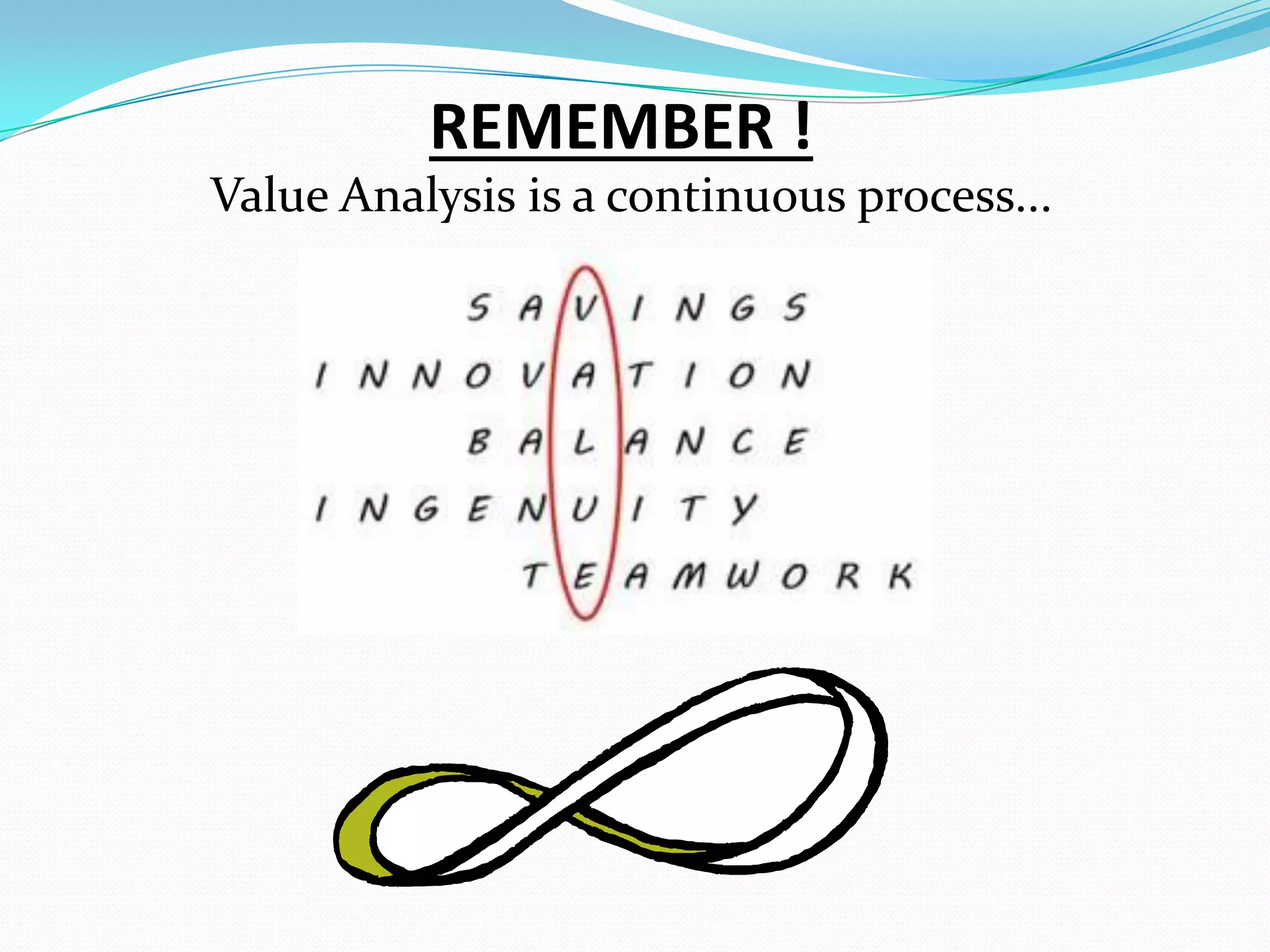
REMEMBER !
Value Analysis is a continuous process...
References
1. www.google.com
2. www.wikipedia.com
3. www. nptel.ac.in
4. Prof. Inderdeep Singh, Mechanical & Industrial Engg.
Dept., I.I.T., Roorkee.
5. ‘Production & Operations Management’ text book, 3rd
edition, by R. Panneerselvam.
Thank You

Value_Analysis_and_Value_Engineering, A_seminar_by_Mohan_Kumar_G

  • 1.
    A Seminar by MohanKumar G. 1st Sem., M.Tech. (M.E.M.), S.J.C.E., Mysore. 14-12-2015
  • 2.
    Overview  Brief History Definition  Difference b/w Value Analysis & Value Engg.  What is Value?  What is Function?  Value Analysis Cycle  Examples of Value Engineering  Benefits of Value Analysis  Case Problem for you  References
  • 3.
    Brief History Value Analysisbegan at General Electric Co., in U.S.A., during World War II (1939-1945). Because of the war, there were shortages of skilled labour, raw materials, and component parts. Lawrence D. Miles, Jerry Leftow, and Harry Erlicher at G.E. looked for acceptable substitutes. They noticed that these substitutions often reduced costs, improved the product, or both. What started out as an accident of necessity was turned into a systematic process. They called their technique “Value Analysis". Lawrence D. Miles, is known as the father of the Value Analysis / Value Engineering concept.
  • 4.
    Definition Value Analysis is“An Organized, Creative, Cost Search technique for Analyzing the Function of a Product with the purpose of Value Enhancement without compromising with it's Quality, Reliability, Performance and Efficiency." "Value analysis is a philosophy implemented by the use of specific set of techniques, and a group of learned skills. It is an organized creative approach which has as it's purpose the efficient identification of unnecessary cost, i.e., cost which provides neither quality, nor use, nor appearance, nor customer features." - L.D. Miles
  • 5.
    Value Analysis (VA)is the application of creative techniques for increasing the Value and Functions to an already Existing Product / Services to minimize the Cost of that Product. This is like a Post-mortem analysis, done after the fact, so a Remedial Process. Value Engineering (VE) is the application of creative techniques for increasing the Value and Functions for New Products at the design stage itself, to minimize the Cost of the Product. This is done before the fact at pre-manufacturing stages such as concept development and design, so a Preventive Process. Difference between VA and VE
  • 6.
    What is VALUE? "Value is the lowest price you must pay to provide a reliable function or service." - Lawrence D. Miles "Money is of no Value; It cannot spend itself. All depends on the skill of the spender.” - Ralph Waldo Emerson Use Value, Esteem Value and Market Value Ex:- 1) Tie Clip (holds tie, keeps tie out of soup while having dinner) 2) Car (travelling is the primary function)
  • 7.
    How to IncreaseValue ? Value Analysis is a systematic method to improve the “Value" of goods or products and services by using an examination of Function. Value is the ratio of Function to Cost. Value can therefore be increased by either improving the Function or reducing the Cost. It is a primary tenet of value engineering that basic functions be preserved and not be reduced as a consequence of pursuing value improvements.
  • 8.
    How to IncreaseValue and Decrease Cost? F C F C F C F C REDUCE INCREASE MAINTAIN Value =
  • 9.
    Let us godeeper into “Value” Let us take an example of a hypothetical bolt, used to fasten wing of a passenger aeroplane. What if the bolt fails to perform its function???
  • 10.
    Now tell me,what is the value of that Bolt? NO. The Value of that Bolt is ZERO. Why? Because that bolt was designed and manufactured to function reliably. It had to perform the function of holding the wing, but it has not performed its function reliably. So we can say the Value of that bolt is zero. So, Value is the performance of the designed Function at the minimal possible cost.
  • 11.
    What is FUNCTION? Basic Function and Secondary Function Example of a Pencil. Why do we use a pencil? What are its Basic Functions and Secondary Functions? To get the answers, let us do brainstorming and ask WHY and HOW type of questions, so that we will be identifying many Functions of a Pencil.
  • 12.
    Functions of Pencil ChangeAttitudes Communicate Ideas Transmit Thoughts Write Words Make Marks Spread Lead
  • 13.
    Then, What isValue Engineering ? Is it cost reduction? Is it item elimination? Is it function deletion? Is it use of cheaper material? Is it use of lower cost process? Answer to all these questions are NO!!! Value Engineering is much more than this...
  • 14.
  • 15.
    How it works? ValueAnalysis follows a structured thought process to evaluate options as follows. 1. Gather information What is being done now? Who is doing it? What could it do? What must it not do? 2. Measure How will the alternatives be measured? What are the alternate ways of meeting requirements? What else can perform the desired function?
  • 16.
    3. Analyze What mustbe done? What does it cost? 4. Generate What else will do the job? 5. Evaluate Which Ideas are the best? 6. Develop and expand ideas What are the impacts? What is the cost? What is the performance? 7. Present ideas Sell alternatives
  • 17.
    Examples of ValueEngineering Russian liquid-fuel rocket motors are intentionally designed to permit ugly (though leak-free) welding. This reduces costs by eliminating grinding and finishing operations that do not help the motor function better. Many vehicle manufacturers have active programs to reduce the numbers and types of fasteners in their product, to reduce inventory, tooling and assembly costs.
  • 18.
    Benefits of ValueAnalysis Save Time Increase Profits Build Teamwork Improve Quality Satisfy Customer Improve Quality Save Money
  • 19.
    Case Problem forYou to Think… Air Cool Electrics Ltd., manufactures ceiling fans. Since this is a standardized product and also faces hectic competition, the company aims to reduce the price of the product, by Value Analysis approach. Think and help them to carry out Value Analysis. Clue:- Motor housing Blades Supporting Rod Bolt and Nut as fasteners Top & Bottom cups as cover
  • 20.
    REMEMBER ! Value Analysisis a continuous process...
  • 21.
    References 1. www.google.com 2. www.wikipedia.com 3.www. nptel.ac.in 4. Prof. Inderdeep Singh, Mechanical & Industrial Engg. Dept., I.I.T., Roorkee. 5. ‘Production & Operations Management’ text book, 3rd edition, by R. Panneerselvam.
  • 22.