RELIABILITY
BY
DR.SHAZIA ZAMIR
RELIABILITY
ACCORDING TO MERRIAM WEBSTER DICTIONARY:
“Reliability is the extent to which an experiment, test, or measuring procedure
yields the same results on repeated trials.”
ACCORDING TO HOPKINS & ANTES (2000):
“Reliability is the consistency of observations yielded over repeated recordings
either for one subject or a set of subjects.”
The more general definition of the reliability is: The degree to which a score is
stable and consistent when measured at different times (test-retest reliability), in
different ways (parallel-forms and alternate-forms), or with different items
within the same scale (internal consistency).
RELIABILITY
Means "repeatability" or "consistency".
It is an ability of an instrument to consistently measure,
what is suppose to measure.
A measure is considered reliable if it would give us the same
result over and over again (assuming that what we are
measuring isn't changing!).
www.vipinpatidar.wordpress.com
TYPES OF
RELIABILITY
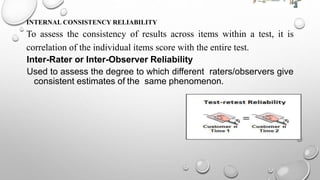
i) Test-Retest Reliability:
ii) To assess the consistency of a measure from one time to
another, when a same test is administered twice and the
results of both administrations are similar, this
constitutes the test-retest reliability. Students may
remember and may be mature after the first
administration creates a problem for test-retest
reliability.
We estimate test-retest reliability when we administer the same test
to the same sample on two different occasions. This approach
assumes that there is no substantial change in the construct being
measured between the two occasions. The amount of time allowed
between measures is critical. We know that if we measure the same
thing twice that the correlation between the two observations will
depend in part by how much time elapses between the two
measurement occasions. The shorter the time gap, the higher the
correlation; the longer the time gap, the lower the correlation. This
is because the two observations are related over time -- the closer
in time we get the more similar the factors that contribute to error.
Since this correlation is the test-retest estimate of reliability, you
can obtain considerably different estimates depending on the
interval.
Parallel-form reliability
To assess the consistency of the results of two tests
constructed in the same way from the same content
domain. Here the test designer tries to develop two tests
of the similar kinds and after administration the results
are similar then it will indicate the parallel form reliability.
INTERNAL CONSISTENCY RELIABILITY
To assess the consistency of results across items within a test, it is
correlation of the individual items score with the entire test.
Inter-Rater or Inter-Observer Reliability
Used to assess the degree to which different raters/observers give
consistent estimates of the same phenomenon.
FACTORS AFFECTING RELIABILITY
Reliability of the test is an important characteristic as we use the
test results for the future decisions about the students’
educational advances and for the job selection and many more.
The methods to assure the reliability of the tests have been
discussed. Here we shall focus upon the different factors that may
affect the reliability of the test. The degree of the affect of each
factor varies from the situation to situation. Controlling the factor
may improve the reliability and otherwise it may lower the
consistency of production of scores. Some of the factors that
directly or indirectly affect the test reliability are given as under.
TEST LENGTH
As a rule, adding more homogeneous questions to a test will increase the test's
reliability. The more observations there are of a specific trait, the more accurate the
measure is likely to be. Adding more questions to a psychological test is similar to
adding finer distinctions on a measuring tape.
HETEROGENEITY OF SCORES
Heterogeneity is referred as the differences among the scores obtained from
class. You may say that there are some students who got high scores and
some students who got low scores or intelligent students who got high scores
and other one got low scores or the difference could be due to any reason
may be income level, intelligence of the students, parents qualification etc.
Whichever is the reason for the variability of the scores the greater the
variability (range) of test scores, the higher the reliability. Increasing the
DIFFICULTY
• A test that is too difficult or too easy reduces the reliability (e.g., Fewer test-takers
get the answers correctly or vice-versa). A moderate level of difficulty increases test
reliability.
• The test itself: the overall look of the test may affect the students score. Normally a
test is written in well readable font size and style, the language of the test should be
simple and understandable.
• The test administration: After the development of the test, the test developer may
have to prepare the manual of the test administration, the time, environment,
invigilation, and the anxiety also affects students’ performance while attempting the
test. Therefore the uniform administration of the test leads to the increased
reliability.
• The test scoring: Marking of the test is another factor towards the variation in the
scores of the students. Normally there are many raters to rate the students’
responses/answers on the test. Objective type test items and the marking rubric for
ACTIVITY
• Develop a test of English for sixth grade students,
administer it twice with a gap of six weeks, find
the relationship between the scores of students
between 1st and 2nd administration.

Reliability

  • 1.
  • 2.
    RELIABILITY ACCORDING TO MERRIAMWEBSTER DICTIONARY: “Reliability is the extent to which an experiment, test, or measuring procedure yields the same results on repeated trials.” ACCORDING TO HOPKINS & ANTES (2000): “Reliability is the consistency of observations yielded over repeated recordings either for one subject or a set of subjects.” The more general definition of the reliability is: The degree to which a score is stable and consistent when measured at different times (test-retest reliability), in different ways (parallel-forms and alternate-forms), or with different items within the same scale (internal consistency).
  • 3.
    RELIABILITY Means "repeatability" or"consistency". It is an ability of an instrument to consistently measure, what is suppose to measure. A measure is considered reliable if it would give us the same result over and over again (assuming that what we are measuring isn't changing!). www.vipinpatidar.wordpress.com
  • 4.
    TYPES OF RELIABILITY i) Test-RetestReliability: ii) To assess the consistency of a measure from one time to another, when a same test is administered twice and the results of both administrations are similar, this constitutes the test-retest reliability. Students may remember and may be mature after the first administration creates a problem for test-retest reliability.
  • 5.
    We estimate test-retestreliability when we administer the same test to the same sample on two different occasions. This approach assumes that there is no substantial change in the construct being measured between the two occasions. The amount of time allowed between measures is critical. We know that if we measure the same thing twice that the correlation between the two observations will depend in part by how much time elapses between the two measurement occasions. The shorter the time gap, the higher the correlation; the longer the time gap, the lower the correlation. This is because the two observations are related over time -- the closer in time we get the more similar the factors that contribute to error. Since this correlation is the test-retest estimate of reliability, you can obtain considerably different estimates depending on the interval.
  • 6.
    Parallel-form reliability To assessthe consistency of the results of two tests constructed in the same way from the same content domain. Here the test designer tries to develop two tests of the similar kinds and after administration the results are similar then it will indicate the parallel form reliability.
  • 7.
    INTERNAL CONSISTENCY RELIABILITY Toassess the consistency of results across items within a test, it is correlation of the individual items score with the entire test. Inter-Rater or Inter-Observer Reliability Used to assess the degree to which different raters/observers give consistent estimates of the same phenomenon.
  • 8.
    FACTORS AFFECTING RELIABILITY Reliabilityof the test is an important characteristic as we use the test results for the future decisions about the students’ educational advances and for the job selection and many more. The methods to assure the reliability of the tests have been discussed. Here we shall focus upon the different factors that may affect the reliability of the test. The degree of the affect of each factor varies from the situation to situation. Controlling the factor may improve the reliability and otherwise it may lower the consistency of production of scores. Some of the factors that directly or indirectly affect the test reliability are given as under.
  • 9.
    TEST LENGTH As arule, adding more homogeneous questions to a test will increase the test's reliability. The more observations there are of a specific trait, the more accurate the measure is likely to be. Adding more questions to a psychological test is similar to adding finer distinctions on a measuring tape. HETEROGENEITY OF SCORES Heterogeneity is referred as the differences among the scores obtained from class. You may say that there are some students who got high scores and some students who got low scores or intelligent students who got high scores and other one got low scores or the difference could be due to any reason may be income level, intelligence of the students, parents qualification etc. Whichever is the reason for the variability of the scores the greater the variability (range) of test scores, the higher the reliability. Increasing the
  • 10.
    DIFFICULTY • A testthat is too difficult or too easy reduces the reliability (e.g., Fewer test-takers get the answers correctly or vice-versa). A moderate level of difficulty increases test reliability. • The test itself: the overall look of the test may affect the students score. Normally a test is written in well readable font size and style, the language of the test should be simple and understandable. • The test administration: After the development of the test, the test developer may have to prepare the manual of the test administration, the time, environment, invigilation, and the anxiety also affects students’ performance while attempting the test. Therefore the uniform administration of the test leads to the increased reliability. • The test scoring: Marking of the test is another factor towards the variation in the scores of the students. Normally there are many raters to rate the students’ responses/answers on the test. Objective type test items and the marking rubric for
  • 11.
    ACTIVITY • Develop atest of English for sixth grade students, administer it twice with a gap of six weeks, find the relationship between the scores of students between 1st and 2nd administration.