Preparation of different vaccines
1. Killed vaccine.
2. Live attenuated vaccine.
3. Subunit vaccine
4. Peptide vaccine
5. Toxoid vaccine
6. Conjugate vaccine
7. Recombinant vector vaccine
8. Anti-idiotypic vaccine
Killed vaccine/inactivated
vaccine
• An inactivated vaccine (or killed vaccine) is a vaccine consisting
of virus, bacteria, or other pathogens that have been grown
in culture and then killed using methods.
• Physical method: pasteurization methods / heating.
• Chemical method: Formalin , beta-Propiolactone (BPL) , binary
ethylenimine (BEI) .
. [Avian Dis. 1991 Jul-Sep;35(3):505-14.]
• Typhoid vaccine is a bacterium based inactivated vaccine.
[Vaccine Types, 2017.]
Live attenuated vaccine.
 Live attenuated vaccines are created by weakening infectious organisms
that can still replicate and induce protective immune responses without
causing disease in the host.
 . Attenuation can be achieved in several ways:
1. Naturally occurring related organisms that are avirulent in humans for
example in the 18th century, the British doctor Edward Jenner used
cowpox virus to vaccinate children against the disease smallpox. This
vaccination strategy was based on the observation that milkmaids, who
were often exposed to cowpox in their work, rarely got smallpox.
Eventually cowpox was replaced by the related vaccinia virus. The vaccinia
and cowpox viruses are highly related to the smallpox virus but cause
minimal or mild disease in humans with a high degree of cross protection
against smallpox. Using the vaccinia virus-based vaccine, smallpox was
successfully eradicated in the late 1970s.
Continue..
2. Multiple rounds of growth of virulent organisms under conditions that
weaken the organism such as in tissue culture or harsh physical
conditions e.g Attenuation for the measles vaccine is achieved by
culture of virulent virus in duck and human cells. The measles vaccine
was FDA approved in 1968.
3. Genetic manipulation of the organism to reduce virulence.
Subunit vaccine
• Subunit vaccines contain only the necessary antigens, not all other
molecules that make up the microbes
• It is a tricky and time-consuming process to determine the best
antigen to stimulate the immune system. However, once scientists
are able to solve the puzzle, they can prepare subunit vaccines in the
following two ways:
1. Scientists cultivate microbes in the laboratory, then break them
apart with chemicals and collect important antigens.
2. Scientists use recombinant DNA technology to make antigen
molecules from microbes. Vaccines produced in this method are
called "recombinant subunit vaccines".
Continue…
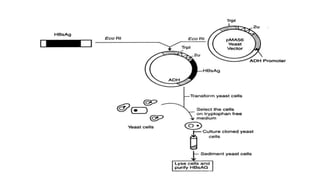
A recombinant subunit vaccine has been made for the hepatitis B virus.
It is a non-infectious subunit viral vaccine derived from Hepatitis B
surface antigen (HBsAg) produced in yeast system. Scientists inserted a
portion of the hepatitis B virus gene that code for HBsAg into common
baker’s yeast. The antigen for hepatitis B is produced from cultures of
this recombinant yeast strain, which is collected and purified for use of
the Hepatitis B vaccine.
Continue…
• Expression systems for vaccine production include prokaryotic
expression system such as E. coli, and eukaryotic system such as
yeast, mammalian or insect cells.
• Factors while selecting expression system:expression levels, selection
markers and the presence of post-translational modifications.
Peptide vaccine
• A peptide vaccine is any peptide which serves to immunize an
organism against a pathogen.
• Two ways of making peptide vaccine.
1. Recombinant technique in which DNA sequence is express in
suitable vehicle. Mostly use for peptide which has more then 50
residue.[WHO, technical report series, No:889, 1999]
2. Synthesis of peptide: sequence reaction. Use for peptides having
residues less then 50.
Continue…
2.Synthesis of peptide
• Carboxyl group of one amino acid is highly activates, in order to make
peptide bond with amino group of 2nd amino acid.
• In addition other side chain group are protected, so that they can’t
interfere in peptide bond . These protection are removed at the end
of synthesis.
• These are series of reactions.
• During each cycle one fresh peptide is added.
Continue…
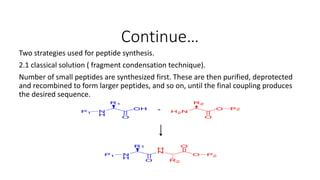
Two strategies used for peptide synthesis.
2.1 classical solution ( fragment condensation technique).
Number of small peptides are synthesized first. These are then purified, deprotected
and recombined to form larger peptides, and so on, until the final coupling produces
the desired sequence.
Continue…
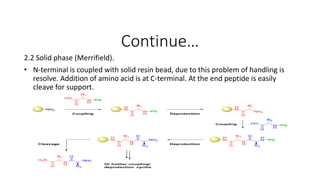
2.2 Solid phase (Merrifield).
• N-terminal is coupled with solid resin bead, due to this problem of handling is
resolve. Addition of amino acid is at C-terminal. At the end peptide is easily
cleave for support.
Toxoid vaccine
• Toxoid is a chemically inactivated toxin. Toxoid vaccines are little
different from the vaccines discussed previously. They use the germs
toxin that causes a disease.
• Diphtheria toxoid is prepared by formaldehyde treatment of toxin
and is standardized for potency according to the U.S. Food and Drug
Administration.
• Toxoid is adsorbed to aluminum salts, which enhances
immunogenicity.
[Irini Daskalaki, in Principles and Practice of Pediatric Infectious Diseases
(Fourth Edition), 2012]
Conjugate vaccine
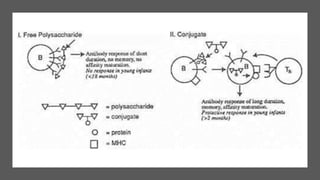
• Conjugate vaccines combine a weak antigen with a strong antigen so that
the immune system has a stronger response to the weak antigen.
• the weak antigen is a polysaccharide that is attached to strong protein
antigen.
• Polysaccharides are poor in activating B-cells to the production of
antibodies in children. If antibodies are formed, they are of short duration.
For conjugate vaccines T-cells are involved in the activation of B-cells.
Presumably, the conjugate is taken up by polysaccharide-specific B-cells,
processed, and presented to carrier-specific T-cells. The involvement of T-
cells results in the activation of B-cells to production of antibodies and
induction of memory in children younger than 2 year of age.
Continue…
• Organic cyanylating reagents, such as 1-cyano-4-(dimethylamino)-
pyridinium tetrafluoroborate, also called “CDAP” has been developed.
These reagents activate polysaccharides and facilitate coupling of
polysaccharides to proteins for conjugate vaccines. The use of CDAP
and other organic cyanylating reagents is described in the following
U.S. Patent and Patent Applications of Andrew Lees: U.S. patent
application Ser. No. 08/124,491 (filed Sep. 22, 1993, now
abandoned), U.S. Pat. No. 5,651,971; and U.S. patent application Ser.
No. 08/482,666 (filed Jun. 7, 1995).
Recombinant vector vaccine.
• Recombinant vector vaccines are experimental vaccines similar to
DNA vaccines, but they use an attenuated virus or bacterium to
introduce microbial DNA to cells of the body. “Vector” refers to the
virus or bacterium used as the carrier. In nature, viruses latch on to
cells and inject their genetic material into them.
• As a result of advances in the fields of molecular biology and genetic
engineering it is now possible to create recombinant vector vaccine.
Anti-idiotypic vaccine
• Epitope is mirror image/opposite of idiotype.
• Epitope (part of antigen)is recognized by idiotype(part of antibody) to immunize.
• So anti-idiotype antibody mimics part of the three dimensional structure of the
antigen.
• This can be used as a vaccine.
• when the anti-idiotype antibody is injected into a person, antibodies (antianti-
idiotype antiobodies) are formed that recognize a structure similar to part of the
virus and might potentially neutralize the virus.
Continue…
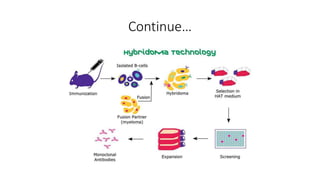
• idiotype protein was produced by a rescue hybridization technique
developed by Ronald Levy's laboratory at Stanford University
(Carroll, et al 1986) and (Center for Applied Medical Research and
University Hospital, University of Navarra, Avda. Pio XII 36-55, 31008
Pamplona, Spain,2010).
Continue…
Continue…
• More recently, recombinant DNA technology has been used to
generate idiotype proteins with the goal of shortening the vaccine
production time. In this approach, the variable regions of the heavy
(VH) and light (VL) chains of the immunoglobulin are cloned by
polymerase chain reaction (PCR) and inserted into an expression
vector for production of the idiotype protein either in mammalian
cells, insect cells, tobacco plants, or Escherichia coli (Hurvitz, et al
2005; McCormick, et al 1999; Kanter, et al 2007)

Vaccine preparation part 2

  • 1.
    Preparation of differentvaccines 1. Killed vaccine. 2. Live attenuated vaccine. 3. Subunit vaccine 4. Peptide vaccine 5. Toxoid vaccine 6. Conjugate vaccine 7. Recombinant vector vaccine 8. Anti-idiotypic vaccine
  • 2.
    Killed vaccine/inactivated vaccine • Aninactivated vaccine (or killed vaccine) is a vaccine consisting of virus, bacteria, or other pathogens that have been grown in culture and then killed using methods. • Physical method: pasteurization methods / heating. • Chemical method: Formalin , beta-Propiolactone (BPL) , binary ethylenimine (BEI) . . [Avian Dis. 1991 Jul-Sep;35(3):505-14.] • Typhoid vaccine is a bacterium based inactivated vaccine. [Vaccine Types, 2017.]
  • 3.
    Live attenuated vaccine. Live attenuated vaccines are created by weakening infectious organisms that can still replicate and induce protective immune responses without causing disease in the host.  . Attenuation can be achieved in several ways: 1. Naturally occurring related organisms that are avirulent in humans for example in the 18th century, the British doctor Edward Jenner used cowpox virus to vaccinate children against the disease smallpox. This vaccination strategy was based on the observation that milkmaids, who were often exposed to cowpox in their work, rarely got smallpox. Eventually cowpox was replaced by the related vaccinia virus. The vaccinia and cowpox viruses are highly related to the smallpox virus but cause minimal or mild disease in humans with a high degree of cross protection against smallpox. Using the vaccinia virus-based vaccine, smallpox was successfully eradicated in the late 1970s.
  • 4.
    Continue.. 2. Multiple roundsof growth of virulent organisms under conditions that weaken the organism such as in tissue culture or harsh physical conditions e.g Attenuation for the measles vaccine is achieved by culture of virulent virus in duck and human cells. The measles vaccine was FDA approved in 1968. 3. Genetic manipulation of the organism to reduce virulence.
  • 5.
    Subunit vaccine • Subunitvaccines contain only the necessary antigens, not all other molecules that make up the microbes • It is a tricky and time-consuming process to determine the best antigen to stimulate the immune system. However, once scientists are able to solve the puzzle, they can prepare subunit vaccines in the following two ways: 1. Scientists cultivate microbes in the laboratory, then break them apart with chemicals and collect important antigens. 2. Scientists use recombinant DNA technology to make antigen molecules from microbes. Vaccines produced in this method are called "recombinant subunit vaccines".
  • 6.
    Continue… A recombinant subunitvaccine has been made for the hepatitis B virus. It is a non-infectious subunit viral vaccine derived from Hepatitis B surface antigen (HBsAg) produced in yeast system. Scientists inserted a portion of the hepatitis B virus gene that code for HBsAg into common baker’s yeast. The antigen for hepatitis B is produced from cultures of this recombinant yeast strain, which is collected and purified for use of the Hepatitis B vaccine.
  • 8.
    Continue… • Expression systemsfor vaccine production include prokaryotic expression system such as E. coli, and eukaryotic system such as yeast, mammalian or insect cells. • Factors while selecting expression system:expression levels, selection markers and the presence of post-translational modifications.
  • 9.
    Peptide vaccine • Apeptide vaccine is any peptide which serves to immunize an organism against a pathogen. • Two ways of making peptide vaccine. 1. Recombinant technique in which DNA sequence is express in suitable vehicle. Mostly use for peptide which has more then 50 residue.[WHO, technical report series, No:889, 1999] 2. Synthesis of peptide: sequence reaction. Use for peptides having residues less then 50.
  • 10.
    Continue… 2.Synthesis of peptide •Carboxyl group of one amino acid is highly activates, in order to make peptide bond with amino group of 2nd amino acid. • In addition other side chain group are protected, so that they can’t interfere in peptide bond . These protection are removed at the end of synthesis. • These are series of reactions. • During each cycle one fresh peptide is added.
  • 11.
    Continue… Two strategies usedfor peptide synthesis. 2.1 classical solution ( fragment condensation technique). Number of small peptides are synthesized first. These are then purified, deprotected and recombined to form larger peptides, and so on, until the final coupling produces the desired sequence.
  • 12.
    Continue… 2.2 Solid phase(Merrifield). • N-terminal is coupled with solid resin bead, due to this problem of handling is resolve. Addition of amino acid is at C-terminal. At the end peptide is easily cleave for support.
  • 13.
    Toxoid vaccine • Toxoidis a chemically inactivated toxin. Toxoid vaccines are little different from the vaccines discussed previously. They use the germs toxin that causes a disease. • Diphtheria toxoid is prepared by formaldehyde treatment of toxin and is standardized for potency according to the U.S. Food and Drug Administration. • Toxoid is adsorbed to aluminum salts, which enhances immunogenicity. [Irini Daskalaki, in Principles and Practice of Pediatric Infectious Diseases (Fourth Edition), 2012]
  • 14.
    Conjugate vaccine • Conjugatevaccines combine a weak antigen with a strong antigen so that the immune system has a stronger response to the weak antigen. • the weak antigen is a polysaccharide that is attached to strong protein antigen. • Polysaccharides are poor in activating B-cells to the production of antibodies in children. If antibodies are formed, they are of short duration. For conjugate vaccines T-cells are involved in the activation of B-cells. Presumably, the conjugate is taken up by polysaccharide-specific B-cells, processed, and presented to carrier-specific T-cells. The involvement of T- cells results in the activation of B-cells to production of antibodies and induction of memory in children younger than 2 year of age.
  • 16.
    Continue… • Organic cyanylatingreagents, such as 1-cyano-4-(dimethylamino)- pyridinium tetrafluoroborate, also called “CDAP” has been developed. These reagents activate polysaccharides and facilitate coupling of polysaccharides to proteins for conjugate vaccines. The use of CDAP and other organic cyanylating reagents is described in the following U.S. Patent and Patent Applications of Andrew Lees: U.S. patent application Ser. No. 08/124,491 (filed Sep. 22, 1993, now abandoned), U.S. Pat. No. 5,651,971; and U.S. patent application Ser. No. 08/482,666 (filed Jun. 7, 1995).
  • 17.
    Recombinant vector vaccine. •Recombinant vector vaccines are experimental vaccines similar to DNA vaccines, but they use an attenuated virus or bacterium to introduce microbial DNA to cells of the body. “Vector” refers to the virus or bacterium used as the carrier. In nature, viruses latch on to cells and inject their genetic material into them. • As a result of advances in the fields of molecular biology and genetic engineering it is now possible to create recombinant vector vaccine.
  • 18.
    Anti-idiotypic vaccine • Epitopeis mirror image/opposite of idiotype. • Epitope (part of antigen)is recognized by idiotype(part of antibody) to immunize. • So anti-idiotype antibody mimics part of the three dimensional structure of the antigen. • This can be used as a vaccine. • when the anti-idiotype antibody is injected into a person, antibodies (antianti- idiotype antiobodies) are formed that recognize a structure similar to part of the virus and might potentially neutralize the virus.
  • 19.
    Continue… • idiotype proteinwas produced by a rescue hybridization technique developed by Ronald Levy's laboratory at Stanford University (Carroll, et al 1986) and (Center for Applied Medical Research and University Hospital, University of Navarra, Avda. Pio XII 36-55, 31008 Pamplona, Spain,2010).
  • 20.
  • 21.
    Continue… • More recently,recombinant DNA technology has been used to generate idiotype proteins with the goal of shortening the vaccine production time. In this approach, the variable regions of the heavy (VH) and light (VL) chains of the immunoglobulin are cloned by polymerase chain reaction (PCR) and inserted into an expression vector for production of the idiotype protein either in mammalian cells, insect cells, tobacco plants, or Escherichia coli (Hurvitz, et al 2005; McCormick, et al 1999; Kanter, et al 2007)