Atifa Ambreen
Government College University, Faisalabad
White blood cells are also called leukocytes. They circulate in the
body in blood vessels and the lymphatic vessels that parallel the
veins and arteries. They are stored in different places in the body,
which are referred to as lymphoid organs. These include the
following:
1. Thymus — a gland between the lungs and just below the neck.
2. Spleen — an organ that filters the blood. It sits in the upper
left of the abdomen.
3. Bone marrow — found in the center of the bones, it also produces
red blood cells.
4. Lymph nodes —small glands positioned throughout the body,
linked by lymphatic vessels.
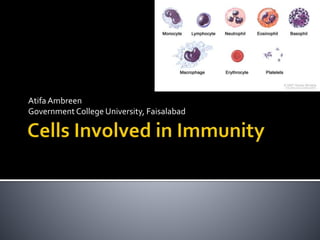
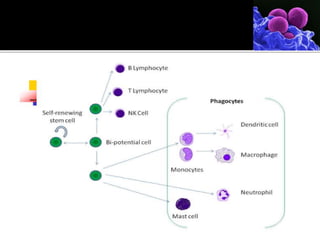
 The cells of immune system are:
1. Lymphocytes
 • T-lymphocytes
 • B- lymphocytes
 • NK cell
 2. Phagocytic cells
 • Monocytes
 • Macrophages
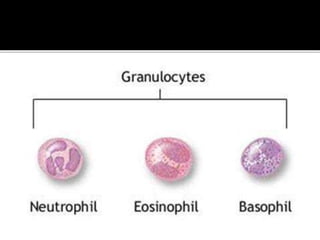
3. Granulocytic cells
• Neutrophils
• Basophils
• Eosinophils
4. Dendritic cells
 Lymphocytes are small, round cells found in peripheral blood,
lymph, lymph nodes, lymphoid organs and in tissues.
 Lymphocytes begin their life in bone marrow. Some stay in the
bone marrow and develop into B lymphocytes (B cells), others
head to the thymus and becomeT lymphocytes (T cells).
 Lymphocytes represent 20-45% of total cells in peripheral
blood and 99% of total cells in lymph and lymph node.
 According to size the lymphocytes are divided into small (5-8
µm), medium (8-12 µm) and large (12-15 µm).
 Depending on life span lymphocytes are classified into short lived
(2 weeks) and long lived (3 years or more or even
lifelong).
 These two cell types have different roles:
1. B lymphocytes — they produce antibodies
and help alert theT lymphocytes.
2. T lymphocytes — they destroy
compromised cells in the body and help alert
other leukocytes.
 Once B lymphocytes spot the antigen, they
begin to secrete antibodies (antigen is short
for "antibody generators"). Antibodies are
special proteins that lock on to specific
antigens.
 Each B cell makes one specific antibody.
 Antibodies are part of a large family of
chemicals called immunoglobulins, which
play many roles in the immune responses.
 Immunoglobulin G (IgG) — marks microbes so other cells
can recognize and deal with them.
 IgM — is expert at killing bacteria.
 IgA — congregates in fluids, such as tears and saliva, where it
protects gateways into the body.
 IgE — protects against parasites and is also to blame for
allergies.
 IgD — stays bound to B lymphocytes, helping them to start
the immune response.
 Antibodies lock onto the antigen, but they do not kill it, only
mark it for death. The killing is the job of other cells, such as
phagocytes.
 There are distinct types ofT lymphocytes:
1. Helper T cells (Th cells) — they coordinate the
immune response. Some communicate with
other cells, and some stimulate B cells to
produce more antibodies. Others attract more T
cells or cell-eating phagocytes.
2. Killer T cells (cytotoxic T lymphocytes) — as
the name suggests, these T cells attack other
cells. They are particularly useful for fighting
viruses. They work by recognizing small parts of
the virus on the outside of infected cells and
destroy the infected cells.
 These cells surround and absorb pathogens and
break them down, effectively eating them. There
are several types, including:
 Neutrophils — these are the most common type
of phagocyte and tend to attack bacteria.
 Monocytes — these are the largest type and have
several roles.
 Macrophages — these are patrol for pathogens
and also remove dead and dying cells.
 Mast cells — they have many jobs, including helping
to heal wounds and defend against pathogens.
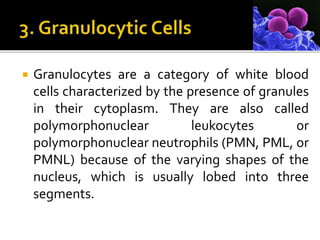
 Granulocytes are a category of white blood
cells characterized by the presence of granules
in their cytoplasm. They are also called
polymorphonuclear leukocytes or
polymorphonuclear neutrophils (PMN, PML, or
PMNL) because of the varying shapes of the
nucleus, which is usually lobed into three
segments.
 Neutrophils are (11-14 µm) in diameter with
multilobed nucleus with granules in
cytoplasm.
 It constitutes 50-70 % of total circulating
WBC and remains for 7-8 hours in blood
and then migrates to tissues
 Life span is 3-4 days.
 Also known as
polymorphonuclear (PMN)
leucocyte.
Dendritic cells (DCs) are
antigen-presenting cells (also
known as accessory cells) of the
mammalian immune system.
Their main function is to
process antigen material and
present it on the cell surface to
the T cells of the immune
system. They act as messengers
between the innate and the
adaptive immune systems.
4. Dendritic Cells
Cells involved in Immunity

Cells involved in Immunity

  • 1.
    Atifa Ambreen Government CollegeUniversity, Faisalabad
  • 2.
    White blood cellsare also called leukocytes. They circulate in the body in blood vessels and the lymphatic vessels that parallel the veins and arteries. They are stored in different places in the body, which are referred to as lymphoid organs. These include the following: 1. Thymus — a gland between the lungs and just below the neck. 2. Spleen — an organ that filters the blood. It sits in the upper left of the abdomen. 3. Bone marrow — found in the center of the bones, it also produces red blood cells. 4. Lymph nodes —small glands positioned throughout the body, linked by lymphatic vessels.
  • 4.
     The cellsof immune system are: 1. Lymphocytes  • T-lymphocytes  • B- lymphocytes  • NK cell  2. Phagocytic cells  • Monocytes  • Macrophages 3. Granulocytic cells • Neutrophils • Basophils • Eosinophils 4. Dendritic cells
  • 6.
     Lymphocytes aresmall, round cells found in peripheral blood, lymph, lymph nodes, lymphoid organs and in tissues.  Lymphocytes begin their life in bone marrow. Some stay in the bone marrow and develop into B lymphocytes (B cells), others head to the thymus and becomeT lymphocytes (T cells).  Lymphocytes represent 20-45% of total cells in peripheral blood and 99% of total cells in lymph and lymph node.  According to size the lymphocytes are divided into small (5-8 µm), medium (8-12 µm) and large (12-15 µm).  Depending on life span lymphocytes are classified into short lived (2 weeks) and long lived (3 years or more or even lifelong).
  • 7.
     These twocell types have different roles: 1. B lymphocytes — they produce antibodies and help alert theT lymphocytes. 2. T lymphocytes — they destroy compromised cells in the body and help alert other leukocytes.
  • 8.
     Once Blymphocytes spot the antigen, they begin to secrete antibodies (antigen is short for "antibody generators"). Antibodies are special proteins that lock on to specific antigens.  Each B cell makes one specific antibody.  Antibodies are part of a large family of chemicals called immunoglobulins, which play many roles in the immune responses.
  • 10.
     Immunoglobulin G(IgG) — marks microbes so other cells can recognize and deal with them.  IgM — is expert at killing bacteria.  IgA — congregates in fluids, such as tears and saliva, where it protects gateways into the body.  IgE — protects against parasites and is also to blame for allergies.  IgD — stays bound to B lymphocytes, helping them to start the immune response.  Antibodies lock onto the antigen, but they do not kill it, only mark it for death. The killing is the job of other cells, such as phagocytes.
  • 12.
     There aredistinct types ofT lymphocytes: 1. Helper T cells (Th cells) — they coordinate the immune response. Some communicate with other cells, and some stimulate B cells to produce more antibodies. Others attract more T cells or cell-eating phagocytes. 2. Killer T cells (cytotoxic T lymphocytes) — as the name suggests, these T cells attack other cells. They are particularly useful for fighting viruses. They work by recognizing small parts of the virus on the outside of infected cells and destroy the infected cells.
  • 13.
     These cellssurround and absorb pathogens and break them down, effectively eating them. There are several types, including:  Neutrophils — these are the most common type of phagocyte and tend to attack bacteria.  Monocytes — these are the largest type and have several roles.  Macrophages — these are patrol for pathogens and also remove dead and dying cells.  Mast cells — they have many jobs, including helping to heal wounds and defend against pathogens.
  • 15.
     Granulocytes area category of white blood cells characterized by the presence of granules in their cytoplasm. They are also called polymorphonuclear leukocytes or polymorphonuclear neutrophils (PMN, PML, or PMNL) because of the varying shapes of the nucleus, which is usually lobed into three segments.
  • 16.
     Neutrophils are(11-14 µm) in diameter with multilobed nucleus with granules in cytoplasm.  It constitutes 50-70 % of total circulating WBC and remains for 7-8 hours in blood and then migrates to tissues  Life span is 3-4 days.  Also known as polymorphonuclear (PMN) leucocyte.
  • 18.
    Dendritic cells (DCs)are antigen-presenting cells (also known as accessory cells) of the mammalian immune system. Their main function is to process antigen material and present it on the cell surface to the T cells of the immune system. They act as messengers between the innate and the adaptive immune systems. 4. Dendritic Cells