The Korean War ends
July 26, 1953 – After 2 years of negotiations, an
armistice was signed between the two sides. The
boarder between North and South Vietnam was
established on the 38th Parallel.
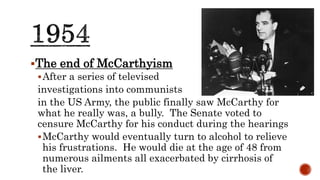
The end of McCarthyism
After a series of televised
investigations into communists
in the US Army, the public finally saw McCarthy for
what he really was, a bully. The Senate voted to
censure McCarthy for his conduct during the hearings
McCarthy would eventually turn to alcohol to relieve
his frustrations. He would die at the age of 48 from
numerous ailments all exacerbated by cirrhosis of
the liver.
May
BROWN V. BOARD OF EDUCATION
In the case of Brown v. Board of Education, the
Supreme Court struck down the Plessy v.
Ferguson “separate but equal” decision when it ruled
that segregation of public school children based on race
was unconstitutional.
It would take several years for this ruling to take
effect. Many states would fight to keep segregation in
schools for years to come.
This would be a major step in the direction of Civil
Warsaw Pact – May 14,
 In response to NATO, 8 Communist Bloc countries signed the
Warsaw Pact, a “Treaty of Friendship, Co-operation and Mutual
Assistance,” to form a mutual defense coalition. Force comparisons
became the centerpiece of the Cold War.
MONTGOMERY BUS BOYCOTT
 Beginning in December after Rosa Parks (Member of the NAACP)
was arrested for not giving up her seat on the bus. The boycott
would be lead by none other than Martin Luther King Jr. It would
be his first major battle for Civil Rights. The boycott lasted just
over a year. It ended in November of 1956 with the Supreme
Court ruling that segregation of city buses was unconstitutional.
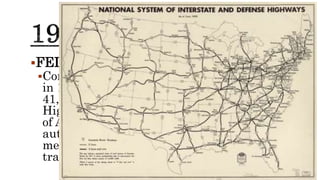
FEDERAL HIGHWAY ACT, JUNE 26
Congress passed the Federal Highway Act
in 1956, allocating $32 billion to build
41,000 miles of interstate highways.
Highways were important not only because
of Americans’ growing dependence on
automobiles but also as a national defense
measure, creating a nationwide
transportation network for the US military.
CIVIL RIGHTS ACT OF 1957, SEPTEMBER 9TH
The Civil Rights Act of 1957 created the US Commission
on Civil Rights to investigate voter restrictions. It also
established the Civil Rights Division of the Justice
Department.
FEDERAL TROOPS SENT TO LITTLE ROCK
(LITTLE ROCK 9), SEPT 24
President Eisenhower sent federal troops to Little Rock,
Arkansas, to protect nine black students enrolling in the
previously segregated Central High.
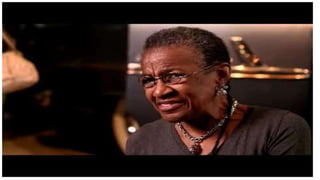
Get your Chromebooks out
Go to the “Little Rock 9 Reaction
Paragraphs” assignment
Read the first question and be prepared to
answer it after the first video
Answer the 2nd question after watching the
2nd video
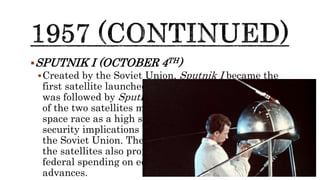
SPUTNIK I (OCTOBER 4TH)
Created by the Soviet Union, Sputnik I became the
first satellite launched into space in October 1957. It
was followed by Sputnik II a month later. The launch
of the two satellites marked the beginning of the
space race as a high stakes competition with national
security implications between the United States and
the Soviet Union. The Soviets’ success in launching
the satellites also prompted the US to increase
federal spending on education and technology
advances.
NASA ESTABLISHED (JULY 29TH)
The National Aeronautics and Space
Act established the National
Aeronautics and Space Agency (NASA).
The primary mission of the agency was
to promote manned space flight.
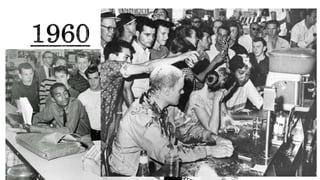
FIRST SIT-INS (FEBRUARY)
 Four black college students from the North Carolina Agricultural
and Technical College staged the first of the Civil Rights
Movement’s sit-ins. The students sat down at a Woolworth’s lunch
counter in Greensboro, North Carolina, and attempted to order
but were refused service. The sit-in movement extended to more
than 140 cities. Participants faced harassment, violence, and
arrest in their attempts to integrate public lunch counters.
JOHN F. KENNEDY ELECTED
PRESIDENT (NOVEMBER 8TH)
In a close election, Democrat John F.
Kennedy edged out Republican Richard
Nixon to win the presidency. Kennedy won
by fewer than 117,000 popular votes.
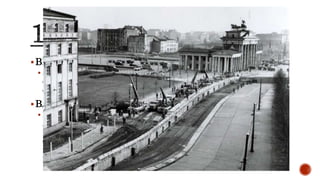
BERLIN WALL ERECTED
 Soviet and East German troops began building the Berlin Wall to
close off the western part of city after shutting down interallied
checkpoints.
BAY OF PIGS INVASION (APRIL)
 In an invasion planned by the United States Central Intelligence
Agency and approved by the Kennedy administration, US-backed
Cuban anti-Castro forces landed at the Bay of Pigs but were
overcome by Castro’s troops. More than 1100 men were captured
in an embarrassing defeat. The prisoners were eventually
ransomed back to the US in exchange for food and medicine.
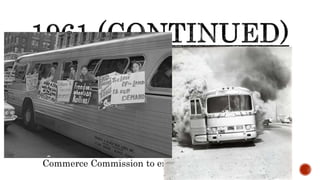
START OF FREEDOM RIDES (MAY 4TH)
It was the rise of the risistance!
African Americans and white activists left DC for New
Orleans to test the ban on segregation in interstate bus
travel
They were attacked several times in the south
Eventually the National Guard was called in to protect
the riders
Pres. Kennedy stepped in and petitioned the Interstate
Commerce Commission to enforce the law
CUBAN MISSILE CRISIS (OCTOBER)
 On October 16, 1962, President Kennedy learned of Soviet plans
for missile installation in Cuba and announced a blockade of Cuba
to prevent more missiles from entering the country.
 In the following days, Kennedy and Khrushchev exchanged
messages under mutual threat of nuclear war.
 On October 28, Khrushchev agreed to halt missile work in Cuba,
and Kennedy promised to withdraw missiles from Turkey.
 The agreement put an end to the crisis and averted an escalation
to major nuclear conflict.
 BUT IS THAT REALLY HOW IT ENDED?
LIMITED TEST BAN TREATY
The United States, the USSR, and almost one hundred
other nations signed the Limited Test Ban Treaty, an
agreement not to conduct nuclear tests in the
atmosphere, outer space, or underwater.
EQUAL PAY ACT
Congress passed the Equal Pay Act of 1963, which made
it illegal to pay men and women different wages for
equal work. And, in October, the President’s Commission
on the Status of Women, established in 1961, issued a
powerful report documenting widespread inequality and
discrimination.
The Children’s March (May 2-3)
a march by over 5,000 school students in Birmingham,
Alabama on May 2–3, 1963. Initiated and organized by
Rev. James Bevel, the purpose of the march was to walk
downtown to talk to the mayor about segregation in their
city.
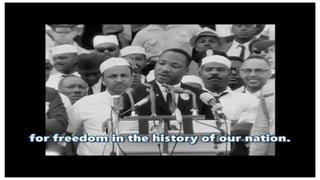
MARCH ON WASHINGTON (AUGUST 28)
Martin Luther King Jr. and others led more than
200,000 civil rights supporters in a March on
Washington. There, King delivered his “I Have a Dream”
speech, declaring that “we will not be satisfied until
justice rolls down like waters and righteousness like a
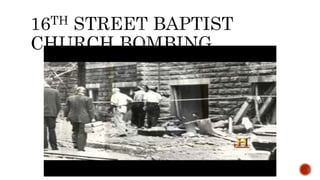
16TH STREET BAPTIST CHURCH
BOMBING (SEPTEMBER)
A prominent church in Birmingham (same
church used in the Children’s March).
Bombed by KKK members during a church
service
4 little girls were killed in the bombing
Convictions wouldn’t come for years after
JOHN F. KENNEDY
ASSASSINATED (NOVEMBER
22ND)
President John F. Kennedy was shot
and killed by assassin Lee Harvey
Oswald while riding in a motorcade
through Dallas, Texas, on November 22,
1963.
TWENTY-FOURTH AMENDMENT (JANUARY
23)
prohibited poll taxes for federal elections, which had
often been imposed by state and local governments to
prevent African Americans from voting.
GULF OF TONKIN RESOLUTION
Congress authorized the United States to “take all
necessary measures to repel” attacks on American forces
in Vietnam.
CIVIL RIGHTS ACT OF 1964 (JULY)
President Lyndon Johnson signed the Civil
Rights Act of 1964. Title VII of the act banned
discrimination based on sex, race, color, religion,
or national origin.
LYNDON JOHNSON ELECTED
PRESIDENT (NOVEMBER)
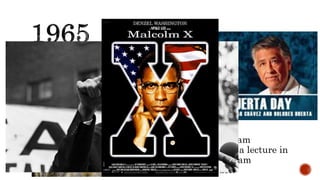
GRAPE STRIKE
Laborers from the National Farm Workers Association
and the Agricultural Workers Organizing Committee
initiated the Delano grape strike and boycott in 1965.
The UFOC was led by César Chávez, Dolores Huerta,
and others.
MALCOLM X ASSASSINATED
Radical black leader and former Nation of Islam
minister Malcolm X was assassinated during a lecture in
Harlem in New York City. Three Nation of Islam
members were later convicted of the murder.
US AIR STRIKES IN VIETNAM
In 1965, President Johnson authorized Operation
Rolling Thunder, a sustained series of air strikes on
North Vietnam that lasted until November 1968. On
March 8, 1965, the first American combat troops entered
South Vietnam.
(WE HAD BEEN INVOLVED IN VIETNAM FOR
QUITE A WHILE)

1953-1960.pptx

  • 2.
    The Korean Warends July 26, 1953 – After 2 years of negotiations, an armistice was signed between the two sides. The boarder between North and South Vietnam was established on the 38th Parallel.
  • 3.
    The end ofMcCarthyism After a series of televised investigations into communists in the US Army, the public finally saw McCarthy for what he really was, a bully. The Senate voted to censure McCarthy for his conduct during the hearings McCarthy would eventually turn to alcohol to relieve his frustrations. He would die at the age of 48 from numerous ailments all exacerbated by cirrhosis of the liver.
  • 4.
    May BROWN V. BOARDOF EDUCATION In the case of Brown v. Board of Education, the Supreme Court struck down the Plessy v. Ferguson “separate but equal” decision when it ruled that segregation of public school children based on race was unconstitutional. It would take several years for this ruling to take effect. Many states would fight to keep segregation in schools for years to come. This would be a major step in the direction of Civil
  • 5.
    Warsaw Pact –May 14,  In response to NATO, 8 Communist Bloc countries signed the Warsaw Pact, a “Treaty of Friendship, Co-operation and Mutual Assistance,” to form a mutual defense coalition. Force comparisons became the centerpiece of the Cold War. MONTGOMERY BUS BOYCOTT  Beginning in December after Rosa Parks (Member of the NAACP) was arrested for not giving up her seat on the bus. The boycott would be lead by none other than Martin Luther King Jr. It would be his first major battle for Civil Rights. The boycott lasted just over a year. It ended in November of 1956 with the Supreme Court ruling that segregation of city buses was unconstitutional.
  • 7.
    FEDERAL HIGHWAY ACT,JUNE 26 Congress passed the Federal Highway Act in 1956, allocating $32 billion to build 41,000 miles of interstate highways. Highways were important not only because of Americans’ growing dependence on automobiles but also as a national defense measure, creating a nationwide transportation network for the US military.
  • 8.
    CIVIL RIGHTS ACTOF 1957, SEPTEMBER 9TH The Civil Rights Act of 1957 created the US Commission on Civil Rights to investigate voter restrictions. It also established the Civil Rights Division of the Justice Department. FEDERAL TROOPS SENT TO LITTLE ROCK (LITTLE ROCK 9), SEPT 24 President Eisenhower sent federal troops to Little Rock, Arkansas, to protect nine black students enrolling in the previously segregated Central High.
  • 9.
    Get your Chromebooksout Go to the “Little Rock 9 Reaction Paragraphs” assignment Read the first question and be prepared to answer it after the first video Answer the 2nd question after watching the 2nd video
  • 11.
    SPUTNIK I (OCTOBER4TH) Created by the Soviet Union, Sputnik I became the first satellite launched into space in October 1957. It was followed by Sputnik II a month later. The launch of the two satellites marked the beginning of the space race as a high stakes competition with national security implications between the United States and the Soviet Union. The Soviets’ success in launching the satellites also prompted the US to increase federal spending on education and technology advances.
  • 12.
    NASA ESTABLISHED (JULY29TH) The National Aeronautics and Space Act established the National Aeronautics and Space Agency (NASA). The primary mission of the agency was to promote manned space flight.
  • 14.
    FIRST SIT-INS (FEBRUARY) Four black college students from the North Carolina Agricultural and Technical College staged the first of the Civil Rights Movement’s sit-ins. The students sat down at a Woolworth’s lunch counter in Greensboro, North Carolina, and attempted to order but were refused service. The sit-in movement extended to more than 140 cities. Participants faced harassment, violence, and arrest in their attempts to integrate public lunch counters.
  • 15.
    JOHN F. KENNEDYELECTED PRESIDENT (NOVEMBER 8TH) In a close election, Democrat John F. Kennedy edged out Republican Richard Nixon to win the presidency. Kennedy won by fewer than 117,000 popular votes.
  • 16.
    BERLIN WALL ERECTED Soviet and East German troops began building the Berlin Wall to close off the western part of city after shutting down interallied checkpoints. BAY OF PIGS INVASION (APRIL)  In an invasion planned by the United States Central Intelligence Agency and approved by the Kennedy administration, US-backed Cuban anti-Castro forces landed at the Bay of Pigs but were overcome by Castro’s troops. More than 1100 men were captured in an embarrassing defeat. The prisoners were eventually ransomed back to the US in exchange for food and medicine.
  • 17.
    START OF FREEDOMRIDES (MAY 4TH) It was the rise of the risistance! African Americans and white activists left DC for New Orleans to test the ban on segregation in interstate bus travel They were attacked several times in the south Eventually the National Guard was called in to protect the riders Pres. Kennedy stepped in and petitioned the Interstate Commerce Commission to enforce the law
  • 18.
    CUBAN MISSILE CRISIS(OCTOBER)  On October 16, 1962, President Kennedy learned of Soviet plans for missile installation in Cuba and announced a blockade of Cuba to prevent more missiles from entering the country.  In the following days, Kennedy and Khrushchev exchanged messages under mutual threat of nuclear war.  On October 28, Khrushchev agreed to halt missile work in Cuba, and Kennedy promised to withdraw missiles from Turkey.  The agreement put an end to the crisis and averted an escalation to major nuclear conflict.  BUT IS THAT REALLY HOW IT ENDED?
  • 20.
    LIMITED TEST BANTREATY The United States, the USSR, and almost one hundred other nations signed the Limited Test Ban Treaty, an agreement not to conduct nuclear tests in the atmosphere, outer space, or underwater. EQUAL PAY ACT Congress passed the Equal Pay Act of 1963, which made it illegal to pay men and women different wages for equal work. And, in October, the President’s Commission on the Status of Women, established in 1961, issued a powerful report documenting widespread inequality and discrimination.
  • 21.
    The Children’s March(May 2-3) a march by over 5,000 school students in Birmingham, Alabama on May 2–3, 1963. Initiated and organized by Rev. James Bevel, the purpose of the march was to walk downtown to talk to the mayor about segregation in their city. MARCH ON WASHINGTON (AUGUST 28) Martin Luther King Jr. and others led more than 200,000 civil rights supporters in a March on Washington. There, King delivered his “I Have a Dream” speech, declaring that “we will not be satisfied until justice rolls down like waters and righteousness like a
  • 23.
    16TH STREET BAPTISTCHURCH BOMBING (SEPTEMBER) A prominent church in Birmingham (same church used in the Children’s March). Bombed by KKK members during a church service 4 little girls were killed in the bombing Convictions wouldn’t come for years after
  • 25.
    JOHN F. KENNEDY ASSASSINATED(NOVEMBER 22ND) President John F. Kennedy was shot and killed by assassin Lee Harvey Oswald while riding in a motorcade through Dallas, Texas, on November 22, 1963.
  • 27.
    TWENTY-FOURTH AMENDMENT (JANUARY 23) prohibitedpoll taxes for federal elections, which had often been imposed by state and local governments to prevent African Americans from voting. GULF OF TONKIN RESOLUTION Congress authorized the United States to “take all necessary measures to repel” attacks on American forces in Vietnam.
  • 28.
    CIVIL RIGHTS ACTOF 1964 (JULY) President Lyndon Johnson signed the Civil Rights Act of 1964. Title VII of the act banned discrimination based on sex, race, color, religion, or national origin. LYNDON JOHNSON ELECTED PRESIDENT (NOVEMBER)
  • 29.
    GRAPE STRIKE Laborers fromthe National Farm Workers Association and the Agricultural Workers Organizing Committee initiated the Delano grape strike and boycott in 1965. The UFOC was led by César Chávez, Dolores Huerta, and others. MALCOLM X ASSASSINATED Radical black leader and former Nation of Islam minister Malcolm X was assassinated during a lecture in Harlem in New York City. Three Nation of Islam members were later convicted of the murder.
  • 30.
    US AIR STRIKESIN VIETNAM In 1965, President Johnson authorized Operation Rolling Thunder, a sustained series of air strikes on North Vietnam that lasted until November 1968. On March 8, 1965, the first American combat troops entered South Vietnam. (WE HAD BEEN INVOLVED IN VIETNAM FOR QUITE A WHILE)