© 2001 by Prentice Hall, Inc.© 2001 by Prentice Hall, Inc.
Magruder’s
American GovernmentC H A P T E R 21
Civil Rights: Equal Justice Under Law
Chapter 21, Section 1Chapter 21, Section 1
22 33 44
A Heterogeneous Society
The composition of the U.S. population has changed over time:
• Immigrants—that is, those people legally admitted as permanent residents—have arrived in near-
record numbers every year since the mid-1960s.
• African American, Hispanic American, and Asian American populations have grown at rates several
times that of the white population.
• Women consist of a greater percentage of the population than males. This has been true for over 50
years.
Something that is heterogeneous is composed of a mix of
ingredients. The population of the U.S. is a heterogeneous one.
African AmericansThe white-male-dominated power structure in the United States has been historically
reluctant to yield a full and equal place in the social, economic, and political life of
America.
Discrimination against African Americans in the U.S. often receives the most attention
for three main reasons:
• African Americans constitute the largest minority group in the United States.
• Since the beginning of slavery in what was to become the United States, African
Americans have been the victims of consistent and deliberate unjust treatment, a
longer time than any other group of Americans.
• Most of the gains America has made in translating the Constitution’s guarantees of
equality into a reality for all persons have come out of efforts made by and on behalf of
African Americans.
Chapter 21, Section 1Chapter 21, Section 1
22 33 44
Discrimination Against Women
• Women are in fact not a
minority, making up over 51
percent of the U.S.
population.
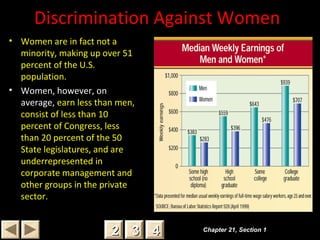
• Women, however, on
average, earn less than men,
consist of less than 10
percent of Congress, less
than 20 percent of the 50
State legislatures, and are
underrepresented in
corporate management and
other groups in the private
sector.
Chapter 21, Section 1Chapter 21, Section 1
22 33 44
Chapter 21, Section 2Chapter 21, Section 2
33 4411
Equal Protection Clause
Reasonable Classification
• The government may reasonably classify, or draw distinctions, between groups of
individuals. Government may not discriminate unreasonably, however.
The Supreme Court often uses two measures to determine the
constitutionality of an action:
The Rational Basis Test
• The rational basis test asks: Does the classification in question bear a reasonable
relationship to the achievement of some proper governmental purpose?
The Strict Scrutiny Test
• Sometimes more imposing standards are used, especially when a case deals with
“fundamental rights” or “suspect classifications.”
The 14th Amendment’s Equal Protection Clause declares
that citizens are protected equally under the law.
Segregation in America
• Segregation means the separation of one group from another.
• Jim Crow Laws, passed in the late 1800s by several States, aimed at
separating minorities from the white population.
• The separate-but-equal doctrine, upheld by Plessy v. Ferguson, 1896,
provided that separate facilities for African Americans were legal as long
as they were equal to those provided for whites.
• In 1954, the Supreme Court struck down separate-but-equal in Brown v.
Board of Education of Topeka.
• Desegregation and integration programs progressed through the 1950s
and 1960s.
• De facto segregation, segregation in fact even if no law requires it, has
emerged in housing and schooling patterns in some areas of the country.
Chapter 21, Section 2Chapter 21, Section 2
33 4411
Classification by Sex
• The only mention to sex
in the Constitution is in
the 19th Amendment,
which forbids the denial
of the right to vote “on
account of sex.”
• Since the 1971 Reed v.
Reed case, the Supreme
Court has struck down
many laws that
discriminated because of
sex.
• Overall, the Court has
ruled that laws that treat
men differently than
women will be
overturned unless (1)
they are intended to
serve an “important
government objective”
and (2) they are
“substantially related” to
achieving that goal.
Chapter 21, Section 2Chapter 21, Section 2
33 4411
Civil Rights: Reconstruction to Today
The Civil Rights Act of 1964
• Prohibited discrimination
against any person on grounds
of race, color, religion,
national origin, sex, or physical
disability in any federally
funded programs.
• Forbid employers to
discriminate against any
person on grounds of race,
color, religion, sex, physical
disability, or age in job-related
matters.
The Civil Rights Act of 1968
• Often referred to as the Open
Housing Act.
• Forbids anyone to refuse to
sell or rent a dwelling to any
person on grounds of race,
color, religion, national origin,
sex, or disability.
• Strengthened in 1988 by
allowing the Justice
Department to bring criminal
charges against those who
violate the terms of the act.
Chapter 21, Section 3Chapter 21, Section 3
22 4411
Affirmative Action
Affirmative Action is a policy that requires most employers to take positive
steps to remedy the effects of past discriminations.
• This policy applies to all the agencies of the Federal
Government, to all the States and their local governments,
and to all those private employers who sell goods or
services to any agency of the Federal Government.
• Beginning in 1965, affirmative action programs established
guidelines and timetables for overcoming past
discriminations.
• Many employers hire certain workers due to their minority
backgrounds or gender. Such rules requiring specific
numbers of jobs or promotions for members of certain
groups are called quotas.
Chapter 21, Section 3Chapter 21, Section 3
22 4411
Affirmative Action Cases and
Measures
Chapter 21, Section 3Chapter 21, Section 3
22 4411
Regents of the University of California v. Bakke, 1978
• Allan Bakke sued the University of California for reverse
discrimination and won. This case shows that the
Constitution does not allow race to be used as the only factor
in the making of affirmative action decisions.
Adarand Constructors v. Pena, 1995
• The Supreme Court’s decision in this case holds that
whenever government provides for any preferential treatment
based on race, that action is almost certainly unconstitutional,
even if it is intended to benefit minority groups suffering from
past injustices.
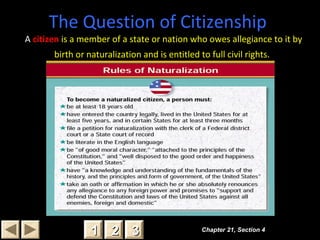
The Question of Citizenship
A citizen is a member of a state or nation who owes allegiance to it by
birth or naturalization and is entitled to full civil rights.
Chapter 21, Section 4Chapter 21, Section 4
22 3311
Citizenship by Birth
Jus Soli
• Jus soli is the law of the
soil, or where one is
born.
• The 14th Amendment
confers citizenship to
any person born within
the United States.
Jus Sanguinis
• Jus Sanguinis is the law
of the blood, or to whom
one is born.
• A child who is born
abroad to at least one
citizen, and who has at
some time lived within
the United States, can
petition for citizenship.
Chapter 21, Section 4Chapter 21, Section 4
22 3311
Citizenship by Naturalization
Individual Naturalization
• Naturalization is generally an
individual process in which the
Immigration and Naturalization
Service investigates each
applicant and then reports to a
judge. If the judge is satisfied,
the oath or affirmation is
administered in open court, and
the new citizen receives a
certificate of naturalization.
Collective Naturalization
• This form of naturalization is
less common than individual
naturalization. This has most
often happened when the
United States has acquired new
territory and the inhabitants are
given citizenship.
Chapter 21, Section 4Chapter 21, Section 4
22 3311
Naturalization is the legal process by which a person becomes a
citizen of another country at some time after birth.
Loss of Citizenship
Expatriation
• Expatriation is the legal
process by which a loss of
citizenship occurs.
• Expatriation is a voluntary act.
• The Supreme Court has held
that the Constitution prohibits
automatic expatriation, so an
individual cannot have his or
her citizenship taken away for
breaking a law.
Denaturalization
• Denaturalization is the
process by which citizens can
lose their citizenship
involuntarily.
• This process can only occur by
court order and only after it
has been shown that the
person became a citizen by
fraud or deception.
Chapter 21, Section 4Chapter 21, Section 4
22 3311
A Nation of Immigrants
Regulation of Immigrants
• Congress has the exclusive power to regulate immigration.
• The first major restrictions on immigration was the Chinese Exclusion Act in 1882.
Other groups were added to the act until there were over 30 restricted groups in the
early 1920s. The next step was the National Origins Act of 1929. This act assigned
quotas of immigrants to each country.
• Eventually, the quota system was eliminated with the Immigration Act of 1965, which
allowed over a quarter million immigrants into the United States each year, without
regard to race, nationality, or country of origin.
Deportation
• This is a legal process in which aliens are legally required to leave the United States.
• The most common cause of deportation is illegal entry to the country.
Chapter 21, Section 4Chapter 21, Section 4
22 3311
Undocumented Aliens
• No one knows for sure how many undocumented aliens live in the United
States today. The Census Bureau and the INS give estimates between three
and six million. However, some feel the number is twice that many.
• The growing number of undocumented aliens places stress on programs
which are based on a known population. With such an increase, there is
added stress on public schools and welfare services in several States.
• After much debate and struggle, Congress passed the Illegal Immigration
Restrictions Act of 1996. This law made it easier for the INS to deport aliens
by toughening the penalties for smuggling aliens into this country,
preventing undocumented aliens from claiming Social Security benefits or
public housing, and allowing State welfare workers to check the legal status
of any alien who applies for any welfare benefits.
Chapter 21, Section 4Chapter 21, Section 4
22 3311

Chapter 21

  • 1.
    © 2001 byPrentice Hall, Inc.© 2001 by Prentice Hall, Inc. Magruder’s American GovernmentC H A P T E R 21 Civil Rights: Equal Justice Under Law
  • 2.
    Chapter 21, Section1Chapter 21, Section 1 22 33 44 A Heterogeneous Society The composition of the U.S. population has changed over time: • Immigrants—that is, those people legally admitted as permanent residents—have arrived in near- record numbers every year since the mid-1960s. • African American, Hispanic American, and Asian American populations have grown at rates several times that of the white population. • Women consist of a greater percentage of the population than males. This has been true for over 50 years. Something that is heterogeneous is composed of a mix of ingredients. The population of the U.S. is a heterogeneous one.
  • 3.
    African AmericansThe white-male-dominatedpower structure in the United States has been historically reluctant to yield a full and equal place in the social, economic, and political life of America. Discrimination against African Americans in the U.S. often receives the most attention for three main reasons: • African Americans constitute the largest minority group in the United States. • Since the beginning of slavery in what was to become the United States, African Americans have been the victims of consistent and deliberate unjust treatment, a longer time than any other group of Americans. • Most of the gains America has made in translating the Constitution’s guarantees of equality into a reality for all persons have come out of efforts made by and on behalf of African Americans. Chapter 21, Section 1Chapter 21, Section 1 22 33 44
  • 4.
    Discrimination Against Women •Women are in fact not a minority, making up over 51 percent of the U.S. population. • Women, however, on average, earn less than men, consist of less than 10 percent of Congress, less than 20 percent of the 50 State legislatures, and are underrepresented in corporate management and other groups in the private sector. Chapter 21, Section 1Chapter 21, Section 1 22 33 44
  • 5.
    Chapter 21, Section2Chapter 21, Section 2 33 4411 Equal Protection Clause Reasonable Classification • The government may reasonably classify, or draw distinctions, between groups of individuals. Government may not discriminate unreasonably, however. The Supreme Court often uses two measures to determine the constitutionality of an action: The Rational Basis Test • The rational basis test asks: Does the classification in question bear a reasonable relationship to the achievement of some proper governmental purpose? The Strict Scrutiny Test • Sometimes more imposing standards are used, especially when a case deals with “fundamental rights” or “suspect classifications.” The 14th Amendment’s Equal Protection Clause declares that citizens are protected equally under the law.
  • 6.
    Segregation in America •Segregation means the separation of one group from another. • Jim Crow Laws, passed in the late 1800s by several States, aimed at separating minorities from the white population. • The separate-but-equal doctrine, upheld by Plessy v. Ferguson, 1896, provided that separate facilities for African Americans were legal as long as they were equal to those provided for whites. • In 1954, the Supreme Court struck down separate-but-equal in Brown v. Board of Education of Topeka. • Desegregation and integration programs progressed through the 1950s and 1960s. • De facto segregation, segregation in fact even if no law requires it, has emerged in housing and schooling patterns in some areas of the country. Chapter 21, Section 2Chapter 21, Section 2 33 4411
  • 7.
    Classification by Sex •The only mention to sex in the Constitution is in the 19th Amendment, which forbids the denial of the right to vote “on account of sex.” • Since the 1971 Reed v. Reed case, the Supreme Court has struck down many laws that discriminated because of sex. • Overall, the Court has ruled that laws that treat men differently than women will be overturned unless (1) they are intended to serve an “important government objective” and (2) they are “substantially related” to achieving that goal. Chapter 21, Section 2Chapter 21, Section 2 33 4411
  • 8.
    Civil Rights: Reconstructionto Today The Civil Rights Act of 1964 • Prohibited discrimination against any person on grounds of race, color, religion, national origin, sex, or physical disability in any federally funded programs. • Forbid employers to discriminate against any person on grounds of race, color, religion, sex, physical disability, or age in job-related matters. The Civil Rights Act of 1968 • Often referred to as the Open Housing Act. • Forbids anyone to refuse to sell or rent a dwelling to any person on grounds of race, color, religion, national origin, sex, or disability. • Strengthened in 1988 by allowing the Justice Department to bring criminal charges against those who violate the terms of the act. Chapter 21, Section 3Chapter 21, Section 3 22 4411
  • 9.
    Affirmative Action Affirmative Actionis a policy that requires most employers to take positive steps to remedy the effects of past discriminations. • This policy applies to all the agencies of the Federal Government, to all the States and their local governments, and to all those private employers who sell goods or services to any agency of the Federal Government. • Beginning in 1965, affirmative action programs established guidelines and timetables for overcoming past discriminations. • Many employers hire certain workers due to their minority backgrounds or gender. Such rules requiring specific numbers of jobs or promotions for members of certain groups are called quotas. Chapter 21, Section 3Chapter 21, Section 3 22 4411
  • 10.
    Affirmative Action Casesand Measures Chapter 21, Section 3Chapter 21, Section 3 22 4411 Regents of the University of California v. Bakke, 1978 • Allan Bakke sued the University of California for reverse discrimination and won. This case shows that the Constitution does not allow race to be used as the only factor in the making of affirmative action decisions. Adarand Constructors v. Pena, 1995 • The Supreme Court’s decision in this case holds that whenever government provides for any preferential treatment based on race, that action is almost certainly unconstitutional, even if it is intended to benefit minority groups suffering from past injustices.
  • 11.
    The Question ofCitizenship A citizen is a member of a state or nation who owes allegiance to it by birth or naturalization and is entitled to full civil rights. Chapter 21, Section 4Chapter 21, Section 4 22 3311
  • 12.
    Citizenship by Birth JusSoli • Jus soli is the law of the soil, or where one is born. • The 14th Amendment confers citizenship to any person born within the United States. Jus Sanguinis • Jus Sanguinis is the law of the blood, or to whom one is born. • A child who is born abroad to at least one citizen, and who has at some time lived within the United States, can petition for citizenship. Chapter 21, Section 4Chapter 21, Section 4 22 3311
  • 13.
    Citizenship by Naturalization IndividualNaturalization • Naturalization is generally an individual process in which the Immigration and Naturalization Service investigates each applicant and then reports to a judge. If the judge is satisfied, the oath or affirmation is administered in open court, and the new citizen receives a certificate of naturalization. Collective Naturalization • This form of naturalization is less common than individual naturalization. This has most often happened when the United States has acquired new territory and the inhabitants are given citizenship. Chapter 21, Section 4Chapter 21, Section 4 22 3311 Naturalization is the legal process by which a person becomes a citizen of another country at some time after birth.
  • 14.
    Loss of Citizenship Expatriation •Expatriation is the legal process by which a loss of citizenship occurs. • Expatriation is a voluntary act. • The Supreme Court has held that the Constitution prohibits automatic expatriation, so an individual cannot have his or her citizenship taken away for breaking a law. Denaturalization • Denaturalization is the process by which citizens can lose their citizenship involuntarily. • This process can only occur by court order and only after it has been shown that the person became a citizen by fraud or deception. Chapter 21, Section 4Chapter 21, Section 4 22 3311
  • 15.
    A Nation ofImmigrants Regulation of Immigrants • Congress has the exclusive power to regulate immigration. • The first major restrictions on immigration was the Chinese Exclusion Act in 1882. Other groups were added to the act until there were over 30 restricted groups in the early 1920s. The next step was the National Origins Act of 1929. This act assigned quotas of immigrants to each country. • Eventually, the quota system was eliminated with the Immigration Act of 1965, which allowed over a quarter million immigrants into the United States each year, without regard to race, nationality, or country of origin. Deportation • This is a legal process in which aliens are legally required to leave the United States. • The most common cause of deportation is illegal entry to the country. Chapter 21, Section 4Chapter 21, Section 4 22 3311
  • 16.
    Undocumented Aliens • Noone knows for sure how many undocumented aliens live in the United States today. The Census Bureau and the INS give estimates between three and six million. However, some feel the number is twice that many. • The growing number of undocumented aliens places stress on programs which are based on a known population. With such an increase, there is added stress on public schools and welfare services in several States. • After much debate and struggle, Congress passed the Illegal Immigration Restrictions Act of 1996. This law made it easier for the INS to deport aliens by toughening the penalties for smuggling aliens into this country, preventing undocumented aliens from claiming Social Security benefits or public housing, and allowing State welfare workers to check the legal status of any alien who applies for any welfare benefits. Chapter 21, Section 4Chapter 21, Section 4 22 3311