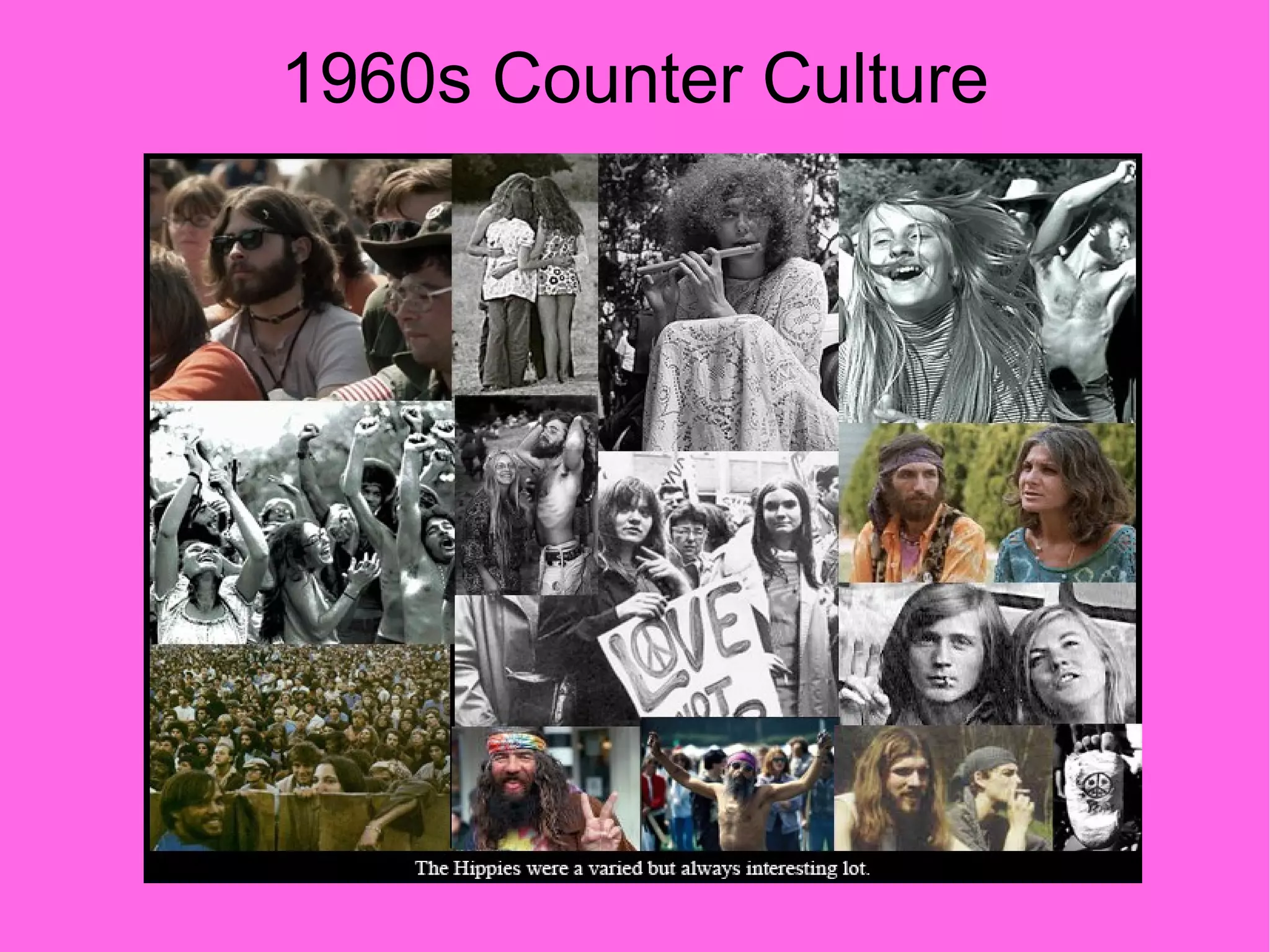
1960s Counter Culture
The Rise of the Counterculture The  counterculture  of the 1960s was a rebellion of teens and young adults against mainstream American society. Young Americans believed that society’s values were hollow and its priorities were misplaced. They called the mainstream the  Establishment . They wanted to create an alternative culture based on peace and love.
Where did the counterculture come from? The number of teens and young adults in the United States rose dramatically in the 1960s. These young people were living in turbulent times:  threat of nuclear war, racial discrimination and segregation, the Vietnam War, and environmental pollution. Rebellion against the dominant culture was not new.  The Beat generation of the 1950s questioned traditional values, challenged authority, and experimented with non-conformist lifestyles.
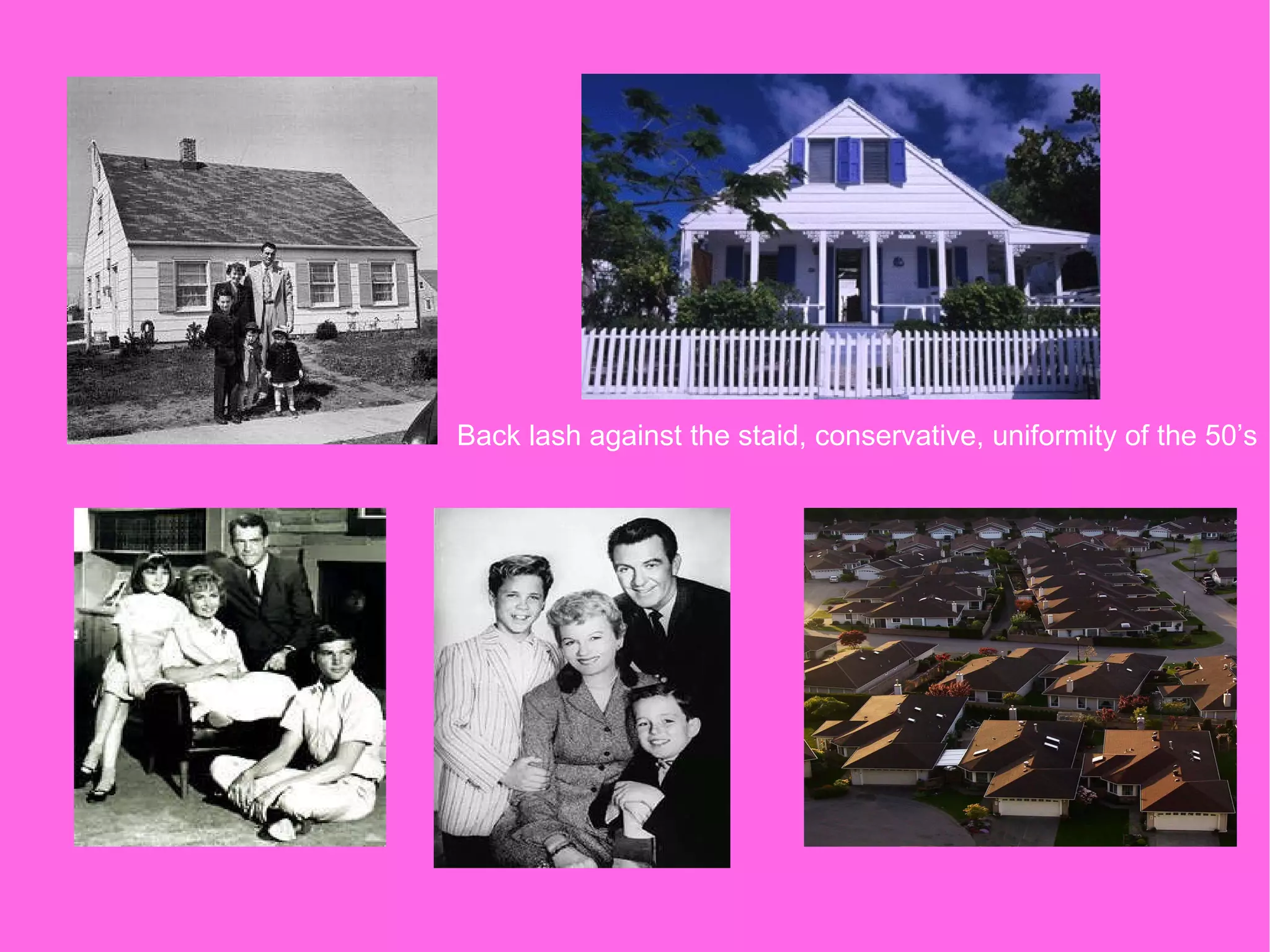
Back lash against the staid, conservative, uniformity of the 50’s
Eve of Destruction?
Civil Rights Struggle
Vietnam. 1960-1975
First Earth Day 1970
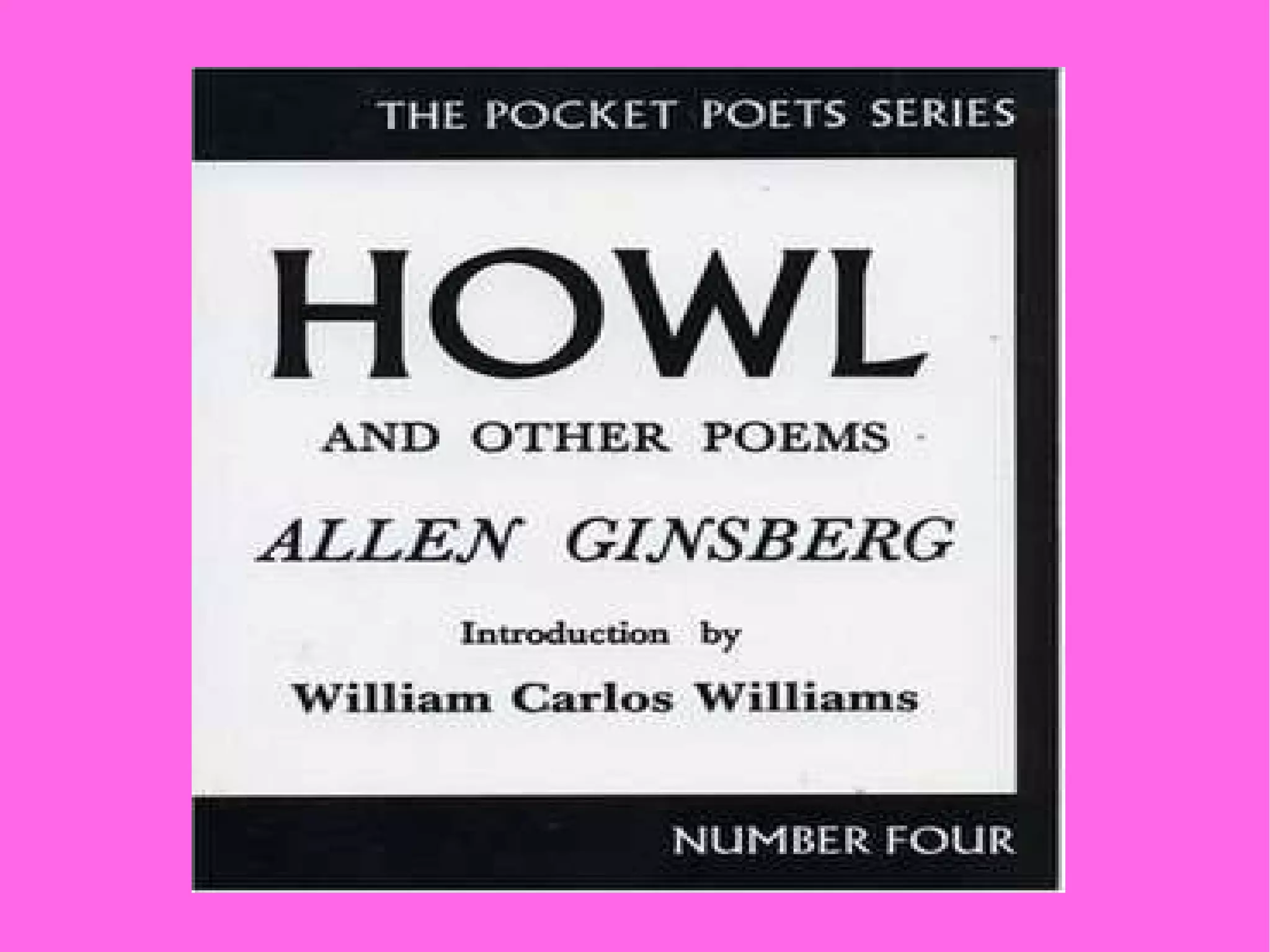
Jack Kerouac - On the Road.
 
Beatniks-Herb Caen .
“ Beat” Generation.”
Marlon Brando, The Wild Ones. “ What are you rebelling against?” “ What da ya got?”
“ Live fast; die young and leave a good looking corpse.”
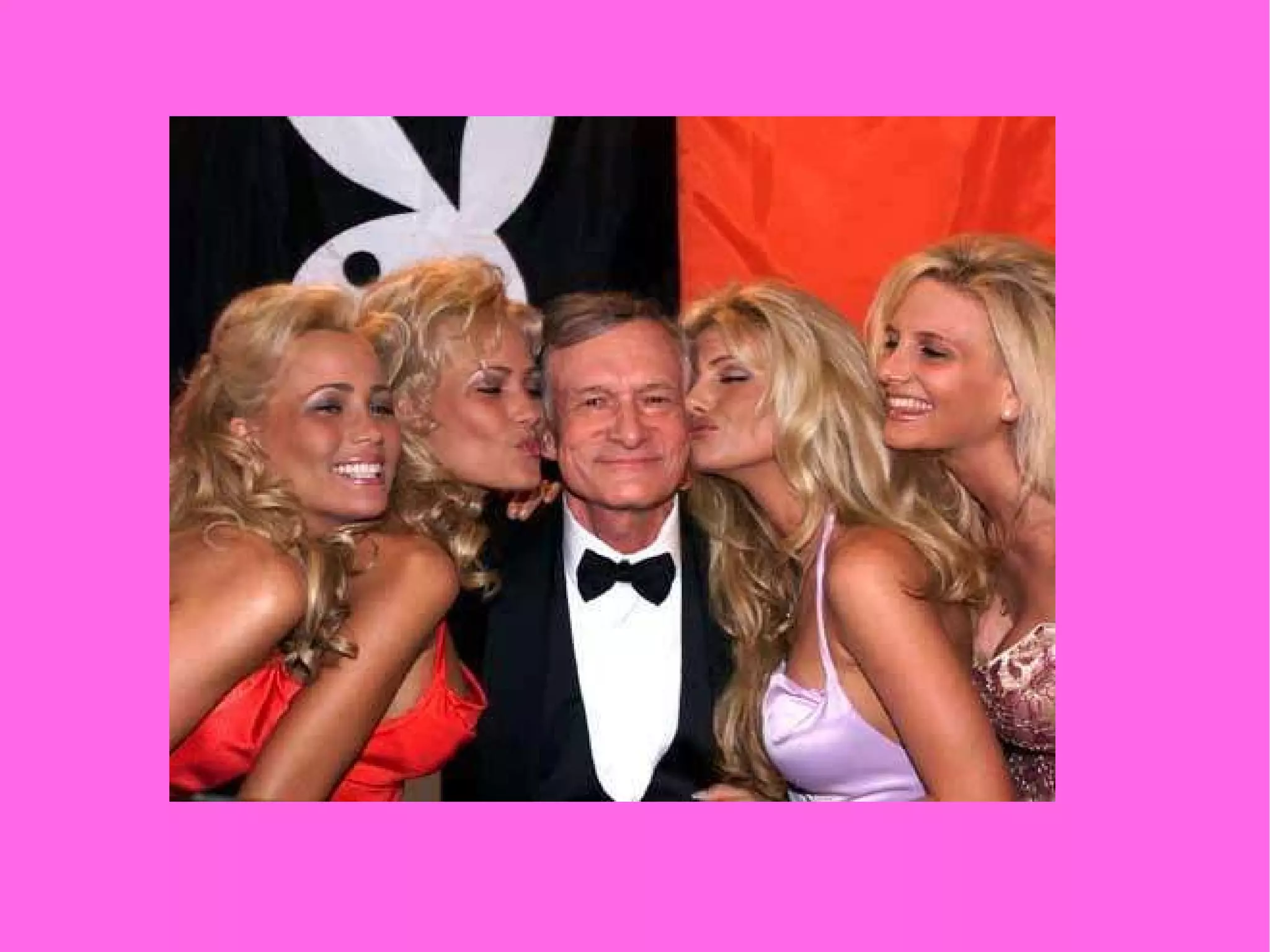
First Playboy Issue-1953
 
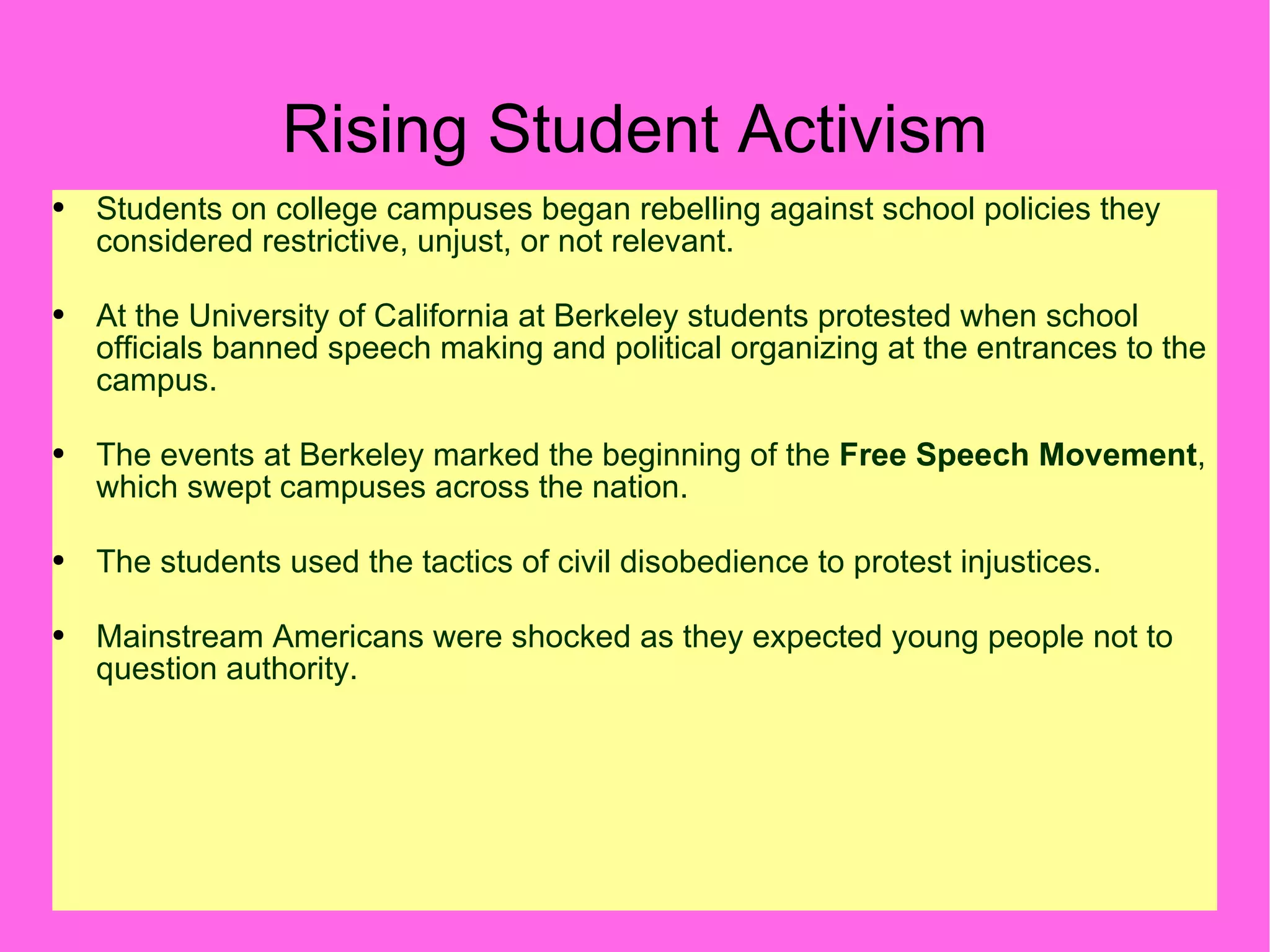
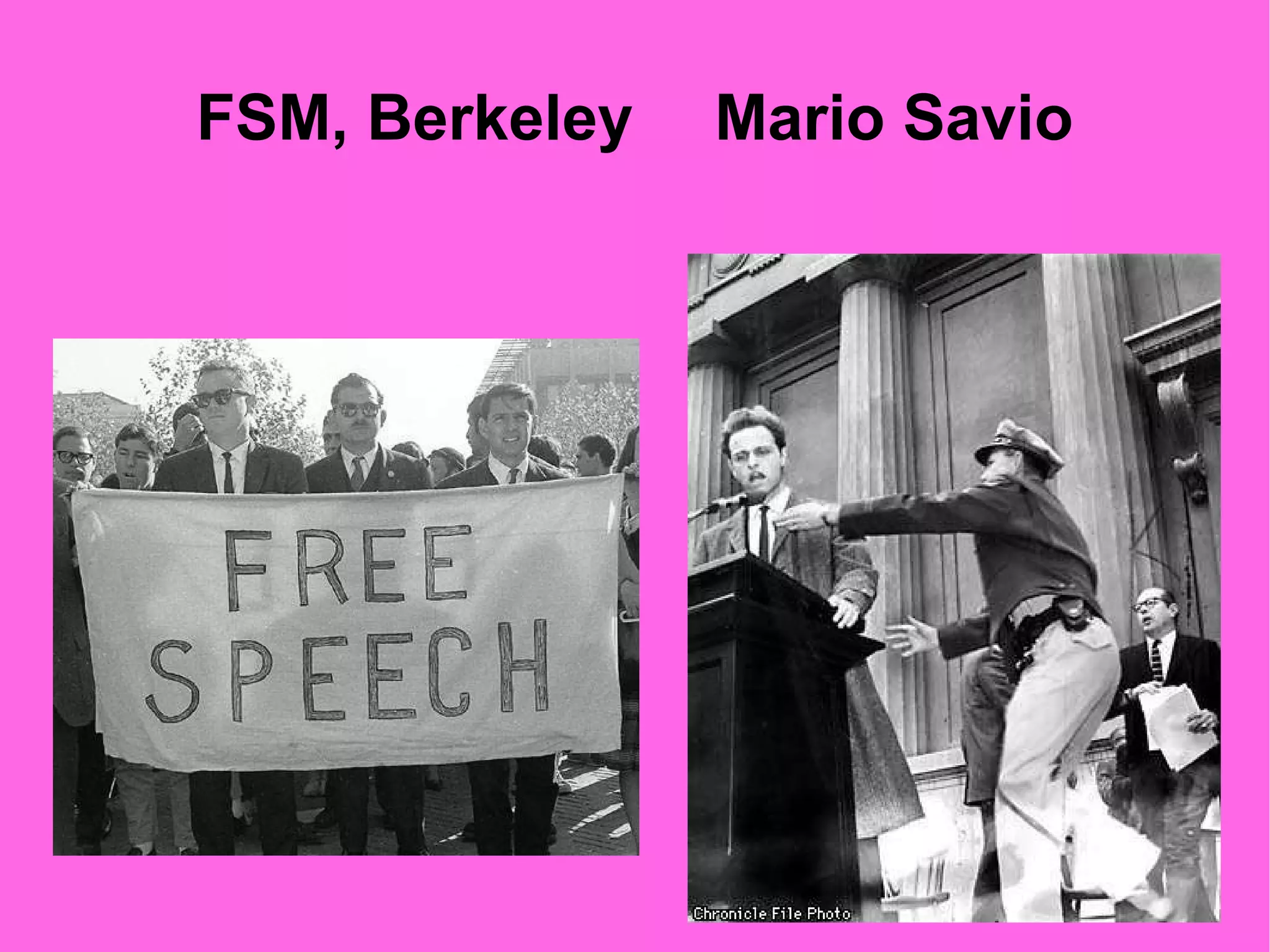
Rising Student Activism Students on college campuses began rebelling against school policies they considered restrictive, unjust, or not relevant. At the University of California at Berkeley students protested when school officials banned speech making and political organizing at the entrances to the campus. The events at Berkeley marked the beginning of the  Free Speech Movement , which swept campuses across the nation. The students used the tactics of civil disobedience to protest injustices. Mainstream Americans were shocked as they expected young people not to question authority.
FSM, Berkeley Mario Savio
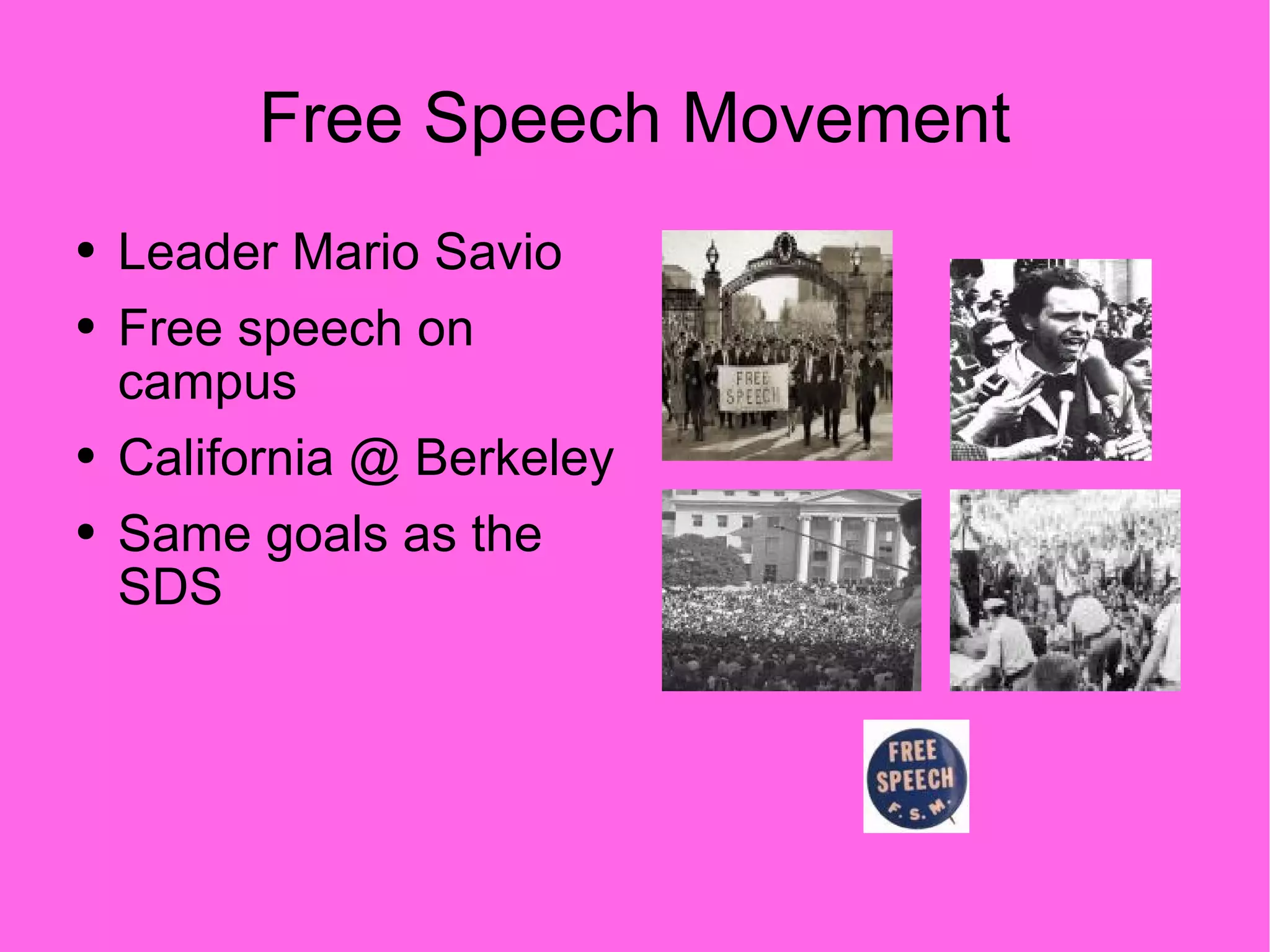
Free Speech Movement Leader Mario Savio Free speech on campus California @ Berkeley Same goals as the SDS
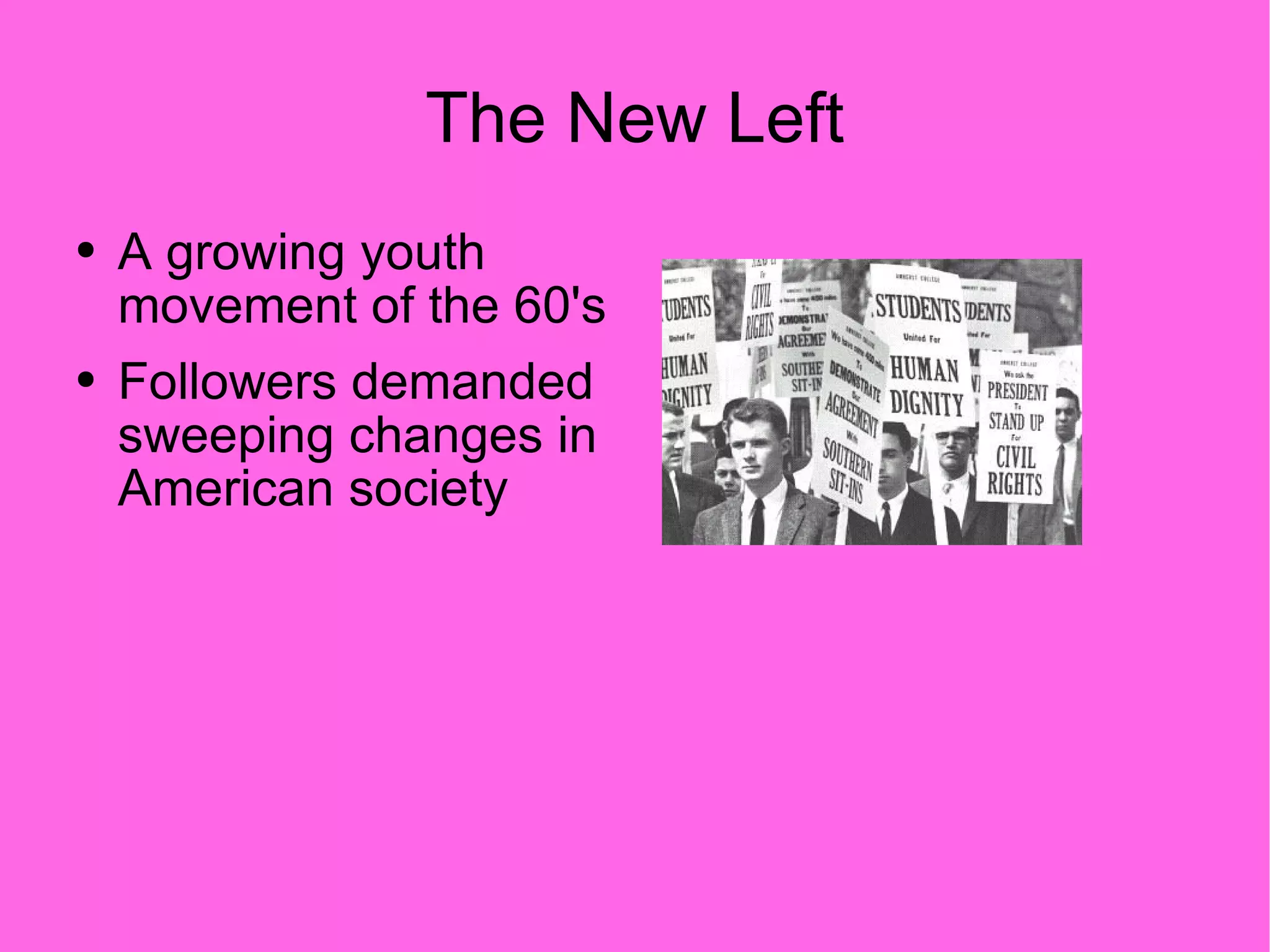
The New Left A growing youth movement of the 60's Followers demanded sweeping changes in American society
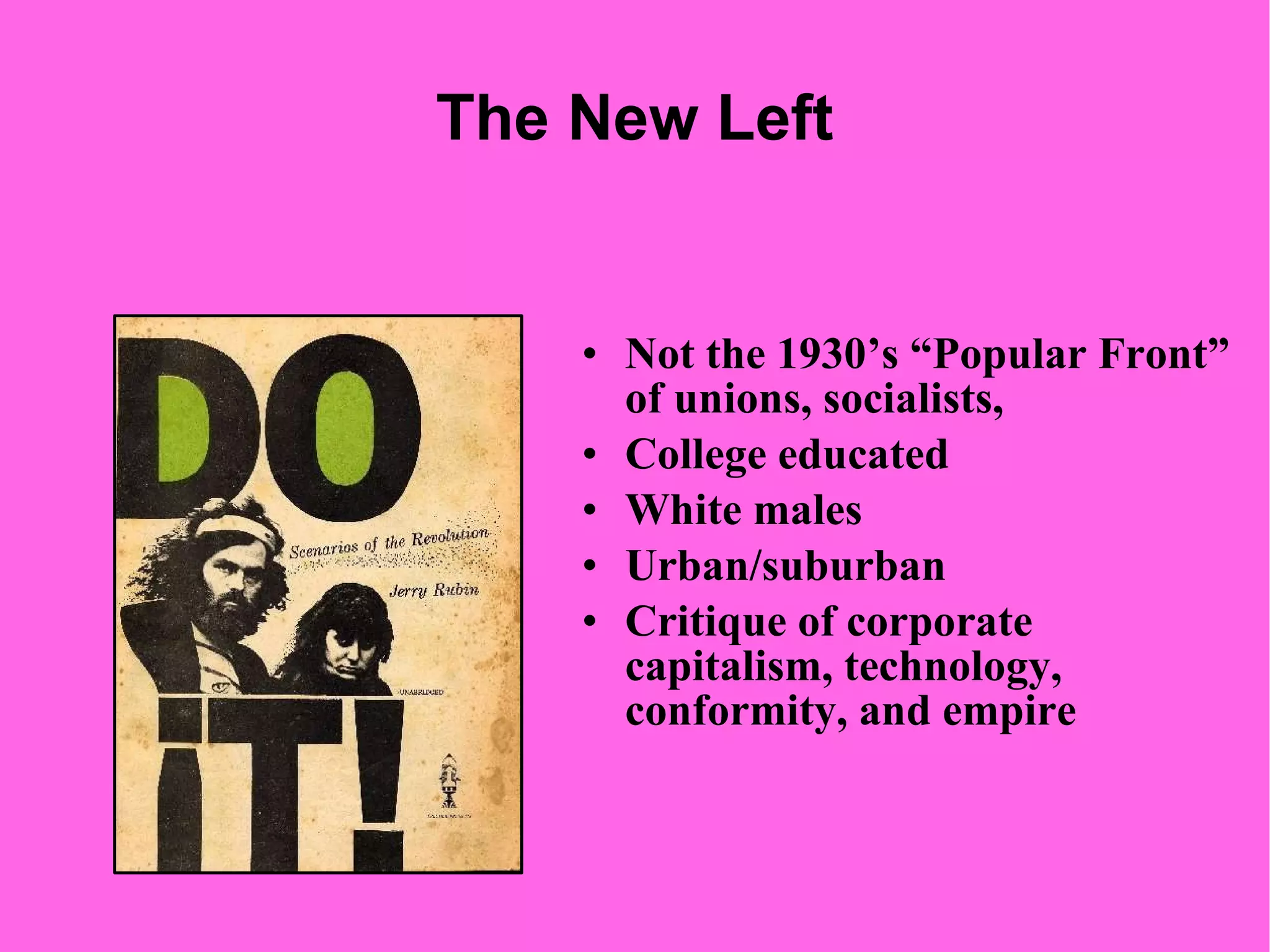
The New Left Not the 1930’s “Popular Front” of unions, socialists,  College educated White males Urban/suburban Critique of corporate capitalism, technology, conformity, and empire
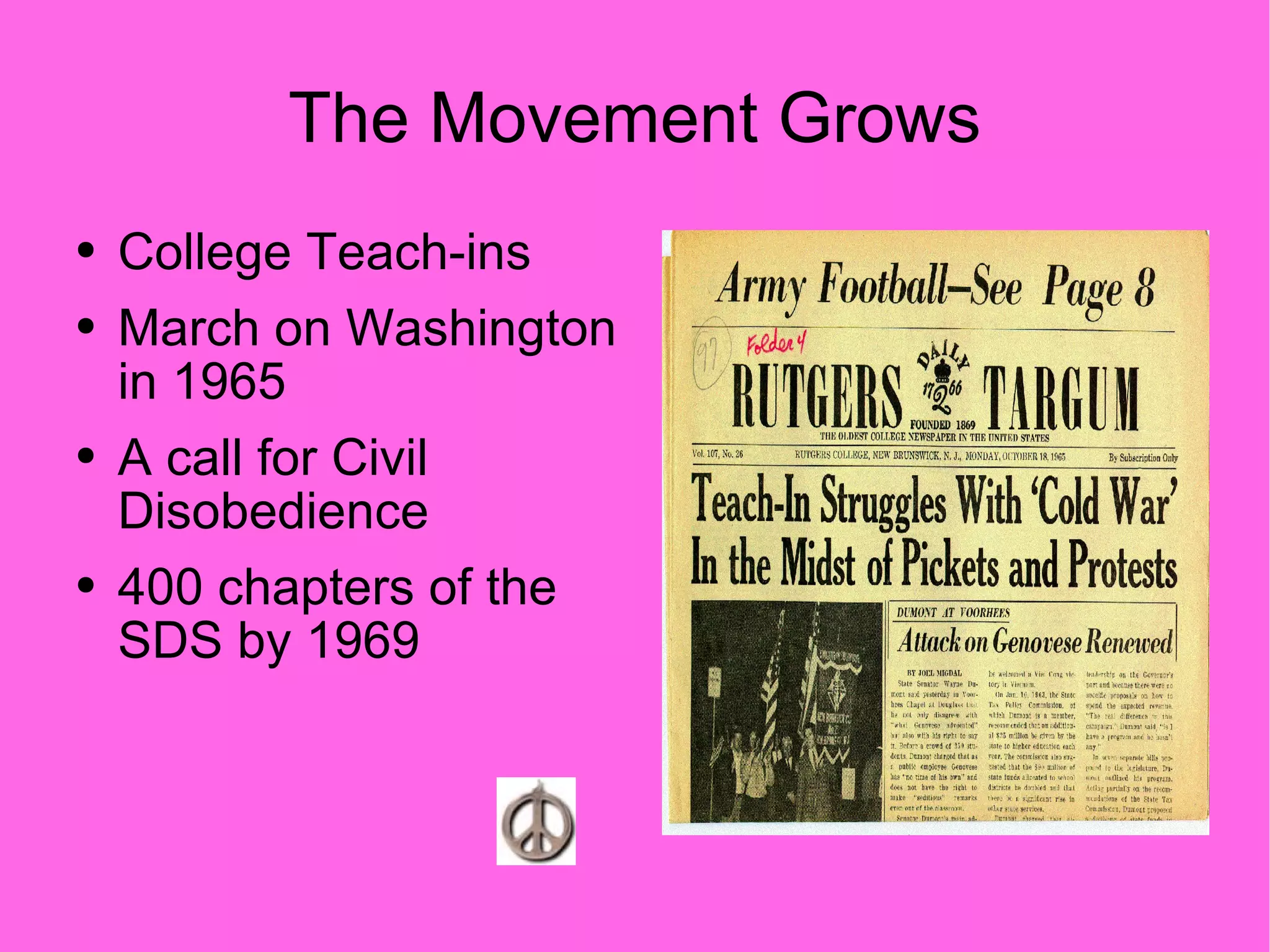
The Movement Grows College Teach-ins March on Washington in 1965 A call for Civil Disobedience  400 chapters of the SDS by 1969
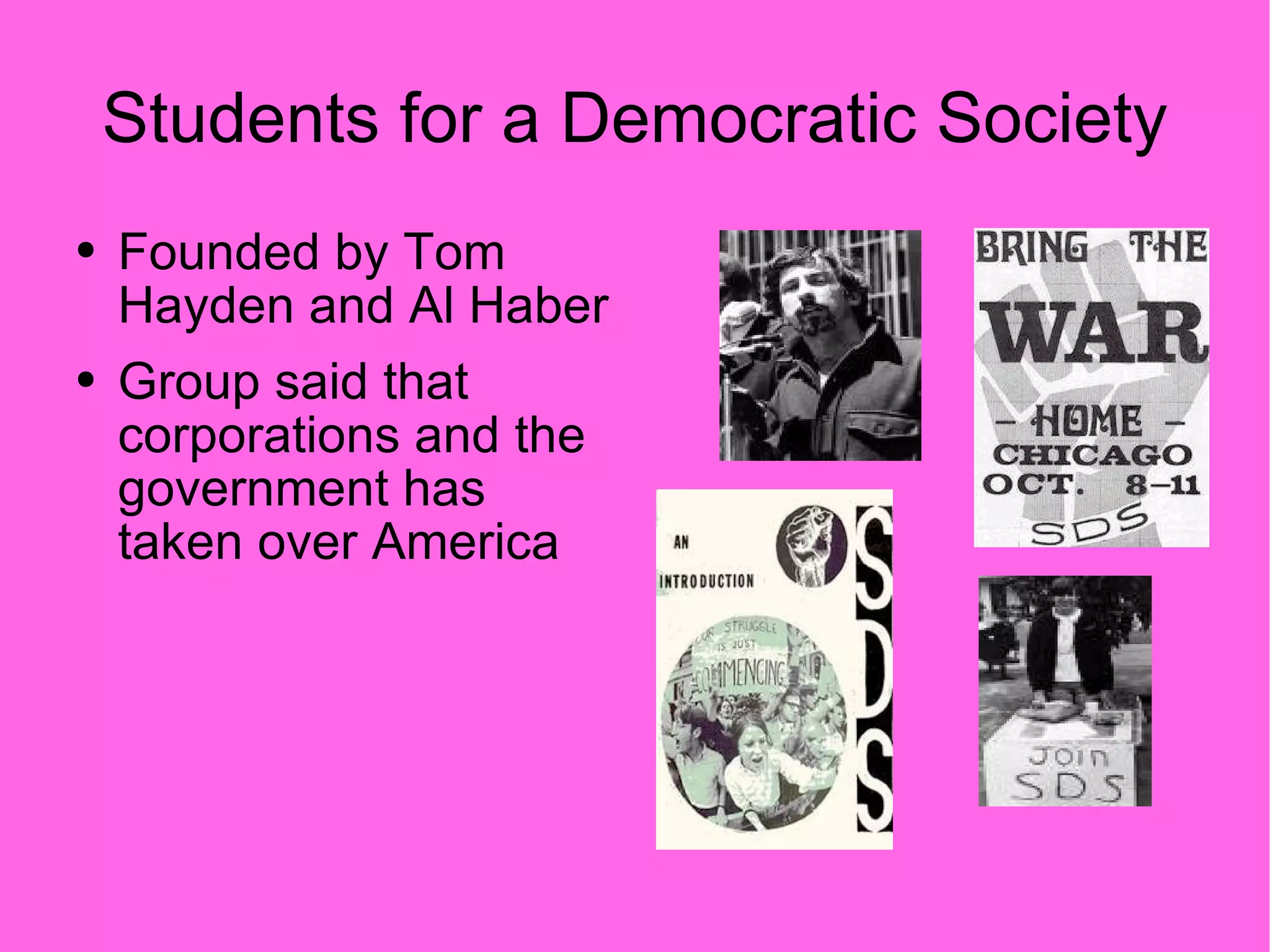
Students for a Democratic Society Founded by Tom Hayden and Al Haber Group said that corporations and the government has taken over America
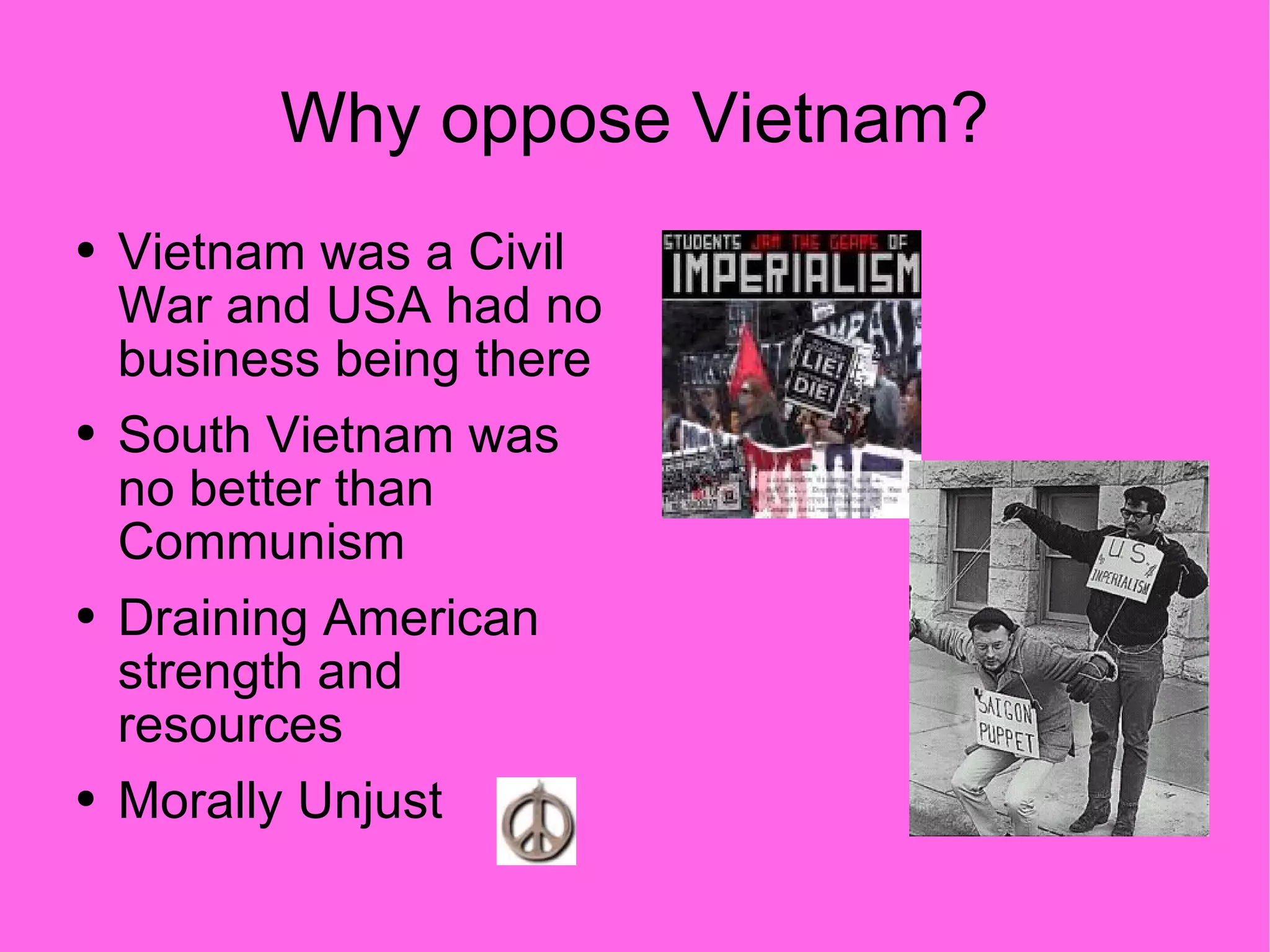
Why oppose Vietnam? Vietnam was a Civil War and USA had no business being there South Vietnam was no better than Communism Draining American strength and resources Morally Unjust
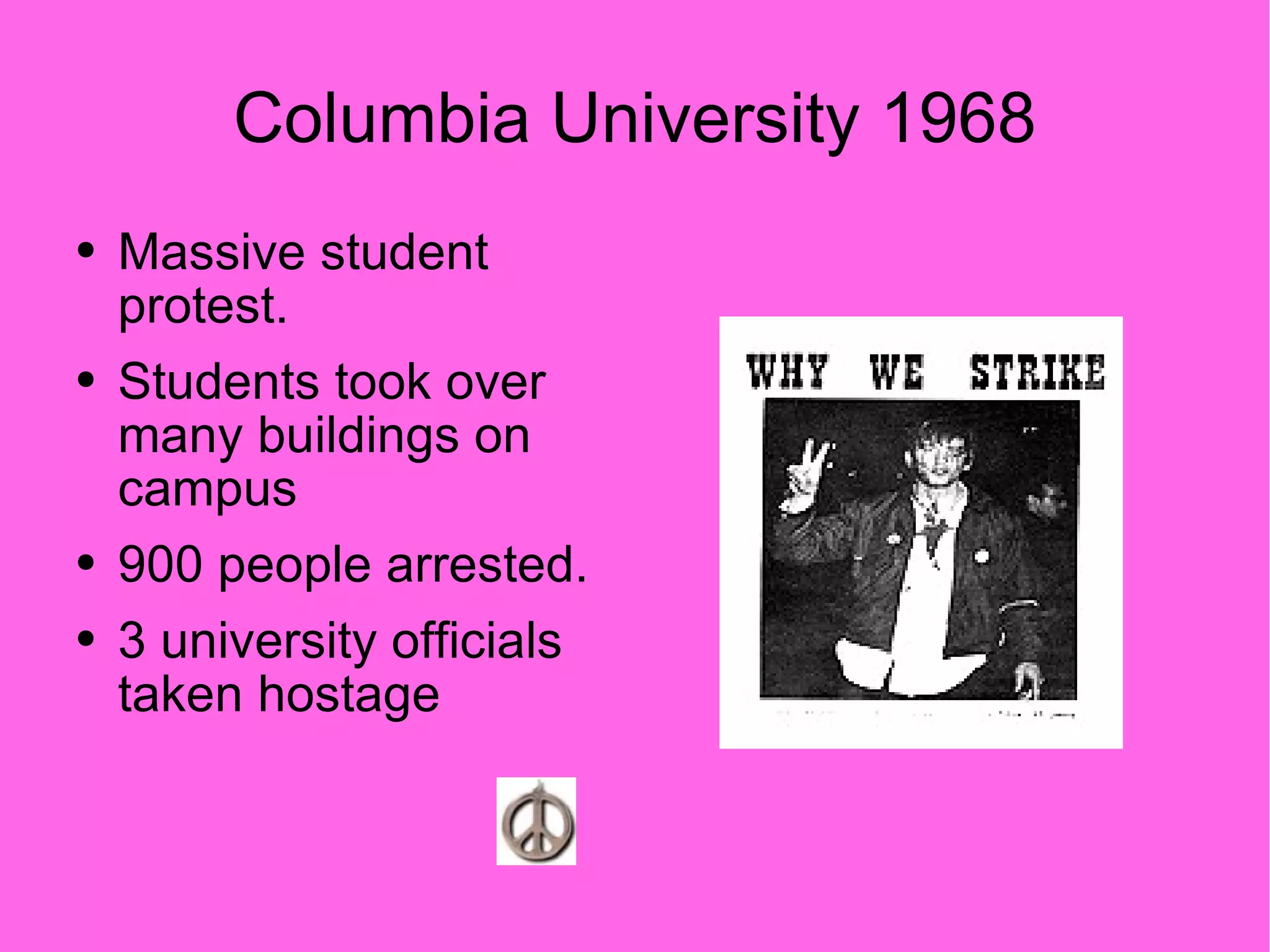
Columbia University 1968 Massive student protest.  Students took over many buildings on campus 900 people arrested. 3 university officials taken hostage
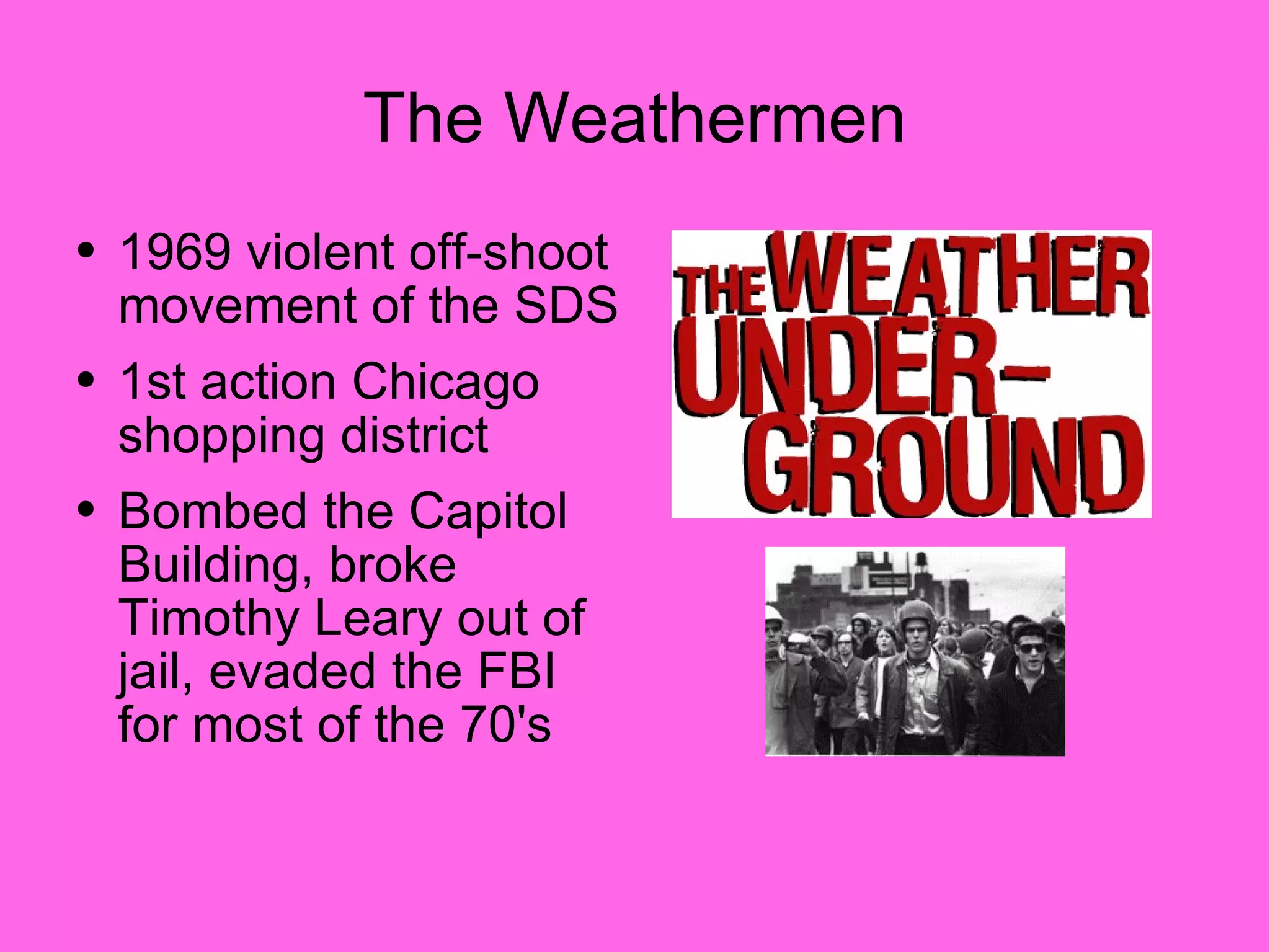
The Weathermen 1969 violent off-shoot movement of the SDS 1st action Chicago shopping district Bombed the Capitol Building, broke Timothy Leary out of jail, evaded the FBI for most of the 70's
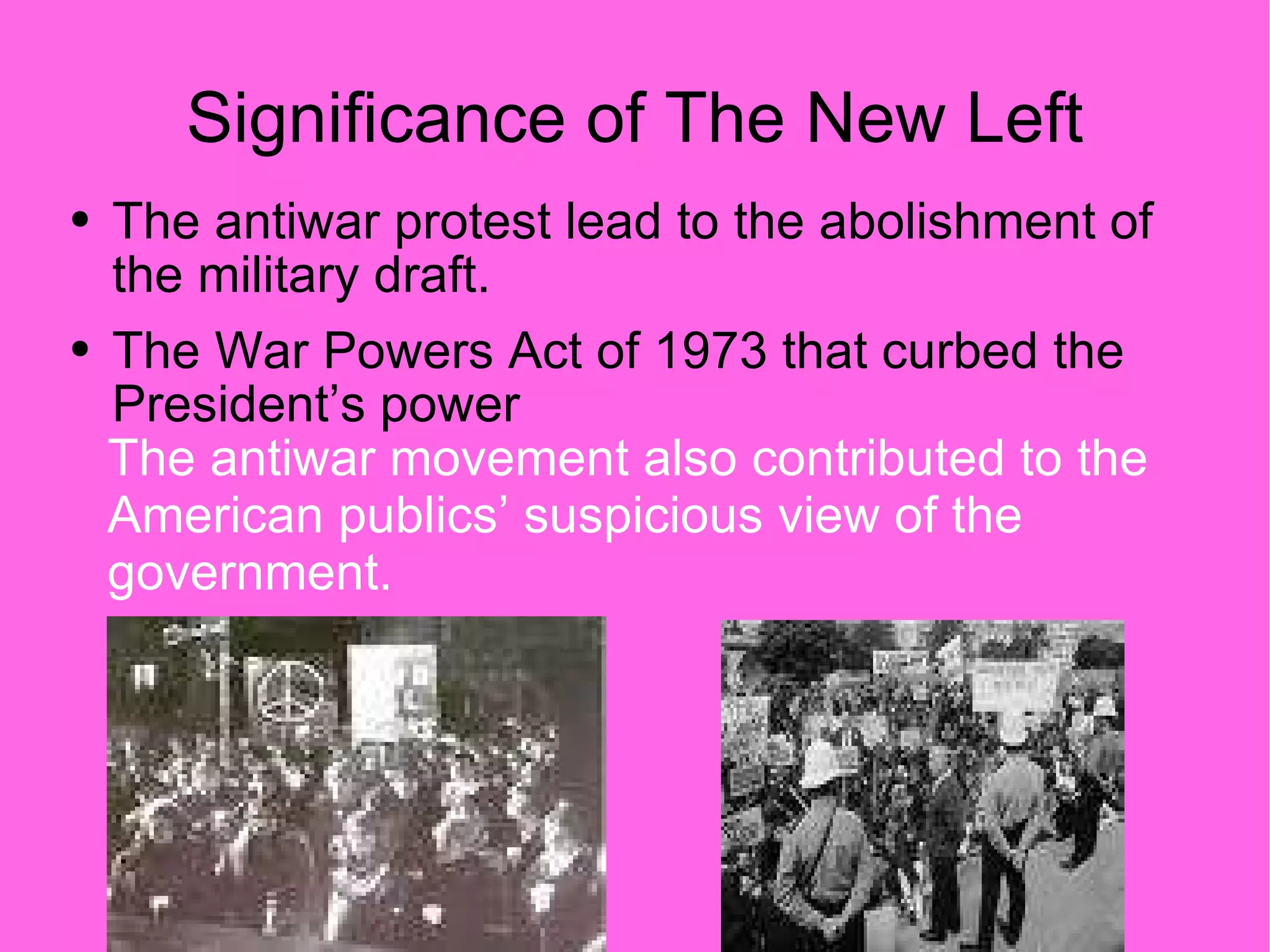
Significance of The New Left The antiwar protest lead to the abolishment of the military draft. The War Powers Act of 1973 that curbed the President’s power The antiwar movement also contributed to the American publics’ suspicious view of the government.
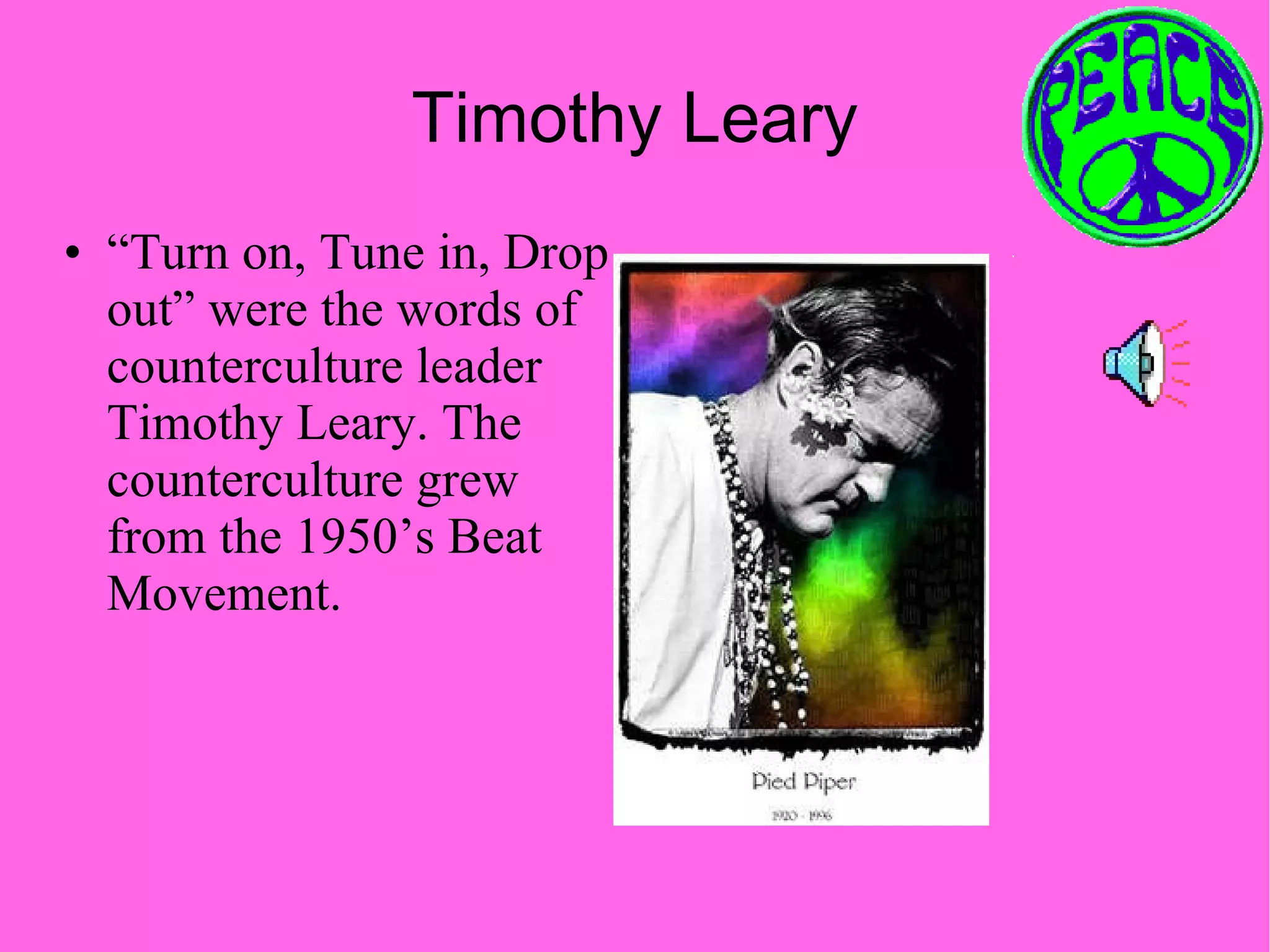
Timothy Leary “ Turn on, Tune in, Drop out” were the words of counterculture leader Timothy Leary. The counterculture grew from the 1950’s Beat Movement.
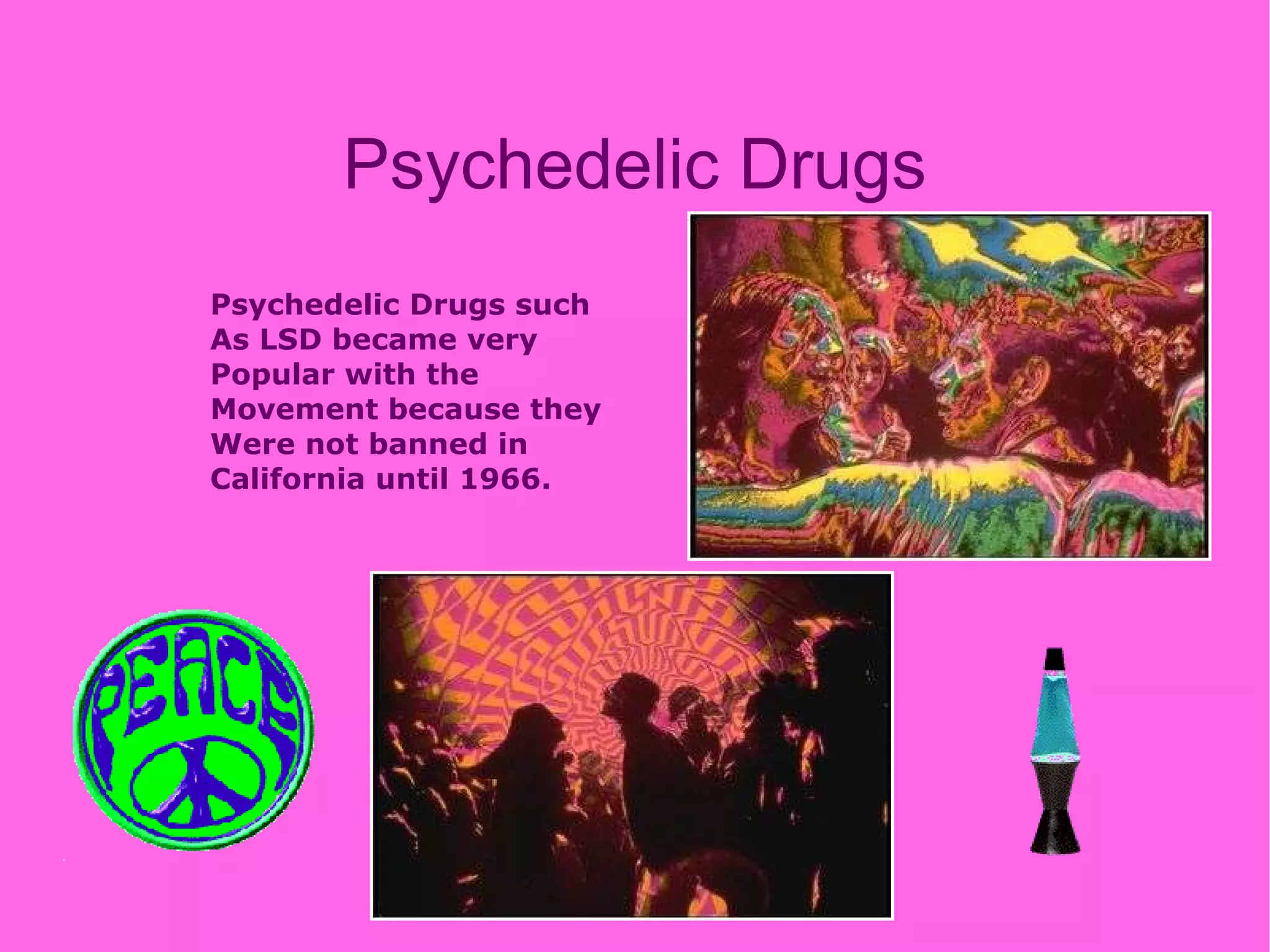
Psychedelic Drugs Psychedelic Drugs such As LSD became very  Popular with the  Movement because they  Were not banned in  California until 1966.
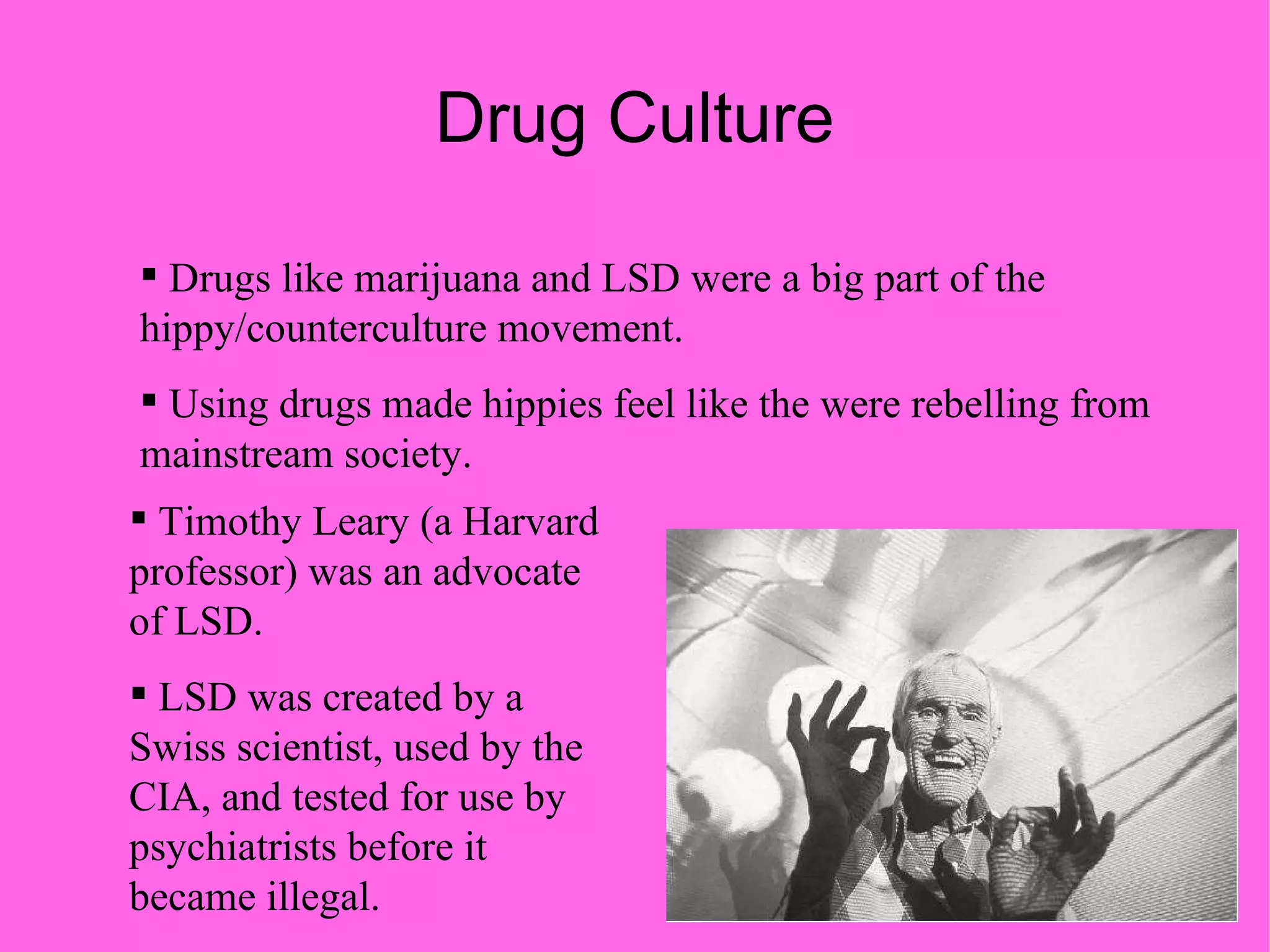
Drug Culture Drugs like marijuana and LSD were a big part of the hippy/counterculture movement. Using drugs made hippies feel like the were rebelling from mainstream society. Timothy Leary (a Harvard professor) was an advocate of LSD. LSD was created by a Swiss scientist, used by the CIA, and tested for use by psychiatrists before it became illegal.
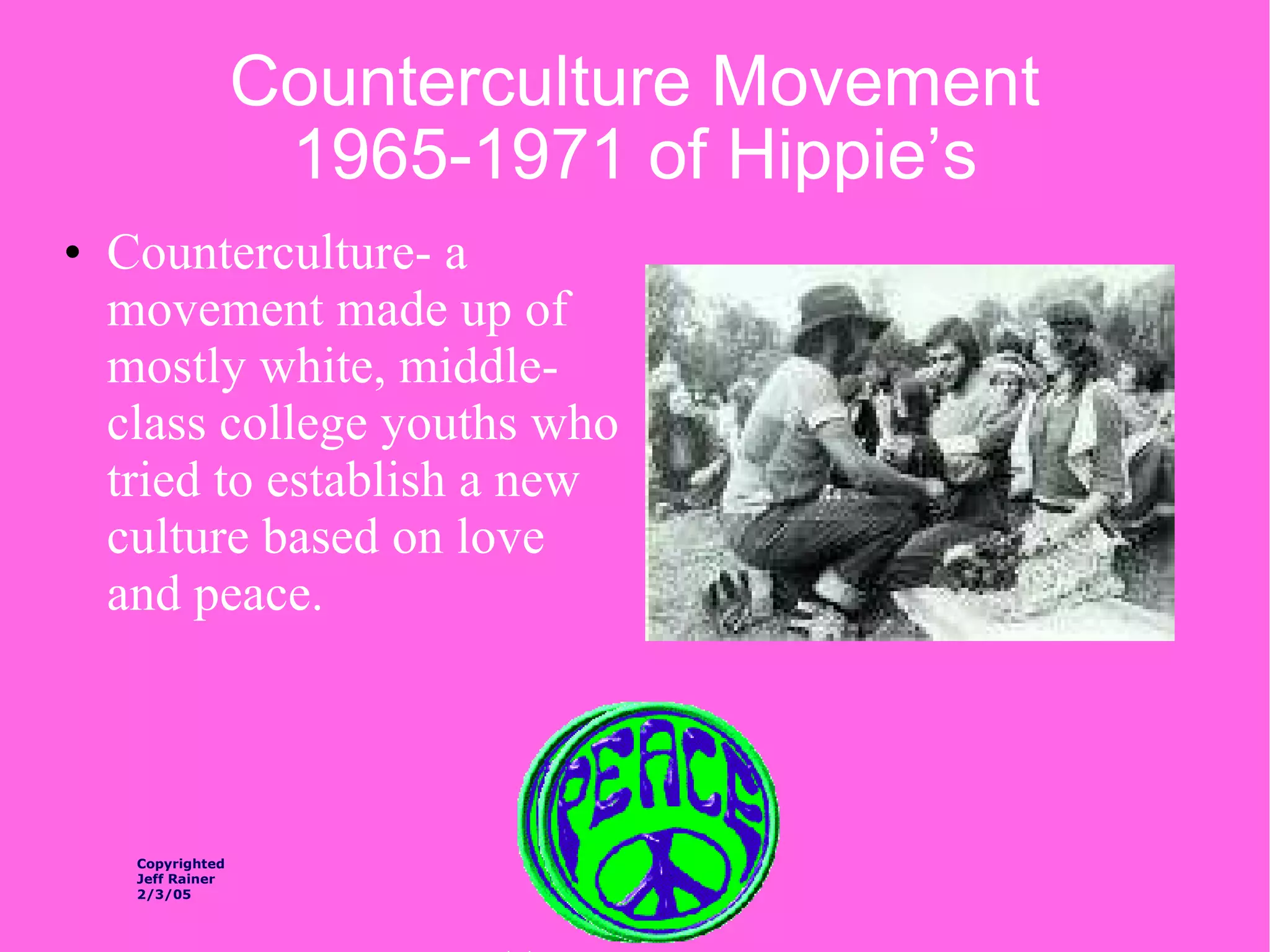
Counterculture Movement 1965-1971 of Hippie’s Counterculture- a movement made up of mostly white, middle-class college youths who tried to establish a new culture based on love and peace. Copyrighted Jeff Rainer 2/3/05
The Hippy Movement The term “hippy” comes from being hip. You were either hip or you were a “square” or a “pig.” Hippies were looking for an alternative way to live life. Most hippies valued freedom, nature, intimacy, peace, sharing, and spirituality.
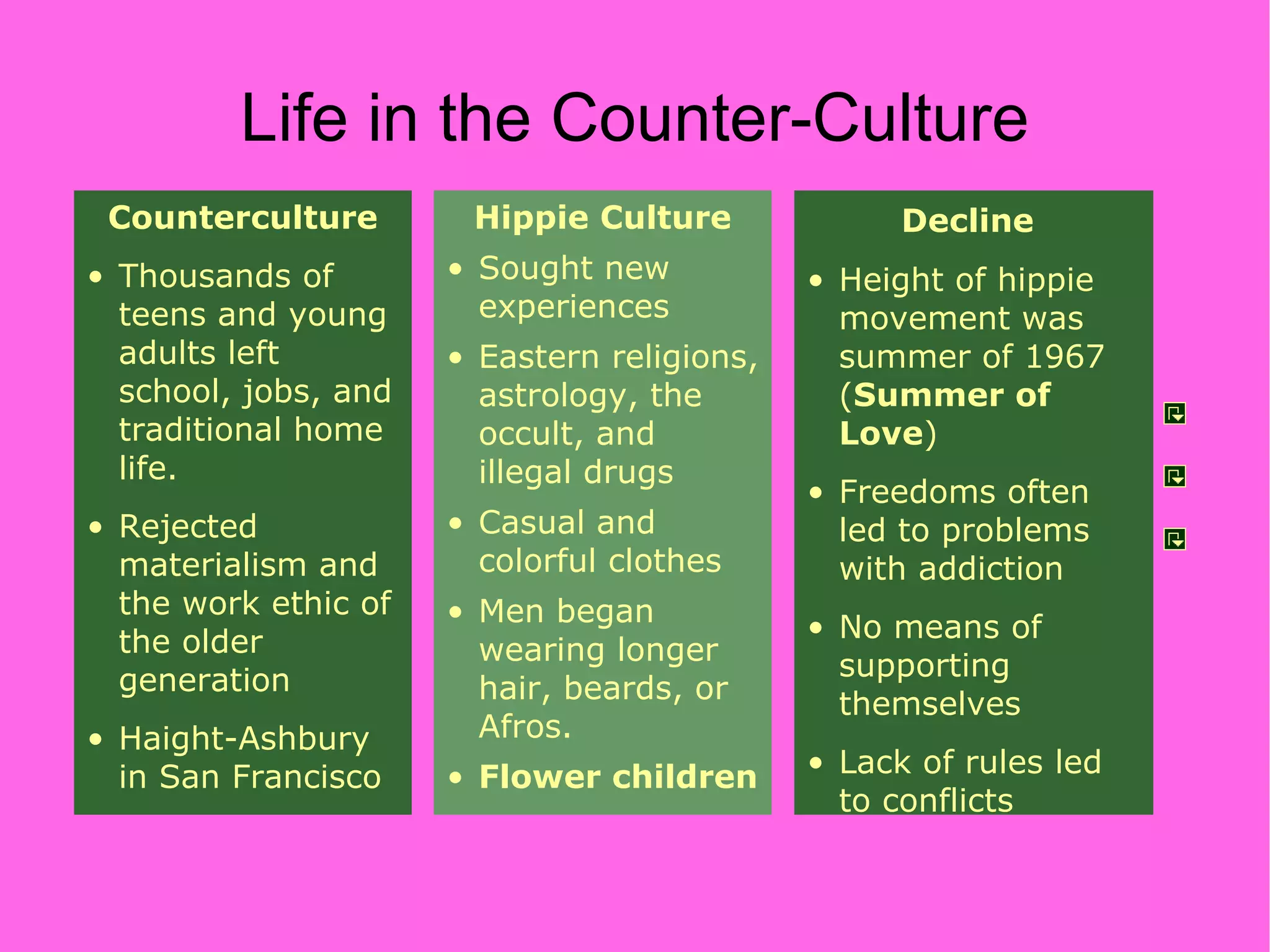
Life in the Counter-Culture Counterculture Thousands of teens and young adults left school, jobs, and traditional home life. Rejected materialism and the work ethic of the older generation Haight-Ashbury in San Francisco Hippie Culture Sought new experiences  Eastern religions, astrology, the occult, and illegal drugs Casual and colorful clothes  Men began wearing longer hair, beards, or Afros. Flower children Decline   Height of hippie movement was summer of 1967 ( Summer of Love ) Freedoms often led to problems with addiction No means of supporting themselves Lack of rules led to conflicts
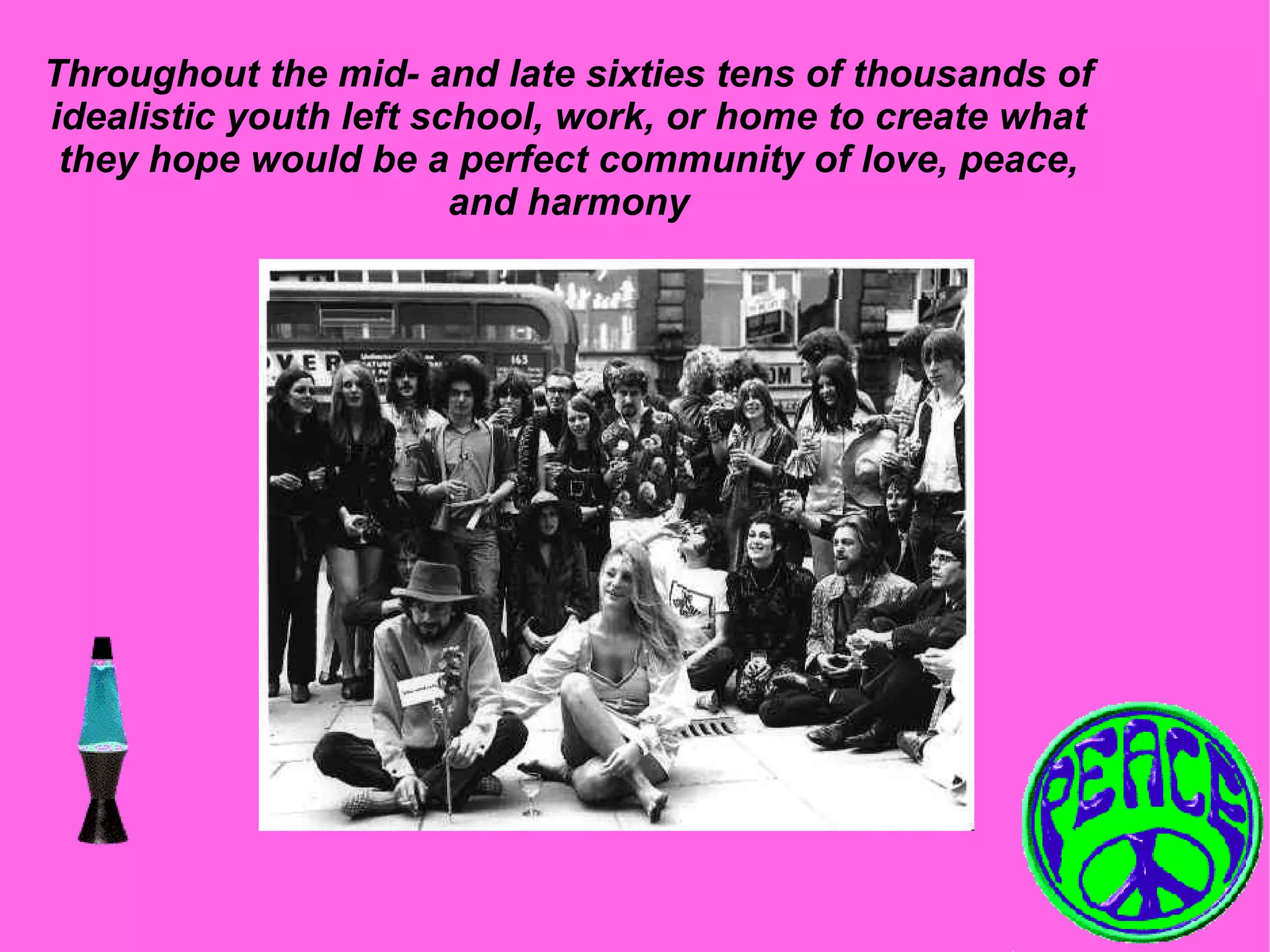
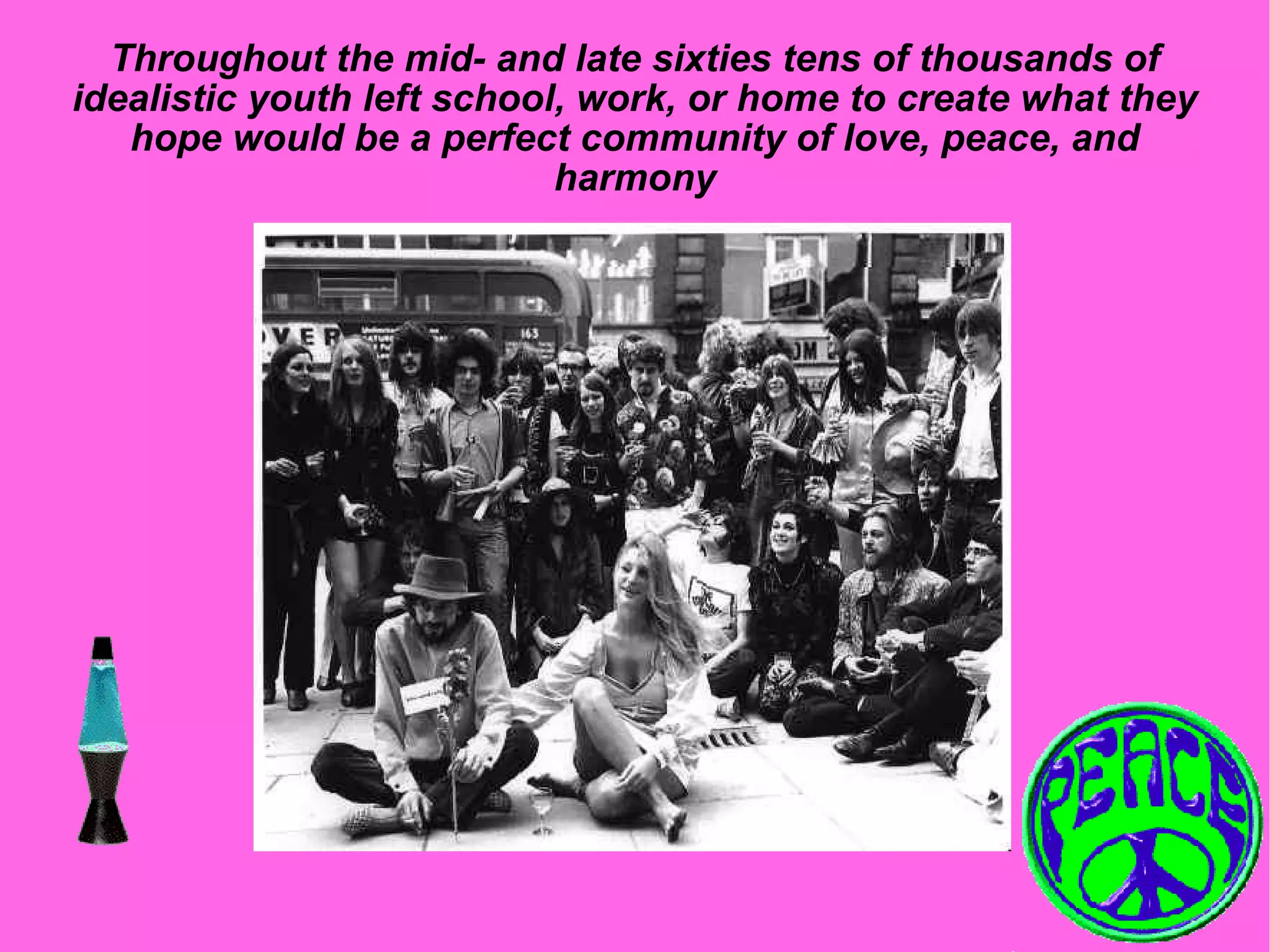
Throughout the mid- and late sixties tens of thousands of idealistic youth left school, work, or home to create what they hope would be a perfect community of love, peace, and harmony
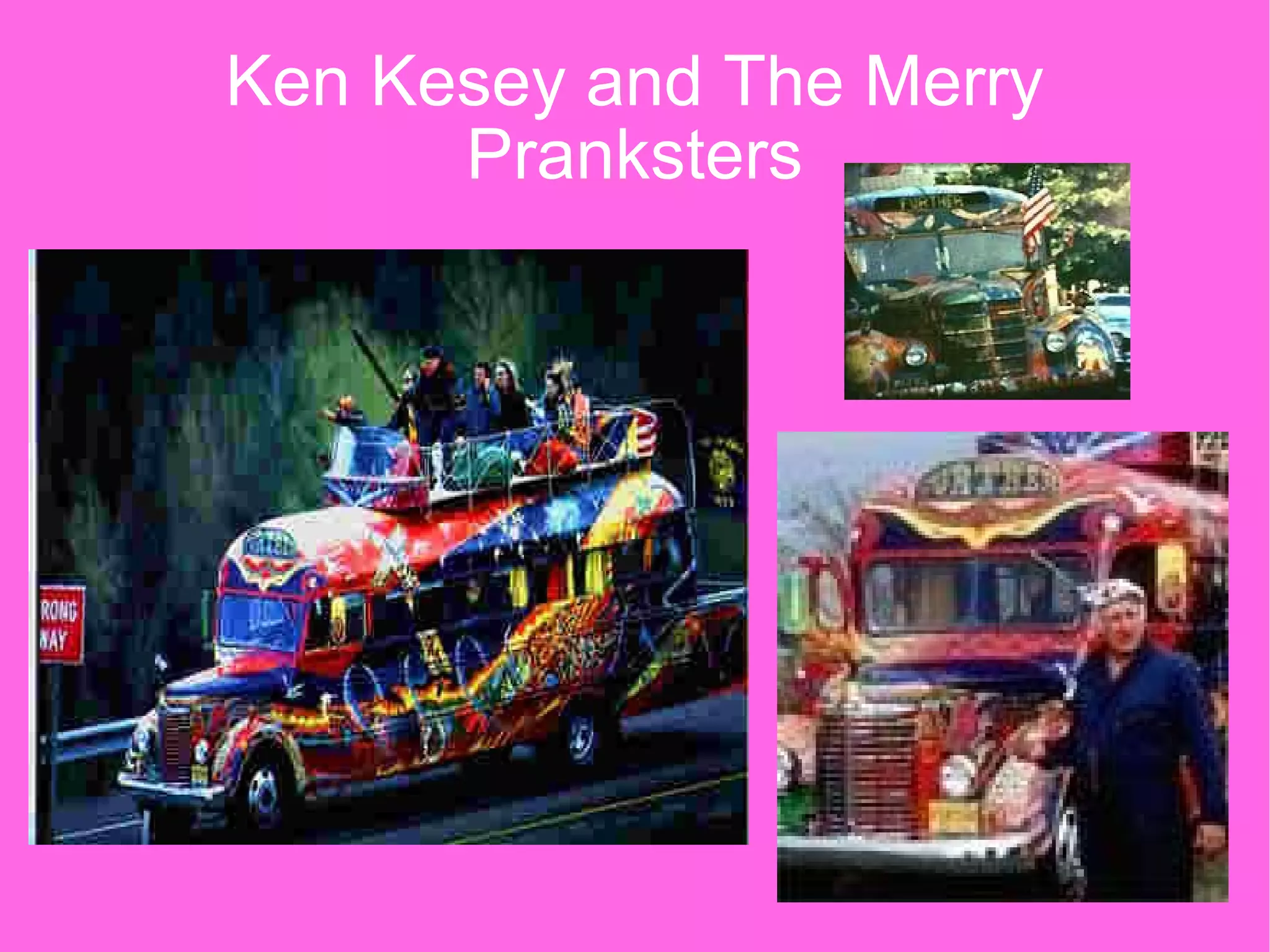
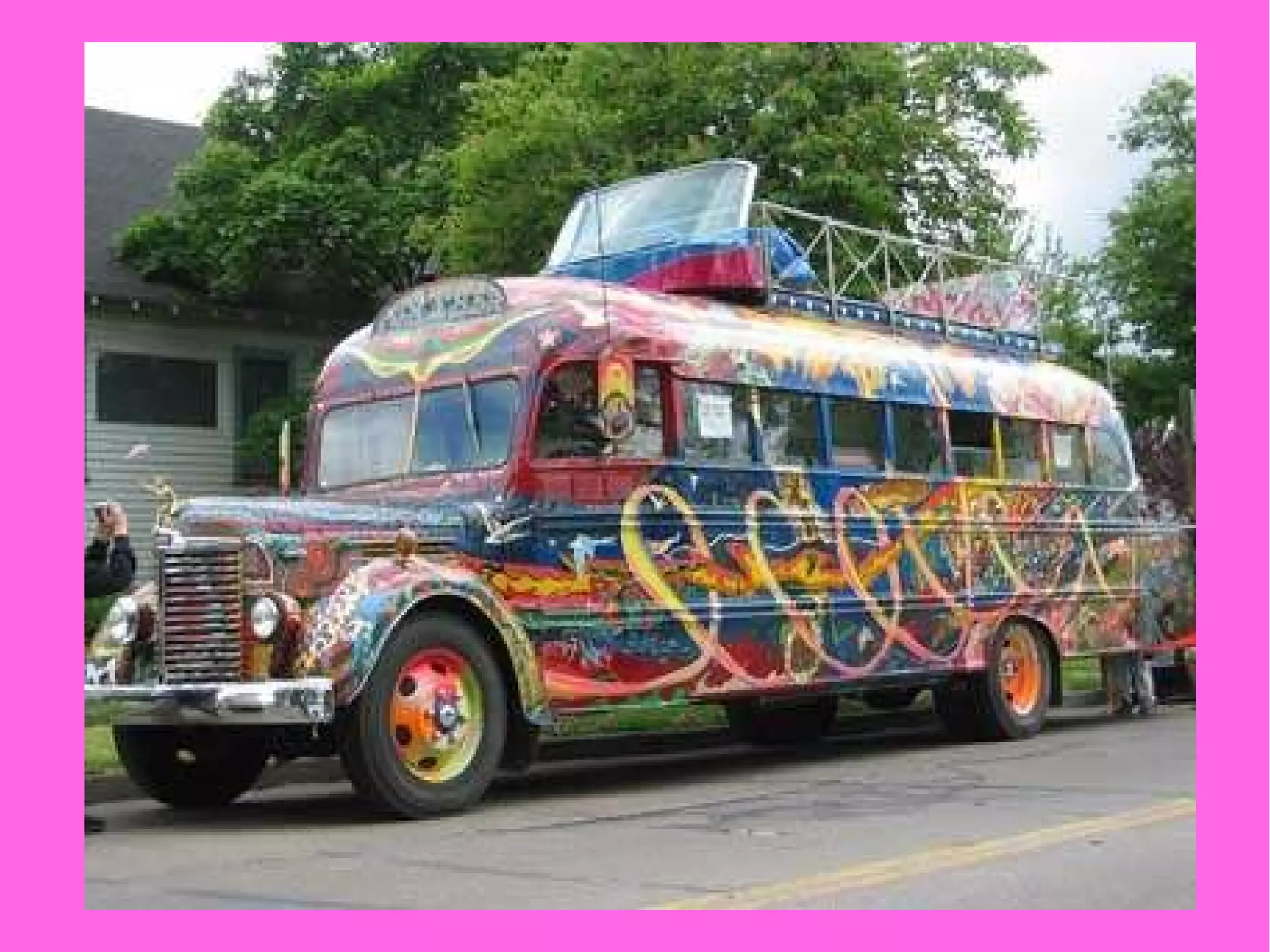
Ken Kesey and The Merry Pranksters
 
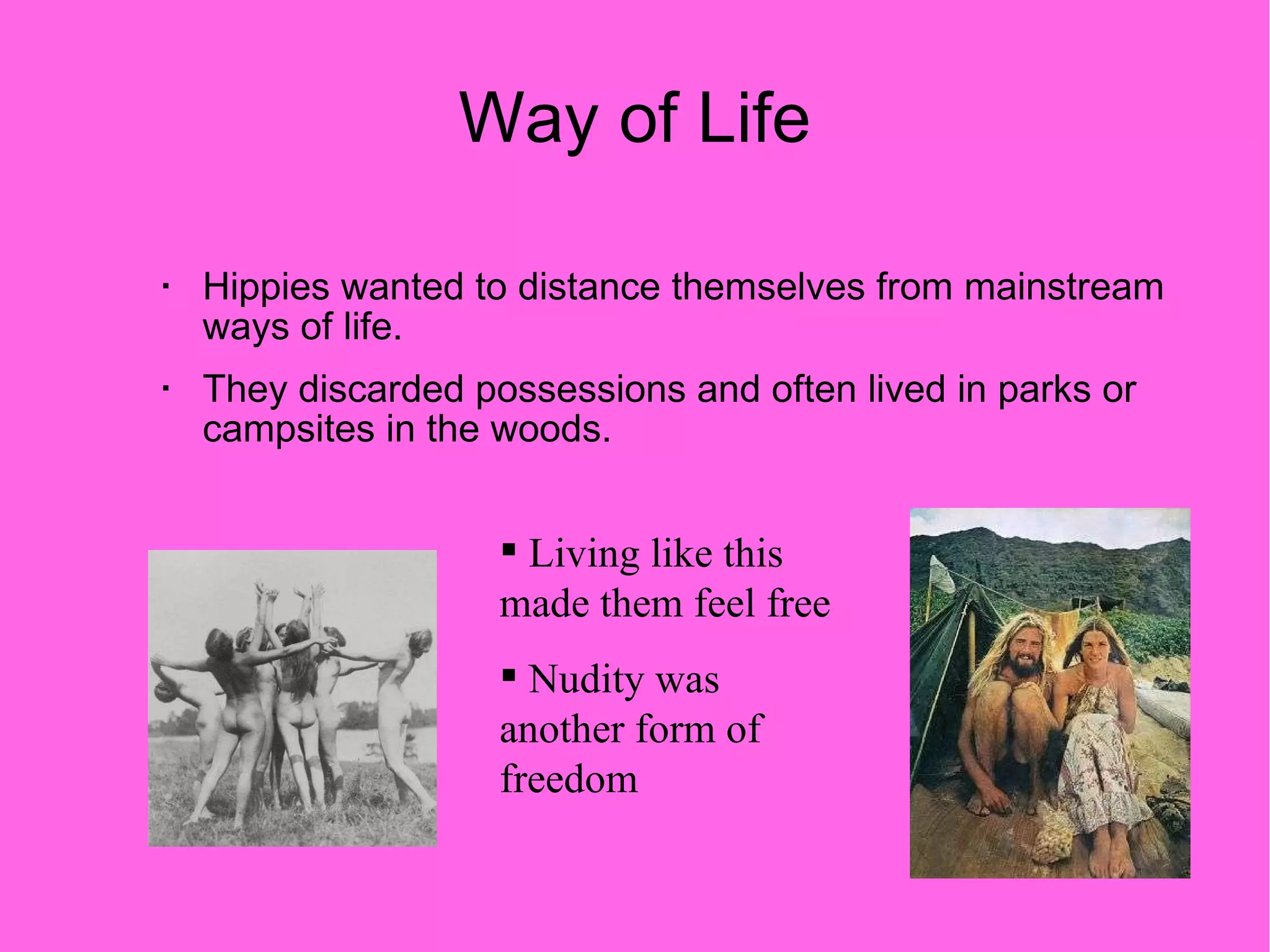
Way of Life Hippies wanted to distance themselves from mainstream ways of life.  They discarded possessions and often lived in parks or campsites in the woods. Living like this made them feel free Nudity was another form of freedom
Throughout the mid- and late sixties tens of thousands of idealistic youth left school, work, or home to create what they hope would be a perfect community of love, peace, and harmony
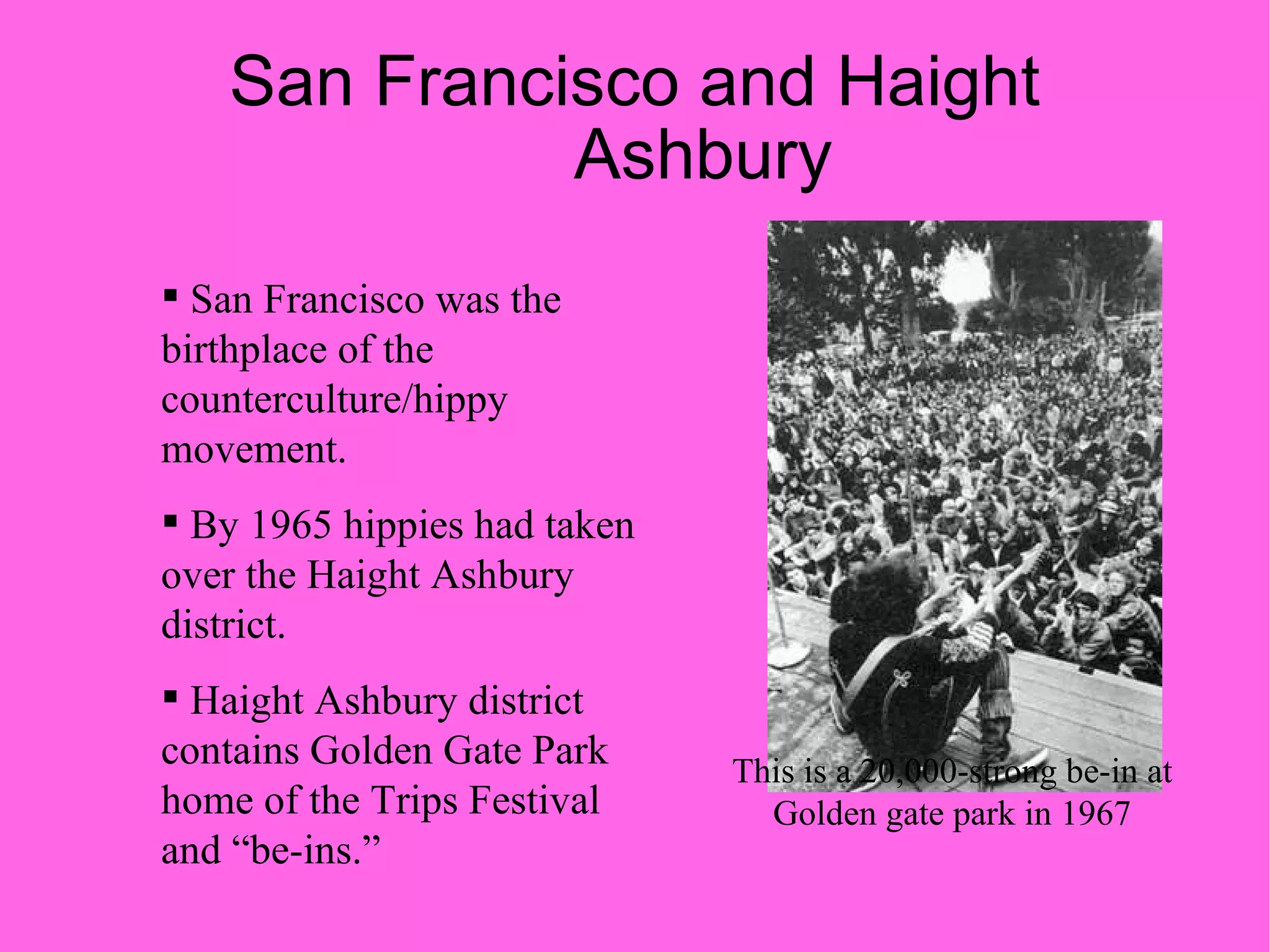
San Francisco and Haight   Ashbury  San Francisco was the birthplace of the counterculture/hippy movement. By 1965 hippies had taken over the Haight Ashbury district. Haight Ashbury district contains Golden Gate Park home of the Trips Festival and “be-ins.” This is a 20,000-strong be-in at Golden gate park in 1967
1967 Summer of Love . The Flower Power movement reached its short but intensive climax in the "Summer of Love" in 1967. Many different people came together to build a new society. They wanted a new, individual style. The postwar generation tried to build its own culture in the 50's. They refused traditional standards and values. Their most important colors were black, red and white - white for the drugs, black for their clothes and the coffee and red for the wine. Their values were radical individualism, an uncontrolled way of life expressed in parties,drugs and free love.
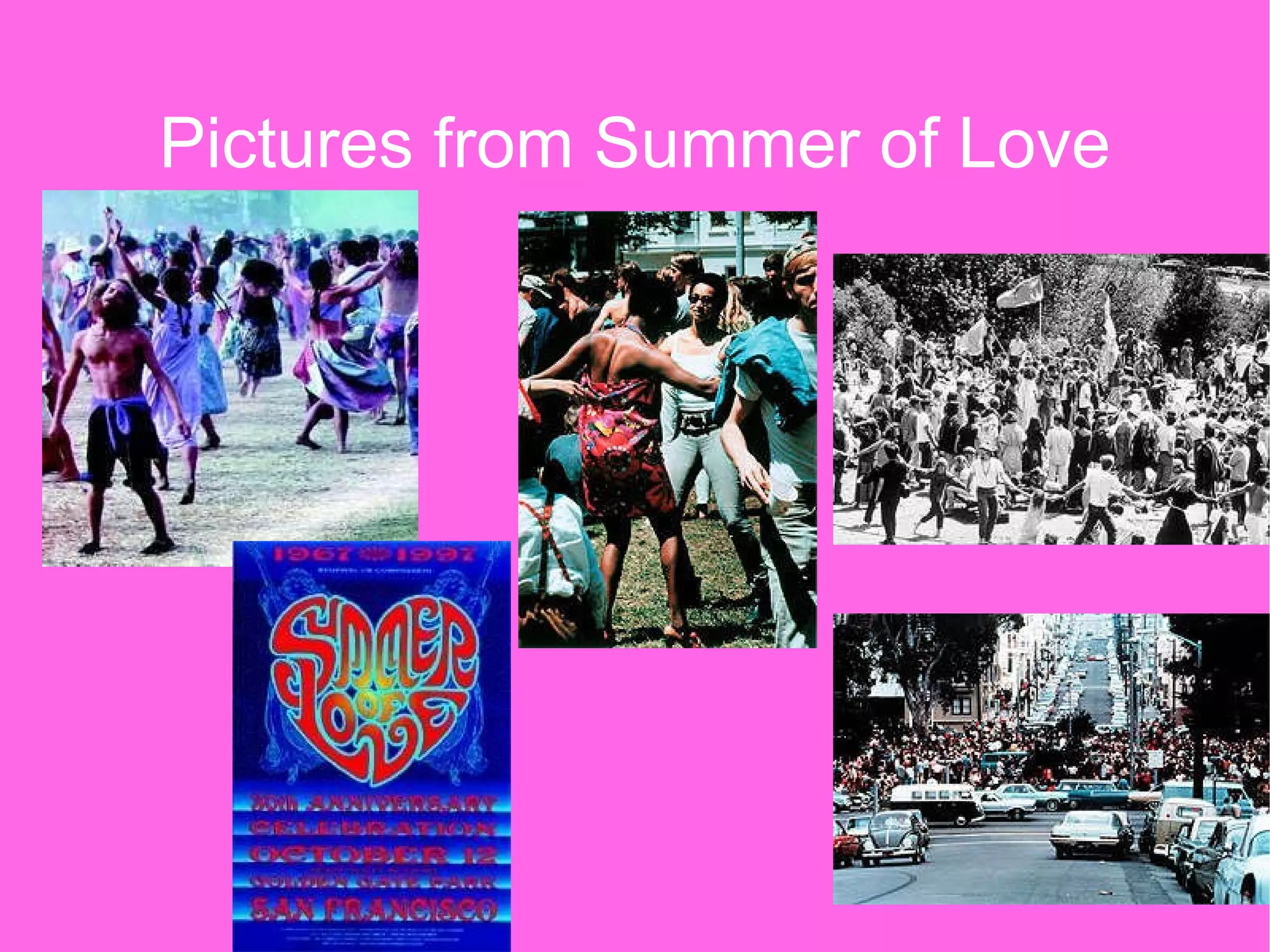
Pictures from Summer of Love
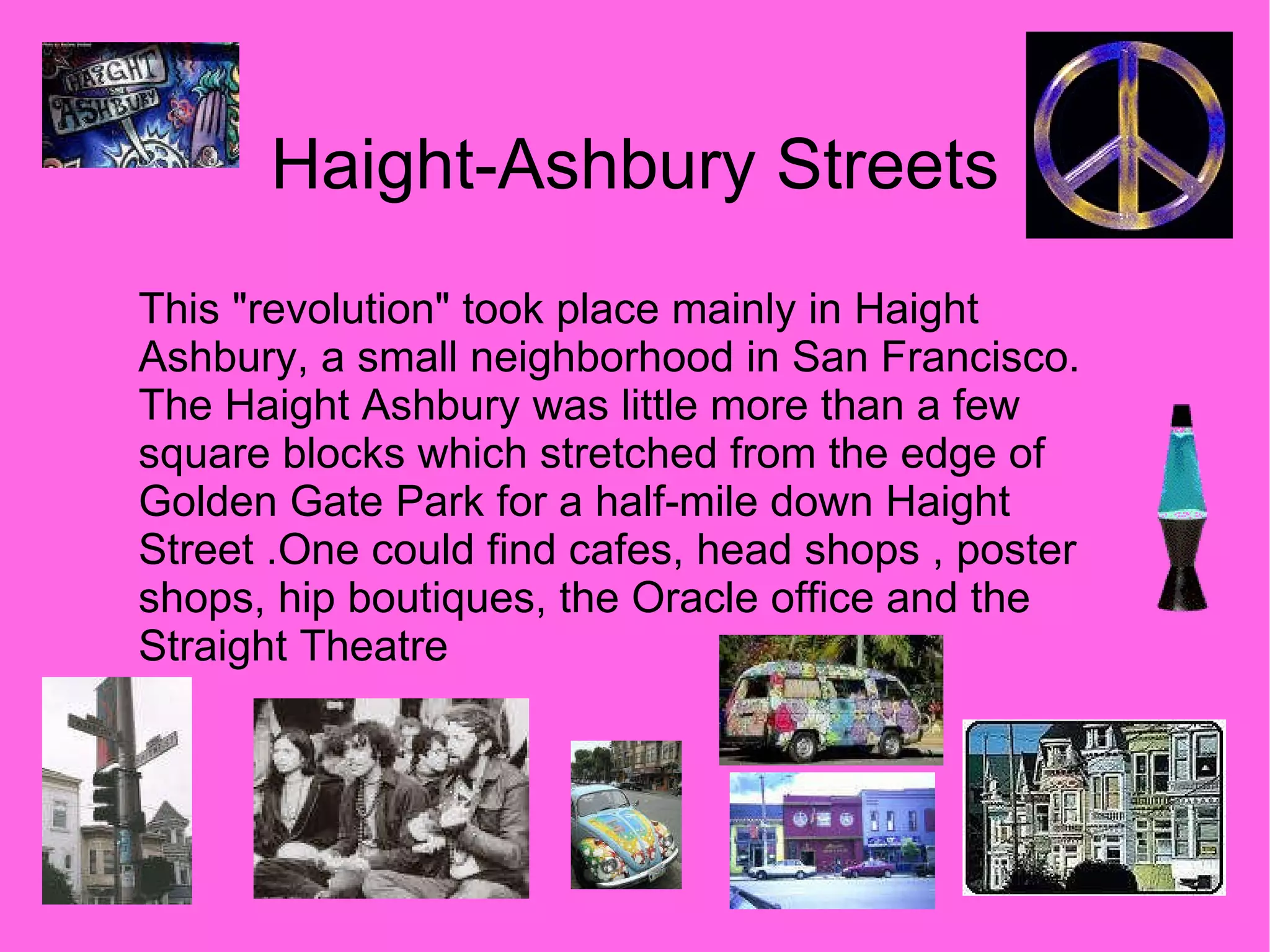
Haight-Ashbury Streets This "revolution" took place mainly in Haight Ashbury, a small neighborhood in San Francisco. The Haight Ashbury was little more than a few square blocks which stretched from the edge of Golden Gate Park for a half-mile down Haight Street .One could find cafes, head shops , poster shops, hip boutiques, the Oracle office and the Straight Theatre
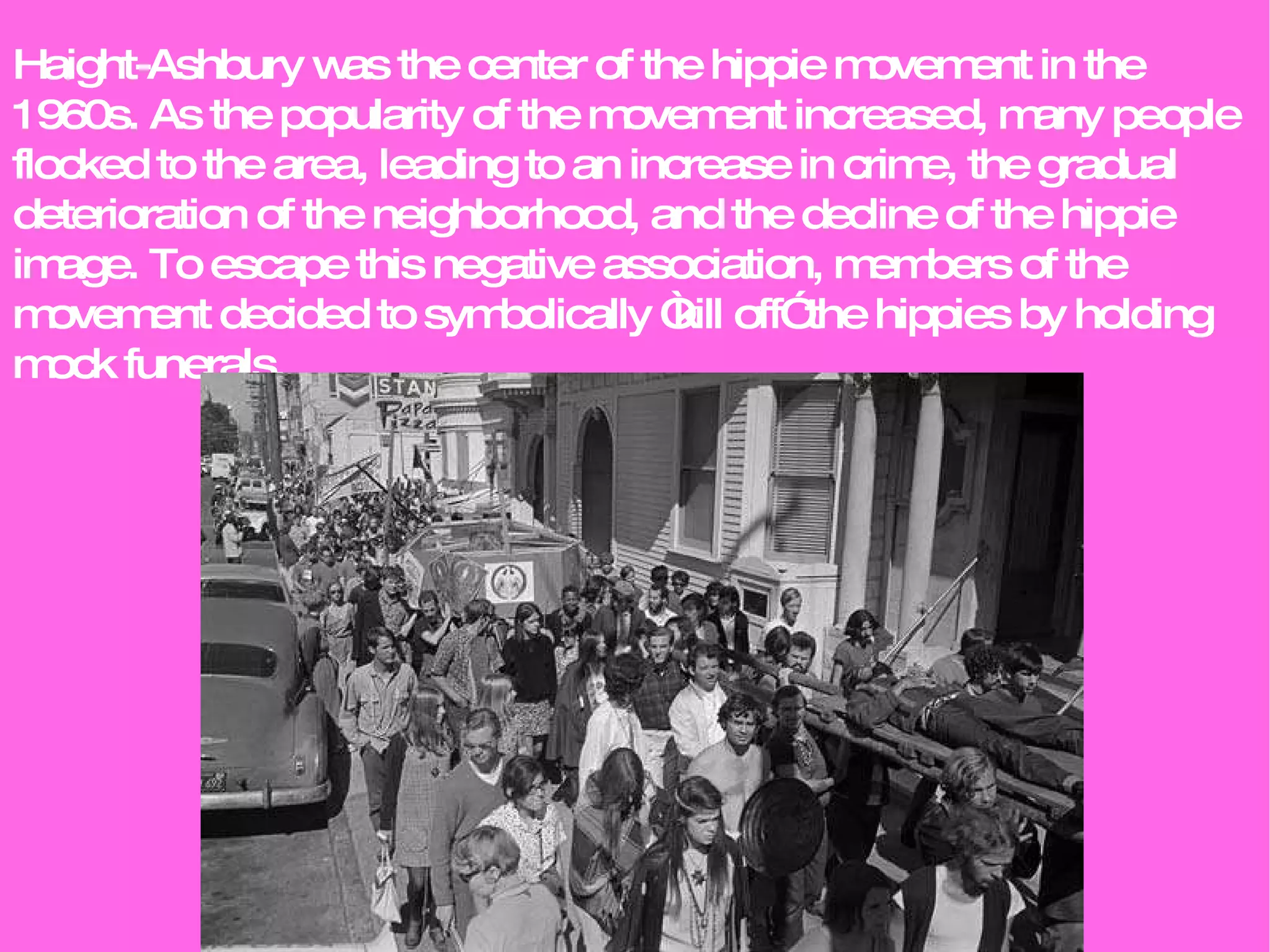
Haight-Ashbury was the center of the hippie movement in the 1960s. As the popularity of the movement increased, many people flocked to the area, leading to an increase in crime, the gradual deterioration of the neighborhood, and the decline of the hippie image. To escape this negative association, members of the movement decided to symbolically “kill off” the hippies by holding mock funerals.
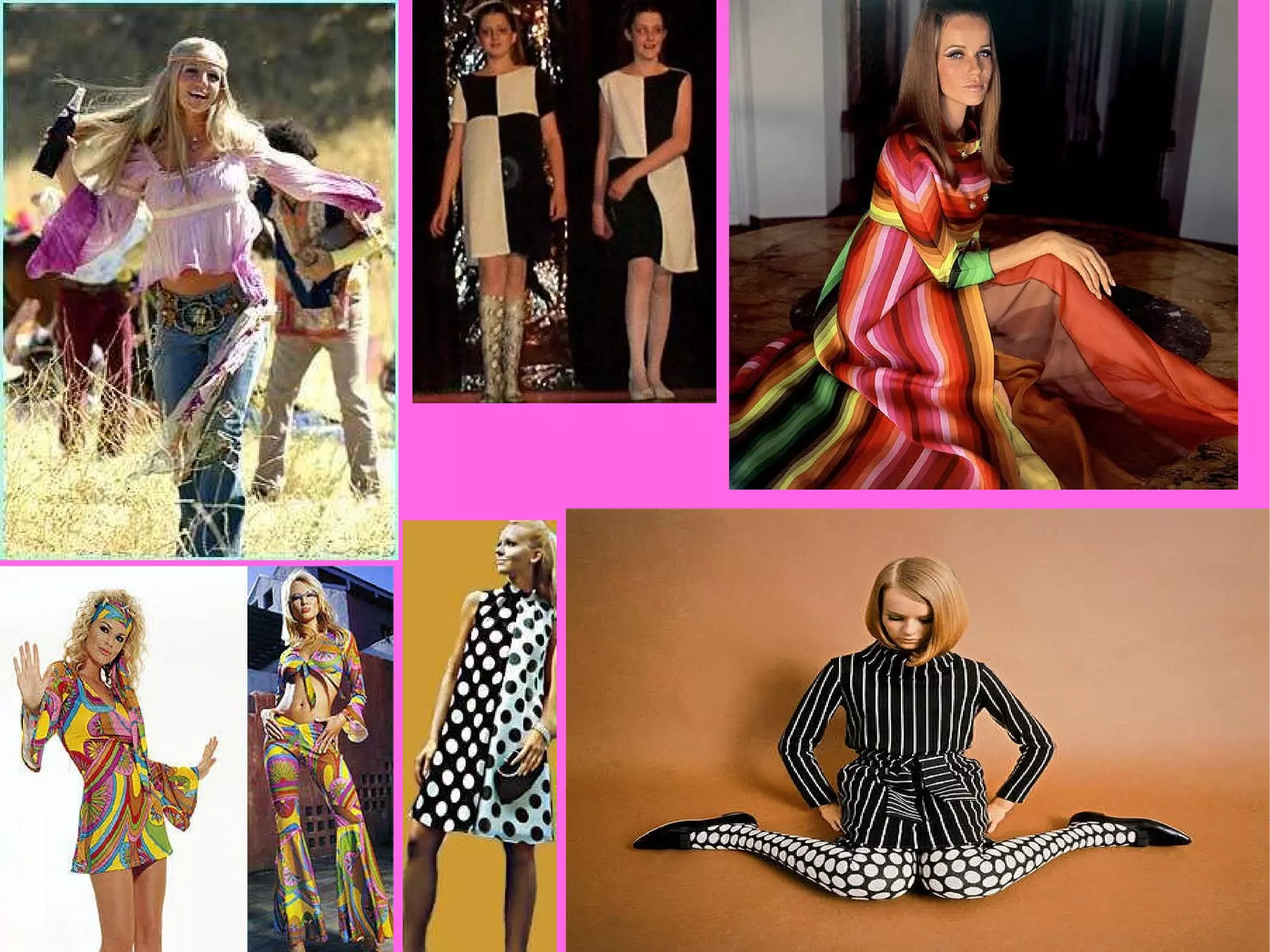
Counter Culture, Fad and Fashion .
 
 
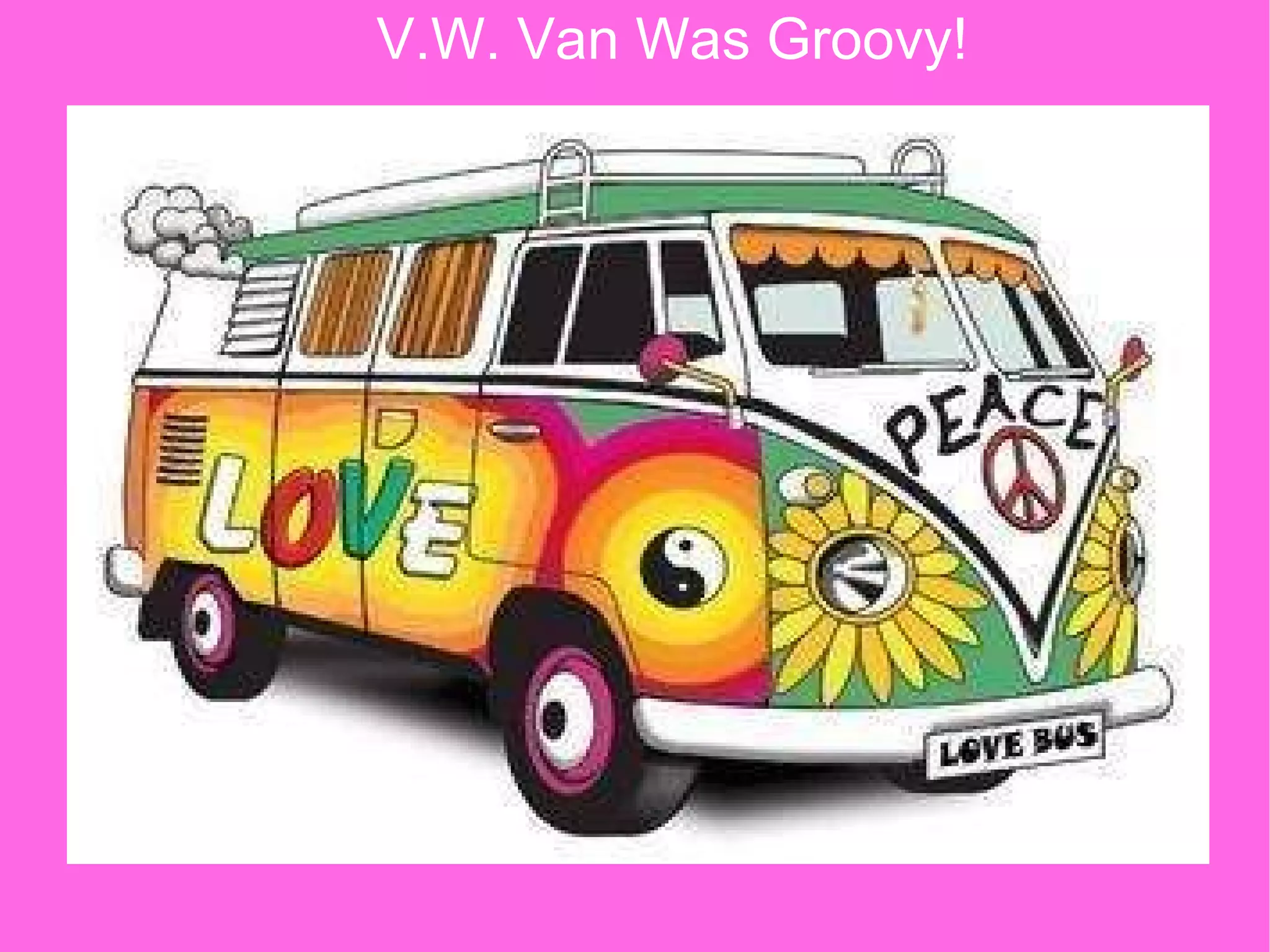
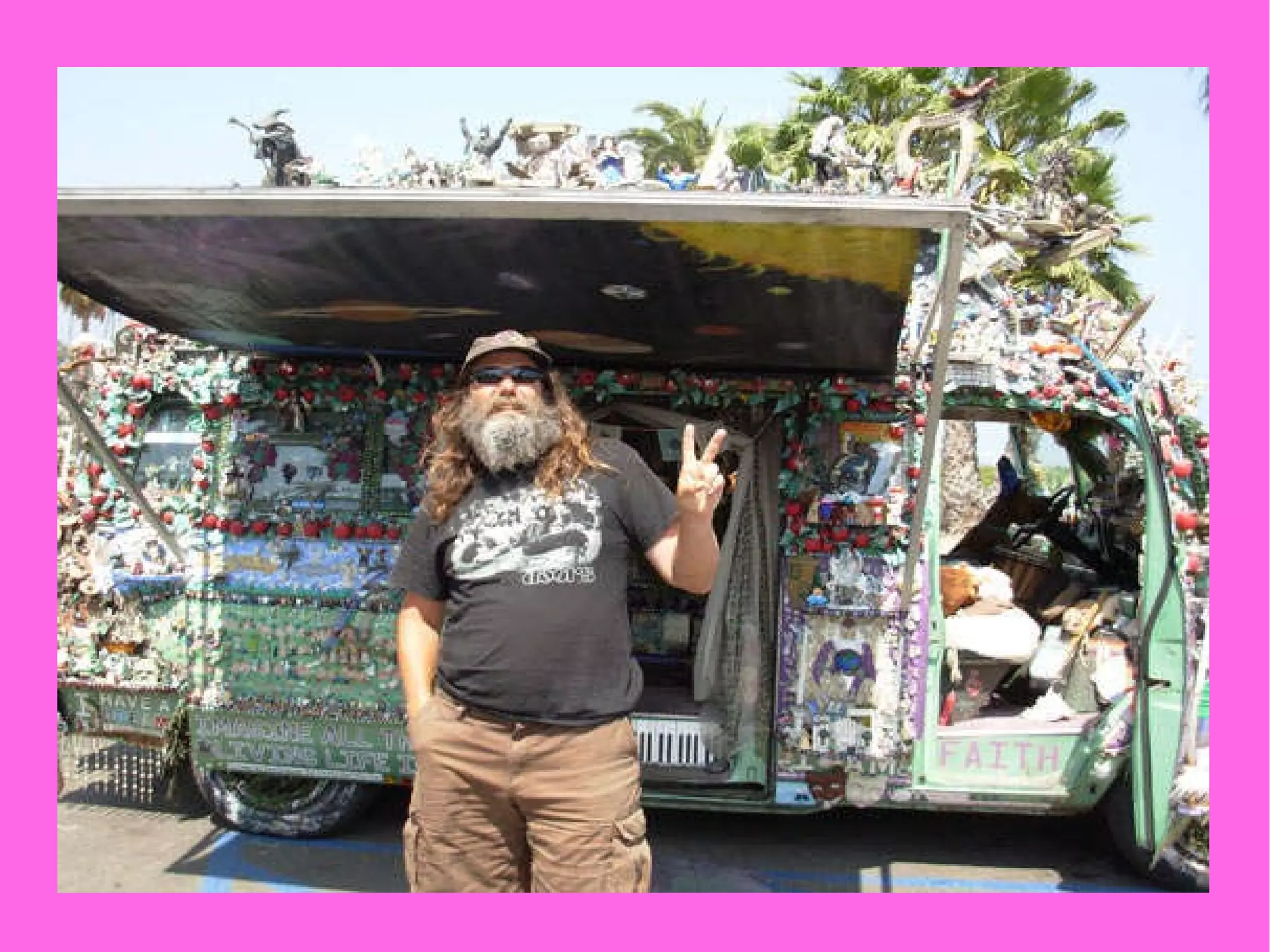
V.W. Van Was Groovy!
 
 
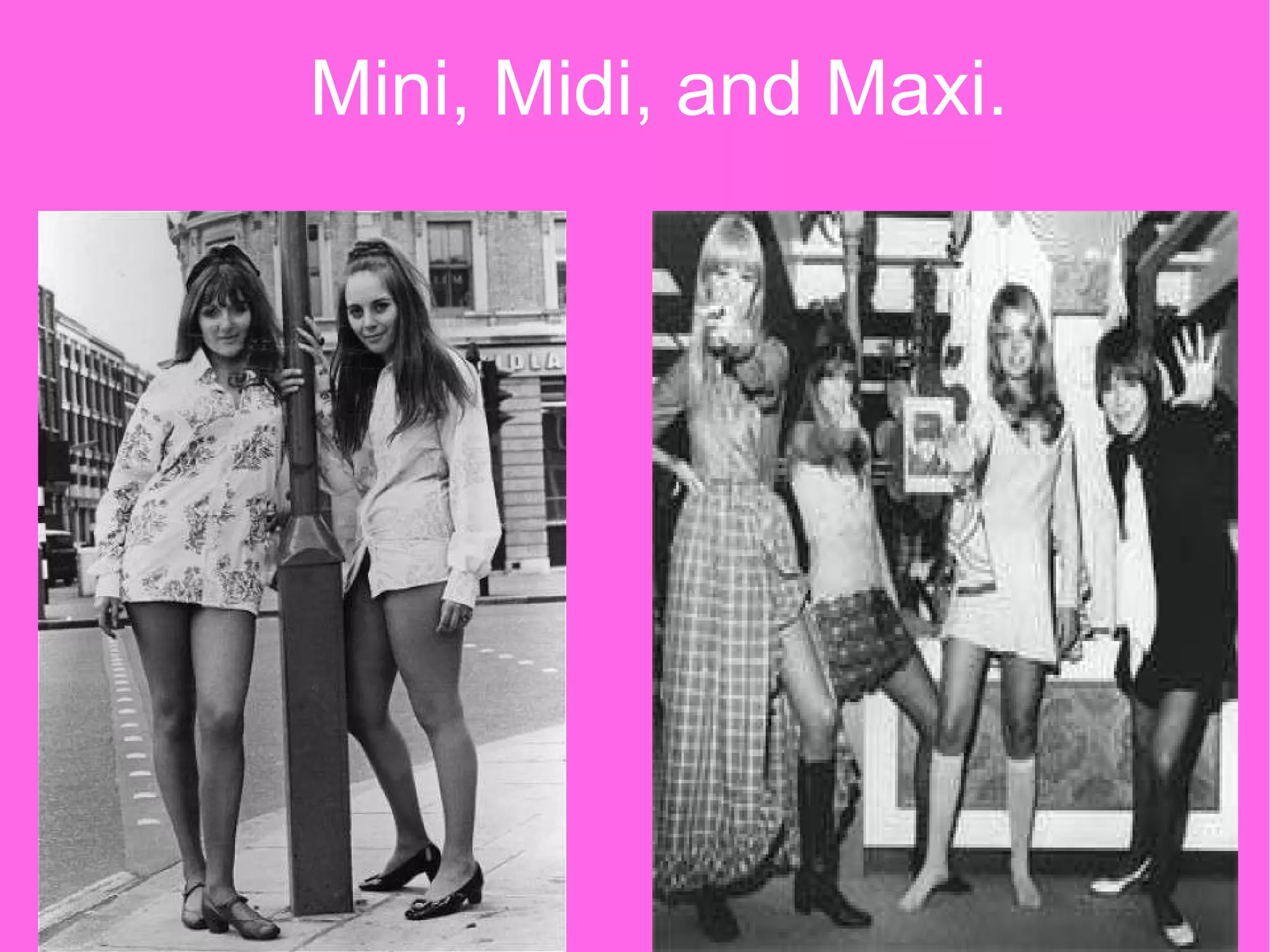
Mini, Midi, and Maxi.
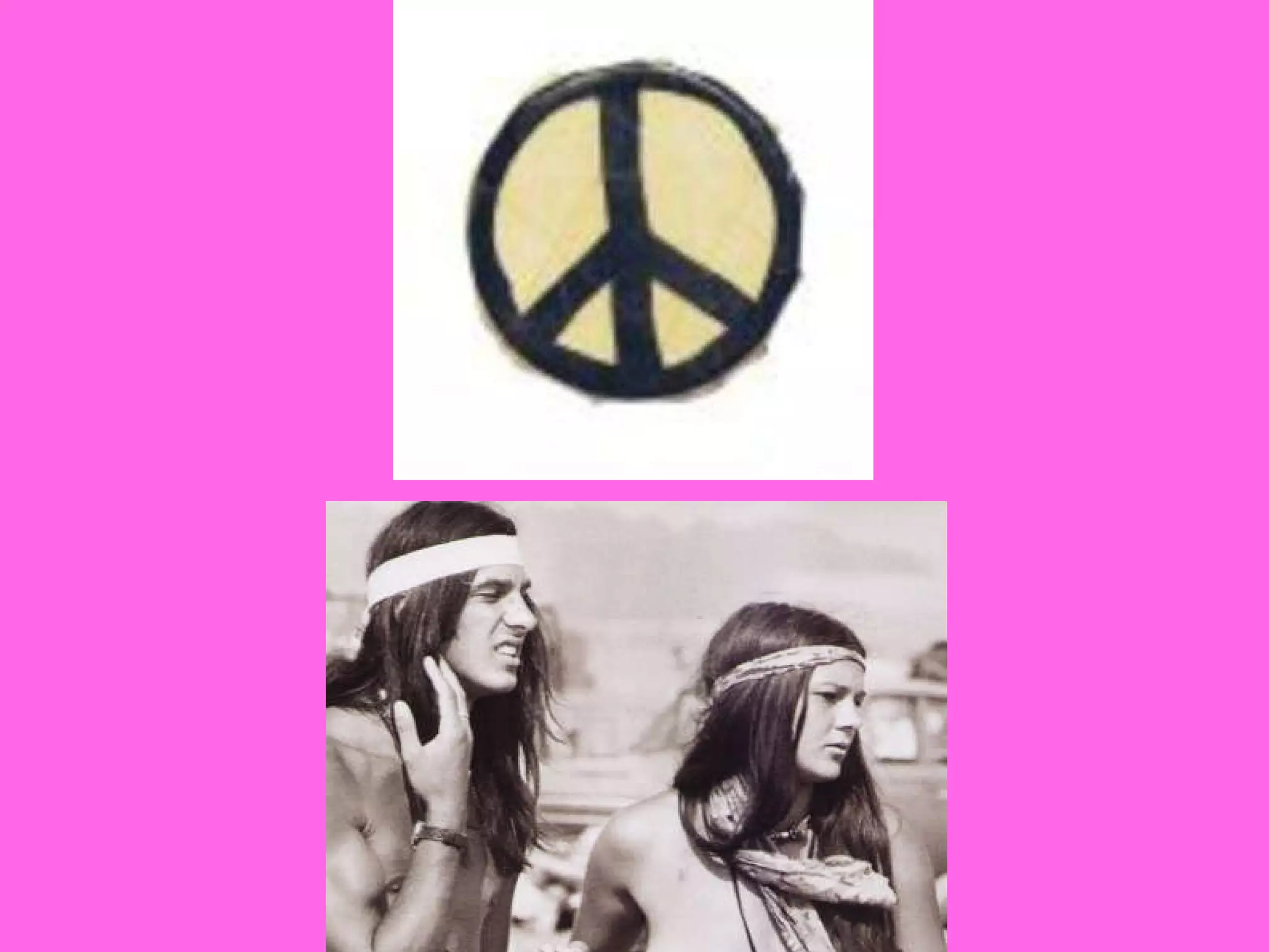
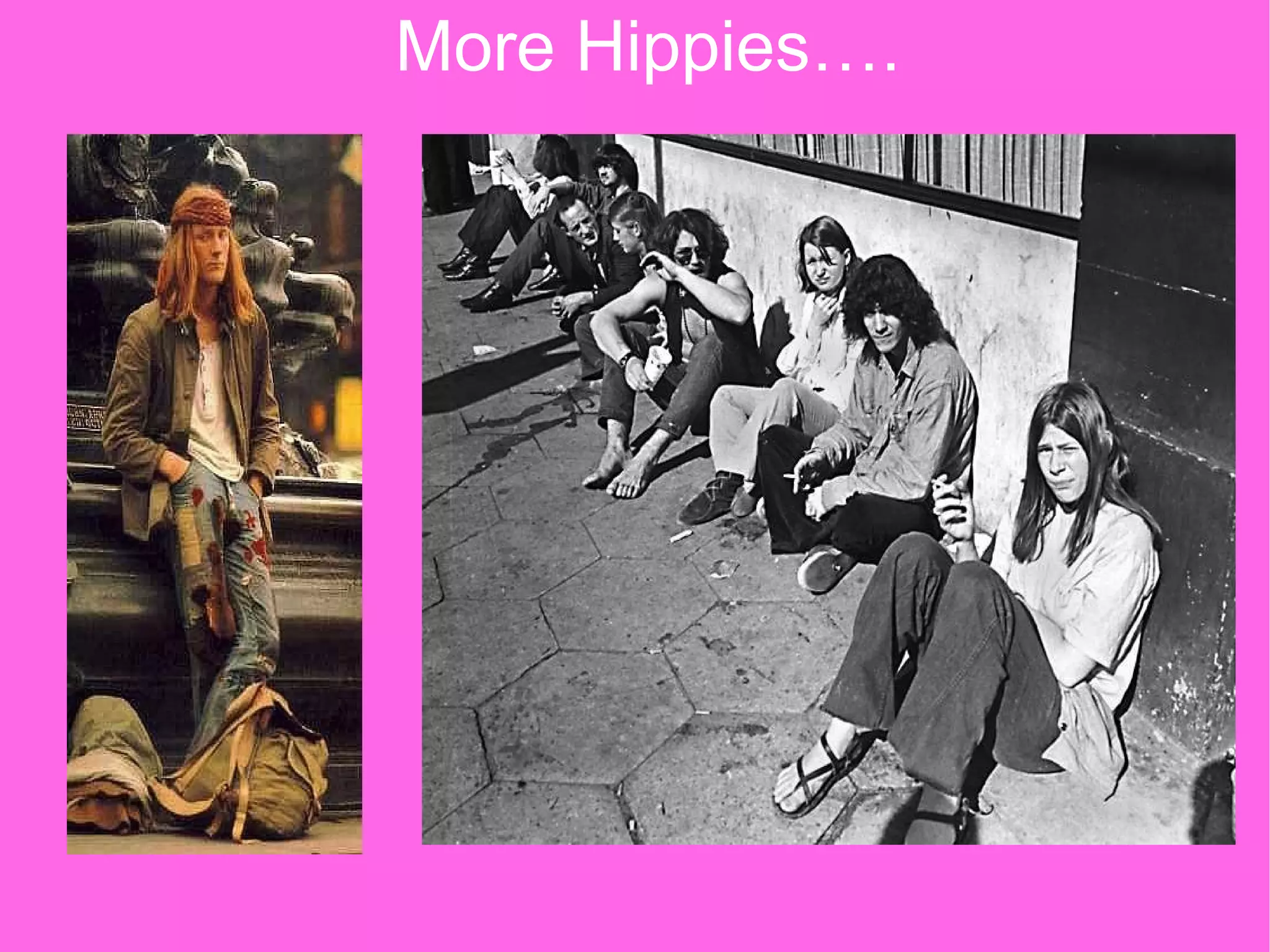
More Hippies….
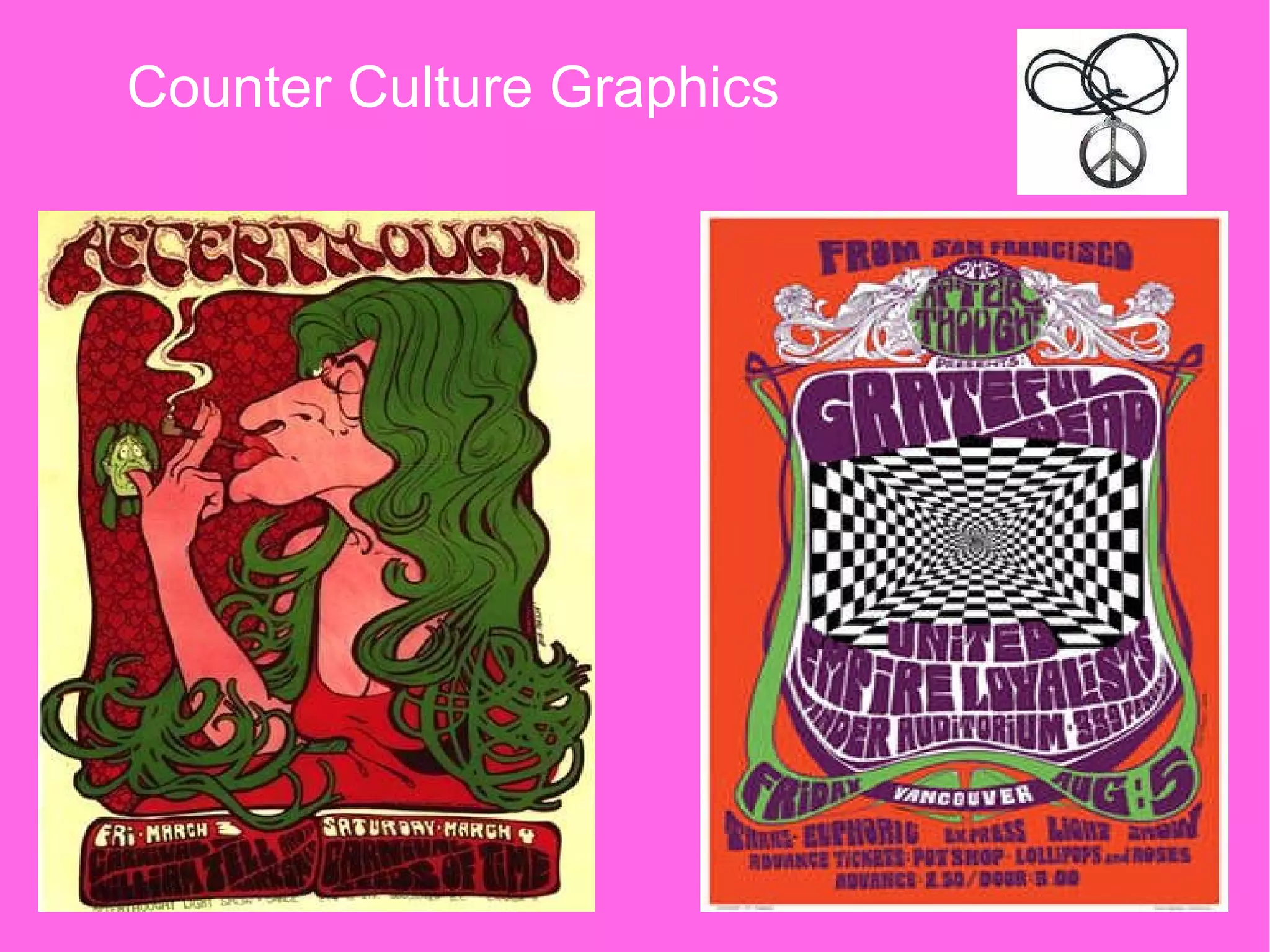
Counter Culture Graphics
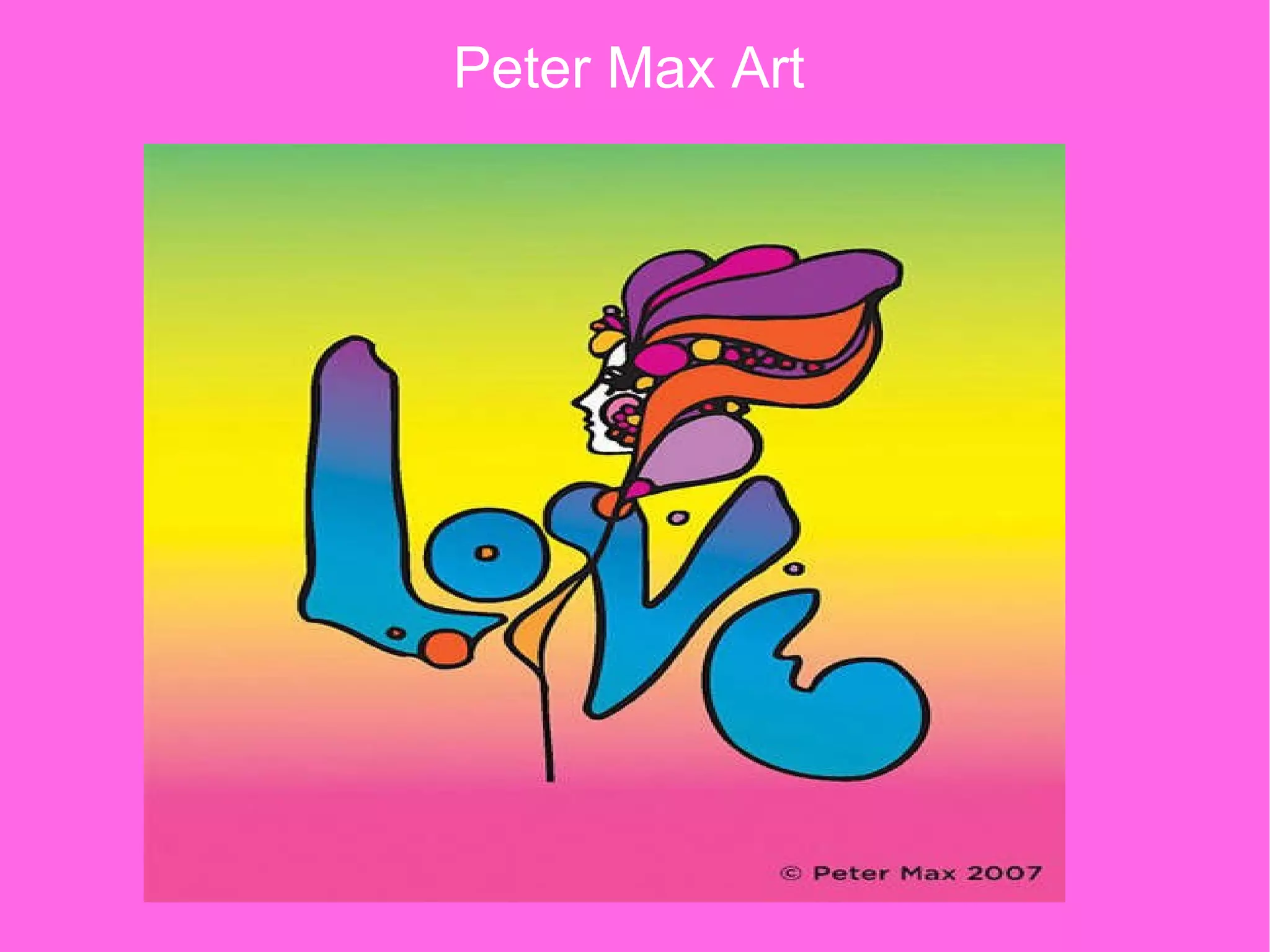
Peter Max Art
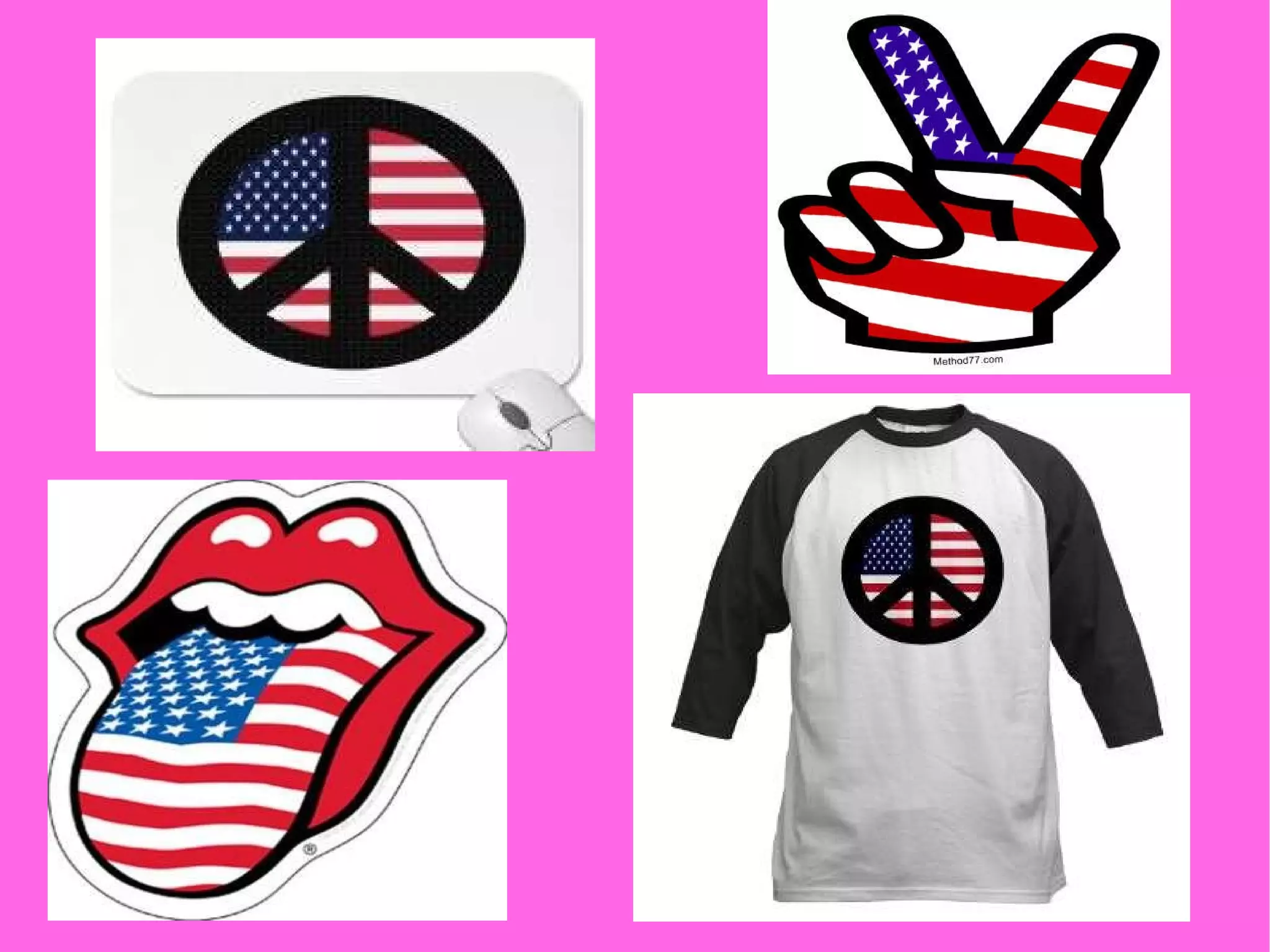
Easy Rider-1969. American Flag As Fashion Statement Inspired Young People to Hit the Road to “Look for America.”
 
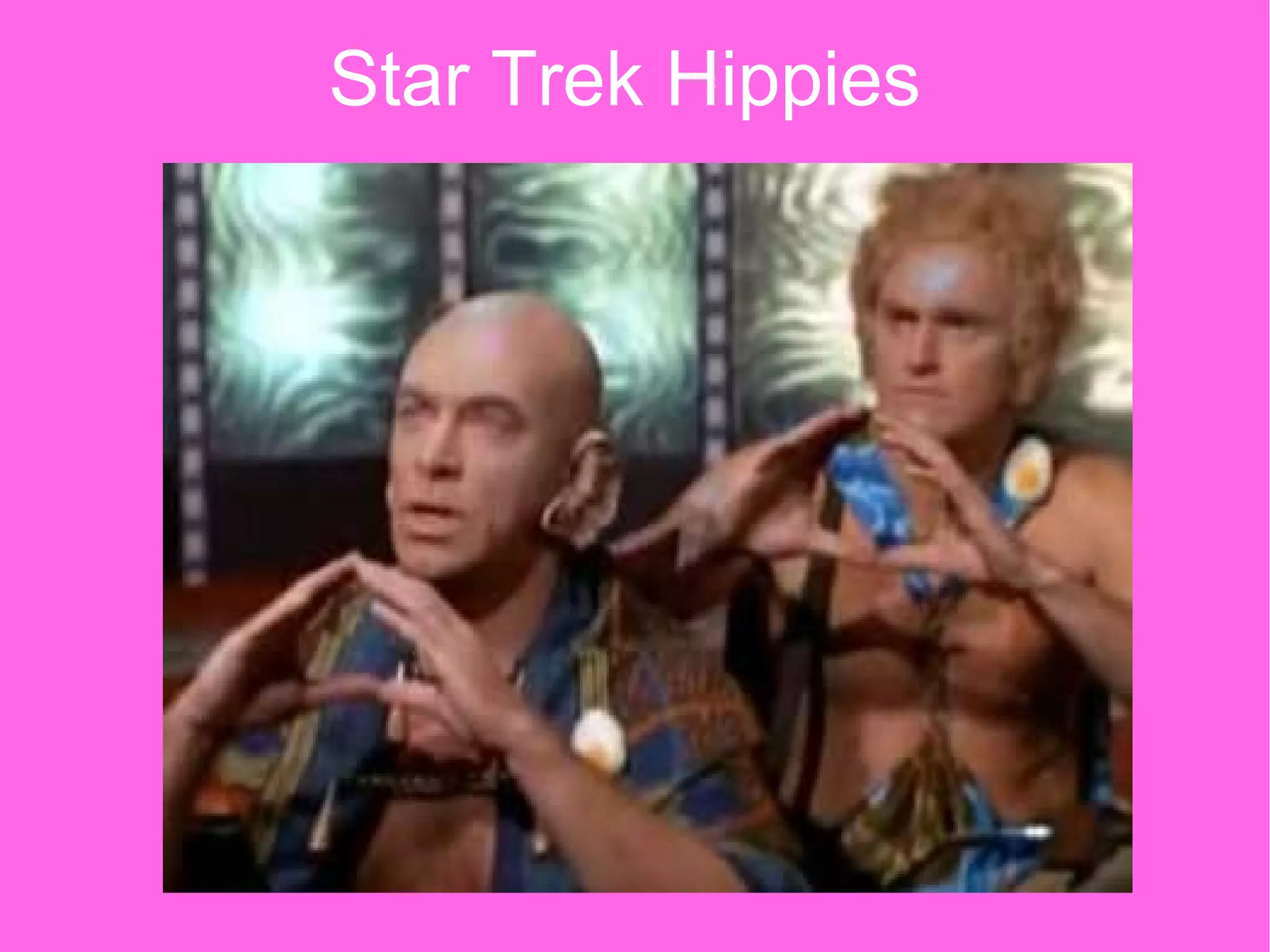
Star Trek Hippies
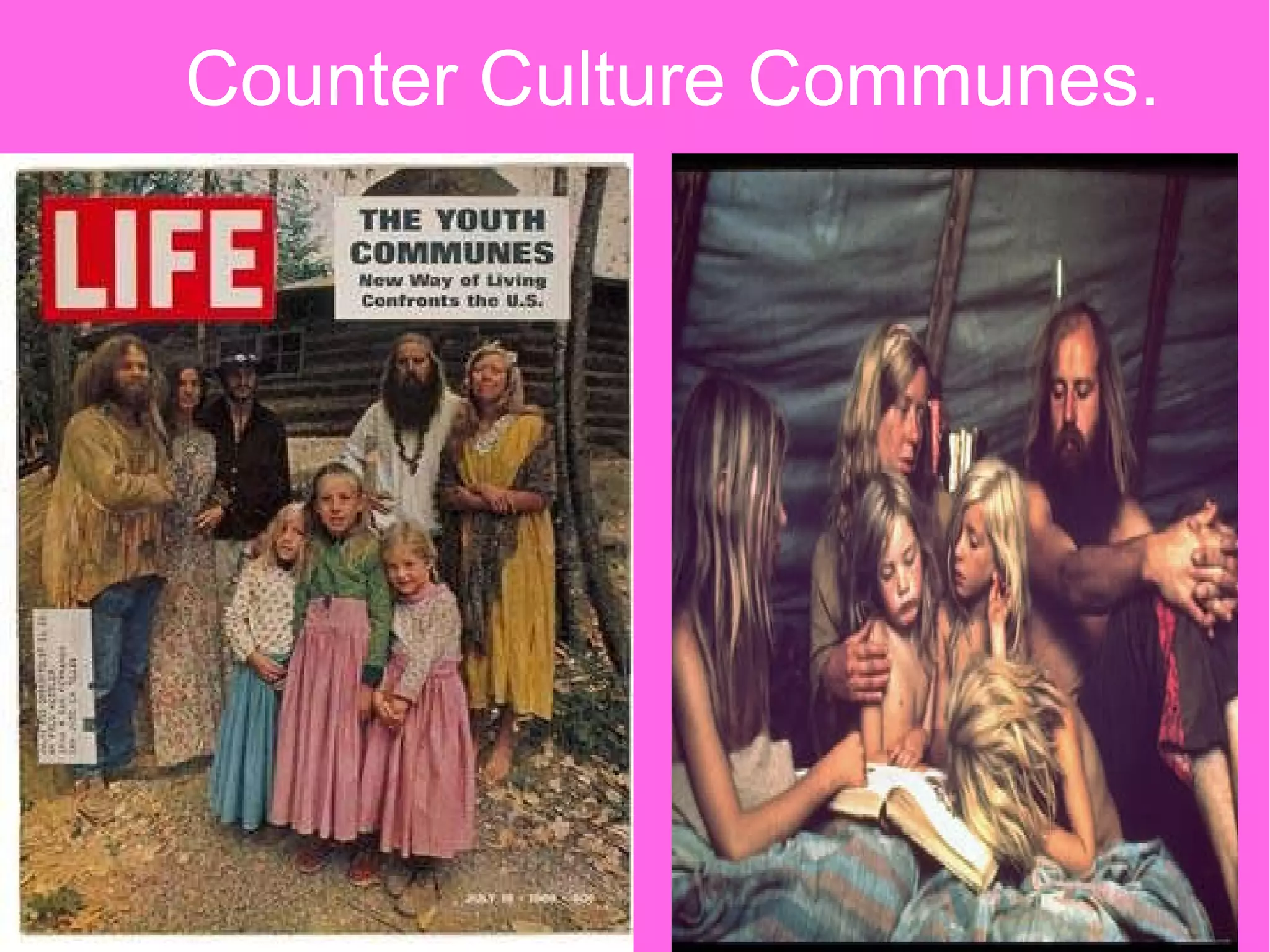
Counter Culture Communes.
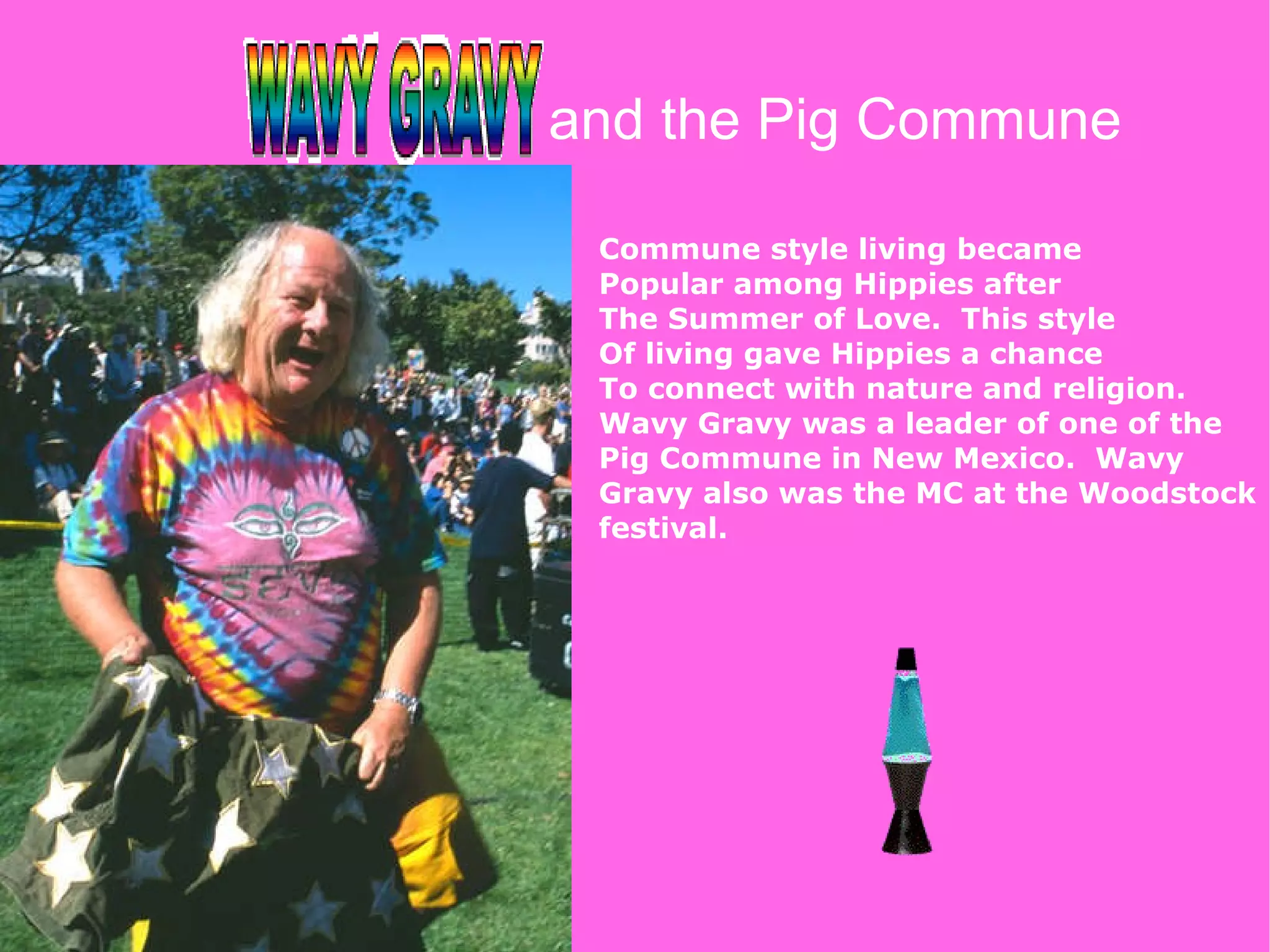
and the Pig Commune Commune style living became  Popular among Hippies after The Summer of Love.  This style Of living gave Hippies a chance To connect with nature and religion. Wavy Gravy was a leader of one of the Pig Commune in New Mexico.  Wavy Gravy also was the MC at the Woodstock festival.
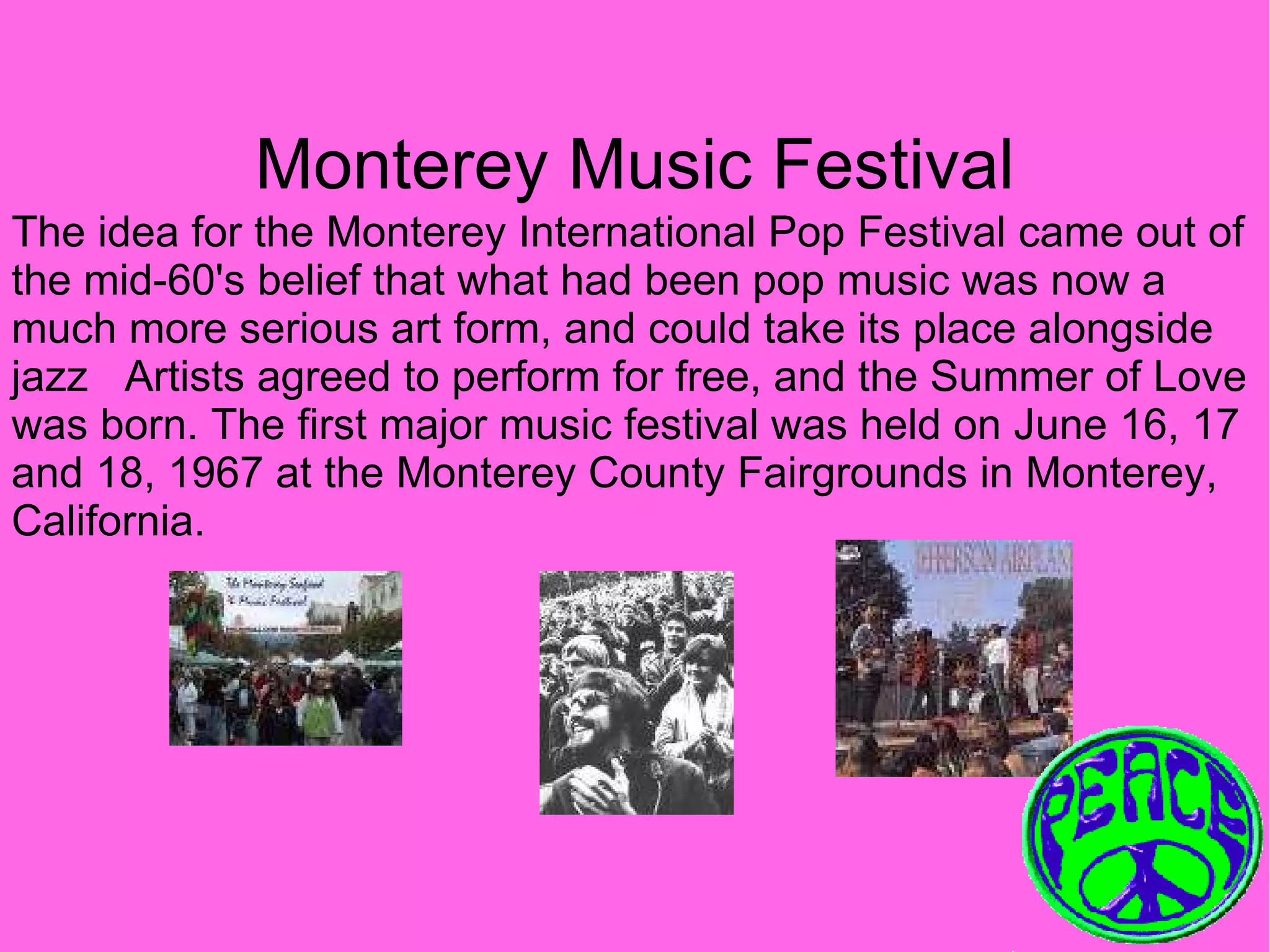
Monterey Music Festival The idea for the Monterey International Pop Festival came out of the mid-60's belief that what had been pop music was now a much more serious art form, and could take its place alongside jazz  Artists agreed to perform for free, and the Summer of Love was born. The first major music festival was held on June 16, 17 and 18, 1967 at the Monterey County Fairgrounds in Monterey, California. 
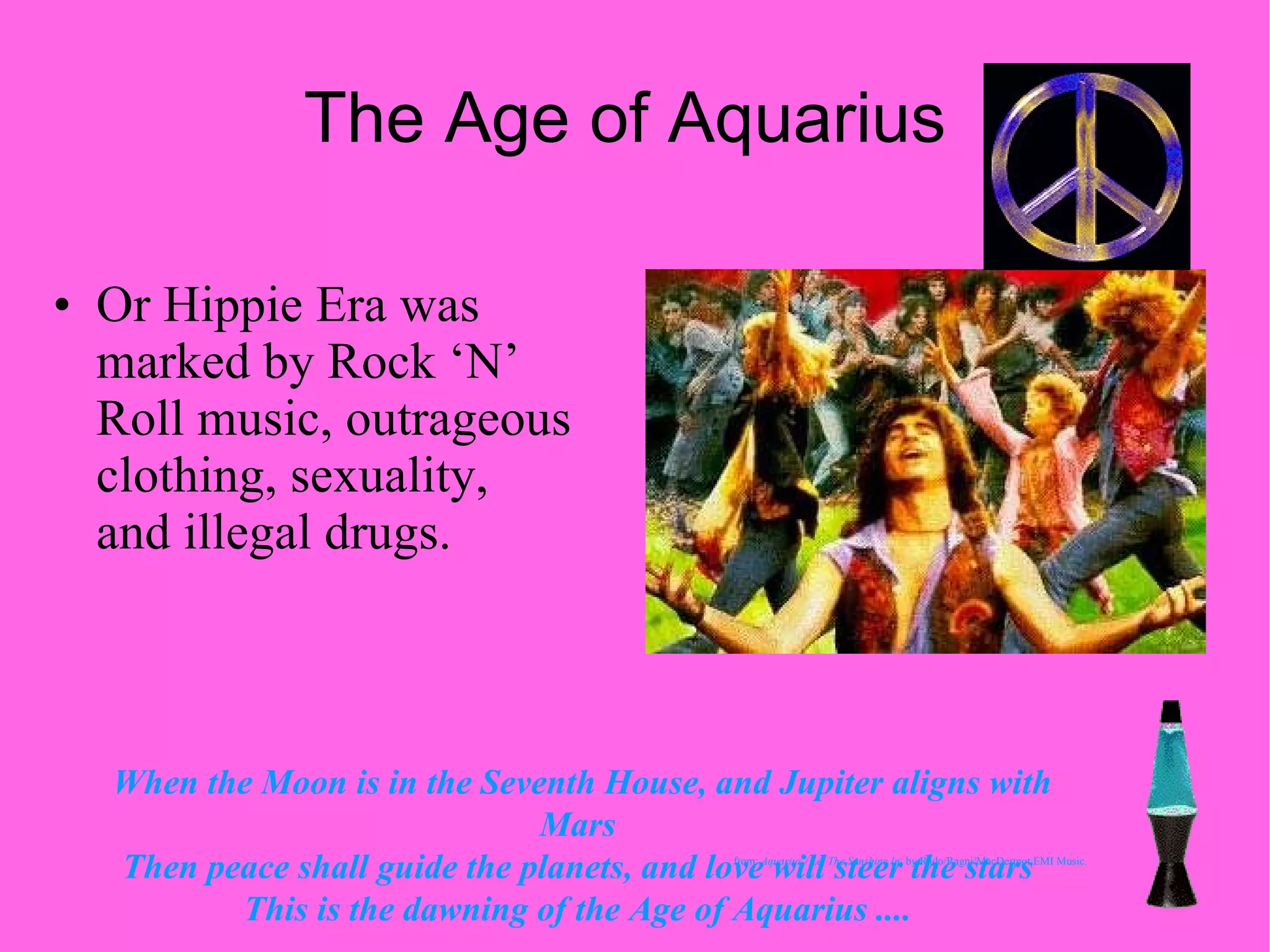
The Age of Aquarius  Or Hippie Era was marked by Rock ‘N’ Roll music, outrageous clothing, sexuality, and illegal drugs. When the Moon is in the Seventh House, and Jupiter aligns with Mars  Then peace shall guide the planets, and love will steer the stars  This is the dawning of the Age of Aquarius ....   from:  Aquarius / Let The Sunshine In ; by Rado/Ragni/MacDermot;EMI Music.
Language of the Counterculture  Different slang word from the Counterculture movement included; Flower Power. Make love, not war. Peace. Love. Cool. Hip. Hippie. Hippie girl. Groovy. Groove on that. Live for today. Mellow out. Mellow down. Mellow yellow. Electrical banana. Far out. Out of sight. Can you dig it? You dig it? Dig it? Dig? Dig. Dig it. I dig it. I can dig it. Like, wow. Like...like, hey man, wow. Safe as mother's milk. Hell no, we won't go. Are you straight? Are you bent? Are you a narc? Twisted. Alice. Acid. Acid Head. Acid Freak. Bad trip. Bum trip. Grass. Pot. Pot Head. Mary Jane. Shrooms. Morning Glorys. Uppers. Downers. Reds. Whites. Yellows. Crosses. Hard stuff. Speed. Speed Freak. Flying. Trip. Trippy. Tripping. Trip out. Tripping out. Freak. Freaky. Freaking. Freak out. Freaking out. High. Up. Spacey. Space out. Spaced out. Spacing. Spacing out. Strung out. Down. Downer. Coming down. Cold Turkey. Crash. Crashing. Crashing and burning. Biting the big one. The ultimate bad trip. Dying. Good friends gone forever. Total bummer.
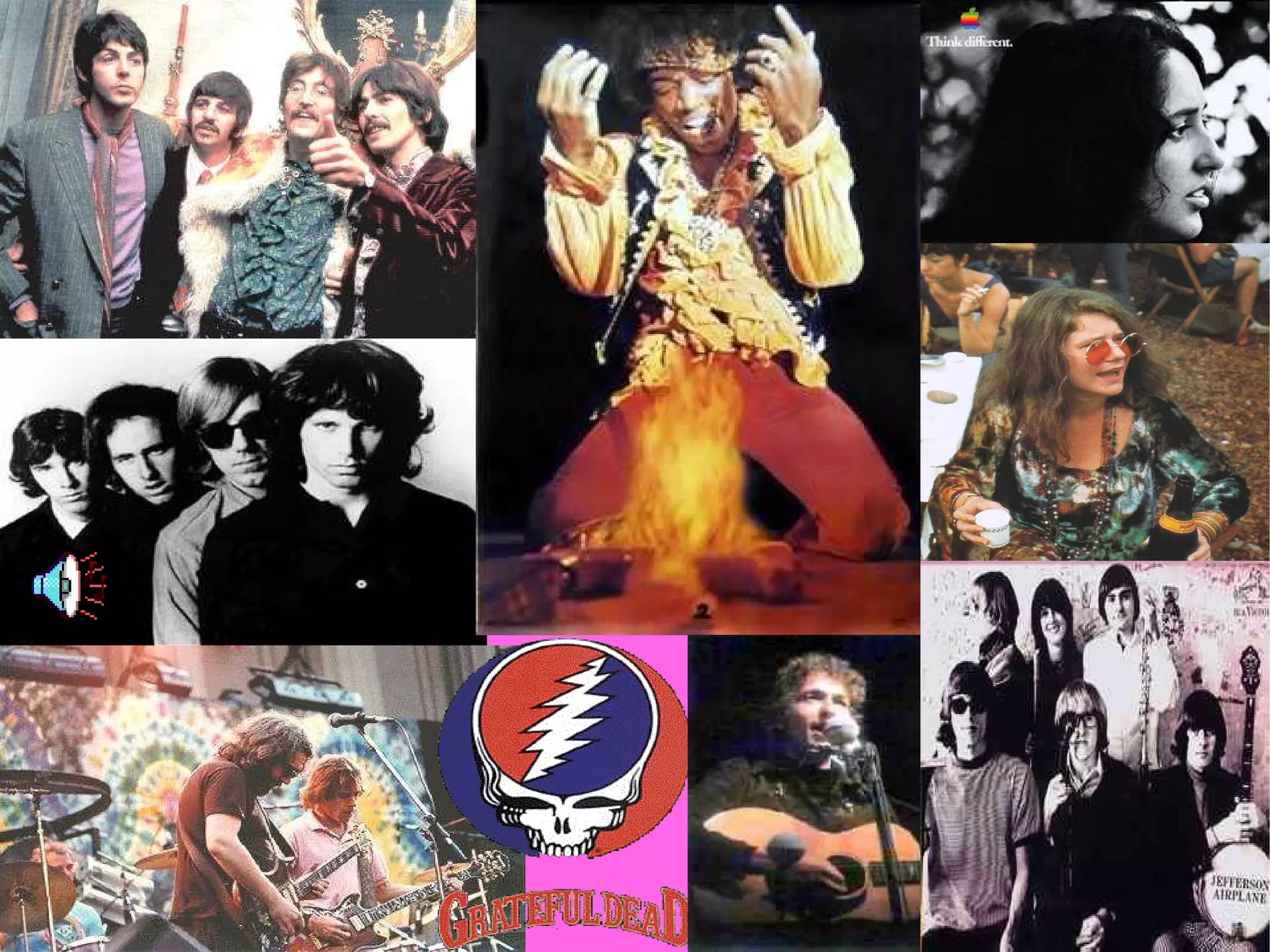
Hippy Music The most popular music of the time was psychedelic rock  Bands like Jefferson Airplane, Quicksilver Messenger Service, the Jimi Hendrix Experience and the Grateful Dead played free concerts at Golden Gate Park. Concerts and be-ins were places for hippies to protest, socialize, dance, or take drugs. At Woodstock over 250,000 hippies showed up to hear artists like Janis Joplin, The Who, Canned Heat, The Allman Brothers, and County Joe and the Fish.
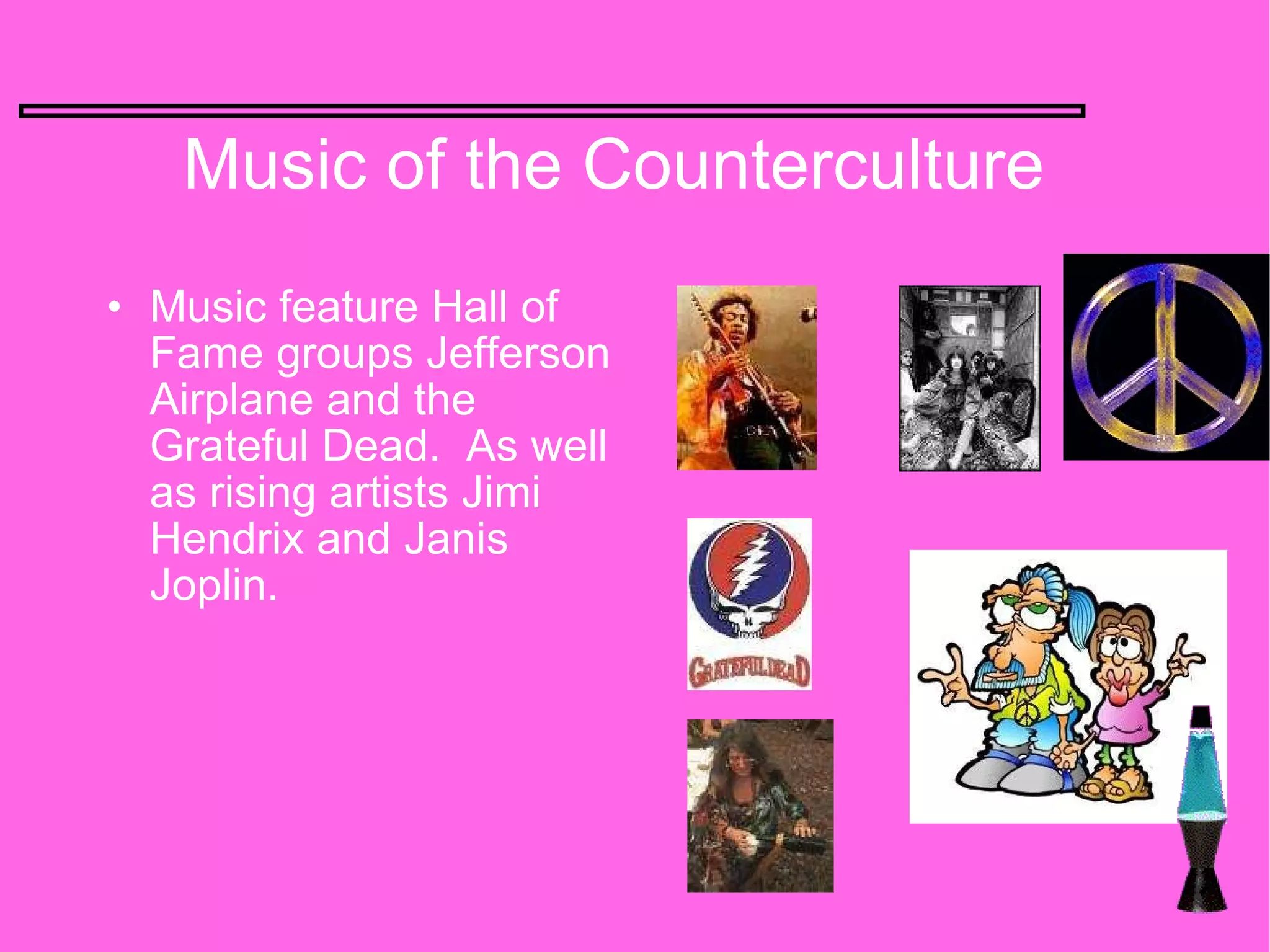
Music of the Counterculture Music feature Hall of Fame groups Jefferson Airplane and the Grateful Dead.  As well as rising artists Jimi Hendrix and Janis Joplin.                                                     
 
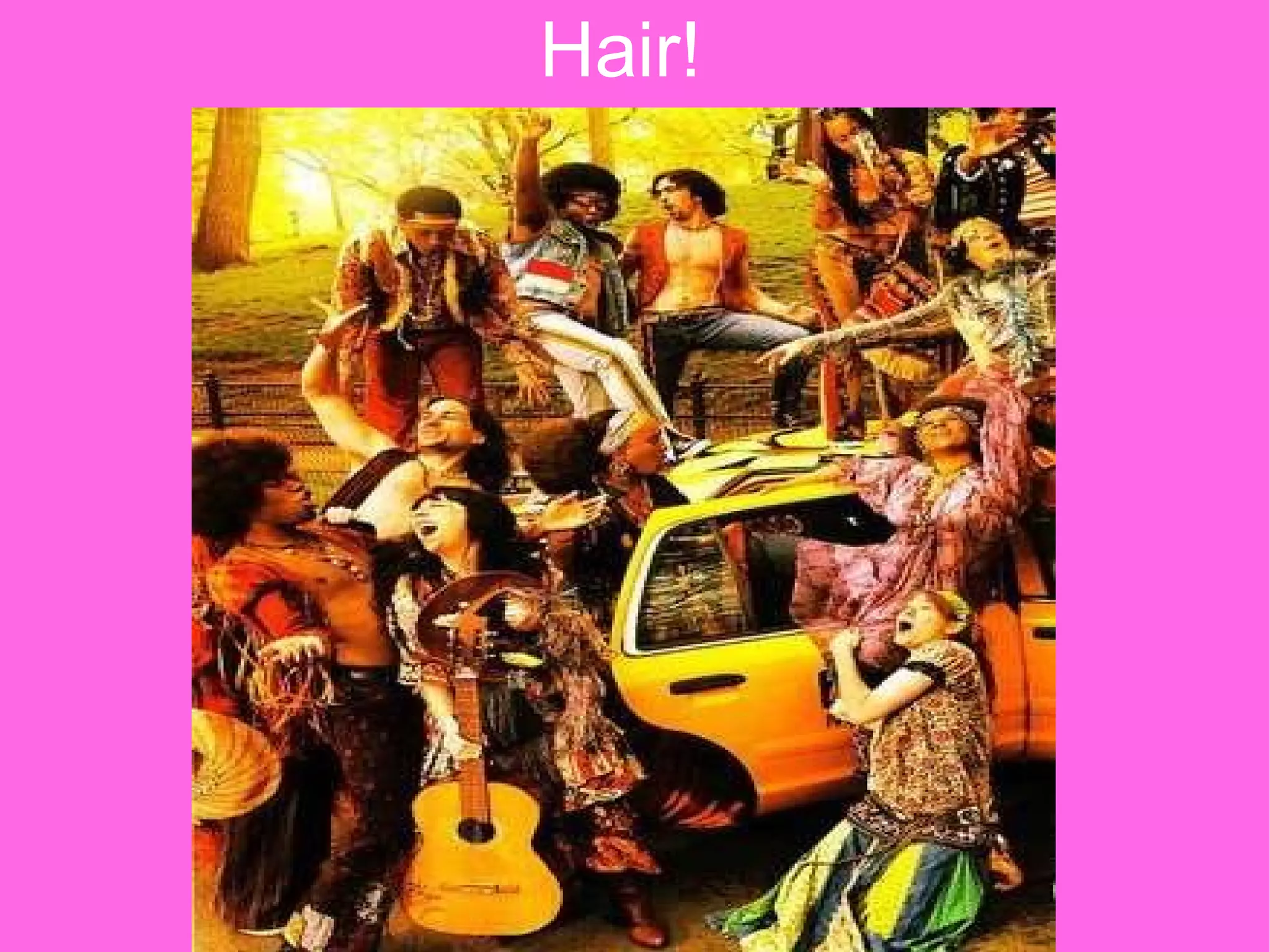
Hair!
 
Woodstock Music Festival The legendary Woodstock Festival took place over three days in August 1970- August 15, 16, 17. Among the performers, there were Janis Joplin, Santana, Richie Havens, Sly and the Family Stone, Jefferson Airplane, Sha Na Na and Jimi Hendrix, or as he called his band, Gypsy Sun and Rainbows. Hendrix was scheduled to close the show on Sunday night, but due to delays, Hendrix and band took the stage on Monday morning, to a crowd of only about thirty-thousand: far less than the estimated peak crowd of four hundred- thousand
 
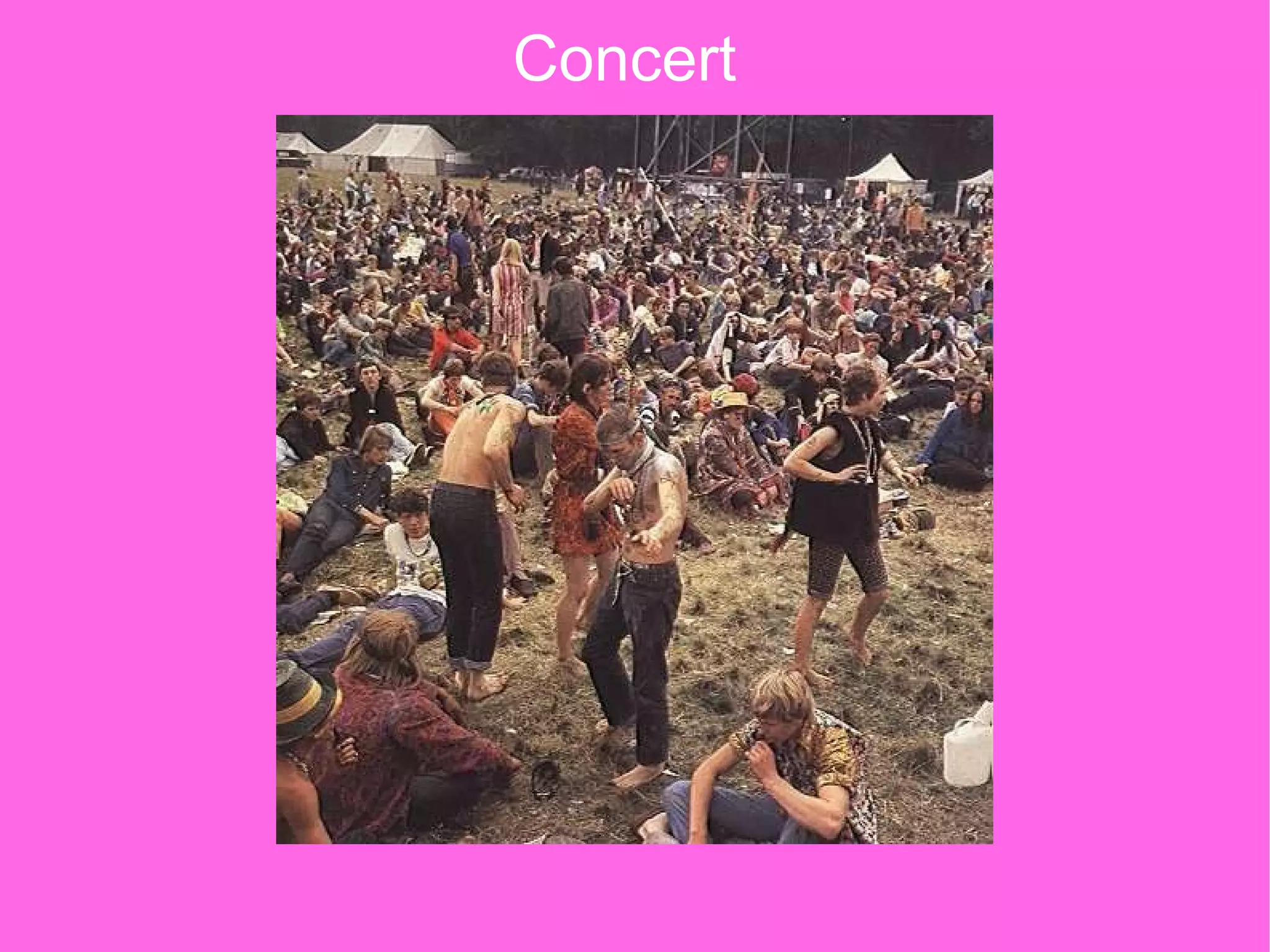
Concert
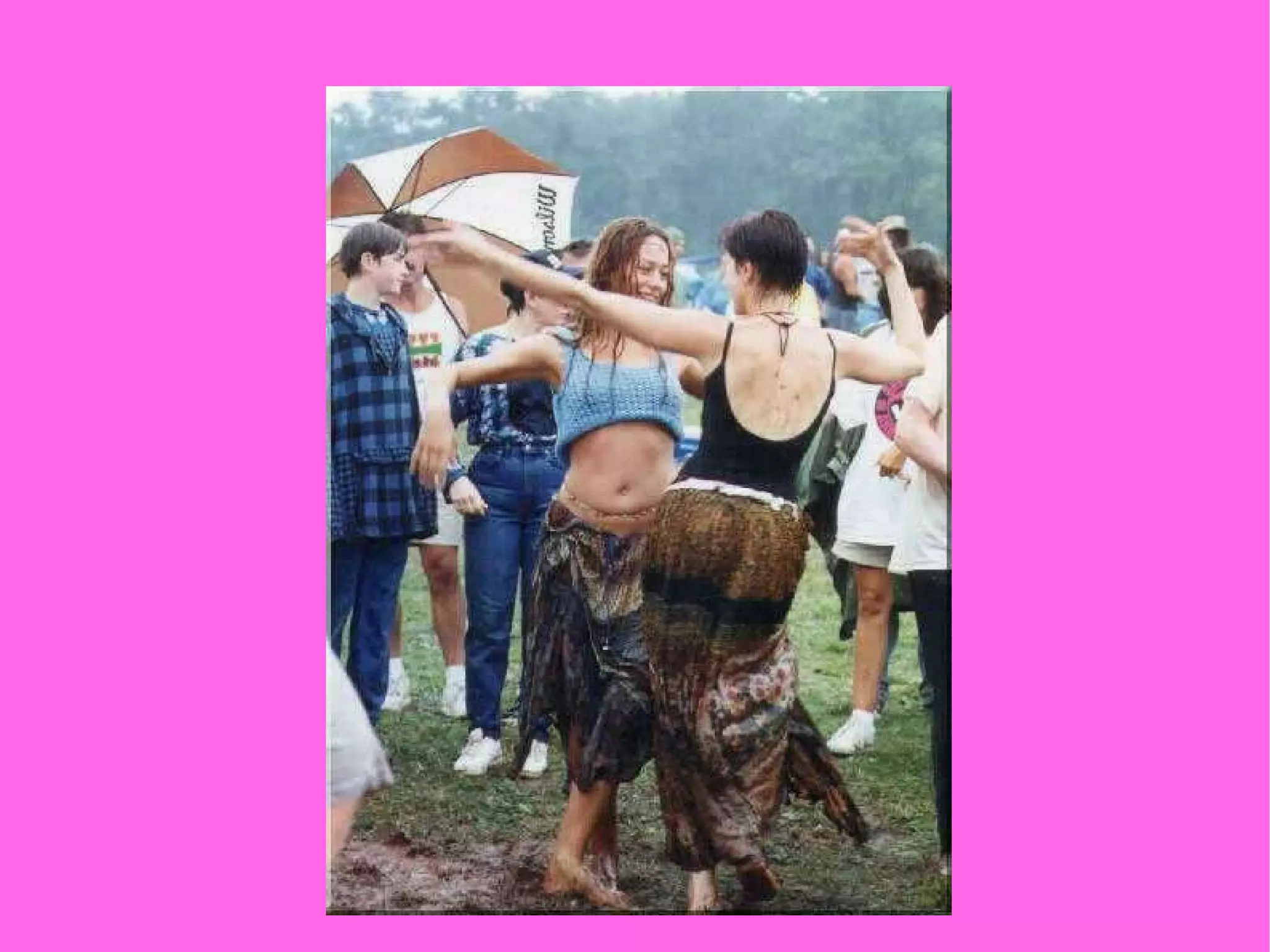
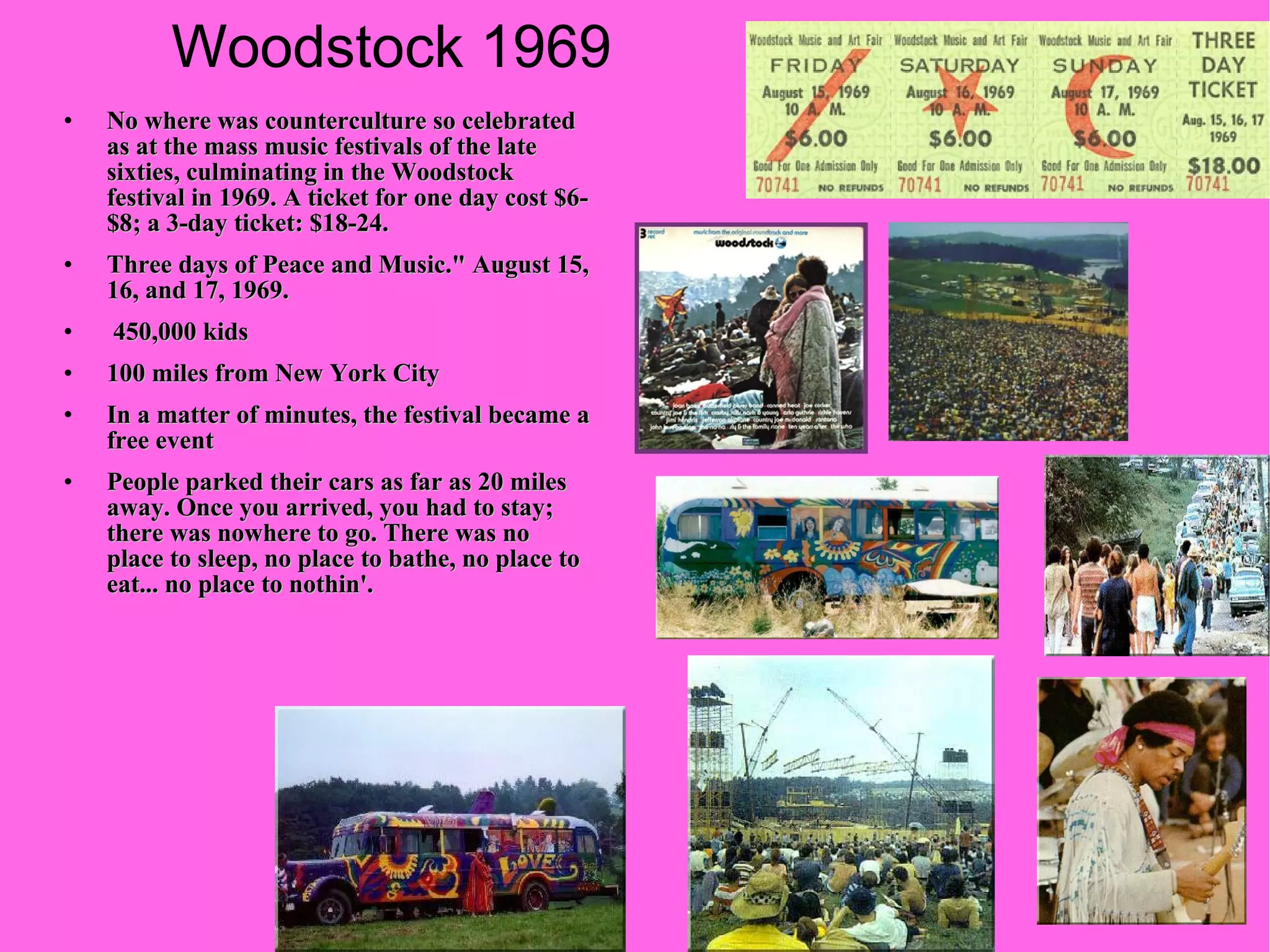
Woodstock 1969 No where was counterculture so celebrated as at the mass music festivals of the late sixties, culminating in the Woodstock festival in 1969. A ticket for one day cost $6-$8; a 3-day ticket: $18-24. Three days of Peace and Music." August 15, 16, and 17, 1969.  450,000 kids  100 miles from New York City In a matter of minutes, the festival became a free event People parked their cars as far as 20 miles away. Once you arrived, you had to stay; there was nowhere to go. There was no place to sleep, no place to bathe, no place to eat... no place to nothin'.
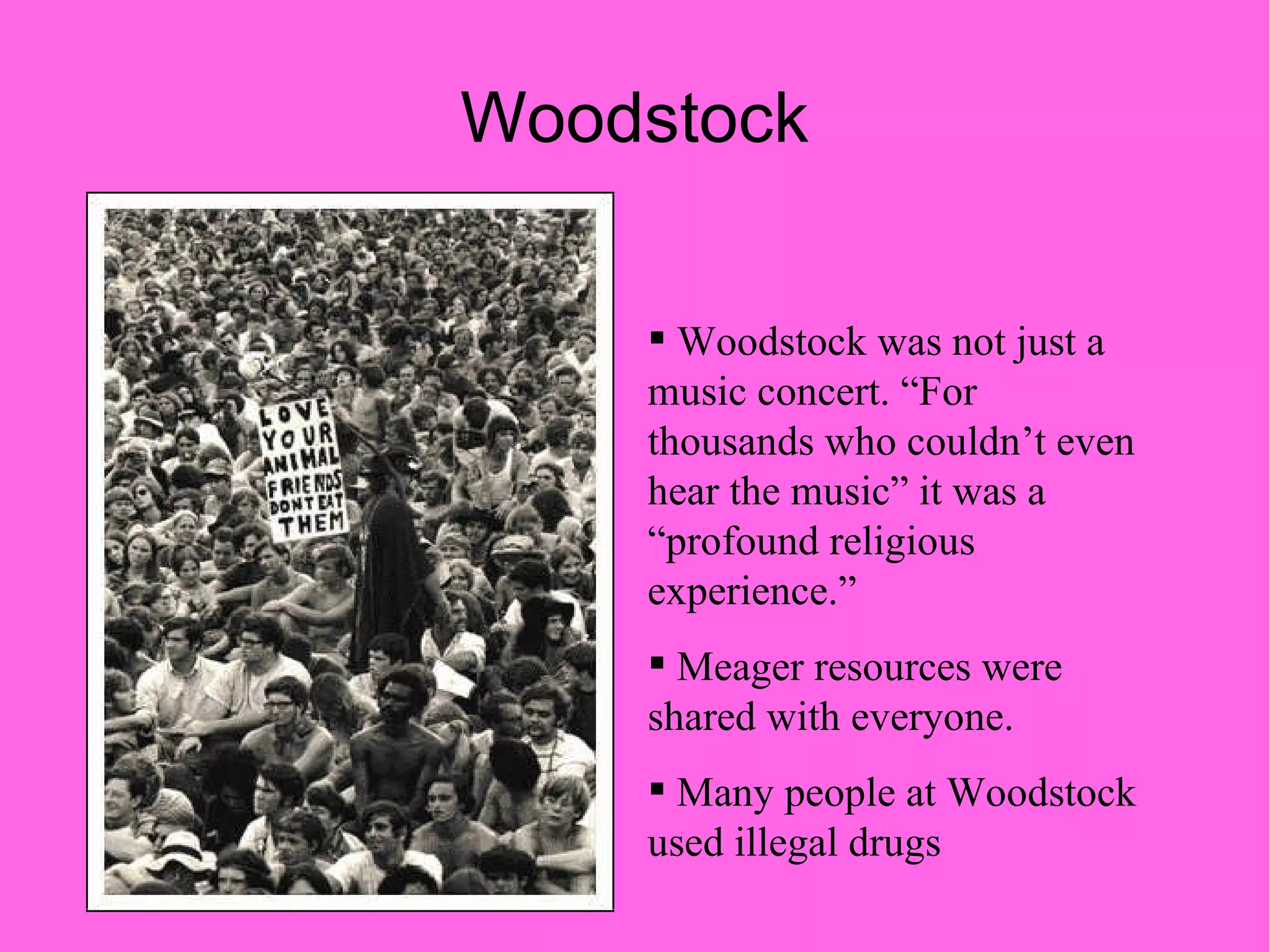
Woodstock Woodstock was not just a music concert. “For thousands who couldn’t even hear the music” it was a “profound religious experience.” Meager resources were shared with everyone. Many people at Woodstock used illegal drugs
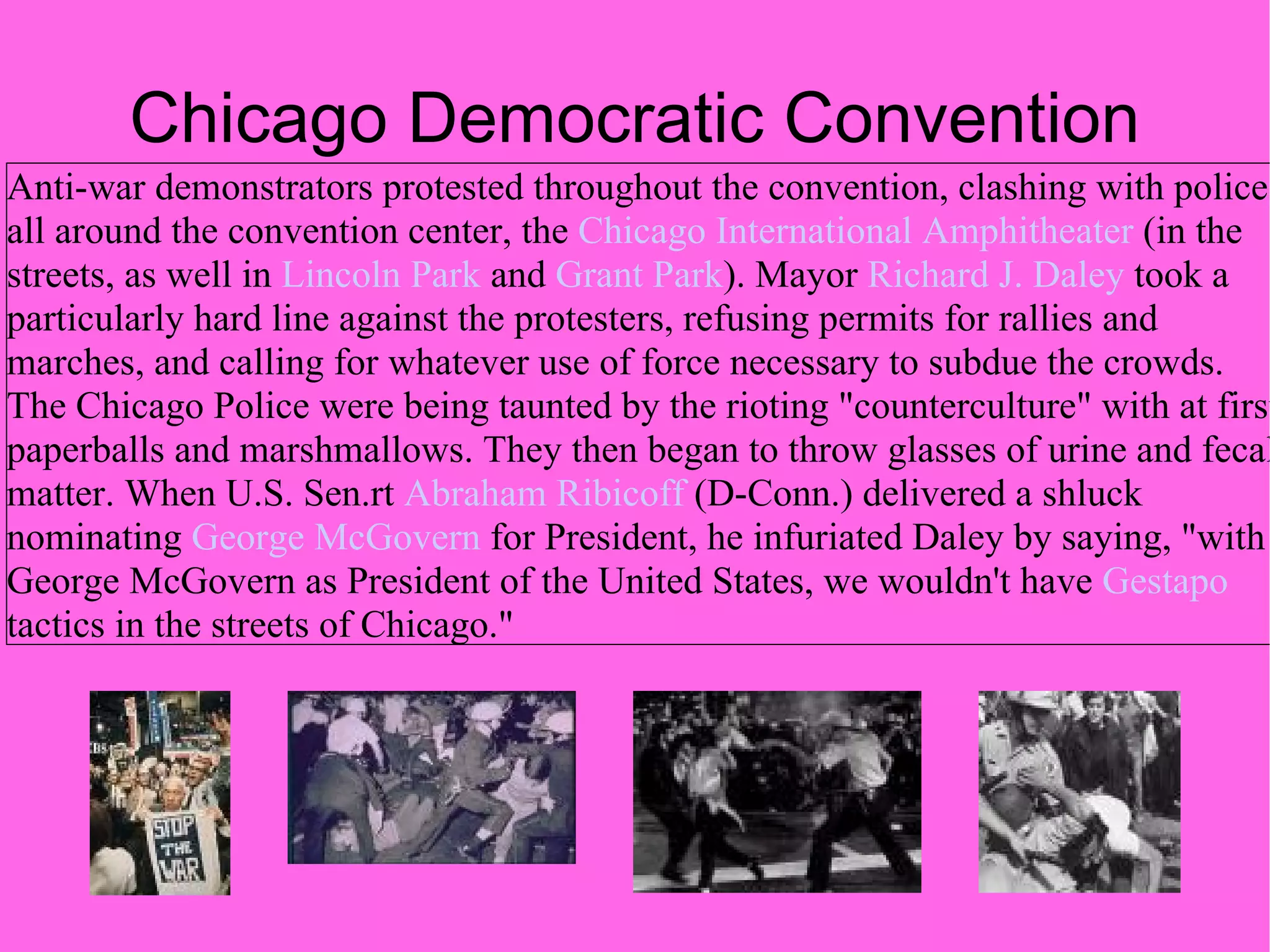
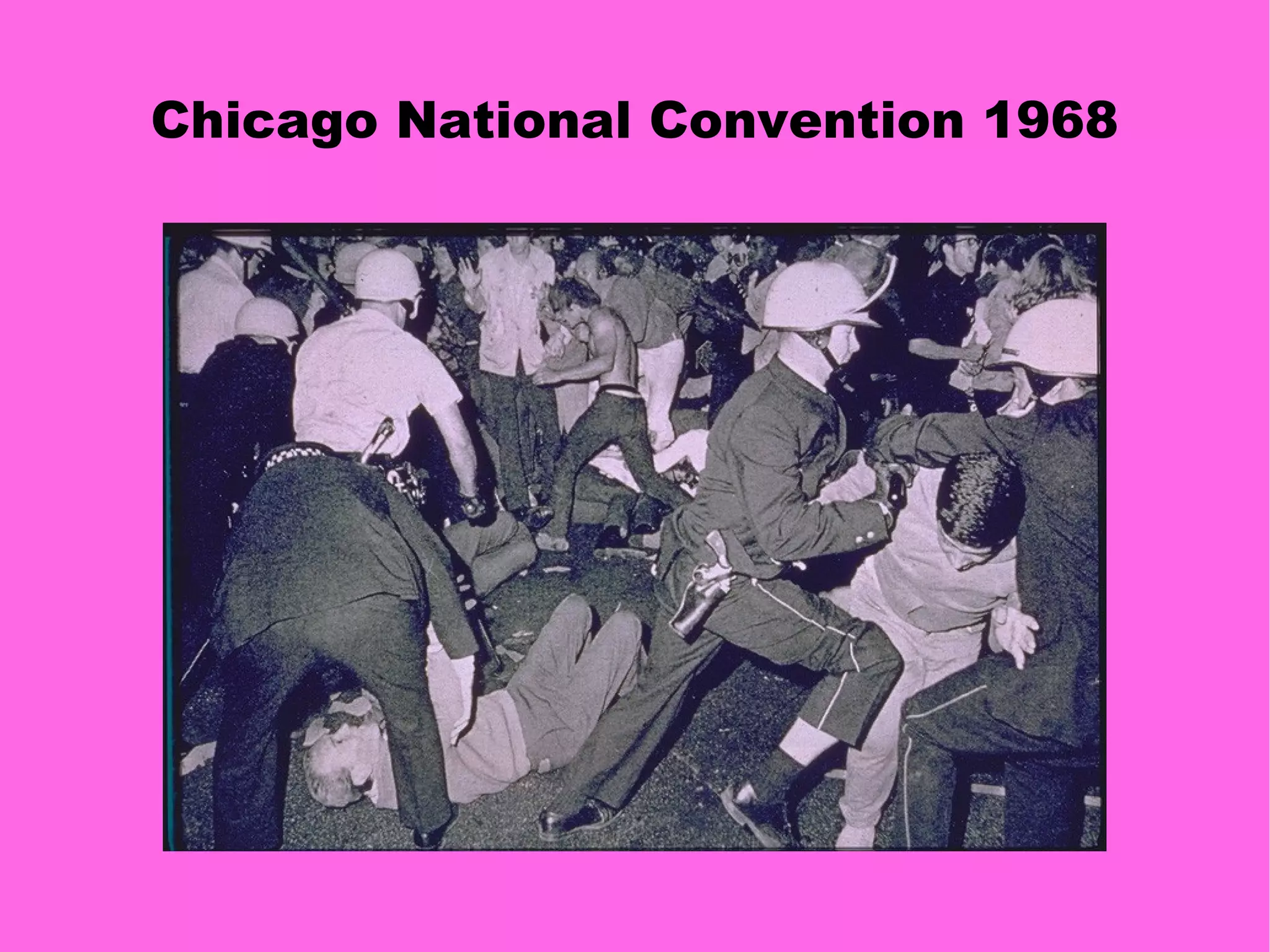
Chicago Democratic Convention Anti-war demonstrators protested throughout the convention, clashing with police all around the convention center, the  Chicago International Amphitheater  (in the streets, as well in  Lincoln Park  and  Grant Park ). Mayor  Richard J. Daley  took a particularly hard line against the protesters, refusing permits for rallies and marches, and calling for whatever use of force necessary to subdue the crowds. The Chicago Police were being taunted by the rioting "counterculture" with at first paperballs and marshmallows. They then began to throw glasses of urine and fecal matter. When U.S. Sen.rt  Abraham Ribicoff  (D-Conn.) delivered a shluck nominating  George McGovern  for President, he infuriated Daley by saying, "with George McGovern as President of the United States, we wouldn't have  Gestapo  tactics in the streets of Chicago."
Chicago National Convention 1968
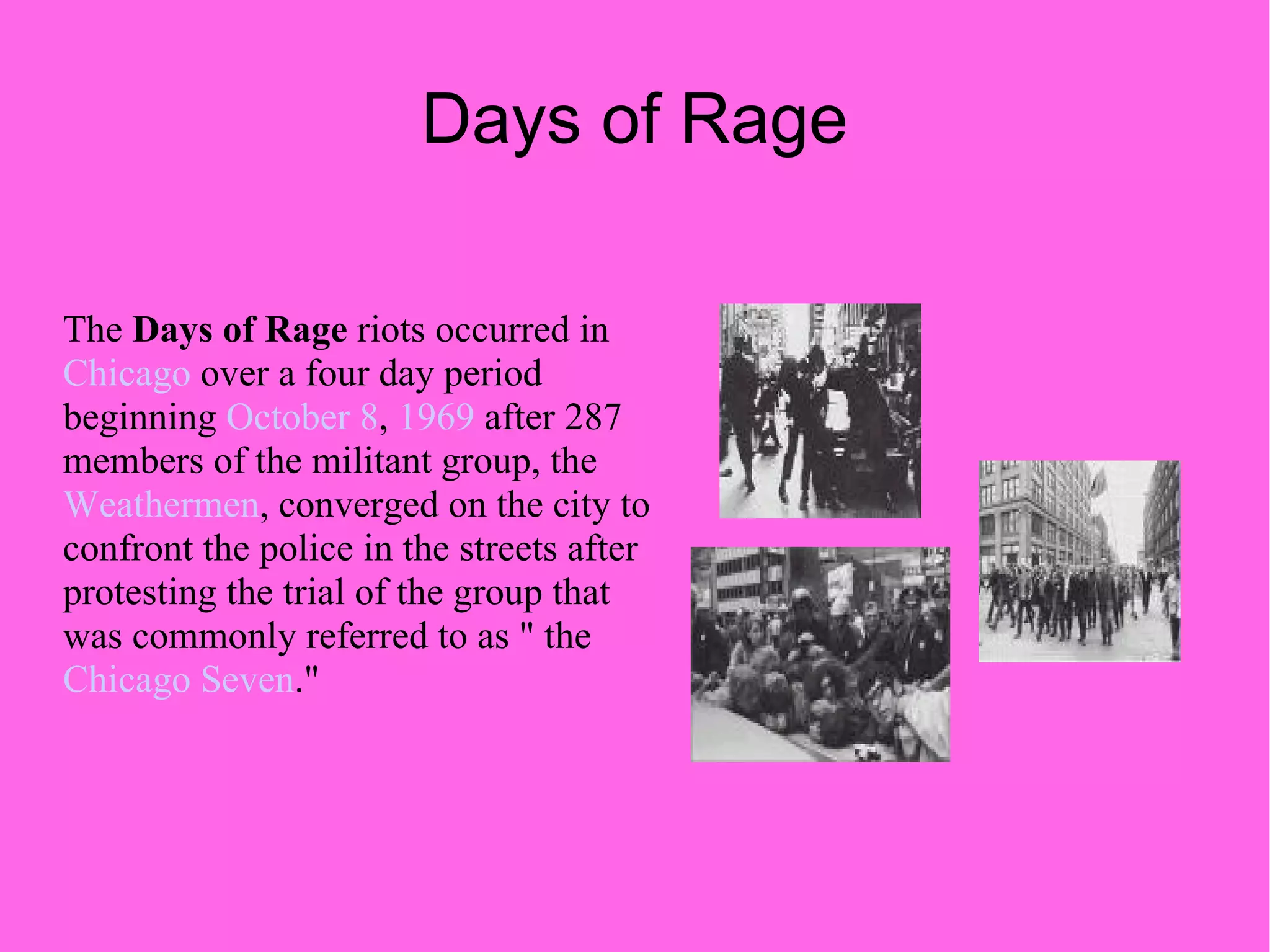
Days of Rage The  Days of Rage  riots occurred in  Chicago  over a four day period beginning  October 8 ,  1969  after 287 members of the militant group, the  Weathermen , converged on the city to confront the police in the streets after protesting the trial of the group that was commonly referred to as " the  Chicago Seven ."
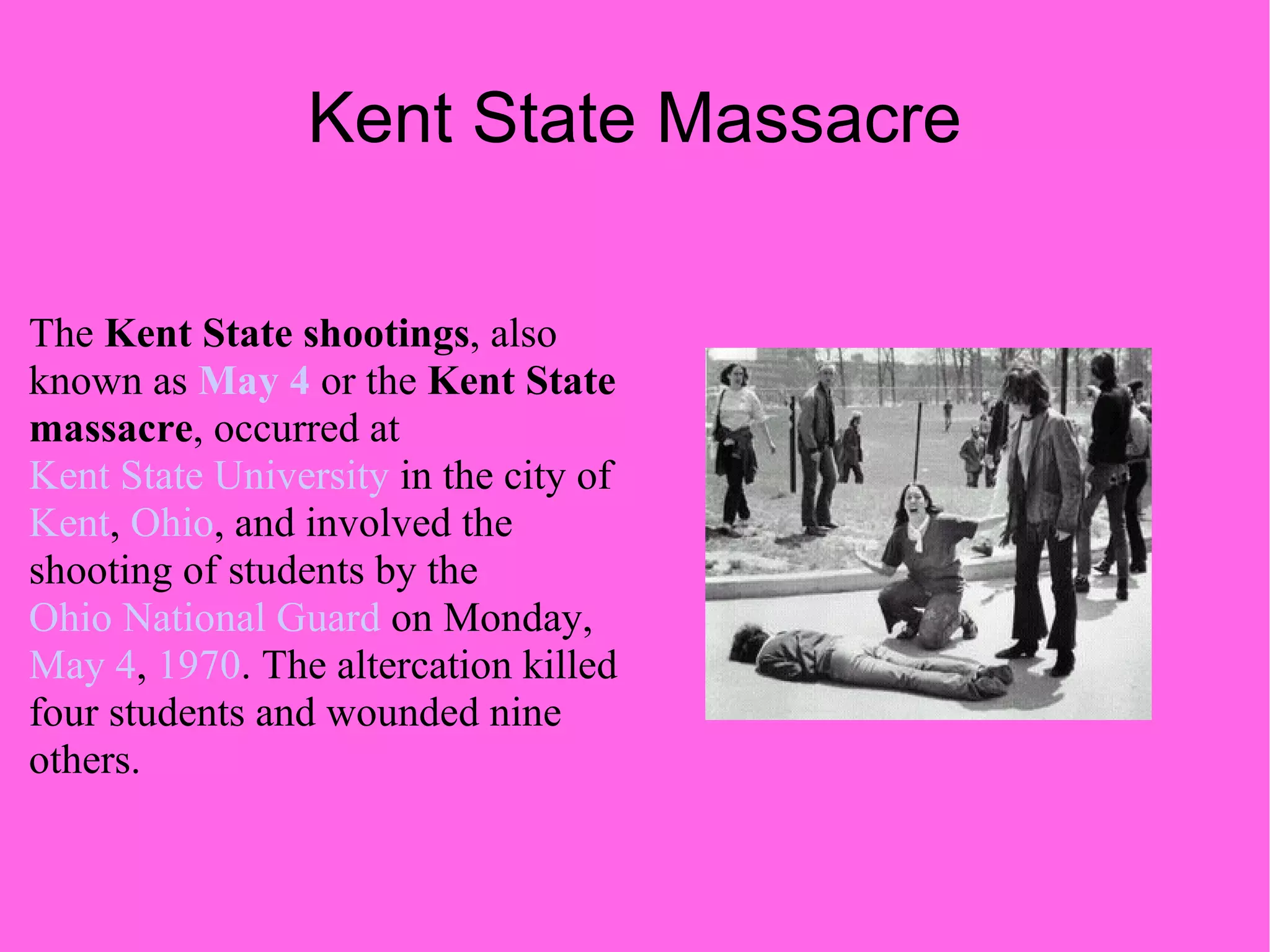
Kent State Massacre The  Kent State shootings , also known as  May 4  or the  Kent State massacre , occurred at  Kent State University  in the city of  Kent ,  Ohio , and involved the shooting of students by the  Ohio National Guard  on Monday,  May 4 ,  1970 . The altercation killed four students and wounded nine others.
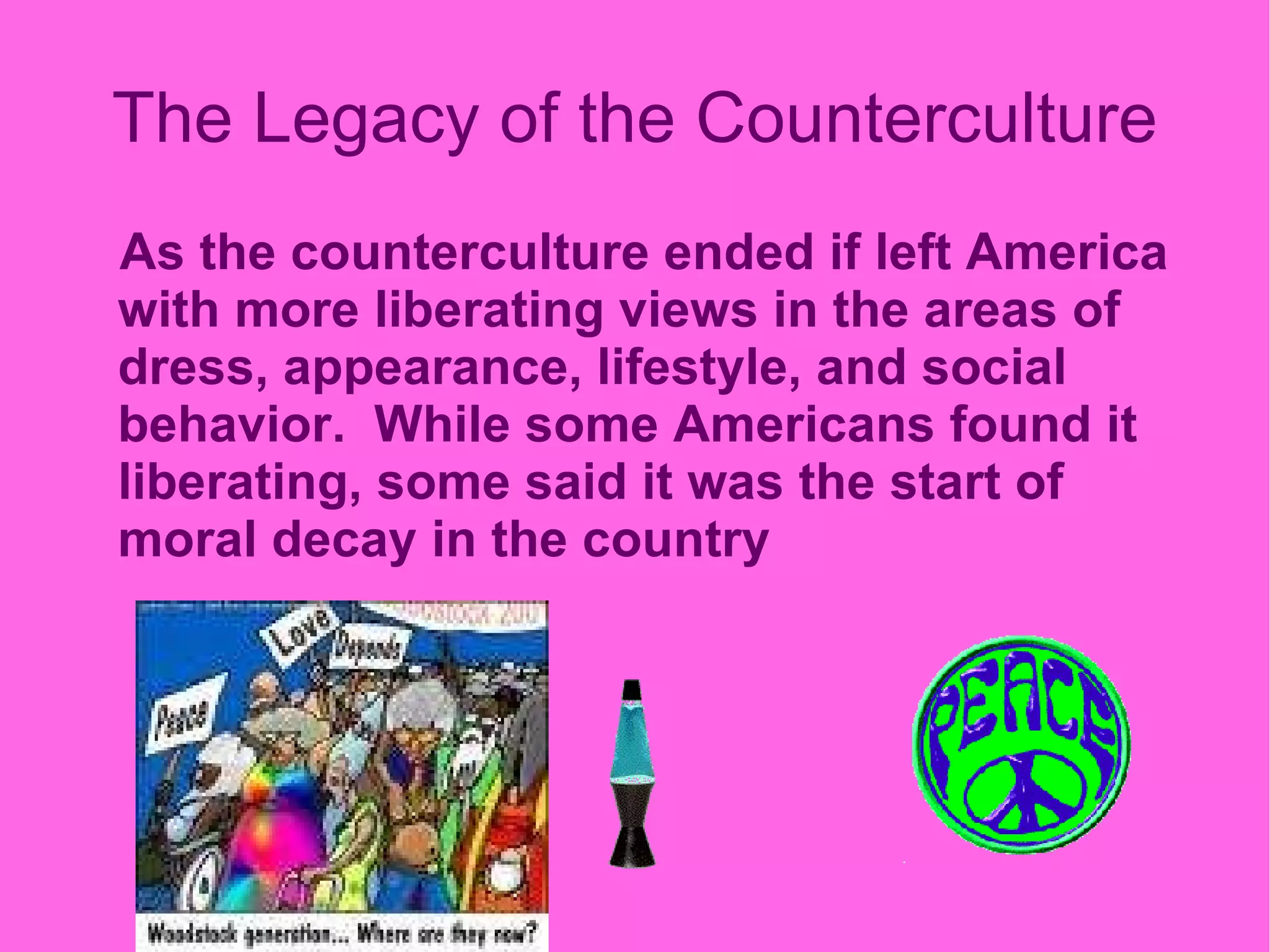
The Legacy of the Counterculture As the counterculture ended if left America with more liberating views in the areas of dress, appearance, lifestyle, and social behavior.  While some Americans found it liberating, some said it was the start of moral decay in   the country
How were these these attitudes Connected? Music. Drugs. Outlandish fashions. Rejection of parents values. Rejection of gov’t leaders. Rejection of war. Anti-establishment. Rebellion against culture (counterculture)
Mainstream Reactions to the Counterculture Some observers of the counterculture were put off by the unkempt appearance of hippies. On a deeper level, many mainstream Americans objected to the unconventional values of the counterculture. They saw hippies as disrespectful, uncivilized, and threatening. To many in the Establishment, it appeared that society was unraveling. The television show  All in the Family  highlighted the older generation’s distrust of the counterculture and the younger generation’s desire to change society.
Legacy of the Counterculture Attitudes  Americans became more casual in the way they dressed and more open-minded about lifestyles and social behavior. Attitudes about sexual behavior loosened. People explored topics that were once taboo. Art and Film New style called  pop art  emerged. Aimed to appeal to popular tastes Andy Warhol led the movement. Film broadened its subject matter as censorship rules relaxed. Film industry adopted a rating system. Music The Beatles brought new techniques and ideas to rock and roll. Bob Dylan wrote political songs and became the spokesperson for his generation. Woodstock Music and Art Fair was the celebration of an era.
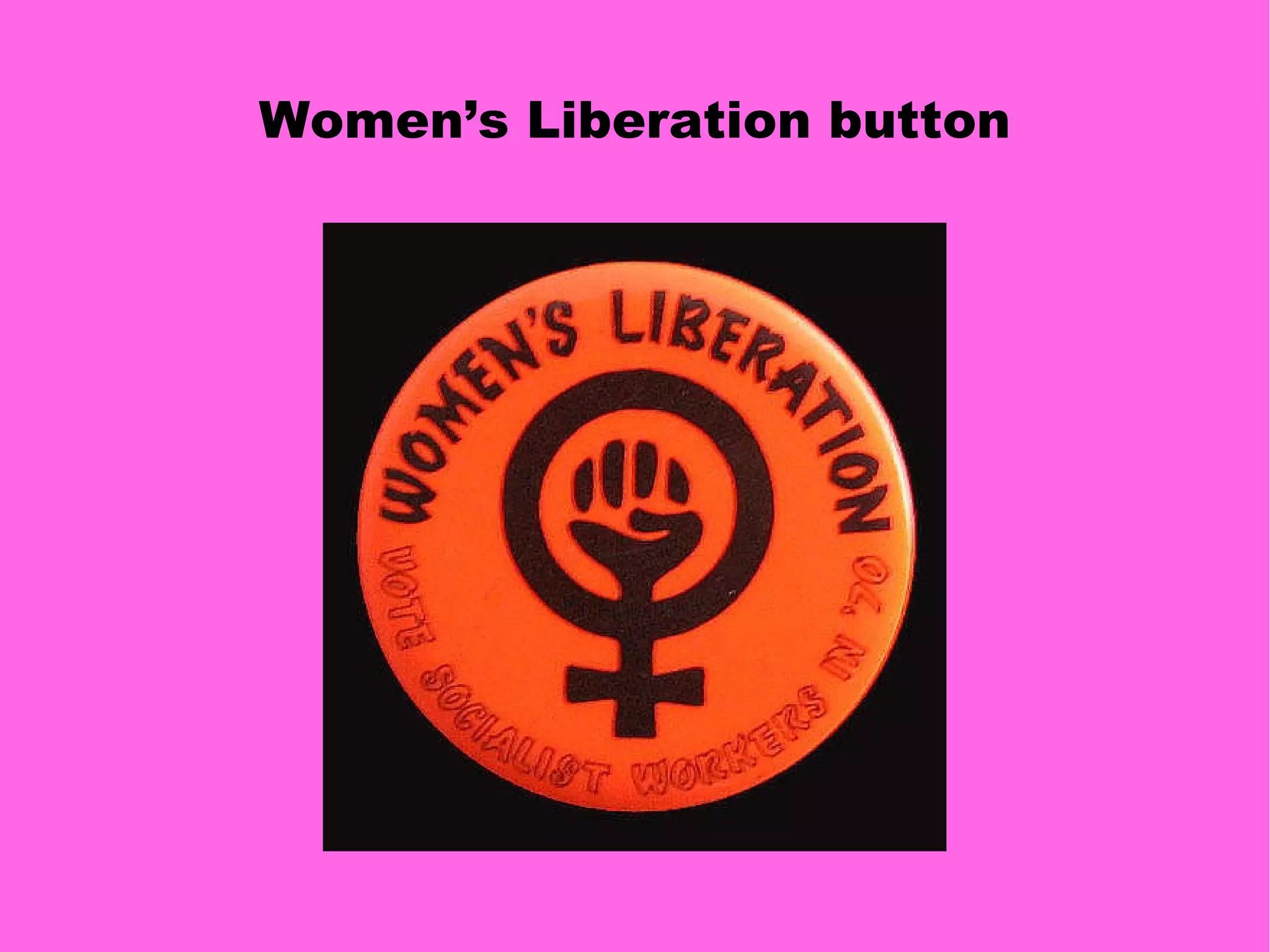
Women’s Liberation button
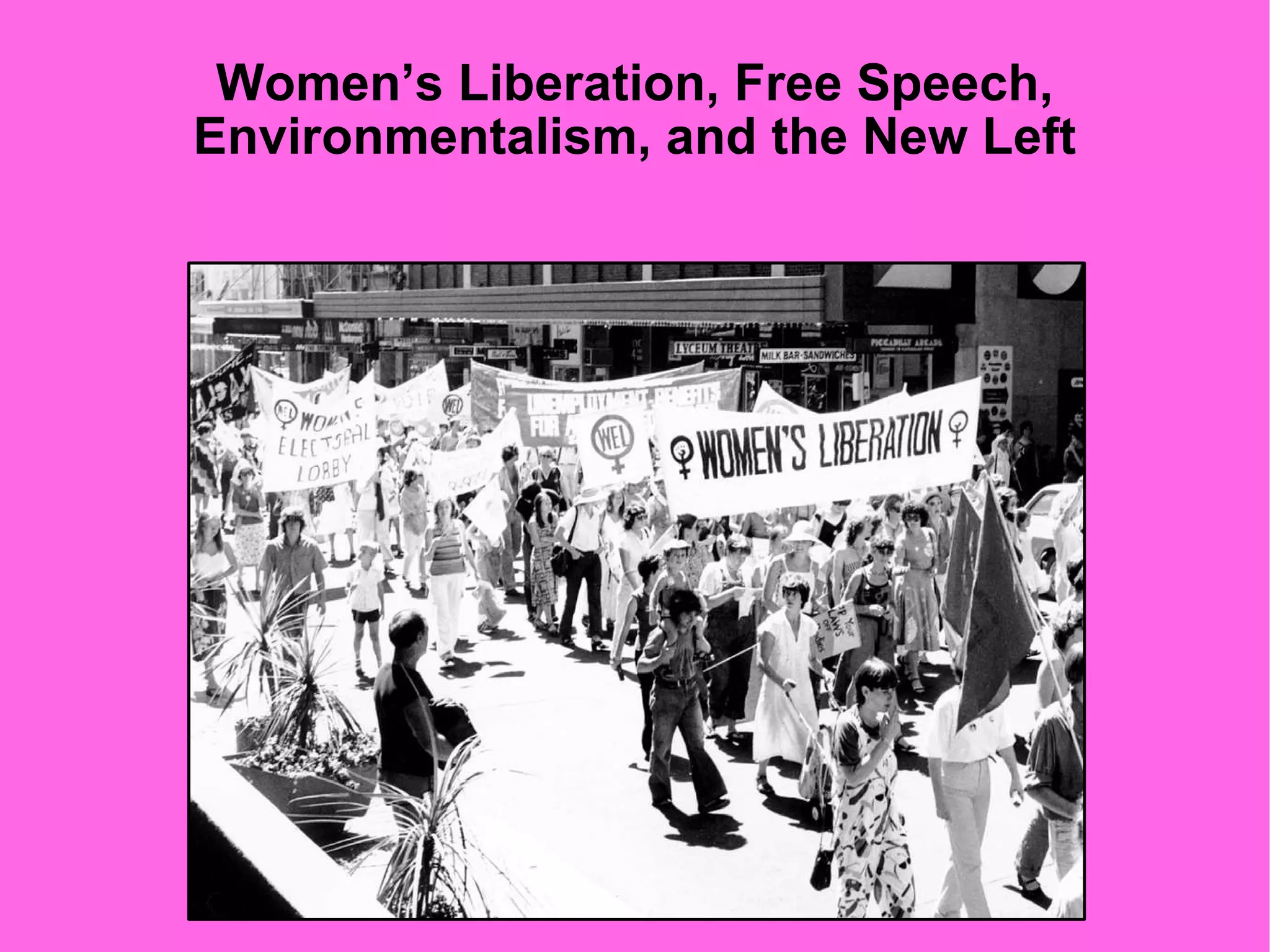
Women’s Liberation, Free Speech, Environmentalism, and the New Left
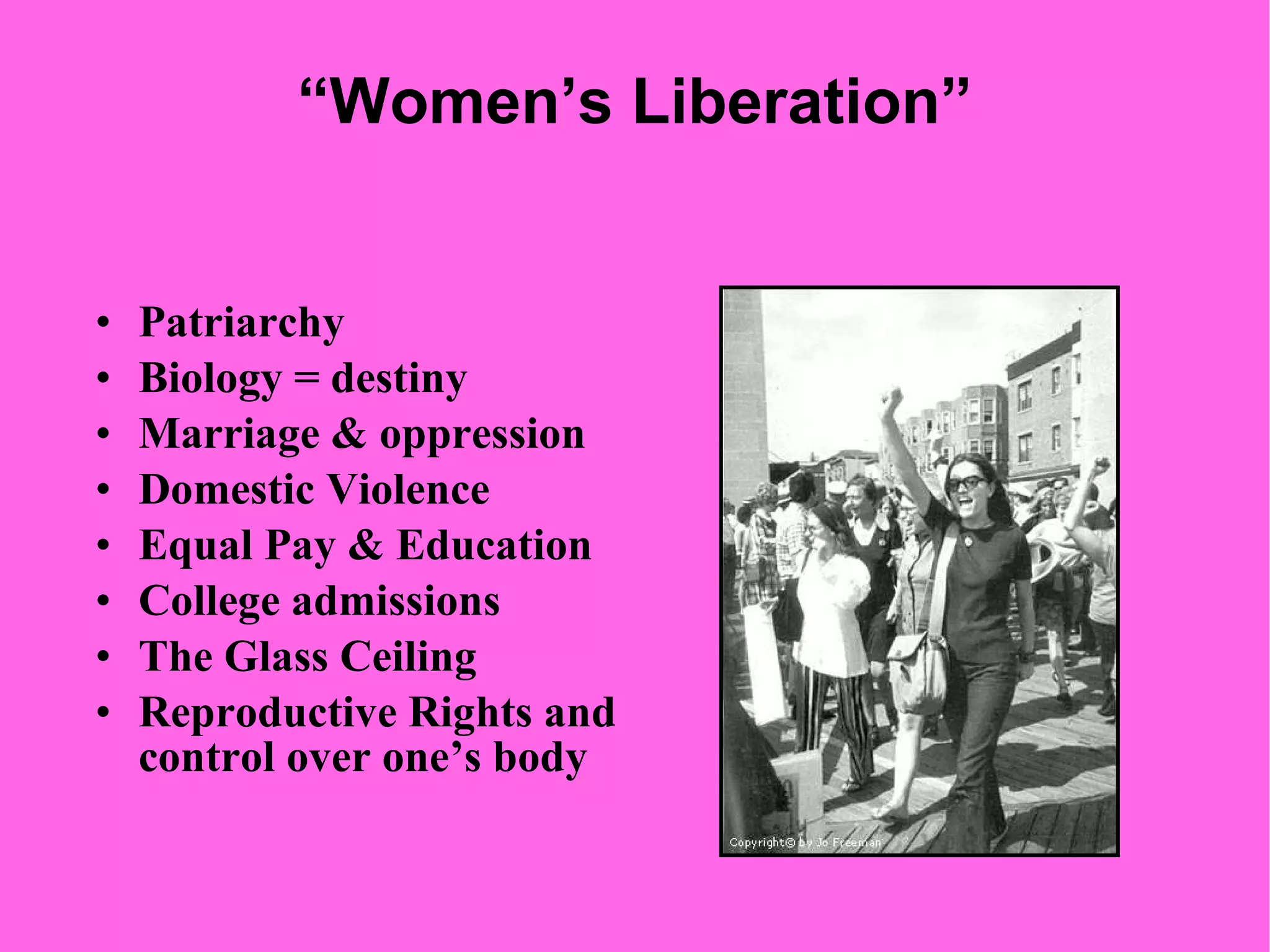
“ Women’s Liberation” Patriarchy Biology = destiny Marriage & oppression Domestic Violence Equal Pay & Education College admissions  The Glass Ceiling  Reproductive Rights and control over one’s body
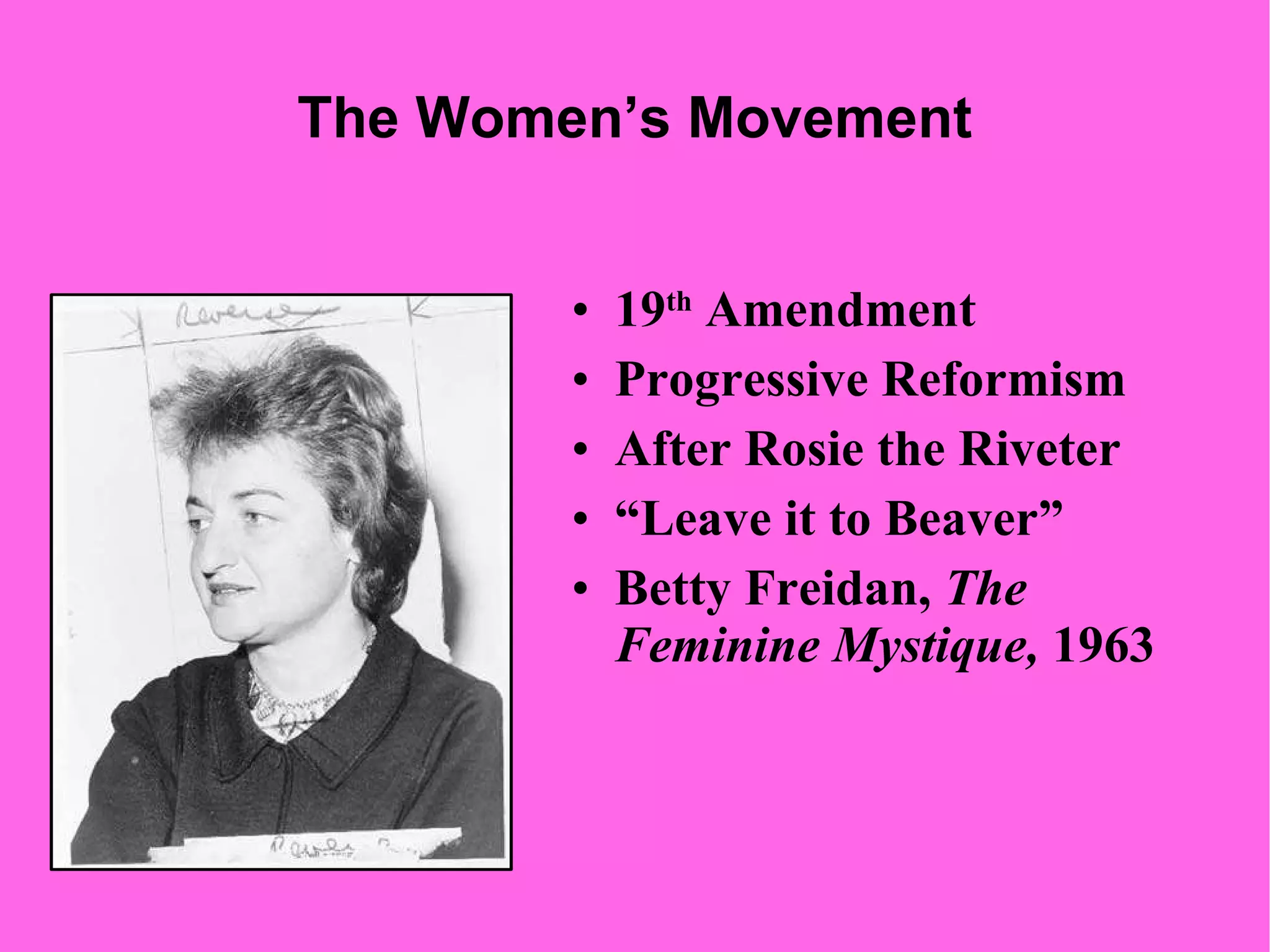
The Women’s Movement 19 th  Amendment Progressive Reformism After Rosie the Riveter “ Leave it to Beaver” Betty Freidan,  The Feminine Mystique,  1963
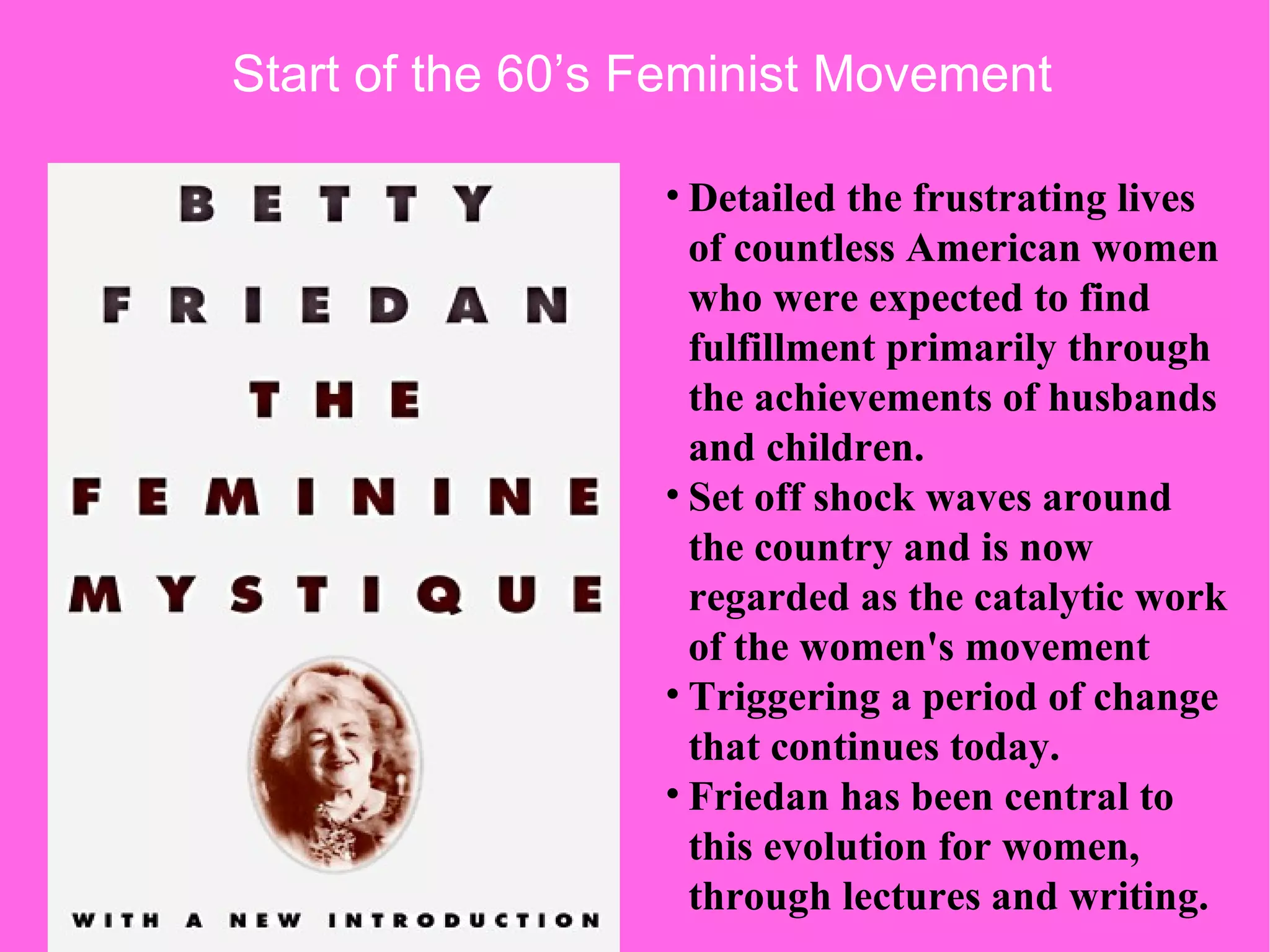
Detailed the frustrating lives of countless American women who were expected to find fulfillment primarily through the achievements of husbands and children. Set off shock waves around the country and is now regarded as the catalytic work of the women's movement Triggering a period of change that continues today. Friedan has been central to this evolution for women, through lectures and writing.  Start of the 60’s Feminist Movement
Friedan Breaks the Silence “ The problem lay buried, unspoken, for many years in the mind of American women.  It was a strange stirring, a sense of dissatisfaction, a yearning that women suffered in the middle of the 20 th  century in the United States.  Each suburban wife struggled with it alone.  As she made the beds, shopped for groceries, matched slipcover material, ate peanut butter sandwiches with her children, chauffeured Cub Scouts and Brownies, lay beside her husband at night – she was afraid to ask even of herself the silent question – “Is this all?’”
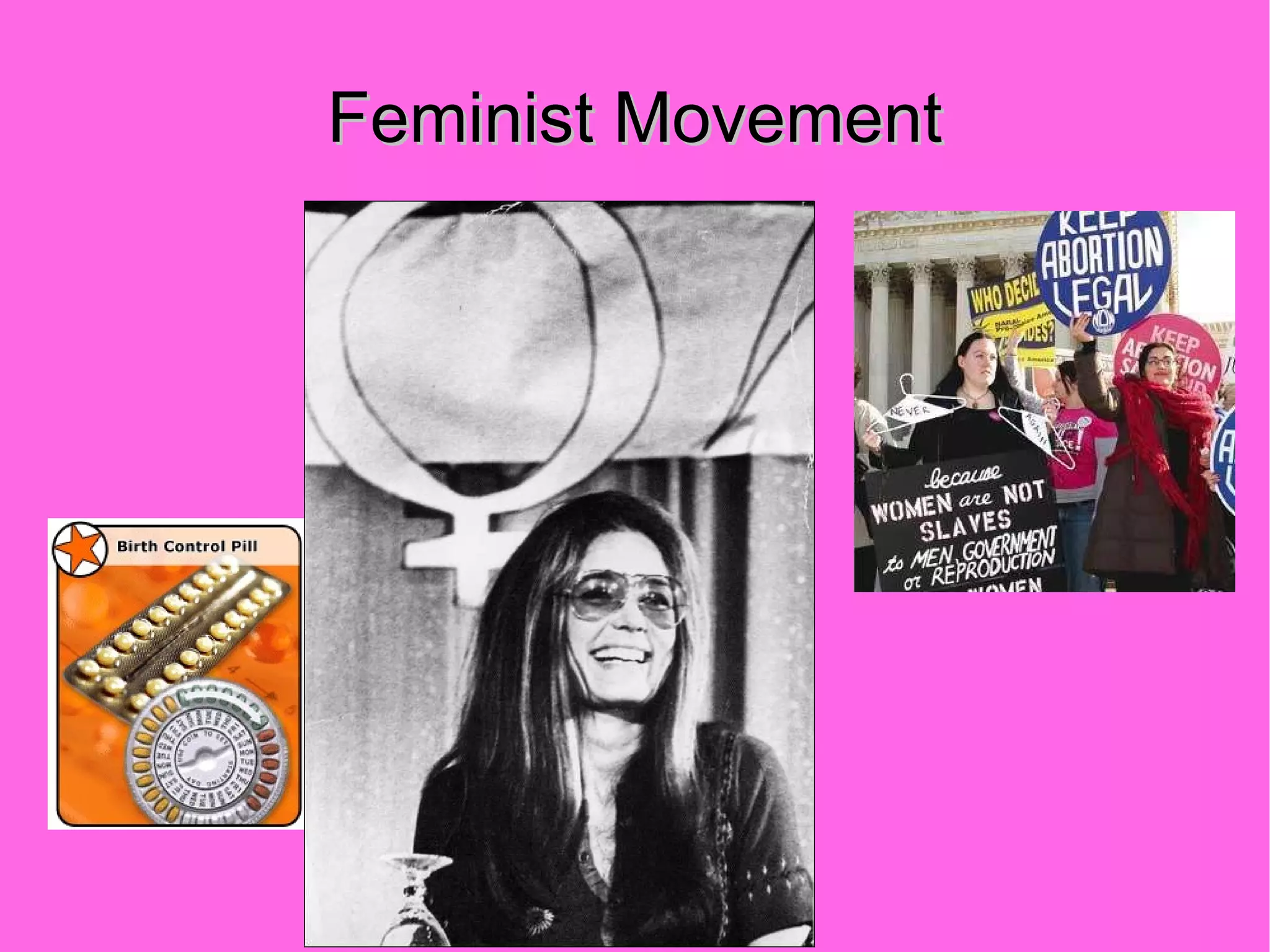
Feminist Movement
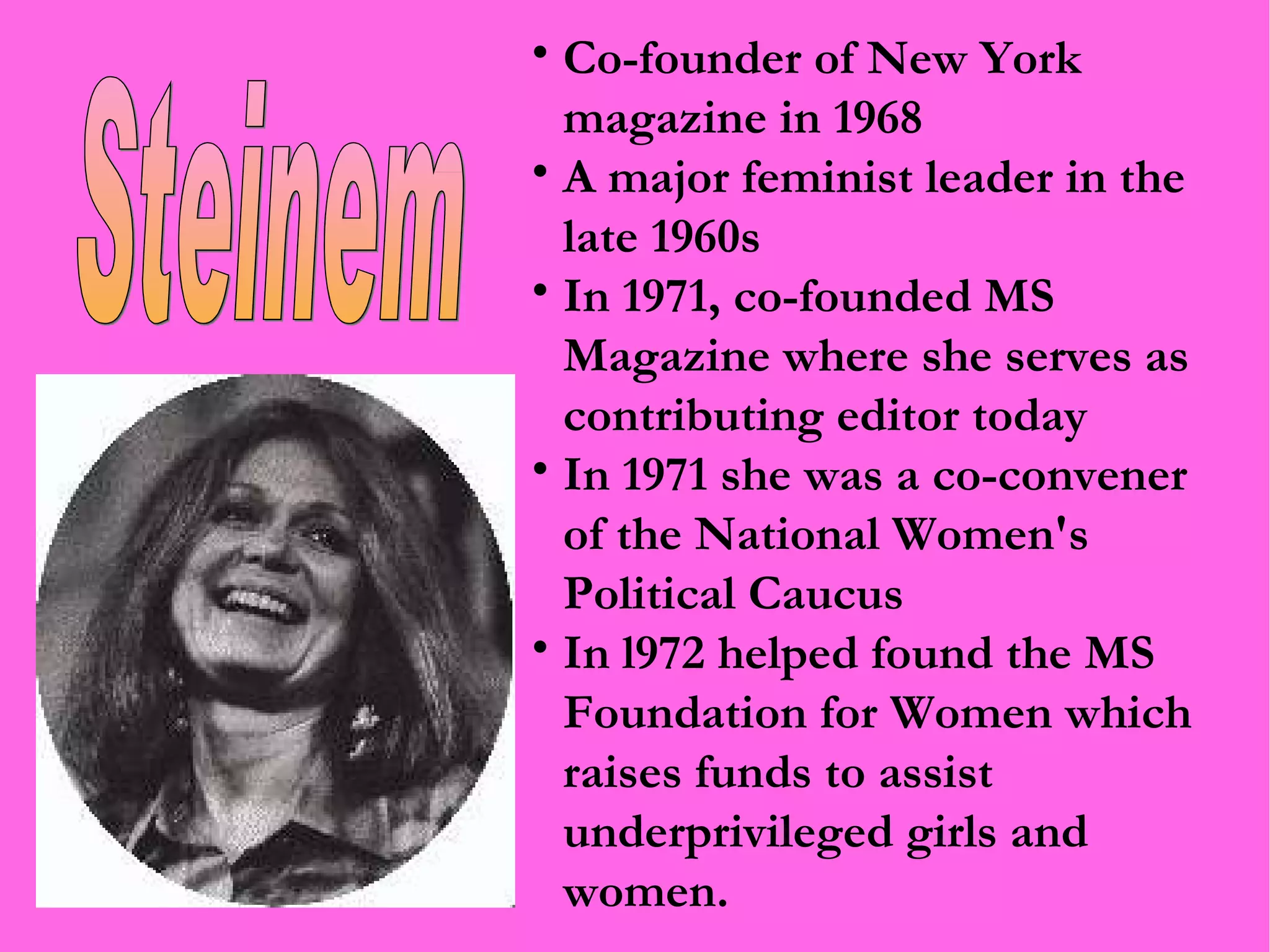
Co-founder of New York magazine in 1968 A major feminist leader in the late 1960s In 1971, co-founded MS Magazine where she serves as contributing editor today In 1971 she was a co-convener of the National Women's Political Caucus In l972 helped found the MS Foundation for Women which raises funds to assist underprivileged girls and women. Steinem
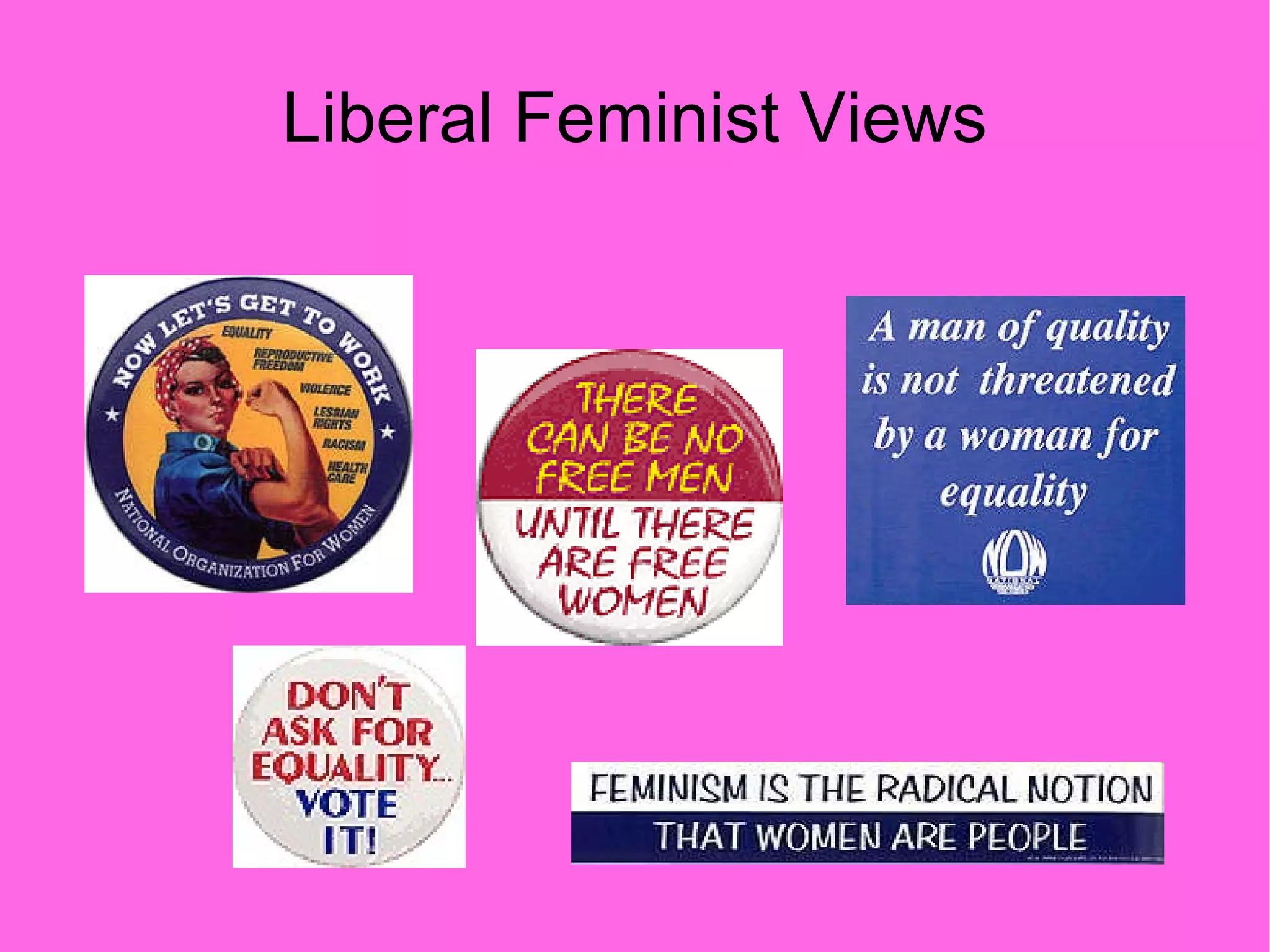
Liberal Feminist Views
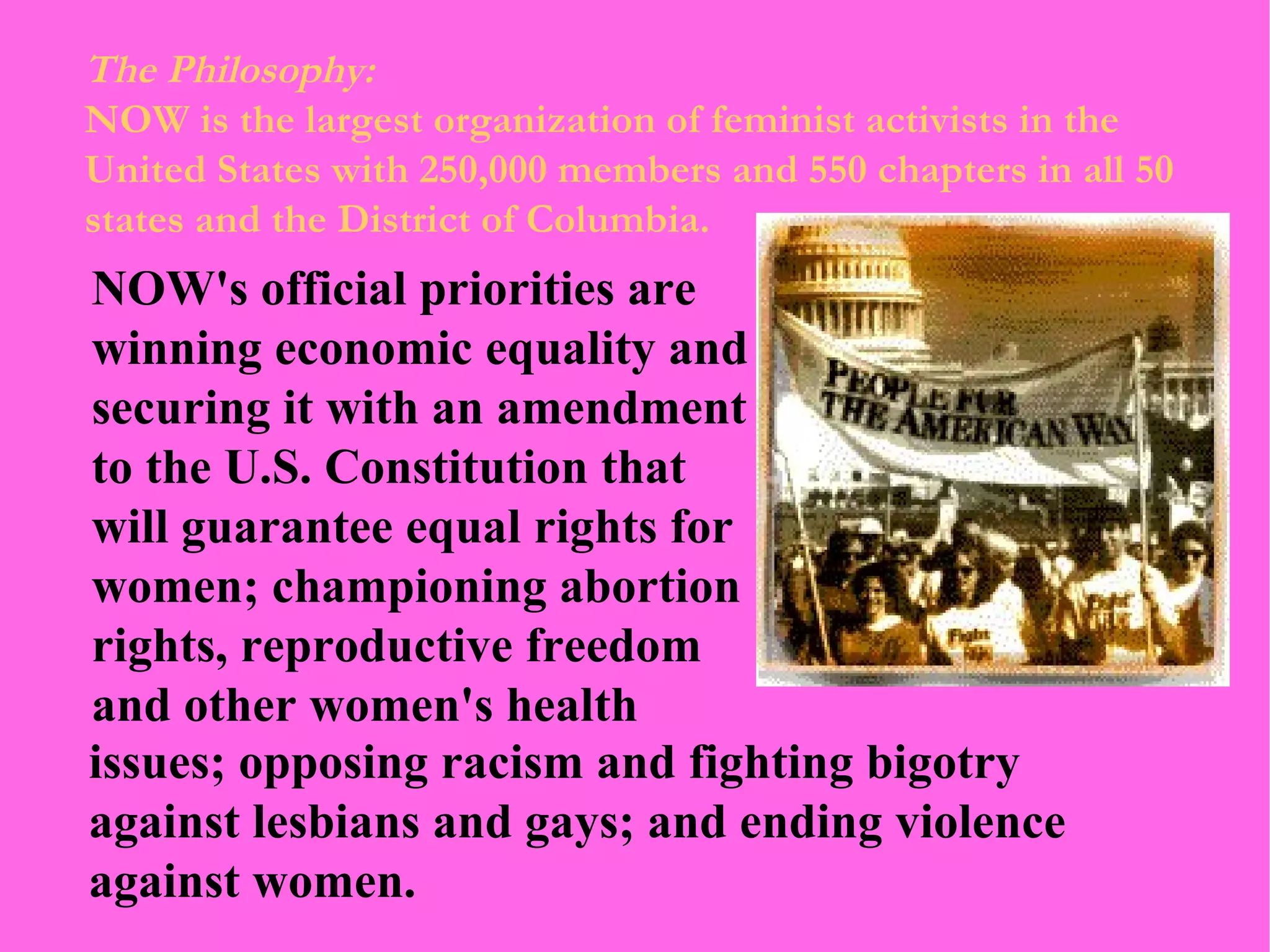
The Philosophy: NOW is the largest organization of feminist activists in the United States with 250,000 members and 550 chapters in all 50 states and the District of Columbia. NOW's official priorities are winning economic equality and securing it with an amendment to the U.S. Constitution that will guarantee equal rights for women; championing abortion rights, reproductive freedom and other women's health issues; opposing racism and fighting bigotry against lesbians and gays; and ending violence against women.
Environmental Movement
1970
View of Earth From Apollo 8. 1968
The Population Bomb Paul R. Ehrlich
Wake Up Report About Pollution
Polluting the Environment Rachel Carson’s  Silent Spring  (1963) detailed the impact of chemicals in the environment  Cold War: down-winders Industrialization Toxic chemicals, PCB’s, DDT, dioxin, mercury, arsenic, lead, nuclear waste, dumping in rivers, CO2, global warming, endangered species, Ozone
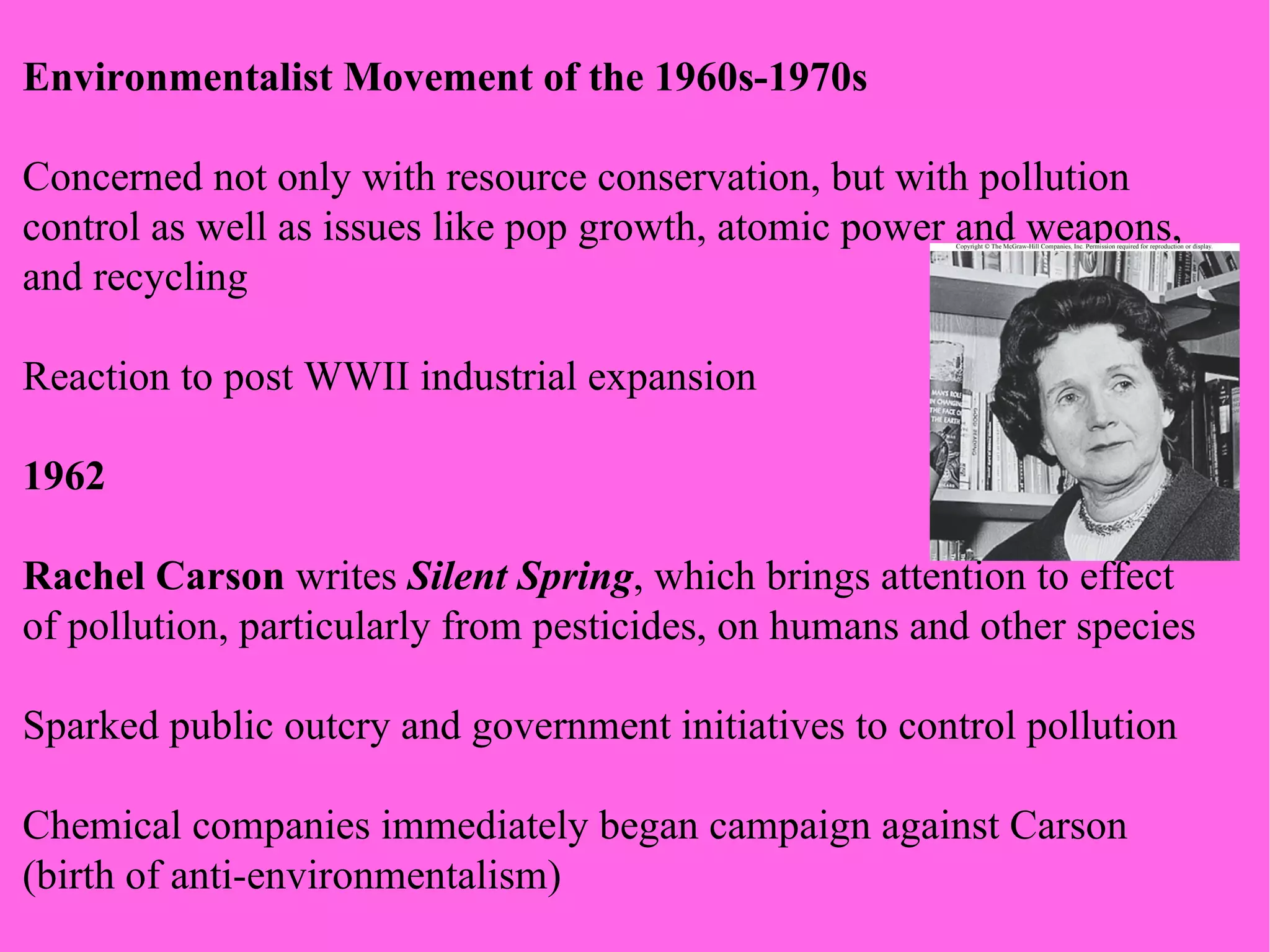
Environmentalist Movement of the 1960s-1970s Concerned not only with resource conservation, but with pollution control as well as issues like pop growth, atomic power and weapons, and recycling Reaction to post WWII industrial expansion 1962 Rachel Carson  writes  Silent Spring , which brings attention to effect  of pollution, particularly from pesticides, on humans and other species Sparked public outcry and government initiatives to control pollution Chemical companies immediately began campaign against Carson (birth of anti-environmentalism)
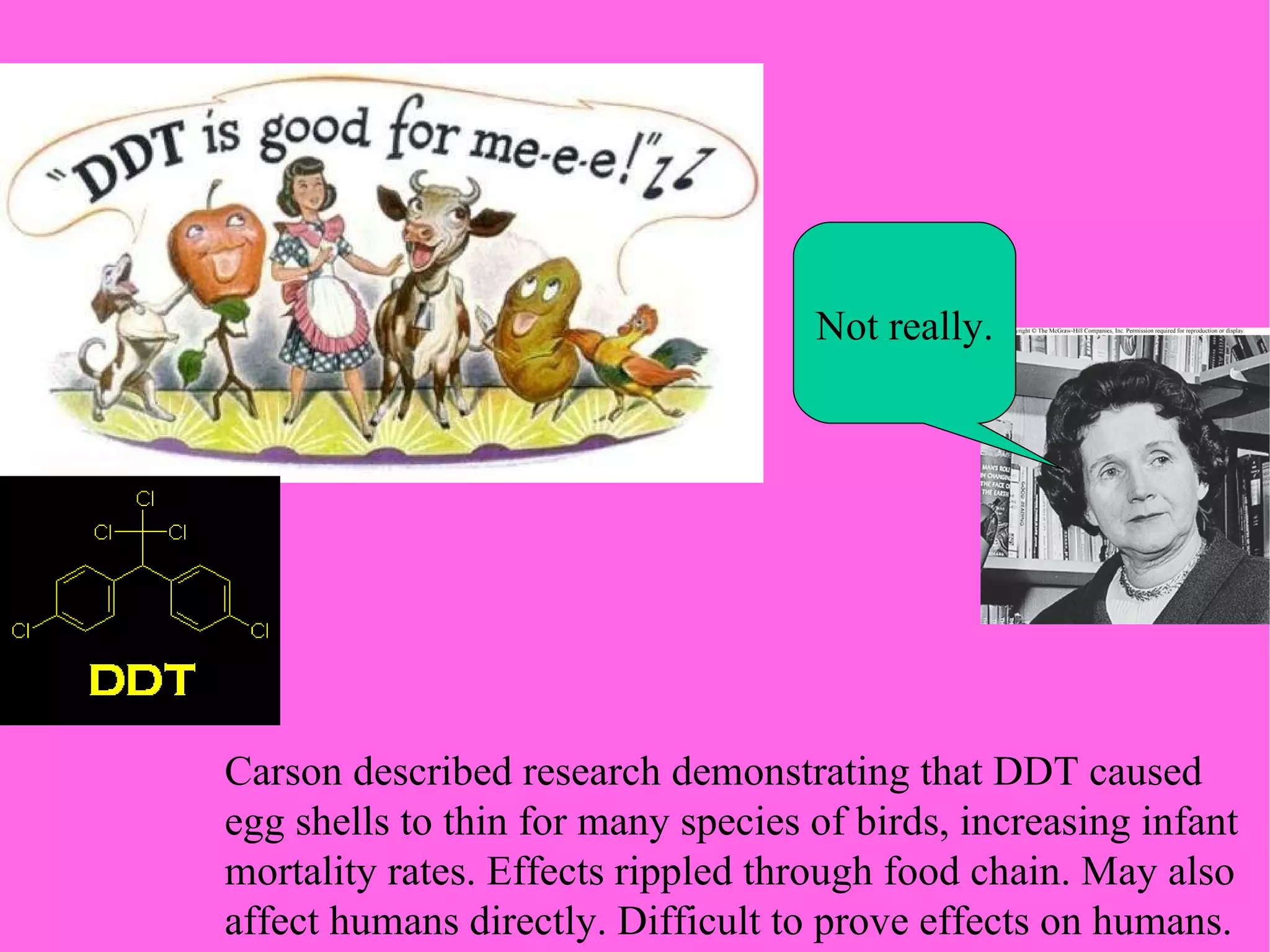
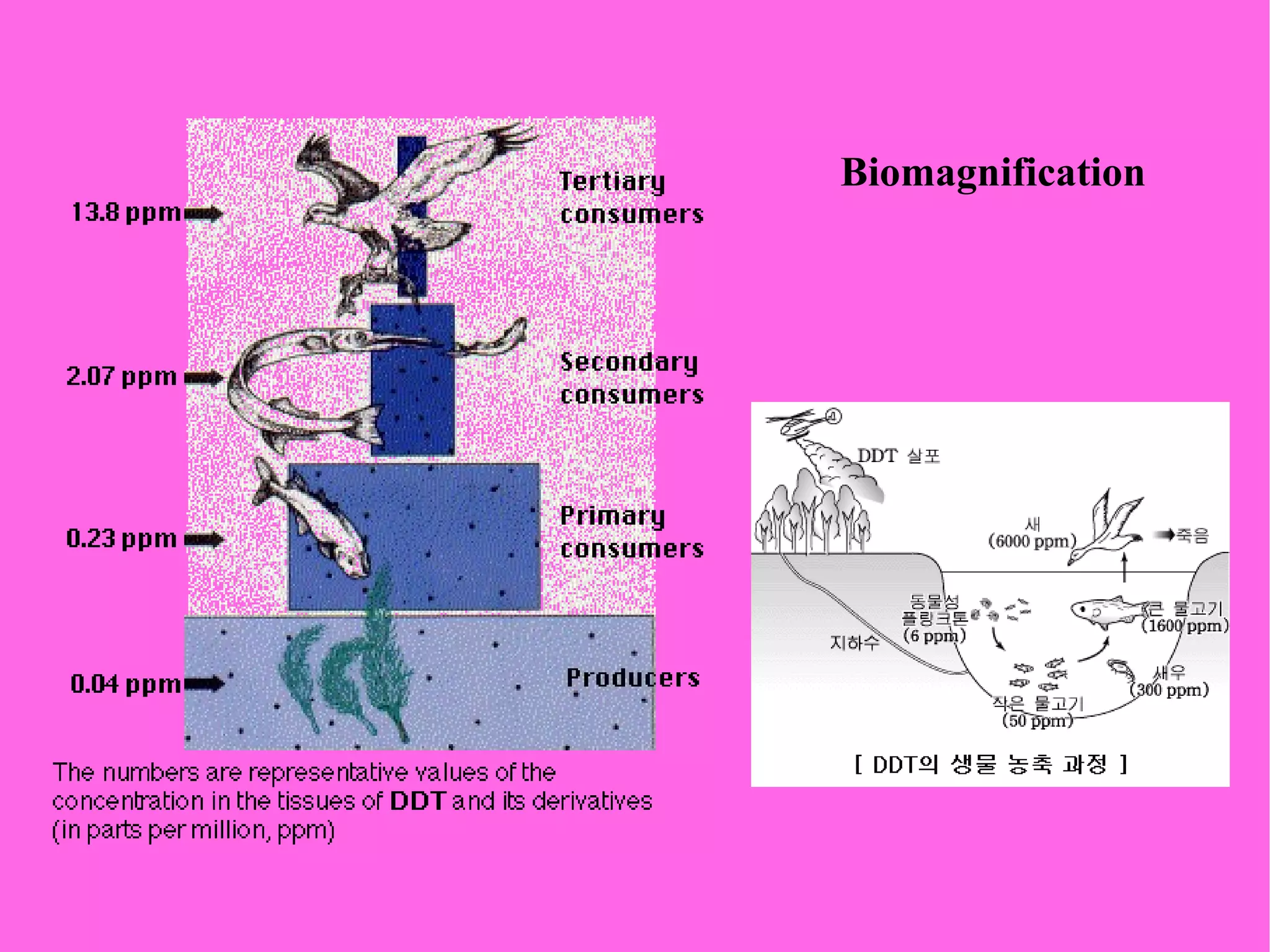
Carson described research demonstrating that DDT caused  egg shells to thin for many species of birds, increasing infant  mortality rates. Effects rippled through food chain. May also affect humans directly. Difficult to prove effects on humans. Not really.
Biomagnification
Legislation and Policies Wilderness Act of 1964  established “wild places” for protection from development 1967:  Clean Air Act Nixon passed the  National Environmental Protection Act  (1969) and  EPA  in 1970
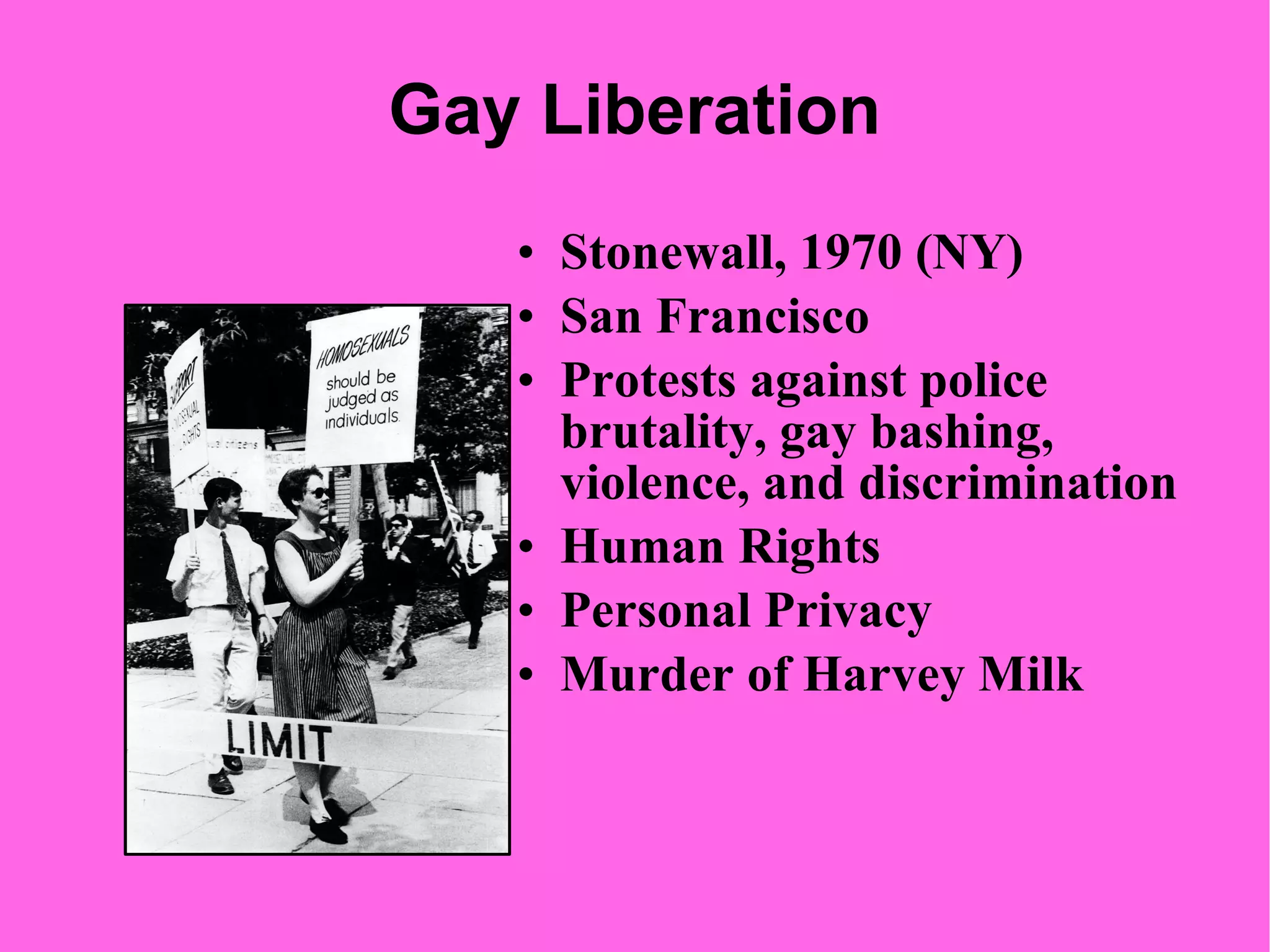
Gay Liberation Stonewall, 1970 (NY) San Francisco Protests against police brutality, gay bashing, violence, and discrimination Human Rights Personal Privacy Murder of Harvey Milk
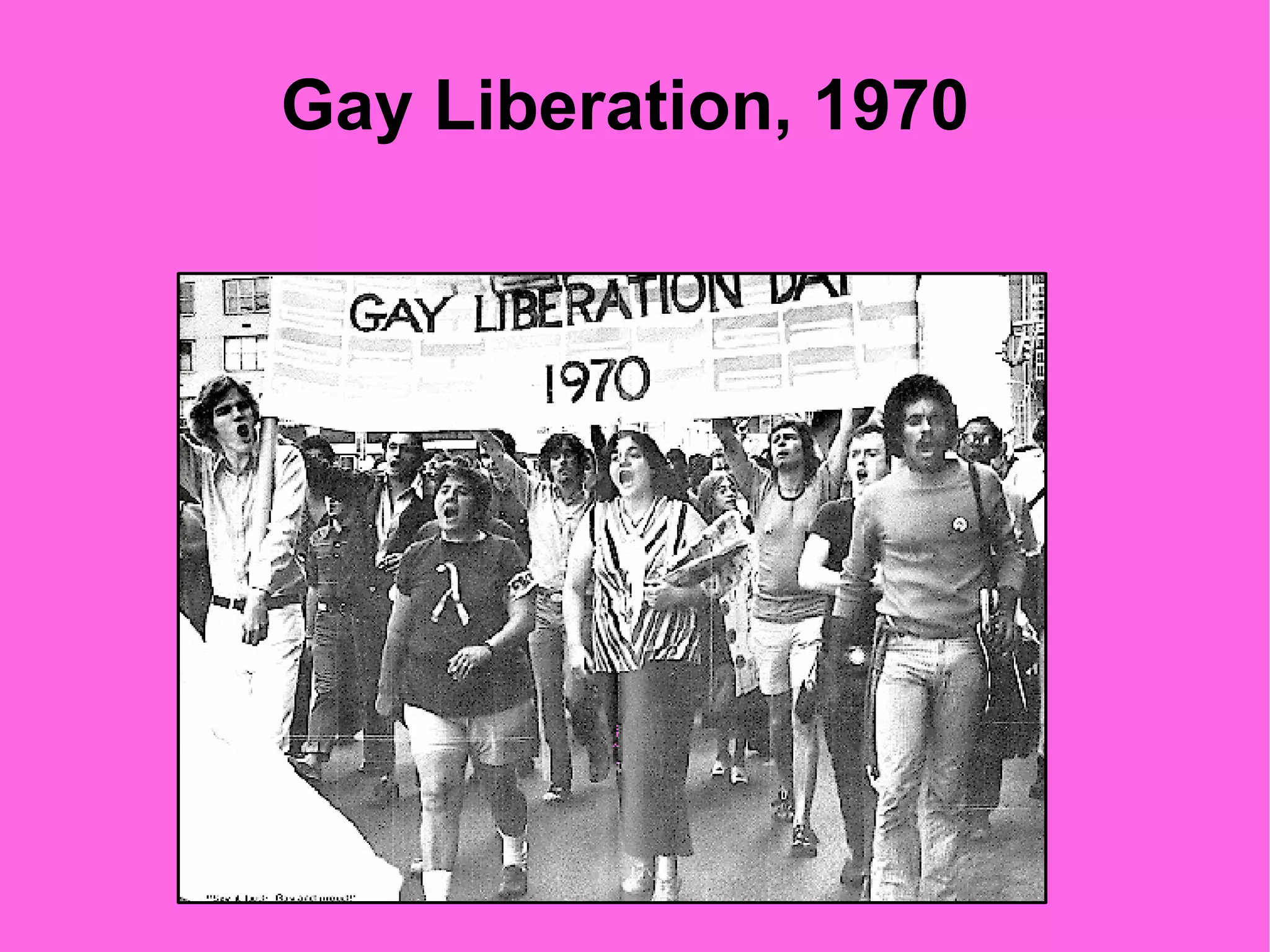
Gay Liberation, 1970
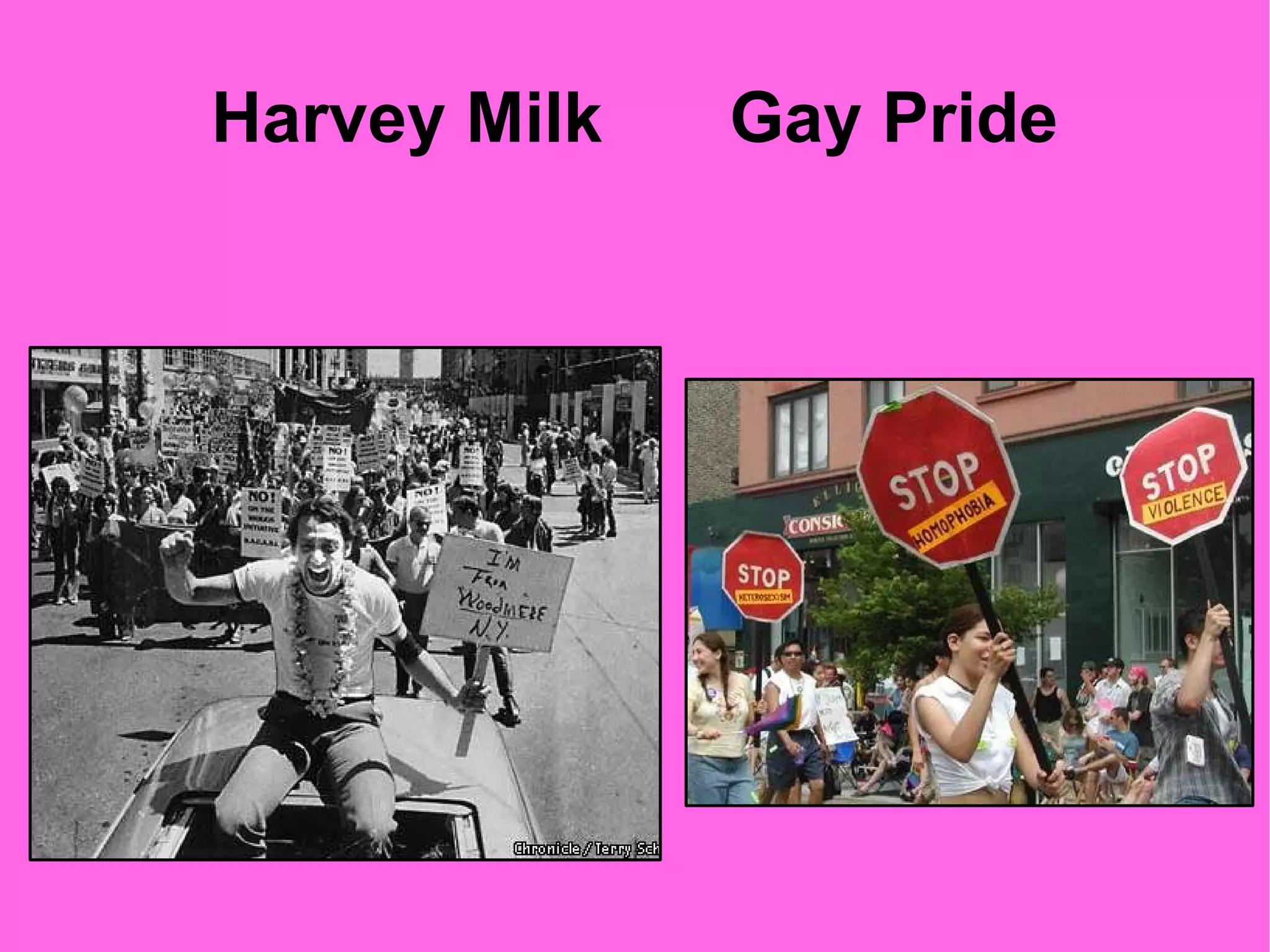
Harvey Milk  Gay Pride
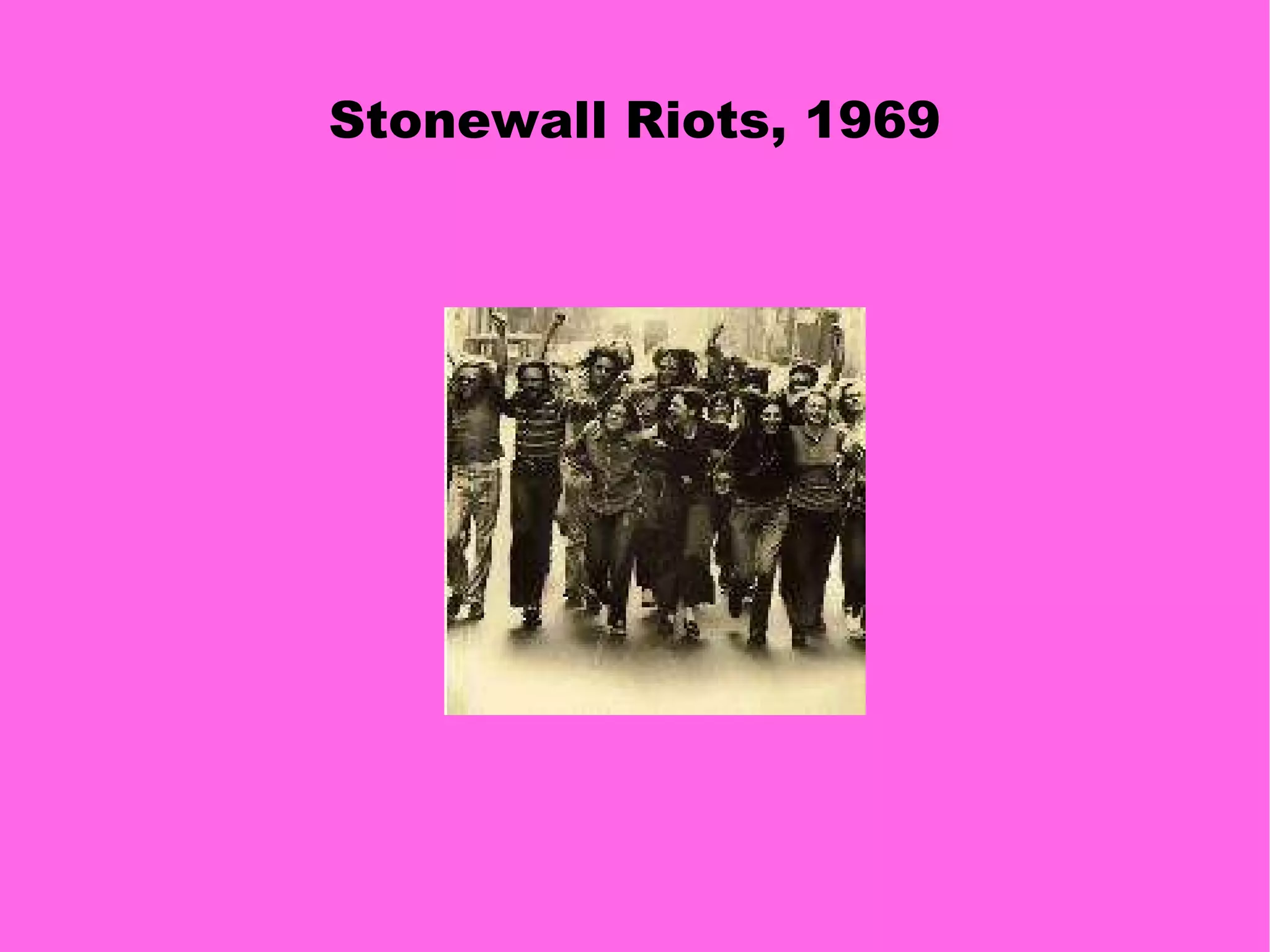
Stonewall Riots, 1969

USH Counter Culture Chapter 18.1

  • 1.
  • 2.
    The Rise ofthe Counterculture The counterculture of the 1960s was a rebellion of teens and young adults against mainstream American society. Young Americans believed that society’s values were hollow and its priorities were misplaced. They called the mainstream the Establishment . They wanted to create an alternative culture based on peace and love.
  • 3.
    Where did thecounterculture come from? The number of teens and young adults in the United States rose dramatically in the 1960s. These young people were living in turbulent times: threat of nuclear war, racial discrimination and segregation, the Vietnam War, and environmental pollution. Rebellion against the dominant culture was not new. The Beat generation of the 1950s questioned traditional values, challenged authority, and experimented with non-conformist lifestyles.
  • 4.
    Back lash againstthe staid, conservative, uniformity of the 50’s
  • 5.
  • 6.
  • 7.
  • 8.
  • 9.
    Jack Kerouac -On the Road.
  • 10.
  • 11.
  • 12.
  • 13.
    Marlon Brando, TheWild Ones. “ What are you rebelling against?” “ What da ya got?”
  • 14.
    “ Live fast;die young and leave a good looking corpse.”
  • 15.
  • 16.
  • 17.
    Rising Student ActivismStudents on college campuses began rebelling against school policies they considered restrictive, unjust, or not relevant. At the University of California at Berkeley students protested when school officials banned speech making and political organizing at the entrances to the campus. The events at Berkeley marked the beginning of the Free Speech Movement , which swept campuses across the nation. The students used the tactics of civil disobedience to protest injustices. Mainstream Americans were shocked as they expected young people not to question authority.
  • 18.
  • 19.
    Free Speech MovementLeader Mario Savio Free speech on campus California @ Berkeley Same goals as the SDS
  • 20.
    The New LeftA growing youth movement of the 60's Followers demanded sweeping changes in American society
  • 21.
    The New LeftNot the 1930’s “Popular Front” of unions, socialists, College educated White males Urban/suburban Critique of corporate capitalism, technology, conformity, and empire
  • 22.
    The Movement GrowsCollege Teach-ins March on Washington in 1965 A call for Civil Disobedience 400 chapters of the SDS by 1969
  • 23.
    Students for aDemocratic Society Founded by Tom Hayden and Al Haber Group said that corporations and the government has taken over America
  • 24.
    Why oppose Vietnam?Vietnam was a Civil War and USA had no business being there South Vietnam was no better than Communism Draining American strength and resources Morally Unjust
  • 25.
    Columbia University 1968Massive student protest. Students took over many buildings on campus 900 people arrested. 3 university officials taken hostage
  • 26.
    The Weathermen 1969violent off-shoot movement of the SDS 1st action Chicago shopping district Bombed the Capitol Building, broke Timothy Leary out of jail, evaded the FBI for most of the 70's
  • 27.
    Significance of TheNew Left The antiwar protest lead to the abolishment of the military draft. The War Powers Act of 1973 that curbed the President’s power The antiwar movement also contributed to the American publics’ suspicious view of the government.
  • 28.
    Timothy Leary “Turn on, Tune in, Drop out” were the words of counterculture leader Timothy Leary. The counterculture grew from the 1950’s Beat Movement.
  • 29.
    Psychedelic Drugs PsychedelicDrugs such As LSD became very Popular with the Movement because they Were not banned in California until 1966.
  • 30.
    Drug Culture Drugslike marijuana and LSD were a big part of the hippy/counterculture movement. Using drugs made hippies feel like the were rebelling from mainstream society. Timothy Leary (a Harvard professor) was an advocate of LSD. LSD was created by a Swiss scientist, used by the CIA, and tested for use by psychiatrists before it became illegal.
  • 31.
    Counterculture Movement 1965-1971of Hippie’s Counterculture- a movement made up of mostly white, middle-class college youths who tried to establish a new culture based on love and peace. Copyrighted Jeff Rainer 2/3/05
  • 32.
    The Hippy MovementThe term “hippy” comes from being hip. You were either hip or you were a “square” or a “pig.” Hippies were looking for an alternative way to live life. Most hippies valued freedom, nature, intimacy, peace, sharing, and spirituality.
  • 33.
    Life in theCounter-Culture Counterculture Thousands of teens and young adults left school, jobs, and traditional home life. Rejected materialism and the work ethic of the older generation Haight-Ashbury in San Francisco Hippie Culture Sought new experiences Eastern religions, astrology, the occult, and illegal drugs Casual and colorful clothes Men began wearing longer hair, beards, or Afros. Flower children Decline Height of hippie movement was summer of 1967 ( Summer of Love ) Freedoms often led to problems with addiction No means of supporting themselves Lack of rules led to conflicts
  • 34.
    Throughout the mid-and late sixties tens of thousands of idealistic youth left school, work, or home to create what they hope would be a perfect community of love, peace, and harmony
  • 35.
    Ken Kesey andThe Merry Pranksters
  • 36.
  • 37.
    Way of LifeHippies wanted to distance themselves from mainstream ways of life. They discarded possessions and often lived in parks or campsites in the woods. Living like this made them feel free Nudity was another form of freedom
  • 38.
    Throughout the mid-and late sixties tens of thousands of idealistic youth left school, work, or home to create what they hope would be a perfect community of love, peace, and harmony
  • 39.
    San Francisco andHaight Ashbury San Francisco was the birthplace of the counterculture/hippy movement. By 1965 hippies had taken over the Haight Ashbury district. Haight Ashbury district contains Golden Gate Park home of the Trips Festival and “be-ins.” This is a 20,000-strong be-in at Golden gate park in 1967
  • 40.
    1967 Summer ofLove . The Flower Power movement reached its short but intensive climax in the "Summer of Love" in 1967. Many different people came together to build a new society. They wanted a new, individual style. The postwar generation tried to build its own culture in the 50's. They refused traditional standards and values. Their most important colors were black, red and white - white for the drugs, black for their clothes and the coffee and red for the wine. Their values were radical individualism, an uncontrolled way of life expressed in parties,drugs and free love.
  • 41.
  • 42.
    Haight-Ashbury Streets This"revolution" took place mainly in Haight Ashbury, a small neighborhood in San Francisco. The Haight Ashbury was little more than a few square blocks which stretched from the edge of Golden Gate Park for a half-mile down Haight Street .One could find cafes, head shops , poster shops, hip boutiques, the Oracle office and the Straight Theatre
  • 43.
    Haight-Ashbury was thecenter of the hippie movement in the 1960s. As the popularity of the movement increased, many people flocked to the area, leading to an increase in crime, the gradual deterioration of the neighborhood, and the decline of the hippie image. To escape this negative association, members of the movement decided to symbolically “kill off” the hippies by holding mock funerals.
  • 44.
    Counter Culture, Fadand Fashion .
  • 45.
  • 46.
  • 47.
    V.W. Van WasGroovy!
  • 48.
  • 49.
  • 50.
  • 51.
  • 52.
  • 53.
  • 54.
    Easy Rider-1969. AmericanFlag As Fashion Statement Inspired Young People to Hit the Road to “Look for America.”
  • 55.
  • 56.
  • 57.
  • 58.
    and the PigCommune Commune style living became Popular among Hippies after The Summer of Love. This style Of living gave Hippies a chance To connect with nature and religion. Wavy Gravy was a leader of one of the Pig Commune in New Mexico. Wavy Gravy also was the MC at the Woodstock festival.
  • 59.
    Monterey Music FestivalThe idea for the Monterey International Pop Festival came out of the mid-60's belief that what had been pop music was now a much more serious art form, and could take its place alongside jazz Artists agreed to perform for free, and the Summer of Love was born. The first major music festival was held on June 16, 17 and 18, 1967 at the Monterey County Fairgrounds in Monterey, California. 
  • 60.
    The Age ofAquarius Or Hippie Era was marked by Rock ‘N’ Roll music, outrageous clothing, sexuality, and illegal drugs. When the Moon is in the Seventh House, and Jupiter aligns with Mars Then peace shall guide the planets, and love will steer the stars This is the dawning of the Age of Aquarius .... from: Aquarius / Let The Sunshine In ; by Rado/Ragni/MacDermot;EMI Music.
  • 61.
    Language of theCounterculture Different slang word from the Counterculture movement included; Flower Power. Make love, not war. Peace. Love. Cool. Hip. Hippie. Hippie girl. Groovy. Groove on that. Live for today. Mellow out. Mellow down. Mellow yellow. Electrical banana. Far out. Out of sight. Can you dig it? You dig it? Dig it? Dig? Dig. Dig it. I dig it. I can dig it. Like, wow. Like...like, hey man, wow. Safe as mother's milk. Hell no, we won't go. Are you straight? Are you bent? Are you a narc? Twisted. Alice. Acid. Acid Head. Acid Freak. Bad trip. Bum trip. Grass. Pot. Pot Head. Mary Jane. Shrooms. Morning Glorys. Uppers. Downers. Reds. Whites. Yellows. Crosses. Hard stuff. Speed. Speed Freak. Flying. Trip. Trippy. Tripping. Trip out. Tripping out. Freak. Freaky. Freaking. Freak out. Freaking out. High. Up. Spacey. Space out. Spaced out. Spacing. Spacing out. Strung out. Down. Downer. Coming down. Cold Turkey. Crash. Crashing. Crashing and burning. Biting the big one. The ultimate bad trip. Dying. Good friends gone forever. Total bummer.
  • 62.
    Hippy Music Themost popular music of the time was psychedelic rock Bands like Jefferson Airplane, Quicksilver Messenger Service, the Jimi Hendrix Experience and the Grateful Dead played free concerts at Golden Gate Park. Concerts and be-ins were places for hippies to protest, socialize, dance, or take drugs. At Woodstock over 250,000 hippies showed up to hear artists like Janis Joplin, The Who, Canned Heat, The Allman Brothers, and County Joe and the Fish.
  • 63.
    Music of theCounterculture Music feature Hall of Fame groups Jefferson Airplane and the Grateful Dead. As well as rising artists Jimi Hendrix and Janis Joplin.                                                     
  • 64.
  • 65.
  • 66.
  • 67.
    Woodstock Music FestivalThe legendary Woodstock Festival took place over three days in August 1970- August 15, 16, 17. Among the performers, there were Janis Joplin, Santana, Richie Havens, Sly and the Family Stone, Jefferson Airplane, Sha Na Na and Jimi Hendrix, or as he called his band, Gypsy Sun and Rainbows. Hendrix was scheduled to close the show on Sunday night, but due to delays, Hendrix and band took the stage on Monday morning, to a crowd of only about thirty-thousand: far less than the estimated peak crowd of four hundred- thousand
  • 68.
  • 69.
  • 70.
    Woodstock 1969 Nowhere was counterculture so celebrated as at the mass music festivals of the late sixties, culminating in the Woodstock festival in 1969. A ticket for one day cost $6-$8; a 3-day ticket: $18-24. Three days of Peace and Music." August 15, 16, and 17, 1969. 450,000 kids 100 miles from New York City In a matter of minutes, the festival became a free event People parked their cars as far as 20 miles away. Once you arrived, you had to stay; there was nowhere to go. There was no place to sleep, no place to bathe, no place to eat... no place to nothin'.
  • 71.
    Woodstock Woodstock wasnot just a music concert. “For thousands who couldn’t even hear the music” it was a “profound religious experience.” Meager resources were shared with everyone. Many people at Woodstock used illegal drugs
  • 72.
    Chicago Democratic ConventionAnti-war demonstrators protested throughout the convention, clashing with police all around the convention center, the Chicago International Amphitheater (in the streets, as well in Lincoln Park and Grant Park ). Mayor Richard J. Daley took a particularly hard line against the protesters, refusing permits for rallies and marches, and calling for whatever use of force necessary to subdue the crowds. The Chicago Police were being taunted by the rioting "counterculture" with at first paperballs and marshmallows. They then began to throw glasses of urine and fecal matter. When U.S. Sen.rt Abraham Ribicoff (D-Conn.) delivered a shluck nominating George McGovern for President, he infuriated Daley by saying, "with George McGovern as President of the United States, we wouldn't have Gestapo tactics in the streets of Chicago."
  • 73.
  • 74.
    Days of RageThe Days of Rage riots occurred in Chicago over a four day period beginning October 8 , 1969 after 287 members of the militant group, the Weathermen , converged on the city to confront the police in the streets after protesting the trial of the group that was commonly referred to as " the Chicago Seven ."
  • 75.
    Kent State MassacreThe Kent State shootings , also known as May 4 or the Kent State massacre , occurred at Kent State University in the city of Kent , Ohio , and involved the shooting of students by the Ohio National Guard on Monday, May 4 , 1970 . The altercation killed four students and wounded nine others.
  • 76.
    The Legacy ofthe Counterculture As the counterculture ended if left America with more liberating views in the areas of dress, appearance, lifestyle, and social behavior. While some Americans found it liberating, some said it was the start of moral decay in the country
  • 77.
    How were thesethese attitudes Connected? Music. Drugs. Outlandish fashions. Rejection of parents values. Rejection of gov’t leaders. Rejection of war. Anti-establishment. Rebellion against culture (counterculture)
  • 78.
    Mainstream Reactions tothe Counterculture Some observers of the counterculture were put off by the unkempt appearance of hippies. On a deeper level, many mainstream Americans objected to the unconventional values of the counterculture. They saw hippies as disrespectful, uncivilized, and threatening. To many in the Establishment, it appeared that society was unraveling. The television show All in the Family highlighted the older generation’s distrust of the counterculture and the younger generation’s desire to change society.
  • 79.
    Legacy of theCounterculture Attitudes Americans became more casual in the way they dressed and more open-minded about lifestyles and social behavior. Attitudes about sexual behavior loosened. People explored topics that were once taboo. Art and Film New style called pop art emerged. Aimed to appeal to popular tastes Andy Warhol led the movement. Film broadened its subject matter as censorship rules relaxed. Film industry adopted a rating system. Music The Beatles brought new techniques and ideas to rock and roll. Bob Dylan wrote political songs and became the spokesperson for his generation. Woodstock Music and Art Fair was the celebration of an era.
  • 80.
  • 81.
    Women’s Liberation, FreeSpeech, Environmentalism, and the New Left
  • 82.
    “ Women’s Liberation”Patriarchy Biology = destiny Marriage & oppression Domestic Violence Equal Pay & Education College admissions The Glass Ceiling Reproductive Rights and control over one’s body
  • 83.
    The Women’s Movement19 th Amendment Progressive Reformism After Rosie the Riveter “ Leave it to Beaver” Betty Freidan, The Feminine Mystique, 1963
  • 84.
    Detailed the frustratinglives of countless American women who were expected to find fulfillment primarily through the achievements of husbands and children. Set off shock waves around the country and is now regarded as the catalytic work of the women's movement Triggering a period of change that continues today. Friedan has been central to this evolution for women, through lectures and writing. Start of the 60’s Feminist Movement
  • 85.
    Friedan Breaks theSilence “ The problem lay buried, unspoken, for many years in the mind of American women. It was a strange stirring, a sense of dissatisfaction, a yearning that women suffered in the middle of the 20 th century in the United States. Each suburban wife struggled with it alone. As she made the beds, shopped for groceries, matched slipcover material, ate peanut butter sandwiches with her children, chauffeured Cub Scouts and Brownies, lay beside her husband at night – she was afraid to ask even of herself the silent question – “Is this all?’”
  • 86.
  • 87.
    Co-founder of NewYork magazine in 1968 A major feminist leader in the late 1960s In 1971, co-founded MS Magazine where she serves as contributing editor today In 1971 she was a co-convener of the National Women's Political Caucus In l972 helped found the MS Foundation for Women which raises funds to assist underprivileged girls and women. Steinem
  • 88.
  • 89.
    The Philosophy: NOWis the largest organization of feminist activists in the United States with 250,000 members and 550 chapters in all 50 states and the District of Columbia. NOW's official priorities are winning economic equality and securing it with an amendment to the U.S. Constitution that will guarantee equal rights for women; championing abortion rights, reproductive freedom and other women's health issues; opposing racism and fighting bigotry against lesbians and gays; and ending violence against women.
  • 90.
  • 91.
  • 92.
    View of EarthFrom Apollo 8. 1968
  • 93.
    The Population BombPaul R. Ehrlich
  • 94.
    Wake Up ReportAbout Pollution
  • 95.
    Polluting the EnvironmentRachel Carson’s Silent Spring (1963) detailed the impact of chemicals in the environment Cold War: down-winders Industrialization Toxic chemicals, PCB’s, DDT, dioxin, mercury, arsenic, lead, nuclear waste, dumping in rivers, CO2, global warming, endangered species, Ozone
  • 96.
    Environmentalist Movement ofthe 1960s-1970s Concerned not only with resource conservation, but with pollution control as well as issues like pop growth, atomic power and weapons, and recycling Reaction to post WWII industrial expansion 1962 Rachel Carson writes Silent Spring , which brings attention to effect of pollution, particularly from pesticides, on humans and other species Sparked public outcry and government initiatives to control pollution Chemical companies immediately began campaign against Carson (birth of anti-environmentalism)
  • 97.
    Carson described researchdemonstrating that DDT caused egg shells to thin for many species of birds, increasing infant mortality rates. Effects rippled through food chain. May also affect humans directly. Difficult to prove effects on humans. Not really.
  • 98.
  • 99.
    Legislation and PoliciesWilderness Act of 1964 established “wild places” for protection from development 1967: Clean Air Act Nixon passed the National Environmental Protection Act (1969) and EPA in 1970
  • 100.
    Gay Liberation Stonewall,1970 (NY) San Francisco Protests against police brutality, gay bashing, violence, and discrimination Human Rights Personal Privacy Murder of Harvey Milk
  • 101.
  • 102.
    Harvey Milk Gay Pride
  • 103.

Editor's Notes

  • #97 Carson was a scientist, but worked primarily in nature writing for the general public about ecology and the interconnectedness of all creatures and their environments. Concerned about DDT spraying near her hometown in MD, she proposed to write about it for Reader’s Digest. They rejected her. Her work, Silent Spring, was eventually published in the New Yorker, serially. Chemical companies put out books about what a nightmare the world would be without pesticides. Attacked her credentials and authority to discredit her. (Example of false criticisms of Carson. Carson died in 1962 from breast cancer.