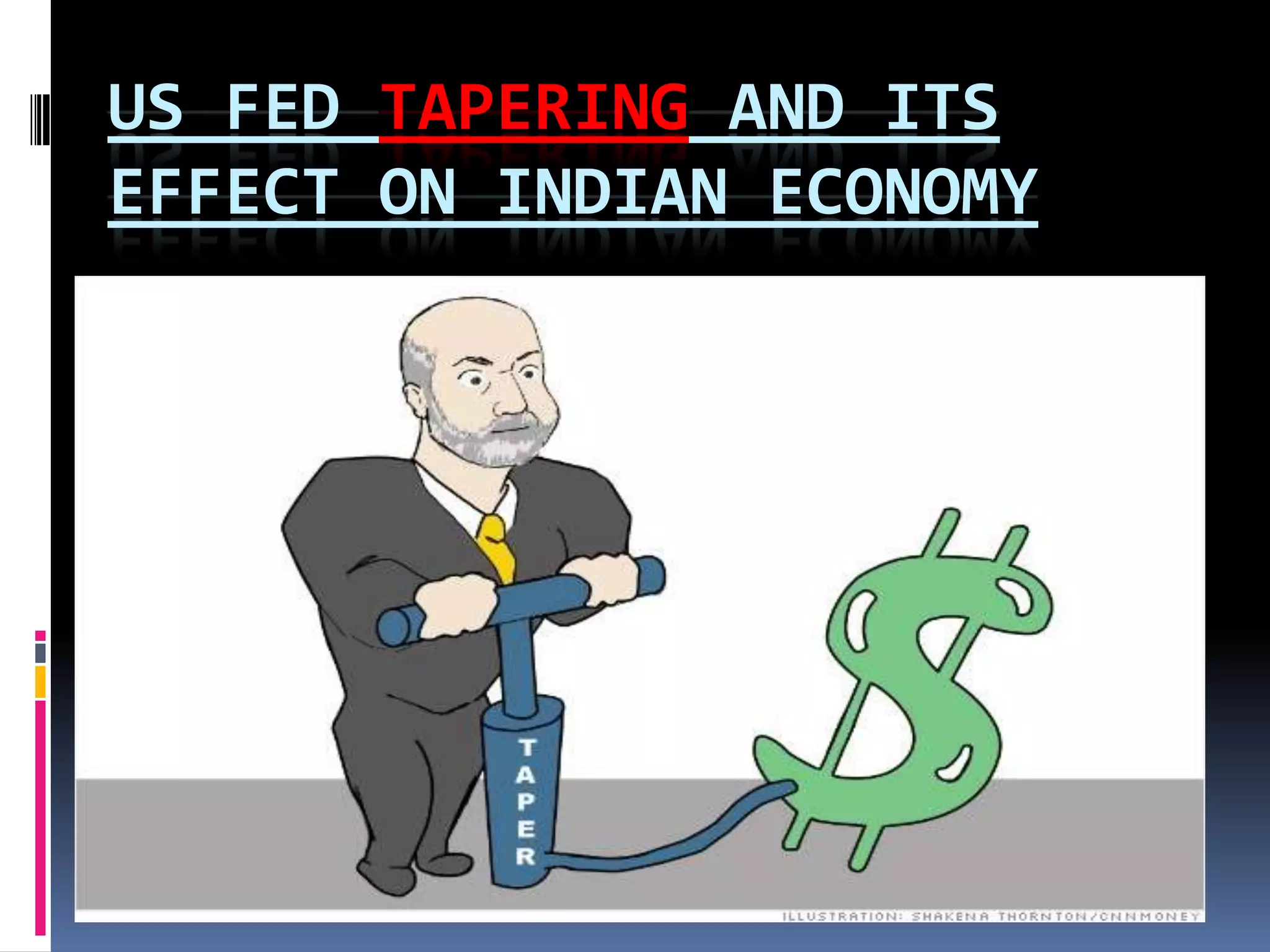
US FED TAPERING AND ITS
EFFECT ON INDIAN ECONOMY
CONTENTS
 Introduction
 Basics of quantitative easing
 Fed tapering
 Market reactions
 Impact on dollar and rupee
 Impact on indian economy
 Conclusion
INTRODUCTION
 The word tapering in financial terms is
increasingly being used to refer to the reduction
of the Federal Reserve's quantitative easing, or
bond buying programme.
 Taper talk" started in June 2013 by Ben Bernake
when speculation increased that the Fed would
start on a tapered end to QE in 2014.
FEDERAL RESERVE
 The Federal Reserve System is the central
banking system of the United States
 The Federal Reserve’s duties can be categorized
into four general areas:
 Conducting national monetary policy
 Supervising and regulating banking
 Maintaining financial system stability and
containing systemic risk.
 Providing financial services
GOVERNMENT BONDS
 Governments and governmental agencies also use
bonds to raise money. U.S.
 Treasury Bonds are the most secure investments.
 when bond yields go up, prices go down, and when
bond yields go down, prices go up.
 In other words, a move in the 10-yearTreasury yield
from 2.2% to 2.6% indicates negative market
conditions, while a move from 2.6% to 2.2%
indicates positive market performance
The Basics of Quantitative
Easing
 The Fed plays an increasingly active role.
 The most well-known of these tools is its
ability to set short-term interest rates
 The central bank enacts a low-rate policy
when it wants to stimulate growth, and it
maintains higher rates when it wants to
contain inflation.
 In recent years, however, this approach ran
into a problem: the Fed effectively cut rates
to zero, meaning that it no longer had the
ability to stimulate growth through its
interest rate policy.
 But even with these ultra-low rates, there's
still too much unemployment.
 This problem prompted the Fed to turn to the
next weapon in its arsenal: quantitative
easing
What is Quantitative Easing?
 Quantitative easing is by creating money and
then buying bonds or other financial assets from
banks.
 Higher loan growth, in turn, should make it
easier to finance projects.
 The Fed’s purchases help drive up the prices of
bonds by reducing their supply, which causes
their yields to fall.
 Lower yields, in turn, provide the fuel for
economic expansion by lowering borrowers’
costs.
“QE1” and "QE2”
 slow growth and high unemployment forced the
Fed to stimulate the economy through its policy
of quantitative easing in the interval from
November, 2008 through March 2010.
 Fed announced an expansion of the program
from $600 billion to $1.25 trillion on March 18,
2009.
 Immediately after the program wrapped up,
trouble emerged in the form of slower growth,
the rise of the European debt crisis, and renewed
instability in the financial markets.
QE-2
 It involved the purchase of $600 billion worth
of short-term bonds.
 This program - which Chairman Ben Bernanke
first hinted at on August 27, 2010 - ran from
November 2010 through June 2011.
 QE2 sparked a rally in the financial markets
but did little to spur sustainable economic
growth.
QE3 Launched in September
2012
 On September 13, 2012, the U.S. Federal Reserve
launched its third round of quantitative easing
 It would keep short-term rates low through 2015.
 These moves reflect the Fed's view that the
economy still hasn't reached the point of self-
sustaining growth.
 The Fed has adopted what has been called "QE
Infinity," a plan to purchase $85 billion of fixed-
income securities per month, $40 billion
of mortgage-backed securities and $45 billion
of U.S.Treasuries.
The Case Against Quantitative
Easing
 The Fed’s various QE programs have led to sharp
criticism Among the arguments against quantitative
easing are:
 It helps banks more than the economy, since they
can opt to strengthen their balance sheets by
“keeping” the money rather than using it to increase
their loan activity.
 By creating money, the Fed makes the U.S. dollar
less competitive against foreign currencies.
 Increasing the money supply can create inflation..
 Quantitative easing can create “bubbles” in asset
prices
“TAPER TALK”
 Global markets started experiencing a sell
off after the Fed indicated that it expected
to ease its asset purchases.
 On the day of Ben Bernanke's last press
conference as chairman of the Federal
Reserve the Federal Open Market Committee
finally decided it would scale down its $85bn-
a-month asset purchase programme
1st Market Reaction to Tapering
 While Bernanke’s tapering statement didn’t
represent an immediate shift, it nonetheless
frightened the markets.
 Once the Fed begins to pull back on it stimulus, the
markets may begin to perform more in line with
economic fundamentals – which in this case, means
weaker performance.
 Bonds indeed sold off sharply in the wake of
Bernanke's first mention of tapering, while stocks
began to exhibit higher volatility than they had
previously.
1st Market Reaction to Tapering
 The Dow was pushed down 105 points - but the idea of Fed
stimulus has caused much more turmoil in certain overseas
markets.
 The problem: A corresponding hike in U.S. debt yields has
fueled higher borrowing costs around the globe.
 This has led to the flight of cheap capital out of emerging
currencies and markets.
 The markets subsequently stablized through the second half
of 2013 as investors gradually grew more comfortable with
the idea of a reduction in QE
That triggered the following
reactions:
 The currencies of India and Turkey fell to new all-
time lows against the U.S. dollar while bond
prices fell.
 Indonesia's currency, the rupiah, also fell to its
lowest level since 2009.
 Stocks in Eastern emerging economies like
Indonesia, Thailand, and the Philippines
plummeted.
 The Philippine Stock Exchange alone plunged
nearly 6% this week.
EFFECT ON EMERGING MARKETS
 Concerns over economic growth, along with
lowered demand forecasts, have hammered
export-reliant countries, likeThailand.
 Thailand's SET and Indonesia's Jakarta
Composite Index have fallen 18% and 20%
respectively since their May peak.
 The Philippine stock index is down 17%, whereas
India's Sensex was down 10%.
 All four of these nations' currencies are down
more than 10% in that time.
EFFECT ON DOLLAR AND RUPEE
 The dollar gained against the majority of its
16 most-traded peers when the fed decided
to taper
 From 53.80 a dollar on 30 April, the rupee
slumped 21.84% to 68.85 on 28 August.
 If tapering releases the headwinds and
interest rates rise within the context of a
stable U.S. economy, then capital may be
attracted toward the U.S. currency.
FED TAPERING
 Fed will begin to wind down the size of its
purchases before 2013 is over, with the goal
of ending the program by 2015.
 At the time present, QE is fluid and subject to
change based on economic conditions.
 This is illustrated by Fed Chairman Ben
Bernanke's May 22, 2013 hint that the Fed
could "taper" QE before year-end.
FED FINALLY TAPERS ITS STIMULUS
 On December 18, 2013, the Fed announced
the first tapering: beginning in January, it will
reduce its purchases to $75 billion per month -
$35 billion of mortgage-backed securities and
$40 billion ofTreasuries.
 The Fed is on track to reduce the program
steadily throughout 2014 as long as economic
growth remains on track and unemployment
continues to fall to 6.5%.
WHY IS FED TAPERING
 Better than expected jobs growth was one
reason cited for the pullback.
 They decided to decrease stimulus efforts in
"measured steps" to avoid surprising markets.
 They're not ending Quantitative
Easing, they're just reducing it barely
How Will a Tapering Look?
 Tapering isn’t an immediate, dramatic event.
 Instead, it is likely to take place gradually throughout
2014 so as to create minimal market disruption.
 Also, it is going to remain dependent on economic
conditions.
 The Fed may pull back slightly if
the economy continues to strengthen, but it could
also increase the program again if the economy
slowed or the financial markets were shocked by an
unforeseen crisis.
REACTIONS FROM MARKETS
 During the summer of 2013, comments made by
outgoing chairman Ben Bernanke indicating a
reduction in stimulus efforts caused market
volatility and a steep increase in mortgage rates.
 In December, investors were more relaxed about
the move.
 All three US indexes posted gains of more than
25% in 2013.
 European and Asian markets posted gains after
the fed taper decision
TAPERING EFFECT ON INDIA
 Sensex slips 0.73%, rupee only 1 paisa weaker
vs $ the decline was moderate, as key global
markets had rallied.
 The market did not respond too negatively. This
is because (FII) inflows are unlikely to be affected
immediately.
 FIIs net-bought shares worth Rs 2,264 crore.
TAPERING EFFECT ON INDIA
 RBI said “we were better prepared to face the
tapering. The good news is that the tapering has not
collapsed all emerging market currencies,”
 The country raised about $34 billion between
September and November when the central bank
opened a special concessional dollar-swap window to
attract FCNR (B) deposits, adding to India’s forex
reserves.
 FIIs have also pumped in a little over Rs 45,000 crore
since September.
 Foreign exchange reserves, which had dropped to a
three-year low in early September, are now at an eight-
month high of $295.7 billion.
STRONG DOLLAR TO IMPACT THE
MARKET
 easy money flowing into the Indian market.
 with the US unemployment rate falling to 7 per
cent the US economy is picking up.
 US tapering can slow down the flow of money
into our market
 It's not just the rupee.
 Across the global all major currencies are trading
weak against the US dollar.
 The dollar is gaining strength on the back of
positive signals from the US economy.
CONCLUSION
 markets took the announcement in their
stride also because of assurances from the
government and the RBI.
 India is now better prepared to deal with the
situation arising out of a tapering of the US’
bond-purchase programme than in May 2013.
 Markets will remain cautious in anticipation
of a steeper tapering announcement

US FED TAPERING

  • 1.
    US FED TAPERINGAND ITS EFFECT ON INDIAN ECONOMY
  • 2.
    CONTENTS  Introduction  Basicsof quantitative easing  Fed tapering  Market reactions  Impact on dollar and rupee  Impact on indian economy  Conclusion
  • 3.
    INTRODUCTION  The wordtapering in financial terms is increasingly being used to refer to the reduction of the Federal Reserve's quantitative easing, or bond buying programme.  Taper talk" started in June 2013 by Ben Bernake when speculation increased that the Fed would start on a tapered end to QE in 2014.
  • 4.
    FEDERAL RESERVE  TheFederal Reserve System is the central banking system of the United States  The Federal Reserve’s duties can be categorized into four general areas:  Conducting national monetary policy  Supervising and regulating banking  Maintaining financial system stability and containing systemic risk.  Providing financial services
  • 5.
    GOVERNMENT BONDS  Governmentsand governmental agencies also use bonds to raise money. U.S.  Treasury Bonds are the most secure investments.  when bond yields go up, prices go down, and when bond yields go down, prices go up.  In other words, a move in the 10-yearTreasury yield from 2.2% to 2.6% indicates negative market conditions, while a move from 2.6% to 2.2% indicates positive market performance
  • 6.
    The Basics ofQuantitative Easing  The Fed plays an increasingly active role.  The most well-known of these tools is its ability to set short-term interest rates  The central bank enacts a low-rate policy when it wants to stimulate growth, and it maintains higher rates when it wants to contain inflation.
  • 7.
     In recentyears, however, this approach ran into a problem: the Fed effectively cut rates to zero, meaning that it no longer had the ability to stimulate growth through its interest rate policy.  But even with these ultra-low rates, there's still too much unemployment.  This problem prompted the Fed to turn to the next weapon in its arsenal: quantitative easing
  • 8.
    What is QuantitativeEasing?  Quantitative easing is by creating money and then buying bonds or other financial assets from banks.  Higher loan growth, in turn, should make it easier to finance projects.  The Fed’s purchases help drive up the prices of bonds by reducing their supply, which causes their yields to fall.  Lower yields, in turn, provide the fuel for economic expansion by lowering borrowers’ costs.
  • 9.
    “QE1” and "QE2” slow growth and high unemployment forced the Fed to stimulate the economy through its policy of quantitative easing in the interval from November, 2008 through March 2010.  Fed announced an expansion of the program from $600 billion to $1.25 trillion on March 18, 2009.  Immediately after the program wrapped up, trouble emerged in the form of slower growth, the rise of the European debt crisis, and renewed instability in the financial markets.
  • 10.
    QE-2  It involvedthe purchase of $600 billion worth of short-term bonds.  This program - which Chairman Ben Bernanke first hinted at on August 27, 2010 - ran from November 2010 through June 2011.  QE2 sparked a rally in the financial markets but did little to spur sustainable economic growth.
  • 11.
    QE3 Launched inSeptember 2012  On September 13, 2012, the U.S. Federal Reserve launched its third round of quantitative easing  It would keep short-term rates low through 2015.  These moves reflect the Fed's view that the economy still hasn't reached the point of self- sustaining growth.  The Fed has adopted what has been called "QE Infinity," a plan to purchase $85 billion of fixed- income securities per month, $40 billion of mortgage-backed securities and $45 billion of U.S.Treasuries.
  • 12.
    The Case AgainstQuantitative Easing  The Fed’s various QE programs have led to sharp criticism Among the arguments against quantitative easing are:  It helps banks more than the economy, since they can opt to strengthen their balance sheets by “keeping” the money rather than using it to increase their loan activity.  By creating money, the Fed makes the U.S. dollar less competitive against foreign currencies.  Increasing the money supply can create inflation..  Quantitative easing can create “bubbles” in asset prices
  • 13.
    “TAPER TALK”  Globalmarkets started experiencing a sell off after the Fed indicated that it expected to ease its asset purchases.  On the day of Ben Bernanke's last press conference as chairman of the Federal Reserve the Federal Open Market Committee finally decided it would scale down its $85bn- a-month asset purchase programme
  • 14.
    1st Market Reactionto Tapering  While Bernanke’s tapering statement didn’t represent an immediate shift, it nonetheless frightened the markets.  Once the Fed begins to pull back on it stimulus, the markets may begin to perform more in line with economic fundamentals – which in this case, means weaker performance.  Bonds indeed sold off sharply in the wake of Bernanke's first mention of tapering, while stocks began to exhibit higher volatility than they had previously.
  • 15.
    1st Market Reactionto Tapering  The Dow was pushed down 105 points - but the idea of Fed stimulus has caused much more turmoil in certain overseas markets.  The problem: A corresponding hike in U.S. debt yields has fueled higher borrowing costs around the globe.  This has led to the flight of cheap capital out of emerging currencies and markets.  The markets subsequently stablized through the second half of 2013 as investors gradually grew more comfortable with the idea of a reduction in QE
  • 16.
    That triggered thefollowing reactions:  The currencies of India and Turkey fell to new all- time lows against the U.S. dollar while bond prices fell.  Indonesia's currency, the rupiah, also fell to its lowest level since 2009.  Stocks in Eastern emerging economies like Indonesia, Thailand, and the Philippines plummeted.  The Philippine Stock Exchange alone plunged nearly 6% this week.
  • 17.
    EFFECT ON EMERGINGMARKETS  Concerns over economic growth, along with lowered demand forecasts, have hammered export-reliant countries, likeThailand.  Thailand's SET and Indonesia's Jakarta Composite Index have fallen 18% and 20% respectively since their May peak.  The Philippine stock index is down 17%, whereas India's Sensex was down 10%.  All four of these nations' currencies are down more than 10% in that time.
  • 18.
    EFFECT ON DOLLARAND RUPEE  The dollar gained against the majority of its 16 most-traded peers when the fed decided to taper  From 53.80 a dollar on 30 April, the rupee slumped 21.84% to 68.85 on 28 August.  If tapering releases the headwinds and interest rates rise within the context of a stable U.S. economy, then capital may be attracted toward the U.S. currency.
  • 19.
    FED TAPERING  Fedwill begin to wind down the size of its purchases before 2013 is over, with the goal of ending the program by 2015.  At the time present, QE is fluid and subject to change based on economic conditions.  This is illustrated by Fed Chairman Ben Bernanke's May 22, 2013 hint that the Fed could "taper" QE before year-end.
  • 20.
    FED FINALLY TAPERSITS STIMULUS  On December 18, 2013, the Fed announced the first tapering: beginning in January, it will reduce its purchases to $75 billion per month - $35 billion of mortgage-backed securities and $40 billion ofTreasuries.  The Fed is on track to reduce the program steadily throughout 2014 as long as economic growth remains on track and unemployment continues to fall to 6.5%.
  • 21.
    WHY IS FEDTAPERING  Better than expected jobs growth was one reason cited for the pullback.  They decided to decrease stimulus efforts in "measured steps" to avoid surprising markets.  They're not ending Quantitative Easing, they're just reducing it barely
  • 22.
    How Will aTapering Look?  Tapering isn’t an immediate, dramatic event.  Instead, it is likely to take place gradually throughout 2014 so as to create minimal market disruption.  Also, it is going to remain dependent on economic conditions.  The Fed may pull back slightly if the economy continues to strengthen, but it could also increase the program again if the economy slowed or the financial markets were shocked by an unforeseen crisis.
  • 23.
    REACTIONS FROM MARKETS During the summer of 2013, comments made by outgoing chairman Ben Bernanke indicating a reduction in stimulus efforts caused market volatility and a steep increase in mortgage rates.  In December, investors were more relaxed about the move.  All three US indexes posted gains of more than 25% in 2013.  European and Asian markets posted gains after the fed taper decision
  • 24.
    TAPERING EFFECT ONINDIA  Sensex slips 0.73%, rupee only 1 paisa weaker vs $ the decline was moderate, as key global markets had rallied.  The market did not respond too negatively. This is because (FII) inflows are unlikely to be affected immediately.  FIIs net-bought shares worth Rs 2,264 crore.
  • 25.
    TAPERING EFFECT ONINDIA  RBI said “we were better prepared to face the tapering. The good news is that the tapering has not collapsed all emerging market currencies,”  The country raised about $34 billion between September and November when the central bank opened a special concessional dollar-swap window to attract FCNR (B) deposits, adding to India’s forex reserves.  FIIs have also pumped in a little over Rs 45,000 crore since September.  Foreign exchange reserves, which had dropped to a three-year low in early September, are now at an eight- month high of $295.7 billion.
  • 26.
    STRONG DOLLAR TOIMPACT THE MARKET  easy money flowing into the Indian market.  with the US unemployment rate falling to 7 per cent the US economy is picking up.  US tapering can slow down the flow of money into our market  It's not just the rupee.  Across the global all major currencies are trading weak against the US dollar.  The dollar is gaining strength on the back of positive signals from the US economy.
  • 27.
    CONCLUSION  markets tookthe announcement in their stride also because of assurances from the government and the RBI.  India is now better prepared to deal with the situation arising out of a tapering of the US’ bond-purchase programme than in May 2013.  Markets will remain cautious in anticipation of a steeper tapering announcement