Fixed Income Analysis Project
Quantitative Easing
Brought to you by:
Jacob Sreekumaran
Ng Wenying
Kritika Rajeev
Wang Si Jie Jessie
Zhao Xin Zhu
Wu Shan
Cao Ya Jie
Meng Ming Jiao
Quantitative Easing
What is QE and How it works?
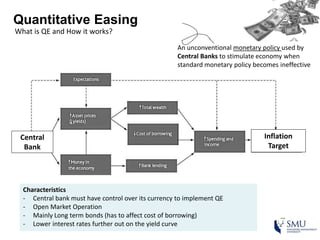
An unconventional monetary policy used by
Central Banks to stimulate economy when
standard monetary policy becomes ineffective
Central
Bank
Inflation
Target
Characteristics
- Central bank must have control over its currency to implement QE
- Open Market Operation
- Mainly Long term bonds (has to affect cost of borrowing)
- Lower interest rates further out on the yield curve
Quantitative Easing
What is QE and How it works?
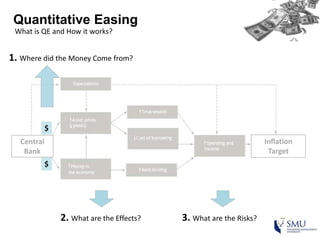
Central
Bank
Inflation
Target
$
$
1. Where did the Money Come from?
2. What are the Effects? 3. What are the Risks?
Quantitative Easing
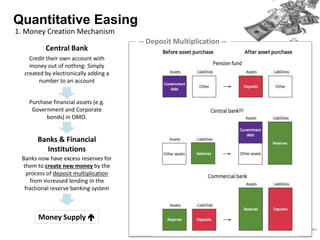
1. Money Creation Mechanism
Central Bank
Credit their own account with
money out of nothing: Simply
created by electronically adding a
number to an account
Banks & Financial
Institutions
Purchase financial assets (e.g.
Government and Corporate
bonds) in OMO.
Banks now have excess reserves for
them to create new money by the
process of deposit multiplication
from increased lending in the
fractional reserve banking system
Money Supply 
-- Deposit Multiplication --
Quantitative Easing
2. Effects
Economic Effects
- Lowers interest rates
- Reduction in systematic risks
- Improvement in market confidence
- Depreciates country’s exchange rates  Stimulates exports
- Higher stock prices  boost consumer wealth  Spur spending
- Boost employment
Limitations
- Reverse inflation more than target Hyperinflation
- Bank may still be reluctant to lend in a climate of increasing defaults
- Capital flight to other markets e.g. Emerging market, instead of lending to local
businesses
- Cost-push inflation instead of demand-pull inflation (due to rise in cost of factor of
productions)
Quantitative Easing
3. Risks
Wealth inequality
Increase in prices of stocks has disproportionately helped the wealthy who own the
vast majority of the financial assets (Bank of England, 2013)
Unpredictability
Lack of control over when the excess money supply will be loaned out (Economist
John Tayor, 2012)
Decrease in real value of savings and pension funds
Low yield rates induced by QE adversely affect returns on pension funds  fund will
stretch over a shorter period of time (World Pensions Council, 2012)
Protectionism
As net exporting countries have their currencies pegged to the Developed nations,
QE causes appreciation of other currencies thereby impacting their export demands
(BRIC, 2012)
Quantitative Easing
3. Risks
Over-leverage
Extremely low rates encourage borrowing  Increase leverage in corporates 
Risky if finance already fragile
Rising interest rates in future
Large scale buying of bonds in market limits the government’s ability to liquidate
their positions  Interests rates to rise in future  limits economic growth
Negligence by government
Loss of market discipline and negligence by government in tackling issue of
increased debt usage if QE can help finance government debts easily
Accumulation of risky assets
Issue of who will subsequently buy the risky assets  How to resolve? (Exit Plan)
Quantitative Easing
Applications of QE – Japan, US & Europe
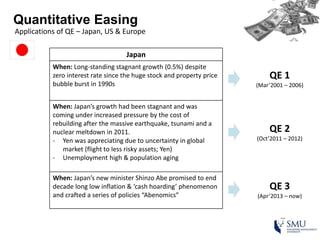
Japan
When: Long-standing stagnant growth (0.5%) despite
zero interest rate since the huge stock and property price
bubble burst in 1990s
When: Japan’s growth had been stagnant and was
coming under increased pressure by the cost of
rebuilding after the massive earthquake, tsunami and a
nuclear meltdown in 2011.
- Yen was appreciating due to uncertainty in global
market (flight to less risky assets; Yen)
- Unemployment high & population aging
When: Japan’s new minister Shinzo Abe promised to end
decade long low inflation & ‘cash hoarding’ phenomenon
and crafted a series of policies “Abenomics”
QE 1
(Mar’2001 – 2006)
QE 2
(Oct’2011 – 2012)
QE 3
(Apr’2013 – now)
Quantitative Easing
Applications of QE – Japan, US & Europe
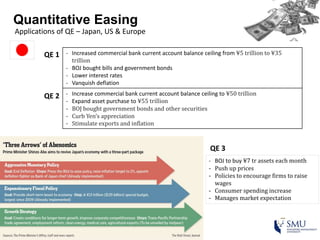
- Increased commercial bank current account balance ceiling from ¥5 trillion to ¥35
trillion for 4 years
- BOJ bought bills and government bonds
- Lower interest rates
- Vanquish deflation
- Increase commercial bank current account balance ceiling to ¥50 trillion
- Expand asset purchase to ¥55 trillion
- BOJ bought government bonds and other securities
- Curb Yen’s appreciation
- Stimulate exports and inflation
- BOJ to buy ¥7 tr assets each month
- Push up prices
- Policies to encourage firms to raise
wages
- Consumer spending increase
- Manages market expectation
QE 1
QE 2
QE 3
Quantitative Easing
Applications of QE – Japan, US & Europe
United States
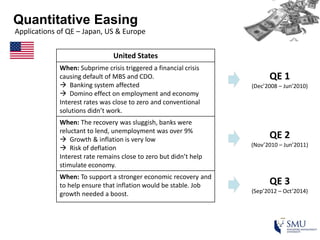
When: Subprime crisis triggered a financial crisis
causing default of MBS and CDO.
 Banking system affected
 Domino effect on employment and economy
Interest rates was close to zero and conventional
solutions didn’t work.
When: The recovery was sluggish, banks were
reluctant to lend, unemployment was over 9%
 Growth & inflation is very low
 Risk of deflation
Interest rate remains close to zero but didn’t help
stimulate economy.
When: To support a stronger economic recovery and
to help ensure that inflation would be stable. Job
growth needed a boost.
QE 1
(Dec’2008 – Jun’2010)
QE 2
(Nov’2010 – Jun’2011)
QE 3
(Sep’2012 – Oct’2014)
Quantitative Easing
Applications of QE – Japan, US & Europe
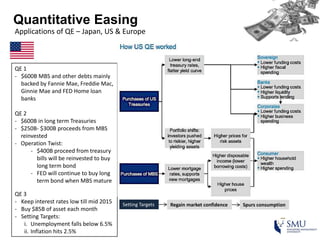
QE 1
- $600B MBS and other debts mainly
backed by Fannie Mae, Freddie Mac,
Ginnie Mae and FED Home loan
banks
QE 2
- $600B in long term Treasuries
- $250B- $300B proceeds from MBS
reinvested
- Operation Twist:
- $400B proceed from treasury
bills will be reinvested to buy
long term bond
- FED will continue to buy long
term bond when MBS mature
QE 3
- Keep interest rates low till mid 2015
- Buy $85B of asset each month
- Setting Targets:
i. Unemployment falls below 6.5%
ii. Inflation hits 2.5%
Setting Targets Regain market confidence Spurs consumption
Quantitative Easing
Applications of QE – Japan, US & Europe
United Monetary
Policy
+
Small economies took
advantage of low
borrowing cost
European
Debt Crisis
EU’s Monetary Policies
- Lower Interest rates
- European Financial
Stability Facility (EFSF)
- Make loaning easier
- Purchase Covered
bonds
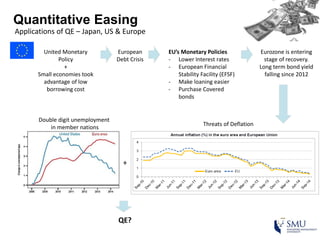
Eurozone is entering
stage of recovery.
Long term bond yield
falling since 2012
Threats of Deflation
QE?
Double digit unemployment
in member nations
+
Quantitative Easing
Applications of QE – Japan, US & Europe
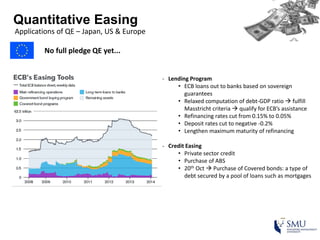
- Lending Program
• ECB loans out to banks based on sovereign
guarantees
• Relaxed computation of debt-GDP ratio  fulfill
Masstricht criteria  qualify for ECB’s assistance
• Refinancing rates cut from 0.15% to 0.05%
• Deposit rates cut to negative -0.2%
• Lengthen maximum maturity of refinancing
- Credit Easing
• Private sector credit
• Purchase of ABS
• 20th Oct  Purchase of Covered bonds: a type of
debt secured by a pool of loans such as mortgages
No full pledge QE yet...
Quantitative Easing
Effectiveness of QE
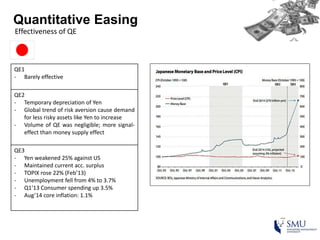
QE1
- Barely effective
QE2
- Temporary depreciation of Yen
- Global trend of risk aversion cause demand
for less risky assets like Yen to increase
- Volume of QE was negligible; more signal-
effect than money supply effect
QE3
- Yen weakened 25% against US
- Maintained current acc. surplus
- TOPIX rose 22% (Feb’13)
- Unemployment fell from 4% to 3.7%
- Q1’13 Consumer spending up 3.5%
- Aug’14 core inflation: 1.1%
Quantitative Easing
Effectiveness of QE
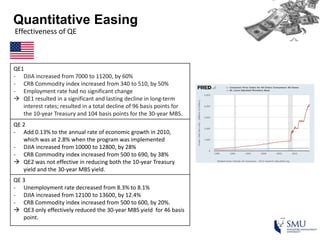
QE1
- DJIA increased from 7000 to 11200, by 60%
- CRB Commodity index increased from 340 to 510, by 50%
- Employment rate had no significant change
 QE1 resulted in a significant and lasting decline in long-term
interest rates; resulted in a total decline of 96 basis points for
the 10-year Treasury and 104 basis points for the 30-year MBS.
QE 2
- Add 0.13% to the annual rate of economic growth in 2010,
which was at 2.8% when the program was implemented
- DJIA increased from 10000 to 12800, by 28%
- CRB Commodity index increased from 500 to 690, by 38%
 QE2 was not effective in reducing both the 10-year Treasury
yield and the 30-year MBS yield.
QE 3
- Unemployment rate decreased from 8.3% to 8.1%
- DJIA increased from 12100 to 13600, by 12.4%
- CRB Commodity index increased from 500 to 600, by 20%.
 QE3 only effectively reduced the 30-year MBS yield for 46 basis
point.
Quantitative Easing
Effectiveness of QE
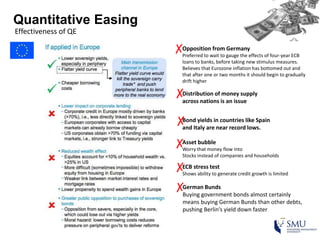
Bond yields in countries like Spain
and Italy are near record lows.
Distribution of money supply
across nations is an issue
Asset bubble
Worry that money flow into
Stocks instead of companies and households
ECB stress test
Shows ability to generate credit growth is limited
Opposition from Germany
Preferred to wait to gauge the effects of four-year ECB
loans to banks, before taking new stimulus measures.
Believes that Eurozone inflation has bottomed out and
that after one or two months it should begin to gradually
drift higher
✗
✗
✗
✗
✗
✗German Bunds
Buying government bonds almost certainly
means buying German Bunds than other debts,
pushing Berlin’s yield down faster
Quantitative Easing
Effectiveness of QE
Critical Factors for An Effective QE
1. Favorable Global conditions
2. Size of QE
3. Availability of Bonds in market
4. Adequate control over domestic currency
5. Focused effort (e.g. Abenomics)
6. Management of market expectation
7. Credibility of government
8. Consensus in market
Quantitative Easing
Aftermath of QE
Update on what are the countries doing
Japan US Europe
BOJ will be publishing assessment
of economy on 31st Oct’14
- Likely to keep QE till inflation
target reached
QE3 tapered and ended in Oct’14
 Keeping interest rates low for
now
 How to get rid of large amt of
bonds?
Recent ECB stress test shows
limited ability to generate credit
growth. After the test, its time ECB
will look into more expansionary
policies. (Inflation was 0.3% Sept)
Disposal of $3 Trillion of Debts
• Can’t sell $3 Trillion of securities at a time  Interest rates rise steeply  Disrupt
economic recovery
• Possible solutions:
• Allow securities to expire at maturity
• Cooperate with Treasury: Reduce issuance of long-term bond so FED can sell long-
term bonds in market and buy short-term debts  reduce impact on yield curve
1
2
Exit Plans
Gain effective control over interest rates
• Control rise in FED fund interest rates with I/r on reserve and overnight reverse REPO rates
Thank you
Brought to you by:
Jacob Sreekumaran
Ng Wenying
Kritika Rajeev
Wang Si Jie Jessie
Zhao Xin Zhu
Wu Shan
Cao Ya Jie
Meng Ming Jiao

Fixed income project quantitative easing

  • 1.
    Fixed Income AnalysisProject Quantitative Easing Brought to you by: Jacob Sreekumaran Ng Wenying Kritika Rajeev Wang Si Jie Jessie Zhao Xin Zhu Wu Shan Cao Ya Jie Meng Ming Jiao
  • 2.
    Quantitative Easing What isQE and How it works? An unconventional monetary policy used by Central Banks to stimulate economy when standard monetary policy becomes ineffective Central Bank Inflation Target Characteristics - Central bank must have control over its currency to implement QE - Open Market Operation - Mainly Long term bonds (has to affect cost of borrowing) - Lower interest rates further out on the yield curve
  • 3.
    Quantitative Easing What isQE and How it works? Central Bank Inflation Target $ $ 1. Where did the Money Come from? 2. What are the Effects? 3. What are the Risks?
  • 4.
    Quantitative Easing 1. MoneyCreation Mechanism Central Bank Credit their own account with money out of nothing: Simply created by electronically adding a number to an account Banks & Financial Institutions Purchase financial assets (e.g. Government and Corporate bonds) in OMO. Banks now have excess reserves for them to create new money by the process of deposit multiplication from increased lending in the fractional reserve banking system Money Supply  -- Deposit Multiplication --
  • 5.
    Quantitative Easing 2. Effects EconomicEffects - Lowers interest rates - Reduction in systematic risks - Improvement in market confidence - Depreciates country’s exchange rates  Stimulates exports - Higher stock prices  boost consumer wealth  Spur spending - Boost employment Limitations - Reverse inflation more than target Hyperinflation - Bank may still be reluctant to lend in a climate of increasing defaults - Capital flight to other markets e.g. Emerging market, instead of lending to local businesses - Cost-push inflation instead of demand-pull inflation (due to rise in cost of factor of productions)
  • 6.
    Quantitative Easing 3. Risks Wealthinequality Increase in prices of stocks has disproportionately helped the wealthy who own the vast majority of the financial assets (Bank of England, 2013) Unpredictability Lack of control over when the excess money supply will be loaned out (Economist John Tayor, 2012) Decrease in real value of savings and pension funds Low yield rates induced by QE adversely affect returns on pension funds  fund will stretch over a shorter period of time (World Pensions Council, 2012) Protectionism As net exporting countries have their currencies pegged to the Developed nations, QE causes appreciation of other currencies thereby impacting their export demands (BRIC, 2012)
  • 7.
    Quantitative Easing 3. Risks Over-leverage Extremelylow rates encourage borrowing  Increase leverage in corporates  Risky if finance already fragile Rising interest rates in future Large scale buying of bonds in market limits the government’s ability to liquidate their positions  Interests rates to rise in future  limits economic growth Negligence by government Loss of market discipline and negligence by government in tackling issue of increased debt usage if QE can help finance government debts easily Accumulation of risky assets Issue of who will subsequently buy the risky assets  How to resolve? (Exit Plan)
  • 8.
    Quantitative Easing Applications ofQE – Japan, US & Europe Japan When: Long-standing stagnant growth (0.5%) despite zero interest rate since the huge stock and property price bubble burst in 1990s When: Japan’s growth had been stagnant and was coming under increased pressure by the cost of rebuilding after the massive earthquake, tsunami and a nuclear meltdown in 2011. - Yen was appreciating due to uncertainty in global market (flight to less risky assets; Yen) - Unemployment high & population aging When: Japan’s new minister Shinzo Abe promised to end decade long low inflation & ‘cash hoarding’ phenomenon and crafted a series of policies “Abenomics” QE 1 (Mar’2001 – 2006) QE 2 (Oct’2011 – 2012) QE 3 (Apr’2013 – now)
  • 9.
    Quantitative Easing Applications ofQE – Japan, US & Europe - Increased commercial bank current account balance ceiling from ¥5 trillion to ¥35 trillion for 4 years - BOJ bought bills and government bonds - Lower interest rates - Vanquish deflation - Increase commercial bank current account balance ceiling to ¥50 trillion - Expand asset purchase to ¥55 trillion - BOJ bought government bonds and other securities - Curb Yen’s appreciation - Stimulate exports and inflation - BOJ to buy ¥7 tr assets each month - Push up prices - Policies to encourage firms to raise wages - Consumer spending increase - Manages market expectation QE 1 QE 2 QE 3
  • 10.
    Quantitative Easing Applications ofQE – Japan, US & Europe United States When: Subprime crisis triggered a financial crisis causing default of MBS and CDO.  Banking system affected  Domino effect on employment and economy Interest rates was close to zero and conventional solutions didn’t work. When: The recovery was sluggish, banks were reluctant to lend, unemployment was over 9%  Growth & inflation is very low  Risk of deflation Interest rate remains close to zero but didn’t help stimulate economy. When: To support a stronger economic recovery and to help ensure that inflation would be stable. Job growth needed a boost. QE 1 (Dec’2008 – Jun’2010) QE 2 (Nov’2010 – Jun’2011) QE 3 (Sep’2012 – Oct’2014)
  • 11.
    Quantitative Easing Applications ofQE – Japan, US & Europe QE 1 - $600B MBS and other debts mainly backed by Fannie Mae, Freddie Mac, Ginnie Mae and FED Home loan banks QE 2 - $600B in long term Treasuries - $250B- $300B proceeds from MBS reinvested - Operation Twist: - $400B proceed from treasury bills will be reinvested to buy long term bond - FED will continue to buy long term bond when MBS mature QE 3 - Keep interest rates low till mid 2015 - Buy $85B of asset each month - Setting Targets: i. Unemployment falls below 6.5% ii. Inflation hits 2.5% Setting Targets Regain market confidence Spurs consumption
  • 12.
    Quantitative Easing Applications ofQE – Japan, US & Europe United Monetary Policy + Small economies took advantage of low borrowing cost European Debt Crisis EU’s Monetary Policies - Lower Interest rates - European Financial Stability Facility (EFSF) - Make loaning easier - Purchase Covered bonds Eurozone is entering stage of recovery. Long term bond yield falling since 2012 Threats of Deflation QE? Double digit unemployment in member nations +
  • 13.
    Quantitative Easing Applications ofQE – Japan, US & Europe - Lending Program • ECB loans out to banks based on sovereign guarantees • Relaxed computation of debt-GDP ratio  fulfill Masstricht criteria  qualify for ECB’s assistance • Refinancing rates cut from 0.15% to 0.05% • Deposit rates cut to negative -0.2% • Lengthen maximum maturity of refinancing - Credit Easing • Private sector credit • Purchase of ABS • 20th Oct  Purchase of Covered bonds: a type of debt secured by a pool of loans such as mortgages No full pledge QE yet...
  • 14.
    Quantitative Easing Effectiveness ofQE QE1 - Barely effective QE2 - Temporary depreciation of Yen - Global trend of risk aversion cause demand for less risky assets like Yen to increase - Volume of QE was negligible; more signal- effect than money supply effect QE3 - Yen weakened 25% against US - Maintained current acc. surplus - TOPIX rose 22% (Feb’13) - Unemployment fell from 4% to 3.7% - Q1’13 Consumer spending up 3.5% - Aug’14 core inflation: 1.1%
  • 15.
    Quantitative Easing Effectiveness ofQE QE1 - DJIA increased from 7000 to 11200, by 60% - CRB Commodity index increased from 340 to 510, by 50% - Employment rate had no significant change  QE1 resulted in a significant and lasting decline in long-term interest rates; resulted in a total decline of 96 basis points for the 10-year Treasury and 104 basis points for the 30-year MBS. QE 2 - Add 0.13% to the annual rate of economic growth in 2010, which was at 2.8% when the program was implemented - DJIA increased from 10000 to 12800, by 28% - CRB Commodity index increased from 500 to 690, by 38%  QE2 was not effective in reducing both the 10-year Treasury yield and the 30-year MBS yield. QE 3 - Unemployment rate decreased from 8.3% to 8.1% - DJIA increased from 12100 to 13600, by 12.4% - CRB Commodity index increased from 500 to 600, by 20%.  QE3 only effectively reduced the 30-year MBS yield for 46 basis point.
  • 16.
    Quantitative Easing Effectiveness ofQE Bond yields in countries like Spain and Italy are near record lows. Distribution of money supply across nations is an issue Asset bubble Worry that money flow into Stocks instead of companies and households ECB stress test Shows ability to generate credit growth is limited Opposition from Germany Preferred to wait to gauge the effects of four-year ECB loans to banks, before taking new stimulus measures. Believes that Eurozone inflation has bottomed out and that after one or two months it should begin to gradually drift higher ✗ ✗ ✗ ✗ ✗ ✗German Bunds Buying government bonds almost certainly means buying German Bunds than other debts, pushing Berlin’s yield down faster
  • 17.
    Quantitative Easing Effectiveness ofQE Critical Factors for An Effective QE 1. Favorable Global conditions 2. Size of QE 3. Availability of Bonds in market 4. Adequate control over domestic currency 5. Focused effort (e.g. Abenomics) 6. Management of market expectation 7. Credibility of government 8. Consensus in market
  • 18.
    Quantitative Easing Aftermath ofQE Update on what are the countries doing Japan US Europe BOJ will be publishing assessment of economy on 31st Oct’14 - Likely to keep QE till inflation target reached QE3 tapered and ended in Oct’14  Keeping interest rates low for now  How to get rid of large amt of bonds? Recent ECB stress test shows limited ability to generate credit growth. After the test, its time ECB will look into more expansionary policies. (Inflation was 0.3% Sept) Disposal of $3 Trillion of Debts • Can’t sell $3 Trillion of securities at a time  Interest rates rise steeply  Disrupt economic recovery • Possible solutions: • Allow securities to expire at maturity • Cooperate with Treasury: Reduce issuance of long-term bond so FED can sell long- term bonds in market and buy short-term debts  reduce impact on yield curve 1 2 Exit Plans Gain effective control over interest rates • Control rise in FED fund interest rates with I/r on reserve and overnight reverse REPO rates
  • 19.
    Thank you Brought toyou by: Jacob Sreekumaran Ng Wenying Kritika Rajeev Wang Si Jie Jessie Zhao Xin Zhu Wu Shan Cao Ya Jie Meng Ming Jiao

Editor's Notes