Slowing down of every economic activity In a recession many things falls together- production, employment, prices, and business profits Business go bust, and this can lead to runs on banks and a crisis in the financial system
Contradictory opinions are provided by economist for causes of “Recession”. A school of thought blames it on “Higher Savings and Less Expenditure” Others thought it as an outcome of “Excessive  Spending”
As it is a vicious circle no body could go back and trace when it started We can trace back “Recession : 2008” to Financial Crisis in United States, which started in 2003(it wasn’t called recession at that time) The period was just after the end of “dotcom boom” busted US Government started pumping money into the system
Higher money in system created higher overall demand in US Starting of “Housing Boom” in US Disbursing money to borrowers (sub-prime loan) to buy houses and other households without checking creditworthiness of borrowers Loans converted into securities by banks and sold to keep liquidity intact with it Extra liquidity out of sale of security again disbursed (prime as well as sub-prime)
Securities widely circulated in the financial system of US Major players were Financial Institutions and Investment Bankers in which many other entities and people are having investments They ( FI`s and IB`s) have investments in developing countries through direct investments and through share market of that nation
Default in repayment of housing loan started FI`s and IB`s started feeling liquidity crunch Along with them all the investors who have invested in those securities started feeling crunch This has affected liquidity and profitability badly at US market as well as in Financial Markets throughout the world
Globalization Dependency of developing countries on the “Demand” generated from high spending countries like US and Eurozone has increased Huge money (some trillion $)of various FI and IB are invested in these developing economies  through direct investment and share market
When these FI`s & IB`s started feeling liquidity crunch, they started withdrawing money from developing countries At the same time process of bankruptcy, heavy losses, huge lay off`s of people started in US  This has resulted into slow down of overall demand in the market of US and vanishing of money from the world market
With a slowdown in US market many in developing economies started feeling pinch of cash in their market This is the beginning of slowdown in other financial markets in the world Along with slowed down US market many FI`s and IB`s started withdrawing money from these developing nations to save there business at home has added fuel to liquidity crunch
Thus slowdown process has gripped whole world slowly and steadily The process is still going on No direct impact on nations like China and India is yet seen Indirect impact was so huge that share market in China and India shaded almost 50% of their value
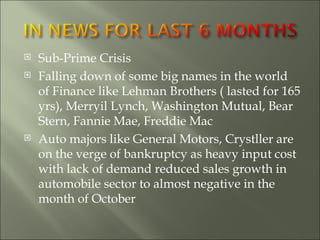
Sub-Prime Crisis Falling down of some big names in the world of Finance like Lehman Brothers ( lasted for 165 yrs), Merryil Lynch, Washington Mutual, Bear Stern, Fannie Mae, Freddie Mac  Auto majors like General Motors, Crystller are on the verge of bankruptcy as heavy input cost with lack of demand reduced sales growth in automobile sector to almost negative in the month of October
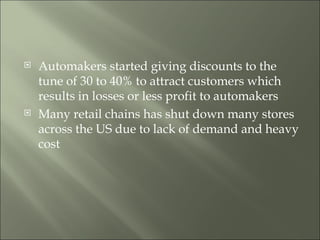
Automakers started giving discounts to the tune of 30 to 40% to attract customers which results in losses or less profit to automakers Many retail chains has shut down many stores across the US due to lack of demand and heavy cost
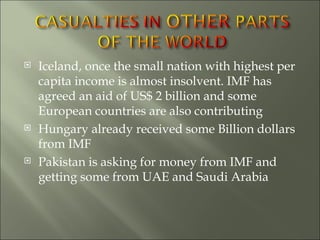
Iceland, once the small nation with highest per capita income is almost insolvent. IMF has agreed an aid of US$ 2 billion and some European countries are also contributing Hungary already received some Billion dollars from IMF Pakistan is asking for money from IMF and getting some from UAE and Saudi Arabia
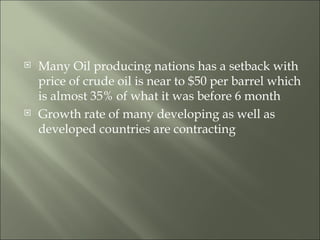
Many Oil producing nations has a setback with price of crude oil is near to $50 per barrel which is almost 35% of what it was before 6 month Growth rate of many developing as well as developed countries are contracting
The slowdown in US and other developed nations is definitely hurting INDIAN growth story The signs of this can be evidenced from the tumbling share market ( BSE & NSE ) which shed more than 50% since Jan 08.
Sectors affected till now are almost all, reason behind this is:  External Trade of India : 40% of GDP FII`s Investment in share market upto Jan 08:  US $ 65 Billion FDI in India (Jan 08) : US $ 50 Billion Estimates of Annual GDP has been lowered  to 7.5% from 9%
70% of IT export is to US, out of which 40 % is to  Finance Sector Many international garment brands  are made in  “Tirupur” factories in “Tamilnadu” in “India” From Surat in Gujarat, Diamonds are exported to  US and other countries All these are few examples how India is going to get affected
Two kind of measures can be taken, first is “Monetary” and other more important “Fiscal” measures RBI has already initiated certain monetary measures to reduce the impact and increase the liquidity in Indian market These measures includes reduction in CRR by 350 bps, Repo by 150 bps and reduction of SLR to 24% from 25%
As of now Government has not taken any concrete fiscal measures to boost the economy Import duty on Steel, Iron and some other metals has been increased by 5 to 20% to make import of these items costlier Government through some central agencies trying to increase FII`s & FDI fund flow in India as well as attracting NRI money
Expect a very good budget for the year 2009-10 from Finance Minister P.Chidambarm Some benefits like reduction in key rates of excise duties, service tax, central sales tax are expected as the next year will be election year This measures will improve the demand as price will reduce for many goods
Try to spend less and save more You can certainly expect lower prices of essentials like houses, consumer goods, computers, buy them if you have spare money  Keep plan ready your budget for worst situation
It is a good opportunity for many to invest in share market and in housing  as the prices are very low Try to invest in yourself to improve your skills, so that after recession you should be the first to grab the right opportunity  It will save the “environment” from the heavy emission of greenhouse gasses


Recession

  • 1.
  • 2.
    Slowing down ofevery economic activity In a recession many things falls together- production, employment, prices, and business profits Business go bust, and this can lead to runs on banks and a crisis in the financial system
  • 3.
    Contradictory opinions areprovided by economist for causes of “Recession”. A school of thought blames it on “Higher Savings and Less Expenditure” Others thought it as an outcome of “Excessive Spending”
  • 4.
    As it isa vicious circle no body could go back and trace when it started We can trace back “Recession : 2008” to Financial Crisis in United States, which started in 2003(it wasn’t called recession at that time) The period was just after the end of “dotcom boom” busted US Government started pumping money into the system
  • 5.
    Higher money insystem created higher overall demand in US Starting of “Housing Boom” in US Disbursing money to borrowers (sub-prime loan) to buy houses and other households without checking creditworthiness of borrowers Loans converted into securities by banks and sold to keep liquidity intact with it Extra liquidity out of sale of security again disbursed (prime as well as sub-prime)
  • 6.
    Securities widely circulatedin the financial system of US Major players were Financial Institutions and Investment Bankers in which many other entities and people are having investments They ( FI`s and IB`s) have investments in developing countries through direct investments and through share market of that nation
  • 7.
    Default in repaymentof housing loan started FI`s and IB`s started feeling liquidity crunch Along with them all the investors who have invested in those securities started feeling crunch This has affected liquidity and profitability badly at US market as well as in Financial Markets throughout the world
  • 8.
    Globalization Dependency ofdeveloping countries on the “Demand” generated from high spending countries like US and Eurozone has increased Huge money (some trillion $)of various FI and IB are invested in these developing economies through direct investment and share market
  • 9.
    When these FI`s& IB`s started feeling liquidity crunch, they started withdrawing money from developing countries At the same time process of bankruptcy, heavy losses, huge lay off`s of people started in US This has resulted into slow down of overall demand in the market of US and vanishing of money from the world market
  • 10.
    With a slowdownin US market many in developing economies started feeling pinch of cash in their market This is the beginning of slowdown in other financial markets in the world Along with slowed down US market many FI`s and IB`s started withdrawing money from these developing nations to save there business at home has added fuel to liquidity crunch
  • 11.
    Thus slowdown processhas gripped whole world slowly and steadily The process is still going on No direct impact on nations like China and India is yet seen Indirect impact was so huge that share market in China and India shaded almost 50% of their value
  • 12.
    Sub-Prime Crisis Fallingdown of some big names in the world of Finance like Lehman Brothers ( lasted for 165 yrs), Merryil Lynch, Washington Mutual, Bear Stern, Fannie Mae, Freddie Mac Auto majors like General Motors, Crystller are on the verge of bankruptcy as heavy input cost with lack of demand reduced sales growth in automobile sector to almost negative in the month of October
  • 13.
    Automakers started givingdiscounts to the tune of 30 to 40% to attract customers which results in losses or less profit to automakers Many retail chains has shut down many stores across the US due to lack of demand and heavy cost
  • 14.
    Iceland, once thesmall nation with highest per capita income is almost insolvent. IMF has agreed an aid of US$ 2 billion and some European countries are also contributing Hungary already received some Billion dollars from IMF Pakistan is asking for money from IMF and getting some from UAE and Saudi Arabia
  • 15.
    Many Oil producingnations has a setback with price of crude oil is near to $50 per barrel which is almost 35% of what it was before 6 month Growth rate of many developing as well as developed countries are contracting
  • 16.
    The slowdown inUS and other developed nations is definitely hurting INDIAN growth story The signs of this can be evidenced from the tumbling share market ( BSE & NSE ) which shed more than 50% since Jan 08.
  • 17.
    Sectors affected tillnow are almost all, reason behind this is: External Trade of India : 40% of GDP FII`s Investment in share market upto Jan 08: US $ 65 Billion FDI in India (Jan 08) : US $ 50 Billion Estimates of Annual GDP has been lowered to 7.5% from 9%
  • 18.
    70% of ITexport is to US, out of which 40 % is to Finance Sector Many international garment brands are made in “Tirupur” factories in “Tamilnadu” in “India” From Surat in Gujarat, Diamonds are exported to US and other countries All these are few examples how India is going to get affected
  • 19.
    Two kind ofmeasures can be taken, first is “Monetary” and other more important “Fiscal” measures RBI has already initiated certain monetary measures to reduce the impact and increase the liquidity in Indian market These measures includes reduction in CRR by 350 bps, Repo by 150 bps and reduction of SLR to 24% from 25%
  • 20.
    As of nowGovernment has not taken any concrete fiscal measures to boost the economy Import duty on Steel, Iron and some other metals has been increased by 5 to 20% to make import of these items costlier Government through some central agencies trying to increase FII`s & FDI fund flow in India as well as attracting NRI money
  • 21.
    Expect a verygood budget for the year 2009-10 from Finance Minister P.Chidambarm Some benefits like reduction in key rates of excise duties, service tax, central sales tax are expected as the next year will be election year This measures will improve the demand as price will reduce for many goods
  • 22.
    Try to spendless and save more You can certainly expect lower prices of essentials like houses, consumer goods, computers, buy them if you have spare money Keep plan ready your budget for worst situation
  • 23.
    It is agood opportunity for many to invest in share market and in housing as the prices are very low Try to invest in yourself to improve your skills, so that after recession you should be the first to grab the right opportunity It will save the “environment” from the heavy emission of greenhouse gasses
  • 24.
  • 25.