The Determinants of Long-Term Japanese 
Government Bonds’ (JGBs) Low Nominal Yields 
Tanweer Akram (Voya Investment Management) 
Anupam Das (Mount Royal University) 
12th International Post Keynesian Conference (Sep 25-Sep 27, 2014) 
University of Missouri Kansas City (UMKC) 
Kansas City, Missouri, USA
Important Disclaimer 
This commentary has been prepared by Voya Investment Management for informational purposes. 
Nothing contained herein should be construed as (i) an offer to sell or solicitation of an offer to buy 
any security or (ii) a recommendation as to the advisability of investing in, purchasing or selling any 
security. Any opinions expressed herein reflect our judgment and are subject to change. Certain of 
the statements contained herein are statements of future expectations and other forward-looking 
statements that are based on management’s current views and assumptions and involve known and 
unknown risks and uncertainties that could cause actual results, performance or events to differ 
materially from those expressed or implied in such statements. Actual results, performance or events 
may differ materially from those in such statements due to, without limitation, (1) general economic 
conditions, (2) performance of financial markets, (3) interest rate levels, (4) increasing levels of loan 
defaults (5) changes in laws and regulations and (6) changes in the policies of governments and/or 
regulatory authorities. The opinions, views and information expressed in this commentary regarding 
holdings are subject to change without notice. The information provided regarding holdings is not a 
recommendation to buy or sell any security. Fund holdings are fluid and are subject to daily change 
based on market conditions and other factors. Past performance is no guarantee of future results. 
Voya Compliance ID # 10535 
2
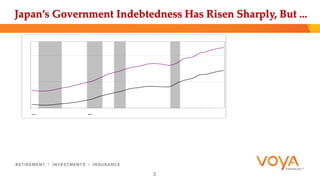
Japan’s Government Indebtedness Has Risen Sharply, But ... 
3
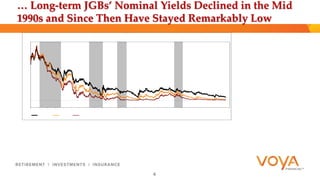
… Long-term JGBs’ Nominal Yields Declined in the Mid 
1990s and Since Then Have Stayed Remarkably Low 
4
Motivation and the Main Research Question 
 The Japanese economy has been mired in slow growth that has 
resulted in large and chronic fiscal deficits (net borrowing) leading 
to elevated and rising government debt (financial liabilities) ratios. 
But long-term JGBs’ nominal yields have stayed remarkably low 
and declined over time. 
 The conventional wisdom holds that higher government deficits 
and indebtedness will exert upward pressure on nominal yields 
(Baldacci and Kumar 2010, Lam and Tokuoka 2011, Tokuoka 2012, 
Gruber and Kamin 2012, and Poghosyan 2012). 
 Why have long term JGBs’ nominal yields stayed ultra low? 
5
The Determinants of Long-term JGBs’ Low Nominal Yields 
 Monetary sovereignty 
 Low short-term interest rates 
 Low inflation and indeed persistent deflationary 
pressures 
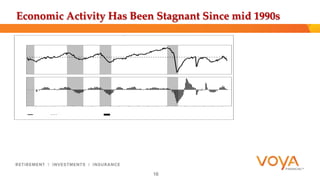
 Tepid economic activity 
6
What is Monetary Sovereignty? 
A government with monetary sovereignty has the 
following characteristics (Wray 2012, p. 30): 
 Sets its own unit of account 
 Issues liability denominated in that unit of 
account 
 A monopoly issuer of unconvertible financial 
means of payment denominated in that unit of 
account 
 The authority to tax and to determine what is 
accepted in payment of taxes that it imposes 
7
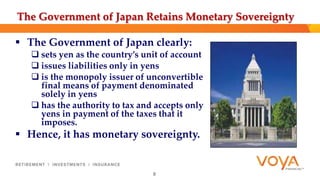
The Government of Japan Retains Monetary Sovereignty 
 The Government of Japan clearly: 
 sets yen as the country’s unit of account 
 issues liabilities only in yens 
 is the monopoly issuer of unconvertible 
final means of payment denominated 
solely in yens 
 has the authority to tax and accepts only 
yens in payment of the taxes that it 
imposes. 
 Hence, it has monetary sovereignty. 
8
JGBs Are Merely Promises to Deliver More of Its Own 
Liabilities! 
 Following Woodford (2001, p. 31), as cited in Tcherneva (2010, p.15), it can 
be paraphrased that for any sovereign government that issues debts in its 
own currency, such as Japan, its debt is merely a promise to deliver more 
of its own liabilities in the future. 
 There are, hence, no operational barriers for the government of Japan to 
service its debt. As such, Japanese authorities are theoretically free from 
obsessing about fiscal consolidation. (In contrast the euro zone countries 
and the state governments of the U.S. have no monetary sovereignty.) 
 The liabilities of governments that retain monetary sovereignty and are 
currency issuers are fundamentally different from that of households, 
businesses, and governments that do not possess sovereignty and hence 
are currency users. 
9
Christopher Sims and “Paper Money” 
10
Nominal Debt Merely Promises Costless “Paper” 
Christopher Sims (2013) has argued that the following: 
 “since nominal debt promises to pay only costless paper, it is never 
necessary for it to default” 
 “a central bank with the fiscal backing from a Treasury that can 
issue nominal debt is the most powerful form of a lender of last 
resort” 
 “The effects of monetary policy actions depend on … fiscal policy 
actions they stimulate …” 
 “Nominal and real government debt are quite different, as are 
inflation and outright default.” 
 “Central bank ‘independence’ should not mean that all connections 
between monetary and fiscal policy authorities are severed.” 
11
Hypothesis: Low Short-term Interest Rates Have Kept 
Long-term JBGs’ Nominal Yields Low 
 Low short-term interest rates, induced by the 
monetary authorities, have been a key driver of 
JGBs’ low nominal yields, while monetary 
sovereignty implies that the Government of Japan 
has the ability to always service its debt issued in its 
own currency. 
 Japan’s experience of JGBs’ low nominal yields 
under extremely accommodative monetary policy 
and ultra low policy rates vindicates Keynes’s (1930) 
view that long-term interest rates primarily respond 
to monetary policy which exerts its direct influence 
on short-term interest rates. 
12
Keynes’s Insights on LT Government Bonds’ Nominal 
Yields 
 The central bank usually sets the overnight rates and various other 
short-term policy rates. This was well understood by John Maynard 
Keynes (1930), as cited in Kregel (2011). 
 Fundamental uncertainty about the future and the effect of short-term 
realization on long-term expectations can keep long-term interest rates 
largely in harmony with short-term interest rates. 
 Keynes’s (1930) conjectures, as cited in Kregel (2011), on long-term 
interest rates were based on his interpretation of the empirical research 
of Reifler (1930). 
13
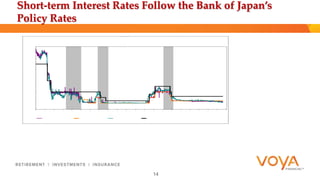
Short-term Interest Rates Follow the Bank of Japan’s 
Policy Rates 
14
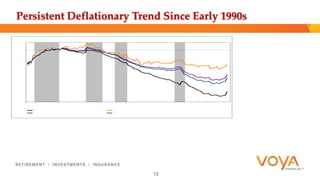
Persistent Deflationary Trend Since Early 1990s 
15
Economic Activity Has Been Stagnant Since mid 1990s 
16
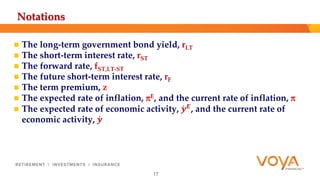
Notations 
 The long-term government bond yield, rLT 
 The short-term interest rate, rST 
 The forward rate, fST,LT-ST 
 The future short-term interest rate, rF 
 The term premium, z 
 The expected rate of inflation, E, and the current rate of inflation,  
 The expected rate of economic activity, 풚 푬, and the current rate of 
economic activity, 풚 
17
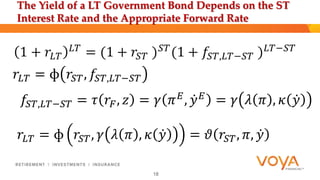
The Yield of a LT Government Bond Depends on the ST 
Interest Rate and the Appropriate Forward Rate 
1 + 푟퐿푇 
퐿푇 = (1 + 푟푆푇 )푆푇 (1 + 푓푆푇,퐿푇−푆푇 )퐿푇−푆푇 
푟퐿푇 = ɸ 푟푆푇 , 푓푆푇,퐿푇−푆푇 
푓푆푇,퐿푇−푆푇 = 휏 푟퐹, 푧 = 훾 휋퐸, 푦 퐸 = 훾 휆 휋 , 휅 푦 
푟퐿푇 = ɸ 푟푆푇, 훾 휆 휋 , 휅 푦 = 휗 푟푆푇, 휋, 푦 
18
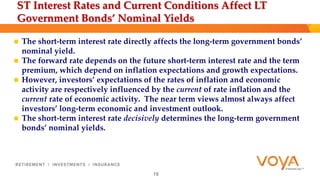
ST Interest Rates and Current Conditions Affect LT 
Government Bonds’ Nominal Yields 
 The short-term interest rate directly affects the long-term government bonds’ 
nominal yield. 
 The forward rate depends on the future short-term interest rate and the term 
premium, which depend on inflation expectations and growth expectations. 
 However, investors’ expectations of the rates of inflation and economic 
activity are respectively influenced by the current of rate inflation and the 
current rate of economic activity. The near term views almost always affect 
investors’ long-term economic and investment outlook. 
 The short-term interest rate decisively determines the long-term government 
bonds’ nominal yields. 
19
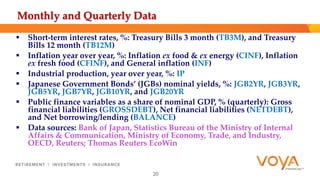
Monthly and Quarterly Data 
 Short-term interest rates, %: Treasury Bills 3 month (TB3M), and Treasury 
Bills 12 month (TB12M) 
 Inflation year over year, %: Inflation ex food & ex energy (CINF), Inflation 
ex fresh food (CFINF), and General inflation (INF) 
 Industrial production, year over year, %: IP 
 Japanese Government Bonds’ (JGBs) nominal yields, %: JGB2YR, JGB3YR, 
JGB5YR, JGB7YR, JGB10YR, and JGB20YR 
 Public finance variables as a share of nominal GDP, % (quarterly): Gross 
financial liabilities (GROSSDEBT), Net financial liabilities (NETDEBT), 
and Net borrowing/lending (BALANCE) 
 Data sources: Bank of Japan, Statistics Bureau of the Ministry of Internal 
Affairs & Communication, Ministry of Economy, Trade, and Industry, 
OECD, Reuters; Thomas Reuters EcoWin 
20
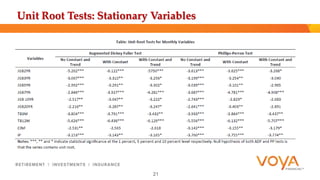
Unit Root Tests: Stationary Variables 
21
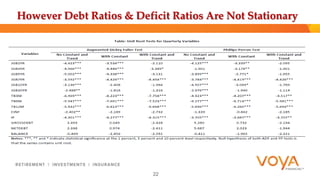
However Debt Ratios & Deficit Ratios Are Not Stationary 
22
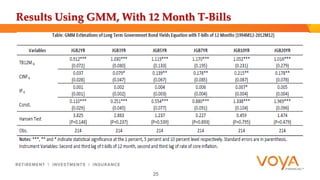
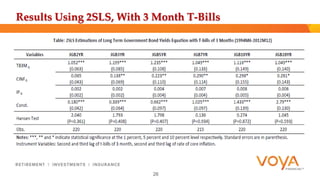
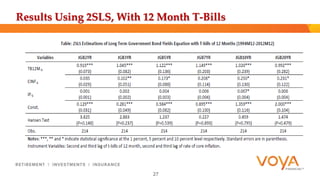
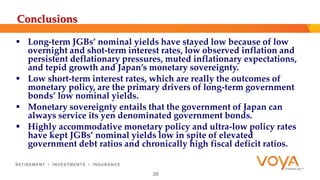
Main Empirical Findings 
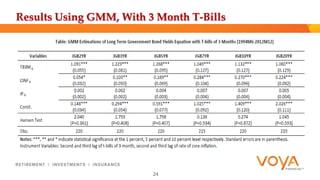
 The coefficients of short‐term interest rates, whether using T‐bills of 3 months or 12 
months, are positive and always statistically significant. It implies that JGBs’ nominal 
yields are extremely sensitive to short-term interest rates. 
 The coefficients of the rates of core inflation are positive and statistically significant but 
moderate in magnitude. It implies that as core inflation picks up (decline) JGBs’ 
nominal yields rise (fall). 
 The coefficients of the growth of industrial production are positive but low and 
statistically insignificant. This implies that JGBs’ nominal yields are fairly insensitive to 
the pace of economic activity. 
 The Hansen (1982) J test for over identifying restrictions is used to check for the validity 
and relevance of instruments. The Hansen’s J statistic is insignificant in most cases, 
which means that the test does not reject the null hypothesis that the instruments are 
uncorrelated with the error term. 
23
Results Using GMM, With 3 Month T-Bills 
24
Results Using GMM, With 12 Month T-Bills 
25
Results Using 2SLS, With 3 Month T-Bills 
26
Results Using 2SLS, With 12 Month T-Bills 
27
Conclusions 
 Long-term JGBs’ nominal yields have stayed low because of low 
overnight and shot-term interest rates, low observed inflation and 
persistent deflationary pressures, muted inflationary expectations, 
and tepid growth and Japan’s monetary sovereignty. 
 Low short-term interest rates, which are really the outcomes of 
monetary policy, are the primary drivers of long-term government 
bonds’ low nominal yields. 
 Monetary sovereignty entails that the government of Japan can 
always service its yen denominated government bonds. 
 Highly accommodative monetary policy and ultra-low policy rates 
have kept JGBs’ nominal yields low in spite of elevated 
government debt ratios and chronically high fiscal deficit ratios. 
28
This Presentation is Based on Recent Papers 
 Akram, Tanweer, and Das, Anupam (2014a). “Understanding the 
Low Yields of the Long-Term Japanese Sovereign Debt,” Journal 
of Economic Issues 48(2): 331-340. 
 Akram, Tanweer , and Das, Anupam (2014b). “The Determinants 
of Long‐Term Japanese Government Bonds’ Low Nominal 
Yields,” unpublished working paper. 
 Akram, Tanweer (2014). “The Economics of Japan’s Stagnation,” 
Business Economics 49(3): 156–175. 
29

The Determinants of Long-Term Japanese Government Bonds’ (JGBs) Low Nominal Yields

  • 1.
    The Determinants ofLong-Term Japanese Government Bonds’ (JGBs) Low Nominal Yields Tanweer Akram (Voya Investment Management) Anupam Das (Mount Royal University) 12th International Post Keynesian Conference (Sep 25-Sep 27, 2014) University of Missouri Kansas City (UMKC) Kansas City, Missouri, USA
  • 2.
    Important Disclaimer Thiscommentary has been prepared by Voya Investment Management for informational purposes. Nothing contained herein should be construed as (i) an offer to sell or solicitation of an offer to buy any security or (ii) a recommendation as to the advisability of investing in, purchasing or selling any security. Any opinions expressed herein reflect our judgment and are subject to change. Certain of the statements contained herein are statements of future expectations and other forward-looking statements that are based on management’s current views and assumptions and involve known and unknown risks and uncertainties that could cause actual results, performance or events to differ materially from those expressed or implied in such statements. Actual results, performance or events may differ materially from those in such statements due to, without limitation, (1) general economic conditions, (2) performance of financial markets, (3) interest rate levels, (4) increasing levels of loan defaults (5) changes in laws and regulations and (6) changes in the policies of governments and/or regulatory authorities. The opinions, views and information expressed in this commentary regarding holdings are subject to change without notice. The information provided regarding holdings is not a recommendation to buy or sell any security. Fund holdings are fluid and are subject to daily change based on market conditions and other factors. Past performance is no guarantee of future results. Voya Compliance ID # 10535 2
  • 3.
    Japan’s Government IndebtednessHas Risen Sharply, But ... 3
  • 4.
    … Long-term JGBs’Nominal Yields Declined in the Mid 1990s and Since Then Have Stayed Remarkably Low 4
  • 5.
    Motivation and theMain Research Question  The Japanese economy has been mired in slow growth that has resulted in large and chronic fiscal deficits (net borrowing) leading to elevated and rising government debt (financial liabilities) ratios. But long-term JGBs’ nominal yields have stayed remarkably low and declined over time.  The conventional wisdom holds that higher government deficits and indebtedness will exert upward pressure on nominal yields (Baldacci and Kumar 2010, Lam and Tokuoka 2011, Tokuoka 2012, Gruber and Kamin 2012, and Poghosyan 2012).  Why have long term JGBs’ nominal yields stayed ultra low? 5
  • 6.
    The Determinants ofLong-term JGBs’ Low Nominal Yields  Monetary sovereignty  Low short-term interest rates  Low inflation and indeed persistent deflationary pressures  Tepid economic activity 6
  • 7.
    What is MonetarySovereignty? A government with monetary sovereignty has the following characteristics (Wray 2012, p. 30):  Sets its own unit of account  Issues liability denominated in that unit of account  A monopoly issuer of unconvertible financial means of payment denominated in that unit of account  The authority to tax and to determine what is accepted in payment of taxes that it imposes 7
  • 8.
    The Government ofJapan Retains Monetary Sovereignty  The Government of Japan clearly:  sets yen as the country’s unit of account  issues liabilities only in yens  is the monopoly issuer of unconvertible final means of payment denominated solely in yens  has the authority to tax and accepts only yens in payment of the taxes that it imposes.  Hence, it has monetary sovereignty. 8
  • 9.
    JGBs Are MerelyPromises to Deliver More of Its Own Liabilities!  Following Woodford (2001, p. 31), as cited in Tcherneva (2010, p.15), it can be paraphrased that for any sovereign government that issues debts in its own currency, such as Japan, its debt is merely a promise to deliver more of its own liabilities in the future.  There are, hence, no operational barriers for the government of Japan to service its debt. As such, Japanese authorities are theoretically free from obsessing about fiscal consolidation. (In contrast the euro zone countries and the state governments of the U.S. have no monetary sovereignty.)  The liabilities of governments that retain monetary sovereignty and are currency issuers are fundamentally different from that of households, businesses, and governments that do not possess sovereignty and hence are currency users. 9
  • 10.
    Christopher Sims and“Paper Money” 10
  • 11.
    Nominal Debt MerelyPromises Costless “Paper” Christopher Sims (2013) has argued that the following:  “since nominal debt promises to pay only costless paper, it is never necessary for it to default”  “a central bank with the fiscal backing from a Treasury that can issue nominal debt is the most powerful form of a lender of last resort”  “The effects of monetary policy actions depend on … fiscal policy actions they stimulate …”  “Nominal and real government debt are quite different, as are inflation and outright default.”  “Central bank ‘independence’ should not mean that all connections between monetary and fiscal policy authorities are severed.” 11
  • 12.
    Hypothesis: Low Short-termInterest Rates Have Kept Long-term JBGs’ Nominal Yields Low  Low short-term interest rates, induced by the monetary authorities, have been a key driver of JGBs’ low nominal yields, while monetary sovereignty implies that the Government of Japan has the ability to always service its debt issued in its own currency.  Japan’s experience of JGBs’ low nominal yields under extremely accommodative monetary policy and ultra low policy rates vindicates Keynes’s (1930) view that long-term interest rates primarily respond to monetary policy which exerts its direct influence on short-term interest rates. 12
  • 13.
    Keynes’s Insights onLT Government Bonds’ Nominal Yields  The central bank usually sets the overnight rates and various other short-term policy rates. This was well understood by John Maynard Keynes (1930), as cited in Kregel (2011).  Fundamental uncertainty about the future and the effect of short-term realization on long-term expectations can keep long-term interest rates largely in harmony with short-term interest rates.  Keynes’s (1930) conjectures, as cited in Kregel (2011), on long-term interest rates were based on his interpretation of the empirical research of Reifler (1930). 13
  • 14.
    Short-term Interest RatesFollow the Bank of Japan’s Policy Rates 14
  • 15.
    Persistent Deflationary TrendSince Early 1990s 15
  • 16.
    Economic Activity HasBeen Stagnant Since mid 1990s 16
  • 17.
    Notations  Thelong-term government bond yield, rLT  The short-term interest rate, rST  The forward rate, fST,LT-ST  The future short-term interest rate, rF  The term premium, z  The expected rate of inflation, E, and the current rate of inflation,   The expected rate of economic activity, 풚 푬, and the current rate of economic activity, 풚 17
  • 18.
    The Yield ofa LT Government Bond Depends on the ST Interest Rate and the Appropriate Forward Rate 1 + 푟퐿푇 퐿푇 = (1 + 푟푆푇 )푆푇 (1 + 푓푆푇,퐿푇−푆푇 )퐿푇−푆푇 푟퐿푇 = ɸ 푟푆푇 , 푓푆푇,퐿푇−푆푇 푓푆푇,퐿푇−푆푇 = 휏 푟퐹, 푧 = 훾 휋퐸, 푦 퐸 = 훾 휆 휋 , 휅 푦 푟퐿푇 = ɸ 푟푆푇, 훾 휆 휋 , 휅 푦 = 휗 푟푆푇, 휋, 푦 18
  • 19.
    ST Interest Ratesand Current Conditions Affect LT Government Bonds’ Nominal Yields  The short-term interest rate directly affects the long-term government bonds’ nominal yield.  The forward rate depends on the future short-term interest rate and the term premium, which depend on inflation expectations and growth expectations.  However, investors’ expectations of the rates of inflation and economic activity are respectively influenced by the current of rate inflation and the current rate of economic activity. The near term views almost always affect investors’ long-term economic and investment outlook.  The short-term interest rate decisively determines the long-term government bonds’ nominal yields. 19
  • 20.
    Monthly and QuarterlyData  Short-term interest rates, %: Treasury Bills 3 month (TB3M), and Treasury Bills 12 month (TB12M)  Inflation year over year, %: Inflation ex food & ex energy (CINF), Inflation ex fresh food (CFINF), and General inflation (INF)  Industrial production, year over year, %: IP  Japanese Government Bonds’ (JGBs) nominal yields, %: JGB2YR, JGB3YR, JGB5YR, JGB7YR, JGB10YR, and JGB20YR  Public finance variables as a share of nominal GDP, % (quarterly): Gross financial liabilities (GROSSDEBT), Net financial liabilities (NETDEBT), and Net borrowing/lending (BALANCE)  Data sources: Bank of Japan, Statistics Bureau of the Ministry of Internal Affairs & Communication, Ministry of Economy, Trade, and Industry, OECD, Reuters; Thomas Reuters EcoWin 20
  • 21.
    Unit Root Tests:Stationary Variables 21
  • 22.
    However Debt Ratios& Deficit Ratios Are Not Stationary 22
  • 23.
    Main Empirical Findings  The coefficients of short‐term interest rates, whether using T‐bills of 3 months or 12 months, are positive and always statistically significant. It implies that JGBs’ nominal yields are extremely sensitive to short-term interest rates.  The coefficients of the rates of core inflation are positive and statistically significant but moderate in magnitude. It implies that as core inflation picks up (decline) JGBs’ nominal yields rise (fall).  The coefficients of the growth of industrial production are positive but low and statistically insignificant. This implies that JGBs’ nominal yields are fairly insensitive to the pace of economic activity.  The Hansen (1982) J test for over identifying restrictions is used to check for the validity and relevance of instruments. The Hansen’s J statistic is insignificant in most cases, which means that the test does not reject the null hypothesis that the instruments are uncorrelated with the error term. 23
  • 24.
    Results Using GMM,With 3 Month T-Bills 24
  • 25.
    Results Using GMM,With 12 Month T-Bills 25
  • 26.
    Results Using 2SLS,With 3 Month T-Bills 26
  • 27.
    Results Using 2SLS,With 12 Month T-Bills 27
  • 28.
    Conclusions  Long-termJGBs’ nominal yields have stayed low because of low overnight and shot-term interest rates, low observed inflation and persistent deflationary pressures, muted inflationary expectations, and tepid growth and Japan’s monetary sovereignty.  Low short-term interest rates, which are really the outcomes of monetary policy, are the primary drivers of long-term government bonds’ low nominal yields.  Monetary sovereignty entails that the government of Japan can always service its yen denominated government bonds.  Highly accommodative monetary policy and ultra-low policy rates have kept JGBs’ nominal yields low in spite of elevated government debt ratios and chronically high fiscal deficit ratios. 28
  • 29.
    This Presentation isBased on Recent Papers  Akram, Tanweer, and Das, Anupam (2014a). “Understanding the Low Yields of the Long-Term Japanese Sovereign Debt,” Journal of Economic Issues 48(2): 331-340.  Akram, Tanweer , and Das, Anupam (2014b). “The Determinants of Long‐Term Japanese Government Bonds’ Low Nominal Yields,” unpublished working paper.  Akram, Tanweer (2014). “The Economics of Japan’s Stagnation,” Business Economics 49(3): 156–175. 29