Economics for your Classroom from 
Ed Dolan’s Econ Blog 
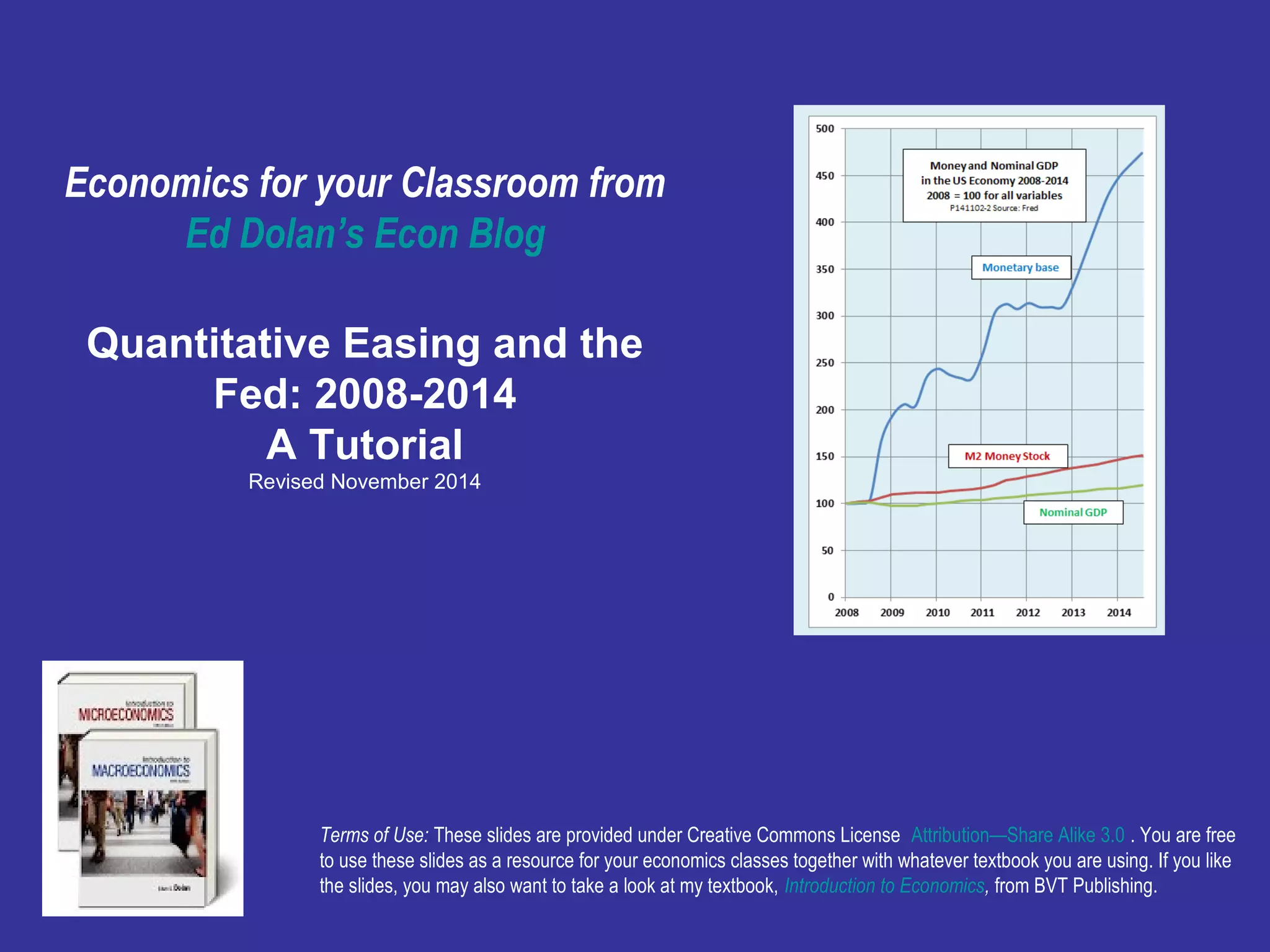
Quantitative Easing and the 
Fed: 2008-2014 
A Tutorial 
Revised November 2014 
Terms of Use: These slides are provided under Creative Commons License Attribution—Share Alike 3.0 . You are free 
to use these slides as a resource for your economics classes together with whatever textbook you are using. If you like 
the slides, you may also want to take a look at my textbook, Introduction to Economics, from BVT Publishing.
Understanding Quantitative Easing 
 Central banks—the Federal 
Reserve, the European Central 
Bank, the People’s Bank of China, 
and others—are among the most 
powerful institutions in the world 
 One of their potentially most 
powerful but least understood 
instruments is Quantitative Easing 
or QE, a type of policy that the Fed 
pursued for six years, from late 2008 
to late 2014 
 This tutorial explains the mechanics 
of QE and its effects on the US 
economy 
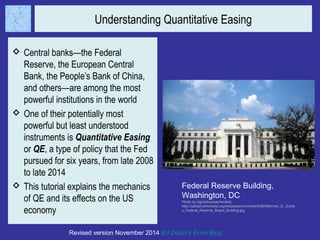
Federal Reserve Building, 
Washington, DC 
Photo by Agnosticpreacherskid, 
http://upload.wikimedia.org/wikipedia/commons/8/8d/Marriner_S._Eccle 
s_Federal_Reserve_Board_Building.jpg 
Revised version November 2014 Ed Dolan’s Econ Blog
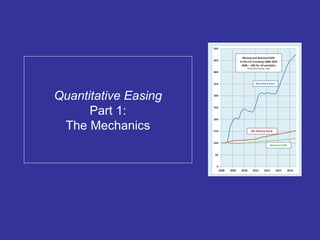
Quantitative Easing 
Part 1: 
The Mechanics
The Central Bank Balance Sheet: Assets 
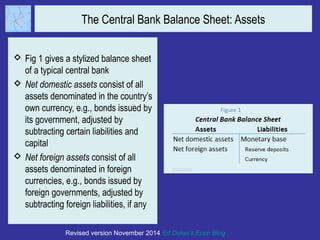
 Fig 1 gives a stylized balance sheet 
of a typical central bank 
 Net domestic assets consist of all 
assets denominated in the country’s 
own currency, e.g., bonds issued by 
its government, adjusted by 
subtracting certain liabilities and 
capital 
 Net foreign assets consist of all 
assets denominated in foreign 
currencies, e.g., bonds issued by 
foreign governments, adjusted by 
subtracting foreign liabilities, if any 
Revised version November 2014 Ed Dolan’s Econ Blog
The Central Bank Balance Sheet: Liabilities 
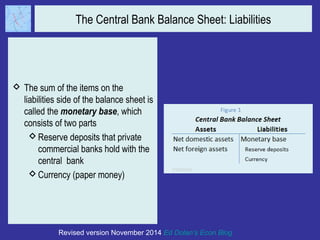
 The sum of the items on the 
liabilities side of the balance sheet is 
called the monetary base, which 
consists of two parts 
Reserve deposits that private 
commercial banks hold with the 
central bank 
Currency (paper money) 
Revised version November 2014 Ed Dolan’s Econ Blog
The Central Bank and Commercial Banks 
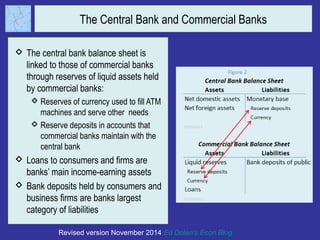
 The central bank balance sheet is 
linked to those of commercial banks 
through reserves of liquid assets held 
by commercial banks: 
Reserves of currency used to fill ATM 
machines and serve other needs 
Reserve deposits in accounts that 
commercial banks maintain with the 
central bank 
 Loans to consumers and firms are 
banks’ main income-earning assets 
 Bank deposits held by consumers and 
business firms are banks largest 
category of liabilities 
Revised version November 2014 Ed Dolan’s Econ Blog
The Complete Financial System 
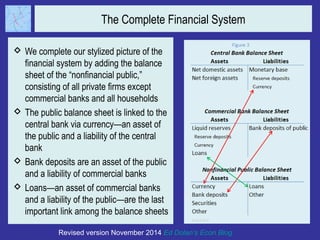
 We complete our stylized picture of the 
financial system by adding the balance 
sheet of the “nonfinancial public,” 
consisting of all private firms except 
commercial banks and all households 
 The public balance sheet is linked to the 
central bank via currency—an asset of 
the public and a liability of the central 
bank 
 Bank deposits are an asset of the public 
and a liability of commercial banks 
 Loans—an asset of commercial banks 
and a liability of the public—are the last 
important link among the balance sheets 
Revised version November 2014 Ed Dolan’s Econ Blog
The Money Stock and the Equation of Exchange 
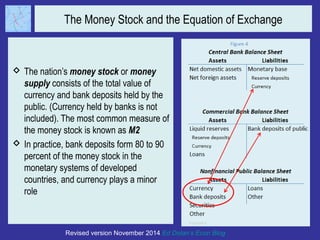
 The nation’s money stock or money 
supply consists of the total value of 
currency and bank deposits held by the 
public. (Currency held by banks is not 
included). The most common measure of 
the money stock is known as M2 
 In practice, bank deposits form 80 to 90 
percent of the money stock in the 
monetary systems of developed 
countries, and currency plays a minor 
role 
Revised version November 2014 Ed Dolan’s Econ Blog
Central Bank Open Market Operations 
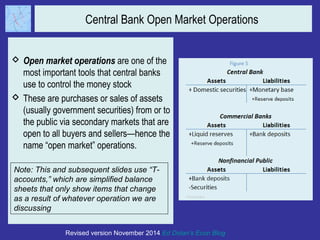
 Open market operations are one of the 
most important tools that central banks 
use to control the money stock 
 These are purchases or sales of assets 
(usually government securities) from or to 
the public via secondary markets that are 
open to all buyers and sellers—hence the 
name “open market” operations. 
Note: This and subsequent slides use “T-accounts,” 
which are simplified balance 
sheets that only show items that change 
as a result of whatever operation we are 
discussing 
Revised version November 2014 Ed Dolan’s Econ Blog
Open Market Operations Step-by-Step 
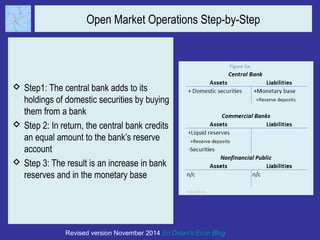
 Step1: The central bank adds to its 
holdings of domestic securities by buying 
them from a bank 
 Step 2: In return, the central bank credits 
an equal amount to the bank’s reserve 
account 
 Step 3: The result is an increase in bank 
reserves and in the monetary base 
Revised version November 2014 Ed Dolan’s Econ Blog
Open Market Operations: Alternative Version 
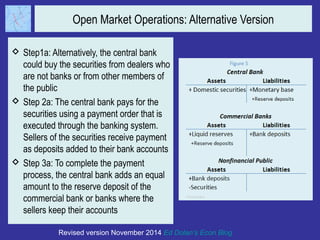
 Step1a: Alternatively, the central bank 
could buy the securities from dealers who 
are not banks or from other members of 
the public 
 Step 2a: The central bank pays for the 
securities using a payment order that is 
executed through the banking system. 
Sellers of the securities receive payment 
as deposits added to their bank accounts 
 Step 3a: To complete the payment 
process, the central bank adds an equal 
amount to the reserve deposit of the 
commercial bank or banks where the 
sellers keep their accounts 
Revised version November 2014 Ed Dolan’s Econ Blog
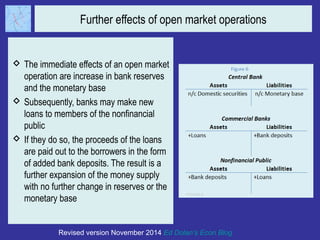
Further effects of open market operations 
 The immediate effects of an open market 
operation are increase in bank reserves 
and the monetary base 
 Subsequently, banks may make new 
loans to members of the nonfinancial 
public 
 If they do so, the proceeds of the loans 
are paid out to the borrowers in the form 
of added bank deposits. The result is a 
further expansion of the money supply 
with no further change in reserves or the 
monetary base 
Revised version November 2014 Ed Dolan’s Econ Blog
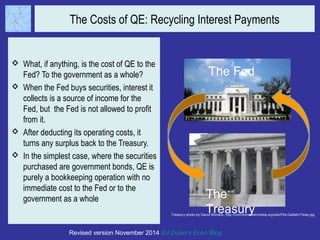
The Costs of QE: Recycling Interest Payments 
 What, if anything, is the cost of QE to the 
Fed? To the government as a whole? 
 When the Fed buys securities, interest it 
collects is a source of income for the 
Fed, but the Fed is not allowed to profit 
from it. 
 After deducting its operating costs, it 
turns any surplus back to the Treasury. 
 In the simplest case, where the securities 
purchased are government bonds, QE is 
purely a bookkeeping operation with no 
immediate cost to the Fed or to the 
government as a whole 
The Fed 
The 
Treasury 
Treasury photo by David Monack, http://commons.wikimedia.org/wiki/File:GallatinTreas.jpg 
Revised version November 2014 Ed Dolan’s Econ Blog
Possible Indirect Costs 
 Qualification No 1: Since 2008, the Fed 
has begun paying interest on banks’ 
reserve deposits, so not all the interest 
is recycled, however, the interest rate is 
low—just 0.25 percent. 
 Qualification No. 2: The Fed may not be 
able to hold its big QE purchases of 
bonds forever. Sooner or later, the 
economy will begin to recover. The 
Fed’s exit strategy from QE may 
require selling off many of the extra 
securities. Under some conditions, it 
might have to sell them at a loss 
Photo: © BrokenSphere / Wikimedia Commons 
Revised version November 2014 Ed Dolan’s Econ Blog
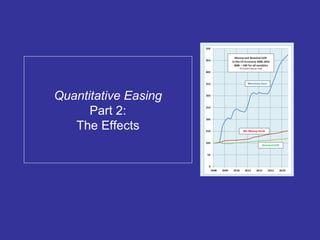
Quantitative Easing 
Part 2: 
The Effects
Effects of Open Market Purchase: Traditional Textbook Version 
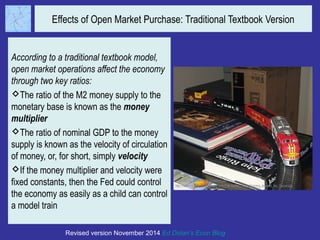
According to a traditional textbook model, 
open market operations affect the economy 
through two key ratios: 
The ratio of the M2 money supply to the 
monetary base is known as the money 
multiplier 
The ratio of nominal GDP to the money 
supply is known as the velocity of circulation 
of money, or, for short, simply velocity 
If the money multiplier and velocity were 
fixed constants, then the Fed could control 
the economy as easily as a child can control 
a model train 
Revised version November 2014 Ed Dolan’s Econ Blog
Before QE 
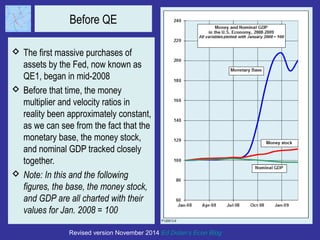
 The first massive purchases of 
assets by the Fed, now known as 
QE1, began in mid-2008 
 Before that time, the money 
multiplier and velocity ratios in 
reality been approximately constant, 
as we can see from the fact that the 
monetary base, the money stock, 
and nominal GDP tracked closely 
together. 
 Note: In this and the following 
figures, the base, the money stock, 
and GDP are all charted with their 
values for Jan. 2008 = 100 
Revised version November 2014 Ed Dolan’s Econ Blog
Effects of QE1 
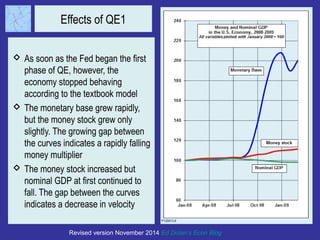
 As soon as the Fed began the first 
phase of QE, however, the 
economy stopped behaving 
according to the textbook model 
 The monetary base grew rapidly, 
but the money stock grew only 
slightly. The growing gap between 
the curves indicates a rapidly falling 
money multiplier 
 The money stock increased but 
nominal GDP at first continued to 
fall. The gap between the curves 
indicates a decrease in velocity 
Revised version November 2014 Ed Dolan’s Econ Blog
From QE1 to QE2 
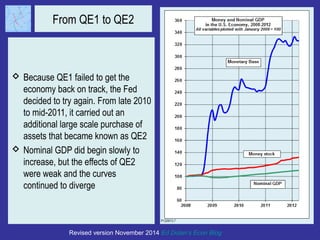
 Because QE1 failed to get the 
economy back on track, the Fed 
decided to try again. From late 2010 
to mid-2011, it carried out an 
additional large scale purchase of 
assets that became known as QE2 
 Nominal GDP did begin slowly to 
increase, but the effects of QE2 
were weak and the curves 
continued to diverge 
Revised version November 2014 Ed Dolan’s Econ Blog
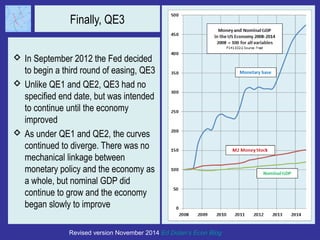
Finally, QE3 
 In September 2012 the Fed decided 
to begin a third round of easing, QE3 
 Unlike QE1 and QE2, QE3 had no 
specified end date, but was intended 
to continue until the economy 
improved 
 As under QE1 and QE2, the curves 
continued to diverge. There was no 
mechanical linkage between 
monetary policy and the economy as 
a whole, but nominal GDP did 
continue to grow and the economy 
began slowly to improve 
Revised version November 2014 Ed Dolan’s Econ Blog
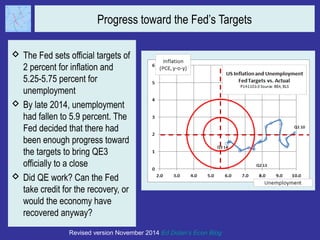
Progress toward the Fed’s Targets 
 The Fed sets official targets of 
2 percent for inflation and 
5.25-5.75 percent for 
unemployment 
 By late 2014, unemployment 
had fallen to 5.9 percent. The 
Fed decided that there had 
been enough progress toward 
the targets to bring QE3 
officially to a close 
 Did QE work? Can the Fed 
take credit for the recovery, or 
would the economy have 
recovered anyway? 
Revised version November 2014 Ed Dolan’s Econ Blog
How QE may have worked 
 Supporters of QE say we should not expect it 
to work through rigid ratios like the money 
multiplier and velocity 
 One theory says that it works by changing 
the relative amounts of long- and short-term 
securities, thereby lowering long-term rates, 
supporting stock prices, and encouraging 
investment 
 Another theory says the most important 
effect is forward guidance, that is, changing 
people’s expectations about what the Fed will 
do in the future 
Jackson Hole, Wyoming 
Source: Enricokamasa via 
http://commons.wikimedia.org/wiki/File:Corbet 
%27s_Couloir_jackson_hole.jpg 
For a detailed discussion of how QE 
works, see this paper by Michael 
Woodford presented at the Fed’s 2012 
conference in Jackson Hole, WY 
Revised version November 2014 Ed Dolan’s Econ Blog
Monetary vs. Fiscal Policy 
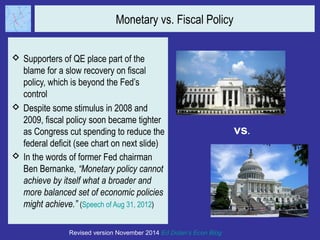
 Supporters of QE place part of the 
blame for a slow recovery on fiscal 
policy, which is beyond the Fed’s 
control 
 Despite some stimulus in 2008 and 
2009, fiscal policy soon became tighter 
as Congress cut spending to reduce the 
federal deficit (see chart on next slide) 
 In the words of former Fed chairman 
Ben Bernanke, “Monetary policy cannot 
achieve by itself what a broader and 
more balanced set of economic policies 
might achieve.” (Speech of Aug 31, 2012) 
Revised version November 2014 Ed Dolan’s Econ Blog 
vs.
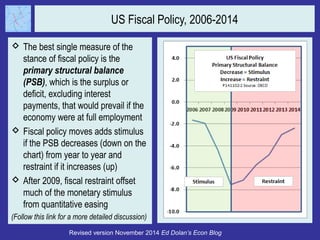
US Fiscal Policy, 2006-2014 
 The best single measure of the 
stance of fiscal policy is the 
primary structural balance 
(PSB), which is the surplus or 
deficit, excluding interest 
payments, that would prevail if the 
economy were at full employment 
 Fiscal policy moves adds stimulus 
if the PSB decreases (down on the 
chart) from year to year and 
restraint if it increases (up) 
 After 2009, fiscal restraint offset 
much of the monetary stimulus 
from quantitative easing 
(Follow this link for a more detailed discussion) 
Revised version November 2014 Ed Dolan’s Econ Blog
The Bottom Line 
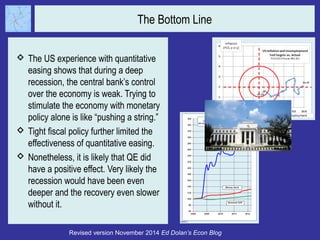
 The US experience with quantitative 
easing shows that during a deep 
recession, the central bank’s control 
over the economy is weak. Trying to 
stimulate the economy with monetary 
policy alone is like “pushing a string.” 
 Tight fiscal policy further limited the 
effectiveness of quantitative easing. 
 Nonetheless, it is likely that QE did 
have a positive effect. Very likely the 
recession would have been even 
deeper and the recovery even slower 
without it. 
Revised version November 2014 Ed Dolan’s Econ Blog
For more slideshows and commentary, follow Ed Dolan’s Econ Blog 
Like this slideshow? 
Follow @DolanEcon on Twitter 
Click here to learn more about Ed Dolan’s Econ texts

Quantitative Easing and the Fed 2008-2014: A Tutorial

  • 1.
    Economics for yourClassroom from Ed Dolan’s Econ Blog Quantitative Easing and the Fed: 2008-2014 A Tutorial Revised November 2014 Terms of Use: These slides are provided under Creative Commons License Attribution—Share Alike 3.0 . You are free to use these slides as a resource for your economics classes together with whatever textbook you are using. If you like the slides, you may also want to take a look at my textbook, Introduction to Economics, from BVT Publishing.
  • 2.
    Understanding Quantitative Easing  Central banks—the Federal Reserve, the European Central Bank, the People’s Bank of China, and others—are among the most powerful institutions in the world  One of their potentially most powerful but least understood instruments is Quantitative Easing or QE, a type of policy that the Fed pursued for six years, from late 2008 to late 2014  This tutorial explains the mechanics of QE and its effects on the US economy Federal Reserve Building, Washington, DC Photo by Agnosticpreacherskid, http://upload.wikimedia.org/wikipedia/commons/8/8d/Marriner_S._Eccle s_Federal_Reserve_Board_Building.jpg Revised version November 2014 Ed Dolan’s Econ Blog
  • 3.
    Quantitative Easing Part1: The Mechanics
  • 4.
    The Central BankBalance Sheet: Assets  Fig 1 gives a stylized balance sheet of a typical central bank  Net domestic assets consist of all assets denominated in the country’s own currency, e.g., bonds issued by its government, adjusted by subtracting certain liabilities and capital  Net foreign assets consist of all assets denominated in foreign currencies, e.g., bonds issued by foreign governments, adjusted by subtracting foreign liabilities, if any Revised version November 2014 Ed Dolan’s Econ Blog
  • 5.
    The Central BankBalance Sheet: Liabilities  The sum of the items on the liabilities side of the balance sheet is called the monetary base, which consists of two parts Reserve deposits that private commercial banks hold with the central bank Currency (paper money) Revised version November 2014 Ed Dolan’s Econ Blog
  • 6.
    The Central Bankand Commercial Banks  The central bank balance sheet is linked to those of commercial banks through reserves of liquid assets held by commercial banks: Reserves of currency used to fill ATM machines and serve other needs Reserve deposits in accounts that commercial banks maintain with the central bank  Loans to consumers and firms are banks’ main income-earning assets  Bank deposits held by consumers and business firms are banks largest category of liabilities Revised version November 2014 Ed Dolan’s Econ Blog
  • 7.
    The Complete FinancialSystem  We complete our stylized picture of the financial system by adding the balance sheet of the “nonfinancial public,” consisting of all private firms except commercial banks and all households  The public balance sheet is linked to the central bank via currency—an asset of the public and a liability of the central bank  Bank deposits are an asset of the public and a liability of commercial banks  Loans—an asset of commercial banks and a liability of the public—are the last important link among the balance sheets Revised version November 2014 Ed Dolan’s Econ Blog
  • 8.
    The Money Stockand the Equation of Exchange  The nation’s money stock or money supply consists of the total value of currency and bank deposits held by the public. (Currency held by banks is not included). The most common measure of the money stock is known as M2  In practice, bank deposits form 80 to 90 percent of the money stock in the monetary systems of developed countries, and currency plays a minor role Revised version November 2014 Ed Dolan’s Econ Blog
  • 9.
    Central Bank OpenMarket Operations  Open market operations are one of the most important tools that central banks use to control the money stock  These are purchases or sales of assets (usually government securities) from or to the public via secondary markets that are open to all buyers and sellers—hence the name “open market” operations. Note: This and subsequent slides use “T-accounts,” which are simplified balance sheets that only show items that change as a result of whatever operation we are discussing Revised version November 2014 Ed Dolan’s Econ Blog
  • 10.
    Open Market OperationsStep-by-Step  Step1: The central bank adds to its holdings of domestic securities by buying them from a bank  Step 2: In return, the central bank credits an equal amount to the bank’s reserve account  Step 3: The result is an increase in bank reserves and in the monetary base Revised version November 2014 Ed Dolan’s Econ Blog
  • 11.
    Open Market Operations:Alternative Version  Step1a: Alternatively, the central bank could buy the securities from dealers who are not banks or from other members of the public  Step 2a: The central bank pays for the securities using a payment order that is executed through the banking system. Sellers of the securities receive payment as deposits added to their bank accounts  Step 3a: To complete the payment process, the central bank adds an equal amount to the reserve deposit of the commercial bank or banks where the sellers keep their accounts Revised version November 2014 Ed Dolan’s Econ Blog
  • 12.
    Further effects ofopen market operations  The immediate effects of an open market operation are increase in bank reserves and the monetary base  Subsequently, banks may make new loans to members of the nonfinancial public  If they do so, the proceeds of the loans are paid out to the borrowers in the form of added bank deposits. The result is a further expansion of the money supply with no further change in reserves or the monetary base Revised version November 2014 Ed Dolan’s Econ Blog
  • 13.
    The Costs ofQE: Recycling Interest Payments  What, if anything, is the cost of QE to the Fed? To the government as a whole?  When the Fed buys securities, interest it collects is a source of income for the Fed, but the Fed is not allowed to profit from it.  After deducting its operating costs, it turns any surplus back to the Treasury.  In the simplest case, where the securities purchased are government bonds, QE is purely a bookkeeping operation with no immediate cost to the Fed or to the government as a whole The Fed The Treasury Treasury photo by David Monack, http://commons.wikimedia.org/wiki/File:GallatinTreas.jpg Revised version November 2014 Ed Dolan’s Econ Blog
  • 14.
    Possible Indirect Costs  Qualification No 1: Since 2008, the Fed has begun paying interest on banks’ reserve deposits, so not all the interest is recycled, however, the interest rate is low—just 0.25 percent.  Qualification No. 2: The Fed may not be able to hold its big QE purchases of bonds forever. Sooner or later, the economy will begin to recover. The Fed’s exit strategy from QE may require selling off many of the extra securities. Under some conditions, it might have to sell them at a loss Photo: © BrokenSphere / Wikimedia Commons Revised version November 2014 Ed Dolan’s Econ Blog
  • 15.
  • 16.
    Effects of OpenMarket Purchase: Traditional Textbook Version According to a traditional textbook model, open market operations affect the economy through two key ratios: The ratio of the M2 money supply to the monetary base is known as the money multiplier The ratio of nominal GDP to the money supply is known as the velocity of circulation of money, or, for short, simply velocity If the money multiplier and velocity were fixed constants, then the Fed could control the economy as easily as a child can control a model train Revised version November 2014 Ed Dolan’s Econ Blog
  • 17.
    Before QE The first massive purchases of assets by the Fed, now known as QE1, began in mid-2008  Before that time, the money multiplier and velocity ratios in reality been approximately constant, as we can see from the fact that the monetary base, the money stock, and nominal GDP tracked closely together.  Note: In this and the following figures, the base, the money stock, and GDP are all charted with their values for Jan. 2008 = 100 Revised version November 2014 Ed Dolan’s Econ Blog
  • 18.
    Effects of QE1  As soon as the Fed began the first phase of QE, however, the economy stopped behaving according to the textbook model  The monetary base grew rapidly, but the money stock grew only slightly. The growing gap between the curves indicates a rapidly falling money multiplier  The money stock increased but nominal GDP at first continued to fall. The gap between the curves indicates a decrease in velocity Revised version November 2014 Ed Dolan’s Econ Blog
  • 19.
    From QE1 toQE2  Because QE1 failed to get the economy back on track, the Fed decided to try again. From late 2010 to mid-2011, it carried out an additional large scale purchase of assets that became known as QE2  Nominal GDP did begin slowly to increase, but the effects of QE2 were weak and the curves continued to diverge Revised version November 2014 Ed Dolan’s Econ Blog
  • 20.
    Finally, QE3 In September 2012 the Fed decided to begin a third round of easing, QE3  Unlike QE1 and QE2, QE3 had no specified end date, but was intended to continue until the economy improved  As under QE1 and QE2, the curves continued to diverge. There was no mechanical linkage between monetary policy and the economy as a whole, but nominal GDP did continue to grow and the economy began slowly to improve Revised version November 2014 Ed Dolan’s Econ Blog
  • 21.
    Progress toward theFed’s Targets  The Fed sets official targets of 2 percent for inflation and 5.25-5.75 percent for unemployment  By late 2014, unemployment had fallen to 5.9 percent. The Fed decided that there had been enough progress toward the targets to bring QE3 officially to a close  Did QE work? Can the Fed take credit for the recovery, or would the economy have recovered anyway? Revised version November 2014 Ed Dolan’s Econ Blog
  • 22.
    How QE mayhave worked  Supporters of QE say we should not expect it to work through rigid ratios like the money multiplier and velocity  One theory says that it works by changing the relative amounts of long- and short-term securities, thereby lowering long-term rates, supporting stock prices, and encouraging investment  Another theory says the most important effect is forward guidance, that is, changing people’s expectations about what the Fed will do in the future Jackson Hole, Wyoming Source: Enricokamasa via http://commons.wikimedia.org/wiki/File:Corbet %27s_Couloir_jackson_hole.jpg For a detailed discussion of how QE works, see this paper by Michael Woodford presented at the Fed’s 2012 conference in Jackson Hole, WY Revised version November 2014 Ed Dolan’s Econ Blog
  • 23.
    Monetary vs. FiscalPolicy  Supporters of QE place part of the blame for a slow recovery on fiscal policy, which is beyond the Fed’s control  Despite some stimulus in 2008 and 2009, fiscal policy soon became tighter as Congress cut spending to reduce the federal deficit (see chart on next slide)  In the words of former Fed chairman Ben Bernanke, “Monetary policy cannot achieve by itself what a broader and more balanced set of economic policies might achieve.” (Speech of Aug 31, 2012) Revised version November 2014 Ed Dolan’s Econ Blog vs.
  • 24.
    US Fiscal Policy,2006-2014  The best single measure of the stance of fiscal policy is the primary structural balance (PSB), which is the surplus or deficit, excluding interest payments, that would prevail if the economy were at full employment  Fiscal policy moves adds stimulus if the PSB decreases (down on the chart) from year to year and restraint if it increases (up)  After 2009, fiscal restraint offset much of the monetary stimulus from quantitative easing (Follow this link for a more detailed discussion) Revised version November 2014 Ed Dolan’s Econ Blog
  • 25.
    The Bottom Line  The US experience with quantitative easing shows that during a deep recession, the central bank’s control over the economy is weak. Trying to stimulate the economy with monetary policy alone is like “pushing a string.”  Tight fiscal policy further limited the effectiveness of quantitative easing.  Nonetheless, it is likely that QE did have a positive effect. Very likely the recession would have been even deeper and the recovery even slower without it. Revised version November 2014 Ed Dolan’s Econ Blog
  • 26.
    For more slideshowsand commentary, follow Ed Dolan’s Econ Blog Like this slideshow? Follow @DolanEcon on Twitter Click here to learn more about Ed Dolan’s Econ texts