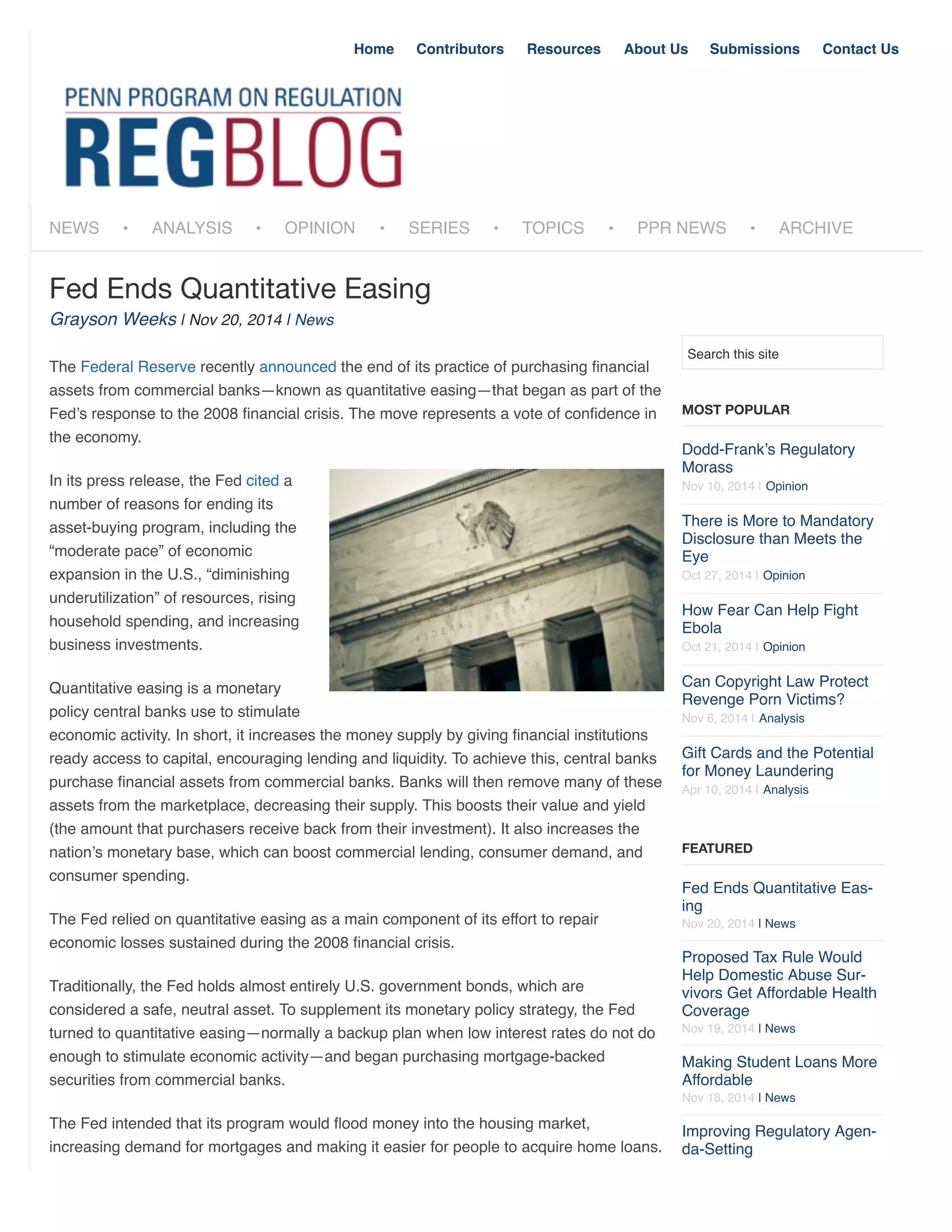
The Federal Reserve recently announced the end of its quantitative easing program that was begun in response to the 2008 financial crisis. The Fed cited improvements in the U.S. economy, including moderate economic expansion, reduced unemployment, and increased business investment and consumer spending. Quantitative easing involved the Fed purchasing financial assets from banks to increase the money supply and encourage lending. While some saw quantitative easing as helping the economic recovery, others argued it favored some industries over others. The effects of ending the program are unclear as the Fed still has a large balance sheet from the purchases.
![From 2008 to 2014, the Fed accumulated nearly $4.5 trillion in assets—a record level.
The Fed’s decision to end quantitative easing signaled confidence that the program has
helped to stabilize the financial system and stimulate the broader economy during the
last few years. Members of the Board of Governors voted 9 to 1 to end the program,
citing “a substantial improvement in the outlook for the labor market since the inception
of [the] current asset purchase program.” The Board explained that its decision to end
the program was based in part on the Federal Open Market Committee’s perception that
there is “sufficient underlying strength in the broader economy to support ongoing
progress toward maximum employment in a context of price stability.”
The announcement was not a surprise. Many analysts think quantitative easing has
helped the recovery, and the Fed has been winding down its asset purchases over the
past year. Indeed, the lack of market backlash illustrates the public sentiment about
quantitative easing at this stage in the recovery. Previously, Fed statements only hinting
at a drawback of quantitative easing reverberated through trading markets.
For example, in June 2013, stock markets fell about 4.3% over three days when former
Federal Reserve Chair Ben Bernanke announced that the Fed was merely considering
pulling back on quantitative easing in the event the economy continued to grow. This
time, markets remained stable in the wake of the announcement, and currently, stocks
are trading at the same level they were before the financial crisis.
Despite its apparent success, quantitative easing was not without its detractors. Some
observers think the program arbitrarily picked winners and losers by favoring certain
types of investments—in this case, housing market investments. Other commentators
have argued that quantitative easing contributed to inequality by making money more
easily available only to those who have it, including financial institutions, strategic
investors, and higher-earning individuals.
The long-term effects of the decision to end quantitative easing are unclear. While its
asset-buying program may have become less necessary, the Fed has a historically high
balance sheet. Before it began buying bank assets in 2008, the Fed held between $700
and $800 billion in treasury notes. Over the last six years, it has accumulated $4.5 trillion
in assets. The Fed’s unusually high balance sheet limits its ability to rely on quantitative
easing in the event of another crisis. And if the Fed ever decides to sell those assets, the
result might be to oversaturate an already congested market in mortgage-backed
securities.
But the Fed has not announced plans to sell its assets. If anything, it is more likely to
start with raising interest rates. Although the Fed described its plans to keep interest
rates low for a “considerable time”—between 0 to 1/4 percent for federal funds—it will
continue to adjust these rates in response to new economic activity, which cannot be
easily forecasted.
Tagged: Economy, Federal Reserve, Finance, Financial Crisis
Nov 17, 2014 | PPR News
Professor Coglianese to
Lead New Initiative on Regu‐latory
Excellence
Nov 13, 2014 | PPR News
RECENT SERIES
Is it Time to Reconsider
Chevron Deference?
September 8, 2014 - September 11,
2014
Regulatory Essay Competi‐tion
Winners
July 7, 2014 - July 9, 2014
Debating the Independent
Retrospective Review of
Regulations
May 19, 2014 - May 23, 2014
Does Regulation Kill Jobs?
March 10, 2014 - March 18, 2014](https://image.slidesharecdn.com/7b61e984-8746-47ee-a705-f45cad33dd9e-141120204246-conversion-gate02/85/Fed-Ends-Quantitative-Easing-RegBlog-2-320.jpg)