November 2014
1 www.hedgespa.com


Quantitative easing (QE) has been a policy tool used by central banks since 2008 when
standard monetary policy turned ineffective with near-zero short rates. Central banks buy
financial assets as a way to decrease yield on the long-end of the yield curve. This has
significantly stimulated consumption and enhanced liquidity in recent years. However, if a
government overdoes quantitative easing, which is a form of “printing” money, inflation
may follow. Therefore, the desirability of QE as a policy tool has been quickly diminishing.
On October 29, 2014, the Fed announced that it would put an end to QE. That announcement
triggered immediate reactions in the financial market. The dollar index soared and gold price
decreased by over 1 percent. According to the Federal Open Market Committee (FOMC)
announcement in October, they will not change the federal funds rate that is currently in the
range between 0 and 0.25 percent. We shall look into two scenarios to analyze whether the
timing for the end of QE is right.
What We Do
HedgeSPA provides state-of-the-art investment analytics and market scenarios on an affordable platform, for
seasoned buy-side professionals. We take care of portfolio managers’ day-to-day headaches and technicalities,
saving them time and effort that they can redirect towards client relationships and strong portfolio performance.
The HedgeSPA Platform
With our platform, you can scan investment sub-universes; check for out-of-balance factor exposures; evaluate your
portfolios under scenarios extracted from published broker research; generate indicative reporting to check against
common errors in broker reports; and send customized risk and performance reports to investors or to third-party
investment reporting tools. Try it here: app.hedgespa.com
HedgeSPA November 2014
Sophisticated Investment Analytics l Trusted Market Insights
	
  
1 www.hedgespa.com
Contents
1
The End of
Quantitative Easing
Who is making progress?
2
Saudi New Oil Strategy
Will lower oil price benefit the
emerging global economy?
3
Oil Reforms in India
Good or Bad?
4
New Framework in the
South Korean Housing
Market
Is traditional system outdated?
	
  
5
A Major Change Awaits
for North Korea?
A Rumor or the Truth?
6
Russia Sanctions and
Its Repercussions
What is the effect?
7
Hong Kong Protests
and its Embattled Chief
Executive
Who will take the lead?
	
  
8
France Breaks EU Rules
Increasing Capital or
Shortfall?
	
  
9
Asia vs. Europe & US
Who will lead global
development in the future?


Market Scenarios
The End of Quantitative Easing
Who is making progress?
Contact
Email
salesnsupport@hedgespa.com
Skype
hedgespa.support
Twitter
@HedgeSPA
Source:	
  	
  Wikipedia	
  (with	
  permission	
  to	
  reuse)	
  
November 2014
2 www.hedgespa.com


Scenario 1: Ending QE Assists U.S. to Move in the
Right Direction
The Fed’s bond-buying programs have increased its
balance sheet from $900 billion to $4.4 trillion based on
the most recent data. There are signs that QE has some
success in reviving the U.S. economy from the financial
crisis. However, now, the Fed believes that growth and
job creation have regained momentum and that there is
no need to continue QE in order to stimulate the US
economy. Ending QE is a correct move to preempt
runaway inflation. Moreover, U.S. economy can move
forward with conventional monetary policy tools,
instead of building up an ever-increasing balance sheet
of assets, which the Fed will eventually need to sell off.
Scenario 2: Cutting off QE too Early Ushers in
Volatility
According to the FOMC announcement, the Fed will
stop buying bonds at the end of October. However, the
Fed will continue reinvesting receipts, so the balance
sheet of Federal Reserve is not getting any smaller.
Now that the Fed has purchased a massive amount of
assets and has to somehow sell off those assets in the
future, doing so may trigger a disaster for the bond
market once the Fed announces its timing to sell. At the
same time, ending the purchase will not help stimulate
the economy. Americans still have difficulties in getting
loans, now that there is a shortage of purchasers of
mortgage and asset-backed securities, and thus cannot
get the financing they need to help move the US
economy forward. The U.S. economy will stay weak.
The fragile state of the US mortgage market can be best
illustrated by former Fed Chairman Bernanke’s inability
to refinance his own mortgage. The absence of a large
buyer in the mortgage-backed securities market can
choke off the fragile economic recovery. Furthermore,
cutting off QE will negatively impact US trade relations
with China and Japan.
When the Fed eventually must sell, it will need the
support by major bond purchasers such as the Chinese
and Japanese. Somehow, the Fed needs to convince	
  
China and Japan that they are not buying
potentially worthless pieces of papers that it does
not want to keep. For now, China is buying large
quantities of US debts to avoid RMB appreciation
and, potentially, massive unemployment if RMB
appreciates too quickly. Simultaneously, China
has been working hard to increase the economic
value added by its manufacturing activities
through selling higher end products and
diversifying demand away from the US.
On October 31, 2014, the Monetary Policy
Committee of the Bank of Japan (BOJ) also
surprised the world by launching QQE II,
increasing its monetary base from 60-70 trillion
yen to 80 trillion yen. The U.S. will have to deal
with its mountain of debts eventually with the
uncertainty and volatility brought on by the end of
QE.
Former PIMCO Chief Investment Officer Bill
Gross recently wrote that, “Stopping the printing
press sounds like a great solution to the
depreciation of our purchasing power but today’s
printing is simply something that the global
finance based economy cannot live without.” This
is particularly true after the Republicans have
taken over the Senate; now, it is unlikely that the
Obama Administration will be able to make
substantive progress on fiscal policies. The US
economy will have to rely on monetary stimulus.
In summary, if the Fed were to cut off QE, it
needs to figure out how to keep large purchasers
such as China, Japan and the Middle East to
continue buying the mountains of bonds that it
needs to sell. Currently, China buys US bonds to
keep its currency artificially low, thanks to a
process known as sterilization. However,
eventually China will ask whether it is ready to
buy a significant piece of the $4 trillion dollars in
U.S. bonds that the Fed will sell off. Chances are
that there may not be an ending to QE that
everyone will be happy about, and the economic
situation of U.S. will only become worse.
	
  
November 2014
3 www.hedgespa.com


Recently, Saudi Arabia surprised the markets by announcing a
substantial reduction in the export price of its crude oil. The
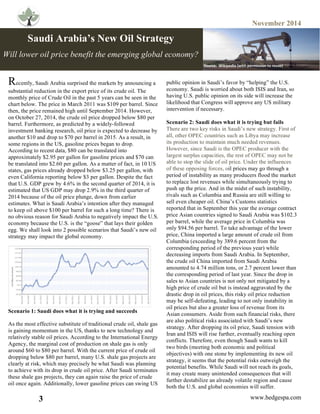
monthly price of Crude Oil in the past 5 years can be seen in the
chart below. The price in March 2011 was $109 per barrel. Since
then, the price remained high until September 2014. However,
on October 27, 2014, the crude oil price dropped below $80 per
barrel. Furthermore, as predicted by a widely-followed
investment banking research, oil price is expected to decrease by
another $10 and drop to $70 per barrel in 2015. As a result, in
some regions in the US, gasoline prices began to drop.
According to recent data, $80 can be translated into
approximately $2.95 per gallon for gasoline prices and $70 can
be translated into $2.60 per gallon. As a matter of fact, in 10 US
states, gas prices already dropped below $3.25 per gallon, with
even California reporting below $3 per gallon. Despite the fact
that U.S. GDP grew by 4.6% in the second quarter of 2014, it is
estimated that US GDP may drop 2.9% in the third quarter of
2014 because of the oil price plunge, down from earlier
estimates. What is Saudi Arabia’s intention after they managed
to keep oil above $100 per barrel for such a long time? There is
no obvious reason for Saudi Arabia to negatively impact the U.S.
economy because the U.S. is the “goose” that lays their golden
egg. We shall look into 2 possible scenarios that Saudi’s new oil
strategy may impact the global economy.
Scenario 1: Saudi does what it is trying and succeeds
As the most effective substitute of traditional crude oil, shale gas
is gaining momentum in the US, thanks to new technology and
relatively stable oil prices. According to the International Energy
Agency, the marginal cost of production on shale gas is only
around $60 to $80 per barrel. With the current price of crude oil
dropping below $80 per barrel, many U.S. shale gas projects are
clearly at risk, which may precisely be what Saudi was planning
to achieve with its drop in crude oil price. After Saudi terminates
these shale gas projects, they can again raise the price of crude
oil once again. Additionally, lower gasoline prices can swing US
	
  
Saudi Arabia’s New Oil Strategy
Will lower oil price benefit the emerging global economy?
public opinion in Saudi’s favor by “helping” the U.S.
economy. Saudi is worried about both ISIS and Iran, so
having U.S. public opinion on its side will increase the
likelihood that Congress will approve any US military
intervention if necessary.
Scenario 2: Saudi does what it is trying but fails
There are two key risks in Saudi’s new strategy. First of
all, other OPEC countries such as Libya may increase
its production to maintain much needed revenues.
However, since Saudi is the OPEC producer with the
largest surplus capacities, the rest of OPEC may not be
able to stop the slide of oil price. Under the influences
of these opposing forces, oil prices may go through a
period of instability as many producers flood the market
to replace lost revenues while simultaneously trying to
push up the price. And in the midst of such instability,
rivals such as Columbia and Russia are still willing to
sell even cheaper oil. China’s Customs statistics
reported that in September this year the average contract
price Asian countries signed to Saudi Arabia was $102.3
per barrel, while the average price in Columbia was
only $94.56 per barrel. To take advantage of the lower
price, China imported a large amount of crude oil from
Columbia (exceeding by 389.6 percent from the
corresponding period of the previous year) while
decreasing imports from Saudi Arabia. In September,
the crude oil China imported from Saudi Arabia
amounted to 4.74 million tons, or 2.7 percent lower than
the corresponding period of last year. Since the drop in
sales to Asian countries is not only not mitigated by a
high price of crude oil but is instead aggravated by the
drastic drop in oil prices, this risky oil price reduction
may be self-defeating, leading to not only instability in
oil prices but also a greater loss of revenue from its
Asian consumers. Aside from such financial risks, there
are also political risks associated with Saudi’s new
strategy. After dropping its oil price, Saudi tension with
Iran and ISIS will rise further, eventually reaching open
conflicts. Therefore, even though Saudi wants to kill
two birds (meeting both economic and political
objectives) with one stone by implementing its new oil
strategy, it seems that the potential risks outweigh the
potential benefits. While Saudi will not reach its goals,
it may create many unintended consequences that will
further destabilize an already volatile region and cause
both the U.S. and global economies will suffer.	


Source:	
  	
  Wikipedia	
  (with	
  permission	
  to	
  reuse)	
  
November 2014
4 www.hedgespa.com


Oil Reforms in India
Good or Bad?	
  
On October 18th, Indian Prime Minister Narendra Modi
announced that his Government will proceed with reforms in the
oil market, which include the deregulation of diesel prices and an
increase in natural gas prices. The deregulated diesel prices will
now be pegged to international rates, while the hike in natural
gas prices will be reviewed on a semiannual basis. Since 44
percent of India’s total fuel consumption is attributed to diesel,
deregulation is likely to cause greater volatility in its economy.
Also, the rise in natural gas prices may increase the cost of living
for locals. These bold steps have attracted speculations on how
India’s energy market will be affected. Here, we further discuss 2
possible outcomes stemming from the policy decision.
Scenario 1: India successfully transforms its economy
With the reforms in place, India strives to move forward by
shifting its focus on using natural gases. First of all, since the
deregulated diesel prices have been rising, many Indian
companies may be incentivized to invest in natural gas or other
kinds of alternative energy technology. Second of all, because of
the price hike, more producers will be entering the market to reap
profits that were previously unavailable to them. With the influx
of new entrants, the natural gas market in India will move
towards competitive pricing, thus lightening the burden borne by
corporations and consumers who are highly dependent on natural
gas in their production or daily lives. Also, since natural gas
prices are set to be revised semiannually, the government retains
great flexibility to adjust prices and to provide subsidies while
ensuring the relative stability of prices for end consumers.
Hence, after placing in such measures, India might experience
However, after implementing such measures, India may
experience some cutback in their productions since
many Indian companies may be unable to immediately
adapt to the change from diesel to natural gas
consumption. For instance, since the deregulated diesel
price is now pegged to international rates, corporations
that heavily rely on diesel are now prone to market
fluctuations. And without government subsidies to help
them weather through such fluctuations, such
corporations will struggle to maintain a stable level of
production. Eventually, they will most likely switch to
to another energy source. So, in the long run, India will
be able to make effective use of their energy resources
and in general reduce the problems associated with the
use of diesel.
Scenario 2: India incurs more private debts
Even given that there are potential benefits to be reaped
in the long run from a shift in which energy sources are
used, the possible risks from such an abrupt change
should not be underestimated. Corporations that are
unable to survive under the new regime might face
elimination. Albeit the possibility that new entrants will
come in to replace the inefficient ones that are presently
operating, there will be lags in between until the
replacements are made.
Although natural gas may be a viable alternative, it will
still undoubtedly raise the costs certain companies have
to face to replace their machineries or to construct
pipelines. Subsidies by the government may alleviate
the cost borne by the companies, yet many of them may
still find it too costly to operate after the change. When
companies exit, the unemployment rate will increase.
The factors mentioned above may lead to a shrinkage in
the overall economy, which may then require fiscal
spending to increase job opportunities.
Hence, it is still unclear if such a measure may result in
an improvement in the budget balance as intended.
Nonetheless, the economy will be able to make a turn
for the better if India is able to go through the reforms.
	
  
Source:	
  	
  Wikipedia	
  (with	
  permission	
  to	
  reuse)	
  
Source:	
  	
  Wikipedia	
  (with	
  permission	
  to	
  reuse)	
  
November 2014
5 www.hedgespa.com
	
  
South Korea’s government realized that the
traditional system may be outdated and may hinder
the future development of South Korea’s housing
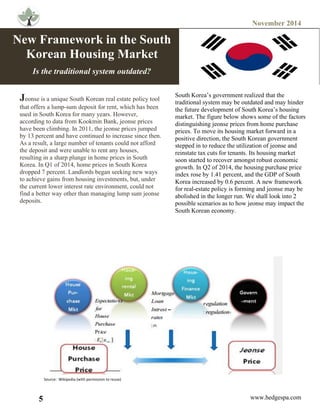
market. The figure below shows some of the factors
distinguishing jeonse prices from home purchase
prices. To move its housing market forward in a
positive direction, the South Korean government
stepped in to reduce the utilization of jeonse and
reinstate tax cuts for tenants. Its housing market
soon started to recover amongst robust economic
growth. In Q2 of 2014, the housing purchase price
index rose by 1.41 percent, and the GDP of South
Korea increased by 0.6 percent. A new framework
for real-estate policy is forming and jeonse may be
abolished in the longer run. We shall look into 2
possible scenarios as to how jeonse may impact the
South Korean economy.
New Framework in the South
Korean Housing Market
Is the traditional system outdated?


Source:	
  	
  Wikipedia	
  (with	
  permission	
  to	
  reuse)	
  
Jeonse is a unique South Korean real estate policy tool
that offers a lump-sum deposit for rent, which has been
used in South Korea for many years. However,
according to data from Kookmin Bank, jeonse prices
have been climbing. In 2011, the jeonse prices jumped
by 13 percent and have continued to increase since then.
As a result, a large number of tenants could not afford
the deposit and were unable to rent any houses,
resulting in a sharp plunge in home prices in South
Korea. In Q1 of 2014, home prices in South Korea
dropped 7 percent. Landlords began seeking new ways
to achieve gains from housing investments, but, under
the current lower interest rate environment, could not
find a better way other than managing lump sum jeonse
deposits.
November 2014
6 www.hedgespa.com
	
  
Scenario 1: Jeonse is abolished and South Korea’s economy benefits
The jeonse system was adopted when South Korea was in the process of rapid industrialization, which made
jeonse attractive when industrialization was the banks’ main lending objective. However, according to recent
research, as long as the housing market is stable and there are no excessive capital gains from home ownership,
it will be easier to access the institutional house finance market, which as a result the price of jeonse will be
comparable to the purchase price of a home. Chances are that the increase in jeonse price will be accompanied
by a decrease in jeonse supply. Moreover, under the increasingly stable South Korea finance market, long-term
asset and mortgage are becoming less important in South Korea’s economic development. Nowadays landlords
tend to shift from the jeonse system to receive monthly rents. The cashflows will be more liquid and improve
short-term investments and consumptions. Consumer confidence is stimulated so South Korea’s economy is
boosted. On the other hand, abolishing jeonse system may contribute to the fall in South Korea’s housing
market.
Scenario 2: Abolishing Jeonse exerts negative impacts on South Korea’s economy
Jeonse was useful when South Korea was short of short run effect, since it offered an effective method for
South Korea to finance growth without relying on banks. The system has been in place for decades, and
abolishing it may fundamentally change the structure of South Korea’s housing market. Simple reforms of the
jeonse system cannot stop rising rents. The Government has been stuck with a limited policy toolkit, such as
increasing the income tax deduction for tenants and easing regulations on private lease businesses. As landlords
prefer to receive monthly rent payments, whether the new framework will be practical or not remains to be seen.
In short, currently there is no obvious need for the South Korea government to shut down the jeonse system in a
big hurry. Government should adopt fresh ideas such as cutting interest rates and increasing income tax
deductions to lessen the financial burdens of tenants. In order to benefit South Korea’s housing market and the
overall economic development, shifting from jeonse to monthly rents may be a wise move in the longer run.
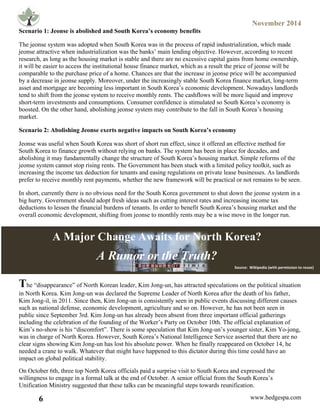
The “disappearance” of North Korean leader, Kim Jong-un, has attracted speculations on the political situation
in North Korea. Kim Jong-un was declared the Supreme Leader of North Korea after the death of his father,
Kim Jong-il, in 2011. Since then, Kim Jong-un is consistently seen in public events discussing different causes
such as national defense, economic development, agriculture and so on. However, he has not been seen in
public since September 3rd. Kim Jong-un has already been absent from three important official gatherings
including the celebration of the founding of the Worker’s Party on October 10th. The official explanation of
Kim’s no-show is his “discomfort”. There is some speculation that Kim Jong-un’s younger sister, Kim Yo-jong,
was in charge of North Korea. However, South Korea’s National Intelligence Service asserted that there are no
clear signs showing Kim Jong-un has lost his absolute power. When he finally reappeared on October 14, he
needed a crane to walk. Whatever that might have happened to this dictator during this time could have an
impact on global political stability.
On October 6th, three top North Korea officials paid a surprise visit to South Korea and expressed the
willingness to engage in a formal talk at the end of October. A senior official from the South Korea’s
Unification Ministry suggested that these talks can be meaningful steps towards reunification.
A Major Change Awaits for North Korea?
A Rumor or the Truth?
Image	
  via	
  Wikipedia	
  
Source:	
  	
  Wikipedia	
  (with	
  permission	
  to	
  reuse)	
  
November 2014
7 www.hedgespa.com
	
  
However, even after this friendly surprise visit, North
Korea and South Korea exchanged fire in disputed
areas. On October 10th, another exchange happened
near the border town of Yeoncheon, only 30 miles
from Seoul. North Korea’s contradicting moves
surprised many. How will the political situation in the
Korean peninsula affect regional economies and the
rest of the world?
Scenario 1:Two Koreas Reunify in the Near
Future
The Korean peninsula has been separated since the
end of World War II. The two Koreas have had talks
for reunification for quite some time, but any positive
efforts are often destroyed by subsequent disputes.
North Korea paid a surprise visit to South Korea.
This trip restores the official communication, which
has been suspended for seven months. The two
Koreas finally agreed to have an official talk at the
end of October. Even though there were subsequent
skirmishes, the talks seem to not be affected. 	
  
South Korean President Park Geun-hye said earlier
this year in a meeting with German Chancellor
Angela Merkel that Germany could be a model for
Korea reunification. On October 10th, North Korea
urged South Korea to respond to a low-level federal
government plan to unify the two Koreas.
Reunification would bring political stability to Korea
and secure long-term growth, but potentially at South
Korea’s cost.
Regardless of cheap labor and natural resources in the
North, reunification might cost 7% of South Korea’s
annual GDP, which is about $1.15 trillion in 2012, as
noted by South Korea’s Finance Ministry last year.
Furthermore, the economic cost for South Korea
would last for many years. The huge cost mainly
stems from the GDP gap between the two Koreas.
South Korea’s GDP is more than 30 times of North
Korea’s.
In terms of foreign relations, reunification would be
the last thing Beijing wants to see in the Korean
peninsula. On one hand, China, which is currently
North Korea largest foreign trade partner, may lose its
economic dominance in North Korea once North
Korea gains access to more foreign investments. On
the other hand, North Korea is a “buffer zone” for
China against the US. Once the two Koreas are
reunified, the U.S. might have access to military
bases near China. Besides China, Russia also will not
want to see reunification in the Korean peninsula for
the same political reasons.
Scenario 2: Two Koreas Will Not Reunify in the
Near Future
Given the serious dispute in terms of Nuclear Weapon
testing, it is unlikely for the two Koreas to reunite in
the near future. President Park supports a Non-
Proliferation Policy in the Korean peninsula and will
discourage any type of Nuclear Weapon testing.
However, North Korea believes that the Korean
Peninsula will have no security without its own
Nuclear Weapons. Given the violent history between
President Park’s family and the North Korean
leadership, there may be no easy way to rebuild
enough trust to overcome such fundamental
difference in philosophy.	
  
Source:	
  	
  Wikipedia	
  (with	
  permission	
  to	
  reuse)	
  
November 2014
8 www.hedgespa.com
	
  
Since the annexation of Crimea by the Russian Federation earlier this year, Russia has faced many criticisms
from around the globe. These criticisms have culminated in economic sanctions against Russia. The many
sanction-imposing countries include the European Union, the United States, and Japan. These sanctions have
collectively impacted Russia’s sovereign credit rating, which will then increase Russia’s cost to borrow.
However, even under such conditions, the Russian Ruble has avoided a one-way slide in its value. On Oct. 30,
2014, the ruble surged as much as 2.8 percent against the dollar, which is the most it has risen since January
2010, even though the swelling was dismissed by some as the result of market manipulation by its central bank.
Let us examine two potential scenarios arising from these sanctions against Russia.
Scenario 1: Russia can work out a route to self-sustenance
Currently, Russia has low debt levels and holds a strong reserve, thanks to high energy prices. Its economy does
not seem to be impaired much by the strained trade ties. Also, since it has developed long-term trading
partnerships with countries such as China, Russia has been able to trade with its nearby ally without any
interruption, rendering the deterioration in its trading ties with the aforementioned countries to not be very
important after all. However, with the increased cost of borrowing due to a fall in sovereign credit ratings, it
would be increasingly difficult for Russia to invest in major projects.
In the shorter term, Russia’s government might be able to entice investors to engage in investments by
artificially suppressing the interest rates with the backing of its strong reserves. In addition, trading with China
suggests that Russia may still be able to engage in indirect trade with other countries in the world. Russia is the
world’s top oil producing country so its economy will be able to continue to function without any lack of
natural or financial resources even if this situation is drawn out longer than expected.
Scenario 2: Strained trade ties and alternatives
Despite Russia’s strong, unwavering stance, one side may decide to ease up on its approach to the issue. Any
Russian plan to stay disengaged with the other major markets in the world may not last very long because the
rest of the world needs Russian resources. Undoubtedly, the effects of the sanctions are detrimental to both
parties as many companies will not be able to adjust to the changes made by multiple governments.
US corporations such as Boeing and General Electrics, both of which were originally in business deals with
their Russia counterparts, had to abruptly end their investment projects. Corporations that are deeply involved
with Russian companies will suffer steep losses due to the immediate cutback in supply or demand.
As discussed earlier, Russia, as the largest oil producing country, is responsible for slightly more than 13% of
the world’s oil production. Countries that impose sanctions against Russia will suffer from the loss of access to
Russian oil while other countries enjoy cheaper oil. This will negatively impact operations in countries that are
dependent on Russian energy. Moreover, with Russian suppliers cutting supply in less favorable markets, the
world’s oil prices can be driven up.
Even though both sides are unyielding towards their stance, there are still plenty of good reasons for
reconciliation.
Russia Sanctions and Its
Repercussions
What is the effect?
November 2014
9 www.hedgespa.com


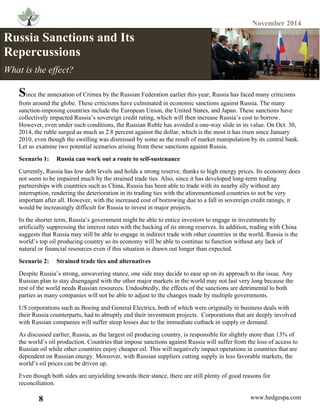
The protests in Hong Kong, initiated by students in response to a decision made by Beijing, have lasted for
over a month. On August 31st, the China’s National People’s Congress (CNPC) standing committee announced
that voters in Hong Kong can only choose their Chief Executive from two or three candidates approved by a
nominating committee in Beijing. Protestors believe that Beijing’s decision breaches its promise of free
nomination in 2017. They also accuse Chief Executive Leung Chun-ying of having done little except to please
Beijing. Therefore, the protestors ask Leung Chun-ying to resign from the Chief Executive’s office. As the
Chief Executive of a Special Administration Region, Leung has been expected (but failed so far) to find a
delicate balance between the Central Government in Beijing and the citizens of Hong Kong. The protest became
more acute after the police fired tear gas canisters at the protestors. Given that it is highly unlikely for Beijing to
give in to the protestors, the best way to mitigate the situation is to fire Leung.
Scenario 1: Beijing Pushes Leung Out Using “Less Direct” Means
A secret source revealed that Chief Executive Leung Chun-ying accepted HK$50 million in undisclosed
payment from UGL, an Australian engineering firm that took over DTZ, for which he was Asia-Pacific
Chairman. Leung was appointed as the Chief Executive in July 2012. This payment was not disclosed and was
made in two installments in 2012 and 2013 when he was in office. The undisclosed information came out on the
eighth day of the Hong Kong protest, resulting in complaints against Leung and demands for him to be filed
with Hong Kong’s independent anti-corruption agency. This is a perfect excuse to fire Leung without making
Beijing look like they are giving in to the protestors. Furthermore, it fits with President Xi’s agenda to fight
corruption. That’s why there are rumors that Beijing is behind this leak.
Leung’s multiple inept comments in response to the situation led many to question whether he even has the
basic political competency for the extremely demanding job. He has been widely ridiculed for setting the “gold
standard” for what not to say in front of global media. Pushing out Leung will mitigate the situation to some
extent; however, it will not solve the problem completely. In the meantime, Hong Kong’s economy is slowing.
With relatively low domestic and international demand, Hong Kong has mainly been relying on mainland
Chinese customers to be its economic driver. Hong Kong’s economy will suffer due to curbs on Chinese tourists.
Moreover, Hong Kong’s competitiveness is fading as Shanghai is on its way to become the new financial hub
for Asia.
Leung’s resignation may put a quicker end to the protests. However, the on-going distrust and conflicts cannot
go away unless Beijing and Hong Kong find a mutually acceptable solution.
Scenario 2: Leung Chun-ying Continues to be Hong Kong’s Chief Executive
As long as Leung stays in his current position, the protests will last with intermittent flare-ups. The Chinese
government has to come up with ways to meet protestors’ demands. Eventually, Beijing will “give up” on
using Hong Kong as its driver for growth and international finance, and will look to implement more “reliable”
policies. China’s economy may suffer in the short run.
Hong Kong Protests and
its Embattled Chief Executive
Who will take the lead?
Source:	
  	
  Wikipedia	
  (with	
  permission	
  to	
  reuse)	
  
Source:	
  	
  Wikipedia	
  (with	
  permission	
  to	
  reuse)	
  
November 2014
10 www.hedgespa.com
	
  
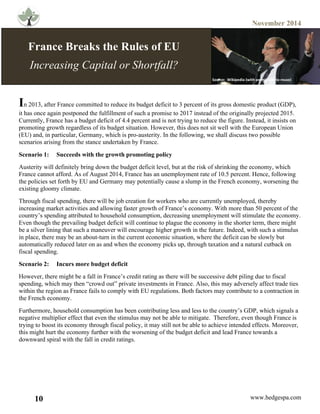
In 2013, after France committed to reduce its budget deficit to 3 percent of its gross domestic product (GDP),
it has once again postponed the fulfillment of such a promise to 2017 instead of the originally projected 2015.
Currently, France has a budget deficit of 4.4 percent and is not trying to reduce the figure. Instead, it insists on
promoting growth regardless of its budget situation. However, this does not sit well with the European Union
(EU) and, in particular, Germany, which is pro-austerity. In the following, we shall discuss two possible
scenarios arising from the stance undertaken by France.	


Scenario 1: Succeeds with the growth promoting policy
Austerity will definitely bring down the budget deficit level, but at the risk of shrinking the economy, which
France cannot afford. As of August 2014, France has an unemployment rate of 10.5 percent. Hence, following
the policies set forth by EU and Germany may potentially cause a slump in the French economy, worsening the
existing gloomy climate.
Through fiscal spending, there will be job creation for workers who are currently unemployed, thereby
increasing market activities and allowing faster growth of France’s economy. With more than 50 percent of the
country’s spending attributed to household consumption, decreasing unemployment will stimulate the economy.
Even though the prevailing budget deficit will continue to plague the economy in the shorter term, there might
be a silver lining that such a maneuver will encourage higher growth in the future. Indeed, with such a stimulus
in place, there may be an about-turn in the current economic situation, where the deficit can be slowly but
automatically reduced later on as and when the economy picks up, through taxation and a natural cutback on
fiscal spending.
Scenario 2: Incurs more budget deficit
However, there might be a fall in France’s credit rating as there will be successive debt piling due to fiscal
spending, which may then “crowd out” private investments in France. Also, this may adversely affect trade ties
within the region as France fails to comply with EU regulations. Both factors may contribute to a contraction in
the French economy.
Furthermore, household consumption has been contributing less and less to the country’s GDP, which signals a
negative multiplier effect that even the stimulus may not be able to mitigate. Therefore, even though France is
trying to boost its economy through fiscal policy, it may still not be able to achieve intended effects. Moreover,
this might hurt the economy further with the worsening of the budget deficit and lead France towards a
downward spiral with the fall in credit ratings.
France Breaks the Rules of EU
Increasing Capital or Shortfall?
Source:	
  	
  Wikipedia	
  (with	
  permission	
  to	
  reuse)	
  
Source:	
  	
  Wikipedia	
  (with	
  permission	
  to	
  reuse)	
  
November 2014
11 www.hedgespa.com
	
  
Asia vs. Europe & the US
Who will lead global
development in the future?
The global financial market has been dominated by the World Bank and the International Monetary Fund
(IMF) since the Bretton Woods Conference held in 1944. These two institutions represent the financial
leadership of Western European countries and the United States.
Today, the World Bank raises a significant portion of its funds from Asian surplus countries, but it is seen by
some as falling short of fully leveraging Asian capital. Asian countries’ attempts to gain more leadership and
visibility at the IMF were conveniently brushed aside at its last leadership race. Adding to the frustration, the
Asian Development Bank (ADB), the main development institution in the Asian-Pacific region, has been
dominated by Japan for decades.
On October 24, 2014, under a Chinese proposal, 21 Asian countries signed off on the creation of Asian
Infrastructure Investment Bank (AIIB) as a way to improve governance and accountability. AIIB has an
authorized capital of US $100 billion, which far exceeds the original expectations. With economic growth in
Asia and the persistently soft economies in Europe and the United States, it is not surprising that market
leadership will shift from the two traditional multilateral institutions to the new Asia-backed institution.
Scenario 1: WB and ADB will become ineffective as Asian surplus countries are focusing on AIIB
The establishment of AIIB intends to address the urgent need for infrastructure financing in not only the Asian
region but also the global financial market. Furthermore, Asian countries, especially China, want to have a
bigger say on the use of their funds, and they are running into constant threats of veto by the US under current
World Bank and IMF rules. According to recent data, though the four major BRICS countries contribute 24.5
percent of world GDP, they only command 10.3 percent of the votes at the IMF. This portion is in sharp
contrast to the four developed western countries-Germany, Italy, UK and France. Though they only contribute
13.4 percent of world GDP, they command 17.6 percent of the votes.
Besides political motives, there are genuine policy concerns as well. For example, the World Bank may fund
infrastructure projects that may not be consistent with Chinese interests, such as controversial dam projects on
rivers sourcing from the Himalayas. The launch of AIIB may show that China can come up with an alternative
approach that will both correct the anachronism of the Bretton Woods institutions and stimulate the global
economy.
This is a turning point that threatens the longer-term survival of the WB and IMF traditionally dominated by the
West. Western governments are already facing problems with the lack of resources and capital, so if the
Source:	
  	
  Wikipedia	
  (with	
  permission	
  to	
  reuse)	
  
November 2014
12 www.hedgespa.com
	
  
Chinese government and companies stop buying World Bank and IMF bonds, it will only be a matter of time
before these two multilateral organizations will run into funding issues.
In most lending situations, the lead creditor always have the final say. It is basically China’s call whether it
prefers a soft power approach or a blunt approach to get its way. Hence, China will play a significant role in
global economy with the establishment of AIIB.
Scenario 2: Western institutions will try to accommodate Asian interests to achieve a more collaborative
environment
China considers AIIB as a driver in global development. Half of the authorized capital of AIIB ($50 billion) is
supported by China. Since the Chinese proposed large infrastructure projects such as the Silk Road Economic
Belt and the Maritime Silk Road Belt, AIIB has plenty of legitimate work to do. However, AIIB has not been
endorsed by some developing countries such as South Korea and Indonesia in fear of undue Chinese influence.
As one of Washington’s most loyal diplomatic allies, South Korea needs to take all factors into account before
they join the AIIB. When Asia tried to nominate an Asian MD of the IMF, the U.S. threatened to veto it.
Traditionally, the MD of the IMF has been a European, while the President of World Bank has been an
American. To pacify Asians, President Obama appointed Jim Yong Kim, a Korean-American with dual
citizenship, to become the current President of World Bank. This move no doubt put South Korea in a difficult
situation. AIIB’s future success partly depends on the commitment of future partners such as South Korea and
Indonesia.
Still, the Bretton Woods institutions can no longer afford to ignore Asian countries’ massive public surpluses
and the aspirations. Hence, in order to benefit both sides, western institutions will need to change its culture and
to begin accommodating Asian interests to achieve a more collaborative environment, such as giving the BRICS
voting power comparable to the current size of their economies.
Disclaimer
The information contained herein: (1) is proprietary to HedgeSPA and/or its content providers; (2) may not be
copied or distributed; and (3) is not warranted to be accurate, complete or timely. Neither HedgeSPA nor its
content providers are responsible for any damages or losses arising from any use of this information. Information
containing any historical information, data or analysis should not be taken as an indication or guarantee of any
future performance, analysis, forecast or prediction. Past performance does not guarantee future results. None of
the Information constitutes an offer to sell (or a solicitation of an offer to buy), any security, financial product or
other investment vehicle or any trading strategy.
© 2014 HedgeSPA Pte. Ltd. All Rights Reserved.
Contact Us
Address 440 N. Wolfe Road Sunnyvale, CA 94085, USA
Phone +1 (415) 465 2503 (California) or +65 9183 1492 (Singapore)
Skype hedgespa.support
Email salesnsupport@hedgespa.com
Website www.hedgespa.com

Publication

  • 1.
    November 2014 1 www.hedgespa.com                                                                   Quantitative easing (QE) has been a policy tool used by central banks since 2008 when standard monetary policy turned ineffective with near-zero short rates. Central banks buy financial assets as a way to decrease yield on the long-end of the yield curve. This has significantly stimulated consumption and enhanced liquidity in recent years. However, if a government overdoes quantitative easing, which is a form of “printing” money, inflation may follow. Therefore, the desirability of QE as a policy tool has been quickly diminishing. On October 29, 2014, the Fed announced that it would put an end to QE. That announcement triggered immediate reactions in the financial market. The dollar index soared and gold price decreased by over 1 percent. According to the Federal Open Market Committee (FOMC) announcement in October, they will not change the federal funds rate that is currently in the range between 0 and 0.25 percent. We shall look into two scenarios to analyze whether the timing for the end of QE is right. What We Do HedgeSPA provides state-of-the-art investment analytics and market scenarios on an affordable platform, for seasoned buy-side professionals. We take care of portfolio managers’ day-to-day headaches and technicalities, saving them time and effort that they can redirect towards client relationships and strong portfolio performance. The HedgeSPA Platform With our platform, you can scan investment sub-universes; check for out-of-balance factor exposures; evaluate your portfolios under scenarios extracted from published broker research; generate indicative reporting to check against common errors in broker reports; and send customized risk and performance reports to investors or to third-party investment reporting tools. Try it here: app.hedgespa.com HedgeSPA November 2014 Sophisticated Investment Analytics l Trusted Market Insights   1 www.hedgespa.com Contents 1 The End of Quantitative Easing Who is making progress? 2 Saudi New Oil Strategy Will lower oil price benefit the emerging global economy? 3 Oil Reforms in India Good or Bad? 4 New Framework in the South Korean Housing Market Is traditional system outdated?   5 A Major Change Awaits for North Korea? A Rumor or the Truth? 6 Russia Sanctions and Its Repercussions What is the effect? 7 Hong Kong Protests and its Embattled Chief Executive Who will take the lead?   8 France Breaks EU Rules Increasing Capital or Shortfall?   9 Asia vs. Europe & US Who will lead global development in the future?           Market Scenarios The End of Quantitative Easing Who is making progress? Contact Email salesnsupport@hedgespa.com Skype hedgespa.support Twitter @HedgeSPA Source:    Wikipedia  (with  permission  to  reuse)  
  • 2.
    November 2014 2 www.hedgespa.com                                                               Scenario 1: Ending QE Assists U.S. to Move in the Right Direction The Fed’s bond-buying programs have increased its balance sheet from $900 billion to $4.4 trillion based on the most recent data. There are signs that QE has some success in reviving the U.S. economy from the financial crisis. However, now, the Fed believes that growth and job creation have regained momentum and that there is no need to continue QE in order to stimulate the US economy. Ending QE is a correct move to preempt runaway inflation. Moreover, U.S. economy can move forward with conventional monetary policy tools, instead of building up an ever-increasing balance sheet of assets, which the Fed will eventually need to sell off. Scenario 2: Cutting off QE too Early Ushers in Volatility According to the FOMC announcement, the Fed will stop buying bonds at the end of October. However, the Fed will continue reinvesting receipts, so the balance sheet of Federal Reserve is not getting any smaller. Now that the Fed has purchased a massive amount of assets and has to somehow sell off those assets in the future, doing so may trigger a disaster for the bond market once the Fed announces its timing to sell. At the same time, ending the purchase will not help stimulate the economy. Americans still have difficulties in getting loans, now that there is a shortage of purchasers of mortgage and asset-backed securities, and thus cannot get the financing they need to help move the US economy forward. The U.S. economy will stay weak. The fragile state of the US mortgage market can be best illustrated by former Fed Chairman Bernanke’s inability to refinance his own mortgage. The absence of a large buyer in the mortgage-backed securities market can choke off the fragile economic recovery. Furthermore, cutting off QE will negatively impact US trade relations with China and Japan. When the Fed eventually must sell, it will need the support by major bond purchasers such as the Chinese and Japanese. Somehow, the Fed needs to convince   China and Japan that they are not buying potentially worthless pieces of papers that it does not want to keep. For now, China is buying large quantities of US debts to avoid RMB appreciation and, potentially, massive unemployment if RMB appreciates too quickly. Simultaneously, China has been working hard to increase the economic value added by its manufacturing activities through selling higher end products and diversifying demand away from the US. On October 31, 2014, the Monetary Policy Committee of the Bank of Japan (BOJ) also surprised the world by launching QQE II, increasing its monetary base from 60-70 trillion yen to 80 trillion yen. The U.S. will have to deal with its mountain of debts eventually with the uncertainty and volatility brought on by the end of QE. Former PIMCO Chief Investment Officer Bill Gross recently wrote that, “Stopping the printing press sounds like a great solution to the depreciation of our purchasing power but today’s printing is simply something that the global finance based economy cannot live without.” This is particularly true after the Republicans have taken over the Senate; now, it is unlikely that the Obama Administration will be able to make substantive progress on fiscal policies. The US economy will have to rely on monetary stimulus. In summary, if the Fed were to cut off QE, it needs to figure out how to keep large purchasers such as China, Japan and the Middle East to continue buying the mountains of bonds that it needs to sell. Currently, China buys US bonds to keep its currency artificially low, thanks to a process known as sterilization. However, eventually China will ask whether it is ready to buy a significant piece of the $4 trillion dollars in U.S. bonds that the Fed will sell off. Chances are that there may not be an ending to QE that everyone will be happy about, and the economic situation of U.S. will only become worse.  
  • 3.
    November 2014 3 www.hedgespa.com                                                           Recently, Saudi Arabia surprised the markets by announcing a substantial reduction in the export price of its crude oil. The monthly price of Crude Oil in the past 5 years can be seen in the chart below. The price in March 2011 was $109 per barrel. Since then, the price remained high until September 2014. However, on October 27, 2014, the crude oil price dropped below $80 per barrel. Furthermore, as predicted by a widely-followed investment banking research, oil price is expected to decrease by another $10 and drop to $70 per barrel in 2015. As a result, in some regions in the US, gasoline prices began to drop. According to recent data, $80 can be translated into approximately $2.95 per gallon for gasoline prices and $70 can be translated into $2.60 per gallon. As a matter of fact, in 10 US states, gas prices already dropped below $3.25 per gallon, with even California reporting below $3 per gallon. Despite the fact that U.S. GDP grew by 4.6% in the second quarter of 2014, it is estimated that US GDP may drop 2.9% in the third quarter of 2014 because of the oil price plunge, down from earlier estimates. What is Saudi Arabia’s intention after they managed to keep oil above $100 per barrel for such a long time? There is no obvious reason for Saudi Arabia to negatively impact the U.S. economy because the U.S. is the “goose” that lays their golden egg. We shall look into 2 possible scenarios that Saudi’s new oil strategy may impact the global economy. Scenario 1: Saudi does what it is trying and succeeds As the most effective substitute of traditional crude oil, shale gas is gaining momentum in the US, thanks to new technology and relatively stable oil prices. According to the International Energy Agency, the marginal cost of production on shale gas is only around $60 to $80 per barrel. With the current price of crude oil dropping below $80 per barrel, many U.S. shale gas projects are clearly at risk, which may precisely be what Saudi was planning to achieve with its drop in crude oil price. After Saudi terminates these shale gas projects, they can again raise the price of crude oil once again. Additionally, lower gasoline prices can swing US   Saudi Arabia’s New Oil Strategy Will lower oil price benefit the emerging global economy? public opinion in Saudi’s favor by “helping” the U.S. economy. Saudi is worried about both ISIS and Iran, so having U.S. public opinion on its side will increase the likelihood that Congress will approve any US military intervention if necessary. Scenario 2: Saudi does what it is trying but fails There are two key risks in Saudi’s new strategy. First of all, other OPEC countries such as Libya may increase its production to maintain much needed revenues. However, since Saudi is the OPEC producer with the largest surplus capacities, the rest of OPEC may not be able to stop the slide of oil price. Under the influences of these opposing forces, oil prices may go through a period of instability as many producers flood the market to replace lost revenues while simultaneously trying to push up the price. And in the midst of such instability, rivals such as Columbia and Russia are still willing to sell even cheaper oil. China’s Customs statistics reported that in September this year the average contract price Asian countries signed to Saudi Arabia was $102.3 per barrel, while the average price in Columbia was only $94.56 per barrel. To take advantage of the lower price, China imported a large amount of crude oil from Columbia (exceeding by 389.6 percent from the corresponding period of the previous year) while decreasing imports from Saudi Arabia. In September, the crude oil China imported from Saudi Arabia amounted to 4.74 million tons, or 2.7 percent lower than the corresponding period of last year. Since the drop in sales to Asian countries is not only not mitigated by a high price of crude oil but is instead aggravated by the drastic drop in oil prices, this risky oil price reduction may be self-defeating, leading to not only instability in oil prices but also a greater loss of revenue from its Asian consumers. Aside from such financial risks, there are also political risks associated with Saudi’s new strategy. After dropping its oil price, Saudi tension with Iran and ISIS will rise further, eventually reaching open conflicts. Therefore, even though Saudi wants to kill two birds (meeting both economic and political objectives) with one stone by implementing its new oil strategy, it seems that the potential risks outweigh the potential benefits. While Saudi will not reach its goals, it may create many unintended consequences that will further destabilize an already volatile region and cause both the U.S. and global economies will suffer.     Source:    Wikipedia  (with  permission  to  reuse)  
  • 4.
    November 2014 4 www.hedgespa.com                                                     Oil Reforms in India Good or Bad?   On October 18th, Indian Prime Minister Narendra Modi announced that his Government will proceed with reforms in the oil market, which include the deregulation of diesel prices and an increase in natural gas prices. The deregulated diesel prices will now be pegged to international rates, while the hike in natural gas prices will be reviewed on a semiannual basis. Since 44 percent of India’s total fuel consumption is attributed to diesel, deregulation is likely to cause greater volatility in its economy. Also, the rise in natural gas prices may increase the cost of living for locals. These bold steps have attracted speculations on how India’s energy market will be affected. Here, we further discuss 2 possible outcomes stemming from the policy decision. Scenario 1: India successfully transforms its economy With the reforms in place, India strives to move forward by shifting its focus on using natural gases. First of all, since the deregulated diesel prices have been rising, many Indian companies may be incentivized to invest in natural gas or other kinds of alternative energy technology. Second of all, because of the price hike, more producers will be entering the market to reap profits that were previously unavailable to them. With the influx of new entrants, the natural gas market in India will move towards competitive pricing, thus lightening the burden borne by corporations and consumers who are highly dependent on natural gas in their production or daily lives. Also, since natural gas prices are set to be revised semiannually, the government retains great flexibility to adjust prices and to provide subsidies while ensuring the relative stability of prices for end consumers. Hence, after placing in such measures, India might experience However, after implementing such measures, India may experience some cutback in their productions since many Indian companies may be unable to immediately adapt to the change from diesel to natural gas consumption. For instance, since the deregulated diesel price is now pegged to international rates, corporations that heavily rely on diesel are now prone to market fluctuations. And without government subsidies to help them weather through such fluctuations, such corporations will struggle to maintain a stable level of production. Eventually, they will most likely switch to to another energy source. So, in the long run, India will be able to make effective use of their energy resources and in general reduce the problems associated with the use of diesel. Scenario 2: India incurs more private debts Even given that there are potential benefits to be reaped in the long run from a shift in which energy sources are used, the possible risks from such an abrupt change should not be underestimated. Corporations that are unable to survive under the new regime might face elimination. Albeit the possibility that new entrants will come in to replace the inefficient ones that are presently operating, there will be lags in between until the replacements are made. Although natural gas may be a viable alternative, it will still undoubtedly raise the costs certain companies have to face to replace their machineries or to construct pipelines. Subsidies by the government may alleviate the cost borne by the companies, yet many of them may still find it too costly to operate after the change. When companies exit, the unemployment rate will increase. The factors mentioned above may lead to a shrinkage in the overall economy, which may then require fiscal spending to increase job opportunities. Hence, it is still unclear if such a measure may result in an improvement in the budget balance as intended. Nonetheless, the economy will be able to make a turn for the better if India is able to go through the reforms.   Source:    Wikipedia  (with  permission  to  reuse)   Source:    Wikipedia  (with  permission  to  reuse)  
  • 5.
    November 2014 5 www.hedgespa.com   South Korea’s government realized that the traditional system may be outdated and may hinder the future development of South Korea’s housing market. The figure below shows some of the factors distinguishing jeonse prices from home purchase prices. To move its housing market forward in a positive direction, the South Korean government stepped in to reduce the utilization of jeonse and reinstate tax cuts for tenants. Its housing market soon started to recover amongst robust economic growth. In Q2 of 2014, the housing purchase price index rose by 1.41 percent, and the GDP of South Korea increased by 0.6 percent. A new framework for real-estate policy is forming and jeonse may be abolished in the longer run. We shall look into 2 possible scenarios as to how jeonse may impact the South Korean economy. New Framework in the South Korean Housing Market Is the traditional system outdated?           Source:    Wikipedia  (with  permission  to  reuse)   Jeonse is a unique South Korean real estate policy tool that offers a lump-sum deposit for rent, which has been used in South Korea for many years. However, according to data from Kookmin Bank, jeonse prices have been climbing. In 2011, the jeonse prices jumped by 13 percent and have continued to increase since then. As a result, a large number of tenants could not afford the deposit and were unable to rent any houses, resulting in a sharp plunge in home prices in South Korea. In Q1 of 2014, home prices in South Korea dropped 7 percent. Landlords began seeking new ways to achieve gains from housing investments, but, under the current lower interest rate environment, could not find a better way other than managing lump sum jeonse deposits.
  • 6.
    November 2014 6 www.hedgespa.com   Scenario 1: Jeonse is abolished and South Korea’s economy benefits The jeonse system was adopted when South Korea was in the process of rapid industrialization, which made jeonse attractive when industrialization was the banks’ main lending objective. However, according to recent research, as long as the housing market is stable and there are no excessive capital gains from home ownership, it will be easier to access the institutional house finance market, which as a result the price of jeonse will be comparable to the purchase price of a home. Chances are that the increase in jeonse price will be accompanied by a decrease in jeonse supply. Moreover, under the increasingly stable South Korea finance market, long-term asset and mortgage are becoming less important in South Korea’s economic development. Nowadays landlords tend to shift from the jeonse system to receive monthly rents. The cashflows will be more liquid and improve short-term investments and consumptions. Consumer confidence is stimulated so South Korea’s economy is boosted. On the other hand, abolishing jeonse system may contribute to the fall in South Korea’s housing market. Scenario 2: Abolishing Jeonse exerts negative impacts on South Korea’s economy Jeonse was useful when South Korea was short of short run effect, since it offered an effective method for South Korea to finance growth without relying on banks. The system has been in place for decades, and abolishing it may fundamentally change the structure of South Korea’s housing market. Simple reforms of the jeonse system cannot stop rising rents. The Government has been stuck with a limited policy toolkit, such as increasing the income tax deduction for tenants and easing regulations on private lease businesses. As landlords prefer to receive monthly rent payments, whether the new framework will be practical or not remains to be seen. In short, currently there is no obvious need for the South Korea government to shut down the jeonse system in a big hurry. Government should adopt fresh ideas such as cutting interest rates and increasing income tax deductions to lessen the financial burdens of tenants. In order to benefit South Korea’s housing market and the overall economic development, shifting from jeonse to monthly rents may be a wise move in the longer run. The “disappearance” of North Korean leader, Kim Jong-un, has attracted speculations on the political situation in North Korea. Kim Jong-un was declared the Supreme Leader of North Korea after the death of his father, Kim Jong-il, in 2011. Since then, Kim Jong-un is consistently seen in public events discussing different causes such as national defense, economic development, agriculture and so on. However, he has not been seen in public since September 3rd. Kim Jong-un has already been absent from three important official gatherings including the celebration of the founding of the Worker’s Party on October 10th. The official explanation of Kim’s no-show is his “discomfort”. There is some speculation that Kim Jong-un’s younger sister, Kim Yo-jong, was in charge of North Korea. However, South Korea’s National Intelligence Service asserted that there are no clear signs showing Kim Jong-un has lost his absolute power. When he finally reappeared on October 14, he needed a crane to walk. Whatever that might have happened to this dictator during this time could have an impact on global political stability. On October 6th, three top North Korea officials paid a surprise visit to South Korea and expressed the willingness to engage in a formal talk at the end of October. A senior official from the South Korea’s Unification Ministry suggested that these talks can be meaningful steps towards reunification. A Major Change Awaits for North Korea? A Rumor or the Truth? Image  via  Wikipedia   Source:    Wikipedia  (with  permission  to  reuse)  
  • 7.
    November 2014 7 www.hedgespa.com   However, even after this friendly surprise visit, North Korea and South Korea exchanged fire in disputed areas. On October 10th, another exchange happened near the border town of Yeoncheon, only 30 miles from Seoul. North Korea’s contradicting moves surprised many. How will the political situation in the Korean peninsula affect regional economies and the rest of the world? Scenario 1:Two Koreas Reunify in the Near Future The Korean peninsula has been separated since the end of World War II. The two Koreas have had talks for reunification for quite some time, but any positive efforts are often destroyed by subsequent disputes. North Korea paid a surprise visit to South Korea. This trip restores the official communication, which has been suspended for seven months. The two Koreas finally agreed to have an official talk at the end of October. Even though there were subsequent skirmishes, the talks seem to not be affected.   South Korean President Park Geun-hye said earlier this year in a meeting with German Chancellor Angela Merkel that Germany could be a model for Korea reunification. On October 10th, North Korea urged South Korea to respond to a low-level federal government plan to unify the two Koreas. Reunification would bring political stability to Korea and secure long-term growth, but potentially at South Korea’s cost. Regardless of cheap labor and natural resources in the North, reunification might cost 7% of South Korea’s annual GDP, which is about $1.15 trillion in 2012, as noted by South Korea’s Finance Ministry last year. Furthermore, the economic cost for South Korea would last for many years. The huge cost mainly stems from the GDP gap between the two Koreas. South Korea’s GDP is more than 30 times of North Korea’s. In terms of foreign relations, reunification would be the last thing Beijing wants to see in the Korean peninsula. On one hand, China, which is currently North Korea largest foreign trade partner, may lose its economic dominance in North Korea once North Korea gains access to more foreign investments. On the other hand, North Korea is a “buffer zone” for China against the US. Once the two Koreas are reunified, the U.S. might have access to military bases near China. Besides China, Russia also will not want to see reunification in the Korean peninsula for the same political reasons. Scenario 2: Two Koreas Will Not Reunify in the Near Future Given the serious dispute in terms of Nuclear Weapon testing, it is unlikely for the two Koreas to reunite in the near future. President Park supports a Non- Proliferation Policy in the Korean peninsula and will discourage any type of Nuclear Weapon testing. However, North Korea believes that the Korean Peninsula will have no security without its own Nuclear Weapons. Given the violent history between President Park’s family and the North Korean leadership, there may be no easy way to rebuild enough trust to overcome such fundamental difference in philosophy.   Source:    Wikipedia  (with  permission  to  reuse)  
  • 8.
    November 2014 8 www.hedgespa.com   Since the annexation of Crimea by the Russian Federation earlier this year, Russia has faced many criticisms from around the globe. These criticisms have culminated in economic sanctions against Russia. The many sanction-imposing countries include the European Union, the United States, and Japan. These sanctions have collectively impacted Russia’s sovereign credit rating, which will then increase Russia’s cost to borrow. However, even under such conditions, the Russian Ruble has avoided a one-way slide in its value. On Oct. 30, 2014, the ruble surged as much as 2.8 percent against the dollar, which is the most it has risen since January 2010, even though the swelling was dismissed by some as the result of market manipulation by its central bank. Let us examine two potential scenarios arising from these sanctions against Russia. Scenario 1: Russia can work out a route to self-sustenance Currently, Russia has low debt levels and holds a strong reserve, thanks to high energy prices. Its economy does not seem to be impaired much by the strained trade ties. Also, since it has developed long-term trading partnerships with countries such as China, Russia has been able to trade with its nearby ally without any interruption, rendering the deterioration in its trading ties with the aforementioned countries to not be very important after all. However, with the increased cost of borrowing due to a fall in sovereign credit ratings, it would be increasingly difficult for Russia to invest in major projects. In the shorter term, Russia’s government might be able to entice investors to engage in investments by artificially suppressing the interest rates with the backing of its strong reserves. In addition, trading with China suggests that Russia may still be able to engage in indirect trade with other countries in the world. Russia is the world’s top oil producing country so its economy will be able to continue to function without any lack of natural or financial resources even if this situation is drawn out longer than expected. Scenario 2: Strained trade ties and alternatives Despite Russia’s strong, unwavering stance, one side may decide to ease up on its approach to the issue. Any Russian plan to stay disengaged with the other major markets in the world may not last very long because the rest of the world needs Russian resources. Undoubtedly, the effects of the sanctions are detrimental to both parties as many companies will not be able to adjust to the changes made by multiple governments. US corporations such as Boeing and General Electrics, both of which were originally in business deals with their Russia counterparts, had to abruptly end their investment projects. Corporations that are deeply involved with Russian companies will suffer steep losses due to the immediate cutback in supply or demand. As discussed earlier, Russia, as the largest oil producing country, is responsible for slightly more than 13% of the world’s oil production. Countries that impose sanctions against Russia will suffer from the loss of access to Russian oil while other countries enjoy cheaper oil. This will negatively impact operations in countries that are dependent on Russian energy. Moreover, with Russian suppliers cutting supply in less favorable markets, the world’s oil prices can be driven up. Even though both sides are unyielding towards their stance, there are still plenty of good reasons for reconciliation. Russia Sanctions and Its Repercussions What is the effect?
  • 9.
    November 2014 9 www.hedgespa.com               The protests in Hong Kong, initiated by students in response to a decision made by Beijing, have lasted for over a month. On August 31st, the China’s National People’s Congress (CNPC) standing committee announced that voters in Hong Kong can only choose their Chief Executive from two or three candidates approved by a nominating committee in Beijing. Protestors believe that Beijing’s decision breaches its promise of free nomination in 2017. They also accuse Chief Executive Leung Chun-ying of having done little except to please Beijing. Therefore, the protestors ask Leung Chun-ying to resign from the Chief Executive’s office. As the Chief Executive of a Special Administration Region, Leung has been expected (but failed so far) to find a delicate balance between the Central Government in Beijing and the citizens of Hong Kong. The protest became more acute after the police fired tear gas canisters at the protestors. Given that it is highly unlikely for Beijing to give in to the protestors, the best way to mitigate the situation is to fire Leung. Scenario 1: Beijing Pushes Leung Out Using “Less Direct” Means A secret source revealed that Chief Executive Leung Chun-ying accepted HK$50 million in undisclosed payment from UGL, an Australian engineering firm that took over DTZ, for which he was Asia-Pacific Chairman. Leung was appointed as the Chief Executive in July 2012. This payment was not disclosed and was made in two installments in 2012 and 2013 when he was in office. The undisclosed information came out on the eighth day of the Hong Kong protest, resulting in complaints against Leung and demands for him to be filed with Hong Kong’s independent anti-corruption agency. This is a perfect excuse to fire Leung without making Beijing look like they are giving in to the protestors. Furthermore, it fits with President Xi’s agenda to fight corruption. That’s why there are rumors that Beijing is behind this leak. Leung’s multiple inept comments in response to the situation led many to question whether he even has the basic political competency for the extremely demanding job. He has been widely ridiculed for setting the “gold standard” for what not to say in front of global media. Pushing out Leung will mitigate the situation to some extent; however, it will not solve the problem completely. In the meantime, Hong Kong’s economy is slowing. With relatively low domestic and international demand, Hong Kong has mainly been relying on mainland Chinese customers to be its economic driver. Hong Kong’s economy will suffer due to curbs on Chinese tourists. Moreover, Hong Kong’s competitiveness is fading as Shanghai is on its way to become the new financial hub for Asia. Leung’s resignation may put a quicker end to the protests. However, the on-going distrust and conflicts cannot go away unless Beijing and Hong Kong find a mutually acceptable solution. Scenario 2: Leung Chun-ying Continues to be Hong Kong’s Chief Executive As long as Leung stays in his current position, the protests will last with intermittent flare-ups. The Chinese government has to come up with ways to meet protestors’ demands. Eventually, Beijing will “give up” on using Hong Kong as its driver for growth and international finance, and will look to implement more “reliable” policies. China’s economy may suffer in the short run. Hong Kong Protests and its Embattled Chief Executive Who will take the lead? Source:    Wikipedia  (with  permission  to  reuse)   Source:    Wikipedia  (with  permission  to  reuse)  
  • 10.
    November 2014 10 www.hedgespa.com   In 2013, after France committed to reduce its budget deficit to 3 percent of its gross domestic product (GDP), it has once again postponed the fulfillment of such a promise to 2017 instead of the originally projected 2015. Currently, France has a budget deficit of 4.4 percent and is not trying to reduce the figure. Instead, it insists on promoting growth regardless of its budget situation. However, this does not sit well with the European Union (EU) and, in particular, Germany, which is pro-austerity. In the following, we shall discuss two possible scenarios arising from the stance undertaken by France.                                                                                                                                                                                             Scenario 1: Succeeds with the growth promoting policy Austerity will definitely bring down the budget deficit level, but at the risk of shrinking the economy, which France cannot afford. As of August 2014, France has an unemployment rate of 10.5 percent. Hence, following the policies set forth by EU and Germany may potentially cause a slump in the French economy, worsening the existing gloomy climate. Through fiscal spending, there will be job creation for workers who are currently unemployed, thereby increasing market activities and allowing faster growth of France’s economy. With more than 50 percent of the country’s spending attributed to household consumption, decreasing unemployment will stimulate the economy. Even though the prevailing budget deficit will continue to plague the economy in the shorter term, there might be a silver lining that such a maneuver will encourage higher growth in the future. Indeed, with such a stimulus in place, there may be an about-turn in the current economic situation, where the deficit can be slowly but automatically reduced later on as and when the economy picks up, through taxation and a natural cutback on fiscal spending. Scenario 2: Incurs more budget deficit However, there might be a fall in France’s credit rating as there will be successive debt piling due to fiscal spending, which may then “crowd out” private investments in France. Also, this may adversely affect trade ties within the region as France fails to comply with EU regulations. Both factors may contribute to a contraction in the French economy. Furthermore, household consumption has been contributing less and less to the country’s GDP, which signals a negative multiplier effect that even the stimulus may not be able to mitigate. Therefore, even though France is trying to boost its economy through fiscal policy, it may still not be able to achieve intended effects. Moreover, this might hurt the economy further with the worsening of the budget deficit and lead France towards a downward spiral with the fall in credit ratings. France Breaks the Rules of EU Increasing Capital or Shortfall? Source:    Wikipedia  (with  permission  to  reuse)   Source:    Wikipedia  (with  permission  to  reuse)  
  • 11.
    November 2014 11 www.hedgespa.com   Asia vs. Europe & the US Who will lead global development in the future? The global financial market has been dominated by the World Bank and the International Monetary Fund (IMF) since the Bretton Woods Conference held in 1944. These two institutions represent the financial leadership of Western European countries and the United States. Today, the World Bank raises a significant portion of its funds from Asian surplus countries, but it is seen by some as falling short of fully leveraging Asian capital. Asian countries’ attempts to gain more leadership and visibility at the IMF were conveniently brushed aside at its last leadership race. Adding to the frustration, the Asian Development Bank (ADB), the main development institution in the Asian-Pacific region, has been dominated by Japan for decades. On October 24, 2014, under a Chinese proposal, 21 Asian countries signed off on the creation of Asian Infrastructure Investment Bank (AIIB) as a way to improve governance and accountability. AIIB has an authorized capital of US $100 billion, which far exceeds the original expectations. With economic growth in Asia and the persistently soft economies in Europe and the United States, it is not surprising that market leadership will shift from the two traditional multilateral institutions to the new Asia-backed institution. Scenario 1: WB and ADB will become ineffective as Asian surplus countries are focusing on AIIB The establishment of AIIB intends to address the urgent need for infrastructure financing in not only the Asian region but also the global financial market. Furthermore, Asian countries, especially China, want to have a bigger say on the use of their funds, and they are running into constant threats of veto by the US under current World Bank and IMF rules. According to recent data, though the four major BRICS countries contribute 24.5 percent of world GDP, they only command 10.3 percent of the votes at the IMF. This portion is in sharp contrast to the four developed western countries-Germany, Italy, UK and France. Though they only contribute 13.4 percent of world GDP, they command 17.6 percent of the votes. Besides political motives, there are genuine policy concerns as well. For example, the World Bank may fund infrastructure projects that may not be consistent with Chinese interests, such as controversial dam projects on rivers sourcing from the Himalayas. The launch of AIIB may show that China can come up with an alternative approach that will both correct the anachronism of the Bretton Woods institutions and stimulate the global economy. This is a turning point that threatens the longer-term survival of the WB and IMF traditionally dominated by the West. Western governments are already facing problems with the lack of resources and capital, so if the Source:    Wikipedia  (with  permission  to  reuse)  
  • 12.
    November 2014 12 www.hedgespa.com   Chinese government and companies stop buying World Bank and IMF bonds, it will only be a matter of time before these two multilateral organizations will run into funding issues. In most lending situations, the lead creditor always have the final say. It is basically China’s call whether it prefers a soft power approach or a blunt approach to get its way. Hence, China will play a significant role in global economy with the establishment of AIIB. Scenario 2: Western institutions will try to accommodate Asian interests to achieve a more collaborative environment China considers AIIB as a driver in global development. Half of the authorized capital of AIIB ($50 billion) is supported by China. Since the Chinese proposed large infrastructure projects such as the Silk Road Economic Belt and the Maritime Silk Road Belt, AIIB has plenty of legitimate work to do. However, AIIB has not been endorsed by some developing countries such as South Korea and Indonesia in fear of undue Chinese influence. As one of Washington’s most loyal diplomatic allies, South Korea needs to take all factors into account before they join the AIIB. When Asia tried to nominate an Asian MD of the IMF, the U.S. threatened to veto it. Traditionally, the MD of the IMF has been a European, while the President of World Bank has been an American. To pacify Asians, President Obama appointed Jim Yong Kim, a Korean-American with dual citizenship, to become the current President of World Bank. This move no doubt put South Korea in a difficult situation. AIIB’s future success partly depends on the commitment of future partners such as South Korea and Indonesia. Still, the Bretton Woods institutions can no longer afford to ignore Asian countries’ massive public surpluses and the aspirations. Hence, in order to benefit both sides, western institutions will need to change its culture and to begin accommodating Asian interests to achieve a more collaborative environment, such as giving the BRICS voting power comparable to the current size of their economies. Disclaimer The information contained herein: (1) is proprietary to HedgeSPA and/or its content providers; (2) may not be copied or distributed; and (3) is not warranted to be accurate, complete or timely. Neither HedgeSPA nor its content providers are responsible for any damages or losses arising from any use of this information. Information containing any historical information, data or analysis should not be taken as an indication or guarantee of any future performance, analysis, forecast or prediction. Past performance does not guarantee future results. None of the Information constitutes an offer to sell (or a solicitation of an offer to buy), any security, financial product or other investment vehicle or any trading strategy. © 2014 HedgeSPA Pte. Ltd. All Rights Reserved. Contact Us Address 440 N. Wolfe Road Sunnyvale, CA 94085, USA Phone +1 (415) 465 2503 (California) or +65 9183 1492 (Singapore) Skype hedgespa.support Email salesnsupport@hedgespa.com Website www.hedgespa.com