

QE & Tapering
By
Kumar T
Vaibhav
Sandeep
Vrinda
SUMMARY
• In response to the global financial crisis and recession
that began in 2007, the major central banks in a number
of advanced economies took unprecedented effort to
stabilize and inject liquidity into financial markets.
• Central bank action was aimed at preventing a
catastrophic failure of the financial system.
• Tools (Conventional, unconventional)
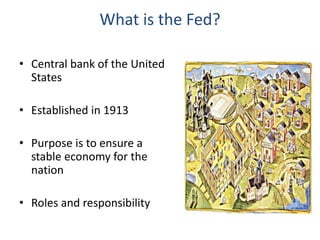
What is the Fed?
• Central bank of the United
States
• Established in 1913
• Purpose is to ensure a
stable economy for the
nation
• Roles and responsibility
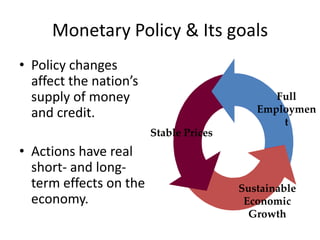
Monetary Policy & Its goals
• Policy changes
affect the nation’s
supply of money
and credit.
• Actions have real
short- and long-
term effects on the
economy.
Stable Prices
Sustainable
Economic
Growth
Full
Employmen
t
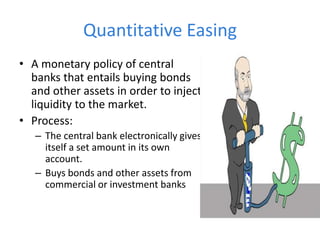
Quantitative Easing
• A monetary policy of central
banks that entails buying bonds
and other assets in order to inject
liquidity to the market.
• Process:
– The central bank electronically gives
itself a set amount in its own
account.
– Buys bonds and other assets from
commercial or investment banks
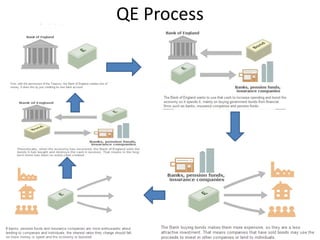
QE Process
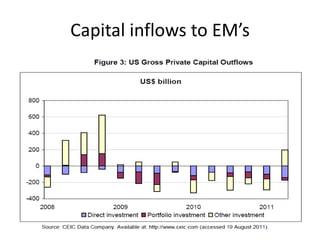
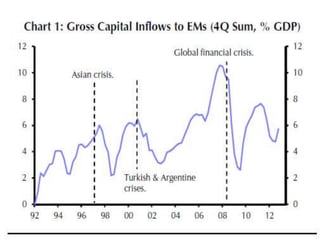
Capital inflows to EM’s
Tapering
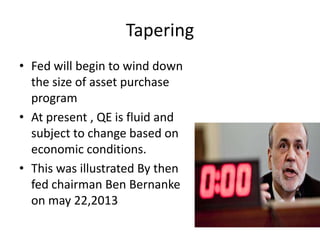
• Fed will begin to wind down
the size of asset purchase
program
• At present , QE is fluid and
subject to change based on
economic conditions.
• This was illustrated By then
fed chairman Ben Bernanke
on may 22,2013
Tapering
• On Dec 18, 2013 the Fed announced the first
tapering: beginning January, it will reduce its
purchases from 85 to 75 billion $
• Fed is on track to reduce the program steadily
throughout 2014 as long as economic growth
and unemployment remains on track
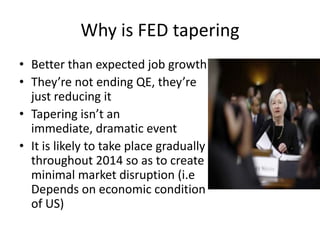
Why is FED tapering
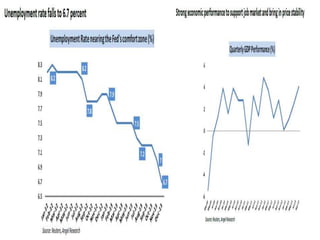
• Better than expected job growth
• They’re not ending QE, they’re
just reducing it
• Tapering isn’t an
immediate, dramatic event
• It is likely to take place gradually
throughout 2014 so as to create
minimal market disruption (i.e
Depends on economic condition
of US)
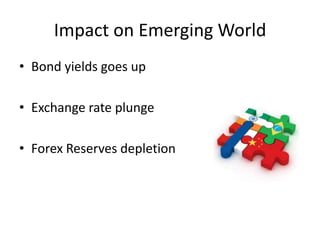
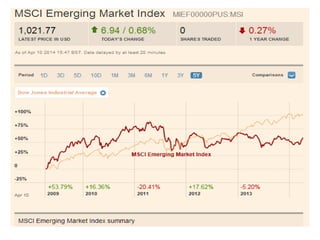
Impact on Emerging World
• Bond yields goes up
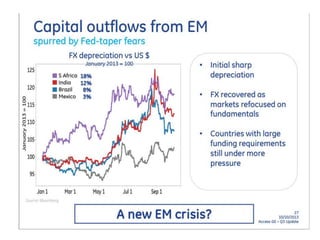
• Exchange rate plunge
• Forex Reserves depletion
Emerging Market Nightmares FED interest rate raises
• Capital outflow
• Growth hit hard
• High rate low growth Impact their
balancesheet
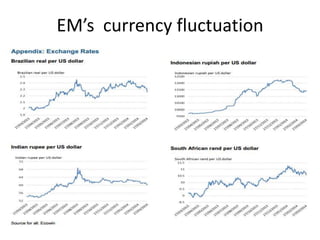
EM’s currency fluctuation
Thank you

QE & Tapering

  • 1.
    QE & Tapering By KumarT Vaibhav Sandeep Vrinda
  • 2.
    SUMMARY • In responseto the global financial crisis and recession that began in 2007, the major central banks in a number of advanced economies took unprecedented effort to stabilize and inject liquidity into financial markets. • Central bank action was aimed at preventing a catastrophic failure of the financial system. • Tools (Conventional, unconventional)
  • 3.
    What is theFed? • Central bank of the United States • Established in 1913 • Purpose is to ensure a stable economy for the nation • Roles and responsibility
  • 4.
    Monetary Policy &Its goals • Policy changes affect the nation’s supply of money and credit. • Actions have real short- and long- term effects on the economy. Stable Prices Sustainable Economic Growth Full Employmen t
  • 5.
    Quantitative Easing • Amonetary policy of central banks that entails buying bonds and other assets in order to inject liquidity to the market. • Process: – The central bank electronically gives itself a set amount in its own account. – Buys bonds and other assets from commercial or investment banks
  • 6.
  • 9.
  • 12.
    Tapering • Fed willbegin to wind down the size of asset purchase program • At present , QE is fluid and subject to change based on economic conditions. • This was illustrated By then fed chairman Ben Bernanke on may 22,2013
  • 13.
    Tapering • On Dec18, 2013 the Fed announced the first tapering: beginning January, it will reduce its purchases from 85 to 75 billion $ • Fed is on track to reduce the program steadily throughout 2014 as long as economic growth and unemployment remains on track
  • 14.
    Why is FEDtapering • Better than expected job growth • They’re not ending QE, they’re just reducing it • Tapering isn’t an immediate, dramatic event • It is likely to take place gradually throughout 2014 so as to create minimal market disruption (i.e Depends on economic condition of US)
  • 15.
    Impact on EmergingWorld • Bond yields goes up • Exchange rate plunge • Forex Reserves depletion
  • 17.
    Emerging Market NightmaresFED interest rate raises • Capital outflow • Growth hit hard • High rate low growth Impact their balancesheet
  • 19.
  • 20.