Market Perspective – November 2016
Experience Insight Impact
biegelwaller.com
Overview: Since the end of the 2008-2009 financial crisis, investors have debated the effect of
loose global monetary policy on economic growth and the equity markets. Monetary policy has
been an undeniable factor in driving growth and inflating asset prices. With interest rates
expected to rise, we examine the impact of central bank policy in this month’s perspective.
Experience Insight Impact
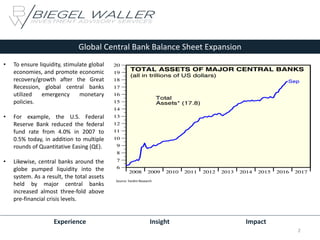
Global Central Bank Balance Sheet Expansion
2
• To ensure liquidity, stimulate global
economies, and promote economic
recovery/growth after the Great
Recession, global central banks
utilized emergency monetary
policies.
• For example, the U.S. Federal
Reserve Bank reduced the federal
fund rate from 4.0% in 2007 to
0.5% today, in addition to multiple
rounds of Quantitative Easing (QE).
• Likewise, central banks around the
globe pumped liquidity into the
system. As a result, the total assets
held by major central banks
increased almost three-fold above
pre-financial crisis levels.
Source: Yardini Research
Effects – Federal Reserve Balance Sheet vs. S&P 500
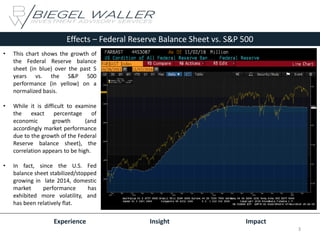
• This chart shows the growth of
the Federal Reserve balance
sheet (in blue) over the past 5
years vs. the S&P 500
performance (in yellow) on a
normalized basis.
• While it is difficult to examine
the exact percentage of
economic growth (and
accordingly market performance
due to the growth of the Federal
Reserve balance sheet), the
correlation appears to be high.
• In fact, since the U.S. Fed
balance sheet stabilized/stopped
growing in late 2014, domestic
market performance has
exhibited more volatility, and
has been relatively flat.
Experience Insight Impact
3
Effects – S&P 500 Earnings vs. P/E Multiple
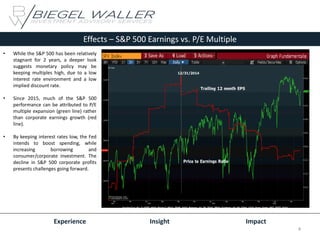
• While the S&P 500 has been relatively
stagnant for 2 years, a deeper look
suggests monetary policy may be
keeping multiples high, due to a low
interest rate environment and a low
implied discount rate.
• Since 2015, much of the S&P 500
performance can be attributed to P/E
multiple expansion (green line) rather
than corporate earnings growth (red
line).
• By keeping interest rates low, the Fed
intends to boost spending, while
increasing borrowing and
consumer/corporate investment. The
decline in S&P 500 corporate profits
presents challenges going forward.
Experience Insight Impact
4
Effects – BOJ Balance Sheet & Yen vs. Nikkei
Experience Insight Impact
5
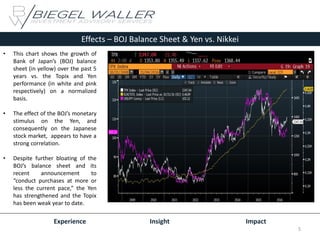
• This chart shows the growth of
Bank of Japan’s (BOJ) balance
sheet (in yellow) over the past 5
years vs. the Topix and Yen
performance (in white and pink
respectively) on a normalized
basis.
• The effect of the BOJ’s monetary
stimulus on the Yen, and
consequently on the Japanese
stock market, appears to have a
strong correlation.
• Despite further bloating of the
BOJ’s balance sheet and its
recent announcement to
“conduct purchases at more or
less the current pace,” the Yen
has strengthened and the Topix
has been weak year to date.
Effects – ECB Balance Sheet and Fed Balance Sheet vs. MSCI Europe
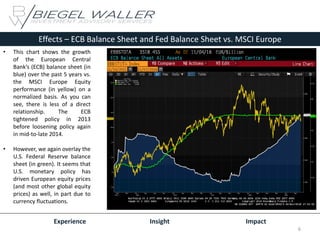
• This chart shows the growth
of the European Central
Bank’s (ECB) balance sheet (in
blue) over the past 5 years vs.
the MSCI Europe Equity
performance (in yellow) on a
normalized basis. As you can
see, there is less of a direct
relationship. The ECB
tightened policy in 2013
before loosening policy again
in mid-to-late 2014.
• However, we again overlay the
U.S. Federal Reserve balance
sheet (in green). It seems that
U.S. monetary policy has
driven European equity prices
(and most other global equity
prices) as well, in part due to
currency fluctuations.
Experience Insight Impact
6
Market Perspective – November 2016
Experience Insight Impact
biegelwaller.com
Conclusion: Global central bank balance sheets have expanded rapidly since the financial crisis.
This appears to have driven asset prices higher. Furthermore, loose monetary policies likely
exacerbated global indebtedness via low interest rates and QE. As Fed policy shifts towards
tightening, markets will react and could become more volatile. Thoughtful portfolio positioning
remains essential, given that monetary policy may be moderating and asset prices may not
appreciate at the same pace in a tighter economic environment.
Experience Insight Impact
Disclaimer
8
Opinions expressed in this commentary may change as conditions warrant and is for informational
purposes only. Information contained herein is not intended to be personal investment advice for
any specific person for any particular purpose. We utilize information sources that we believe to
be reliable but cannot guarantee the accuracy of those sources. Past performance is no guarantee
of future performance; investing involves risk and may result in loss of capital. Consider seeking
advice from a professional before implementing any investing strategy.

Market perspective november 2016

  • 1.
    Market Perspective –November 2016 Experience Insight Impact biegelwaller.com Overview: Since the end of the 2008-2009 financial crisis, investors have debated the effect of loose global monetary policy on economic growth and the equity markets. Monetary policy has been an undeniable factor in driving growth and inflating asset prices. With interest rates expected to rise, we examine the impact of central bank policy in this month’s perspective.
  • 2.
    Experience Insight Impact GlobalCentral Bank Balance Sheet Expansion 2 • To ensure liquidity, stimulate global economies, and promote economic recovery/growth after the Great Recession, global central banks utilized emergency monetary policies. • For example, the U.S. Federal Reserve Bank reduced the federal fund rate from 4.0% in 2007 to 0.5% today, in addition to multiple rounds of Quantitative Easing (QE). • Likewise, central banks around the globe pumped liquidity into the system. As a result, the total assets held by major central banks increased almost three-fold above pre-financial crisis levels. Source: Yardini Research
  • 3.
    Effects – FederalReserve Balance Sheet vs. S&P 500 • This chart shows the growth of the Federal Reserve balance sheet (in blue) over the past 5 years vs. the S&P 500 performance (in yellow) on a normalized basis. • While it is difficult to examine the exact percentage of economic growth (and accordingly market performance due to the growth of the Federal Reserve balance sheet), the correlation appears to be high. • In fact, since the U.S. Fed balance sheet stabilized/stopped growing in late 2014, domestic market performance has exhibited more volatility, and has been relatively flat. Experience Insight Impact 3
  • 4.
    Effects – S&P500 Earnings vs. P/E Multiple • While the S&P 500 has been relatively stagnant for 2 years, a deeper look suggests monetary policy may be keeping multiples high, due to a low interest rate environment and a low implied discount rate. • Since 2015, much of the S&P 500 performance can be attributed to P/E multiple expansion (green line) rather than corporate earnings growth (red line). • By keeping interest rates low, the Fed intends to boost spending, while increasing borrowing and consumer/corporate investment. The decline in S&P 500 corporate profits presents challenges going forward. Experience Insight Impact 4
  • 5.
    Effects – BOJBalance Sheet & Yen vs. Nikkei Experience Insight Impact 5 • This chart shows the growth of Bank of Japan’s (BOJ) balance sheet (in yellow) over the past 5 years vs. the Topix and Yen performance (in white and pink respectively) on a normalized basis. • The effect of the BOJ’s monetary stimulus on the Yen, and consequently on the Japanese stock market, appears to have a strong correlation. • Despite further bloating of the BOJ’s balance sheet and its recent announcement to “conduct purchases at more or less the current pace,” the Yen has strengthened and the Topix has been weak year to date.
  • 6.
    Effects – ECBBalance Sheet and Fed Balance Sheet vs. MSCI Europe • This chart shows the growth of the European Central Bank’s (ECB) balance sheet (in blue) over the past 5 years vs. the MSCI Europe Equity performance (in yellow) on a normalized basis. As you can see, there is less of a direct relationship. The ECB tightened policy in 2013 before loosening policy again in mid-to-late 2014. • However, we again overlay the U.S. Federal Reserve balance sheet (in green). It seems that U.S. monetary policy has driven European equity prices (and most other global equity prices) as well, in part due to currency fluctuations. Experience Insight Impact 6
  • 7.
    Market Perspective –November 2016 Experience Insight Impact biegelwaller.com Conclusion: Global central bank balance sheets have expanded rapidly since the financial crisis. This appears to have driven asset prices higher. Furthermore, loose monetary policies likely exacerbated global indebtedness via low interest rates and QE. As Fed policy shifts towards tightening, markets will react and could become more volatile. Thoughtful portfolio positioning remains essential, given that monetary policy may be moderating and asset prices may not appreciate at the same pace in a tighter economic environment.
  • 8.
    Experience Insight Impact Disclaimer 8 Opinionsexpressed in this commentary may change as conditions warrant and is for informational purposes only. Information contained herein is not intended to be personal investment advice for any specific person for any particular purpose. We utilize information sources that we believe to be reliable but cannot guarantee the accuracy of those sources. Past performance is no guarantee of future performance; investing involves risk and may result in loss of capital. Consider seeking advice from a professional before implementing any investing strategy.