


Barry Fudge Head of Endurance and Sport Sciences 
Integration of sport science for optimal training adaptation and competition performance in track and field
Overview 
1.SSM strategy 
2.Integration of science within the endurance program 
3.Questions
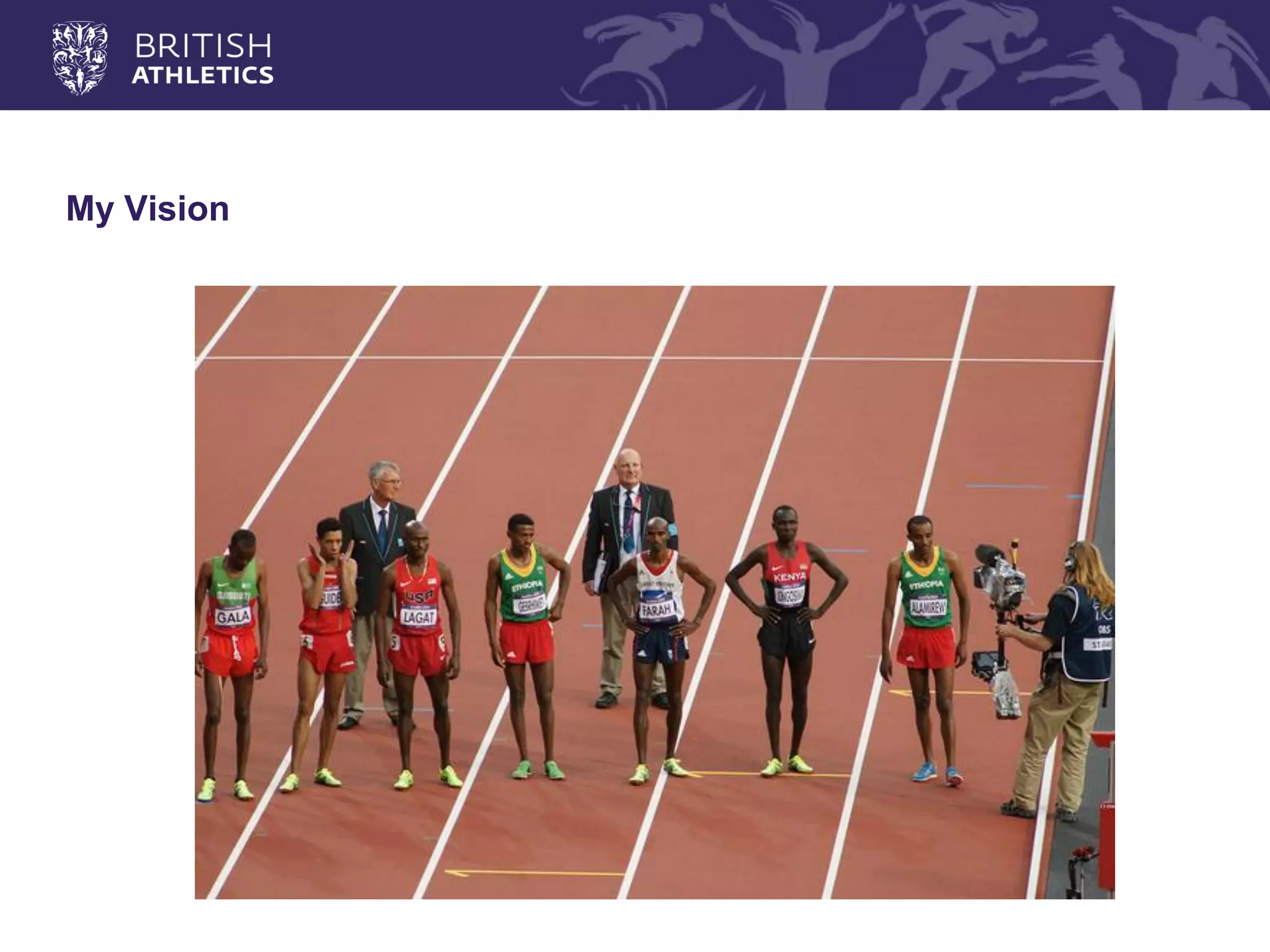
My Vision
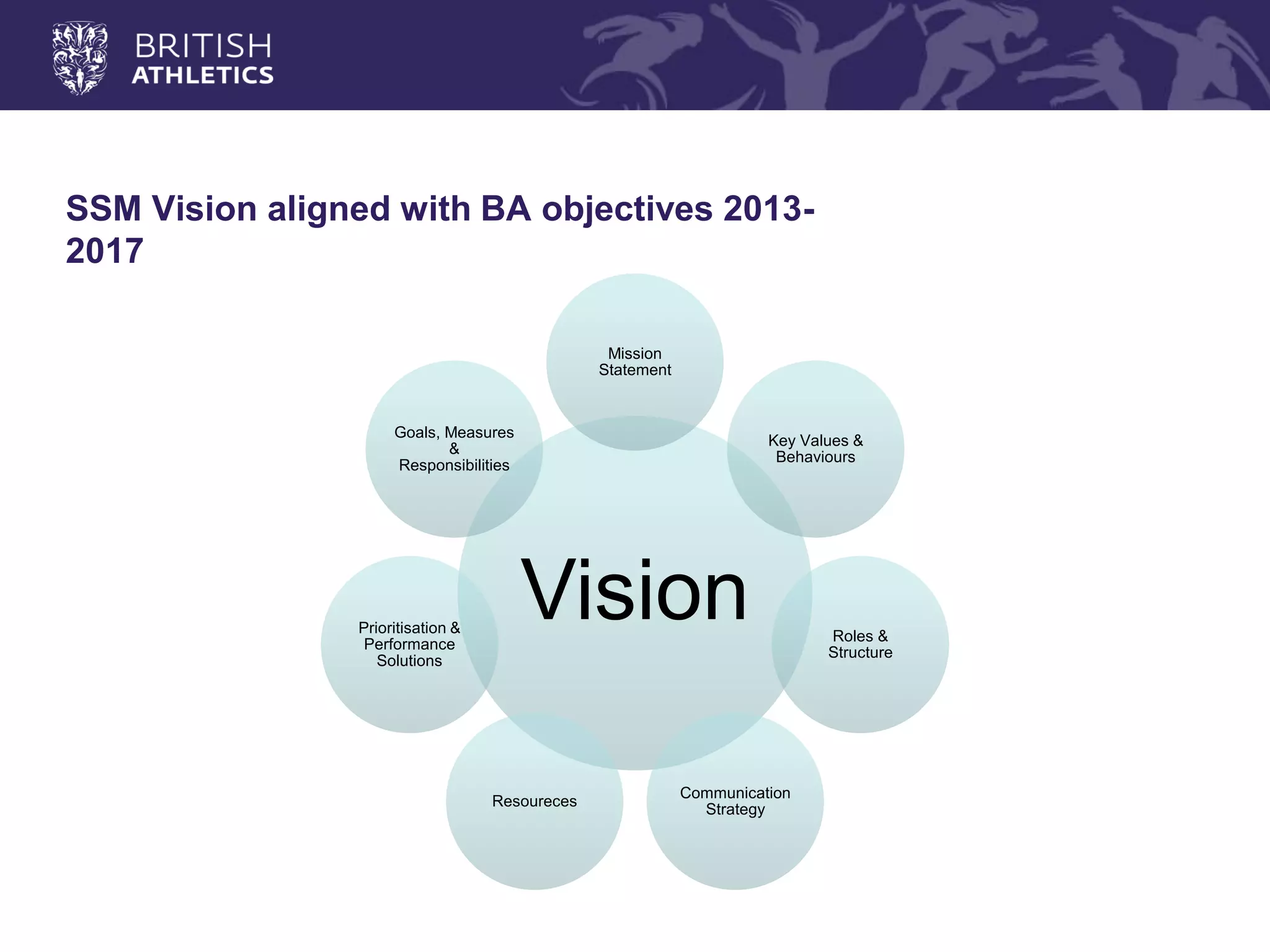
Vision 
Mission Statement 
Key Values & Behaviours 
Roles & Structure 
Communication Strategy 
Resoureces 
Prioritisation & Performance Solutions 
Goals, Measures & Responsibilities 
SSM Vision aligned with BA objectives 2013- 2017
BA Strategic Objectives 2013-2017 
•Based on the number and quality of athletes now within our WCP pipeline, and given the resources to fully implement our vision, we believe that our team can win 8 to 10 medals in Rio 2016 and 8 to 10 medals at the London World Championship in 2017. 
•As milestones towards these targets we would expect to win 6 to 8 medals at the 2013 Moscow World Championships, 12 to 17 medals at the European Championships (although the proximity of this event to the Commonwealth Games makes prediction less easy) and 7 to 9 medals at the 2015 Beijing World Championships. 
•At every stage in the plan our underlying philosophy remains that the key to success in athletics is great athletes working with world class coaches in great facilities with quality integrated support services. Over the London cycle we have learnt that world class coaches and quality service providers are role models in their professionalism, hunger to learn and their objective, no compromise approach to improving athletes’ performance. In the new cycle we aim to implement each aspect of this philosophy through consistent clear leadership and increasingly focused delivery to athletes.
SSM Vision 
•To be recognised as the best track & field science and medicine team in the world, supporting athletes capable of winning medals at major championships.
SSM Mission Statement 
To understand and optimise training and performance of track & field athletes by: 
•Respecting and understanding different training philosophies 
•Developing trusting, accountable and supportive working relationships with athletes and coaches 
•Identifying and prioritising athletes through specific event profiling intelligence to inform support processes 
•Delivering flexible, bespoke and innovative science and medicine solutions to performance questions 
•Delivering novel and creative science and medicine initiatives to manage injury and illness risk 
•Working together as a team, in the relentless pursuit of excellence 
•Focussing on medals whilst driving down costs 
•Providing quality assured science and medicine practices
SSM Key Values & Behaviours 
•Athlete owned: understand and agree the individualised rules of engagement within each athlete & coaching partnership 
•Understand, recognise and be comfortable with your own role and responsibility within the team 
•Discuss; decide; support 
•Strive for excellence 
•Collaboration 
•Open-minded 
•Consistency through familiarity and stability
SSM Prioritisation & Performance Solutions 
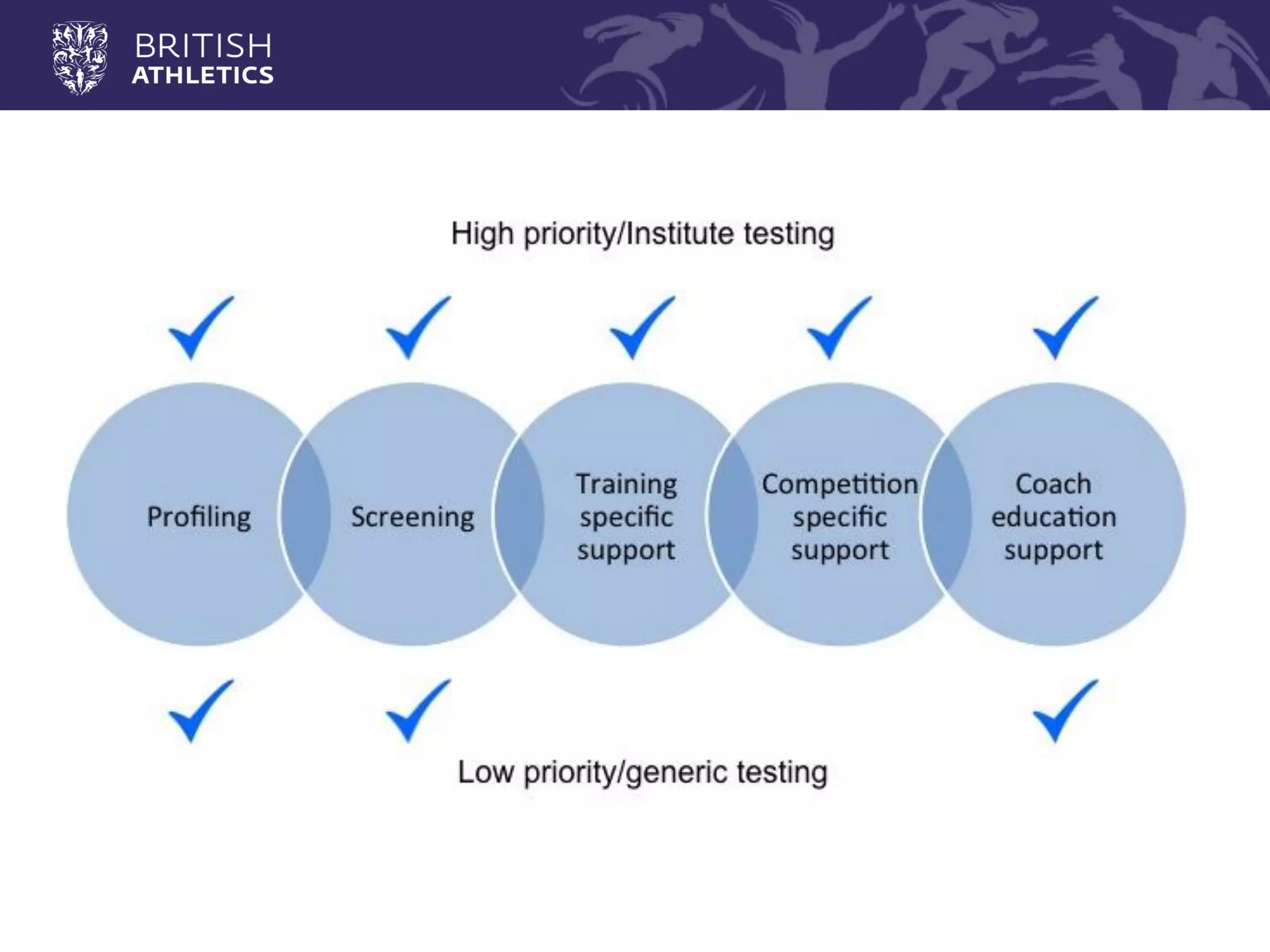
Applied support broadly fits in to the following categories: 
•Profiling is key to monitoring progression and to mapping an athlete’s strengths and weaknesses relative to their event demands. 
•Screening on a regular basis provides information on factors that may affect performance and/or health and wellbeing of an athlete. 
•Training specific support is a fundamental element of the support process and aims to ensure athletes are adapting optimally to their training load relative to their event demands.
SSM Prioritisation & Performance Solutions 
•Competition specific support aims to help athletes attain peak performance when it matters most. 
•Coach education support provides appropriate information delivered in a relevant manner for coaches and athletes on a range of topics, usually in collaboration with other service providers.
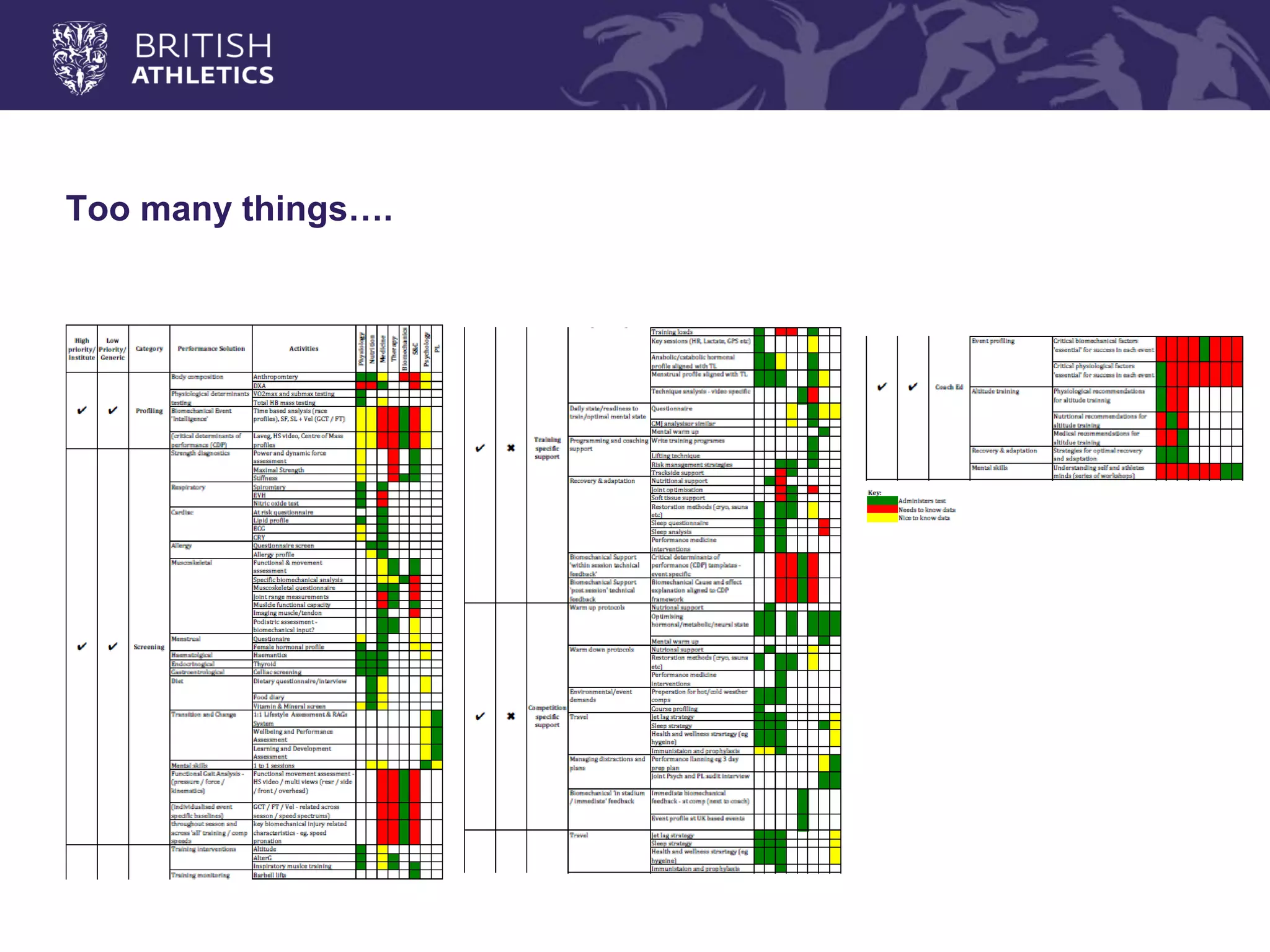
Too many things….
Science Team 
–Physiology: Kate Spilsbury & Gareth Turner 
–Psychology: Simon Drane, Mike Stoker & Jen Savage (Steve Peters) 
–Nutrition: Joe Agu & Kevin Currell 
–S&C science: Michael Johnston & Mphil student 
–Biomechanics: Paul Brice, Ross Tugwood & sports science technician 
–Performance Lifestyle: Julie Smith
You need to have a very good understanding…and you need to lead/manage or… 
You’ll wake up one day and a physio/S&C coach/physiologist/etc. will be running your program.
Endurance Initiative – Working in partnership 
Creating Winning Environments
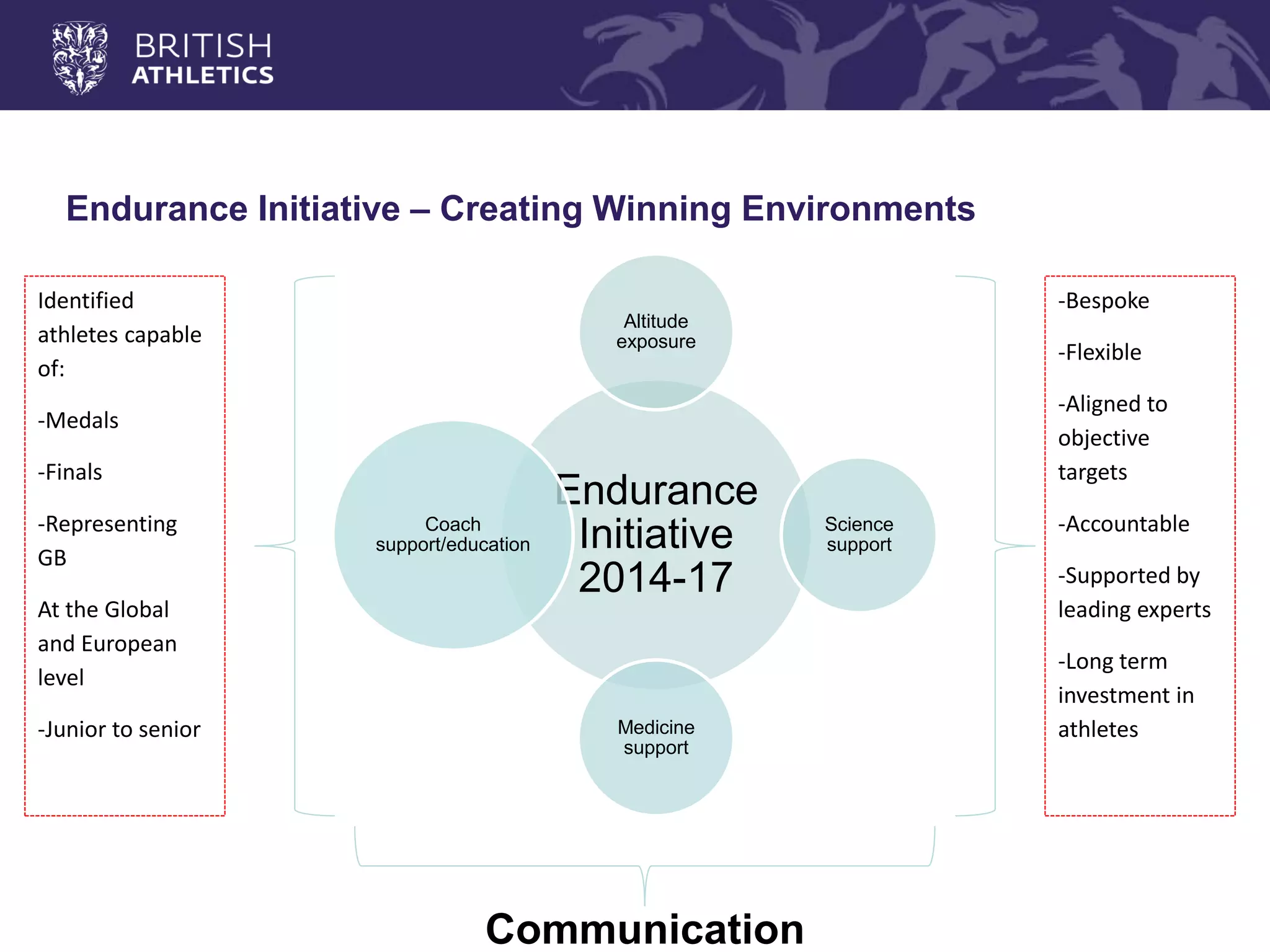
Endurance Initiative – Creating Winning Environments 
Endurance Initiative 2014-17 
Altitude exposure 
Science support 
Medicine support 
Coach support/education 
Identified athletes capable of: -Medals -Finals -Representing GB At the Global and European level -Junior to senior 
-Bespoke 
-Flexible 
-Aligned to objective targets 
-Accountable 
-Supported by leading experts 
-Long term investment in athletes 
Communication
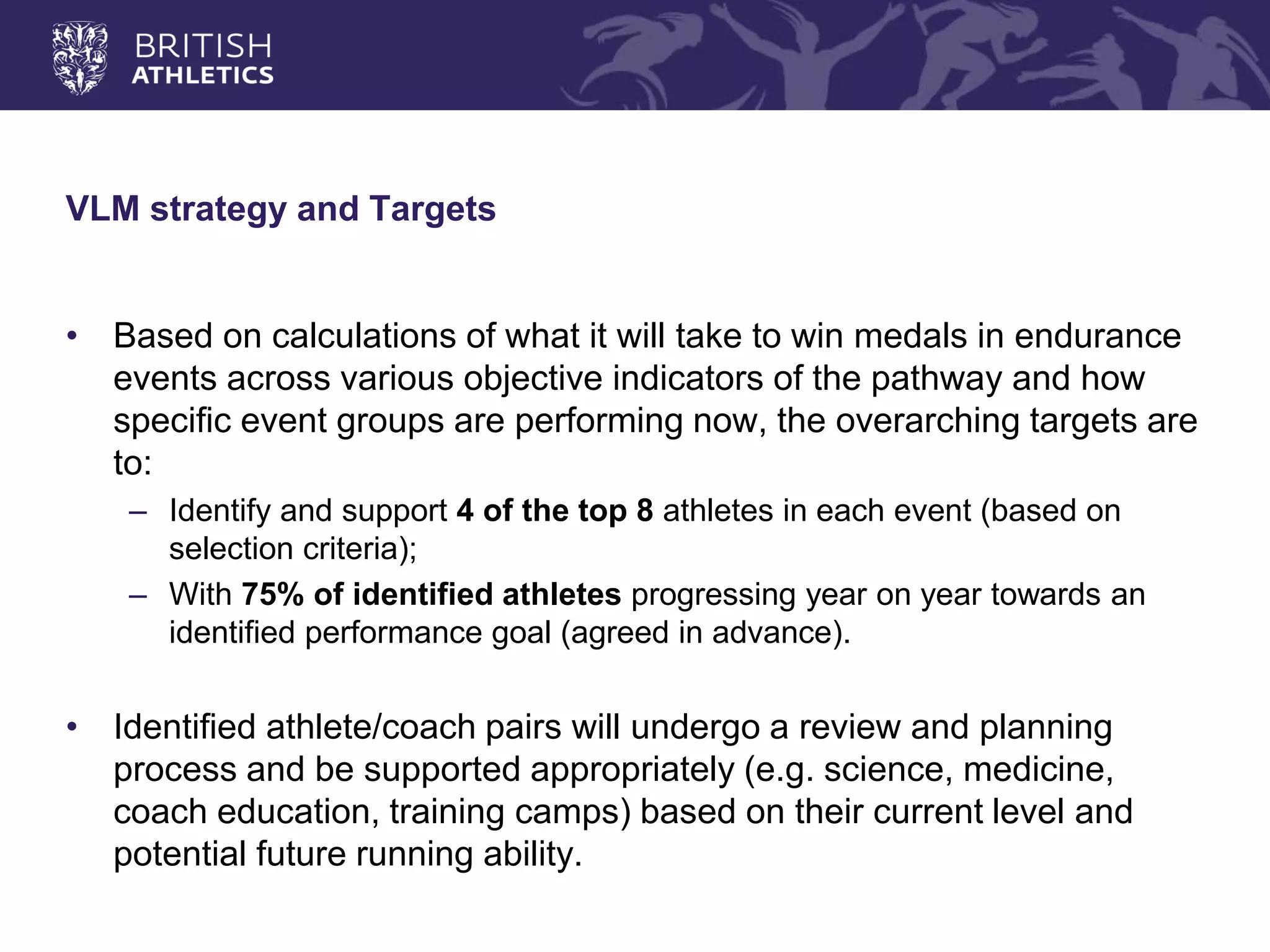
VLM strategy and Targets 
•Based on calculations of what it will take to win medals in endurance events across various objective indicators of the pathway and how specific event groups are performing now, the overarching targets are to: 
–Identify and support 4 of the top 8 athletes in each event (based on selection criteria); 
–With 75% of identified athletes progressing year on year towards an identified performance goal (agreed in advance). 
•Identified athlete/coach pairs will undergo a review and planning process and be supported appropriately (e.g. science, medicine, coach education, training camps) based on their current level and potential future running ability.
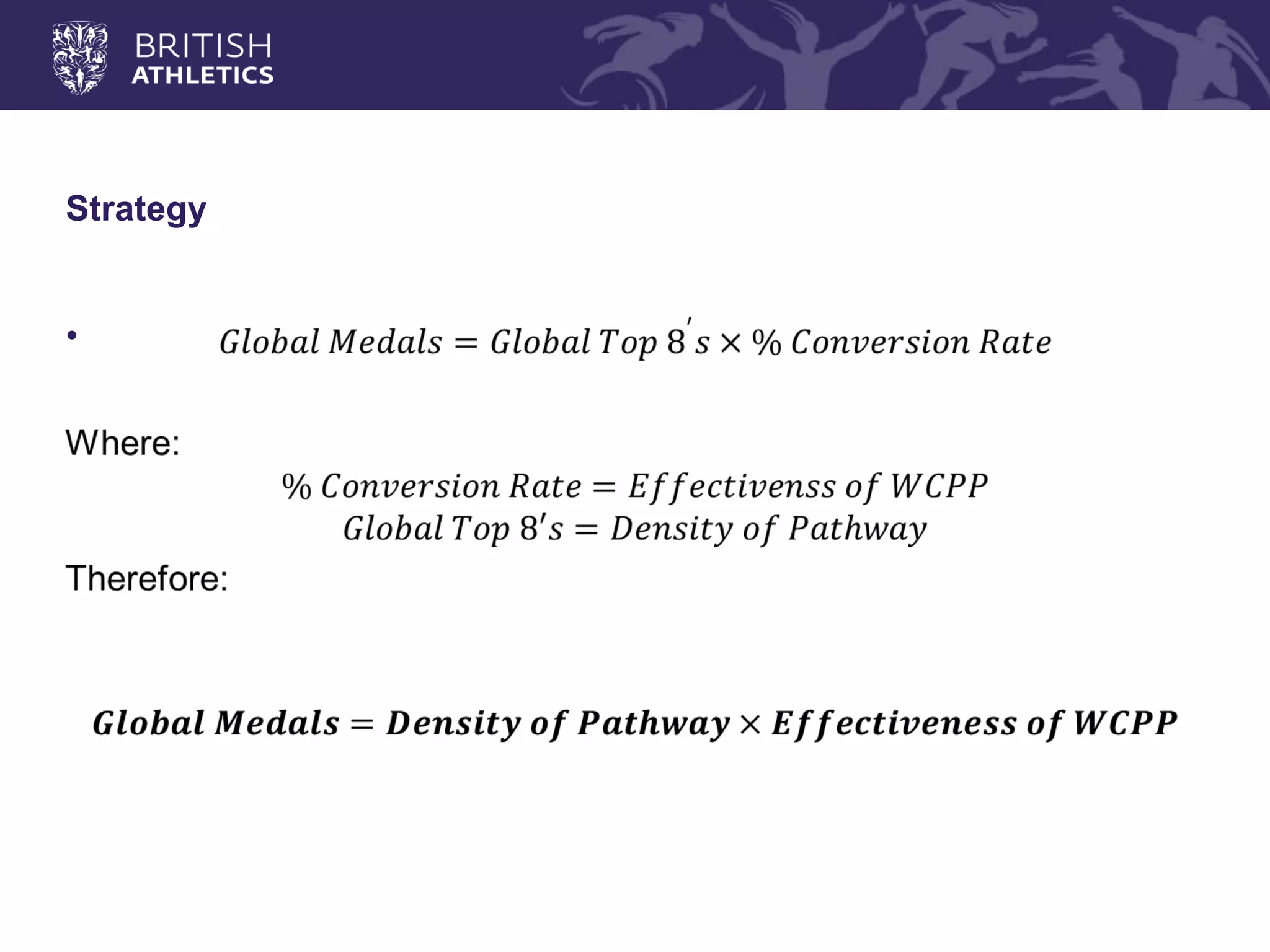
Strategy 
•
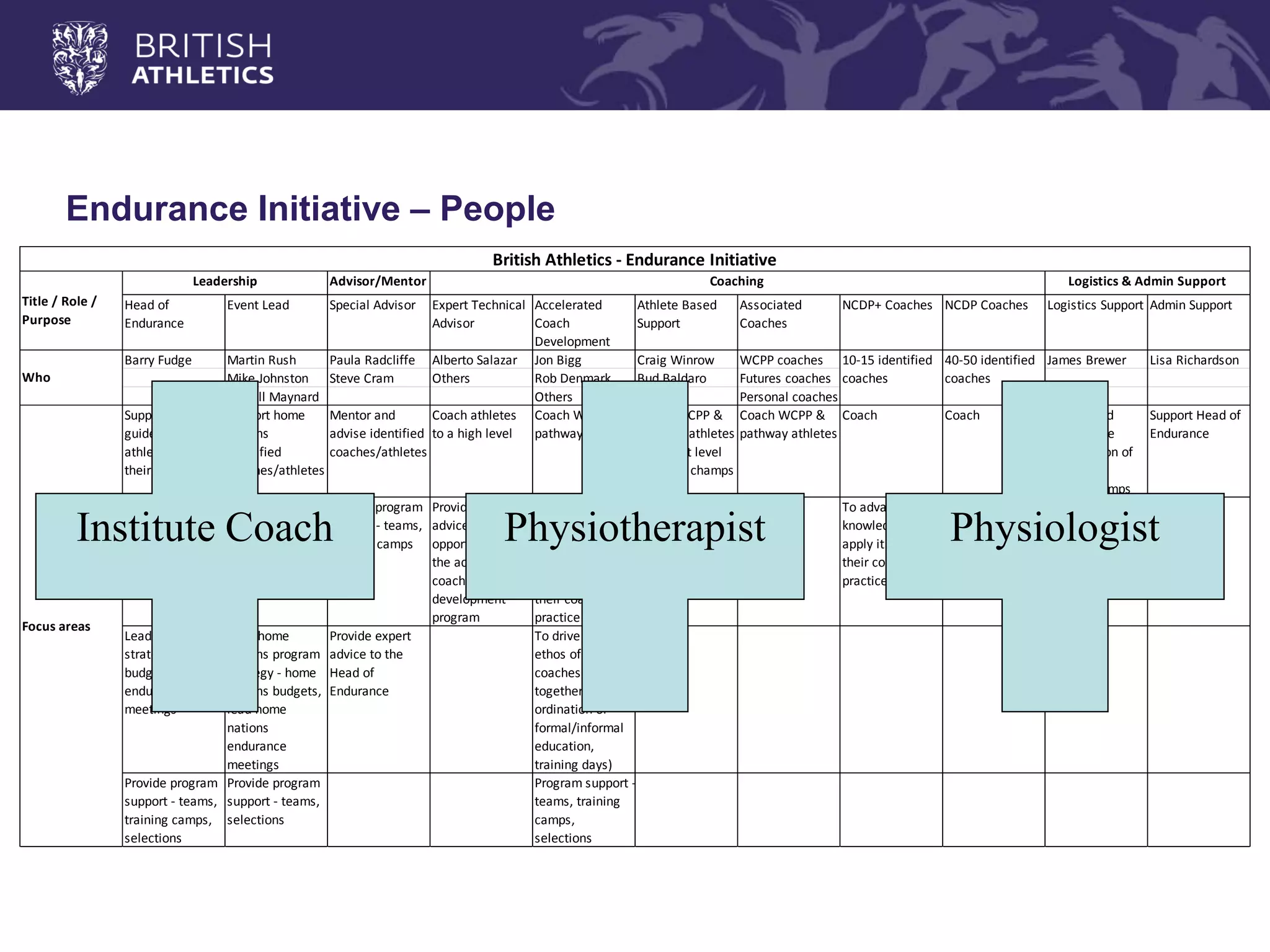
Endurance Initiative – People 
Advisor/Mentor 
Head of 
Endurance 
Event Lead Special Advisor Expert Technical 
Advisor 
Accelerated 
Coach 
Development 
Athlete Based 
Support 
Associated 
Coaches 
NCDP+ Coaches NCDP Coaches Logistics Support Admin Support 
Barry Fudge Martin Rush Paula Radcliffe Alberto Salazar Jon Bigg Craig Winrow WCPP coaches James Brewer Lisa Richardson 
Mike Johnston Steve Cram Others Rob Denmark Bud Baldaro Futures coaches 
Darrell Maynard Others Others Personal coaches 
Support and 
guide WCPP 
athletes and 
their coaches 
Support home 
nations 
identified 
coaches/athletes 
Mentor and 
advise identified 
coaches/athletes 
Coach athletes 
to a high level 
Coach WCPP & 
pathway athletes 
Coach WCPP & 
pathway athletes 
to finalist level 
at global champs 
Coach WCPP & 
pathway athletes 
Coach Coach To lead and 
manage the 
organisation of 
identified 
training camps 
Support Head of 
Endurance 
Lead the 
accelerated 
coach 
development 
program 
Lead home 
nations coach 
education 
programes 
Provide program 
support - teams, 
training camps 
Provide expert 
advice and 
opportunities for 
the accelerated 
coach 
development 
program 
To quickly 
advance their 
knowledge to a 
high level and 
apply it to the 
their coaching 
practice 
Provide program 
support - teams, 
training camps, 
selections 
To advance their 
knowledge and 
apply it to the 
their coaching 
practice 
To advance their 
knowledge and 
apply it to the 
their coaching 
practice 
To manage the 
endurance house 
Lead BA program 
strategy - BA 
budgets, lead BA 
endurance 
meetings 
Lead home 
nations program 
strategy - home 
nations budgets, 
lead home 
nations 
endurance 
meetings 
Provide expert 
advice to the 
Head of 
Endurance 
To drive the 
ethos of British 
coaches working 
together (co-ordination 
of 
formal/informal 
education, 
training days) 
Provide program 
support - teams, 
training camps, 
selections 
Provide program 
support - teams, 
selections 
Program support - 
teams, training 
camps, 
selections 
Focus areas 
Who 
Logistics & Admin Support 
British Athletics - Endurance Initiative 
Title / Role / 
Purpose 
10-15 identified 
coaches 
40-50 identified 
coaches 
Leadership Coaching 
Institute Coach Physiotherapist Physiologist
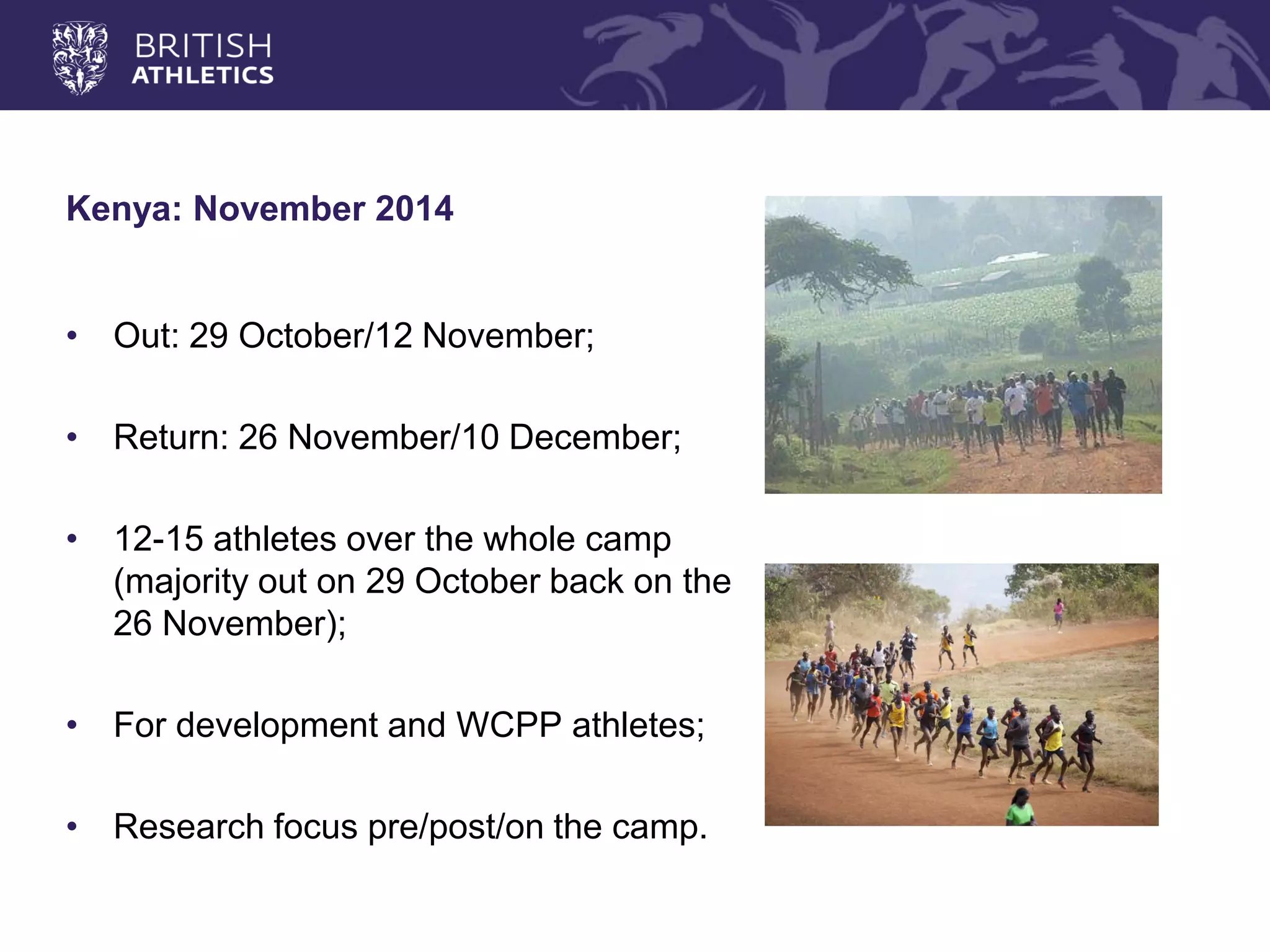
Kenya: November 2014 
•Out: 29 October/12 November; 
•Return: 26 November/10 December; 
•12-15 athletes over the whole camp (majority out on 29 October back on the 26 November); 
•For development and WCPP athletes; 
•Research focus pre/post/on the camp.
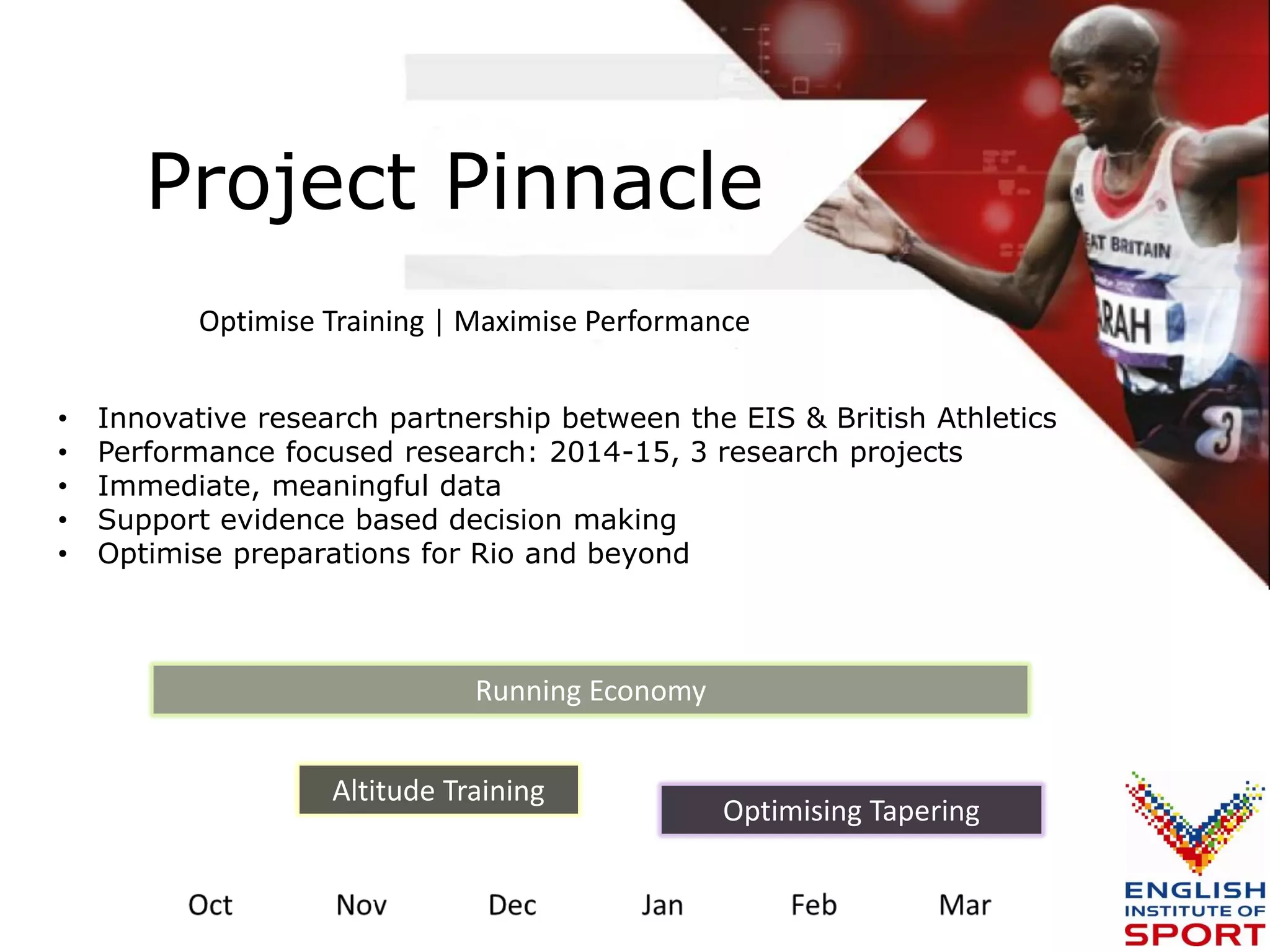
Project Pinnacle 
Optimise Training | Maximise Performance 
•Innovative research partnership between the EIS & British Athletics 
•Performance focused research: 2014-15, 3 research projects 
•Immediate, meaningful data 
•Support evidence based decision making 
•Optimise preparations for Rio and beyond 
Optimising Tapering 
Altitude Training 
Running Economy
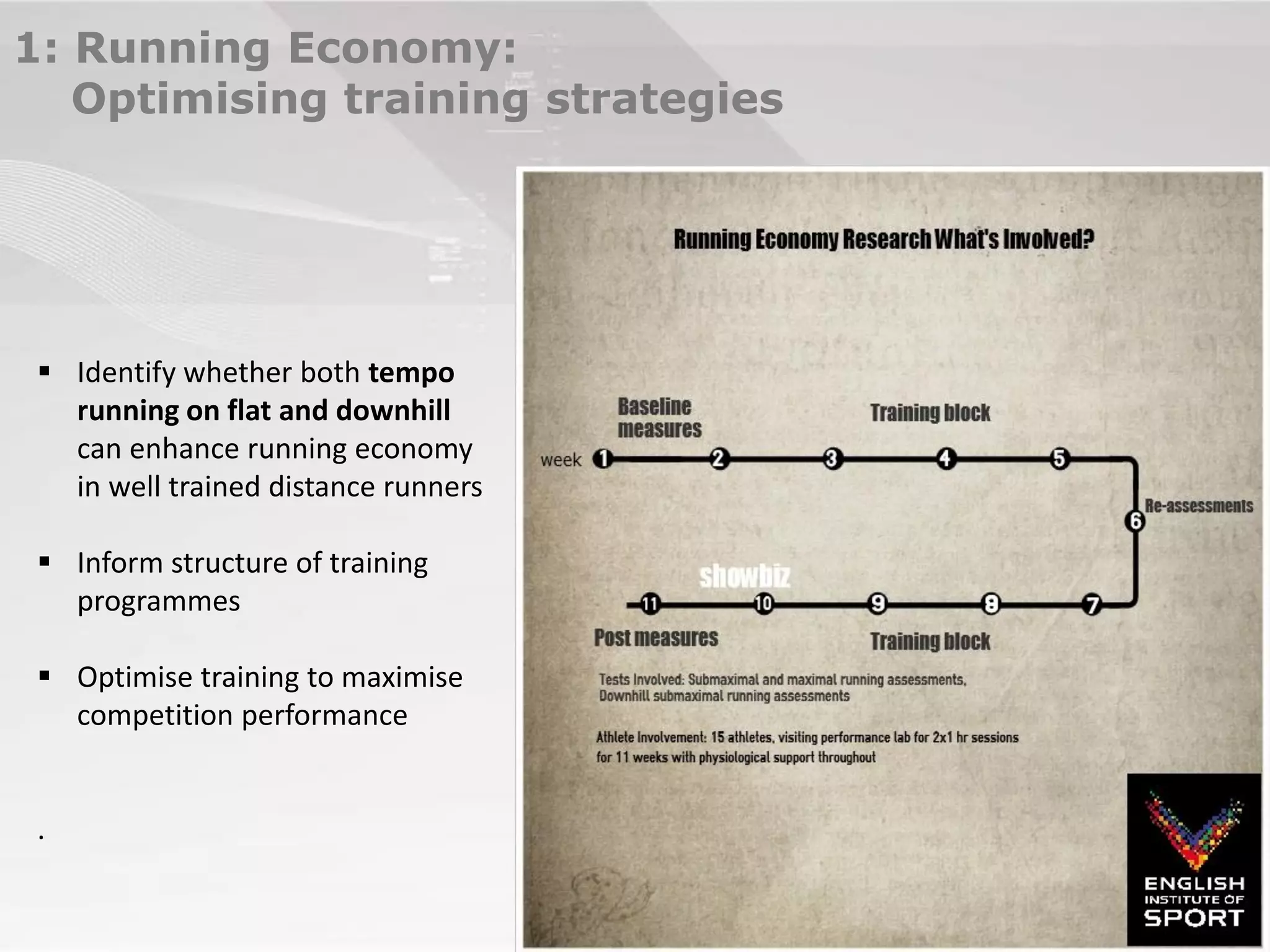
1: Running Economy: Optimising training strategies 
Identify whether both tempo running on flat and downhill can enhance running economy in well trained distance runners 
Inform structure of training programmes 
Optimise training to maximise competition performance .
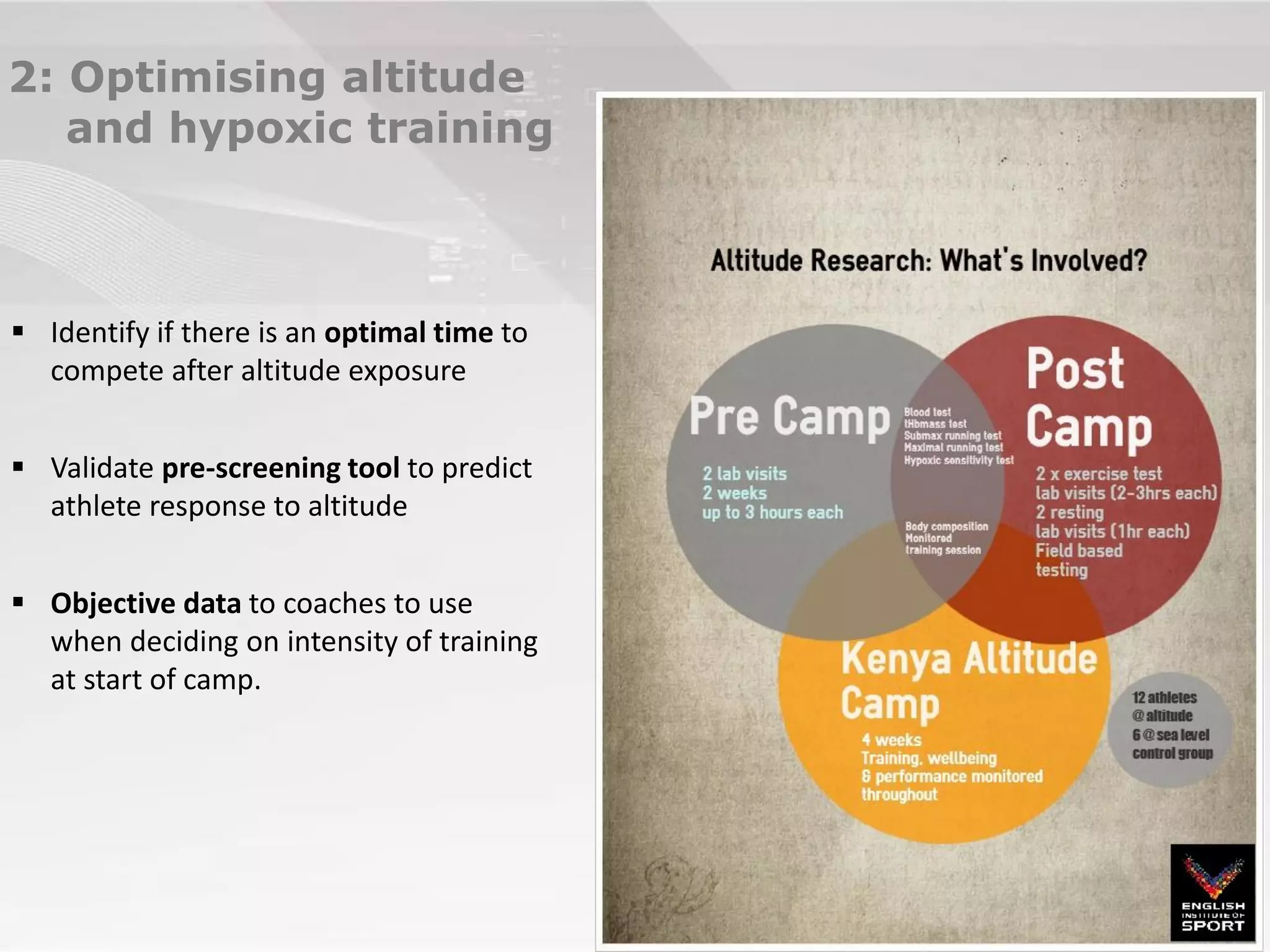
2: Optimising altitude and hypoxic training 
Identify if there is an optimal time to compete after altitude exposure 
Validate pre-screening tool to predict athlete response to altitude 
Objective data to coaches to use when deciding on intensity of training at start of camp.
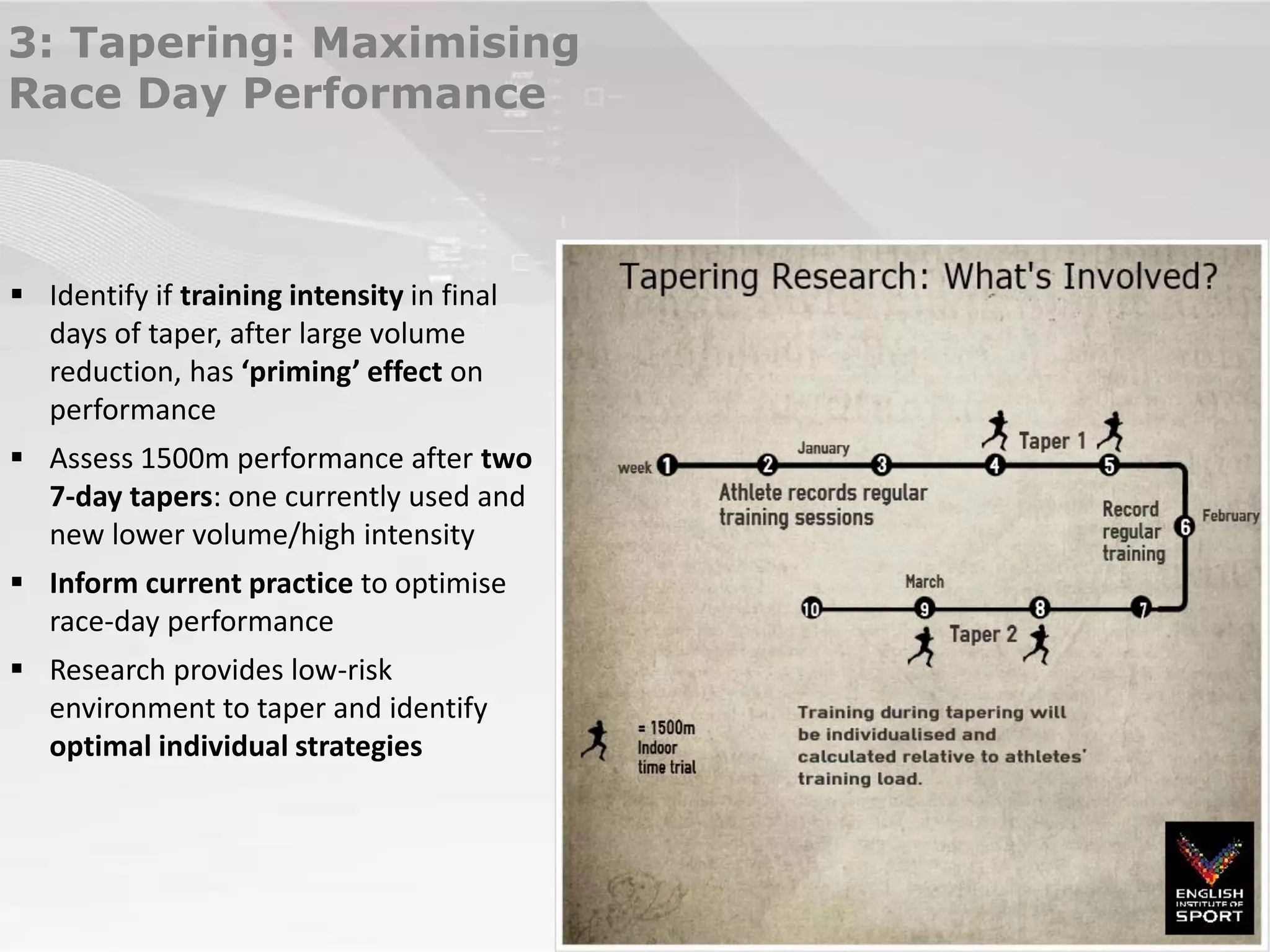
3: Tapering: Maximising Race Day Performance 
Identify if training intensity in final days of taper, after large volume reduction, has ‘priming’ effect on performance 
Assess 1500m performance after two 7-day tapers: one currently used and new lower volume/high intensity 
Inform current practice to optimise race-day performance 
Research provides low-risk environment to taper and identify optimal individual strategies
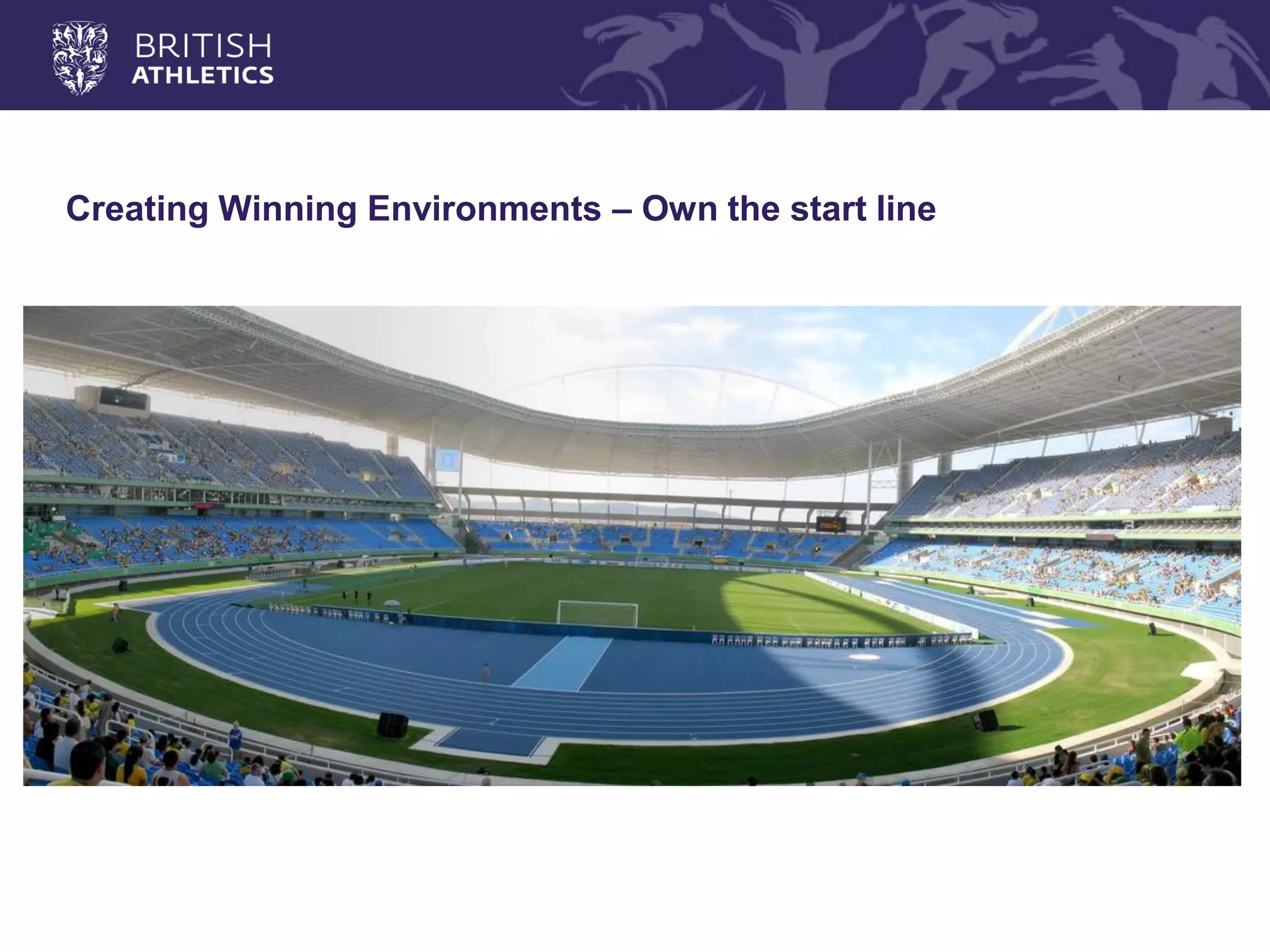
Creating Winning Environments – Own the start line
Questions and thanks for inviting me
For further information please contact: British Athletics, Athletics House, Alexander Stadium, Walsall Road, Perry Barr, Birmingham B42 2BE www.britishathletics.org.uk

Integration of sport science for optimal training adaptation and competition in track & field.

  • 1.
    Barry Fudge Headof Endurance and Sport Sciences Integration of sport science for optimal training adaptation and competition performance in track and field
  • 2.
    Overview 1.SSM strategy 2.Integration of science within the endurance program 3.Questions
  • 3.
  • 4.
    Vision Mission Statement Key Values & Behaviours Roles & Structure Communication Strategy Resoureces Prioritisation & Performance Solutions Goals, Measures & Responsibilities SSM Vision aligned with BA objectives 2013- 2017
  • 5.
    BA Strategic Objectives2013-2017 •Based on the number and quality of athletes now within our WCP pipeline, and given the resources to fully implement our vision, we believe that our team can win 8 to 10 medals in Rio 2016 and 8 to 10 medals at the London World Championship in 2017. •As milestones towards these targets we would expect to win 6 to 8 medals at the 2013 Moscow World Championships, 12 to 17 medals at the European Championships (although the proximity of this event to the Commonwealth Games makes prediction less easy) and 7 to 9 medals at the 2015 Beijing World Championships. •At every stage in the plan our underlying philosophy remains that the key to success in athletics is great athletes working with world class coaches in great facilities with quality integrated support services. Over the London cycle we have learnt that world class coaches and quality service providers are role models in their professionalism, hunger to learn and their objective, no compromise approach to improving athletes’ performance. In the new cycle we aim to implement each aspect of this philosophy through consistent clear leadership and increasingly focused delivery to athletes.
  • 6.
    SSM Vision •Tobe recognised as the best track & field science and medicine team in the world, supporting athletes capable of winning medals at major championships.
  • 7.
    SSM Mission Statement To understand and optimise training and performance of track & field athletes by: •Respecting and understanding different training philosophies •Developing trusting, accountable and supportive working relationships with athletes and coaches •Identifying and prioritising athletes through specific event profiling intelligence to inform support processes •Delivering flexible, bespoke and innovative science and medicine solutions to performance questions •Delivering novel and creative science and medicine initiatives to manage injury and illness risk •Working together as a team, in the relentless pursuit of excellence •Focussing on medals whilst driving down costs •Providing quality assured science and medicine practices
  • 8.
    SSM Key Values& Behaviours •Athlete owned: understand and agree the individualised rules of engagement within each athlete & coaching partnership •Understand, recognise and be comfortable with your own role and responsibility within the team •Discuss; decide; support •Strive for excellence •Collaboration •Open-minded •Consistency through familiarity and stability
  • 9.
    SSM Prioritisation &Performance Solutions Applied support broadly fits in to the following categories: •Profiling is key to monitoring progression and to mapping an athlete’s strengths and weaknesses relative to their event demands. •Screening on a regular basis provides information on factors that may affect performance and/or health and wellbeing of an athlete. •Training specific support is a fundamental element of the support process and aims to ensure athletes are adapting optimally to their training load relative to their event demands.
  • 10.
    SSM Prioritisation &Performance Solutions •Competition specific support aims to help athletes attain peak performance when it matters most. •Coach education support provides appropriate information delivered in a relevant manner for coaches and athletes on a range of topics, usually in collaboration with other service providers.
  • 12.
  • 14.
    Science Team –Physiology:Kate Spilsbury & Gareth Turner –Psychology: Simon Drane, Mike Stoker & Jen Savage (Steve Peters) –Nutrition: Joe Agu & Kevin Currell –S&C science: Michael Johnston & Mphil student –Biomechanics: Paul Brice, Ross Tugwood & sports science technician –Performance Lifestyle: Julie Smith
  • 15.
    You need tohave a very good understanding…and you need to lead/manage or… You’ll wake up one day and a physio/S&C coach/physiologist/etc. will be running your program.
  • 16.
    Endurance Initiative –Working in partnership Creating Winning Environments
  • 17.
    Endurance Initiative –Creating Winning Environments Endurance Initiative 2014-17 Altitude exposure Science support Medicine support Coach support/education Identified athletes capable of: -Medals -Finals -Representing GB At the Global and European level -Junior to senior -Bespoke -Flexible -Aligned to objective targets -Accountable -Supported by leading experts -Long term investment in athletes Communication
  • 18.
    VLM strategy andTargets •Based on calculations of what it will take to win medals in endurance events across various objective indicators of the pathway and how specific event groups are performing now, the overarching targets are to: –Identify and support 4 of the top 8 athletes in each event (based on selection criteria); –With 75% of identified athletes progressing year on year towards an identified performance goal (agreed in advance). •Identified athlete/coach pairs will undergo a review and planning process and be supported appropriately (e.g. science, medicine, coach education, training camps) based on their current level and potential future running ability.
  • 20.
  • 21.
    Endurance Initiative –People Advisor/Mentor Head of Endurance Event Lead Special Advisor Expert Technical Advisor Accelerated Coach Development Athlete Based Support Associated Coaches NCDP+ Coaches NCDP Coaches Logistics Support Admin Support Barry Fudge Martin Rush Paula Radcliffe Alberto Salazar Jon Bigg Craig Winrow WCPP coaches James Brewer Lisa Richardson Mike Johnston Steve Cram Others Rob Denmark Bud Baldaro Futures coaches Darrell Maynard Others Others Personal coaches Support and guide WCPP athletes and their coaches Support home nations identified coaches/athletes Mentor and advise identified coaches/athletes Coach athletes to a high level Coach WCPP & pathway athletes Coach WCPP & pathway athletes to finalist level at global champs Coach WCPP & pathway athletes Coach Coach To lead and manage the organisation of identified training camps Support Head of Endurance Lead the accelerated coach development program Lead home nations coach education programes Provide program support - teams, training camps Provide expert advice and opportunities for the accelerated coach development program To quickly advance their knowledge to a high level and apply it to the their coaching practice Provide program support - teams, training camps, selections To advance their knowledge and apply it to the their coaching practice To advance their knowledge and apply it to the their coaching practice To manage the endurance house Lead BA program strategy - BA budgets, lead BA endurance meetings Lead home nations program strategy - home nations budgets, lead home nations endurance meetings Provide expert advice to the Head of Endurance To drive the ethos of British coaches working together (co-ordination of formal/informal education, training days) Provide program support - teams, training camps, selections Provide program support - teams, selections Program support - teams, training camps, selections Focus areas Who Logistics & Admin Support British Athletics - Endurance Initiative Title / Role / Purpose 10-15 identified coaches 40-50 identified coaches Leadership Coaching Institute Coach Physiotherapist Physiologist
  • 22.
    Kenya: November 2014 •Out: 29 October/12 November; •Return: 26 November/10 December; •12-15 athletes over the whole camp (majority out on 29 October back on the 26 November); •For development and WCPP athletes; •Research focus pre/post/on the camp.
  • 23.
    Project Pinnacle OptimiseTraining | Maximise Performance •Innovative research partnership between the EIS & British Athletics •Performance focused research: 2014-15, 3 research projects •Immediate, meaningful data •Support evidence based decision making •Optimise preparations for Rio and beyond Optimising Tapering Altitude Training Running Economy
  • 24.
    1: Running Economy:Optimising training strategies Identify whether both tempo running on flat and downhill can enhance running economy in well trained distance runners Inform structure of training programmes Optimise training to maximise competition performance .
  • 25.
    2: Optimising altitudeand hypoxic training Identify if there is an optimal time to compete after altitude exposure Validate pre-screening tool to predict athlete response to altitude Objective data to coaches to use when deciding on intensity of training at start of camp.
  • 26.
    3: Tapering: MaximisingRace Day Performance Identify if training intensity in final days of taper, after large volume reduction, has ‘priming’ effect on performance Assess 1500m performance after two 7-day tapers: one currently used and new lower volume/high intensity Inform current practice to optimise race-day performance Research provides low-risk environment to taper and identify optimal individual strategies
  • 27.
    Creating Winning Environments– Own the start line
  • 28.
    Questions and thanksfor inviting me
  • 29.
    For further informationplease contact: British Athletics, Athletics House, Alexander Stadium, Walsall Road, Perry Barr, Birmingham B42 2BE www.britishathletics.org.uk