
QUANTITATIVE 
EASING 
Intensive Course – Fall semester 2014 
Group 4 - Alexandre, Turtemuulen, Quang Trung Dang
What is QE ? 
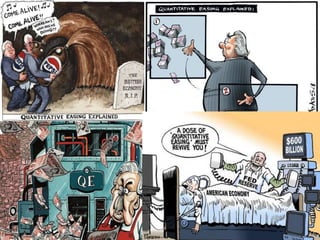
Quantitative easing (QE) is an unconventional monetary 
policy used by central banks to stimulate the economy when 
standard monetary policy has become ineffective 
The central bank is an institution that manages a state’s (or 
several states’) currency, money supply, and interest rates. 
Basically, it describes a form of monetary policy used by central 
banks to increase the supply of money in an economy when the 
control bank interest is close to 0.
How does it work? 
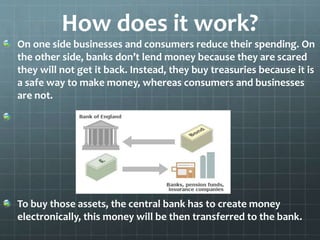
On one side businesses and consumers reduce their spending. On 
the other side, banks don’t lend money because they are scared 
they will not get it back. Instead, they buy treasuries because it is 
a safe way to make money, whereas consumers and businesses 
are not. 
To buy those assets, the central bank has to create money 
electronically, this money will be then transferred to the bank.
How does it work? 
Therefore, by buying those treasuries, the central bank increases 
their prices and lower their yield… 
 …Reducing the cost of borrowing for businesses and households, 
making them more likely to spend. 
Bank can also buy directly assets of the companies. This should 
increases spending to help keeping inflation around the 
governments’ 2% target.
How does it work? 
Therefore, by buying those treasuries, the central bank increases 
their prices and lower their yield… 
 …Reducing the cost of borrowing for businesses and households, 
making them more likely to spend. 
Bank can also buy directly assets of the companies. This should 
increases spending to help keeping inflation around the 
governments’ 2% target.
History of QE 
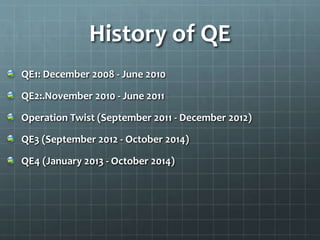
QE1: December 2008 - June 2010 
QE2:.November 2010 - June 2011 
Operation Twist (September 2011 - December 2012) 
QE3 (September 2012 - October 2014) 
QE4 (January 2013 - October 2014)
Did QE work? 
QE achieved some of its goals: 
It removed toxic subprime mortgages from banks. Balance 
sheets 
It also helped to stabilize the U.S. economy, providing the 
funds and the confidence to pull out of the recession. 
It kept interest rates low enough to revive the housing 
market. 
It did stimulate economic growth, although probably not 
as much as the Fed would have liked.
Did QE work? 
The Fed has been cutting its purchase of Treasury and mortgage-backed 
securities by $10bn a month at each meeting, from a peak of 
$85bn. 
$25bn in August and September, and a final $15bn tranche in 
October. 
Annual rate of growth in April, May and June to 4.2 percent 
The unemployment rate has fallen to 6.2 percent from 8.2 percent 
two years ago. 
Companies are investing, consumers are spending.
The benefits of 
Quantitative Easing 
Quantitative easing can fuel economic growth since money 
funneled into the economy should allow people to more 
comfortably make purchases. This can have a trickle down 
effect on both the consumer and business communities, leading 
to increased stock market performance and GDP growth.
The benefits of 
Quantitative Easing 
Foster maximum employment 
Encourage lending 
Encourage borrowing 
Increase spending. 
Complement low interest rates
The risks of 
Quantitative Easing 
QE cannot simply generate wealth, and the 
drawbacks and potential risks of even more QE will 
become greater the more money has been created 
already. Thereby, QE has several drawbacks worth to 
consider.
The risks of 
Quantitative Easing 
It drives inflation much higher. 
It creates dangers with international trade. 
Threat to the money value. 
Benefits do not exist QE programs. When the central bank stops 
printing money, the recovery often gets put on hold, or worse, 
begins to reverse. 
Encourages debt.
The risks of 
Quantitative Easing 
QE generally leads to short-term benefits with the risk of 
exacerbating long-term problems. As a result, it is often used as a 
last resort when the economy faces a great risk of a recession or 
depression.
THANK YOU 
FOR LISTENING

Quantitative easing

  • 1.
    QUANTITATIVE EASING IntensiveCourse – Fall semester 2014 Group 4 - Alexandre, Turtemuulen, Quang Trung Dang
  • 2.
    What is QE? Quantitative easing (QE) is an unconventional monetary policy used by central banks to stimulate the economy when standard monetary policy has become ineffective The central bank is an institution that manages a state’s (or several states’) currency, money supply, and interest rates. Basically, it describes a form of monetary policy used by central banks to increase the supply of money in an economy when the control bank interest is close to 0.
  • 3.
    How does itwork? On one side businesses and consumers reduce their spending. On the other side, banks don’t lend money because they are scared they will not get it back. Instead, they buy treasuries because it is a safe way to make money, whereas consumers and businesses are not. To buy those assets, the central bank has to create money electronically, this money will be then transferred to the bank.
  • 4.
    How does itwork? Therefore, by buying those treasuries, the central bank increases their prices and lower their yield…  …Reducing the cost of borrowing for businesses and households, making them more likely to spend. Bank can also buy directly assets of the companies. This should increases spending to help keeping inflation around the governments’ 2% target.
  • 5.
    How does itwork? Therefore, by buying those treasuries, the central bank increases their prices and lower their yield…  …Reducing the cost of borrowing for businesses and households, making them more likely to spend. Bank can also buy directly assets of the companies. This should increases spending to help keeping inflation around the governments’ 2% target.
  • 7.
    History of QE QE1: December 2008 - June 2010 QE2:.November 2010 - June 2011 Operation Twist (September 2011 - December 2012) QE3 (September 2012 - October 2014) QE4 (January 2013 - October 2014)
  • 8.
    Did QE work? QE achieved some of its goals: It removed toxic subprime mortgages from banks. Balance sheets It also helped to stabilize the U.S. economy, providing the funds and the confidence to pull out of the recession. It kept interest rates low enough to revive the housing market. It did stimulate economic growth, although probably not as much as the Fed would have liked.
  • 9.
    Did QE work? The Fed has been cutting its purchase of Treasury and mortgage-backed securities by $10bn a month at each meeting, from a peak of $85bn. $25bn in August and September, and a final $15bn tranche in October. Annual rate of growth in April, May and June to 4.2 percent The unemployment rate has fallen to 6.2 percent from 8.2 percent two years ago. Companies are investing, consumers are spending.
  • 10.
    The benefits of Quantitative Easing Quantitative easing can fuel economic growth since money funneled into the economy should allow people to more comfortably make purchases. This can have a trickle down effect on both the consumer and business communities, leading to increased stock market performance and GDP growth.
  • 11.
    The benefits of Quantitative Easing Foster maximum employment Encourage lending Encourage borrowing Increase spending. Complement low interest rates
  • 12.
    The risks of Quantitative Easing QE cannot simply generate wealth, and the drawbacks and potential risks of even more QE will become greater the more money has been created already. Thereby, QE has several drawbacks worth to consider.
  • 13.
    The risks of Quantitative Easing It drives inflation much higher. It creates dangers with international trade. Threat to the money value. Benefits do not exist QE programs. When the central bank stops printing money, the recovery often gets put on hold, or worse, begins to reverse. Encourages debt.
  • 14.
    The risks of Quantitative Easing QE generally leads to short-term benefits with the risk of exacerbating long-term problems. As a result, it is often used as a last resort when the economy faces a great risk of a recession or depression.
  • 15.
    THANK YOU FORLISTENING