PMR
BUZZ
Volume 2, Issue 1, February 2021
“The life so short,
the craft so long to learn.”
~ Hippocrates
Preface
Dear Friends,
A very happy new year filled with new hopes and energy.
This is our first issue of 2021, entering the second year was possible only due to your
encouragement and efforts from the contributors. We also thank IAPMR Executive
Committee to recognise our efforts and giving us space on IAPMR website.
This edition includes interesting abstracts from some well known journals to kindle your
academic desires.
So keep buzzing with .
“PMR Buzz”
- Dr. Mrinal Joshi
Contributors:
• Dr. Ravi Gaur, Associate Professor, Department of PMR, AIIMS, Jodhpur.
• Dr. Navin BP, Assistant Professor, Department of Neurorehabilitation,
NIMHANS, Bengaluru.
• Dr. Mahima Agrawal, Assistant Professor, Department of PMR,
JLN Medical College, Ajmer.
• Dr. Harleen Uppal, Assistant Professor, Dr. Baba Saheb Ambedkar Medical College
& Hospital, New Delhi.
Editor & Contributor:
• Dr. Mrinal Joshi, Department of PMR, RRC, SMS Medical College & Hospital, Jaipur.
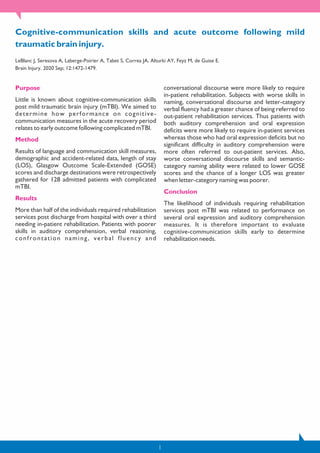
Cognitive-communication skills and acute outcome following mild
traumatic brain injury.
LeBlanc J, Seresova A, Laberge-Poirier A, Tabet S, Correa JA, Alturki AY, Feyz M, de Guise E.
Brain Injury. 2020 Sep; 12:1472-1479.
Purpose
Little is known about cognitive-communication skills
post mild traumatic brain injury (mTBI). We aimed to
determine how performance on cognitive-
communication measures in the acute recovery period
relates to early outcome following complicated mTBI.
Method
Results of language and communication skill measures,
demographic and accident-related data, length of stay
(LOS), Glasgow Outcome Scale-Extended (GOSE)
scores and discharge destinations were retrospectively
gathered for 128 admitted patients with complicated
mTBI.
Results
More than half of the individuals required rehabilitation
services post discharge from hospital with over a third
needing in-patient rehabilitation. Patients with poorer
skills in auditory comprehension, verbal reasoning,
confrontation naming, verbal fluency and
conversational discourse were more likely to require
in-patient rehabilitation. Subjects with worse skills in
naming, conversational discourse and letter-category
verbal fluency had a greater chance of being referred to
out-patient rehabilitation services. Thus patients with
both auditory comprehension and oral expression
deficits were more likely to require in-patient services
whereas those who had oral expression deficits but no
significant difficulty in auditory comprehension were
more often referred to out-patient services. Also,
worse conversational discourse skills and semantic-
category naming ability were related to lower GOSE
scores and the chance of a longer LOS was greater
when letter-category naming was poorer.
Conclusion
The likelihood of individuals requiring rehabilitation
services post mTBI was related to performance on
several oral expression and auditory comprehension
measures. It is therefore important to evaluate
cognitive-communication skills early to determine
rehabilitation needs.
1
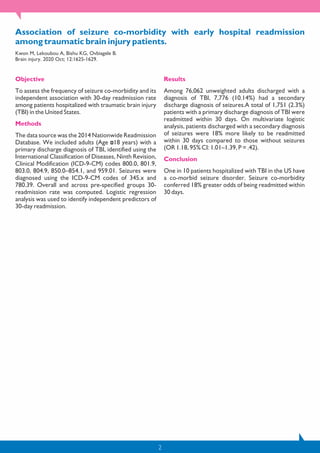
Association of seizure co-morbidity with early hospital readmission
among traumatic brain injury patients.
Kwon M, Lekoubou A, Bishu KG, Ovbiagele B.
Brain injury. 2020 Oct; 12:1625-1629.
Objective
To assess the frequency of seizure co-morbidity and its
independent association with 30-day readmission rate
among patients hospitalized with traumatic brain injury
(TBI) in the United States.
Methods
The data source was the 2014 Nationwide Readmission
Database. We included adults (Age 18 years) with a
primary discharge diagnosis of TBI, identified using the
International Classification of Diseases, Ninth Revision,
Clinical Modification (ICD-9-CM) codes 800.0, 801.9,
803.0, 804.9, 850.0–854.1, and 959.01. Seizures were
diagnosed using the ICD-9-CM codes of 345.x and
780.39. Overall and across pre-specified groups 30-
readmission rate was computed. Logistic regression
analysis was used to identify independent predictors of
30-day readmission.
Results
Among 76,062 unweighted adults discharged with a
diagnosis of TBI, 7,776 (10.14%) had a secondary
discharge diagnosis of seizures.A total of 1,751 (2.3%)
patients with a primary discharge diagnosis of TBI were
readmitted within 30 days. On multivariate logistic
analysis, patients discharged with a secondary diagnosis
of seizures were 18% more likely to be readmitted
within 30 days compared to those without seizures
(OR 1.18, 95% CI: 1.01–1.39, P = .42).
Conclusion
One in 10 patients hospitalized with TBI in the US have
a co-morbid seizure disorder. Seizure co-morbidity
conferred 18% greater odds of being readmitted within
30 days.
2
3
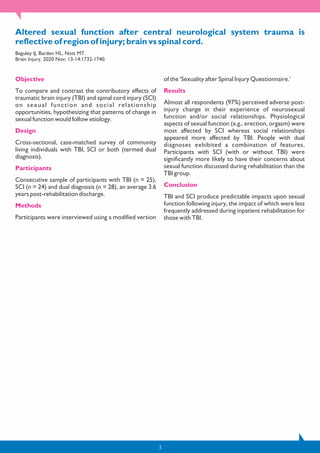
Altered sexual function after central neurological system trauma is
reflective of region of injury; brain vs spinal cord.
Baguley IJ, Barden HL, Nott MT.
Brain Injury. 2020 Nov; 13-14:1732-1740.
Objective
To compare and contrast the contributory effects of
traumatic brain injury (TBI) and spinal cord injury (SCI)
on sexual function and social relationship
opportunities, hypothesizing that patterns of change in
sexual function would follow etiology.
Design
Cross-sectional, case-matched survey of community
living individuals with TBI, SCI or both (termed dual
diagnosis).
Participants
Consecutive sample of participants with TBI (n = 25),
SCI (n = 24) and dual diagnosis (n = 28), an average 3.6
years post-rehabilitation discharge.
Methods
Participants were interviewed using a modified version
of the ‘Sexuality after Spinal Injury Questionnaire.’
Results
Almost all respondents (97%) perceived adverse post-
injury change in their experience of neurosexual
function and/or social relationships. Physiological
aspects of sexual function (e.g., erection, orgasm) were
most affected by SCI whereas social relationships
appeared more affected by TBI. People with dual
diagnoses exhibited a combination of features.
Participants with SCI (with or without TBI) were
significantly more likely to have their concerns about
sexual function discussed during rehabilitation than the
TBI group.
Conclusion
TBI and SCI produce predictable impacts upon sexual
function following injury, the impact of which were less
frequently addressed during inpatient rehabilitation for
those with TBI.
4
White Matter Hyperintensities Predict Response to Language Treatment
in Poststroke Aphasia.
Varkanitsa M, Peñaloza C, Charidimou A, Caplan D, Kiran S.
Neurorehabilitation and neural repair. 2020 Oct; 10:945-53.
Background
White matter hyperintensities (WMH) are a
radiological marker of brain health that has been
associated with language status in poststroke aphasia;
however, its association with language treatment
outcomes remains unknown.
Objective
To determine whether WMH in the right hemisphere
(RH) predict response to language therapy
independently from demographics and stroke
lesion–related factors in poststroke aphasia.
Methods
We used the Fazekas scale to rate WMH in the RH in
30 patients with poststroke aphasia who received
language treatment. We developed ordinal regression
models to examine language treatment effects as a
function of WMH severity after controlling for aphasia
severity, stroke lesion volume, time post onset, age,
and education level. We also evaluated associations
between WMH severity and both pre-treatment
naming ability and executive function.
Results
The severity of WMH in the RH predicted treatment
response independently from demographic and stroke-
related factors such that patients with less severe
WMH exhibited better treatment outcome. WMH
scores were not significantly correlated with
pretreatment language scores, but they were
significantly correlated with pretreatment scores of
executive function.
Conclusion
We suggest that the severity of WMH in the RH is a
clinically relevant predictor of treatment response in
this population.
5
Mental Imagery as a Rehabilitative Therapy for Neuropathic Pain in
People With Spinal Cord Injury: A Randomized Controlled Trial.
Kaur J, Ghosh S, Sahani AK, Sinha JK.
Neurorehabilitation and Neural Repair. 2020 Nov; 11:1038-49.
Background
Pain of neuropathic origin in spinal cord injury (SCI) is
unbearable and challenging to treat. Research studies
conducted in the past have shown that mental imagery
(MI) techniques have a significant impact on the
reduction of symptoms of central neuropathic pain in
people with SCI.
Objectives
The objective of this study was to evaluate the effect of
MI training on pain intensity, neuropathic pain
symptoms, and interference of pain with function in
SCI.
Methods
A total of 42 SCI participants with central neuropathic
pain (duration 6-12 months) were recruited and
randomly allocated to MI or control groups. A MI
training protocol was administered to MI group and for
30 min/d for 5 days. Outcome measures were assessed
at baseline and at the end of 4 weeks.
Results
There was significant reduction in differences of mean
[95% CI] scores of numeric rating scale ( 2.1 [CI 2.78
to 1.41]; P < .001) between groups. Mean [95% CI]
total scores of Neuropathic Pain Symptom Inventory
declined in MI group as compared with control group
( 4.52 [CI 5.86 to 3.18]; P < .001). Similarly, Brief
Pain Inventory interference scale total dropped
significantly (P < .001) in MI group. Majority of
participants in the MI group (55%) reported
improvement in scores of Patients’ Global Impression
of Change scale as compared with control group where
most of the participants (52%) reported no change.
Conclusions
This study shows the effectiveness of the MI protocol
developed as a rehabilitative approach in improving
central neuropathic pain in SCI.
6
Impairments in spatial navigation during walking in patients 70 years or
younger with mild stroke.
Hamre C, Fure B, Helbostad JL, Wyller TB, Ihle-Hansen H, Vlachos G, Ursin MH, Tangen GG.
Topics in Stroke Rehabilitation. 2020 Nov 24:1-9.
Background
Spatial navigation, the ability to determine and maintain
a route from one place to another, is needed for
independence in everyday life. Knowledge about
impairments in spatial navigation in people with mild
stroke is scarce.
Objectives
To explore impairments in spatial navigation in patients
70 years after first-ever mild ischemic stroke (NIHSS 3)
and to explore which variables are associated with
these impairments 12 months later.
Methods
Patients were examined in the acute phase, and after 3
and 12 months. To assess impairments in spatial
navigation, we used the Floor Maze Test (FMT), with
time and FMT-errors as outcomes. Patients’ perceived
navigational skills were collected using self-report.
Logistic regression was used to explore which variables
(sociodemographic data, stroke characteristics,
cognition, and mobility) were associated with impaired
navigation ability.
Results
Ninety-seven patients (20 females) were included. The
mean (SD) age was 55.5 (11.4) years. Timed FMT
improved significantly from the acute phase to 12
months (p = <.001). At 12 months, 24 (24.7%) of the
participants walked through the maze with errors, and
22 (22.7%) reported spatial navigational problems. The
Trail Making Test (TMT)-B was the only variable from
the acute phase associated with FMT-errors at 12
months, and being female was the only variable
associated with self-reported navigational problems at
12 months.
Conclusion
Nearly one in four patients experienced spatial
navigation problems 12 months after a mild stroke.
Executive function (TMT-B), measured in the acute
phase, was associated with navigational impairments
(FMT-errors) at 12 months, and being female was
associated with self-reported navigational problems.
7
Use of repetitive transcranial magnetic stimulation in the treatment of
neuropsychiatric and neurocognitive symptoms associated with
concussion in military populations.
Bender Pape T, Oberman LM, Exley S, Philip NS, Siddiqi SH, Adamson MM, Brody DL.
Journal of head trauma rehabilitation. 2020 Nov/Dec 6:388-400.
Background
Since the year 2000, over 342 000 military service
members have experienced a concussion, often
associated with chronic neuropsychiatric and
neurocognitive symptoms. Repetitive transcranial
magnetic stimulation (rTMS) protocols have been
developed for many of these symptoms in the general
population.
Objective
To conduct a scoping review of the literature on rTMS
for neuropsychological and neurocognitive symptoms
following concussion.
Methods
PubMed and Google Scholar search engines identified 9
articles, written in English, corresponding to the search
terms TBI or concussion; and TMS or rTMS; and
depression, PTSD, or cognition. Studies that were not
therapeutic trials or case reports, did not have
neuropsychiatric or neurocognitive primary outcome
measures, or described samples where 80% or more of
the cohort did not have a TBI were excluded.
Results
There were no reports of seizures nor difference in the
frequency or quality of other adverse events as
compared with the broader rTMS literature,
supporting the safety of rTMS in this population.
Support for the efficacy of rTMS for the treatment of
neuropsychiatric and neurocognitive symptoms, in this
population, is limited.
Conclusions
Large-scale, innovative, neuroscience-informed
protocols are recommended to elucidate the potential
utility of rTMS for the complex neuropsychiatric and
neurocognitive symptoms associated with military
concussions.
8
Assessing Diagnostic and Severity Grading Accuracy of Ultrasound
Measurements for Carpal Tunnel Syndrome Compared to
Electrodiagnostics.
Yin-Ting C, Miller Olson EK, Lee SH, Sainani K, Fredericson M.
PM R. 2020 Dec 11.
Introduction
The combined sensory index (CSI) is the most sensitive
electrodiagnostic criteria for carpal tunnel syndrome
(CTS), and the CSI and Bland criteria have been shown
to predict surgical treatment outcomes. The proposed
ultrasound measurements have not been assessed
against the CSI for diagnostic accuracy and grading of
CTS severity.
Objective
The primary objective of this paper was to investigate
the use of ultrasound evaluations for both diagnosis and
assessment of severity grading of CTS in comparison to
electrodiagnostic assessment.
Design
All patients underwent an electrodiagnostic evaluation
using the CSI and Bland severity grading. Each patient
underwent an ultrasound evaluation including cross
sectional area (CSA), the change in CSA from the
forearm to the tunnel (DCSA), and the wrist-forearm
ratio (WFR). These measurements were assessed for
diagnostic and severity grading accuracy using the CSI
as the gold standard.
Setting
Tertiary academic center
Participants
All patients referred for electrodiagnostic evaluation
for CTS were eligible for the study. Only those with
idiopathic CTS were included and those with prior CTS
treatment were also excluded. Ninety-five patients
were included in the study.
Interventions
Not Applicable.
Outcome Measures
The primary study outcome measure was concordance
between CSI diagnosis and severity categories and the
ultrasound measurements. Both outcomes were also
assessed using Bland criteria.
Results
Optimal cut-points for diagnosis of CTS were found to
2 2
be CSA >12 mm , DCSA >4 mm , WFR >1.4. Using
these cut-points, C-statistics comparing diagnosis of
CTS using ultrasound measurements versus using the
CSI ranged from 0.893-0.966. When looking at CSI
severity grading compared to DCSA, however, the C-
statistics were 0.640-0.661 with substantial overlap
between severity groups.
Conclusion
While ultrasound measurements had high diagnostic
accuracy for CTS based on the CSI criteria, ultrasound
measurements were unable to adequately distinguish
between CSI severity groups among patients with CTS.
9
Long-Term Observational Results from the ASPIRE Study:
OnabotulinumtoxinA Treatment for Adult Lower Limb Spasticity.
Esquenazi A, Bavikatte G, Bandari DS, Jost WH, Munin MC, Tang SFT, Largent J, Adams AM, Zuzek A, Francisco GE.
PM R. 2020 Nov 5.
Introduction
OnabotulinumtoxinA treatment for spasticity varies
according to numerous factors and is individualized to
meet treatment goals.
Objective
Explore real-world onabotulinumtoxinA utilization and
effectiveness in patients with lower limb spasticity from
the Adult Spasticity International Registry (ASPIRE)
study.
Design
2-year, multicenter, prospective, observational registry
(NCT01930786).
Setting
54 international clinical sites.
Patients
Adults (naïve or non-naïve to botulinum toxin[s]
treatment for spasticity, across multiple etiologies)
with lower limb spasticity related to upper motor
neuron syndrome.
Interventions
OnabotulinumtoxinA administered at the clinician's
discretion.
Main Outcome Measures
OnabotulinumtoxinA treatment utilization, clinician
and patient-reported satisfaction.
Results
I n A S P I R E , 5 3 0 p a t i e n t s r e c e i v e d > 1
onabotulinumtoxinA treatment for lower limb
spasticity (mean age, 52 years; stroke, 49.4%; multiple
sclerosis 20.4%). Equinovarus foot was treated most
often (80.9% of patients), followed by flexed knee
(26.0%), stiff extended knee (22.5%), and flexed toes
(22.3%). OnabotulinumtoxinA doses ranged between
10-1100 U across all presentations. Electromyography
(EMG) was most commonly used for injection
localization (>41.1% of treatment sessions). Despite
low patient response on the satisfaction questionnaire,
clinicians (94.6% of treatment sessions) and patients
(84.5%) reported satisfaction/extreme satisfaction that
treatment helped manage spasticity, and clinicians
(98.3%) and patients (91.6%) would probably/definitely
continue onabotulinumtoxinA treatment. These data
should be interpreted with care. 21 adverse events
(AEs) in 18 patients (3.4%) were considered treatment-
related. 67 patients (12.6%) reported 138 serious AEs;
3 serious AEs in 2 patients (0.4%) were considered
treatment-related. No new safety signals were
identified.
Conclusions
ASPIRE provides long-term observational data on the
treatment of lower limb spasticity with
onabotulinumtoxinA. Real-world data from this
primary analysis can help to guide the clinical use of
onabotulinumtoxinA to improve spasticity
management.
10
Systematic Review and Meta-Analysis of Nonoperative Platelet-Rich
Plasma Shoulder Injections for Rotator Cuff Pathology.
Lui M, Shih W, Yim N, Brandstater M, Ashfaq M, Tran D.
PM R. 2020 Nov 1.
Background
Platelet-rich plasma (PRP) injections have been
introduced to augment the recovery of patients with
shoulder pathology. While multiple studies have been
published, no large-scale trials or meta-analyses have
assessed the efficacy of non-operative shoulder PRP
injection.
Objective
To assess the efficacy of non‐operative PRP shoulder
injection in rotator cuff pathology for pain as measured
by the visual analog scale (VAS) and range of motion
(ROM).
Design
Two authors independently screened the Medline and
Cochrane databases to include prospective studies that
reported VAS and ROM outcomes for non-operative
shoulder PRP injections for rotator cuff pathology.
Study quality was assessed using the revised Cochrane
Collaboration risk-of-bias tool and modified Downs
and Black checklist. Subsequent meta-analysis was
performed to determine the effect of non-operative
PRP injections on pain and ROM 3 to 12 months post-
intervention.
Results
Six studies met systematic review criteria. The included
studies used different PRP formulations
(concentration, leukocyte count), injection protocols
(approach, injection number), and varied study designs.
Three studies concluded that PRP provided no
significant benefit for pain and ROM when compared to
physical therapy. Within-group meta-analysis of six
2
fairly heterogeneous studies (I 77.8%) demonstrated a
statistically significant (p < .001) improvement in pain 3
to 12 months after PRP injection. Within-group meta-
analysis for four studies for shoulder flexion and
abduction was found to be too heterogeneous to
derive meaningful results.
Conclusion
There is a limited quantity of high-quality studies that
assess the efficacy of non-operative PRP shoulder
injection for pain and ROM. Systematic review of PRP
injections did not demonstrate an improvement in pain
or ROM compared to physical therapy. While within-
group meta-analysis of non-operative PRP statistically
showed that non-operative PRP improved pain, the lack
of adequate negative controls precludes the ability to
conclude whether improvements were due to natural
recovery or non-operative PRP.
11
The Levels of Insulin-Like Growth Factor in Patients with Myofascial Pain
Syndrome and in Healthy Controls.
Grosman-Rimon L, Vadasz B, Parkinson W, Clarke H, Katz JD, Kumbhare D.
PM R. 2020 Oct 7.
Background
Insulin‐like growth factor-1 (IGF-1) plays an important
role in muscle maintenance and repair. The role of IGF-
2 in the muscle is less clear.
Objective
To compare the levels of IGF-1 and IGF-2 in
participants with acute myofascial pain syndrome (MPS)
versus healthy controls and to determine whether age,
gender, body mass index (BMI), region of pain, and pain
intensity are associated with IGF levels.
Design
A case-control study design included a total of 74
participants.
Setting
Hospital emergency department.
Participants
Participants presenting with acute MPS (n = 43) and
non-MPS controls (n = 31).
Main Outcome Measures
Serum IGF-1 and IGF-2 (pg/mL) were measured in
participants with MPS within 24 hours of symptom
onset, and in non-MPS controls. Group and gender
differences in serum IGF-1 and IGF-2 were assessed,
with group and gender as factors, while controlling for
age and BMI.
Results
The mean IGF-1 levels were not significantly different
between MPS and controls (88 554.1, confidence
interval [CI], 79 724.4-97 383.7 vs. 97 911.2, CI, 85
322.8-110 493.6). Significant differences were also not
observed in IGF-1 levels between men and women with
MPS nor between men and women in the control
group. Mean levels of IGF-2 were significantly lower in
patients with MPS than in controls (226 608.9, CI, 180
057.3-273 160.5 versus 460 343.9, CI, 387 809.4-532
878.2, P < .001). There were no significant gender
differences in the levels of IGF-2 in patients with MPS.
Mean IGF-2 levels (pg/mL) of men and women with MPS
were lower (253 343.0, CI, 179 891.0-326 795.0, and
204 524.2, CI, 141 176.4-267 872.0, respectively) than
those of healthy men and women (428 177.2, CI, 368
345.7-488 008.6, and 511 274.4, 355 178.6-687 370.1,
respectively). Lower BMI and younger age were
associated with higher levels of IGF-2. Pain intensity
was associated with IGF-2 but not with IGF-1, whereas
region of pain was not associated with either IGF-1 or
IGF-2 levels.
Conclusions
IGF-2 levels were lower in patients with acute MPS
versus healthy controls with no gender differences, and
IGF-1 levels were not different among the groups.
Future studies should investigate the role of IGF-2 in
muscle maintenance and repair in MPS.
12
Effect of Strength Training on Glycemic Control and Adiponectin in
Diabetic Children.
Petschnig, Renate; Wagner, Thomas; Robubi, Armin; Baron, Ramon
Medicine & Science in Sports & Exercise. 2020;52(10):2172-2178.
Purpose
This study aimed to examine the effect of isolated
supervised progressive resistance training with
duration of more than 32 wk on muscle strength,
metabolic control and adiponectin.
Method
Twenty-one children with type 1 diabetes mellitus
were separated into an intervention group (IG) (n = 11
age 11.0 ± 0.8) and a control group (CG) (n = 10 age
11.30 ± 0.7) without training to control for the effect of
progressive resistance training on muscle strength,
hemoglobin (HbA)1C and adiponectin. All parameters
were assessed before and after a period of 32 wk. No
attempt was made to change diet and the daily
behaviors during the study in both groups.
Results
After a period of 32 wk, upper and lower limb strength
increased significantly (P < 0.05) in the IG, whereas no
changes occurred in the CG. In the IG, HbA1C
decreased significantly after 32 wk but not after 17 wk
(P < 0.00), whereas HbA1C increased in the CG (P <
0.007). Adiponectin increased significantly (P < 0.000)
only in the IG. Self-monitored blood glucose levels,
measured before and after each session, showed a
significant reduction (P < 0.00) of 26.5% ± 4.4% after
each session. Effect size (ES) for the strength training on
limb strength was medium (d = 0.464 to d = 0.661), the
ES for strength training on HbA1C (d = 1.292) and the
ES for strength training on adiponectin (d = 1.34) was
large. There was no hypoglycemia as the result of
training.
Conclusions
An isolated supervised progressive resistance training
two times a week in children with type 1 diabetes
mellitus must last at least 32 wk to get a significant
decrease in blood glucose level HbA1C. In addition,
exercise-induced increase in adiponectin improves
insulin sensitivity.
13
Is There a Link between Stress and Cognition, and Capacity to Execute
Motor Skill?
Serpell, Benjamin G.; Waddington, Gordon; Mcgrath, Braden; Cook, Christian J.
Medicine & Science in Sports & Exercise. 2020;52(11):2365-2372.
Purpose
This study aimed to examine the link between stress
(measured via salivary cortisol and testosterone),
cognition (measured via pupillometry, with greater
pupil constriction and reduced pupil constriction
latency associated with increased attention and
improved information processing), and motor skill
capacity (measured via somatosensory processing).
Methods
Twenty-five professional rugby players participated in
this study. Saliva samples were collected upon waking,
before pupillometry and somatosensory processing
testing, and after testing. Testing times varied for
participants; however, it was always in the morning, and
the order of testing was randomized.
Results
Very small differences in hormone concentrations
were seen across the morning (effect size = 0.01).
Moderate to large differences in left eye pupil
constriction for direct (left eye) versus consensual
(right eye) stimulus were also seen (P < 0.01; effect size
= 0.51 to 1.04). No differences for pupil constriction
latency were seen for direct versus consensual
stimulus. Some positive weak to moderate
relationships were seen for testosterone and pupil
constriction latency (r = 0.37 to 0.39, P < 0.05).
Moderate to strong inverse relationships were seen for
hormones with left eye pupil constriction difference
between direct and consensual stimulus, and for pre- to
posttest testosterone-to-cortisol ratio decline with left
eye pupil constriction for direct and consensual
stimulus (r = 0.41 to 0.52, P < 0.05). Weak to moderate
inverse relationships for testosterone-to-cortisol ratio
decline and somatosensory processing were seen (r =
0.36 to 0.47, P < 0.05).
Conclusion
Stress may affect ability to receive information and
ability to execute motor tasks. Thus, stress may
compromise ability to make appropriate objective
decisions and consequently execute skill/task
behaviour. Strategies to help mitigate negative stress
responses are noted.
14
Categorizing 10 Sports According to Bone and Soft Tissue Profiles in
Adolescents.
Agostinete, Ricardo Ribeiro; Fernandes, Romulo Araújo; Narciso, Pedro Henrique; Maillane-Vanegas, Santiago;
Werneck, André Oliveira; Vlachopoulos, Dimitris
Medicine & Science in Sports & Exercise. 2020;52(11):2673-2681.
Purpose
Considering the different loading and training
characteristics of the sports practiced during growth, it
is important to specify and categorize the bone and soft
tissue adaptations in adolescent athletes. This study
aimed to categorize 10 different loading sports and a
nonsport group and identify the differences in bone
density and soft tissues.
Methods
The sample included 625 adolescents (10 to 17 yr of
age) of 10 sports (soccer, basketball, volleyball, track
and field, judo, karate, kung fu, gymnastics, baseball, and
swimming) and a nonsport group. Dual-energy x-ray
absorptiometry assessed areal bone mineral density
(aBMD), bone mineral apparent density (BMAD), and
soft tissues (lean soft tissue and fat mass). The results
were adjusted for sex, peak height velocity status, lean
soft tissue, fat mass, and weekly training volume.
Results
The comparisons among groups showed that soccer
had the highest whole-body aBMD (mean ± SEM: 1.082
± 0.007 g.cm-2) and lower limb aBMD (1.302 ± 0.010
g.cm-2). Gymnastics presented the highest upper limb
aBMD (0.868 ± 0.012 g.cm-2) and whole-body BMAD
(0.094 ± 0.001 g.cm-3). Swimming presented the
lowest aBMD values in all skeletal sites (except at the
upper limbs) and whole-body BMAD. The soft tissue
comparisons showed that soccer players had the
highest lean soft tissue (43.8 ± 0.7 kg). The lowest fat
mass was found in gymnasts (8.04 ± 1.0 kg).
Conclusion
The present study investigated and categorized for the
first time 10 different sports according to bone density
and soft tissue profiles. Soccer and gymnastics sport
groups were found to have the highest bone density in
most body segments, and both sports were among the
groups with the lowest fat mass.
15
Clinicians initial experiences of transition to online interdisciplinary pain
rehabilitation during the covid-19 pandemic.
Vera A. Baadjou, Marlies den Hollander, Thijs van Meulenbroek, Jeanine A. Verbunt, Inge Timmers
Journal of Rehabilitation Medicine 2020;3(5):
Objective
Public health legislation during the COVID-19
pandemic has resulted in forced transitioning to the use
of remote care in order to continue the provision of
pain rehabilitation worldwide. The objective of this
study was to gain insight into clinicians´ initial
experiences with the provision of interdisciplinary pain
rehabilitation via videoconferencing.
Design
Observational, cross-sectional design.
Participants
Twelve team members (specialists in rehabilitation
medicine -MD, psychologists, physiotherapists and
occupational therapists) from a tertiary expertise
centre in pain rehabilitation.
Methods
Quantitative and qualitative data were collected via a
digital survey. Theme-based content analysis was
performed for qualitative data.
Results
The themes that emerged were: the compulsory
context; prerequisites for proper use of
videoconferencing methods, which are strongly
associated with the clinicians´ experiences; changes
experienced in specific components of pain
rehabilitation; and overarching changes experienced,
including opportunities and limitations (sub-themes:
therapeutic relationship, system involvement,
efficiency, hands-on possibilities, interdisciplinary
teamwork, and formalities). Overall, clinicians
expressed moderate agreement with the statements
that the quality of the pain rehabilitation programme
can be maintained using videoconferencing, and that
the COVID-19 pandemic offers opportunities for
growth and innovation in telehealth.
Conclusion
It is feasible to provide valid and satisfactory pain
rehabilitation via videoconferencing. This study
identified facilitators and barriers to the use of
videoconferencing, and great potential for integrating
aspects of telehealth into standard care after the
pandemic.
Lay Abstract
Legislation during the COVID-19 pandemic forced
transitioning to remote care to continue pain
rehabilitation treatment. In this study, first experiences
with interdisciplinary pain rehabilitation by
videoconferencing were gathered. Both qualitative and
quantitative data were collected from team members
of a pain rehabilitation team via a digital survey. Overall,
clinicians reported that videoconferencing is a valid way
to continue care in times when legalisation does not
allow for standard face-to-face care. Furthermore,
clinicians see opportunities to integrate aspects of
telehealth into standard care after the COVID-19
pandemic. However, several limitations and
restrictions have been experienced, such as the lack of
a physical examination and questions about long-term
effectiveness of the treatment. In addition, further
investigation is needed to investigate whether pain
rehabilitation provided by videoconferencing reaches
quality standards of regular care.
16
Three-dimensional printing in prosthetics: Method for managing rapid
limb volume change.
Eric Nickel, Kyle Barrons, Barry Hand, Alana Cataldo, Andrew Hansen
Prosthet Orthot Int. 2020 Oct; 44(5):355-358.
Background and Aim
During post-amputation recovery or rapid body mass
change, residual limb volume can change quickly,
requiring frequent adjustments or replacement of the
socket to maintain fit. The aim of this pilot test was to
evaluate the feasibility of using a three-dimensional-
printed insert to extend the service life of a prosthetic
socket after substantial residual limb volume loss.
Technique
One research subject with a well-fitting transtibial
prosthetic socket had an oversized socket fabricated to
simulate substantial limb volume loss. The digital shapes
of the oversized and well-fitting sockets were used to
create a three-dimensional-printed insert to restore fit.
Discussion
Two-minute walk test distance decreased when using
the oversized socket without the insert, but not when
using the socket with the insert. Socket comfort score
was 8+ under all conditions. These results suggest that
three-dimensional-printed inserts may be an effective
method of extending the service life of prosthetic
sockets when rapid limb volume loss occurs.
Clinical relevance
Three-dimensional (3D) printing gives prosthetists a
new tool to manage large volume changes without
refabricating entire sockets. Sockets can be fabricated
in anticipation of volume gain/loss, using replaceable
3D-printed inserts to maintain fit and comfort.
17
Lower limb prosthetic interfaces: Clinical and technological advancement
and potential future direction.
Safari R.
Prosthet Orthot Int. 2020 Dec; 44(6):384-401.(50 year Celebratory edition)
The human–prosthesis interface is one of the most
complicated challenges facing the field of prosthetics,
despite substantive investments in research and
development by researchers and clinicians around the
world. The journal of the International Society for
Prosthetics and Orthotics, Prosthetics and Orthotics
International, has contributed substantively to the
growing body of knowledge on this topic.
In celebrating the 50th anniversary of the International
Society for Prosthetics and Orthotics, this narrative
review aims to explore how human–prosthesis
interfaces have changed over the last five decades; how
research has contributed to an understanding of
interface mechanics; how clinical practice has been
informed as a result; and what might be potential future
directions. Studies reporting on comparison, design,
manufacturing and evaluation of lower limb prosthetic
sockets, and osseointegration were considered. This
review demonstrates that, over the last 50 years,
clinical research has improved our understanding of
socket designs and their effects; however, high-quality
research is still needed. In particular, there have been
advances in the development of volume and thermal
control mechanisms with a few designs having the
potential for clinical application. Similarly, advances in
sensing technology, soft tissue quantification
techniques, computing technology, and additive
manufacturing are moving towards enabling
automated, data-driven manufacturing of sockets.
In people who are unable to use a prosthetic socket,
osseointegration provides a functional solution not
available 50 years ago. Furthermore, osseointegration
has the potential to facilitate neuromuscular
integration. Despite these advances, further
improvement in mechanical features of implants, and
infection control and prevention are needed.
18
Let’s not go back to ‘normal’! lessons from COVID-19 for professionals
working in childhood disability.
Peter L. Rosenbaum, Mindy Silva & Chantal Camden
Disabil Rehabil, Dec 2020.
Purpose
The worldwide COVID-19 pandemic has changed
almost all aspects of our lives, and the field of childhood
disability is no exception.
Methods
This article is based on an invited lecture by the first
author at a conference–the eHealth Summit (“Pediatric
Rehabilitation in a Digital Space”)–organized by the
other authors and their colleagues in May 2020.
Results
The first author offers his own experiences and
perspectives, supplemented by comments and
observations contributed by many of the 9000+
attendees at this talk, as curated by the second and
third authors. The basic messages are that while life for
families of children with developmental disabilities, and
for service providers who work with them, is
significantly altered, many important lessons are being
learned.
Conclusions
The comments from participants support the currency
of the ideas that were presented, and encourage
childhood disability professionals to reflect on what we
are learning, so that we can seize the opportunities they
afford to do things differently–and we believe
better–moving forward.
Implications For Rehabilitation
• Ideas generated by colleagues and parents suggest
that there may be alternatives to “business as usual”
in childhood disability services after the COVID
pandemic is over.
• People are recognizing opportunities, and benefits,
to offering services virtually, including being able to
see children in their natural environments, saving
parents time, money and hassles to attend clinics in
person, and perhaps increasing the availability of
services.
• Many issues remain to be investigated systematically,
including, among others, what services (assessments
and interventions) require hands-on connections,
what payment structures can accommodate new
models of services, how professionals can work
together in a virtual world, and what families will
want.
• Regardless of the final answers to these issues, we
believe that we should not simply “go back to
normal”; rather, we should expand the range, nature
and locations of our services for children with
developmental disabilities and their families.
19
Impacts of goal setting on engagement and rehabilitation outcomes
following acquired brain injury: a systematic review of reviews.
Katri Knutti, Anita Björklund Carlstedt, Rieke Clasen & Dido Green
Disabil Rehabil, Nov 2020.
Purpose
To appraise and synthesize evidence from previous
systematic reviews (SRs) concerning the impacts of goal
setting on engagement in the rehabilitation process and
on outcomes of participation and occupational
performance for individuals with acquired brain injury
(ABI).
Materials and methods
Systematic review of SRs following the preferred
reporting items for SRs and meta-analysis guidelines.
Sixteen full text articles were assessed for eligibility,
from which four were included in the review. The
Critical Appraisal Skills Programme checklists for SRs
was used to rate quality and risk of bias.
Results
Four SRs of moderate to high quality included a variety
of methodologies. Evidence of moderate quality
showed clients’ active participation in goal setting had
positive impacts on the client and their engagement in
the process. Findings suggested that goal-directed
interventions, particularly in outpatient rehabilitation,
may improve occupational performance. There was
some indication that goal setting may support
adherence to therapeutic exercises, but relevance to
rehabilitation outcomes was less clear. Findings related
to participation outcomes were minimal.
Conclusions
Goal setting is a complex and multidimensional
process. Goal setting may contribute to improved
engagement in rehabilitation although few studies
explored occupational performance and participation
outcomes for individuals with ABI.
Implications For Rehabilitation
• Active goal setting may contribute to improved
engagement in rehabilitation, however, including
individual clients in the goal setting process requires
creativity and flexibility on behalf of professionals.
• A model is presented to promote understanding of
the personal and environmental barriers and
facilitators that may interact with goal setting
approaches to promote engagement in
rehabilitation.
• There is a need for more research exploring impact
of active client-centered goal setting on occupational
performance and participation outcomes for people
with acquired brain injury.
20
The effect of innovative smartphone application on adherence to a home-
based exercise programs for female older adults with knee osteoarthritis
in Saudi Arabia: A randomized controlled trial.
Maryam Alasfour & Maha Almarwani
Disabil Rehabil, Oct 2020.
Purpose
To examine the effects of an Arabic smartphone
application on adherence to home exercise programs
(HEPs) and the effectiveness of mobile-based HEPs on
pain, physical function, and lower-limb muscle strength
among older women with knee osteoarthritis (OA).
Materials and methods
This randomised control trial (ClinicalTrials.gov:
(NCT04159883) enrolled 40 women aged 50>years
with knee OA who were randomised into the app
group (experimental; n = 20) receiving HEPs using an
Arabic smartphone application called “My Dear Knee”,
whereas the paper group (control; n = 20) receiving
HEPs as hand-outs. Both groups had the same exercise
program. Outcome measures were self-reported
adherence, changes in the Arabic Numeric Pain Rating
Scale, the Arabic version of the reduced Western
Ontario, McMaster Universities Osteoarthritis Index-
Physical Function subscale, and Five-Times Sit-To-
Stand Test scores. All participants were assessed at
baseline, at week 3 and week 6. Using completer-only
analyses, the repeated measures ANOVA was used to
compare the means of the outcome measures between
the two groups.
Results
At the end of week 6, the app group reported greater
adherence to HEPs (p = .002) and significant reduction
in pain (p = .015).
Conclusions
A smartphone application with motivational and
attractive features could enhance adherence to HEPs in
this patient cohort.
Implications For Rehabilitation
• Older adults with knee OA may face many obstacles
that prevent or limit their adherence to the
prescribed HEP.
• Smart device apps supported with attractive and
motivational features could be an effective strategy
to enhance adherence to HEPs among older adults
with knee OA.
• Using such remote technology appears to overcome
the barriers that may limit the ability of older women
to receive supervised physical therapy in a clinical
setting.
21
Current trends in the treatment of patients with post-stroke unilateral
spatial neglect: a scoping review.
Chuka Umeonwuka, Ronel Roos & Veronica Ntsiea
Disabil Rehabil, Sept 2020.
Purpose
The purpose of this scoping review was to explore the
current treatment approaches for patients with post-
stroke unilateral spatial neglect.
Methods
A three-step search strategy using the Johanna Briggs
Institute (JBI) guidelines, was undertaken. PubMed,
CINAHL, The Cochrane Central Register of
Controlled Trial, SCOPUS, PROSPERO, JBI, Sport
Discus, and Google Scholar databases were searched.
Searches were limited to publications from January 1,
2008, to May 1, 2020. Critical appraisal was undertaken
by two independent reviewers using a standardized
critical appraisal instrument developed by JBI. Data
were extracted using a study-specific charting table.
Results
A total of 3,648 articles were identified, 311 full-text
articles were screened and 86 articles were critically
appraised, with 83 articles included in the review.
Intervention approaches for post-stroke unilateral
spatial neglect symptom amelioration were identified
and categorized as prism adaptation and visual scanning,
mental practice and mirror therapy, electrical
stimulation and robotics, combination therapy,
pharmacological therapy, and other interventions. Both
positive and negative results across identified
interventions were identified without specific
reference to the phase of recovery.
Conclusion
This review provides insight into current interventions
for post-stroke unilateral spatial neglect. A plethora of
intervention studies have been explored to ameliorate
neglect symptoms post-stroke.
Implication For Rehabilitation
• Prism adaptation (PA) and combination therapy are
most commonly investigated intervention for
unilateral spatial neglect (USN) and showed promise
in ameliorating USN symptoms.
• No single treatment approach seems optimally
superior in the rehabilitation of USN post-stroke.
• Evidence for the selection of treatment at a specific
phase of recovery is not conclusive as both positive
and negative outcome on neglect measure were
observed across all treatment approaches without
specific reference to the phase of recovery.
• Evidence for the long-term use of PA in USN
rehabilitation appears to be modest.
22
Detecting physical abilities through smartphone sensors: an assistive
technology application.
Paul Whittington, Huseyin Dogan, Keith Phalp & Nan Jiang
Disabil Rehabil Assist Technol, Dec 2020.
Purpose
It is important to promote assistive technologies to
improve quality of life. The proposed SmartAbility
Android Application recommends assistive
technologies for people with reduced physical abilities,
by focussing on actions that can be performed
independently.
Materials and methods
The SmartAbility Application uses Android built-in
sensors, e.g., accelerometer and gyroscope and
application programming interfaces (APIs) to detect
physical abilities, e.g., head movements and blowing and
recommend suitable assistive technologies. This is
supported by a MySQL database that stores assistive
technologies and mappings between abilities. The
underpinning research is the SmartAbility Framework
that culminates the knowledge obtained during
previously feasibility trials and usability evaluations.
Results
The Application was evaluated by pupils (n = 18) at
special educational needs schools with physical
conditions, including cerebral palsy, autism and
Noonan syndrome, and assessed through the NASA
Task Load Index (TLX) and System Usability Scale
(SUS). Analysis using the Adjective Rating Scale
highlighted that the Application achieves “Good
Usability”.
Conclusion
The SmartAbility Application demonstrates that built-
in sensors of Android devices and their APIs, can detect
actions that users perform, e.g., head movements and
speaking. The Application contains a database where
assistive technologies are mapped to physical abilities,
in order to provide suitable recommendations. It will
be disseminated to assistive technology charities and
manufacturers and be used by healthcare professionals
as part of the rehabilitation process. Future
developments of SmartAbility include the creation of a
second Application designed specifically to recommend
assistive technologies for the education sector, based
on users’ physical and cognitive abilities.
Implications For Rehabilitation
• Assistive technology is any item, equipment or piece
of software designed to increase, maintain or
improve the functional capabilities of people with
disabilities.
• SmartAbility should be introduced into rehabilitation
to promote awareness of assistive technologies that
are suitable for the physical abilities of the user.
• Our research highlighted that physical abilities can be
detected using built-in sensors of Android devices,
e.g. accelerometer and gyroscope.
• Involvement of the intended user community during
evaluations is essential to ensure that a smartphone
application is suitable for people with reduced
physical abilities.
• Assistive technologies can support the rehabilitation
of people with reduced physical abilities by providing
increased independence and improved quality of life.
23
Can google glass™ technology improve freezing of gait in parkinsonism? A
pilot study.
Andrea Lee, Natalie Hellmers, Mary Vo, Fei Wang, Paul Popa, Samantha Barkan, Dylon Patel, Carter Campbell,
Claire Henchcliffe & Harini Sarva
Disabil Rehabil Assist Technol, Nov 2020.
Purpose
Freezing of gait (FOG) is a disabling phenomenon
defined by the periodic absence or reduction of
forward progression of the feet despite the intention to
walk. We sought to understand whether Google Glass
(GG), a lightweight wearable device that provides
simultaneous visual-auditory cues, might improve FOG
in parkinsonism.
Methods
Patients with parkinsonism and FOG utilized GG
custom-made auditory-visual cue applications: “Walk
With Me” and “Unfreeze Me” in a single session
intervention. We recorded ambulation time with and
without GG under multiple conditions including 25 feet
straight walk, dual task of performing serial 7’s while
straight walking, 180 degree turn after walking 25 feet,
and walking through a doorway. FOG and patient
experience questionnaires were administered.
Results
Using the GG “Walk With Me” program,
improvements were noted in the following: average 25
feet straight walk by 0.32 s (SD 2.12); average dual task
of serial 7’s and 25 feet straight walk by 1.79 s (SD 2.91);
and average walk through doorway by 0.59 s (SD 0.81).
Average 180 degree turn after 25 feet walk worsened
by 1.89 s (SD 10.66). Using the “Unfreeze Me”
program, only the average dual task of serial 7’s and 25
feet straight walk improved (better by 0.82 s (SD
3.08 sec). All other tasks had worse performance in
terms of speed of completion.
Conclusion
This feasibility study provides preliminary data
suggesting that some walking tasks may improve with
GG, which uses various musical dance programs to
provide visual and auditory cueing for patients with
FOG.
Implications For Rehabilitation
• Freezing of gait in parkinsonian syndromes is a
disabling motor block described by patients as having
their feet stuck to the floor leading to difficulty in
initiation of gait and increased risk for falls.
• Wearable assistive devices such as Google Glass™
use visual and auditory cueing that may improve gait
pattern in patients with freezing of gait.
• Augmented reality programs using wearable assistive
devices are a home-based therapy, with the potential
for reinforcing physical therapy techniques; this is
especially meaningful during the COVID-19
pandemic when access to both medical and
rehabilitative care has been curtailed.
24
People with intellectual and visual disabilities access basic leisure and
communication using a smartphone’s Google Assistant and voice
recording devices.
Giulio E. Lancioni, Nirbhay N. Singh, Mark F. O’Reilly, Jeff Sigafoos, Gloria Alberti, Valeria Chiariello & Lorenzo Desideri
Disabil Rehabil Assist Technol, Oct 2020.
Purpose
This study assessed a new technology system to help six
participants with intellectual and visual disabilities
manage leisure engagement and communication with
distant partners in an independent manner.
Methods
A nonconcurrent multiple baseline design across
participants was used to assess the effects of the new
technology system. This included a Samsung Galaxy J4
Plus smartphone with Android 9.0 operating system,
mini voice recording devices, and a Bluetooth speaker.
The smartphone was provided with a Google account
and Internet connection. The participants could
activate the smartphone’s Google Assistant and thus
access leisure events, start telephone calls or send
messages by triggering mini voice recording devices.
Each device, when triggered, uttered a specific verbal
request (i.e., a request for a leisure option or for a
communication partner to call or to reach by
messages). Messages received from those partners
were read automatically by the smartphone.
Results
During baseline (when the voice recording devices
were not available), the participants did not manage to
activate the smartphone’s Google Assistant and thus
did not access leisure events and did not make
telephone calls or send messages independently.
During the post-intervention phase (when the voice
recording devices were available), all participants
accessed leisure events and made telephone calls or
sent and received messages independently, remaining
positively engaged throughout the 10-min sessions.
Staff rated the new technology system positively.
Conclusion
The new technology system may be a useful resource
to help people like the participants of this study access
basic leisure and communication independently.
Implications for rehabilitation
• A technology system relying on commercial devices
may be practical and acceptable in daily programs for
persons with intellectual and other disabilities.
• Such system may be used for supporting the persons’
independent leisure engagement and communication
with distant partners.
• A system may be accessible to persons with
significant disabilities if the responses needed to
operate it are simple.
• Simple hand-pressure responses may be sufficient to
operate a system that relies on the input of mini voice
recording devices
25
A clinical review of the use of Botulinum Toxin type A in managing central
neuropathic pain in patients with spinal cord injury.
Lakra C, Cohen H. A clinical review of the use of Botulinum Toxin type A in managing central neuropathic pain in patients with
spinal cord injury.
J Spinal Cord Med. 2020 Dec 2:1-5.
Context
Botulinum Toxin type A (BTX-A) has historically been
used as a treatment to reduce spasticity. However, its
potential to treat neuropathic pain is increasingly being
recognized in the literature. This clinical review
examines the evidence regarding the use of BTX-A in
directly treating neuropathic pain in the spinal cord
injured population.
Methods
An electronic literature search was conducted in
MEDLINE, PubMed and Scopus from inception to May
2020. The key words 'spinal cord injury' AND
'neuropathic pain' AND 'botulinum toxin' AND
'human' were used. The literature search produced a
total of 65 results of which 14 duplicates were
removed. There was 1 additional paper included
following a manual search, providing a total of 52
papers. Taking into account inclusion and exclusion
criteria, 2 case reports and 2 randomized control trials
were reviewed.
Results
While there are multiple studies published on the use of
BTX-A to manage neuropathic pain in other patient
populations, there is very little published on its
potential to treat spinal cord injury-related neuropathic
pain. The provisional data provides some evidence that
subcutaneous injection of BTX-A may benefit this
patient group, although dosing and application
schedules remain untested, and information on longer-
term complications has yet to be been collected.
Conclusion
While early results are interesting, the quality and
quantity of research published is not yet high enough to
provide formal guidance on the use of BTX-A in
treating central neuropathic pain in the spinal cord
injury population. Further high-quality research is
therefore recommended going forward.
26
A review and evaluation of patient-reported outcome measures for
spasticity in persons with spinal cord damage: Recommendations from
the Ability Network - an international initiative.
Ertzgaard P, Nene A, Kiekens C, Burns AS.
J Spinal Cord Med. 2020 Nov;43(6):813-823.
Context
Patient-reported outcome measures (PROMs) are
valuable for capturing the impact of spasticity on health-
related quality of life (HRQoL) in persons with spinal
cord damage (SCD) and evaluating the efficacy of
interventions.
Objective
To provide practical guidance for measuring HRQoL in
persons with spasticity following SCD.
Methods
Literature reviews identified measures of HRQoL and
caregiver burden, utilized in studies addressing
spasticity in SCD. Identified measures were evaluated
for clinical relevance and practicality for use in clinical
practice and research. The PRISM, SCI-SET, EQ-5D and
SF-36 instruments were mapped to the International
Classification of Functioning, Disability and Health
(ICF). The PRISM and SCI-SET were evaluated using the
Consensus-based Standards for the Selection of Health
Measurement Instruments (COSMIN) checklist.
Results
Two spasticity-specific, five generic, and four
preference-based measures were identified. ICF
mapping and the COSMIN checklist supported the use
of the PRISM and SCI-SET in SCD. The SF-36 is
considered the most useful generic measure; disability-
adapted versions may be more acceptable but further
studies on psychometric properties are required. The
SF-36 can be converted to a preference-based measure
(SF-6D), or alternatively the EQ-5D can be used. While
no measures specific to caregivers of people with SCD
were identified, the Caregiver Burden Scale and the
Zarit Burden Interview are considered suitable.
Conclusion
Recommended measures include the PRISM and SCI-
SET (condition-specific), SF-36 (generic), and Caregiver
Burden Scale and Zarit Burden Interview (caregiver
burden). Consideration should be given to using
condition-specific and generic measures in
combination; the PRISM or SCI-SET combined with SF-
36 is recommended.
27
Evaluation of the efficiency of Boston brace on scoliotic curve control: A
review of literature.
Karimi MT, Rabczuk T.
J Spinal Cord Med. 2020 Nov;43(6):824-831.
Context
Bracing is one of the most important treatment
approaches that have been utilized in patients with
scoliosis. Boston brace used to manage a scoliotic
curve especially in lumbar and thoracolumbar areas.
Objective
The aim of this review was to evaluate the efficiency of
Boston brace to control the progression of the curve
based on the available literature.
Methods
A search was carried out using the following databases
including Scopus, ISI Web of knowledge, PubMed,
Ebsco, and Embasco. The key words used for the
search were Boston brace, Boston orthosis which
were used in combination with scoliosis. Articles
identified were screened based on titles and abstracts.
The quality of the studies was evaluated using Black and
Down tool. Data were summarized based on PICO
style.
Results
Based on the aforementioned key words, 18 papers
were selected, in which 7 studies focused on efficiency
of Boston brace, 3 papers focused on quality of life, 5
papers on finite element analysis and 3 papers on
comparison of efficiency of Boston with other available
braces. The quality of the selected studies varied
between 14 and 21.
Conclusion
The results of most of the studies support the efficiency
of this brace to control the progression of scoliotic
curve, especially for the curve between T6 and L2. The
efficiency of this brace may be due to its rigid structure
and also location and direction of the straps.
28
Axial MRI biomarkers of spinal cord damage to predict future walking and
motor function: a retrospective study.
Smith AC, Albin SR, O'Dell DR, Berliner JC, Dungan D, Sevigny M, Draganich C, Elliott JM, Weber Ii KA.
Spinal Cord. 2020 Oct 6.
Study design
Retrospective.
Objectives
Primary: to assess if axial damage ratios are predictors
of future walking after spinal cord injury (SCI), and if
they add any predictive value if initial neurological
impairment grades are available. Secondary: to
determine if lateral spinal cord regions are predictors
of future lower extremity motor scores (LEMS).
Setting
University/hospital.
Methods
Axial T2-weighted MRIs were used. Axial damage
ratios and non-damaged lateral cord volumes were
calculated. Each participant answered at 1 year after
SCI, "Are you able to walk for 150 feet? (45.72 meters)"
For the secondary aim, right and left LEMS were used.
Results
In total, 145 participants were selected. Individuals that
could walk had smaller ratios than those that were
unable. Walking and axial damage ratios were
negatively correlated. A 0.374 ratio cut-off showed
optimal sensitivity/specificity. When initial neurological
grades were used, axial damage ratios did not add
predictive value. Forty-two participants had LEMS
available and were included for the secondary aim.
Right cord regions and right LEMS were positively
correlated and left regions and left LEMS, but these
variables were also correlated with each other.
Conclusions
Axial damage ratios were significant predictors of
walking ability 1 year after SCI. However, this measure
did not add predictive value over initial neurological
grades. Lateral cord regions correlated with same-side
LEMS, but the opposite was also found, calling this
biomarker's specificity into question. Axial damage
ratios may be useful in predicting walking after SCI if
initial neurological grades are unavailable.
29
A prediction model of functional outcome at 6 months using clinical
findings of a person with traumatic spinal cord injury at 1 month after
injury.
Ariji Y, Hayashi T, Ideta R, Koga R, Murai S, Towatari F, Terashi Y, Sakai H, Kurata H, Maeda T.
Spinal Cord. 2020 Nov;58(11):1158-1165.
Study design
Retrospective statistical analysis of database.
Objectives
Prediction of the Spinal Cord Independence Measure
version III Total Score (SCIM-TS) at 6 months after
injury based on physical findings at 1 month after injury
is an important index for rehabilitation approach in the
recovery phase.
Setting
Spinal Injuries Center, Fukuoka, Japan.
Methods
The study participants were selected from patients
with traumatic spinal cord injuries who were registered
in the Japan Single Center Study for Spinal Cord Injury
Data Base (JSSCI-DB) of the Japan Spinal Injuries
Center specializing in spine and spinal cord injuries. Of
the 534 participants registered with the JSSCI-DB
between January 2012 and October 2018, we
retrospectively extracted 137 participants for 6
months after injury, and these participants were
included in this study.
Results
According to multiple regression analysis, SCIM-TS at 6
months after injury could be predicted based on only
six variables, i.e., age at injury, three key muscles (C6
wrist extensors, C8 finger flexors, and L3 knee
extensors), and two mobility assessments (WISCI and
SCIM-item13) (Adjusted R-Squared: 0.83). These six
independent variables were significant factors reflecting
SCIM-TS at 6 months.
Conclusions
In rehabilitation after traumatic spinal cord injuries, a
simple and reliable prognostic model can help
accurately predict the achievable activity of daily living
competency to set a goal. In addition, if the procedure is
simple, evaluation can be completed in a short period of
time, and the physical burden on both treating staff and
patients can be reduced.
30
Predictors of respiratory complications in patients with C5-T5 spinal cord
injuries.
Sampol J, González-Viejo MÁ, Gómez A, Martí S, Pallero M, Rodríguez E, Launois P, Sampol G, Ferrer J.
Spinal Cord. 2020 Dec;58(12):1249-1254.
Study design
Retrospective chart audit.
Objectives
Describing the respiratory complications and their
predictive factors in patients with acute traumatic
spinal cord injuries at C5-T5 level during the initial
hospitalization.
Setting
Hospital Vall d'Hebron, Barcelona.
Methods
Data from patients admitted in a reference unit with
acute traumatic injuries involving levels C5-T5.
Respiratory complications were defined as: acute
respiratory failure, respiratory infection, atelectasis,
non-hemothorax pleural effusion, pulmonary embolism
or haemoptysis. Candidate predictors of these
complications were demographic data, comorbidity,
smoking, history of respiratory disease, the spinal cord
injury characteristics (level and ASIA Impairment Scale)
and thoracic trauma. A logistic regression model was
created to determine associations between potential
predictors and respiratory complications.
Results
We studied 174 patients with an age of 47.9 (19.7)
years, mostly men (87%), with low comorbidity.
Coexistent thoracic trauma was found in 24 (19%)
patients with cervical and 35 (75%) with thoracic
injuries (p < 0.001). Respiratory complications were
frequent (53%) and were associated to longer hospital
stay: 83.1 (61.3) and 45.3 (28.1) days in patients with
and without respiratory complications (p < 0.001). The
strongest predictors of respiratory complications
were: previous respiratory disease (OR 5.4, 95% CI:
1.5-19.2), complete motor function impairment (AIS A-
B) (OR 4.7, 95% CI: 2.4-9.5) and concurrent chest
trauma (OR 3.73, 95% CI: 1.8-7.9).
Conclusions
Respiratory complications are common in traumatic
spinal cord injuries between C5-T5. We identified
previous respiratory disease, complete motor function
impairment and the coexistence of thoracic trauma as
predictors of respiratory complications. Identification
of patients at risk might help clinicians to implement
preventive strategies.
31
Is it Possible to Distinguish Cervicogenic Headache from Neck Pain with
Cervicospinal Posture? A Single-Blind, Prospective Cross-Sectional Trial.
Bahar-Ozdemir Y, Ozdemir O.
Pain Physician. 2020 Nov;23(6):E687-E694.
Background
Cervicogenic headache (CEH) is a type of headache
that is considered to be originated from the upper
cervical spine. There are conflicting results in studies
showing changes in the cervical spine in patients with
CEH.
Objectives
We aimed to compare the cervical radiographs of
patients with CEH and nonspecific neck pain.
Study design
A single-blind, prospective study.
Setting
The department of neurosurgery and physical medicine
and rehabilitation in a university hospital.
Methods
In this cross-sectional study; 45 women with CEH and
45 women with neck pain were involved. The pain
assessment of the patients was done by the Visual
Analog Scale (VAS), and the disability assessment was
tested with the Neck Disability Index (NDI). General
cervical lordosis (GCL) and upper cervical lordosis
(UCL) angles were calculated on the lateral cervical x-
ray. Clinical parameters including age, weight, height,
pain (VAS), disability (NDI), and disease duration were
recorded. Patients with CEH and neck pain were
compared. Correlations between GCL, UCL, and pain
assessment were analyzed.
Results
Both groups were demographically similar. There was
no significant difference at the lateral cervical x-ray
measurements between CEH and neck pain groups
(CEH group mean GCL = 19.2, UCL = 13.6; neck pain
group mean GCL = 19.1, UCL= 14.8). The positive
correlation between GCL and UCL in the neck pain
group (r = 0.453; P = 0.002) was not found in the CEH
group (P > 0.05).
Limitations
Anesthetic blockade was not used for the diagnosis.
Also, the whole spinal alignment was not evaluated.
Conclusions
According to cervical lateral x-ray, there was no
significant difference in posture in patients with CEH
and neck pain.
32
A Comparison of the Effectiveness of Ultrasound-Guided Versus
Landmark-Guided Suprascapular Nerve Block in Chronic Shoulder Pain:
A Prospective Randomized Study.
Saglam G, Alisar DÇ.
Pain Physician. 2020 Nov;23(6):581-588.
Background
Suprascapular nerve block (SSNB) is an effective
therapeutic approach for shoulder pain and has been
increasingly used by professionals in clinical practice. In
the landmark-guided nerve block technique, it could be
difficult to determine the exact localization of the
suprascapular nerve.
Objectives
To evaluate and compare the clinical and functional
outcomes of ultrasound (US)-guided versus landmark-
guided SSNB for the treatment of chronic shoulder
pain.
Study design
Randomized, prospective analysis.
Setting
Outpatient physical therapy and rehabilitation clinic.
Methods
Seventy-two patients with chronic shoulder pain were
enrolled into this study. The patients were randomly
allocated to 2 groups. Thirty-six patients received US-
guided SSNB and 36 underwent landmark-guided
SSNB. Initial examinations before injection and for the
first week and first and third months postinjection were
recorded. Visual Analog Scale (VAS) pain intensity
levels, shoulder functions based on the Shoulder Pain
and Disability Index (SPADI), and quality of life levels
based on the Health Assessment Questionnaire (HAQ)
were evaluated at each control.
Results
Statistically significant recovery was observed in terms
of VAS pain levels, SPADI, and HAQ from the first week
after injection in both groups, but no significant
difference was observed between the groups.
Limitations
The absence of a control group.
Conclusions
Our results indicate that US-guided SSNB does not
potentially offer a significantly greater clinical
improvement over landmark-guided SSNB in patients
with chronic shoulder pain. Further research is
required to establish whether this hypothesis is
consistently supported in practice.
33
The Treatment of Topical Drugs for Postherpetic Neuralgia: A Network
Meta-Analysis.
Liu X, Wei L, Zeng Q, Lin K, Zhang J.
Pain Physician. 2020 Nov;23(6):541-551.
Background
Postherpetic neuralgia (PHN) is a neuropathic pain that
causes a reduction in patients' quality of life. There are
many topical drugs for PHN, including topical lidocaine
patch, topical application of capsaicin, and others.
Objectives
This study aims to compare the efficacy and safety of
topical drugs for PHN.
Study design
Relevant studies were found by systemically searching
for terms including "topical" and "Postherpetic
neuralgia" in PubMed, Cochrane library, MEDLINE, and
EMBASE databases (inception through June 12, 2019).
The primary outcome was the percentage of change in
the Numeric Rating Scale or the Visual Analog Scale
scores from baseline. The secondary outcome was the
number of adverse events.
Methods
The efficacy and safety of topical drugs for PHN was
investigated by the pairwise meta-analysis and Bayesian
network meta-analysis, applying Revman 5.3, the Stata
14.0 software, and GeMTC 0.14.3.
Results
Twelve studies met the inclusion criteria, and eligible
studies were selected for the ultimate meta-analysis.
Our meta-analysis displayed 6 topical drugs for PHN.
Lidocaine, high-concentration capsaicin, and
aspirin/diethyl ether (ADE) had a higher possibility of
bringing pain relief than placebo. Among them,
lidocaine had the highest possibility of being the most
effective drug for PHN and had the statistical
significances compared with diclofenac, high-
concentration capsaicin, indomethacin, low-
concentration capsaicin, and placebo, and lidocaine was
significantly preferable than other effective drugs in the
aspect of safety.
Limitations
(1) The small number of included studies; (2) a small
number of patients and short-term trials in progress,
including lidocaine and ADE; (3) both randomized
controlled trial and crossover randomized trial were
included in our network meta-analysis; (4) only studies
published in English were evaluated; (5) lack of head-to-
head comparisons of some treatments; (6) different
measurement methods were used in different trial,
which may cause deviation; and (7) with the lack of
cycles in the included trials, the inconsistency factors
cannot be calculated, and node-splitting method cannot
be performed in our network meta-analysis to check
the inconsistency.
Conclusions
Compared with other topical drugs, lidocaine was the
most effective and most tolerable drug to be
recommended for PHN.
0000000
Supports patients initiatives programs
In Cerebral Palsy,
In Spasticity,
Abridged Prescribing Information (BACLOF)
Active Ingredient: each tablet of BACLOF contains: baclofen 10, 25 mg, BACLOF liquid contains baclofen 5mg/5ml, 100 ml bottle. Indication: treatment of spasticity resulting from multiple sclerosis, particularly for the relief of flexor spasms and concomitant
pain, clonus, and muscular rigidity. Dosage: Tablets: Initiate with a low dosage, preferably in divided doses, administered orally. Increase gradually based on clinical response and tolerability. The maximum dosage is 80 mg daily (20 mg four times a day). When
discontinuing, reduce the dosage slowly. Liquid: adults: One 5ml spoonful (5mg) 3 times a day for 3 days; Two 5ml spoonfuls (10mg) 3 times a day for 3 days; Three 5ml spoonfuls (15mg) 3 times a day for 3 days; Four 5ml spoonfuls (20mg) 3 times a day for 3
days.Elderly:Smalldosesshouldbeusedatthe start oftreatment, the dosebeing titrated graduallyagainst the response,under carefulsupervision.Paediatric population(0to<18years):Adosageof0.75-2mg/kg bodyweight shouldbeused.In children over
ten years of age, however a maximum daily dosage of 2.5mg/kg body weight may be given. Treatment is usually started with half a 5ml spoonful (2.5mg) given 4 times daily. The recommended daily dosages for maintenance therapy are as: 12 months – 2
years: Two to four 5ml spoonfuls (10-20mg), 2 years – 6 years: Four to six 5ml spoonfuls (20-30mg); 6 years – 10 years: Six to twelve 5ml spoonfuls (30-60mg). Contraindications: hypersensitivity to baclofen or any component of this product. Warning and
precautions: Abrupt discontinuation of baclofen has resulted in serious adverse reactions including death; therefore, reduce the dosage slowly when baclofen is discontinued. Neonatal withdrawal symptoms can occur; gradually reduce the dosage and
discontinue baclofen before delivery. Baclofen can cause drowsiness and sedation. Patients should avoid the operation of automobiles or other dangerous machinery until they know how the drug affects them. Advise patients that the central nervous system
effects of baclofen may be additive to those of alcohol and other CNS depressants. Baclofen can cause exacerbation of the following: psychotic disorders, schizophrenia, or confusional states; autonomic dysreflexia; epilepsy. Use with caution in patients with
these condition. Pregnancy & Lactation: Pregnancy: Based on animal data, may cause fetal harm. At recommended oral doses, baclofen is present in human milk. There are no human data on the effects of baclofen on milk production and on breastfed infant.
Interaction: CNS depressants like benzodiazepines, antihistamine, antipsychotic, and alcohol etc., may cause increased sedative effects. Morphine (epidural) may cause hypotension and dyspnea. Laboratory Test Interactions may cause false elevation of
AST (aspartate aminotransferase), alkaline phosphatase, or blood glucose. Adverse reactions: most common drowsiness, dizziness, and weakness. Overdose: Symptoms: Patients may present in coma or with progressive drowsiness, lightheadedness,
dizziness, somnolence, accommodation disorders, respiratory depression, seizures, or hypotonia progressing to loss of consciousness. Treatment: includes gastric decontamination, maintaining an adequate airway and respirations. (Prepared on 23rd Feb
2020. It is recommended to refer full prescribing information before prescription. For further medical information, please write to: Intas Pharmaceuticals Ltd., Corporate House, Near Sola Bridge, SG highway, Thaltej, Ahmedabad-380054, Gujarat, India.
productqueries@intaspharma.com.)
Abridged Prescribing Information (BACLOF LIQUID)
Active Ingredient: each tablet of BACLOF contains: baclofen 10, 25 mg, BACLOF liquid contains baclofen 5mg/5ml, 100 ml bottle. Indication: treatment of spasticity resulting from multiple sclerosis, particularly for the relief of flexor spasms and concomitant
pain, clonus, and muscular rigidity. Dosage: Tablets: Initiate with a low dosage, preferably in divided doses, administered orally. Increase gradually based on clinical response and tolerability. The maximum dosage is 80 mg daily (20 mg four times a day). When
discontinuing, reduce the dosage slowly. Liquid: adults: One 5ml spoonful (5mg) 3 times a day for 3 days; Two 5ml spoonfuls (10mg) 3 times a day for 3 days; Three 5ml spoonfuls (15mg) 3 times a day for 3 days; Four 5ml spoonfuls (20mg) 3 times a day for 3
days.Elderly:Smalldosesshouldbeusedatthe start oftreatment, the dosebeing titrated graduallyagainst the response,under carefulsupervision.Paediatric population(0to<18years):Adosageof0.75-2mg/kg bodyweight shouldbeused.In children over
ten years of age, however a maximum daily dosage of 2.5mg/kg body weight may be given. Treatment is usually started with half a 5ml spoonful (2.5mg) given 4 times daily. The recommended daily dosages for maintenance therapy are as: 12 months – 2
years: Two to four 5ml spoonfuls (10-20mg), 2 years – 6 years: Four to six 5ml spoonfuls (20-30mg); 6 years – 10 years: Six to twelve 5ml spoonfuls (30-60mg). Contraindications: hypersensitivity to baclofen or any component of this product. Warning and
precautions: Abrupt discontinuation of baclofen has resulted in serious adverse reactions including death; therefore, reduce the dosage slowly when baclofen is discontinued. Neonatal withdrawal symptoms can occur; gradually reduce the dosage and
discontinue baclofen before delivery. Baclofen can cause drowsiness and sedation. Patients should avoid the operation of automobiles or other dangerous machinery until they know how the drug affects them. Advise patients that the central nervous system
effects of baclofen may be additive to those of alcohol and other CNS depressants. Baclofen can cause exacerbation of the following: psychotic disorders, schizophrenia, or confusional states; autonomic dysreflexia; epilepsy. Use with caution in patients with
these condition. Pregnancy & Lactation: Pregnancy: Based on animal data, may cause fetal harm. At recommended oral doses, baclofen is present in human milk. There are no human data on the effects of baclofen on milk production and on breastfed infant.
Interaction: CNS depressants like benzodiazepines, antihistamine, antipsychotic, and alcohol etc., may cause increased sedative effects. Morphine (epidural) may cause hypotension and dyspnea. Laboratory Test Interactions may cause false elevation of
AST (aspartate aminotransferase), alkaline phosphatase, or blood glucose. Adverse reactions: most common drowsiness, dizziness, and weakness. Overdose: Symptoms: Patients may present in coma or with progressive drowsiness, lightheadedness,
dizziness, somnolence, accommodation disorders, respiratory depression, seizures, or hypotonia progressing to loss of consciousness. Treatment: includes gastric decontamination, maintaining an adequate airway and respirations. (Prepared on 23rd Feb
2020. It is recommended to refer full prescribing information before prescription. For further medical information, please write to: Intas Pharmaceuticals Ltd., Corporate House, Near Sola Bridge, SG highway, Thaltej, Ahmedabad-380054, Gujarat, India.
productqueries@intaspharma.com.)

Pmr buzz-jan21

  • 1.
    PMR BUZZ Volume 2, Issue1, February 2021 “The life so short, the craft so long to learn.” ~ Hippocrates
  • 2.
    Preface Dear Friends, A veryhappy new year filled with new hopes and energy. This is our first issue of 2021, entering the second year was possible only due to your encouragement and efforts from the contributors. We also thank IAPMR Executive Committee to recognise our efforts and giving us space on IAPMR website. This edition includes interesting abstracts from some well known journals to kindle your academic desires. So keep buzzing with . “PMR Buzz” - Dr. Mrinal Joshi Contributors: • Dr. Ravi Gaur, Associate Professor, Department of PMR, AIIMS, Jodhpur. • Dr. Navin BP, Assistant Professor, Department of Neurorehabilitation, NIMHANS, Bengaluru. • Dr. Mahima Agrawal, Assistant Professor, Department of PMR, JLN Medical College, Ajmer. • Dr. Harleen Uppal, Assistant Professor, Dr. Baba Saheb Ambedkar Medical College & Hospital, New Delhi. Editor & Contributor: • Dr. Mrinal Joshi, Department of PMR, RRC, SMS Medical College & Hospital, Jaipur.
  • 3.
    Cognitive-communication skills andacute outcome following mild traumatic brain injury. LeBlanc J, Seresova A, Laberge-Poirier A, Tabet S, Correa JA, Alturki AY, Feyz M, de Guise E. Brain Injury. 2020 Sep; 12:1472-1479. Purpose Little is known about cognitive-communication skills post mild traumatic brain injury (mTBI). We aimed to determine how performance on cognitive- communication measures in the acute recovery period relates to early outcome following complicated mTBI. Method Results of language and communication skill measures, demographic and accident-related data, length of stay (LOS), Glasgow Outcome Scale-Extended (GOSE) scores and discharge destinations were retrospectively gathered for 128 admitted patients with complicated mTBI. Results More than half of the individuals required rehabilitation services post discharge from hospital with over a third needing in-patient rehabilitation. Patients with poorer skills in auditory comprehension, verbal reasoning, confrontation naming, verbal fluency and conversational discourse were more likely to require in-patient rehabilitation. Subjects with worse skills in naming, conversational discourse and letter-category verbal fluency had a greater chance of being referred to out-patient rehabilitation services. Thus patients with both auditory comprehension and oral expression deficits were more likely to require in-patient services whereas those who had oral expression deficits but no significant difficulty in auditory comprehension were more often referred to out-patient services. Also, worse conversational discourse skills and semantic- category naming ability were related to lower GOSE scores and the chance of a longer LOS was greater when letter-category naming was poorer. Conclusion The likelihood of individuals requiring rehabilitation services post mTBI was related to performance on several oral expression and auditory comprehension measures. It is therefore important to evaluate cognitive-communication skills early to determine rehabilitation needs. 1
  • 4.
    Association of seizureco-morbidity with early hospital readmission among traumatic brain injury patients. Kwon M, Lekoubou A, Bishu KG, Ovbiagele B. Brain injury. 2020 Oct; 12:1625-1629. Objective To assess the frequency of seizure co-morbidity and its independent association with 30-day readmission rate among patients hospitalized with traumatic brain injury (TBI) in the United States. Methods The data source was the 2014 Nationwide Readmission Database. We included adults (Age 18 years) with a primary discharge diagnosis of TBI, identified using the International Classification of Diseases, Ninth Revision, Clinical Modification (ICD-9-CM) codes 800.0, 801.9, 803.0, 804.9, 850.0–854.1, and 959.01. Seizures were diagnosed using the ICD-9-CM codes of 345.x and 780.39. Overall and across pre-specified groups 30- readmission rate was computed. Logistic regression analysis was used to identify independent predictors of 30-day readmission. Results Among 76,062 unweighted adults discharged with a diagnosis of TBI, 7,776 (10.14%) had a secondary discharge diagnosis of seizures.A total of 1,751 (2.3%) patients with a primary discharge diagnosis of TBI were readmitted within 30 days. On multivariate logistic analysis, patients discharged with a secondary diagnosis of seizures were 18% more likely to be readmitted within 30 days compared to those without seizures (OR 1.18, 95% CI: 1.01–1.39, P = .42). Conclusion One in 10 patients hospitalized with TBI in the US have a co-morbid seizure disorder. Seizure co-morbidity conferred 18% greater odds of being readmitted within 30 days. 2
  • 5.
    3 Altered sexual functionafter central neurological system trauma is reflective of region of injury; brain vs spinal cord. Baguley IJ, Barden HL, Nott MT. Brain Injury. 2020 Nov; 13-14:1732-1740. Objective To compare and contrast the contributory effects of traumatic brain injury (TBI) and spinal cord injury (SCI) on sexual function and social relationship opportunities, hypothesizing that patterns of change in sexual function would follow etiology. Design Cross-sectional, case-matched survey of community living individuals with TBI, SCI or both (termed dual diagnosis). Participants Consecutive sample of participants with TBI (n = 25), SCI (n = 24) and dual diagnosis (n = 28), an average 3.6 years post-rehabilitation discharge. Methods Participants were interviewed using a modified version of the ‘Sexuality after Spinal Injury Questionnaire.’ Results Almost all respondents (97%) perceived adverse post- injury change in their experience of neurosexual function and/or social relationships. Physiological aspects of sexual function (e.g., erection, orgasm) were most affected by SCI whereas social relationships appeared more affected by TBI. People with dual diagnoses exhibited a combination of features. Participants with SCI (with or without TBI) were significantly more likely to have their concerns about sexual function discussed during rehabilitation than the TBI group. Conclusion TBI and SCI produce predictable impacts upon sexual function following injury, the impact of which were less frequently addressed during inpatient rehabilitation for those with TBI.
  • 6.
    4 White Matter HyperintensitiesPredict Response to Language Treatment in Poststroke Aphasia. Varkanitsa M, Peñaloza C, Charidimou A, Caplan D, Kiran S. Neurorehabilitation and neural repair. 2020 Oct; 10:945-53. Background White matter hyperintensities (WMH) are a radiological marker of brain health that has been associated with language status in poststroke aphasia; however, its association with language treatment outcomes remains unknown. Objective To determine whether WMH in the right hemisphere (RH) predict response to language therapy independently from demographics and stroke lesion–related factors in poststroke aphasia. Methods We used the Fazekas scale to rate WMH in the RH in 30 patients with poststroke aphasia who received language treatment. We developed ordinal regression models to examine language treatment effects as a function of WMH severity after controlling for aphasia severity, stroke lesion volume, time post onset, age, and education level. We also evaluated associations between WMH severity and both pre-treatment naming ability and executive function. Results The severity of WMH in the RH predicted treatment response independently from demographic and stroke- related factors such that patients with less severe WMH exhibited better treatment outcome. WMH scores were not significantly correlated with pretreatment language scores, but they were significantly correlated with pretreatment scores of executive function. Conclusion We suggest that the severity of WMH in the RH is a clinically relevant predictor of treatment response in this population.
  • 7.
    5 Mental Imagery asa Rehabilitative Therapy for Neuropathic Pain in People With Spinal Cord Injury: A Randomized Controlled Trial. Kaur J, Ghosh S, Sahani AK, Sinha JK. Neurorehabilitation and Neural Repair. 2020 Nov; 11:1038-49. Background Pain of neuropathic origin in spinal cord injury (SCI) is unbearable and challenging to treat. Research studies conducted in the past have shown that mental imagery (MI) techniques have a significant impact on the reduction of symptoms of central neuropathic pain in people with SCI. Objectives The objective of this study was to evaluate the effect of MI training on pain intensity, neuropathic pain symptoms, and interference of pain with function in SCI. Methods A total of 42 SCI participants with central neuropathic pain (duration 6-12 months) were recruited and randomly allocated to MI or control groups. A MI training protocol was administered to MI group and for 30 min/d for 5 days. Outcome measures were assessed at baseline and at the end of 4 weeks. Results There was significant reduction in differences of mean [95% CI] scores of numeric rating scale ( 2.1 [CI 2.78 to 1.41]; P < .001) between groups. Mean [95% CI] total scores of Neuropathic Pain Symptom Inventory declined in MI group as compared with control group ( 4.52 [CI 5.86 to 3.18]; P < .001). Similarly, Brief Pain Inventory interference scale total dropped significantly (P < .001) in MI group. Majority of participants in the MI group (55%) reported improvement in scores of Patients’ Global Impression of Change scale as compared with control group where most of the participants (52%) reported no change. Conclusions This study shows the effectiveness of the MI protocol developed as a rehabilitative approach in improving central neuropathic pain in SCI.
  • 8.
    6 Impairments in spatialnavigation during walking in patients 70 years or younger with mild stroke. Hamre C, Fure B, Helbostad JL, Wyller TB, Ihle-Hansen H, Vlachos G, Ursin MH, Tangen GG. Topics in Stroke Rehabilitation. 2020 Nov 24:1-9. Background Spatial navigation, the ability to determine and maintain a route from one place to another, is needed for independence in everyday life. Knowledge about impairments in spatial navigation in people with mild stroke is scarce. Objectives To explore impairments in spatial navigation in patients 70 years after first-ever mild ischemic stroke (NIHSS 3) and to explore which variables are associated with these impairments 12 months later. Methods Patients were examined in the acute phase, and after 3 and 12 months. To assess impairments in spatial navigation, we used the Floor Maze Test (FMT), with time and FMT-errors as outcomes. Patients’ perceived navigational skills were collected using self-report. Logistic regression was used to explore which variables (sociodemographic data, stroke characteristics, cognition, and mobility) were associated with impaired navigation ability. Results Ninety-seven patients (20 females) were included. The mean (SD) age was 55.5 (11.4) years. Timed FMT improved significantly from the acute phase to 12 months (p = <.001). At 12 months, 24 (24.7%) of the participants walked through the maze with errors, and 22 (22.7%) reported spatial navigational problems. The Trail Making Test (TMT)-B was the only variable from the acute phase associated with FMT-errors at 12 months, and being female was the only variable associated with self-reported navigational problems at 12 months. Conclusion Nearly one in four patients experienced spatial navigation problems 12 months after a mild stroke. Executive function (TMT-B), measured in the acute phase, was associated with navigational impairments (FMT-errors) at 12 months, and being female was associated with self-reported navigational problems.
  • 9.
    7 Use of repetitivetranscranial magnetic stimulation in the treatment of neuropsychiatric and neurocognitive symptoms associated with concussion in military populations. Bender Pape T, Oberman LM, Exley S, Philip NS, Siddiqi SH, Adamson MM, Brody DL. Journal of head trauma rehabilitation. 2020 Nov/Dec 6:388-400. Background Since the year 2000, over 342 000 military service members have experienced a concussion, often associated with chronic neuropsychiatric and neurocognitive symptoms. Repetitive transcranial magnetic stimulation (rTMS) protocols have been developed for many of these symptoms in the general population. Objective To conduct a scoping review of the literature on rTMS for neuropsychological and neurocognitive symptoms following concussion. Methods PubMed and Google Scholar search engines identified 9 articles, written in English, corresponding to the search terms TBI or concussion; and TMS or rTMS; and depression, PTSD, or cognition. Studies that were not therapeutic trials or case reports, did not have neuropsychiatric or neurocognitive primary outcome measures, or described samples where 80% or more of the cohort did not have a TBI were excluded. Results There were no reports of seizures nor difference in the frequency or quality of other adverse events as compared with the broader rTMS literature, supporting the safety of rTMS in this population. Support for the efficacy of rTMS for the treatment of neuropsychiatric and neurocognitive symptoms, in this population, is limited. Conclusions Large-scale, innovative, neuroscience-informed protocols are recommended to elucidate the potential utility of rTMS for the complex neuropsychiatric and neurocognitive symptoms associated with military concussions.
  • 10.
    8 Assessing Diagnostic andSeverity Grading Accuracy of Ultrasound Measurements for Carpal Tunnel Syndrome Compared to Electrodiagnostics. Yin-Ting C, Miller Olson EK, Lee SH, Sainani K, Fredericson M. PM R. 2020 Dec 11. Introduction The combined sensory index (CSI) is the most sensitive electrodiagnostic criteria for carpal tunnel syndrome (CTS), and the CSI and Bland criteria have been shown to predict surgical treatment outcomes. The proposed ultrasound measurements have not been assessed against the CSI for diagnostic accuracy and grading of CTS severity. Objective The primary objective of this paper was to investigate the use of ultrasound evaluations for both diagnosis and assessment of severity grading of CTS in comparison to electrodiagnostic assessment. Design All patients underwent an electrodiagnostic evaluation using the CSI and Bland severity grading. Each patient underwent an ultrasound evaluation including cross sectional area (CSA), the change in CSA from the forearm to the tunnel (DCSA), and the wrist-forearm ratio (WFR). These measurements were assessed for diagnostic and severity grading accuracy using the CSI as the gold standard. Setting Tertiary academic center Participants All patients referred for electrodiagnostic evaluation for CTS were eligible for the study. Only those with idiopathic CTS were included and those with prior CTS treatment were also excluded. Ninety-five patients were included in the study. Interventions Not Applicable. Outcome Measures The primary study outcome measure was concordance between CSI diagnosis and severity categories and the ultrasound measurements. Both outcomes were also assessed using Bland criteria. Results Optimal cut-points for diagnosis of CTS were found to 2 2 be CSA >12 mm , DCSA >4 mm , WFR >1.4. Using these cut-points, C-statistics comparing diagnosis of CTS using ultrasound measurements versus using the CSI ranged from 0.893-0.966. When looking at CSI severity grading compared to DCSA, however, the C- statistics were 0.640-0.661 with substantial overlap between severity groups. Conclusion While ultrasound measurements had high diagnostic accuracy for CTS based on the CSI criteria, ultrasound measurements were unable to adequately distinguish between CSI severity groups among patients with CTS.
  • 11.
    9 Long-Term Observational Resultsfrom the ASPIRE Study: OnabotulinumtoxinA Treatment for Adult Lower Limb Spasticity. Esquenazi A, Bavikatte G, Bandari DS, Jost WH, Munin MC, Tang SFT, Largent J, Adams AM, Zuzek A, Francisco GE. PM R. 2020 Nov 5. Introduction OnabotulinumtoxinA treatment for spasticity varies according to numerous factors and is individualized to meet treatment goals. Objective Explore real-world onabotulinumtoxinA utilization and effectiveness in patients with lower limb spasticity from the Adult Spasticity International Registry (ASPIRE) study. Design 2-year, multicenter, prospective, observational registry (NCT01930786). Setting 54 international clinical sites. Patients Adults (naïve or non-naïve to botulinum toxin[s] treatment for spasticity, across multiple etiologies) with lower limb spasticity related to upper motor neuron syndrome. Interventions OnabotulinumtoxinA administered at the clinician's discretion. Main Outcome Measures OnabotulinumtoxinA treatment utilization, clinician and patient-reported satisfaction. Results I n A S P I R E , 5 3 0 p a t i e n t s r e c e i v e d > 1 onabotulinumtoxinA treatment for lower limb spasticity (mean age, 52 years; stroke, 49.4%; multiple sclerosis 20.4%). Equinovarus foot was treated most often (80.9% of patients), followed by flexed knee (26.0%), stiff extended knee (22.5%), and flexed toes (22.3%). OnabotulinumtoxinA doses ranged between 10-1100 U across all presentations. Electromyography (EMG) was most commonly used for injection localization (>41.1% of treatment sessions). Despite low patient response on the satisfaction questionnaire, clinicians (94.6% of treatment sessions) and patients (84.5%) reported satisfaction/extreme satisfaction that treatment helped manage spasticity, and clinicians (98.3%) and patients (91.6%) would probably/definitely continue onabotulinumtoxinA treatment. These data should be interpreted with care. 21 adverse events (AEs) in 18 patients (3.4%) were considered treatment- related. 67 patients (12.6%) reported 138 serious AEs; 3 serious AEs in 2 patients (0.4%) were considered treatment-related. No new safety signals were identified. Conclusions ASPIRE provides long-term observational data on the treatment of lower limb spasticity with onabotulinumtoxinA. Real-world data from this primary analysis can help to guide the clinical use of onabotulinumtoxinA to improve spasticity management.
  • 12.
    10 Systematic Review andMeta-Analysis of Nonoperative Platelet-Rich Plasma Shoulder Injections for Rotator Cuff Pathology. Lui M, Shih W, Yim N, Brandstater M, Ashfaq M, Tran D. PM R. 2020 Nov 1. Background Platelet-rich plasma (PRP) injections have been introduced to augment the recovery of patients with shoulder pathology. While multiple studies have been published, no large-scale trials or meta-analyses have assessed the efficacy of non-operative shoulder PRP injection. Objective To assess the efficacy of non‐operative PRP shoulder injection in rotator cuff pathology for pain as measured by the visual analog scale (VAS) and range of motion (ROM). Design Two authors independently screened the Medline and Cochrane databases to include prospective studies that reported VAS and ROM outcomes for non-operative shoulder PRP injections for rotator cuff pathology. Study quality was assessed using the revised Cochrane Collaboration risk-of-bias tool and modified Downs and Black checklist. Subsequent meta-analysis was performed to determine the effect of non-operative PRP injections on pain and ROM 3 to 12 months post- intervention. Results Six studies met systematic review criteria. The included studies used different PRP formulations (concentration, leukocyte count), injection protocols (approach, injection number), and varied study designs. Three studies concluded that PRP provided no significant benefit for pain and ROM when compared to physical therapy. Within-group meta-analysis of six 2 fairly heterogeneous studies (I 77.8%) demonstrated a statistically significant (p < .001) improvement in pain 3 to 12 months after PRP injection. Within-group meta- analysis for four studies for shoulder flexion and abduction was found to be too heterogeneous to derive meaningful results. Conclusion There is a limited quantity of high-quality studies that assess the efficacy of non-operative PRP shoulder injection for pain and ROM. Systematic review of PRP injections did not demonstrate an improvement in pain or ROM compared to physical therapy. While within- group meta-analysis of non-operative PRP statistically showed that non-operative PRP improved pain, the lack of adequate negative controls precludes the ability to conclude whether improvements were due to natural recovery or non-operative PRP.
  • 13.
    11 The Levels ofInsulin-Like Growth Factor in Patients with Myofascial Pain Syndrome and in Healthy Controls. Grosman-Rimon L, Vadasz B, Parkinson W, Clarke H, Katz JD, Kumbhare D. PM R. 2020 Oct 7. Background Insulin‐like growth factor-1 (IGF-1) plays an important role in muscle maintenance and repair. The role of IGF- 2 in the muscle is less clear. Objective To compare the levels of IGF-1 and IGF-2 in participants with acute myofascial pain syndrome (MPS) versus healthy controls and to determine whether age, gender, body mass index (BMI), region of pain, and pain intensity are associated with IGF levels. Design A case-control study design included a total of 74 participants. Setting Hospital emergency department. Participants Participants presenting with acute MPS (n = 43) and non-MPS controls (n = 31). Main Outcome Measures Serum IGF-1 and IGF-2 (pg/mL) were measured in participants with MPS within 24 hours of symptom onset, and in non-MPS controls. Group and gender differences in serum IGF-1 and IGF-2 were assessed, with group and gender as factors, while controlling for age and BMI. Results The mean IGF-1 levels were not significantly different between MPS and controls (88 554.1, confidence interval [CI], 79 724.4-97 383.7 vs. 97 911.2, CI, 85 322.8-110 493.6). Significant differences were also not observed in IGF-1 levels between men and women with MPS nor between men and women in the control group. Mean levels of IGF-2 were significantly lower in patients with MPS than in controls (226 608.9, CI, 180 057.3-273 160.5 versus 460 343.9, CI, 387 809.4-532 878.2, P < .001). There were no significant gender differences in the levels of IGF-2 in patients with MPS. Mean IGF-2 levels (pg/mL) of men and women with MPS were lower (253 343.0, CI, 179 891.0-326 795.0, and 204 524.2, CI, 141 176.4-267 872.0, respectively) than those of healthy men and women (428 177.2, CI, 368 345.7-488 008.6, and 511 274.4, 355 178.6-687 370.1, respectively). Lower BMI and younger age were associated with higher levels of IGF-2. Pain intensity was associated with IGF-2 but not with IGF-1, whereas region of pain was not associated with either IGF-1 or IGF-2 levels. Conclusions IGF-2 levels were lower in patients with acute MPS versus healthy controls with no gender differences, and IGF-1 levels were not different among the groups. Future studies should investigate the role of IGF-2 in muscle maintenance and repair in MPS.
  • 14.
    12 Effect of StrengthTraining on Glycemic Control and Adiponectin in Diabetic Children. Petschnig, Renate; Wagner, Thomas; Robubi, Armin; Baron, Ramon Medicine & Science in Sports & Exercise. 2020;52(10):2172-2178. Purpose This study aimed to examine the effect of isolated supervised progressive resistance training with duration of more than 32 wk on muscle strength, metabolic control and adiponectin. Method Twenty-one children with type 1 diabetes mellitus were separated into an intervention group (IG) (n = 11 age 11.0 ± 0.8) and a control group (CG) (n = 10 age 11.30 ± 0.7) without training to control for the effect of progressive resistance training on muscle strength, hemoglobin (HbA)1C and adiponectin. All parameters were assessed before and after a period of 32 wk. No attempt was made to change diet and the daily behaviors during the study in both groups. Results After a period of 32 wk, upper and lower limb strength increased significantly (P < 0.05) in the IG, whereas no changes occurred in the CG. In the IG, HbA1C decreased significantly after 32 wk but not after 17 wk (P < 0.00), whereas HbA1C increased in the CG (P < 0.007). Adiponectin increased significantly (P < 0.000) only in the IG. Self-monitored blood glucose levels, measured before and after each session, showed a significant reduction (P < 0.00) of 26.5% ± 4.4% after each session. Effect size (ES) for the strength training on limb strength was medium (d = 0.464 to d = 0.661), the ES for strength training on HbA1C (d = 1.292) and the ES for strength training on adiponectin (d = 1.34) was large. There was no hypoglycemia as the result of training. Conclusions An isolated supervised progressive resistance training two times a week in children with type 1 diabetes mellitus must last at least 32 wk to get a significant decrease in blood glucose level HbA1C. In addition, exercise-induced increase in adiponectin improves insulin sensitivity.
  • 15.
    13 Is There aLink between Stress and Cognition, and Capacity to Execute Motor Skill? Serpell, Benjamin G.; Waddington, Gordon; Mcgrath, Braden; Cook, Christian J. Medicine & Science in Sports & Exercise. 2020;52(11):2365-2372. Purpose This study aimed to examine the link between stress (measured via salivary cortisol and testosterone), cognition (measured via pupillometry, with greater pupil constriction and reduced pupil constriction latency associated with increased attention and improved information processing), and motor skill capacity (measured via somatosensory processing). Methods Twenty-five professional rugby players participated in this study. Saliva samples were collected upon waking, before pupillometry and somatosensory processing testing, and after testing. Testing times varied for participants; however, it was always in the morning, and the order of testing was randomized. Results Very small differences in hormone concentrations were seen across the morning (effect size = 0.01). Moderate to large differences in left eye pupil constriction for direct (left eye) versus consensual (right eye) stimulus were also seen (P < 0.01; effect size = 0.51 to 1.04). No differences for pupil constriction latency were seen for direct versus consensual stimulus. Some positive weak to moderate relationships were seen for testosterone and pupil constriction latency (r = 0.37 to 0.39, P < 0.05). Moderate to strong inverse relationships were seen for hormones with left eye pupil constriction difference between direct and consensual stimulus, and for pre- to posttest testosterone-to-cortisol ratio decline with left eye pupil constriction for direct and consensual stimulus (r = 0.41 to 0.52, P < 0.05). Weak to moderate inverse relationships for testosterone-to-cortisol ratio decline and somatosensory processing were seen (r = 0.36 to 0.47, P < 0.05). Conclusion Stress may affect ability to receive information and ability to execute motor tasks. Thus, stress may compromise ability to make appropriate objective decisions and consequently execute skill/task behaviour. Strategies to help mitigate negative stress responses are noted.
  • 16.
    14 Categorizing 10 SportsAccording to Bone and Soft Tissue Profiles in Adolescents. Agostinete, Ricardo Ribeiro; Fernandes, Romulo Araújo; Narciso, Pedro Henrique; Maillane-Vanegas, Santiago; Werneck, André Oliveira; Vlachopoulos, Dimitris Medicine & Science in Sports & Exercise. 2020;52(11):2673-2681. Purpose Considering the different loading and training characteristics of the sports practiced during growth, it is important to specify and categorize the bone and soft tissue adaptations in adolescent athletes. This study aimed to categorize 10 different loading sports and a nonsport group and identify the differences in bone density and soft tissues. Methods The sample included 625 adolescents (10 to 17 yr of age) of 10 sports (soccer, basketball, volleyball, track and field, judo, karate, kung fu, gymnastics, baseball, and swimming) and a nonsport group. Dual-energy x-ray absorptiometry assessed areal bone mineral density (aBMD), bone mineral apparent density (BMAD), and soft tissues (lean soft tissue and fat mass). The results were adjusted for sex, peak height velocity status, lean soft tissue, fat mass, and weekly training volume. Results The comparisons among groups showed that soccer had the highest whole-body aBMD (mean ± SEM: 1.082 ± 0.007 g.cm-2) and lower limb aBMD (1.302 ± 0.010 g.cm-2). Gymnastics presented the highest upper limb aBMD (0.868 ± 0.012 g.cm-2) and whole-body BMAD (0.094 ± 0.001 g.cm-3). Swimming presented the lowest aBMD values in all skeletal sites (except at the upper limbs) and whole-body BMAD. The soft tissue comparisons showed that soccer players had the highest lean soft tissue (43.8 ± 0.7 kg). The lowest fat mass was found in gymnasts (8.04 ± 1.0 kg). Conclusion The present study investigated and categorized for the first time 10 different sports according to bone density and soft tissue profiles. Soccer and gymnastics sport groups were found to have the highest bone density in most body segments, and both sports were among the groups with the lowest fat mass.
  • 17.
    15 Clinicians initial experiencesof transition to online interdisciplinary pain rehabilitation during the covid-19 pandemic. Vera A. Baadjou, Marlies den Hollander, Thijs van Meulenbroek, Jeanine A. Verbunt, Inge Timmers Journal of Rehabilitation Medicine 2020;3(5): Objective Public health legislation during the COVID-19 pandemic has resulted in forced transitioning to the use of remote care in order to continue the provision of pain rehabilitation worldwide. The objective of this study was to gain insight into clinicians´ initial experiences with the provision of interdisciplinary pain rehabilitation via videoconferencing. Design Observational, cross-sectional design. Participants Twelve team members (specialists in rehabilitation medicine -MD, psychologists, physiotherapists and occupational therapists) from a tertiary expertise centre in pain rehabilitation. Methods Quantitative and qualitative data were collected via a digital survey. Theme-based content analysis was performed for qualitative data. Results The themes that emerged were: the compulsory context; prerequisites for proper use of videoconferencing methods, which are strongly associated with the clinicians´ experiences; changes experienced in specific components of pain rehabilitation; and overarching changes experienced, including opportunities and limitations (sub-themes: therapeutic relationship, system involvement, efficiency, hands-on possibilities, interdisciplinary teamwork, and formalities). Overall, clinicians expressed moderate agreement with the statements that the quality of the pain rehabilitation programme can be maintained using videoconferencing, and that the COVID-19 pandemic offers opportunities for growth and innovation in telehealth. Conclusion It is feasible to provide valid and satisfactory pain rehabilitation via videoconferencing. This study identified facilitators and barriers to the use of videoconferencing, and great potential for integrating aspects of telehealth into standard care after the pandemic. Lay Abstract Legislation during the COVID-19 pandemic forced transitioning to remote care to continue pain rehabilitation treatment. In this study, first experiences with interdisciplinary pain rehabilitation by videoconferencing were gathered. Both qualitative and quantitative data were collected from team members of a pain rehabilitation team via a digital survey. Overall, clinicians reported that videoconferencing is a valid way to continue care in times when legalisation does not allow for standard face-to-face care. Furthermore, clinicians see opportunities to integrate aspects of telehealth into standard care after the COVID-19 pandemic. However, several limitations and restrictions have been experienced, such as the lack of a physical examination and questions about long-term effectiveness of the treatment. In addition, further investigation is needed to investigate whether pain rehabilitation provided by videoconferencing reaches quality standards of regular care.
  • 18.
    16 Three-dimensional printing inprosthetics: Method for managing rapid limb volume change. Eric Nickel, Kyle Barrons, Barry Hand, Alana Cataldo, Andrew Hansen Prosthet Orthot Int. 2020 Oct; 44(5):355-358. Background and Aim During post-amputation recovery or rapid body mass change, residual limb volume can change quickly, requiring frequent adjustments or replacement of the socket to maintain fit. The aim of this pilot test was to evaluate the feasibility of using a three-dimensional- printed insert to extend the service life of a prosthetic socket after substantial residual limb volume loss. Technique One research subject with a well-fitting transtibial prosthetic socket had an oversized socket fabricated to simulate substantial limb volume loss. The digital shapes of the oversized and well-fitting sockets were used to create a three-dimensional-printed insert to restore fit. Discussion Two-minute walk test distance decreased when using the oversized socket without the insert, but not when using the socket with the insert. Socket comfort score was 8+ under all conditions. These results suggest that three-dimensional-printed inserts may be an effective method of extending the service life of prosthetic sockets when rapid limb volume loss occurs. Clinical relevance Three-dimensional (3D) printing gives prosthetists a new tool to manage large volume changes without refabricating entire sockets. Sockets can be fabricated in anticipation of volume gain/loss, using replaceable 3D-printed inserts to maintain fit and comfort.
  • 19.
    17 Lower limb prostheticinterfaces: Clinical and technological advancement and potential future direction. Safari R. Prosthet Orthot Int. 2020 Dec; 44(6):384-401.(50 year Celebratory edition) The human–prosthesis interface is one of the most complicated challenges facing the field of prosthetics, despite substantive investments in research and development by researchers and clinicians around the world. The journal of the International Society for Prosthetics and Orthotics, Prosthetics and Orthotics International, has contributed substantively to the growing body of knowledge on this topic. In celebrating the 50th anniversary of the International Society for Prosthetics and Orthotics, this narrative review aims to explore how human–prosthesis interfaces have changed over the last five decades; how research has contributed to an understanding of interface mechanics; how clinical practice has been informed as a result; and what might be potential future directions. Studies reporting on comparison, design, manufacturing and evaluation of lower limb prosthetic sockets, and osseointegration were considered. This review demonstrates that, over the last 50 years, clinical research has improved our understanding of socket designs and their effects; however, high-quality research is still needed. In particular, there have been advances in the development of volume and thermal control mechanisms with a few designs having the potential for clinical application. Similarly, advances in sensing technology, soft tissue quantification techniques, computing technology, and additive manufacturing are moving towards enabling automated, data-driven manufacturing of sockets. In people who are unable to use a prosthetic socket, osseointegration provides a functional solution not available 50 years ago. Furthermore, osseointegration has the potential to facilitate neuromuscular integration. Despite these advances, further improvement in mechanical features of implants, and infection control and prevention are needed.
  • 20.
    18 Let’s not goback to ‘normal’! lessons from COVID-19 for professionals working in childhood disability. Peter L. Rosenbaum, Mindy Silva & Chantal Camden Disabil Rehabil, Dec 2020. Purpose The worldwide COVID-19 pandemic has changed almost all aspects of our lives, and the field of childhood disability is no exception. Methods This article is based on an invited lecture by the first author at a conference–the eHealth Summit (“Pediatric Rehabilitation in a Digital Space”)–organized by the other authors and their colleagues in May 2020. Results The first author offers his own experiences and perspectives, supplemented by comments and observations contributed by many of the 9000+ attendees at this talk, as curated by the second and third authors. The basic messages are that while life for families of children with developmental disabilities, and for service providers who work with them, is significantly altered, many important lessons are being learned. Conclusions The comments from participants support the currency of the ideas that were presented, and encourage childhood disability professionals to reflect on what we are learning, so that we can seize the opportunities they afford to do things differently–and we believe better–moving forward. Implications For Rehabilitation • Ideas generated by colleagues and parents suggest that there may be alternatives to “business as usual” in childhood disability services after the COVID pandemic is over. • People are recognizing opportunities, and benefits, to offering services virtually, including being able to see children in their natural environments, saving parents time, money and hassles to attend clinics in person, and perhaps increasing the availability of services. • Many issues remain to be investigated systematically, including, among others, what services (assessments and interventions) require hands-on connections, what payment structures can accommodate new models of services, how professionals can work together in a virtual world, and what families will want. • Regardless of the final answers to these issues, we believe that we should not simply “go back to normal”; rather, we should expand the range, nature and locations of our services for children with developmental disabilities and their families.
  • 21.
    19 Impacts of goalsetting on engagement and rehabilitation outcomes following acquired brain injury: a systematic review of reviews. Katri Knutti, Anita Björklund Carlstedt, Rieke Clasen & Dido Green Disabil Rehabil, Nov 2020. Purpose To appraise and synthesize evidence from previous systematic reviews (SRs) concerning the impacts of goal setting on engagement in the rehabilitation process and on outcomes of participation and occupational performance for individuals with acquired brain injury (ABI). Materials and methods Systematic review of SRs following the preferred reporting items for SRs and meta-analysis guidelines. Sixteen full text articles were assessed for eligibility, from which four were included in the review. The Critical Appraisal Skills Programme checklists for SRs was used to rate quality and risk of bias. Results Four SRs of moderate to high quality included a variety of methodologies. Evidence of moderate quality showed clients’ active participation in goal setting had positive impacts on the client and their engagement in the process. Findings suggested that goal-directed interventions, particularly in outpatient rehabilitation, may improve occupational performance. There was some indication that goal setting may support adherence to therapeutic exercises, but relevance to rehabilitation outcomes was less clear. Findings related to participation outcomes were minimal. Conclusions Goal setting is a complex and multidimensional process. Goal setting may contribute to improved engagement in rehabilitation although few studies explored occupational performance and participation outcomes for individuals with ABI. Implications For Rehabilitation • Active goal setting may contribute to improved engagement in rehabilitation, however, including individual clients in the goal setting process requires creativity and flexibility on behalf of professionals. • A model is presented to promote understanding of the personal and environmental barriers and facilitators that may interact with goal setting approaches to promote engagement in rehabilitation. • There is a need for more research exploring impact of active client-centered goal setting on occupational performance and participation outcomes for people with acquired brain injury.
  • 22.
    20 The effect ofinnovative smartphone application on adherence to a home- based exercise programs for female older adults with knee osteoarthritis in Saudi Arabia: A randomized controlled trial. Maryam Alasfour & Maha Almarwani Disabil Rehabil, Oct 2020. Purpose To examine the effects of an Arabic smartphone application on adherence to home exercise programs (HEPs) and the effectiveness of mobile-based HEPs on pain, physical function, and lower-limb muscle strength among older women with knee osteoarthritis (OA). Materials and methods This randomised control trial (ClinicalTrials.gov: (NCT04159883) enrolled 40 women aged 50>years with knee OA who were randomised into the app group (experimental; n = 20) receiving HEPs using an Arabic smartphone application called “My Dear Knee”, whereas the paper group (control; n = 20) receiving HEPs as hand-outs. Both groups had the same exercise program. Outcome measures were self-reported adherence, changes in the Arabic Numeric Pain Rating Scale, the Arabic version of the reduced Western Ontario, McMaster Universities Osteoarthritis Index- Physical Function subscale, and Five-Times Sit-To- Stand Test scores. All participants were assessed at baseline, at week 3 and week 6. Using completer-only analyses, the repeated measures ANOVA was used to compare the means of the outcome measures between the two groups. Results At the end of week 6, the app group reported greater adherence to HEPs (p = .002) and significant reduction in pain (p = .015). Conclusions A smartphone application with motivational and attractive features could enhance adherence to HEPs in this patient cohort. Implications For Rehabilitation • Older adults with knee OA may face many obstacles that prevent or limit their adherence to the prescribed HEP. • Smart device apps supported with attractive and motivational features could be an effective strategy to enhance adherence to HEPs among older adults with knee OA. • Using such remote technology appears to overcome the barriers that may limit the ability of older women to receive supervised physical therapy in a clinical setting.
  • 23.
    21 Current trends inthe treatment of patients with post-stroke unilateral spatial neglect: a scoping review. Chuka Umeonwuka, Ronel Roos & Veronica Ntsiea Disabil Rehabil, Sept 2020. Purpose The purpose of this scoping review was to explore the current treatment approaches for patients with post- stroke unilateral spatial neglect. Methods A three-step search strategy using the Johanna Briggs Institute (JBI) guidelines, was undertaken. PubMed, CINAHL, The Cochrane Central Register of Controlled Trial, SCOPUS, PROSPERO, JBI, Sport Discus, and Google Scholar databases were searched. Searches were limited to publications from January 1, 2008, to May 1, 2020. Critical appraisal was undertaken by two independent reviewers using a standardized critical appraisal instrument developed by JBI. Data were extracted using a study-specific charting table. Results A total of 3,648 articles were identified, 311 full-text articles were screened and 86 articles were critically appraised, with 83 articles included in the review. Intervention approaches for post-stroke unilateral spatial neglect symptom amelioration were identified and categorized as prism adaptation and visual scanning, mental practice and mirror therapy, electrical stimulation and robotics, combination therapy, pharmacological therapy, and other interventions. Both positive and negative results across identified interventions were identified without specific reference to the phase of recovery. Conclusion This review provides insight into current interventions for post-stroke unilateral spatial neglect. A plethora of intervention studies have been explored to ameliorate neglect symptoms post-stroke. Implication For Rehabilitation • Prism adaptation (PA) and combination therapy are most commonly investigated intervention for unilateral spatial neglect (USN) and showed promise in ameliorating USN symptoms. • No single treatment approach seems optimally superior in the rehabilitation of USN post-stroke. • Evidence for the selection of treatment at a specific phase of recovery is not conclusive as both positive and negative outcome on neglect measure were observed across all treatment approaches without specific reference to the phase of recovery. • Evidence for the long-term use of PA in USN rehabilitation appears to be modest.
  • 24.
    22 Detecting physical abilitiesthrough smartphone sensors: an assistive technology application. Paul Whittington, Huseyin Dogan, Keith Phalp & Nan Jiang Disabil Rehabil Assist Technol, Dec 2020. Purpose It is important to promote assistive technologies to improve quality of life. The proposed SmartAbility Android Application recommends assistive technologies for people with reduced physical abilities, by focussing on actions that can be performed independently. Materials and methods The SmartAbility Application uses Android built-in sensors, e.g., accelerometer and gyroscope and application programming interfaces (APIs) to detect physical abilities, e.g., head movements and blowing and recommend suitable assistive technologies. This is supported by a MySQL database that stores assistive technologies and mappings between abilities. The underpinning research is the SmartAbility Framework that culminates the knowledge obtained during previously feasibility trials and usability evaluations. Results The Application was evaluated by pupils (n = 18) at special educational needs schools with physical conditions, including cerebral palsy, autism and Noonan syndrome, and assessed through the NASA Task Load Index (TLX) and System Usability Scale (SUS). Analysis using the Adjective Rating Scale highlighted that the Application achieves “Good Usability”. Conclusion The SmartAbility Application demonstrates that built- in sensors of Android devices and their APIs, can detect actions that users perform, e.g., head movements and speaking. The Application contains a database where assistive technologies are mapped to physical abilities, in order to provide suitable recommendations. It will be disseminated to assistive technology charities and manufacturers and be used by healthcare professionals as part of the rehabilitation process. Future developments of SmartAbility include the creation of a second Application designed specifically to recommend assistive technologies for the education sector, based on users’ physical and cognitive abilities. Implications For Rehabilitation • Assistive technology is any item, equipment or piece of software designed to increase, maintain or improve the functional capabilities of people with disabilities. • SmartAbility should be introduced into rehabilitation to promote awareness of assistive technologies that are suitable for the physical abilities of the user. • Our research highlighted that physical abilities can be detected using built-in sensors of Android devices, e.g. accelerometer and gyroscope. • Involvement of the intended user community during evaluations is essential to ensure that a smartphone application is suitable for people with reduced physical abilities. • Assistive technologies can support the rehabilitation of people with reduced physical abilities by providing increased independence and improved quality of life.
  • 25.
    23 Can google glass™technology improve freezing of gait in parkinsonism? A pilot study. Andrea Lee, Natalie Hellmers, Mary Vo, Fei Wang, Paul Popa, Samantha Barkan, Dylon Patel, Carter Campbell, Claire Henchcliffe & Harini Sarva Disabil Rehabil Assist Technol, Nov 2020. Purpose Freezing of gait (FOG) is a disabling phenomenon defined by the periodic absence or reduction of forward progression of the feet despite the intention to walk. We sought to understand whether Google Glass (GG), a lightweight wearable device that provides simultaneous visual-auditory cues, might improve FOG in parkinsonism. Methods Patients with parkinsonism and FOG utilized GG custom-made auditory-visual cue applications: “Walk With Me” and “Unfreeze Me” in a single session intervention. We recorded ambulation time with and without GG under multiple conditions including 25 feet straight walk, dual task of performing serial 7’s while straight walking, 180 degree turn after walking 25 feet, and walking through a doorway. FOG and patient experience questionnaires were administered. Results Using the GG “Walk With Me” program, improvements were noted in the following: average 25 feet straight walk by 0.32 s (SD 2.12); average dual task of serial 7’s and 25 feet straight walk by 1.79 s (SD 2.91); and average walk through doorway by 0.59 s (SD 0.81). Average 180 degree turn after 25 feet walk worsened by 1.89 s (SD 10.66). Using the “Unfreeze Me” program, only the average dual task of serial 7’s and 25 feet straight walk improved (better by 0.82 s (SD 3.08 sec). All other tasks had worse performance in terms of speed of completion. Conclusion This feasibility study provides preliminary data suggesting that some walking tasks may improve with GG, which uses various musical dance programs to provide visual and auditory cueing for patients with FOG. Implications For Rehabilitation • Freezing of gait in parkinsonian syndromes is a disabling motor block described by patients as having their feet stuck to the floor leading to difficulty in initiation of gait and increased risk for falls. • Wearable assistive devices such as Google Glass™ use visual and auditory cueing that may improve gait pattern in patients with freezing of gait. • Augmented reality programs using wearable assistive devices are a home-based therapy, with the potential for reinforcing physical therapy techniques; this is especially meaningful during the COVID-19 pandemic when access to both medical and rehabilitative care has been curtailed.
  • 26.
    24 People with intellectualand visual disabilities access basic leisure and communication using a smartphone’s Google Assistant and voice recording devices. Giulio E. Lancioni, Nirbhay N. Singh, Mark F. O’Reilly, Jeff Sigafoos, Gloria Alberti, Valeria Chiariello & Lorenzo Desideri Disabil Rehabil Assist Technol, Oct 2020. Purpose This study assessed a new technology system to help six participants with intellectual and visual disabilities manage leisure engagement and communication with distant partners in an independent manner. Methods A nonconcurrent multiple baseline design across participants was used to assess the effects of the new technology system. This included a Samsung Galaxy J4 Plus smartphone with Android 9.0 operating system, mini voice recording devices, and a Bluetooth speaker. The smartphone was provided with a Google account and Internet connection. The participants could activate the smartphone’s Google Assistant and thus access leisure events, start telephone calls or send messages by triggering mini voice recording devices. Each device, when triggered, uttered a specific verbal request (i.e., a request for a leisure option or for a communication partner to call or to reach by messages). Messages received from those partners were read automatically by the smartphone. Results During baseline (when the voice recording devices were not available), the participants did not manage to activate the smartphone’s Google Assistant and thus did not access leisure events and did not make telephone calls or send messages independently. During the post-intervention phase (when the voice recording devices were available), all participants accessed leisure events and made telephone calls or sent and received messages independently, remaining positively engaged throughout the 10-min sessions. Staff rated the new technology system positively. Conclusion The new technology system may be a useful resource to help people like the participants of this study access basic leisure and communication independently. Implications for rehabilitation • A technology system relying on commercial devices may be practical and acceptable in daily programs for persons with intellectual and other disabilities. • Such system may be used for supporting the persons’ independent leisure engagement and communication with distant partners. • A system may be accessible to persons with significant disabilities if the responses needed to operate it are simple. • Simple hand-pressure responses may be sufficient to operate a system that relies on the input of mini voice recording devices
  • 27.
    25 A clinical reviewof the use of Botulinum Toxin type A in managing central neuropathic pain in patients with spinal cord injury. Lakra C, Cohen H. A clinical review of the use of Botulinum Toxin type A in managing central neuropathic pain in patients with spinal cord injury. J Spinal Cord Med. 2020 Dec 2:1-5. Context Botulinum Toxin type A (BTX-A) has historically been used as a treatment to reduce spasticity. However, its potential to treat neuropathic pain is increasingly being recognized in the literature. This clinical review examines the evidence regarding the use of BTX-A in directly treating neuropathic pain in the spinal cord injured population. Methods An electronic literature search was conducted in MEDLINE, PubMed and Scopus from inception to May 2020. The key words 'spinal cord injury' AND 'neuropathic pain' AND 'botulinum toxin' AND 'human' were used. The literature search produced a total of 65 results of which 14 duplicates were removed. There was 1 additional paper included following a manual search, providing a total of 52 papers. Taking into account inclusion and exclusion criteria, 2 case reports and 2 randomized control trials were reviewed. Results While there are multiple studies published on the use of BTX-A to manage neuropathic pain in other patient populations, there is very little published on its potential to treat spinal cord injury-related neuropathic pain. The provisional data provides some evidence that subcutaneous injection of BTX-A may benefit this patient group, although dosing and application schedules remain untested, and information on longer- term complications has yet to be been collected. Conclusion While early results are interesting, the quality and quantity of research published is not yet high enough to provide formal guidance on the use of BTX-A in treating central neuropathic pain in the spinal cord injury population. Further high-quality research is therefore recommended going forward.
  • 28.
    26 A review andevaluation of patient-reported outcome measures for spasticity in persons with spinal cord damage: Recommendations from the Ability Network - an international initiative. Ertzgaard P, Nene A, Kiekens C, Burns AS. J Spinal Cord Med. 2020 Nov;43(6):813-823. Context Patient-reported outcome measures (PROMs) are valuable for capturing the impact of spasticity on health- related quality of life (HRQoL) in persons with spinal cord damage (SCD) and evaluating the efficacy of interventions. Objective To provide practical guidance for measuring HRQoL in persons with spasticity following SCD. Methods Literature reviews identified measures of HRQoL and caregiver burden, utilized in studies addressing spasticity in SCD. Identified measures were evaluated for clinical relevance and practicality for use in clinical practice and research. The PRISM, SCI-SET, EQ-5D and SF-36 instruments were mapped to the International Classification of Functioning, Disability and Health (ICF). The PRISM and SCI-SET were evaluated using the Consensus-based Standards for the Selection of Health Measurement Instruments (COSMIN) checklist. Results Two spasticity-specific, five generic, and four preference-based measures were identified. ICF mapping and the COSMIN checklist supported the use of the PRISM and SCI-SET in SCD. The SF-36 is considered the most useful generic measure; disability- adapted versions may be more acceptable but further studies on psychometric properties are required. The SF-36 can be converted to a preference-based measure (SF-6D), or alternatively the EQ-5D can be used. While no measures specific to caregivers of people with SCD were identified, the Caregiver Burden Scale and the Zarit Burden Interview are considered suitable. Conclusion Recommended measures include the PRISM and SCI- SET (condition-specific), SF-36 (generic), and Caregiver Burden Scale and Zarit Burden Interview (caregiver burden). Consideration should be given to using condition-specific and generic measures in combination; the PRISM or SCI-SET combined with SF- 36 is recommended.
  • 29.
    27 Evaluation of theefficiency of Boston brace on scoliotic curve control: A review of literature. Karimi MT, Rabczuk T. J Spinal Cord Med. 2020 Nov;43(6):824-831. Context Bracing is one of the most important treatment approaches that have been utilized in patients with scoliosis. Boston brace used to manage a scoliotic curve especially in lumbar and thoracolumbar areas. Objective The aim of this review was to evaluate the efficiency of Boston brace to control the progression of the curve based on the available literature. Methods A search was carried out using the following databases including Scopus, ISI Web of knowledge, PubMed, Ebsco, and Embasco. The key words used for the search were Boston brace, Boston orthosis which were used in combination with scoliosis. Articles identified were screened based on titles and abstracts. The quality of the studies was evaluated using Black and Down tool. Data were summarized based on PICO style. Results Based on the aforementioned key words, 18 papers were selected, in which 7 studies focused on efficiency of Boston brace, 3 papers focused on quality of life, 5 papers on finite element analysis and 3 papers on comparison of efficiency of Boston with other available braces. The quality of the selected studies varied between 14 and 21. Conclusion The results of most of the studies support the efficiency of this brace to control the progression of scoliotic curve, especially for the curve between T6 and L2. The efficiency of this brace may be due to its rigid structure and also location and direction of the straps.
  • 30.
    28 Axial MRI biomarkersof spinal cord damage to predict future walking and motor function: a retrospective study. Smith AC, Albin SR, O'Dell DR, Berliner JC, Dungan D, Sevigny M, Draganich C, Elliott JM, Weber Ii KA. Spinal Cord. 2020 Oct 6. Study design Retrospective. Objectives Primary: to assess if axial damage ratios are predictors of future walking after spinal cord injury (SCI), and if they add any predictive value if initial neurological impairment grades are available. Secondary: to determine if lateral spinal cord regions are predictors of future lower extremity motor scores (LEMS). Setting University/hospital. Methods Axial T2-weighted MRIs were used. Axial damage ratios and non-damaged lateral cord volumes were calculated. Each participant answered at 1 year after SCI, "Are you able to walk for 150 feet? (45.72 meters)" For the secondary aim, right and left LEMS were used. Results In total, 145 participants were selected. Individuals that could walk had smaller ratios than those that were unable. Walking and axial damage ratios were negatively correlated. A 0.374 ratio cut-off showed optimal sensitivity/specificity. When initial neurological grades were used, axial damage ratios did not add predictive value. Forty-two participants had LEMS available and were included for the secondary aim. Right cord regions and right LEMS were positively correlated and left regions and left LEMS, but these variables were also correlated with each other. Conclusions Axial damage ratios were significant predictors of walking ability 1 year after SCI. However, this measure did not add predictive value over initial neurological grades. Lateral cord regions correlated with same-side LEMS, but the opposite was also found, calling this biomarker's specificity into question. Axial damage ratios may be useful in predicting walking after SCI if initial neurological grades are unavailable.
  • 31.
    29 A prediction modelof functional outcome at 6 months using clinical findings of a person with traumatic spinal cord injury at 1 month after injury. Ariji Y, Hayashi T, Ideta R, Koga R, Murai S, Towatari F, Terashi Y, Sakai H, Kurata H, Maeda T. Spinal Cord. 2020 Nov;58(11):1158-1165. Study design Retrospective statistical analysis of database. Objectives Prediction of the Spinal Cord Independence Measure version III Total Score (SCIM-TS) at 6 months after injury based on physical findings at 1 month after injury is an important index for rehabilitation approach in the recovery phase. Setting Spinal Injuries Center, Fukuoka, Japan. Methods The study participants were selected from patients with traumatic spinal cord injuries who were registered in the Japan Single Center Study for Spinal Cord Injury Data Base (JSSCI-DB) of the Japan Spinal Injuries Center specializing in spine and spinal cord injuries. Of the 534 participants registered with the JSSCI-DB between January 2012 and October 2018, we retrospectively extracted 137 participants for 6 months after injury, and these participants were included in this study. Results According to multiple regression analysis, SCIM-TS at 6 months after injury could be predicted based on only six variables, i.e., age at injury, three key muscles (C6 wrist extensors, C8 finger flexors, and L3 knee extensors), and two mobility assessments (WISCI and SCIM-item13) (Adjusted R-Squared: 0.83). These six independent variables were significant factors reflecting SCIM-TS at 6 months. Conclusions In rehabilitation after traumatic spinal cord injuries, a simple and reliable prognostic model can help accurately predict the achievable activity of daily living competency to set a goal. In addition, if the procedure is simple, evaluation can be completed in a short period of time, and the physical burden on both treating staff and patients can be reduced.
  • 32.
    30 Predictors of respiratorycomplications in patients with C5-T5 spinal cord injuries. Sampol J, González-Viejo MÁ, Gómez A, Martí S, Pallero M, Rodríguez E, Launois P, Sampol G, Ferrer J. Spinal Cord. 2020 Dec;58(12):1249-1254. Study design Retrospective chart audit. Objectives Describing the respiratory complications and their predictive factors in patients with acute traumatic spinal cord injuries at C5-T5 level during the initial hospitalization. Setting Hospital Vall d'Hebron, Barcelona. Methods Data from patients admitted in a reference unit with acute traumatic injuries involving levels C5-T5. Respiratory complications were defined as: acute respiratory failure, respiratory infection, atelectasis, non-hemothorax pleural effusion, pulmonary embolism or haemoptysis. Candidate predictors of these complications were demographic data, comorbidity, smoking, history of respiratory disease, the spinal cord injury characteristics (level and ASIA Impairment Scale) and thoracic trauma. A logistic regression model was created to determine associations between potential predictors and respiratory complications. Results We studied 174 patients with an age of 47.9 (19.7) years, mostly men (87%), with low comorbidity. Coexistent thoracic trauma was found in 24 (19%) patients with cervical and 35 (75%) with thoracic injuries (p < 0.001). Respiratory complications were frequent (53%) and were associated to longer hospital stay: 83.1 (61.3) and 45.3 (28.1) days in patients with and without respiratory complications (p < 0.001). The strongest predictors of respiratory complications were: previous respiratory disease (OR 5.4, 95% CI: 1.5-19.2), complete motor function impairment (AIS A- B) (OR 4.7, 95% CI: 2.4-9.5) and concurrent chest trauma (OR 3.73, 95% CI: 1.8-7.9). Conclusions Respiratory complications are common in traumatic spinal cord injuries between C5-T5. We identified previous respiratory disease, complete motor function impairment and the coexistence of thoracic trauma as predictors of respiratory complications. Identification of patients at risk might help clinicians to implement preventive strategies.
  • 33.
    31 Is it Possibleto Distinguish Cervicogenic Headache from Neck Pain with Cervicospinal Posture? A Single-Blind, Prospective Cross-Sectional Trial. Bahar-Ozdemir Y, Ozdemir O. Pain Physician. 2020 Nov;23(6):E687-E694. Background Cervicogenic headache (CEH) is a type of headache that is considered to be originated from the upper cervical spine. There are conflicting results in studies showing changes in the cervical spine in patients with CEH. Objectives We aimed to compare the cervical radiographs of patients with CEH and nonspecific neck pain. Study design A single-blind, prospective study. Setting The department of neurosurgery and physical medicine and rehabilitation in a university hospital. Methods In this cross-sectional study; 45 women with CEH and 45 women with neck pain were involved. The pain assessment of the patients was done by the Visual Analog Scale (VAS), and the disability assessment was tested with the Neck Disability Index (NDI). General cervical lordosis (GCL) and upper cervical lordosis (UCL) angles were calculated on the lateral cervical x- ray. Clinical parameters including age, weight, height, pain (VAS), disability (NDI), and disease duration were recorded. Patients with CEH and neck pain were compared. Correlations between GCL, UCL, and pain assessment were analyzed. Results Both groups were demographically similar. There was no significant difference at the lateral cervical x-ray measurements between CEH and neck pain groups (CEH group mean GCL = 19.2, UCL = 13.6; neck pain group mean GCL = 19.1, UCL= 14.8). The positive correlation between GCL and UCL in the neck pain group (r = 0.453; P = 0.002) was not found in the CEH group (P > 0.05). Limitations Anesthetic blockade was not used for the diagnosis. Also, the whole spinal alignment was not evaluated. Conclusions According to cervical lateral x-ray, there was no significant difference in posture in patients with CEH and neck pain.
  • 34.
    32 A Comparison ofthe Effectiveness of Ultrasound-Guided Versus Landmark-Guided Suprascapular Nerve Block in Chronic Shoulder Pain: A Prospective Randomized Study. Saglam G, Alisar DÇ. Pain Physician. 2020 Nov;23(6):581-588. Background Suprascapular nerve block (SSNB) is an effective therapeutic approach for shoulder pain and has been increasingly used by professionals in clinical practice. In the landmark-guided nerve block technique, it could be difficult to determine the exact localization of the suprascapular nerve. Objectives To evaluate and compare the clinical and functional outcomes of ultrasound (US)-guided versus landmark- guided SSNB for the treatment of chronic shoulder pain. Study design Randomized, prospective analysis. Setting Outpatient physical therapy and rehabilitation clinic. Methods Seventy-two patients with chronic shoulder pain were enrolled into this study. The patients were randomly allocated to 2 groups. Thirty-six patients received US- guided SSNB and 36 underwent landmark-guided SSNB. Initial examinations before injection and for the first week and first and third months postinjection were recorded. Visual Analog Scale (VAS) pain intensity levels, shoulder functions based on the Shoulder Pain and Disability Index (SPADI), and quality of life levels based on the Health Assessment Questionnaire (HAQ) were evaluated at each control. Results Statistically significant recovery was observed in terms of VAS pain levels, SPADI, and HAQ from the first week after injection in both groups, but no significant difference was observed between the groups. Limitations The absence of a control group. Conclusions Our results indicate that US-guided SSNB does not potentially offer a significantly greater clinical improvement over landmark-guided SSNB in patients with chronic shoulder pain. Further research is required to establish whether this hypothesis is consistently supported in practice.
  • 35.
    33 The Treatment ofTopical Drugs for Postherpetic Neuralgia: A Network Meta-Analysis. Liu X, Wei L, Zeng Q, Lin K, Zhang J. Pain Physician. 2020 Nov;23(6):541-551. Background Postherpetic neuralgia (PHN) is a neuropathic pain that causes a reduction in patients' quality of life. There are many topical drugs for PHN, including topical lidocaine patch, topical application of capsaicin, and others. Objectives This study aims to compare the efficacy and safety of topical drugs for PHN. Study design Relevant studies were found by systemically searching for terms including "topical" and "Postherpetic neuralgia" in PubMed, Cochrane library, MEDLINE, and EMBASE databases (inception through June 12, 2019). The primary outcome was the percentage of change in the Numeric Rating Scale or the Visual Analog Scale scores from baseline. The secondary outcome was the number of adverse events. Methods The efficacy and safety of topical drugs for PHN was investigated by the pairwise meta-analysis and Bayesian network meta-analysis, applying Revman 5.3, the Stata 14.0 software, and GeMTC 0.14.3. Results Twelve studies met the inclusion criteria, and eligible studies were selected for the ultimate meta-analysis. Our meta-analysis displayed 6 topical drugs for PHN. Lidocaine, high-concentration capsaicin, and aspirin/diethyl ether (ADE) had a higher possibility of bringing pain relief than placebo. Among them, lidocaine had the highest possibility of being the most effective drug for PHN and had the statistical significances compared with diclofenac, high- concentration capsaicin, indomethacin, low- concentration capsaicin, and placebo, and lidocaine was significantly preferable than other effective drugs in the aspect of safety. Limitations (1) The small number of included studies; (2) a small number of patients and short-term trials in progress, including lidocaine and ADE; (3) both randomized controlled trial and crossover randomized trial were included in our network meta-analysis; (4) only studies published in English were evaluated; (5) lack of head-to- head comparisons of some treatments; (6) different measurement methods were used in different trial, which may cause deviation; and (7) with the lack of cycles in the included trials, the inconsistency factors cannot be calculated, and node-splitting method cannot be performed in our network meta-analysis to check the inconsistency. Conclusions Compared with other topical drugs, lidocaine was the most effective and most tolerable drug to be recommended for PHN.
  • 36.
    0000000 Supports patients initiativesprograms In Cerebral Palsy, In Spasticity, Abridged Prescribing Information (BACLOF) Active Ingredient: each tablet of BACLOF contains: baclofen 10, 25 mg, BACLOF liquid contains baclofen 5mg/5ml, 100 ml bottle. Indication: treatment of spasticity resulting from multiple sclerosis, particularly for the relief of flexor spasms and concomitant pain, clonus, and muscular rigidity. Dosage: Tablets: Initiate with a low dosage, preferably in divided doses, administered orally. Increase gradually based on clinical response and tolerability. The maximum dosage is 80 mg daily (20 mg four times a day). When discontinuing, reduce the dosage slowly. Liquid: adults: One 5ml spoonful (5mg) 3 times a day for 3 days; Two 5ml spoonfuls (10mg) 3 times a day for 3 days; Three 5ml spoonfuls (15mg) 3 times a day for 3 days; Four 5ml spoonfuls (20mg) 3 times a day for 3 days.Elderly:Smalldosesshouldbeusedatthe start oftreatment, the dosebeing titrated graduallyagainst the response,under carefulsupervision.Paediatric population(0to<18years):Adosageof0.75-2mg/kg bodyweight shouldbeused.In children over ten years of age, however a maximum daily dosage of 2.5mg/kg body weight may be given. Treatment is usually started with half a 5ml spoonful (2.5mg) given 4 times daily. The recommended daily dosages for maintenance therapy are as: 12 months – 2 years: Two to four 5ml spoonfuls (10-20mg), 2 years – 6 years: Four to six 5ml spoonfuls (20-30mg); 6 years – 10 years: Six to twelve 5ml spoonfuls (30-60mg). Contraindications: hypersensitivity to baclofen or any component of this product. Warning and precautions: Abrupt discontinuation of baclofen has resulted in serious adverse reactions including death; therefore, reduce the dosage slowly when baclofen is discontinued. Neonatal withdrawal symptoms can occur; gradually reduce the dosage and discontinue baclofen before delivery. Baclofen can cause drowsiness and sedation. Patients should avoid the operation of automobiles or other dangerous machinery until they know how the drug affects them. Advise patients that the central nervous system effects of baclofen may be additive to those of alcohol and other CNS depressants. Baclofen can cause exacerbation of the following: psychotic disorders, schizophrenia, or confusional states; autonomic dysreflexia; epilepsy. Use with caution in patients with these condition. Pregnancy & Lactation: Pregnancy: Based on animal data, may cause fetal harm. At recommended oral doses, baclofen is present in human milk. There are no human data on the effects of baclofen on milk production and on breastfed infant. Interaction: CNS depressants like benzodiazepines, antihistamine, antipsychotic, and alcohol etc., may cause increased sedative effects. Morphine (epidural) may cause hypotension and dyspnea. Laboratory Test Interactions may cause false elevation of AST (aspartate aminotransferase), alkaline phosphatase, or blood glucose. Adverse reactions: most common drowsiness, dizziness, and weakness. Overdose: Symptoms: Patients may present in coma or with progressive drowsiness, lightheadedness, dizziness, somnolence, accommodation disorders, respiratory depression, seizures, or hypotonia progressing to loss of consciousness. Treatment: includes gastric decontamination, maintaining an adequate airway and respirations. (Prepared on 23rd Feb 2020. It is recommended to refer full prescribing information before prescription. For further medical information, please write to: Intas Pharmaceuticals Ltd., Corporate House, Near Sola Bridge, SG highway, Thaltej, Ahmedabad-380054, Gujarat, India. productqueries@intaspharma.com.) Abridged Prescribing Information (BACLOF LIQUID) Active Ingredient: each tablet of BACLOF contains: baclofen 10, 25 mg, BACLOF liquid contains baclofen 5mg/5ml, 100 ml bottle. Indication: treatment of spasticity resulting from multiple sclerosis, particularly for the relief of flexor spasms and concomitant pain, clonus, and muscular rigidity. Dosage: Tablets: Initiate with a low dosage, preferably in divided doses, administered orally. Increase gradually based on clinical response and tolerability. The maximum dosage is 80 mg daily (20 mg four times a day). When discontinuing, reduce the dosage slowly. Liquid: adults: One 5ml spoonful (5mg) 3 times a day for 3 days; Two 5ml spoonfuls (10mg) 3 times a day for 3 days; Three 5ml spoonfuls (15mg) 3 times a day for 3 days; Four 5ml spoonfuls (20mg) 3 times a day for 3 days.Elderly:Smalldosesshouldbeusedatthe start oftreatment, the dosebeing titrated graduallyagainst the response,under carefulsupervision.Paediatric population(0to<18years):Adosageof0.75-2mg/kg bodyweight shouldbeused.In children over ten years of age, however a maximum daily dosage of 2.5mg/kg body weight may be given. Treatment is usually started with half a 5ml spoonful (2.5mg) given 4 times daily. The recommended daily dosages for maintenance therapy are as: 12 months – 2 years: Two to four 5ml spoonfuls (10-20mg), 2 years – 6 years: Four to six 5ml spoonfuls (20-30mg); 6 years – 10 years: Six to twelve 5ml spoonfuls (30-60mg). Contraindications: hypersensitivity to baclofen or any component of this product. Warning and precautions: Abrupt discontinuation of baclofen has resulted in serious adverse reactions including death; therefore, reduce the dosage slowly when baclofen is discontinued. Neonatal withdrawal symptoms can occur; gradually reduce the dosage and discontinue baclofen before delivery. Baclofen can cause drowsiness and sedation. Patients should avoid the operation of automobiles or other dangerous machinery until they know how the drug affects them. Advise patients that the central nervous system effects of baclofen may be additive to those of alcohol and other CNS depressants. Baclofen can cause exacerbation of the following: psychotic disorders, schizophrenia, or confusional states; autonomic dysreflexia; epilepsy. Use with caution in patients with these condition. Pregnancy & Lactation: Pregnancy: Based on animal data, may cause fetal harm. At recommended oral doses, baclofen is present in human milk. There are no human data on the effects of baclofen on milk production and on breastfed infant. Interaction: CNS depressants like benzodiazepines, antihistamine, antipsychotic, and alcohol etc., may cause increased sedative effects. Morphine (epidural) may cause hypotension and dyspnea. Laboratory Test Interactions may cause false elevation of AST (aspartate aminotransferase), alkaline phosphatase, or blood glucose. Adverse reactions: most common drowsiness, dizziness, and weakness. Overdose: Symptoms: Patients may present in coma or with progressive drowsiness, lightheadedness, dizziness, somnolence, accommodation disorders, respiratory depression, seizures, or hypotonia progressing to loss of consciousness. Treatment: includes gastric decontamination, maintaining an adequate airway and respirations. (Prepared on 23rd Feb 2020. It is recommended to refer full prescribing information before prescription. For further medical information, please write to: Intas Pharmaceuticals Ltd., Corporate House, Near Sola Bridge, SG highway, Thaltej, Ahmedabad-380054, Gujarat, India. productqueries@intaspharma.com.)