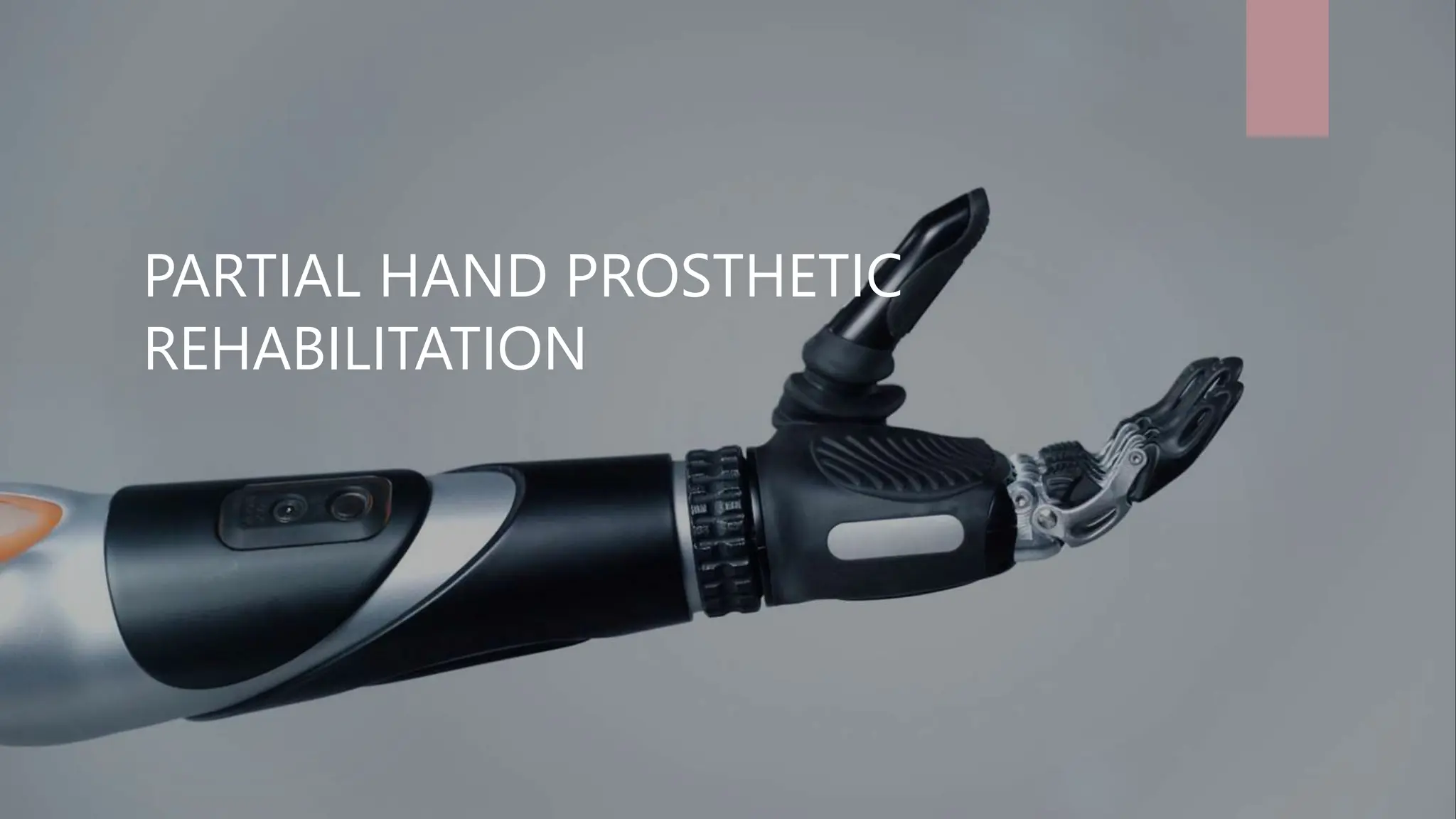
PARTIAL HAND PROSTHETIC
REHABILITATION
Prosthetic Rehabilitation....
What is prosthesis?
o Substitutes for a part of the body that may have been
missing
 at birth
 lost in an accident
 lost through amputation.
o Many amputees have lost a limb as part of treatment for
cancer, diabetes, or severe infection.
What is the purpose of prosthetic
rehabilitation ?
 To promote function and mobility following
amputation.
 Prosthetists are closely involved in amputee
rehabilitation
The Biomedical Sub-fields related to Partial
Hand Prosthetic Rehabilitation
 REHABILITATION
BIOMECHANICS
 NEUROREHABILITATION
 BIOMATERIALS
 BIO PROSTHETIC TECHNOLOGIES
Working
Principle of
Prosthetic
Arm
Bionic limbs and prosthetic technology
connect the mind to the prosthesis through
sensors that detect muscles’ electrical signals
and translate those contractions and signals
to various movements. They help improve
sensation, integration with the body, and
control.
The Types Of Partial Hand Prosthetic Rehabilitation…
 Passive partial hand prosthesis:
• Helps to provide function for everyday life but do not have active grasp and release.
• Passive options include cosmetic replica fingers, multi-positional finger joints and even ratcheting titanium fingers (with flexion at both joints) to
provide functional enhancement.
 Body powered partial hand prosthesis:
• There are three types of body-powered prostheses for partial hand amputees:
I. Joint-driven
II. Cable-controlled
III. Wrist-driven
• can be very durable and generally have a high-tech appearance.
• One of the biggest benefits is that the force exerted by the prosthesis is directly controlled using a person’s wrist, or the remaining portion of
their hand, which makes movement and control feel very natural.
Continuous……
 Electrically powered partial hand prosthesis:
• Have tiny motors inside each finger to create motion
• The motors are Controlled using sensing electrodes or resistors that detect movement of muscles
in the remaining portion of the hand or wrist.
 Activity-specific partial hand prosthesis:
• Designed for work, sports, and hobbies where a residual hand or general prosthesis could be
damaged or would not work as needed.
 Hybrid partial hand prosthesis:
• Combine elements of two or more prosthetic options with the aim of improving a person’s
functional ability.
What are the advancements of the partial hand prosthetic
rehabilitation compared to existing methods?
Complete or partial finger loss is the most frequently encountered form of partial hand loss, which can
result in physical, psychosocial, and economic damage to an individual. Thus, fabrication of
a prosthesis that can offer a psychological, functional, and rehabilitative advantage can be a big morale
booster to such individuals.
Prosthetics have progressed dramatically in recent years, with many people choosing to move away
from the standard NHS (National Health Service , UK) provided prosthetics, to highly functioning,
technologically advanced limbs.
With these types of prosthetics now available on the market, there’s a wide range of options to choose
from, especially for people looking to participate in different activities, such as driving, swimming,
and cycling.
There are top five advances in prosthetic technology that are being
expected to see from 2020…….
 Consciously controlled limbs
 3D printing
 See-through designs
 Bionic arms
 Nerve detectors
Types of prosthetics
arm
Control and movement Benefits Limitations
Passive
Stationary and adjustable Aesthetic (Natural appearance)
Minimal/no harnessing
Easy to use
Low cost
Less maintenance
Poor usability (gripping, grasping, etc.).
Explicit movement/Less functional
Difficulty in Bimanual tasks.
Body powered Movements are controlled by links or
cables.
Light weight
Low cost
Ease of access
Proprioception
Low maintenance
Easy installation
Less Training Requirement
Aesthetically unpleasant due to hooks and
harnessing cables
The unattractive appearance of end effectors has
negative social and psychological impacts.
Reliant on muscle strength for ideal use.
Difficult controlling in high amputation.
Limited gripping force.
Limited cosmesis.
Certain restrictive motions.
High discomfort.
Benefits and limitations of various prosthetic technologies.....
Electrically powered Movement controlled by motors.
Motors are controlled in different ways,
generally flipping switches or buttons
Larger functional scope
Grip force adaptability
Independent of muscle strength/body
strength
Expensive
Heavy
Poor amputation architecture may prohibit the use
Battery dependent
Susceptible from moisture
Expensive maintenance
Professional assistance is required
Steep learning curve (complex due to switches &
buttons)
Myoelectric Movement controlled by motors.
Sensors get electrical signals produced by
residual muscle at the connection point.
Electrical signs are handled through
different control plans to activate motors.
Grip force adaptability
Larger functional scope
Reliable control
Instinctive use because of similarity to
normal limb
Non-invasive & invasive approach
Susceptible from moisture.
Poor amputation architecture may prohibit its use.
Electrode calibration required.
Battery dependent.
Expensive maintenance.
Professional assistance required.
The myoelectric prosthesis can only be used with
Vivo muscle cells.
Obesity and advanced age reduce the clinical yield.
Presence of electrical noise.
Intensive training required.
Adipose tissue affects Electromyography Recordings.
Arm Flex-sensor based The resistance difference due to
bending of flex sensor is utilized to
control the actuation of the
prosthetic arm with the help of
micro-controller and servo motors.
Flex sensors can be mounted on any
bending body part such as the knee,
elbow, fingers, etc.
Low cost
Easy to use
Less training required
Less maintenance
One or more body parts involved for
actuation
The electrical resistance of the flex sensor
decay over time
Low reliability
Low linearity under 30°
Humidity and temperature influence the
measuring capability thus reducing accuracy
Brain-controlled Brain sensors get electrical voltage
differences from neurons due to the
fluctuation of electrical activity in
micro-voltage.
Amplification of electric signal
received by brain sensor.
Motor actuation depends on brain
activity with the help of a brain sensor
and microcontroller.
High functional
Useful for the patient with paralyzed
muscles
No dependency on body
strength/power
Highly expensive.
High maintenance.
Infection risk in invasive approach.
Battery dependent.
Professional assistance required.
Professional assistance required .
Meditation and attention are required.
Intensive Training requirements.
High electrode setup time in the
noninvasive approach.
Prostheses Materials……
Material Usage
Wood Utilized in lower-limb prostheses to give shape and inside structural strength. Consistent in textures,
lightweight, inexpensive, strong, and easy to work. Generally, willow, basswood, and poplar wood are
utilized for prosthetic shins and knees.
Metal Metals such as aluminium, titanium, magnesium, copper, steel are utilized for prosthetic limbs. Metals
are sometimes utilized either pure or alloyed. Copper, Iron, Aluminium, and Nickel are used for the
load-bearing structures.
Leather Usually utilized for abdomen/waist belts and socket linings in prosthetics. Biocompatible and delicately
soft.
Cloth For limb straps and harness, waist belts, and prosthetic socks. Improve the fitment, it keeps the
skin dry and absorbs the shear forces. Prosthetic socks are usually made of cotton, wool, or a
mixture of these standard fibres, often combined with acrylics, nylon, Orion, and other man-
made materials.
Nylon It is utilized to cover prostheses for plastic lamination, prosthetics sheath, and bushings. The
versatility, elasticity, quality, strength, and low friction co-efficient of this fibre are the major
point of interest. Nylon prosthetic sheaths are commonly used for transtibial amputees. Three
to eight nylon layers are impregnated with acrylic saps or polyester during the overlay process
to provide the aesthetic appearance and essential quality. It tends to be heated and remoulded
without adversely influencing its physical properties.
Polyester Polyester resin is a thermosetting plastic, utilized for prosthetics lamination. In a fluid structure,
polyester resins may be pigmented to coordinate the regular skin tone of the patient.
Polypropylene Utilized for hip joints, knee joints, pelvic groups, and lighter prostheses. It is a white opaque
material that is strong, durable, and moderately inexpensive. Hot air or nitrogen may be used to
weld this material.
Polyurethane Widely used in prosthetics for, responsive soft cosmetic foam covers and rigid structural parts.
Flexible urethane It is utilized to covers endoskeleton prostheses in preassembled parts. The prosthetist forms the
foam by measuring and tracing the patient’s limbs. Polyurethane foams are also commonly used
in manufacturing prosthetic feet.
Rigid polyurethane foam It provides knee units and ankle blocks with structural stability. Prosthetists regularly use these
foams to add strength and shape to the exoskeletal silicone prosthesis.
Silicone It is utilized for flexible rubber-like ends in cushion sockets. Room temperature
vulcanizing silicones are most widely used in prosthetic applications.
Fiberglass Fiberglass is used to reinforce the lamination of polyester resin, with mechanical
connections such as bolts and screws. It prevents breakage and stiffens areas.
Carbon fibre Carbon fibres are more expensive yet provide superior strength and stiffness than
fiberglass. Besides, they are being used by manufacturers to substitute metal.
Carbon fibres are usually made of epoxy and provide twice toughness concerning
steel weight.
Conclusion and Future perspectives……
The bionic hand is still very much experimental and several challenges need to be overcome such as
new lightweight materials, stimuli responsive materials, electrically conductive biomaterials for
implantation and integration, tissue regeneration, and new technological advances promoting reliable
recording and stimulation of nerves. Following prosthetic fitting, the subjects must undergo training
for controlling limb prosthetic movement with periodic adjustments and adaptation based on sensory
and tactile feedback.
The field of neuroprosthetics holds significant promise in revolutionizing the options for amputees
especially in providing a functional replacement and regenerative device that interfaces the biological
process with robotic components composed of shoulders, elbow, wrist and the digits.
The regenerative toolbox will facilitate convergence of discrete disciplines to effect guided tissue
regeneration using components such as scaffolds, controlled surface topographies, stimulatory cues,
both chemical and physical factors, and their integration with robotic systems, to restore limb
functionality. Continued funding from several sources including government organizations and private
foundations will foster synergistic collaborations between, engineers, chemists, biologists, material
scientists, clinicians and physiotherapists to make bionic limbs a common and affordable reality.
References….
1. E. Biddiss and T. Chau, “Upper-limb prosthetics,” American Journal of Physical Medicine & Rehabilitation, vol. 86, no. 12, pp. 977–987, 2007.View at: Publisher Site | Google Scholar
2. D. S. Childress, “Closed-loop control in prosthetic systems: historical perspective,” Annals of Biomedical Engineering, vol. 8, no. 4-6, pp. 293–303, 1980.View at: Publisher Site | Google Scholar
3. D. W. Tan, M. A. Schiefer, M. W. Keith, J. R. Anderson, J. Tyler, and D. J. Tyler, “A neural interface provides long-term stable natural touch perception,” Science Translational Medicine, vol. 6, no. 257,
article 257ra138, 2014.View at: Publisher Site | Google Scholar
4. E. D’Anna, G. Valle, A. Mazzoni et al., “A closed-loop hand prosthesis with simultaneous intraneural tactile and position feedback,” Science Robotics, vol. 4, no. 27, article eaau8892, 2019.View
at: Publisher Site | Google Scholar
5. M. Hao, C. H. Chou, J. Zhang et al., “Restoring finger-specific sensory feedback for transradial amputees via non-invasive evoked tactile sensation,” IEEE Open Journal of Engineering in Medicine and
Biology, vol. 1, pp. 98–107, 2020.View at: Publisher Site | Google Scholar
6. C. M. Niu, Q. Luo, C. Chou, J. Liu, M. Hao, and N. Lan, “Neuromorphic model of reflex for realtime human-like compliant control of prosthetic hand,” Annals of Biomedical Engineering, vol. 49, no. 2, pp.
673–688, 2021.View at: Publisher Site | Google Scholar
7. S. J. Bensmaia, D. J. Tyler, and S. Micera, “Restoration of sensory information via bionic hands,” Nature Biomedical Engineering, pp. 1–13, 2020.View at: Publisher Site | Google Scholar
8. E. Bizzi, V. C. K. Cheung, A. d’Avella, P. Saltiel, and M. Tresch, “Combining modules for movement,” Brain Research Reviews, vol. 57, no. 1, pp. 125–133, 2008.View at: Publisher Site | Google Scholar
9. B. Alstermark and T. Isa, “Circuits for skilled reaching and grasping,” Annual Review of Neuroscience, vol. 35, no. 1, pp. 559–578, 2012.View at: Publisher Site | Google Scholar
10. M. Hao, X. He, Q. Xiao, B. Alstermark, and N. Lan, “Corticomuscular transmission of tremor signals by propriospinal neurons in Parkinson’s disease,” PLoS One, vol. 8, no. 11, article e79829, 2013.View
at: Publisher Site | Google Scholar
11. I. Imbinto, C. Peccia, M. Controzzi, A. G. Cutti, A. Davalli, R. Sacchetti, and C. Cipriani, “Treatment of the partial hand amputation: an engineering perspective,” IEEE reviews in biomedical engineering,
vol. 9, pp. 32–48, 2016.
12. B. Pawar and M. Mungla, “A systematic review on available technologies and selection for prosthetic arm restoration,” Technology and Disability, no. Preprint, pp. 1–15, 2022
Thank You!
No Tough
Queries….
This Photo by Unknown Author is licensed under CC BY-NC-ND

Partial hand prosthetic rehabilitation.pptx

  • 1.
  • 2.
    Prosthetic Rehabilitation.... What isprosthesis? o Substitutes for a part of the body that may have been missing  at birth  lost in an accident  lost through amputation. o Many amputees have lost a limb as part of treatment for cancer, diabetes, or severe infection. What is the purpose of prosthetic rehabilitation ?  To promote function and mobility following amputation.  Prosthetists are closely involved in amputee rehabilitation
  • 3.
    The Biomedical Sub-fieldsrelated to Partial Hand Prosthetic Rehabilitation  REHABILITATION BIOMECHANICS  NEUROREHABILITATION  BIOMATERIALS  BIO PROSTHETIC TECHNOLOGIES
  • 4.
    Working Principle of Prosthetic Arm Bionic limbsand prosthetic technology connect the mind to the prosthesis through sensors that detect muscles’ electrical signals and translate those contractions and signals to various movements. They help improve sensation, integration with the body, and control.
  • 5.
    The Types OfPartial Hand Prosthetic Rehabilitation…  Passive partial hand prosthesis: • Helps to provide function for everyday life but do not have active grasp and release. • Passive options include cosmetic replica fingers, multi-positional finger joints and even ratcheting titanium fingers (with flexion at both joints) to provide functional enhancement.  Body powered partial hand prosthesis: • There are three types of body-powered prostheses for partial hand amputees: I. Joint-driven II. Cable-controlled III. Wrist-driven • can be very durable and generally have a high-tech appearance. • One of the biggest benefits is that the force exerted by the prosthesis is directly controlled using a person’s wrist, or the remaining portion of their hand, which makes movement and control feel very natural.
  • 6.
    Continuous……  Electrically poweredpartial hand prosthesis: • Have tiny motors inside each finger to create motion • The motors are Controlled using sensing electrodes or resistors that detect movement of muscles in the remaining portion of the hand or wrist.  Activity-specific partial hand prosthesis: • Designed for work, sports, and hobbies where a residual hand or general prosthesis could be damaged or would not work as needed.  Hybrid partial hand prosthesis: • Combine elements of two or more prosthetic options with the aim of improving a person’s functional ability.
  • 7.
    What are theadvancements of the partial hand prosthetic rehabilitation compared to existing methods? Complete or partial finger loss is the most frequently encountered form of partial hand loss, which can result in physical, psychosocial, and economic damage to an individual. Thus, fabrication of a prosthesis that can offer a psychological, functional, and rehabilitative advantage can be a big morale booster to such individuals. Prosthetics have progressed dramatically in recent years, with many people choosing to move away from the standard NHS (National Health Service , UK) provided prosthetics, to highly functioning, technologically advanced limbs. With these types of prosthetics now available on the market, there’s a wide range of options to choose from, especially for people looking to participate in different activities, such as driving, swimming, and cycling.
  • 8.
    There are topfive advances in prosthetic technology that are being expected to see from 2020…….  Consciously controlled limbs  3D printing  See-through designs  Bionic arms  Nerve detectors
  • 9.
    Types of prosthetics arm Controland movement Benefits Limitations Passive Stationary and adjustable Aesthetic (Natural appearance) Minimal/no harnessing Easy to use Low cost Less maintenance Poor usability (gripping, grasping, etc.). Explicit movement/Less functional Difficulty in Bimanual tasks. Body powered Movements are controlled by links or cables. Light weight Low cost Ease of access Proprioception Low maintenance Easy installation Less Training Requirement Aesthetically unpleasant due to hooks and harnessing cables The unattractive appearance of end effectors has negative social and psychological impacts. Reliant on muscle strength for ideal use. Difficult controlling in high amputation. Limited gripping force. Limited cosmesis. Certain restrictive motions. High discomfort. Benefits and limitations of various prosthetic technologies.....
  • 10.
    Electrically powered Movementcontrolled by motors. Motors are controlled in different ways, generally flipping switches or buttons Larger functional scope Grip force adaptability Independent of muscle strength/body strength Expensive Heavy Poor amputation architecture may prohibit the use Battery dependent Susceptible from moisture Expensive maintenance Professional assistance is required Steep learning curve (complex due to switches & buttons) Myoelectric Movement controlled by motors. Sensors get electrical signals produced by residual muscle at the connection point. Electrical signs are handled through different control plans to activate motors. Grip force adaptability Larger functional scope Reliable control Instinctive use because of similarity to normal limb Non-invasive & invasive approach Susceptible from moisture. Poor amputation architecture may prohibit its use. Electrode calibration required. Battery dependent. Expensive maintenance. Professional assistance required. The myoelectric prosthesis can only be used with Vivo muscle cells. Obesity and advanced age reduce the clinical yield. Presence of electrical noise. Intensive training required. Adipose tissue affects Electromyography Recordings.
  • 11.
    Arm Flex-sensor basedThe resistance difference due to bending of flex sensor is utilized to control the actuation of the prosthetic arm with the help of micro-controller and servo motors. Flex sensors can be mounted on any bending body part such as the knee, elbow, fingers, etc. Low cost Easy to use Less training required Less maintenance One or more body parts involved for actuation The electrical resistance of the flex sensor decay over time Low reliability Low linearity under 30° Humidity and temperature influence the measuring capability thus reducing accuracy Brain-controlled Brain sensors get electrical voltage differences from neurons due to the fluctuation of electrical activity in micro-voltage. Amplification of electric signal received by brain sensor. Motor actuation depends on brain activity with the help of a brain sensor and microcontroller. High functional Useful for the patient with paralyzed muscles No dependency on body strength/power Highly expensive. High maintenance. Infection risk in invasive approach. Battery dependent. Professional assistance required. Professional assistance required . Meditation and attention are required. Intensive Training requirements. High electrode setup time in the noninvasive approach.
  • 12.
    Prostheses Materials…… Material Usage WoodUtilized in lower-limb prostheses to give shape and inside structural strength. Consistent in textures, lightweight, inexpensive, strong, and easy to work. Generally, willow, basswood, and poplar wood are utilized for prosthetic shins and knees. Metal Metals such as aluminium, titanium, magnesium, copper, steel are utilized for prosthetic limbs. Metals are sometimes utilized either pure or alloyed. Copper, Iron, Aluminium, and Nickel are used for the load-bearing structures. Leather Usually utilized for abdomen/waist belts and socket linings in prosthetics. Biocompatible and delicately soft. Cloth For limb straps and harness, waist belts, and prosthetic socks. Improve the fitment, it keeps the skin dry and absorbs the shear forces. Prosthetic socks are usually made of cotton, wool, or a mixture of these standard fibres, often combined with acrylics, nylon, Orion, and other man- made materials. Nylon It is utilized to cover prostheses for plastic lamination, prosthetics sheath, and bushings. The versatility, elasticity, quality, strength, and low friction co-efficient of this fibre are the major point of interest. Nylon prosthetic sheaths are commonly used for transtibial amputees. Three to eight nylon layers are impregnated with acrylic saps or polyester during the overlay process to provide the aesthetic appearance and essential quality. It tends to be heated and remoulded without adversely influencing its physical properties. Polyester Polyester resin is a thermosetting plastic, utilized for prosthetics lamination. In a fluid structure, polyester resins may be pigmented to coordinate the regular skin tone of the patient. Polypropylene Utilized for hip joints, knee joints, pelvic groups, and lighter prostheses. It is a white opaque material that is strong, durable, and moderately inexpensive. Hot air or nitrogen may be used to weld this material. Polyurethane Widely used in prosthetics for, responsive soft cosmetic foam covers and rigid structural parts. Flexible urethane It is utilized to covers endoskeleton prostheses in preassembled parts. The prosthetist forms the foam by measuring and tracing the patient’s limbs. Polyurethane foams are also commonly used in manufacturing prosthetic feet. Rigid polyurethane foam It provides knee units and ankle blocks with structural stability. Prosthetists regularly use these foams to add strength and shape to the exoskeletal silicone prosthesis.
  • 13.
    Silicone It isutilized for flexible rubber-like ends in cushion sockets. Room temperature vulcanizing silicones are most widely used in prosthetic applications. Fiberglass Fiberglass is used to reinforce the lamination of polyester resin, with mechanical connections such as bolts and screws. It prevents breakage and stiffens areas. Carbon fibre Carbon fibres are more expensive yet provide superior strength and stiffness than fiberglass. Besides, they are being used by manufacturers to substitute metal. Carbon fibres are usually made of epoxy and provide twice toughness concerning steel weight.
  • 14.
    Conclusion and Futureperspectives…… The bionic hand is still very much experimental and several challenges need to be overcome such as new lightweight materials, stimuli responsive materials, electrically conductive biomaterials for implantation and integration, tissue regeneration, and new technological advances promoting reliable recording and stimulation of nerves. Following prosthetic fitting, the subjects must undergo training for controlling limb prosthetic movement with periodic adjustments and adaptation based on sensory and tactile feedback. The field of neuroprosthetics holds significant promise in revolutionizing the options for amputees especially in providing a functional replacement and regenerative device that interfaces the biological process with robotic components composed of shoulders, elbow, wrist and the digits. The regenerative toolbox will facilitate convergence of discrete disciplines to effect guided tissue regeneration using components such as scaffolds, controlled surface topographies, stimulatory cues, both chemical and physical factors, and their integration with robotic systems, to restore limb functionality. Continued funding from several sources including government organizations and private foundations will foster synergistic collaborations between, engineers, chemists, biologists, material scientists, clinicians and physiotherapists to make bionic limbs a common and affordable reality.
  • 15.
    References…. 1. E. Biddissand T. Chau, “Upper-limb prosthetics,” American Journal of Physical Medicine & Rehabilitation, vol. 86, no. 12, pp. 977–987, 2007.View at: Publisher Site | Google Scholar 2. D. S. Childress, “Closed-loop control in prosthetic systems: historical perspective,” Annals of Biomedical Engineering, vol. 8, no. 4-6, pp. 293–303, 1980.View at: Publisher Site | Google Scholar 3. D. W. Tan, M. A. Schiefer, M. W. Keith, J. R. Anderson, J. Tyler, and D. J. Tyler, “A neural interface provides long-term stable natural touch perception,” Science Translational Medicine, vol. 6, no. 257, article 257ra138, 2014.View at: Publisher Site | Google Scholar 4. E. D’Anna, G. Valle, A. Mazzoni et al., “A closed-loop hand prosthesis with simultaneous intraneural tactile and position feedback,” Science Robotics, vol. 4, no. 27, article eaau8892, 2019.View at: Publisher Site | Google Scholar 5. M. Hao, C. H. Chou, J. Zhang et al., “Restoring finger-specific sensory feedback for transradial amputees via non-invasive evoked tactile sensation,” IEEE Open Journal of Engineering in Medicine and Biology, vol. 1, pp. 98–107, 2020.View at: Publisher Site | Google Scholar 6. C. M. Niu, Q. Luo, C. Chou, J. Liu, M. Hao, and N. Lan, “Neuromorphic model of reflex for realtime human-like compliant control of prosthetic hand,” Annals of Biomedical Engineering, vol. 49, no. 2, pp. 673–688, 2021.View at: Publisher Site | Google Scholar 7. S. J. Bensmaia, D. J. Tyler, and S. Micera, “Restoration of sensory information via bionic hands,” Nature Biomedical Engineering, pp. 1–13, 2020.View at: Publisher Site | Google Scholar 8. E. Bizzi, V. C. K. Cheung, A. d’Avella, P. Saltiel, and M. Tresch, “Combining modules for movement,” Brain Research Reviews, vol. 57, no. 1, pp. 125–133, 2008.View at: Publisher Site | Google Scholar 9. B. Alstermark and T. Isa, “Circuits for skilled reaching and grasping,” Annual Review of Neuroscience, vol. 35, no. 1, pp. 559–578, 2012.View at: Publisher Site | Google Scholar 10. M. Hao, X. He, Q. Xiao, B. Alstermark, and N. Lan, “Corticomuscular transmission of tremor signals by propriospinal neurons in Parkinson’s disease,” PLoS One, vol. 8, no. 11, article e79829, 2013.View at: Publisher Site | Google Scholar 11. I. Imbinto, C. Peccia, M. Controzzi, A. G. Cutti, A. Davalli, R. Sacchetti, and C. Cipriani, “Treatment of the partial hand amputation: an engineering perspective,” IEEE reviews in biomedical engineering, vol. 9, pp. 32–48, 2016. 12. B. Pawar and M. Mungla, “A systematic review on available technologies and selection for prosthetic arm restoration,” Technology and Disability, no. Preprint, pp. 1–15, 2022
  • 16.
    Thank You! No Tough Queries…. ThisPhoto by Unknown Author is licensed under CC BY-NC-ND