PMR
BUZZ
Volume 1, Issue 3, October 2020
“Medicine is a science of uncertainty
and an art of probabilty.”
~ William Osler
Preface
In line with the previous edition of our PMR buzz, an abstract review in an electronic form
comprising inputs from well-known current journals covering various fields in
rehabilitation medicine.
This is fourth edition, and with this we welcome a new contributor Dr Harleen Uppal,
Assistant Professor at Dr Baba Saheb Ambedker Medical College & Hospital, New Delhi.
As we move forward we strive to be better than the last but feedbacks will help us to be
even better. So keep us posted with your ideas, and we will grab the most feasible and
bright.
We have selected one abstract from each volume of these journals published in the
preceeding quarter It does not mean that the others are any less in originality or quality,
but we picked only those appearing to be practice-changing in Indian clinical scenario.
Moreover, like any medley, there might be bias in the overture, but we are only humans.
Keep buzzing with .“PMR Buzz”
- Dr. Mrinal Joshi
Contributors:
• Dr. Ravi Gaur, Associate Professor, Department of PMR, AIIMS, Jodhpur.
• Dr. Navin BP, Assistant Professor, Department of Neurorehabilitation,
NIMHANS, Bengaluru.
• Dr. Mahima Agrawal, Assistant Professor, Department of PMR,
JLN Medical College, Ajmer.
• Dr. Harleen Uppal, Assistant Professor, Department of PMR, Dr B R Ambedker
Medical College & Hospital, New Delhi.
Editor & Contributor:
• Dr. Mrinal Joshi, Department of PMR, RRC, SMS Medical College & Hospital, Jaipur.
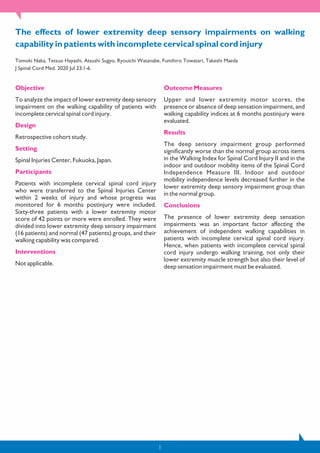
The effects of lower extremity deep sensory impairments on walking
capability in patients with incomplete cervical spinal cord injury
Tomoki Naka, Tetsuo Hayashi, Atsushi Sugyo, Ryouichi Watanabe, Fumihiro Towatari, Takeshi Maeda
J Spinal Cord Med. 2020 Jul 23;1-6.
Objective
To analyze the impact of lower extremity deep sensory
impairment on the walking capability of patients with
incomplete cervical spinal cord injury.
Design
Retrospective cohort study.
Setting
Spinal Injuries Center, Fukuoka, Japan.
Participants
Patients with incomplete cervical spinal cord injury
who were transferred to the Spinal Injuries Center
within 2 weeks of injury and whose progress was
monitored for 6 months postinjury were included.
Sixty-three patients with a lower extremity motor
score of 42 points or more were enrolled. They were
divided into lower extremity deep sensory impairment
(16 patients) and normal (47 patients) groups, and their
walking capability was compared.
Interventions
Not applicable.
Outcome Measures
Upper and lower extremity motor scores, the
presence or absence of deep sensation impairment, and
walking capability indices at 6 months postinjury were
evaluated.
Results
The deep sensory impairment group performed
significantly worse than the normal group across items
in the Walking Index for Spinal Cord Injury II and in the
indoor and outdoor mobility items of the Spinal Cord
Independence Measure III. Indoor and outdoor
mobility independence levels decreased further in the
lower extremity deep sensory impairment group than
in the normal group.
Conclusions
The presence of lower extremity deep sensation
impairments was an important factor affecting the
achievement of independent walking capabilities in
patients with incomplete cervical spinal cord injury.
Hence, when patients with incomplete cervical spinal
cord injury undergo walking training, not only their
lower extremity muscle strength but also their level of
deep sensation impairment must be evaluated.
1
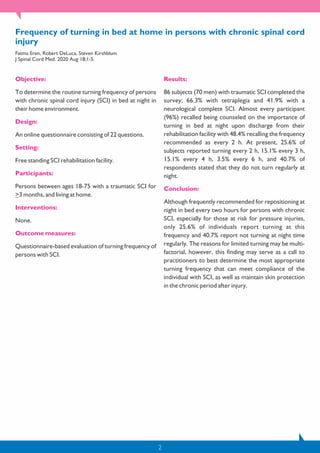
Frequency of turning in bed at home in persons with chronic spinal cord
injury
Fatma Eren, Robert DeLuca, Steven Kirshblum
J Spinal Cord Med. 2020 Aug 18;1-5.
Objective:
To determine the routine turning frequency of persons
with chronic spinal cord injury (SCI) in bed at night in
their home environment.
Design:
An online questionnaire consisting of 22 questions.
Setting:
Free standing SCI rehabilitation facility.
Participants:
Persons between ages 18-75 with a traumatic SCI for
>3 months, and living at home.
Interventions:
None.
Outcome measures:
Questionnaire-based evaluation of turning frequency of
persons with SCI.
Results:
86 subjects (70 men) with traumatic SCI completed the
survey; 66.3% with tetraplegia and 41.9% with a
neurological complete SCI. Almost every participant
(96%) recalled being counseled on the importance of
turning in bed at night upon discharge from their
rehabilitation facility with 48.4% recalling the frequency
recommended as every 2 h. At present, 25.6% of
subjects reported turning every 2 h, 15.1% every 3 h,
15.1% every 4 h, 3.5% every 6 h, and 40.7% of
respondents stated that they do not turn regularly at
night.
Conclusion:
Although frequently recommended for repositioning at
night in bed every two hours for persons with chronic
SCI, especially for those at risk for pressure injuries,
only 25.6% of individuals report turning at this
frequency and 40.7% report not turning at night time
regularly. The reasons for limited turning may be multi-
factorial, however, this finding may serve as a call to
practitioners to best determine the most appropriate
turning frequency that can meet compliance of the
individual with SCI, as well as maintain skin protection
in the chronic period after injury.
2
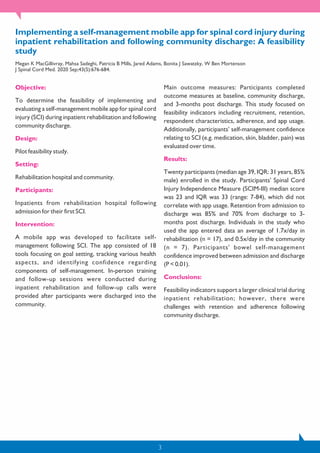
Implementing a self-management mobile app for spinal cord injury during
inpatient rehabilitation and following community discharge: A feasibility
study
Megan K MacGillivray, Mahsa Sadeghi, Patricia B Mills, Jared Adams, Bonita J Sawatzky, W Ben Mortenson
J Spinal Cord Med. 2020 Sep;43(5):676-684.
Objective:
To determine the feasibility of implementing and
evaluating a self-management mobile app for spinal cord
injury (SCI) during inpatient rehabilitation and following
community discharge.
Design:
Pilot feasibility study.
Setting:
Rehabilitation hospital and community.
Participants:
Inpatients from rehabilitation hospital following
admission for their first SCI.
Intervention:
A mobile app was developed to facilitate self-
management following SCI. The app consisted of 18
tools focusing on goal setting, tracking various health
aspects, and identifying confidence regarding
components of self-management. In-person training
and follow-up sessions were conducted during
inpatient rehabilitation and follow-up calls were
provided after participants were discharged into the
community.
Main outcome measures: Participants completed
outcome measures at baseline, community discharge,
and 3-months post discharge. This study focused on
feasibility indicators including recruitment, retention,
respondent characteristics, adherence, and app usage.
Additionally, participants' self-management confidence
relating to SCI (e.g. medication, skin, bladder, pain) was
evaluated over time.
Results:
Twenty participants (median age 39, IQR: 31 years, 85%
male) enrolled in the study. Participants' Spinal Cord
Injury Independence Measure (SCIM-III) median score
was 23 and IQR was 33 (range: 7-84), which did not
correlate with app usage. Retention from admission to
discharge was 85% and 70% from discharge to 3-
months post discharge. Individuals in the study who
used the app entered data an average of 1.7x/day in
rehabilitation (n = 17), and 0.5x/day in the community
(n = 7). Participants' bowel self-management
confidence improved between admission and discharge
(P < 0.01).
Conclusions:
Feasibility indicators support a larger clinical trial during
inpatient rehabilitation; however, there were
challenges with retention and adherence following
community discharge.
3
A scoping review of trials for cell-based therapies in human spinal cord
injury
Alice G. Willison, Sam Smith, Benjamin M. Davies, Mark R. N. Kotter, Susan C. Barnett
Spinal Cord 58, 844–856 (2020).
Introduction:
Spinal cord injury (SCI) is associated with significant and
life-long disability. Yet, despite decades of research, no
regenerative treatment has reached clinical practice.
Cell-based therapies are one possible regenerative
strategy beginning to transfer to human trials from a
more extensive pre-clinical basis.
Methods:
We therefore conducted a scoping review to
synthesise all cell-based trials in SCI to consider the
current state of the field and the cell transplant type or
strategy with greatest promise. A search strategy of
MEDLINE returned 1513 results. All clinical trials
including adult human patients with acute or chronic,
compete or incomplete SCI and a recorded ASIA score
were sought. Exclusion criteria included non-traumatic
SCI, paediatric patients and animal studies. A total of 43
studies, treating 1061 patients, were identified. Most
trials evaluated cells from the bone marrow (22 papers,
660 patients) or the olfactory bulb (10 papers, 245
patients).
Results:
Cell transplantation does appear to be safe, with no
serious adverse effects being reported in the short-
term. 86% of trials described efficacy as a primary
outcome. However, varying degrees of outcome
reporting prevented meta-analysis. No emerging cell
type or technique was identified. The majority of trials,
53%, took place in developing countries, which may
suggest more stringent regulatory requirements within
Western countries.
Conclusion:
We believe cell-based transplantation translation
remains in its infancy and that, although further robust
clinical research is required, it is an important strategy
to consider in the treatment of SCI.
4
Study design:
Prospective, quasi-experimental study, pre- and post-
design, single arm study.
Objectives:
Investigate whether persons affected by SCI can safely
experience walking function using Robotic
Exoskeletons and Functional Electrical Stimulation
(FES).
Setting:
Inpatient
Methods:
52 persons with SCI were recruited (36 completed the
protocol) and assigned to one of two groups based on
their Lower Limb Motor Scores (LEMS): Group A:
LEMS > 10 and Group B: LEMS < 10. Participants in
Group A (n = 19) underwent 20 sessions of Robot-
Assisted Gait Training (RAGT) on a treadmill followed
by 20 sessions of FES during Overground Gait (FES-
OG). Participants in Group B (n = 17) received 20
sessions of FES-cycling followed by 20 sessions of
overground RAGT. The main outcome measures were:
WISCI-II, 10MWT, 6MWT, TUG and SCIM-II.
Results:
36 persons completed the study with no complications;
only 4 of the 16 dropped out because of mild
complications during the RAGT. Participants in Group
A exhibited significant improvements in WISCI-II,
10MWT, 6MWT and TUG (p < 0.05), while those in
Group B did not significantly improve their gait function
but their walking velocity and resistance with the
assistance of the robotic exoskeleton increased. SCIM-
II scores increased followed therapy only in Group A.
Conclusions:
Persons affected by SCI can safely experience their
walking function with RAGT and FES therapy; only few
mild complications were observed. Our data provides
initial evidence of the potential value of these
technologies, especially in persons with SCI having
LEMS > 10.
5
Gait rehabilitation in persons with spinal cord injury using innovative
technologies: an observational study
Giulia Stampacchia, Matteo Olivieri, Alessandro Rustici, Carla D’Avino, Adriana Gerini, Stefano Mazzoleni
Spinal Cord 58, 988–997 (2020).
6
Study design:
Prospective observational study.
Objectives:
A tool to help decision-making tool for Neurogenic
Bowel Dysfunction (NBD) in individuals with SCI is
needed. We present a project to create and validate a
new tool, the Monitoring Efficacy of NBD Treatment
On Response (MENTOR), and to determine its level of
concordance with decisions made by experienced
clinicians in the field.
Setting:
UK, Denmark, USA, Italy, The Netherlands, Germany.
Methods:
The first phase was creation of the tool through a
modified Delphi process. The second phase was the
validation, wherein individuals with spinal cord injury
with NBD were asked to complete the MENTOR tool
immediately prior to clinic consultation. From the
responses to the questionnaire of the tool, each
participant was allocated into one of three categories
reflecting the possible therapeutic recommendations
(“recommend change”, “further discussion” and
“monitoring”). An expert clinician then assessed the
participant, blinded to MENTOR results, and made an
independent treatment decision.
Results:
A total of 248 MENTOR forms were completed.
Strong agreement was found when the MENTOR tool
recommended monitoring (92%) or treatment change
(83%); the lowest concordance when the decision was
for the “further discussion” option (59%). Patient
acceptability was reported by 97% of individuals.
Creation and validation of a new tool for the monitoring efficacy of
neurogenic bowel dysfunction treatment on response: the MENTOR tool
Anton Emmanuel, Klaus Krogh, Steven Kirshblum, Peter Christensen, Michele Spinelli, Dirk van Kuppevelt, Rainer Abel,
Dietrich Leder, Bruno Gallo Santacruz, Kimberly Bain, Valentina Passananti
Spinal Cord 58, 795–802 (2020).
7
Background:
Myofascial mobilization has been used as an
intervention for patients with fibromyalgia (FM) for
acting on ascending nociceptive pathways possibly
involved in the central sensitization process,
modulating the pain experience. However, there is still
a gap in its efficacy compared with another hands-on
approach because manual therapy has nonspecific
effects, such as placebo.
Objectives:
This systematic review aims to review the scientific
literature for an overview of the efficacy of manual
therapy in pain, disease impact, and quality of life in
patients with FM compared with control or other
treatments through randomized clinical trials.
Study Design:
This study involved systematic review of published
randomized controlled trials (RCTs).
Setting:
This study examined all RCTs evaluating the effect of
manual therapy on pain, impact of disease, and quality of
life for patients with FM.
Methods:
Systematic review. The research was performed in 9
databases: MEDLINE/PubMed, CINAHL, Web of
Science, Scopus, ScienceDirect, Lilacs, SciELO, PEDro,
and Cochrane. Searches were carried out from the end
of the project until September 2019, with no language
and year restrictions. Randomized controlled clinical
trials that used the following outcome measures were
included: Visual Analog Scale, Fibromyalgia Impact
Questionnaire, and SF-36 Quality of Life
Questionnaire. The risk of bias and quality of studies
was assessed using the PEDro scale; the Cochrane risk-
of-bias tool; and Grading of Recommendations
Assessment, Development, and Evaluation System.
Results:
Seven studies were included (368 patients). The
quantitative analysis was performed on 4 studies
because of the lack of data in the others. Myofascial
release was the most used modality. The level of
evidence ranged from very low to moderate, mainly
because of the inconsistency and inaccuracy of results.
Limitations:
The present systematic review presented limitations
because of the heterogeneity of the included studies
and only a short-term analysis of the intervention
results. It was observed that other information, such as
pressure, repetition, and/or sustaining manual therapy
techniques, could be better described in future
protocols, aiming at a better comparison between the
techniques and their subsequent reproducibility.
Conclusions:
Current evidence of manual therapy in patients with
FM, based on a very low to moderate quality of
evidence, was inconclusive and insufficient to support
and recommend the use of manual therapy in this
population. To date, only general osteopathic
treatment has achieved clinically relevant pain
improvement when compared with control.
Efficacy of Manual Therapy on Pain, Impact of Disease, and Quality of Life
in the Treatment of Fibromyalgia: A Systematic Review
Nina B. Schulze, Marianna de Melo Salemi, Geisa G. de Alencar, Marcela C. Moreira, Gisela R. de Siqueira
Pain Physician 2020; 23:461-475.
8
Background:
The COVID-19 pandemic has worsened the pain and
suffering of chronic pain patients due to stoppage of
“elective” interventional pain management and office
visits across the United States. The reopening of
America and restarting of interventional techniques
and elective surgical procedures has started.
Unfortunately, with resurgence in some states,
restrictions are once again being imposed. In addition,
even during the Phase II and III of reopening, chronic
pain patients and interventional pain physicians have
faced difficulties because of the priority selection of
elective surgical procedures.
Chronic pain patients require high intensity care,
specifically during a pandemic such as COVID-19.
Consequently, it has become necessary to provide
guidance for triaging interventional pain procedures, or
related elective surgery restrictions during a pandemic.
Objectives:
The aim of these guidelines is to provide education and
guidance for physicians, healthcare administrators, the
public and patients during the COVID-19 pandemic.
Our goal is to restore the opportunity to receive
appropriate care for our patients who may benefit from
interventional techniques.
Methods:
The American Society of Interventional Pain Physicians
(ASIPP) has created the COVID-19 Task Force in order
to provide guidance for triaging interventional pain
procedures or related elective surgery restrictions to
provide appropriate access to interventional pain
management (IPM) procedures in par with other
elective surgical procedures.
In developing the guidance, trustworthy standards and
appropriate disclosures of conflicts of interest were
applied with a section of a panel of experts from various
regions, specialties, types of practices (private practice,
community hospital and academic institutes) and
groups. The literature pertaining to all aspects of
COVID-19, specifically related to epidemiology, risk
factors, complications, morbidity and mortality, and
literature related to risk mitigation and stratification
was reviewed. The evidence -- informed with the
incorporation of the best available research and
practice knowledge was utilized, instead of a simplified
evidence-based approach. Consequently, these
guidelines are considered evidence-informed with the
incorporation of the best available research and
practice knowledge.
Results:
The Task Force defined the medical urgency of a case
and developed an IPM acuity scale for elective IPM
procedures with 3 tiers. These included emergent,
urgent, and elective procedures. Examples of emergent
and urgent procedures included new onset or
exacerbation of complex regional pain syndrome
(CRPS), acute trauma or acute exacerbation of
degenerative or neurological disease resulting in
impaired mobility and inability to perform activities of
daily living. Examples include painful rib fractures
affecting oxygenation and post-dural puncture
headaches limiting the ability to sit upright, stand and
walk. In addition, urgent procedures include
procedures to treat any severe or debilitating disease
that prevents the patient from carrying out activities of
daily living. Elective procedures were considered as any
condition that is stable and can be safely managed with
alternatives.
Limitations:
COVID-19 continues to be an ongoing pandemic.
When these recommendations were developed,
different stages of reopening based on geographical
regulations were in process. The pandemic continues
to be dynamic creating every changing evidence-based
guidance. Consequently, we provided evidence-
informed guidance.
Conclusion:
The COVID-19 pandemic has created unprecedented
challenges in IPM creating needless suffering for pain
patients. Many IPM procedures cannot be indefinitely
postponed without adverse consequences. Chronic
pain exacerbations are associated with marked
functional declines and risks with alternative treatment
modalities. They must be treated with the concern that
they deserve. Clinicians must assess patients, local
healthcare resources, and weigh the risks and benefits
of a procedure against the risks of suffering from
disabling pain and exposure to the COVID-19 virus.
Triaging Interventional Pain Procedures During COVID-19 or Related
Elective Surgery Restrictions: Evidence-Informed Guidance from the
American Society of Interventional Pain Physicians (ASIPP)
Christopher Gharibo, Amit Sharma, Amol Soin, Shalini Shah, Kartic Rajput, Sudhir Diwan, Ricardo Buenaventura, Devi E.
Nampiaparampil, Steve M. Aydin, Sanjay Bakshi, Salahadin Abdi, Sachin Sunny Jha, Harold J. Cordner, Alan D. Kaye, Alaa Abd-Elsayed,
Kenneth D. Candido, Nebojsa Nick Knezevic, Sairam Atluri, Bradley W. Wargo, Mahendra R. Sanapati, Sukdeb Datta, Joshua A.
Hirsch, Laxmaiah Manchikanti
Pain Physician 2020; 23:S183-S204
9
Background:
Epidural steroid injection (ESI) is a common practice for
pain treatment since 1953. In 2014, the FDA issued a
warning about ESI. Studies have focused on the effect of
the particle size and their ability to generate harmful
aggregates. Although steroid aggregates provide longer
times for reabsorption, therefore a longer anti-
inflammatory effect, they are potentially harmful to the
central nervous system via embolic mechanisms.
Previous studies have established that steroidal
aggregates with asizes over 100 µm are potentially able
to occlude blood vessels. Studies by Tiso et al and
Benzon et al addressed the role of steroids on CNS
adverse events, with similar outcomes. The main
difference was on the role of aggregates with a size over
100 µm, which Benzon et al. attributed to the ability of
certain steroid preparations to rapidly precipitate and
form large aggregates.
Objectives:
Studying the effect of the time elapsed between mixing
the steroid preparation and injection on the number
and size of aggregates with sizes above 100 µm.
Study Design:
Original study in basic science.
Setting:
Basic science.
Methods:
Steroids evaluated are commonly used in Spain for ESI:
betamethasone, triamcinolone, and dexamethasone.
The size and number of the aggregates was determined
for undiluted commercial steroid preparations in the
usual amount for a single and double dosage used for
ESI.
Samples were examined with a Leica TCS-SP2
microscope at the first, the fifth and the 30th minute
after shaking the preparations. Aggregates observed in
the different preparations were manually counted and
grouped in the following size range: 0-20, 20-50, 50-
100, 100-300, 300-500 and > 500 µm.
Statistical analysis was carried out using the R software.
Nonparametric techniques were used in the
comparison of aggregate size. Global comparison of the
groups using the Kruskal-Wallis test and post-hoc
comparisons using the Wilcoxon test, adjusting P-
values by the Holm method for multiple comparisons.
Results:
Aggregates present in triamcinolone and
betamethasone samples were statistically larger than in
dexamethasone samples. Triamcinolone suspensions
produced significantly larger aggregates than
betamethasone five minutes after mixing.
Triamcinolone preparations produced greater particle
aggregates (> 500 µm), which were not present in
dexamethasone and betamethasone preparations.
Limitations:
Study how the human internal factors like blood
elements and spinal fluid could interact with steroids
and influence the size of the aggregates formed.
Conclusions:
This study demonstrates that the size of the particles
injected depends on the type of steroid and the time
allowed between mixing and injecting. The results
demonstrate that waiting longer than 5 minutes
between mixing and injecting can predispose the
formation of potentially harmful aggregates in
triamcinolone and betamethasone samples. The
presence of greater particle aggregates (> 500 µm) may
occlude some important vessels and arteries with
serious adverse results. Vigorous shaking of the
injectable could prevent such events.
Microscopic Study of Injectable Steroids: Effects of Postmixing Time on
Particle Aggregation
Jorge M. Ordunã -Valls, David L. Cedeno, Carlos Nebreda-Clavo, Carlos Tornero-Tornero, Juliań Aĺ varez-Escudero,
Mireya Ferrandis Martinez, Alfonso A. Valverde-Navarro, Amparo Ruiz-Sauri
Pain Physician 2020; 23:E417-E424.
10
Objectives:
To compare the efficacy and safety between
leucocyte‐rich platelet‐rich plasma (LR‐PRP) and
corticosteroid in fluoroscopically guided caudal
epidural injection for patients with complex chronic
lumbar spinal pain.
Study Design:
A prospective randomized controlled double‐blinded
study.
Methods:
Fifty eligible patients with complex chronic
degenerative spinal pain were randomly assigned with a
1:1 allocation ratio to receive caudal epidural injection
of corticosteroid (triamcinolone acetonide, 60 mg) or
LR‐PRP (isolated from 60 mL autologous blood) under
fluoroscopic guidance. Levels of low back pain, quality
of life, and complications (or adverse effects) were
evaluated at 1, 3, and 6 months after treatment. Pain
levels and quality of life were assessed using the VAS
and Short Form 36‐Item Health Survey (SF‐36),
respectively.
Results:
No significant difference was shown at baseline
between the 2 groups. Compared with the
pretreatment values, there were significant reductions
in the VAS score in both groups. A significantly lower
VAS score at 1‐month follow‐up was detected in
patients who received corticosteroid injection.
However, the scores were lower in the LR‐PRP group
at 3‐ and 6‐month follow‐up. SF‐36 responses at 6
months showed significant improvement in all domains
in the LR‐PRP group. There were no complications or
adverse effects related to treatment at 6‐month
follow‐up in either group.
Conclusions:
Both autologous LR‐PRP and corticosteroid for caudal
epidural injections under fluoroscopic guidance are
equally safe and therapeutically effective in patients
with complex chronic lumbar spinal pain. However,
LR‐PRP is superior to corticosteroid for a longer
pain‐relieving effect and improvement in quality of life.
A Randomized Double‐Blind Controlled Pilot Study Comparing
Leucocyte‐Rich Platelet‐Rich Plasma and Corticosteroid in Caudal
Epidural Injection for Complex Chronic Degenerative Spinal Pain
Ricardo Ruiz‐Lopez, Yu‐Chuan Tsai
Pain Pract. 2020 Jul;20(6):639-646.
11
Objective:
To describe the effectiveness and risk management of
remote rehabilitation for coronavirus disease (COVID-
19) patients in general wards.
Design:
Single-centre, retrospective, observational study.
Patients:
COVID-19 patients undergoing rehabilitation (24 April
to 24 May 2020).
Methods:
All COVID-19 in patients undergoing rehabilitation in
the general ward of Tokyo Medical and Dental
University were assessed. Data were collected on age,
sex, physical ability, rehabilitation modality
(remote/direct), need for intubation or extracorporeal
membrane oxygenation, degree of pneumonia, oxygen
therapy from the start of rehabilitation, D-dimer and C-
reactive protein levels, and rehabilitation-related
complications. Activities of daily living were measured
using the Barthel Index.
Results:
Out of a total of 43 patients, 14 were initially provided
with remote rehabilitation and 29 with direct (hands-
on) rehabilitation. Four patients were switched from
direct to remote rehabilitation during the study, thus at
the end of the study there were 18 in the remote
rehabilitation group and 25 in the direct rehabilitation
group. Patients in remote rehabilitation were
significantly younger than those in direct rehabilitation.
Of 12 patients who required intubation, 3 were given
remote rehabilitation. One extracorporeal membrane
oxygenation survivor underwent direct rehabilitation.
All patients on remote rehabilitation were discharged
home or to a hotel. Twelve out of 29 patients on direct
rehabilitation were transferred to a rehabilitation
hospital due to delayed recovery of activities of daily
living. No serious adverse events occurred.
Conclusion:
Effective and safe remote rehabilitation was performed
in 41.9% of COVID-19 patients in this study, which
resulted in which facilitated rehabilitation in COVID-19
specialized general wards.
Remote rehabilitation for patients with covid-19
Tomoko Sakai, Chisato Hoshino, Reiko Yamaguchi, Masanobu Hirao, Rui Nakahara, Atsushi Okawa,
Journal of Rehabilitation Medicine, Sept. 2020;52(9):jrm00096
12
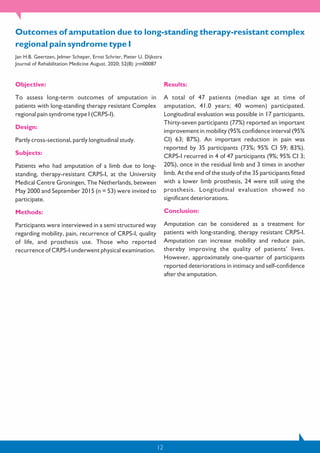
Objective:
To assess long-term outcomes of amputation in
patients with long-standing therapy resistant Complex
regional pain syndrome type I (CRPS-I).
Design:
Partly cross-sectional, partly longitudinal study.
Subjects:
Patients who had amputation of a limb due to long-
standing, therapy-resistant CRPS-I, at the University
Medical Centre Groningen, The Netherlands, between
May 2000 and September 2015 (n = 53) were invited to
participate.
Methods:
Participants were interviewed in a semi structured way
regarding mobility, pain, recurrence of CRPS-I, quality
of life, and prosthesis use. Those who reported
recurrence of CRPS-I underwent physical examination.
Results:
A total of 47 patients (median age at time of
amputation, 41.0 years; 40 women) participated.
Longitudinal evaluation was possible in 17 participants.
Thirty-seven participants (77%) reported an important
improvement in mobility (95% confidence interval (95%
CI) 63; 87%). An important reduction in pain was
reported by 35 participants (73%; 95% CI 59; 83%).
CRPS-I recurred in 4 of 47 participants (9%; 95% CI 3;
20%), once in the residual limb and 3 times in another
limb. At the end of the study of the 35 participants fitted
with a lower limb prosthesis, 24 were still using the
prosthesis. Longitudinal evaluation showed no
significant deteriorations.
Conclusion:
Amputation can be considered as a treatment for
patients with long-standing, therapy resistant CRPS-I.
Amputation can increase mobility and reduce pain,
thereby improving the quality of patients’ lives.
However, approximately one-quarter of participants
reported deteriorations in intimacy and self-confidence
after the amputation.
Outcomes of amputation due to long-standing therapy-resistant complex
regional pain syndrome type I
Jan H.B. Geertzen, Jelmer Scheper, Ernst Schrier, Pieter U. Dijkstra
Journal of Rehabilitation Medicine August. 2020; 52(8): jrm00087
13
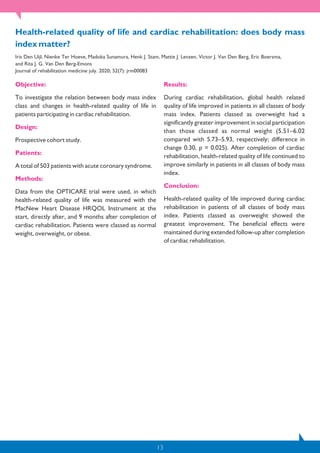
Objective:
To investigate the relation between body mass index
class and changes in health-related quality of life in
patients participating in cardiac rehabilitation.
Design:
Prospective cohort study.
Patients:
A total of 503 patients with acute coronary syndrome.
Methods:
Data from the OPTICARE trial were used, in which
health-related quality of life was measured with the
MacNew Heart Disease HRQOL Instrument at the
start, directly after, and 9 months after completion of
cardiac rehabilitation. Patients were classed as normal
weight, overweight, or obese.
Results:
During cardiac rehabilitation, global health related
quality of life improved in patients in all classes of body
mass index. Patients classed as overweight had a
significantly greater improvement in social participation
than those classed as normal weight (5.51–6.02
compared with 5.73–5.93, respectively; difference in
change 0.30, p = 0.025). After completion of cardiac
rehabilitation, health-related quality of life continued to
improve similarly in patients in all classes of body mass
index.
Conclusion:
Health-related quality of life improved during cardiac
rehabilitation in patients of all classes of body mass
index. Patients classed as overweight showed the
greatest improvement. The beneficial effects were
maintained during extended follow-up after completion
of cardiac rehabilitation.
Health-related quality of life and cardiac rehabilitation: does body mass
index matter?
Iris Den Uijl, Nienke Ter Hoeve, Madoka Sunamura, Henk J. Stam, Mattie J. Lenzen, Victor J. Van Den Berg, Eric Boersma,
and Rita J. G. Van Den Berg-Emons
Journal of rehabilitation medicine july. 2020; 52(7): jrm00083
14
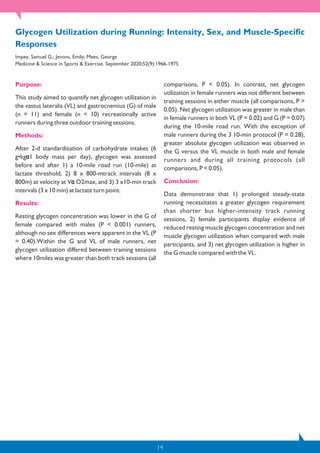
Purpose:
This study aimed to quantify net glycogen utilization in
the vastus lateralis (VL) and gastrocnemius (G) of male
(n = 11) and female (n = 10) recreationally active
runners during three outdoor training sessions.
Methods:
After 2-d standardization of carbohydrate intakes (6
g•kg 1 body mass per day), glycogen was assessed
before and after 1) a 10-mile road run (10-mile) at
lactate threshold, 2) 8 x 800-mtrack intervals (8 x
800m) at velocity at V O2max, and 3) 3 x10-min track
intervals (3 x 10 min) at lactate turn point.
Results:
Resting glycogen concentration was lower in the G of
female compared with males (P < 0.001) runners,
although no sex differences were apparent in the VL (P
= 0.40).Within the G and VL of male runners, net
glycogen utilization differed between training sessions
where 10miles was greater than both track sessions (all
comparisons, P < 0.05). In contrast, net glycogen
utilization in female runners was not different between
training sessions in either muscle (all comparisons, P >
0.05). Net glycogen utilization was greater in male than
in female runners in both VL (P = 0.02) and G (P = 0.07)
during the 10-mile road run. With the exception of
male runners during the 3 10-min protocol (P = 0.28),
greater absolute glycogen utilization was observed in
the G versus the VL muscle in both male and female
runners and during all training protocols (all
comparisons, P < 0.05).
Conclusion:
Data demonstrate that 1) prolonged steady-state
running necessitates a greater glycogen requirement
than shorter but higher-intensity track running
sessions, 2) female participants display evidence of
reduced resting muscle glycogen concentration and net
muscle glycogen utilization when compared with male
participants, and 3) net glycogen utilization is higher in
the G muscle compared with the VL.
Glycogen Utilization during Running: Intensity, Sex, and Muscle-Specific
Responses
Impey, Samuel G.; Jevons, Emily; Mees, George
Medicine & Science in Sports & Exercise. September 2020;52(9):1966-1975
15
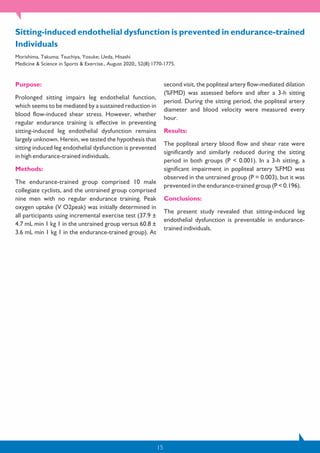
Purpose:
Prolonged sitting impairs leg endothelial function,
which seems to be mediated by a sustained reduction in
blood flow-induced shear stress. However, whether
regular endurance training is effective in preventing
sitting-induced leg endothelial dysfunction remains
largely unknown. Herein, we tested the hypothesis that
sitting induced leg endothelial dysfunction is prevented
in high endurance-trained individuals.
Methods:
The endurance-trained group comprised 10 male
collegiate cyclists, and the untrained group comprised
nine men with no regular endurance training. Peak
oxygen uptake (V O2peak) was initially determined in
all participants using incremental exercise test (37.9 ±
4.7 mL min 1 kg 1 in the untrained group versus 60.8 ±
3.6 mL min 1 kg 1 in the endurance-trained group). At
second visit, the popliteal artery flow-mediated dilation
(%FMD) was assessed before and after a 3-h sitting
period. During the sitting period, the popliteal artery
diameter and blood velocity were measured every
hour.
Results:
The popliteal artery blood flow and shear rate were
significantly and similarly reduced during the sitting
period in both groups (P < 0.001). In a 3-h sitting, a
significant impairment in popliteal artery %FMD was
observed in the untrained group (P = 0.003), but it was
prevented in the endurance-trained group (P < 0.196).
Conclusions:
The present study revealed that sitting-induced leg
endothelial dysfunction is preventable in endurance-
trained individuals.
Sitting-induced endothelial dysfunction is prevented in endurance-trained
Individuals
Morishima, Takuma; Tsuchiya, Yosuke; Ueda, Hisashi
Medicine & Science in Sports & Exercise., August 2020;, 52(8):1770-1775.
16
Purpose:
The primary objective of this Study was to examine and
compare lumbar multifidus (LM) muscle size,
asymmetry, and function in university football
playerswith and without low back pain (LBP). A
secondary objective was to examine the relationship
between LM characteristics and body composition in
football players.
Methods:
Ultrasound assessments of the LM muscle were
performed in 41 university football players during the
preseason. LM muscle cross-sectional area, echo
intensity (e.g., indicator of fatty infiltration and
connective tissue), thickness at rest, and thickness
during submaximal contraction (e.g., contralateral arm
lift) measurements in prone and standing positions
were obtained bilaterally at the L5–S1 level. Body
composition measures were acquired using dual-
energy x-ray absorptiometry. A self-administered
questionnaire was used to obtain LBP history data.
Results:
The LM muscle thickness at rest in prone and in
standing was significantly smaller in football players
who reported the presence of LBP in the previous 3
months. The LM cross-sectional area in prone was
significantly and positively correlated with weight,
height, lean body mass, total fat mass, and total percent
body fat. LM echo intensity was strongly correlated
with total percent body fat and total fat mass and
negatively correlated with the percent thickness
change during contraction.
Conclusion:
The results of this study provide novel information on
LM muscle morphology and activation in football
players in prone and standing and suggest that players
with LBP in the previous 3 months had smaller LM
muscle thickness. LM morphology was strongly
correlated with body composition measurements.
Ultrasonography of Lumbar Multifidus Muscle in University American
Football Players
Schryver, Alexa; Rivaz, Hassan; Rizk, Amanda;
Medicine & Science in Sports & Exercise. July 2020; 52(7):1495-1501.
17
Background:
Factors that are related to mobility apprehension were
measured in a sample of persons with lower-limb
amputation.
Objectives:
The purpose was to determine whether intensity,
interference, or catastrophizing are associated with
mobility apprehension.
Study Design:
Cross-sectional study.
Methods:
Persons with amputation of a lower limb who were
attending a national limb loss conference were
recruited to complete a survey. Subjects were
administered the Tampa Scale for Kinesiophobia to
measure mobility apprehension. The Brief Pain
Inventory was administered to quantify the affect of
pain on general activity, walking ability, and enjoyment
of life. The Pain Catastrophizing Scale was administered
to assess the tendency to ruminate and magnify pain
sensations. A multivariable linear regression was
performed to determine factors associated with
mobility apprehension.
Results:
Fifty-three people with lower-limb amputation
participated in the study. The mean (standard
deviation) score for mobility apprehension was 34.2
(6.0). Mean (standard deviation) pain intensity and
interference scores were 1.6 (1.7) and 2.5 (2.6),
respectively. The mean (standard deviation) pain
catastrophizing score was 9.1 (10). Pain catastrophizing
was the only variable associated with higher mobility
apprehension (β=0.31, p<0.001, R2=0.32). Results
suggest that for every one-point increase in the pain
catastrophizing score, mobility apprehension will
increase by 0.3 of a point.
Conclusion:
These preliminary results suggest that pain
catastrophizing was related to mobility apprehension in
this cohort of persons with lower-limb amputation.
This relationship indicates that the exploration of
avoidance behaviours, such as pain catastrophizing, may
be useful when developing a program for physical
rehabilitation.
Clinical Relevance:
Pain catastrophizing, an avoidance behaviour, may be
associated with higher levels of mobility apprehension
in persons with major lower-limb amputation.
Understanding the impact of fear-avoidance behaviour
will allow clinicians to identify individuals at risk for
poor outcomes following amputation surgery and to
develop psychological strategies to complement
treatment.
Factors associated with mobility apprehension in persons with lower limb
amputation
Shannon L Mathis
Prosthet Orthot Int. 2020 Aug;44(4):208-214.
18
Objective:
To better identify variables related to discrepancies
between subjective cognitive complaints and objective
neuropsychological findings in persons with traumatic
brain injury (TBI).
Setting:
Three rehabilitation centers in the United States.
Participants:
In total, 504 community-dwelling adult survivors of TBI
following discharge from inpatient rehabilitation.
Design:
Prospective cohort observation study.
Main Measures:
Wechsler Adult Intelligence Scale, Fourth Edition, Digit
Span; Rey Auditory Verbal Learning Test; Trail Making
Test, Part B; Word Memory Test; Patient Health
Questionnaire-9; Neurobehavioral Symptom
Inventory; TBI-Quality of Life item bank.
Results:
Statistical analyses revealed multiple factors associated
with subjective-objective discrepancies in attention,
memory, and executive functions. Depression was
consistently associated with underestimation of
cognitive abilities. However, subjective-objective
discrepancies varied by cognitive domains in regard to
other factors related to underestimation and
overestimation of abilities.
Conclusions:
Reconciling and interpreting subjective-objective
discrepancies regarding cognitive functions following
TBI are important tasks for case conceptualization and
treatment planning. Depression is an important patient
characteristic to consider when discrepancy patterns
indicate underestimation of cognitive abilities. This
study highlights the importance of assessing mood, a
modifiable patient characteristic, with self-report
symptom inventories. Future studies are needed to
connect these findings with TBI outcomes.
The Discrepancy Between Cognitive Complaints and Neuropsychological
Test Findings in Persons With Traumatic Brain Injury
Vos, Leia; Williams, Michael W.; Poritz, Julia M. P.; Ngan, Esther; Leon-Novelo, Luis; Sherer, Mark
Journal of Head Trauma Rehabilitation. 2020 July/August;35(4):E382-E392.
19
Objective:
Identify the treatment effects of 6 weeks of daily 30-
minute sessions of morning blue light therapy
compared with placebo amber light therapy in the
treatment of sleep disruption following mild traumatic
brain injury.
Design:
Placebo-controlled randomized trial.
Participants:
Adults aged 18 to 45 years with a mild traumatic brain
injury within the past 18 months (n = 35).
Main Outcome Measures:
Epworth Sleepiness Scale, Pittsburgh Sleep Quality
Index, Beck Depression Inventory II, Rivermead Post-
concussion Symptom Questionnaire, Functional
Outcomes of Sleep Questionnaire, and actigraphy-
derived sleep measures.
Results:
Following treatment, moderate to large improvements
were observed with individuals in the blue light therapy
group reporting lower Epworth Sleepiness Scale
(Hedges' g = 0.882), Beck Depression Inventory II (g =
0.684), Rivermead Post-concussion Symptom
Questionnaire chronic (g = 0.611), and somatic (g =
0.597) symptoms, and experiencing lower normalized
wake after sleep onset (g = 0.667) than those in the
amber light therapy group. In addition, individuals in the
blue light therapy group experienced greater total
sleep time ( g = 0.529) and reported improved
Functional Outcomes of Sleep Questionnaire scores ( g
= 0.929) than those in the amber light therapy group.
Conclusion:
Daytime sleepiness, fatigue, and sleep disruption are
common following a mild traumatic brain injury. These
findings further substantiate blue light therapy as a
promising nonpharmacological approach to improve
these sleep-related complaints with the added benefit
of improved postconcussion symptoms and depression
severity.
Daily Morning Blue Light Therapy Improves Daytime Sleepiness, Sleep
Quality, and Quality of Life Following a Mild Traumatic Brain Injury
Raikes, Adam C.; Dailey, Natalie S.; Shane, Bradley R.; Forbeck, Brittany; Alkozei, Anna; Killgore, William D. S.
Journal of Head Trauma Rehabilitation. 2020 September/October;35(5):E405-E42.
20
Objective:
To assess a simple technology solution to support basic
communication and leisure in people with neurological
disorders, extensive motor impairment, and absence of
speech.
Design:
The design was a non-concurrent multiple baseline
across participants.
Methods:
The study included eight participants and assessed a
technology setup including a Samsung Galaxy Tab S2
LTE tablet and a Samsung Galaxy A3 smartphone. The
smartphone, automated via MacroDroid, presented
the participant with leisure, messages, and caregiver
options. Choosing leisure or messages (by activating
the smartphone’s proximity sensor) led the
smartphone to present the alternatives available for
that option and eventually verbalize the alternative
selected. This verbalization triggered the tablet’s
Google Assistant and led the tablet to present a leisure
event or start a message exchange. Choosing the
caregiver led the smartphone to invite the caregiver to
interact with the participant.
Results:
During baseline (i.e., when a standard smartphone was
available), the participants did not activate any of the
options. During intervention and post-intervention
(i.e., with the technology described above), participants
activated all options and spent most of the session time
positively engaged with them.
Conclusions:
The aforementioned technology seems to be a useful
tool for individuals like those involved in this study.
Mainstream technology to support basic communication and leisure in
people with neurological disorders, motor impairment and lack of speech
Lancioni GE, Singh NN, O’Reilly MF, Sigafoos J, D’Amico F, Buonocunto F, Lanzilotti C, Alberti G, Navarro J.
Brain Injury. 2020 May 24:1-7.
21
Objective:
To assess variables associated with decannulation in
patients with traumatic brain injury (TBI).
Participants:
79 patients with TBI requiring tracheostomy and ICU
admission from January 1st to December 31st, 2014.
Design:
Retrospective analysis.
Measures:
Patients decannulated prior to 90 days were compared
with patients who remained cannulated. Two Cox
Proportional Hazards models were used to predict
decannulation using variables prior to tracheostomy
and throughout hospitalization.
Results:
Median time to decannulation was 37 days
(Interquartile Range [IQR] 29–67). Variables prior to
tracheostomy associated with decannulation included
diabetes (HR, 0.15; 95% CI, 0.03–0.84; p =.03),
craniotomy (HR, 0.25; 95% CI, 0.06–1.02; p =.05) and
acute kidney injury (AKI) (HR, 0.06; 95% CI, 0.01–0.48;
p =.01). Variables present throughout hospitalization
included age (HR, 1.12; 95% CI, 1.01–1.21; p =.03),
ventilator days (HR, 0.74; 95% CI, 0.57–0.95; p =.02),
reintubation (HR, 0.07; 95% CI, 0.01–0.64; p =.02),
aspiration (HR, 0.01; 95% CI, 0.0–0.29, p =.01),
craniotomy (HR, 0.004; 95% CI, 0.0–0.39; p =.02) and
AKI (HR, 0.0; 95% CI, 0.0–0.21; p =.01).
Conclusion:
The presence of diabetes, craniotomy and acute kidney
injury may inform the conversation surrounding
chances for decannulation prior to tracheostomy.
Factors associated with tracheostomy decannulation in patients with
severe traumatic brain injury
Jenkins R, Badjatia N, Haac B, Van Besien R, Biedlingmaier JF, Stein DM, Chang WT, Schwartzbauer G, Parikh G, Morris NA.
Brain Injury. 2020 Jul;34(8):1106-11.
22
Objective:
With the increasing global prevalence of acquired brain
injury (ABI), the burden of visual problems as a sequelae
to ABI is on the rise. This study reports the visual
profile of patients with ABI seen in Neuro-Optometry
Clinic (NOC) at a tertiary eye-care center in Southern
India.
Methods:
A retrospective study was carried out between January
2014 and December 2015. Medical records of patients
diagnosed with ABI referred by Neuro-
Ophthalmologists to the NOC were reviewed. The
detailed history, clinical findings of neuro assessment
and management details were recorded.
Results:
Of the 241 patients with ABI, 208 had Traumatic Brain
Injury (TBI) and 33 had Cerebro-Vascular Accident
(CVA). The mean (SD) age of patients with TBI was 35
± 14 years and CVA was 52 ± 16 years. Binocular
diplopia (61%) was seen predominantly in TBI due to
vertical deviation (31%). Cranial nerve palsy was most
common in TBI (55%) than CVA (36%) and visual field
defects were most frequently seen in CVA (27%).
Conclusion:
Cranial nerve paresis and restrictive strabismus with
diplopia were the most common presentations in TBI
and visual field defects in CVA. A neuro-optometric
evaluation is recommended to identify visual
dysfunctions and provide appropriate management
options.
Visual profile of acquired brain injury in Indian cohort: a retrospective
study
Ambika S, Atiya A, Ravi A, Mani R, Bhattacharya B, Praveen S, Hussaindeen JR.
Brain injury. 2020 Jul 28;34(9):1168-74.
23
Purpose:
To elucidate the predictive factors for persistent post-
concussion symptoms at 1 and 3 months following
minor traumatic brain injuries (mTBIs) in patients with
no psychiatric history.
Methods:
This was an observational study in an academic trauma
centre including adult patients with a history of mTBI
and no psychiatric history. Exclusion criteria were
missing the follow-up phone calls, radiologic
abnormalities, simultaneous injuries and refusal to
participate. Outcomes were post-concussion
syndrome according to the international classification
of diseases (ICD)-10 (ICD-PCS) and persistence of
more than one mTBI related symptoms at 1 and 3
months post-injury.
Results:
From 364 enrolled patients, 16 (4.4%) developed ICD-
PCS, whereas 28 (7.6%) and 8(2.1%) reported more
than one symptom at one and three months,
respectively. Multivariable analysis showed associations
between ICD-PCS with more than one initial symptom
in the emergency department (ED) and the non-motor
vehicle collision (non-MVC) impact mechanism with
area under curve of 0.77. The former variable was
associated with the persistence of more than one post-
concussion symptom at one and three months.
Conclusion:
More than one symptom in the ED and the mechanism
of injury not related to MVCs (sports, violence or fall
injuries) may predict symptom persistence. Early
treatment and follow-up strategies may be beneficial
for vulnerable patients.
Persistence of post-concussion symptoms in patients with mild traumatic
brain injury and no psychiatric history in the emergency department
Mehrolhassani N, Movahedi M, Nazemi-Rafi M, Mirafzal A.
Brain injury. 2020 Aug 10:1-8.
24
Study Objectives:
To identify the prevalence of excessive daytime
sleepiness (EDS) in a prospectively recruited patient
population with traumatic brain injury (TBI) of mixed
severity. Furthermore, the study aimed to assess the
relationship between patient factors and EDS.
Method:
One-hundred and eighteen patients with TBI were
assessed in a neurorehabilitation clinic after discharge
from the emergency department. Enrolled participants
were evaluated using several TBI-related outcome
measures, 6–8 weeks after injury.
Results:
EDS (defined using the Epworth Sleepiness Scale 10)
occurred in 48 of 118 (41.7%) patients in this study.
Anxiety; depression; change in ability to work;
employment status; global outcome (GOSE); social and
functional outcome (RHFUQ); and symptom severity
(RPCS) were associated with EDS in a univariate
analysis. Anxiety was the only factor associated with
EDS in the multivariate analysis (OR: 0.28 [95% CI:
0.09–0.90], P = .032).
Conclusion:
EDS is common after TBI in a community setting and is
associated with several factors, which likely interact to
contribute toward worse outcome. Anxiety is a factor
that, if routinely assessed and considered during patient
care choices, may assist in favorable sleep-related
outcome during and after post-TBI recovery.
Excessive daytime sleepiness after traumatic brain injury
Crichton T, Singh R, Abosi-Appeadu K, Dennis G.
Brain injury. 2020 Aug 25:1-7.
25
Background:
Many research studies attempting to improve
locomotor function following motor incomplete spinal
cord injury (iSCI) focus on providing stepping practice.
However, observational studies of physical therapy
strategies suggest the amount of stepping practice
during clinical rehabilitation is limited; rather, many
interventions focus on mitigating impairments
underlying walking dysfunction.
Objective:
The purpose of this blinded-assessor randomized trial
was to evaluate the effects of task-specific versus
impairment-based interventions on walking outcomes
in individuals with iSCI.
Methods:
Using a crossover design, ambulatory participants with
iSCI >1-year duration performed either task-specific
(upright stepping) or impairment-based training for up
to 20 sessions over 6 weeks, with interventions
alternated after >4 weeks delay. Both strategies
focused on achieving higher cardiovascular intensities,
with training specificity manipulated by practicing only
stepping practice in variable contexts or practicing
tasks targeting impairments underlying locomotor
dysfunction (strengthening, balance tasks, and
recumbent stepping).
Results:
Significantly greater increases in fastest overground and
treadmill walking speeds were observed following task-
specific versus impairment-based training, with
moderate associations between differences in amount
of practice and outcomes. Gains in balance confidence
were also observed following task-specific vs
impairment-based training, although incidence of falls
was also increased with the former protocol. Limited
gains were observed with impairment-based training
except for peak power during recumbent stepping
tests.
Conclusion:
The present study reinforces work from other patient
populations that the specificity of task practice is a
critical determinant of locomotor outcomes and
suggest impairment-based exercises may not translate
to improvements in functional tasks.
Task-Specific Versus Impairment-Based Training on Locomotor
Performance in Individuals With Chronic Spinal Cord Injury: A
Randomized Crossover Study
Lotter JK, Henderson CE, Plawecki A, Holthus ME, Lucas EH, Ardestani MM, Schmit BD, Hornby TG.
Neurorehabil Neural Repair. 2020 Jul; 34(7): 627–639.
26
Background:
The relative rarity of ischemic compared with
traumatic spinal cord injury (SCI) has limited a
comparison of the outcomes of these conditions.
Objective:
To investigate the neurological and functional recovery
of ischemic compared with traumatic acute SCI.
Methods:
Data were derived from the European Multicenter
Study Spinal Cord Injury database. Patients with
ischemic (iSCI) or traumatic SCI (tSCI), aged 18 years
or older were evaluated at different time points from
incidence: at about 1 month, 3 months, and 6 months.
The neurological status was assessed at each time point
by the International Standards for Neurological
Classification of Spinal Cord Injury and the functional
status by the Spinal Cord Independence Measure.
Walking ability was evaluated by Walking Index for
Spinal Cord Injury, 10-Meter Walk Test, and 6-Minute
Walk Test. Because of the imbalances of the 2 groups in
respect to size and lesion severity, a matching
procedure according to age, neurological level, and
severity of injury was performed. Outcomes evaluation
was performed by means of a 2-way repeated-
measures ANOVA.
Results:
The matching procedure resulted in 191 pairs. Both
groups significantly improved from about 15 days after
the lesion to 6 months. No differences were found in
the course of neurological and functional recovery of
iSCI compared with tSCI.
Conclusions:
This analysis from a representative cohort of
participants revealed that from 15 days following the
cord damage onward, the outcomes after iSCI and tSCI
are comparable. This finding supports the potential
enrolment of patients with acute iSCI into clinical trials
from that point in time after the event and an evaluation
up to 6 months afterward.
Acute Traumatic and Ischemic Spinal Cord Injuries Have a Comparable
Course of Recovery
Scivoletto G, Torre M, Mammone A, Maier DD, Weidner N, Schubert M, Rupp R, Abel R, Yorck-Bernhard K, Jiri K, Curt A.
Neurorehabilitation and Neural Repair. 2020 Aug;34(8):723-32.
27
Background:
Nigrostriatal dopaminergic loss is a hallmark of
Parkinson’s disease (PD) pathophysiology, leading to
motor Parkinsonism. Different intervention protocols
have shown that motor and cognitive functions
improvement in PD occur via the modulation of distinct
motor and cognitive pathways.
Objective:
To investigate the effects of two motor training
programs on the brains’ functional networks in PD
patients.
Methods:
Thirty-seven PD patients were prospectively studied.
All enrolled patients underwent either treadmill
training (TT) (n = 19) or treadmill with virtual reality
(TT + VR) (n = 18) for 6 weeks. Magnetic resonance
imaging (MRI) scans (3 T) acquiring 3-dimensional T1-
weighted and resting-state functional MRI (rs-fMRI)
data sets were performed at baseline and after 6 weeks.
Independent component analysis (ICA) was conducted,
and functional connectivity (FC) changes within large-
scale functional brain networks were examined.
Results:
In both groups, significant post-training FC decrease in
striatal, limbic, and parietal regions within the basal
ganglia network, executive control network, and
frontal-striatal network, and significant FC increase in
the caudate, and cingulate within the sensorimotor
network (SMN) were observed. Moreover, a significant
time × group interaction was detected where TT + VR
training had greater effects on FC levels in the
supplementary motor area (SMA) and right precentral
gyrus within the SMN, and in the right middle frontal
gyrus (MFG) within the cerebellar network. These FC
alterations were associated with improved usual and
dual-task walking performance.
Conclusions:
These results suggest that TT with-and-without the
addition of a VR component affects distinct neural
pathways, highlighting the potential for beneficial neural
plasticity in PD. Such distinctive task-specific pathways
may foster the facilitation of interventions tailored to
the individual needs of PD patients.
Distinct Effects of Motor Training on Resting-State Functional Networks
of the Brain in Parkinson’s Disease
Droby A, Maidan I, Jacob Y, Giladi N, Hausdorff JM, Mirelman A.
Neurorehabilitation and Neural Repair. 2020 September 34(9):795-803.
28
Objectives:
Visual field defects due to hemi- or quadrantanopia
after stroke represent an under-recognized
neurological symptom with inefficient instruments for
neurorehabilitation to date. We here examined the
effects of training in a virtual reality (VR) supermarket
on cognitive functions, depressive symptoms, and
subjective cognitive complaints in patients with
hemianopia/quadrantanopia and healthy controls.
Methods:
During a 14-day rehabilitation program, 20 patients and
20 healthy controls accomplished a real-life-like
shopping task in a VR supermarket. A comparison
between pre- and post-training standard
neuropsychological measures, depressive symptoms,
and subjective memory complaints allowed us to assess
a putative transfer of rehabilitation effects from the
training tasks to specific cognitive functions.
Results:
The results indicate that VR training may improve
performance not only in the trained task but also in
specific neuropsychological functions. After the
training, both patients and controls showed improved
performances in visual scanning, mental rotation,
visuoconstruction, and cognitive flexibility. Moreover,
depressive symptoms were attenuated in both groups.
In the patient group compared to the control group,
the training particularly resulted in improved visual
memory retrieval and reduced memory complaints.
Conclusions:
The results of the current study suggest that VR
training can improve particularly visual-spatial skills in
patients with hemianopia or quadrantanopia. Our study
thus introduces an interesting novel treatment
approach to improve cognitive functions relevant to
daily life in stroke patients with visual field defects.
Cognitive training in an everyday-like virtual reality enhances visual-
spatial memory capacities in stroke survivors with visual field defects
Dehn LB, Piefke M, Toepper M, Kohsik A, Rogalewski A, Dyck E, Botsch M, Schäbitz WR.
Topics in Stroke Rehabilitation. 2020 Aug;27:442-452.
29
Background and Objectives:
High-intensity interval training (HIIT) is a promising
strategy for improving gait and fitness after stroke, but
optimal parameters remain unknown. We tested the
effects of short vs long interval type and over-ground vs
treadmill mode on training intensity.
Methods:
Using a repeated measures design, 10 participants with
chronic hemiparesis performed 12 HIIT sessions over 4
weeks, alternating between short and long-interval
HIIT sessions. Both protocols included 10 minutes of
over-ground HIIT, 20 minutes of treadmill HIIT and
another 10 minutes over-ground. Short-interval HIIT
involved 30 second bursts at maximum safe speed and
30–60 second rest periods. Long-interval HIIT involved
4-minute bursts at ~90% of peak heart rate (HRpeak)
and 3-minute recovery periods at ~70% HRpeak.
Results:
Compared with long-interval HIIT, short-interval HIIT
had significantly faster mean overground speeds (0.75
vs 0.67 m/s) and treadmill speeds (0.90 vs 0.51 m/s),
with similar mean treadmill HR (82.9 vs 81.8%HRpeak)
and session perceived exertion (16.3 vs 16.3), but
lower overground HR (78.4 vs 81.1%HRpeak) and
session step counts (1481 vs 1672). For short-interval
HIIT, training speeds and HR were significantly higher
on the treadmill vs. overground. For long-interval HIIT,
the treadmill elicited HR similar to overground training
at significantly slower speeds.
Conclusions:
Both short and long-interval HIIT elicit high intensities
but emphasize different dosing parameters. From these
preliminary findings and previous studies, we
hypothesize that overground and treadmill short-
interval HIIT could be optimal for improving gait speed
and overground long-interval HIIT could be optimal for
improving gait endurance.
Locomotor training intensity after stroke: Effects of interval type and
mode
Boyne P, Scholl V, Doren S, Carl D, Billinger SA, Reisman DS, Gerson M, Kissela B, Vannest J, Dunning K.
Topics in Stroke Rehabilitation. 2020 Sept;27:483-493.
Supports patients initiatives programs
In Cerebral Palsy,
In Spasticity,
Abridged Prescribing Information (BACLOF)
Active Ingredient: each tablet of BACLOF contains: baclofen 10, 25 mg, BACLOF liquid contains baclofen 5mg/5ml, 100 ml bottle. Indication: treatment of spasticity resulting from multiple sclerosis, particularly for the relief of flexor spasms and concomitant
pain, clonus, and muscular rigidity. Dosage: Tablets: Initiate with a low dosage, preferably in divided doses, administered orally. Increase gradually based on clinical response and tolerability. The maximum dosage is 80 mg daily (20 mg four times a day). When
discontinuing, reduce the dosage slowly. Liquid: adults: One 5ml spoonful (5mg) 3 times a day for 3 days; Two 5ml spoonfuls (10mg) 3 times a day for 3 days; Three 5ml spoonfuls (15mg) 3 times a day for 3 days; Four 5ml spoonfuls (20mg) 3 times a day for 3
days.Elderly:Smalldosesshouldbeusedatthe start oftreatment, the dosebeing titrated graduallyagainst the response,under carefulsupervision.Paediatric population(0to<18years):Adosageof0.75-2mg/kg bodyweight shouldbeused.In children over
ten years of age, however a maximum daily dosage of 2.5mg/kg body weight may be given. Treatment is usually started with half a 5ml spoonful (2.5mg) given 4 times daily. The recommended daily dosages for maintenance therapy are as: 12 months – 2
years: Two to four 5ml spoonfuls (10-20mg), 2 years – 6 years: Four to six 5ml spoonfuls (20-30mg); 6 years – 10 years: Six to twelve 5ml spoonfuls (30-60mg). Contraindications: hypersensitivity to baclofen or any component of this product. Warning and
precautions: Abrupt discontinuation of baclofen has resulted in serious adverse reactions including death; therefore, reduce the dosage slowly when baclofen is discontinued. Neonatal withdrawal symptoms can occur; gradually reduce the dosage and
discontinue baclofen before delivery. Baclofen can cause drowsiness and sedation. Patients should avoid the operation of automobiles or other dangerous machinery until they know how the drug affects them. Advise patients that the central nervous system
effects of baclofen may be additive to those of alcohol and other CNS depressants. Baclofen can cause exacerbation of the following: psychotic disorders, schizophrenia, or confusional states; autonomic dysreflexia; epilepsy. Use with caution in patients with
these condition. Pregnancy & Lactation: Pregnancy: Based on animal data, may cause fetal harm. At recommended oral doses, baclofen is present in human milk. There are no human data on the effects of baclofen on milk production and on breastfed infant.
Interaction: CNS depressants like benzodiazepines, antihistamine, antipsychotic, and alcohol etc., may cause increased sedative effects. Morphine (epidural) may cause hypotension and dyspnea. Laboratory Test Interactions may cause false elevation of
AST (aspartate aminotransferase), alkaline phosphatase, or blood glucose. Adverse reactions: most common drowsiness, dizziness, and weakness. Overdose: Symptoms: Patients may present in coma or with progressive drowsiness, lightheadedness,
dizziness, somnolence, accommodation disorders, respiratory depression, seizures, or hypotonia progressing to loss of consciousness. Treatment: includes gastric decontamination, maintaining an adequate airway and respirations. (Prepared on 23rd Feb
2020. It is recommended to refer full prescribing information before prescription. For further medical information, please write to: Intas Pharmaceuticals Ltd., Corporate House, Near Sola Bridge, SG highway, Thaltej, Ahmedabad-380054, Gujarat, India.
productqueries@intaspharma.com.)
Abridged Prescribing Information (BACLOF LIQUID)
Active Ingredient: each tablet of BACLOF contains: baclofen 10, 25 mg, BACLOF liquid contains baclofen 5mg/5ml, 100 ml bottle. Indication: treatment of spasticity resulting from multiple sclerosis, particularly for the relief of flexor spasms and concomitant
pain, clonus, and muscular rigidity. Dosage: Tablets: Initiate with a low dosage, preferably in divided doses, administered orally. Increase gradually based on clinical response and tolerability. The maximum dosage is 80 mg daily (20 mg four times a day). When
discontinuing, reduce the dosage slowly. Liquid: adults: One 5ml spoonful (5mg) 3 times a day for 3 days; Two 5ml spoonfuls (10mg) 3 times a day for 3 days; Three 5ml spoonfuls (15mg) 3 times a day for 3 days; Four 5ml spoonfuls (20mg) 3 times a day for 3
days.Elderly:Smalldosesshouldbeusedatthe start oftreatment, the dosebeing titrated graduallyagainst the response,under carefulsupervision.Paediatric population(0to<18years):Adosageof0.75-2mg/kg bodyweight shouldbeused.In children over
ten years of age, however a maximum daily dosage of 2.5mg/kg body weight may be given. Treatment is usually started with half a 5ml spoonful (2.5mg) given 4 times daily. The recommended daily dosages for maintenance therapy are as: 12 months – 2
years: Two to four 5ml spoonfuls (10-20mg), 2 years – 6 years: Four to six 5ml spoonfuls (20-30mg); 6 years – 10 years: Six to twelve 5ml spoonfuls (30-60mg). Contraindications: hypersensitivity to baclofen or any component of this product. Warning and
precautions: Abrupt discontinuation of baclofen has resulted in serious adverse reactions including death; therefore, reduce the dosage slowly when baclofen is discontinued. Neonatal withdrawal symptoms can occur; gradually reduce the dosage and
discontinue baclofen before delivery. Baclofen can cause drowsiness and sedation. Patients should avoid the operation of automobiles or other dangerous machinery until they know how the drug affects them. Advise patients that the central nervous system
effects of baclofen may be additive to those of alcohol and other CNS depressants. Baclofen can cause exacerbation of the following: psychotic disorders, schizophrenia, or confusional states; autonomic dysreflexia; epilepsy. Use with caution in patients with
these condition. Pregnancy & Lactation: Pregnancy: Based on animal data, may cause fetal harm. At recommended oral doses, baclofen is present in human milk. There are no human data on the effects of baclofen on milk production and on breastfed infant.
Interaction: CNS depressants like benzodiazepines, antihistamine, antipsychotic, and alcohol etc., may cause increased sedative effects. Morphine (epidural) may cause hypotension and dyspnea. Laboratory Test Interactions may cause false elevation of
AST (aspartate aminotransferase), alkaline phosphatase, or blood glucose. Adverse reactions: most common drowsiness, dizziness, and weakness. Overdose: Symptoms: Patients may present in coma or with progressive drowsiness, lightheadedness,
dizziness, somnolence, accommodation disorders, respiratory depression, seizures, or hypotonia progressing to loss of consciousness. Treatment: includes gastric decontamination, maintaining an adequate airway and respirations. (Prepared on 23rd Feb
2020. It is recommended to refer full prescribing information before prescription. For further medical information, please write to: Intas Pharmaceuticals Ltd., Corporate House, Near Sola Bridge, SG highway, Thaltej, Ahmedabad-380054, Gujarat, India.
productqueries@intaspharma.com.)
0000000

Pmr buzz magazine oct 2020

  • 1.
    PMR BUZZ Volume 1, Issue3, October 2020 “Medicine is a science of uncertainty and an art of probabilty.” ~ William Osler
  • 2.
    Preface In line withthe previous edition of our PMR buzz, an abstract review in an electronic form comprising inputs from well-known current journals covering various fields in rehabilitation medicine. This is fourth edition, and with this we welcome a new contributor Dr Harleen Uppal, Assistant Professor at Dr Baba Saheb Ambedker Medical College & Hospital, New Delhi. As we move forward we strive to be better than the last but feedbacks will help us to be even better. So keep us posted with your ideas, and we will grab the most feasible and bright. We have selected one abstract from each volume of these journals published in the preceeding quarter It does not mean that the others are any less in originality or quality, but we picked only those appearing to be practice-changing in Indian clinical scenario. Moreover, like any medley, there might be bias in the overture, but we are only humans. Keep buzzing with .“PMR Buzz” - Dr. Mrinal Joshi Contributors: • Dr. Ravi Gaur, Associate Professor, Department of PMR, AIIMS, Jodhpur. • Dr. Navin BP, Assistant Professor, Department of Neurorehabilitation, NIMHANS, Bengaluru. • Dr. Mahima Agrawal, Assistant Professor, Department of PMR, JLN Medical College, Ajmer. • Dr. Harleen Uppal, Assistant Professor, Department of PMR, Dr B R Ambedker Medical College & Hospital, New Delhi. Editor & Contributor: • Dr. Mrinal Joshi, Department of PMR, RRC, SMS Medical College & Hospital, Jaipur.
  • 3.
    The effects oflower extremity deep sensory impairments on walking capability in patients with incomplete cervical spinal cord injury Tomoki Naka, Tetsuo Hayashi, Atsushi Sugyo, Ryouichi Watanabe, Fumihiro Towatari, Takeshi Maeda J Spinal Cord Med. 2020 Jul 23;1-6. Objective To analyze the impact of lower extremity deep sensory impairment on the walking capability of patients with incomplete cervical spinal cord injury. Design Retrospective cohort study. Setting Spinal Injuries Center, Fukuoka, Japan. Participants Patients with incomplete cervical spinal cord injury who were transferred to the Spinal Injuries Center within 2 weeks of injury and whose progress was monitored for 6 months postinjury were included. Sixty-three patients with a lower extremity motor score of 42 points or more were enrolled. They were divided into lower extremity deep sensory impairment (16 patients) and normal (47 patients) groups, and their walking capability was compared. Interventions Not applicable. Outcome Measures Upper and lower extremity motor scores, the presence or absence of deep sensation impairment, and walking capability indices at 6 months postinjury were evaluated. Results The deep sensory impairment group performed significantly worse than the normal group across items in the Walking Index for Spinal Cord Injury II and in the indoor and outdoor mobility items of the Spinal Cord Independence Measure III. Indoor and outdoor mobility independence levels decreased further in the lower extremity deep sensory impairment group than in the normal group. Conclusions The presence of lower extremity deep sensation impairments was an important factor affecting the achievement of independent walking capabilities in patients with incomplete cervical spinal cord injury. Hence, when patients with incomplete cervical spinal cord injury undergo walking training, not only their lower extremity muscle strength but also their level of deep sensation impairment must be evaluated. 1
  • 4.
    Frequency of turningin bed at home in persons with chronic spinal cord injury Fatma Eren, Robert DeLuca, Steven Kirshblum J Spinal Cord Med. 2020 Aug 18;1-5. Objective: To determine the routine turning frequency of persons with chronic spinal cord injury (SCI) in bed at night in their home environment. Design: An online questionnaire consisting of 22 questions. Setting: Free standing SCI rehabilitation facility. Participants: Persons between ages 18-75 with a traumatic SCI for >3 months, and living at home. Interventions: None. Outcome measures: Questionnaire-based evaluation of turning frequency of persons with SCI. Results: 86 subjects (70 men) with traumatic SCI completed the survey; 66.3% with tetraplegia and 41.9% with a neurological complete SCI. Almost every participant (96%) recalled being counseled on the importance of turning in bed at night upon discharge from their rehabilitation facility with 48.4% recalling the frequency recommended as every 2 h. At present, 25.6% of subjects reported turning every 2 h, 15.1% every 3 h, 15.1% every 4 h, 3.5% every 6 h, and 40.7% of respondents stated that they do not turn regularly at night. Conclusion: Although frequently recommended for repositioning at night in bed every two hours for persons with chronic SCI, especially for those at risk for pressure injuries, only 25.6% of individuals report turning at this frequency and 40.7% report not turning at night time regularly. The reasons for limited turning may be multi- factorial, however, this finding may serve as a call to practitioners to best determine the most appropriate turning frequency that can meet compliance of the individual with SCI, as well as maintain skin protection in the chronic period after injury. 2
  • 5.
    Implementing a self-managementmobile app for spinal cord injury during inpatient rehabilitation and following community discharge: A feasibility study Megan K MacGillivray, Mahsa Sadeghi, Patricia B Mills, Jared Adams, Bonita J Sawatzky, W Ben Mortenson J Spinal Cord Med. 2020 Sep;43(5):676-684. Objective: To determine the feasibility of implementing and evaluating a self-management mobile app for spinal cord injury (SCI) during inpatient rehabilitation and following community discharge. Design: Pilot feasibility study. Setting: Rehabilitation hospital and community. Participants: Inpatients from rehabilitation hospital following admission for their first SCI. Intervention: A mobile app was developed to facilitate self- management following SCI. The app consisted of 18 tools focusing on goal setting, tracking various health aspects, and identifying confidence regarding components of self-management. In-person training and follow-up sessions were conducted during inpatient rehabilitation and follow-up calls were provided after participants were discharged into the community. Main outcome measures: Participants completed outcome measures at baseline, community discharge, and 3-months post discharge. This study focused on feasibility indicators including recruitment, retention, respondent characteristics, adherence, and app usage. Additionally, participants' self-management confidence relating to SCI (e.g. medication, skin, bladder, pain) was evaluated over time. Results: Twenty participants (median age 39, IQR: 31 years, 85% male) enrolled in the study. Participants' Spinal Cord Injury Independence Measure (SCIM-III) median score was 23 and IQR was 33 (range: 7-84), which did not correlate with app usage. Retention from admission to discharge was 85% and 70% from discharge to 3- months post discharge. Individuals in the study who used the app entered data an average of 1.7x/day in rehabilitation (n = 17), and 0.5x/day in the community (n = 7). Participants' bowel self-management confidence improved between admission and discharge (P < 0.01). Conclusions: Feasibility indicators support a larger clinical trial during inpatient rehabilitation; however, there were challenges with retention and adherence following community discharge. 3
  • 6.
    A scoping reviewof trials for cell-based therapies in human spinal cord injury Alice G. Willison, Sam Smith, Benjamin M. Davies, Mark R. N. Kotter, Susan C. Barnett Spinal Cord 58, 844–856 (2020). Introduction: Spinal cord injury (SCI) is associated with significant and life-long disability. Yet, despite decades of research, no regenerative treatment has reached clinical practice. Cell-based therapies are one possible regenerative strategy beginning to transfer to human trials from a more extensive pre-clinical basis. Methods: We therefore conducted a scoping review to synthesise all cell-based trials in SCI to consider the current state of the field and the cell transplant type or strategy with greatest promise. A search strategy of MEDLINE returned 1513 results. All clinical trials including adult human patients with acute or chronic, compete or incomplete SCI and a recorded ASIA score were sought. Exclusion criteria included non-traumatic SCI, paediatric patients and animal studies. A total of 43 studies, treating 1061 patients, were identified. Most trials evaluated cells from the bone marrow (22 papers, 660 patients) or the olfactory bulb (10 papers, 245 patients). Results: Cell transplantation does appear to be safe, with no serious adverse effects being reported in the short- term. 86% of trials described efficacy as a primary outcome. However, varying degrees of outcome reporting prevented meta-analysis. No emerging cell type or technique was identified. The majority of trials, 53%, took place in developing countries, which may suggest more stringent regulatory requirements within Western countries. Conclusion: We believe cell-based transplantation translation remains in its infancy and that, although further robust clinical research is required, it is an important strategy to consider in the treatment of SCI. 4
  • 7.
    Study design: Prospective, quasi-experimentalstudy, pre- and post- design, single arm study. Objectives: Investigate whether persons affected by SCI can safely experience walking function using Robotic Exoskeletons and Functional Electrical Stimulation (FES). Setting: Inpatient Methods: 52 persons with SCI were recruited (36 completed the protocol) and assigned to one of two groups based on their Lower Limb Motor Scores (LEMS): Group A: LEMS > 10 and Group B: LEMS < 10. Participants in Group A (n = 19) underwent 20 sessions of Robot- Assisted Gait Training (RAGT) on a treadmill followed by 20 sessions of FES during Overground Gait (FES- OG). Participants in Group B (n = 17) received 20 sessions of FES-cycling followed by 20 sessions of overground RAGT. The main outcome measures were: WISCI-II, 10MWT, 6MWT, TUG and SCIM-II. Results: 36 persons completed the study with no complications; only 4 of the 16 dropped out because of mild complications during the RAGT. Participants in Group A exhibited significant improvements in WISCI-II, 10MWT, 6MWT and TUG (p < 0.05), while those in Group B did not significantly improve their gait function but their walking velocity and resistance with the assistance of the robotic exoskeleton increased. SCIM- II scores increased followed therapy only in Group A. Conclusions: Persons affected by SCI can safely experience their walking function with RAGT and FES therapy; only few mild complications were observed. Our data provides initial evidence of the potential value of these technologies, especially in persons with SCI having LEMS > 10. 5 Gait rehabilitation in persons with spinal cord injury using innovative technologies: an observational study Giulia Stampacchia, Matteo Olivieri, Alessandro Rustici, Carla D’Avino, Adriana Gerini, Stefano Mazzoleni Spinal Cord 58, 988–997 (2020).
  • 8.
    6 Study design: Prospective observationalstudy. Objectives: A tool to help decision-making tool for Neurogenic Bowel Dysfunction (NBD) in individuals with SCI is needed. We present a project to create and validate a new tool, the Monitoring Efficacy of NBD Treatment On Response (MENTOR), and to determine its level of concordance with decisions made by experienced clinicians in the field. Setting: UK, Denmark, USA, Italy, The Netherlands, Germany. Methods: The first phase was creation of the tool through a modified Delphi process. The second phase was the validation, wherein individuals with spinal cord injury with NBD were asked to complete the MENTOR tool immediately prior to clinic consultation. From the responses to the questionnaire of the tool, each participant was allocated into one of three categories reflecting the possible therapeutic recommendations (“recommend change”, “further discussion” and “monitoring”). An expert clinician then assessed the participant, blinded to MENTOR results, and made an independent treatment decision. Results: A total of 248 MENTOR forms were completed. Strong agreement was found when the MENTOR tool recommended monitoring (92%) or treatment change (83%); the lowest concordance when the decision was for the “further discussion” option (59%). Patient acceptability was reported by 97% of individuals. Creation and validation of a new tool for the monitoring efficacy of neurogenic bowel dysfunction treatment on response: the MENTOR tool Anton Emmanuel, Klaus Krogh, Steven Kirshblum, Peter Christensen, Michele Spinelli, Dirk van Kuppevelt, Rainer Abel, Dietrich Leder, Bruno Gallo Santacruz, Kimberly Bain, Valentina Passananti Spinal Cord 58, 795–802 (2020).
  • 9.
    7 Background: Myofascial mobilization hasbeen used as an intervention for patients with fibromyalgia (FM) for acting on ascending nociceptive pathways possibly involved in the central sensitization process, modulating the pain experience. However, there is still a gap in its efficacy compared with another hands-on approach because manual therapy has nonspecific effects, such as placebo. Objectives: This systematic review aims to review the scientific literature for an overview of the efficacy of manual therapy in pain, disease impact, and quality of life in patients with FM compared with control or other treatments through randomized clinical trials. Study Design: This study involved systematic review of published randomized controlled trials (RCTs). Setting: This study examined all RCTs evaluating the effect of manual therapy on pain, impact of disease, and quality of life for patients with FM. Methods: Systematic review. The research was performed in 9 databases: MEDLINE/PubMed, CINAHL, Web of Science, Scopus, ScienceDirect, Lilacs, SciELO, PEDro, and Cochrane. Searches were carried out from the end of the project until September 2019, with no language and year restrictions. Randomized controlled clinical trials that used the following outcome measures were included: Visual Analog Scale, Fibromyalgia Impact Questionnaire, and SF-36 Quality of Life Questionnaire. The risk of bias and quality of studies was assessed using the PEDro scale; the Cochrane risk- of-bias tool; and Grading of Recommendations Assessment, Development, and Evaluation System. Results: Seven studies were included (368 patients). The quantitative analysis was performed on 4 studies because of the lack of data in the others. Myofascial release was the most used modality. The level of evidence ranged from very low to moderate, mainly because of the inconsistency and inaccuracy of results. Limitations: The present systematic review presented limitations because of the heterogeneity of the included studies and only a short-term analysis of the intervention results. It was observed that other information, such as pressure, repetition, and/or sustaining manual therapy techniques, could be better described in future protocols, aiming at a better comparison between the techniques and their subsequent reproducibility. Conclusions: Current evidence of manual therapy in patients with FM, based on a very low to moderate quality of evidence, was inconclusive and insufficient to support and recommend the use of manual therapy in this population. To date, only general osteopathic treatment has achieved clinically relevant pain improvement when compared with control. Efficacy of Manual Therapy on Pain, Impact of Disease, and Quality of Life in the Treatment of Fibromyalgia: A Systematic Review Nina B. Schulze, Marianna de Melo Salemi, Geisa G. de Alencar, Marcela C. Moreira, Gisela R. de Siqueira Pain Physician 2020; 23:461-475.
  • 10.
    8 Background: The COVID-19 pandemichas worsened the pain and suffering of chronic pain patients due to stoppage of “elective” interventional pain management and office visits across the United States. The reopening of America and restarting of interventional techniques and elective surgical procedures has started. Unfortunately, with resurgence in some states, restrictions are once again being imposed. In addition, even during the Phase II and III of reopening, chronic pain patients and interventional pain physicians have faced difficulties because of the priority selection of elective surgical procedures. Chronic pain patients require high intensity care, specifically during a pandemic such as COVID-19. Consequently, it has become necessary to provide guidance for triaging interventional pain procedures, or related elective surgery restrictions during a pandemic. Objectives: The aim of these guidelines is to provide education and guidance for physicians, healthcare administrators, the public and patients during the COVID-19 pandemic. Our goal is to restore the opportunity to receive appropriate care for our patients who may benefit from interventional techniques. Methods: The American Society of Interventional Pain Physicians (ASIPP) has created the COVID-19 Task Force in order to provide guidance for triaging interventional pain procedures or related elective surgery restrictions to provide appropriate access to interventional pain management (IPM) procedures in par with other elective surgical procedures. In developing the guidance, trustworthy standards and appropriate disclosures of conflicts of interest were applied with a section of a panel of experts from various regions, specialties, types of practices (private practice, community hospital and academic institutes) and groups. The literature pertaining to all aspects of COVID-19, specifically related to epidemiology, risk factors, complications, morbidity and mortality, and literature related to risk mitigation and stratification was reviewed. The evidence -- informed with the incorporation of the best available research and practice knowledge was utilized, instead of a simplified evidence-based approach. Consequently, these guidelines are considered evidence-informed with the incorporation of the best available research and practice knowledge. Results: The Task Force defined the medical urgency of a case and developed an IPM acuity scale for elective IPM procedures with 3 tiers. These included emergent, urgent, and elective procedures. Examples of emergent and urgent procedures included new onset or exacerbation of complex regional pain syndrome (CRPS), acute trauma or acute exacerbation of degenerative or neurological disease resulting in impaired mobility and inability to perform activities of daily living. Examples include painful rib fractures affecting oxygenation and post-dural puncture headaches limiting the ability to sit upright, stand and walk. In addition, urgent procedures include procedures to treat any severe or debilitating disease that prevents the patient from carrying out activities of daily living. Elective procedures were considered as any condition that is stable and can be safely managed with alternatives. Limitations: COVID-19 continues to be an ongoing pandemic. When these recommendations were developed, different stages of reopening based on geographical regulations were in process. The pandemic continues to be dynamic creating every changing evidence-based guidance. Consequently, we provided evidence- informed guidance. Conclusion: The COVID-19 pandemic has created unprecedented challenges in IPM creating needless suffering for pain patients. Many IPM procedures cannot be indefinitely postponed without adverse consequences. Chronic pain exacerbations are associated with marked functional declines and risks with alternative treatment modalities. They must be treated with the concern that they deserve. Clinicians must assess patients, local healthcare resources, and weigh the risks and benefits of a procedure against the risks of suffering from disabling pain and exposure to the COVID-19 virus. Triaging Interventional Pain Procedures During COVID-19 or Related Elective Surgery Restrictions: Evidence-Informed Guidance from the American Society of Interventional Pain Physicians (ASIPP) Christopher Gharibo, Amit Sharma, Amol Soin, Shalini Shah, Kartic Rajput, Sudhir Diwan, Ricardo Buenaventura, Devi E. Nampiaparampil, Steve M. Aydin, Sanjay Bakshi, Salahadin Abdi, Sachin Sunny Jha, Harold J. Cordner, Alan D. Kaye, Alaa Abd-Elsayed, Kenneth D. Candido, Nebojsa Nick Knezevic, Sairam Atluri, Bradley W. Wargo, Mahendra R. Sanapati, Sukdeb Datta, Joshua A. Hirsch, Laxmaiah Manchikanti Pain Physician 2020; 23:S183-S204
  • 11.
    9 Background: Epidural steroid injection(ESI) is a common practice for pain treatment since 1953. In 2014, the FDA issued a warning about ESI. Studies have focused on the effect of the particle size and their ability to generate harmful aggregates. Although steroid aggregates provide longer times for reabsorption, therefore a longer anti- inflammatory effect, they are potentially harmful to the central nervous system via embolic mechanisms. Previous studies have established that steroidal aggregates with asizes over 100 µm are potentially able to occlude blood vessels. Studies by Tiso et al and Benzon et al addressed the role of steroids on CNS adverse events, with similar outcomes. The main difference was on the role of aggregates with a size over 100 µm, which Benzon et al. attributed to the ability of certain steroid preparations to rapidly precipitate and form large aggregates. Objectives: Studying the effect of the time elapsed between mixing the steroid preparation and injection on the number and size of aggregates with sizes above 100 µm. Study Design: Original study in basic science. Setting: Basic science. Methods: Steroids evaluated are commonly used in Spain for ESI: betamethasone, triamcinolone, and dexamethasone. The size and number of the aggregates was determined for undiluted commercial steroid preparations in the usual amount for a single and double dosage used for ESI. Samples were examined with a Leica TCS-SP2 microscope at the first, the fifth and the 30th minute after shaking the preparations. Aggregates observed in the different preparations were manually counted and grouped in the following size range: 0-20, 20-50, 50- 100, 100-300, 300-500 and > 500 µm. Statistical analysis was carried out using the R software. Nonparametric techniques were used in the comparison of aggregate size. Global comparison of the groups using the Kruskal-Wallis test and post-hoc comparisons using the Wilcoxon test, adjusting P- values by the Holm method for multiple comparisons. Results: Aggregates present in triamcinolone and betamethasone samples were statistically larger than in dexamethasone samples. Triamcinolone suspensions produced significantly larger aggregates than betamethasone five minutes after mixing. Triamcinolone preparations produced greater particle aggregates (> 500 µm), which were not present in dexamethasone and betamethasone preparations. Limitations: Study how the human internal factors like blood elements and spinal fluid could interact with steroids and influence the size of the aggregates formed. Conclusions: This study demonstrates that the size of the particles injected depends on the type of steroid and the time allowed between mixing and injecting. The results demonstrate that waiting longer than 5 minutes between mixing and injecting can predispose the formation of potentially harmful aggregates in triamcinolone and betamethasone samples. The presence of greater particle aggregates (> 500 µm) may occlude some important vessels and arteries with serious adverse results. Vigorous shaking of the injectable could prevent such events. Microscopic Study of Injectable Steroids: Effects of Postmixing Time on Particle Aggregation Jorge M. Ordunã -Valls, David L. Cedeno, Carlos Nebreda-Clavo, Carlos Tornero-Tornero, Juliań Aĺ varez-Escudero, Mireya Ferrandis Martinez, Alfonso A. Valverde-Navarro, Amparo Ruiz-Sauri Pain Physician 2020; 23:E417-E424.
  • 12.
    10 Objectives: To compare theefficacy and safety between leucocyte‐rich platelet‐rich plasma (LR‐PRP) and corticosteroid in fluoroscopically guided caudal epidural injection for patients with complex chronic lumbar spinal pain. Study Design: A prospective randomized controlled double‐blinded study. Methods: Fifty eligible patients with complex chronic degenerative spinal pain were randomly assigned with a 1:1 allocation ratio to receive caudal epidural injection of corticosteroid (triamcinolone acetonide, 60 mg) or LR‐PRP (isolated from 60 mL autologous blood) under fluoroscopic guidance. Levels of low back pain, quality of life, and complications (or adverse effects) were evaluated at 1, 3, and 6 months after treatment. Pain levels and quality of life were assessed using the VAS and Short Form 36‐Item Health Survey (SF‐36), respectively. Results: No significant difference was shown at baseline between the 2 groups. Compared with the pretreatment values, there were significant reductions in the VAS score in both groups. A significantly lower VAS score at 1‐month follow‐up was detected in patients who received corticosteroid injection. However, the scores were lower in the LR‐PRP group at 3‐ and 6‐month follow‐up. SF‐36 responses at 6 months showed significant improvement in all domains in the LR‐PRP group. There were no complications or adverse effects related to treatment at 6‐month follow‐up in either group. Conclusions: Both autologous LR‐PRP and corticosteroid for caudal epidural injections under fluoroscopic guidance are equally safe and therapeutically effective in patients with complex chronic lumbar spinal pain. However, LR‐PRP is superior to corticosteroid for a longer pain‐relieving effect and improvement in quality of life. A Randomized Double‐Blind Controlled Pilot Study Comparing Leucocyte‐Rich Platelet‐Rich Plasma and Corticosteroid in Caudal Epidural Injection for Complex Chronic Degenerative Spinal Pain Ricardo Ruiz‐Lopez, Yu‐Chuan Tsai Pain Pract. 2020 Jul;20(6):639-646.
  • 13.
    11 Objective: To describe theeffectiveness and risk management of remote rehabilitation for coronavirus disease (COVID- 19) patients in general wards. Design: Single-centre, retrospective, observational study. Patients: COVID-19 patients undergoing rehabilitation (24 April to 24 May 2020). Methods: All COVID-19 in patients undergoing rehabilitation in the general ward of Tokyo Medical and Dental University were assessed. Data were collected on age, sex, physical ability, rehabilitation modality (remote/direct), need for intubation or extracorporeal membrane oxygenation, degree of pneumonia, oxygen therapy from the start of rehabilitation, D-dimer and C- reactive protein levels, and rehabilitation-related complications. Activities of daily living were measured using the Barthel Index. Results: Out of a total of 43 patients, 14 were initially provided with remote rehabilitation and 29 with direct (hands- on) rehabilitation. Four patients were switched from direct to remote rehabilitation during the study, thus at the end of the study there were 18 in the remote rehabilitation group and 25 in the direct rehabilitation group. Patients in remote rehabilitation were significantly younger than those in direct rehabilitation. Of 12 patients who required intubation, 3 were given remote rehabilitation. One extracorporeal membrane oxygenation survivor underwent direct rehabilitation. All patients on remote rehabilitation were discharged home or to a hotel. Twelve out of 29 patients on direct rehabilitation were transferred to a rehabilitation hospital due to delayed recovery of activities of daily living. No serious adverse events occurred. Conclusion: Effective and safe remote rehabilitation was performed in 41.9% of COVID-19 patients in this study, which resulted in which facilitated rehabilitation in COVID-19 specialized general wards. Remote rehabilitation for patients with covid-19 Tomoko Sakai, Chisato Hoshino, Reiko Yamaguchi, Masanobu Hirao, Rui Nakahara, Atsushi Okawa, Journal of Rehabilitation Medicine, Sept. 2020;52(9):jrm00096
  • 14.
    12 Objective: To assess long-termoutcomes of amputation in patients with long-standing therapy resistant Complex regional pain syndrome type I (CRPS-I). Design: Partly cross-sectional, partly longitudinal study. Subjects: Patients who had amputation of a limb due to long- standing, therapy-resistant CRPS-I, at the University Medical Centre Groningen, The Netherlands, between May 2000 and September 2015 (n = 53) were invited to participate. Methods: Participants were interviewed in a semi structured way regarding mobility, pain, recurrence of CRPS-I, quality of life, and prosthesis use. Those who reported recurrence of CRPS-I underwent physical examination. Results: A total of 47 patients (median age at time of amputation, 41.0 years; 40 women) participated. Longitudinal evaluation was possible in 17 participants. Thirty-seven participants (77%) reported an important improvement in mobility (95% confidence interval (95% CI) 63; 87%). An important reduction in pain was reported by 35 participants (73%; 95% CI 59; 83%). CRPS-I recurred in 4 of 47 participants (9%; 95% CI 3; 20%), once in the residual limb and 3 times in another limb. At the end of the study of the 35 participants fitted with a lower limb prosthesis, 24 were still using the prosthesis. Longitudinal evaluation showed no significant deteriorations. Conclusion: Amputation can be considered as a treatment for patients with long-standing, therapy resistant CRPS-I. Amputation can increase mobility and reduce pain, thereby improving the quality of patients’ lives. However, approximately one-quarter of participants reported deteriorations in intimacy and self-confidence after the amputation. Outcomes of amputation due to long-standing therapy-resistant complex regional pain syndrome type I Jan H.B. Geertzen, Jelmer Scheper, Ernst Schrier, Pieter U. Dijkstra Journal of Rehabilitation Medicine August. 2020; 52(8): jrm00087
  • 15.
    13 Objective: To investigate therelation between body mass index class and changes in health-related quality of life in patients participating in cardiac rehabilitation. Design: Prospective cohort study. Patients: A total of 503 patients with acute coronary syndrome. Methods: Data from the OPTICARE trial were used, in which health-related quality of life was measured with the MacNew Heart Disease HRQOL Instrument at the start, directly after, and 9 months after completion of cardiac rehabilitation. Patients were classed as normal weight, overweight, or obese. Results: During cardiac rehabilitation, global health related quality of life improved in patients in all classes of body mass index. Patients classed as overweight had a significantly greater improvement in social participation than those classed as normal weight (5.51–6.02 compared with 5.73–5.93, respectively; difference in change 0.30, p = 0.025). After completion of cardiac rehabilitation, health-related quality of life continued to improve similarly in patients in all classes of body mass index. Conclusion: Health-related quality of life improved during cardiac rehabilitation in patients of all classes of body mass index. Patients classed as overweight showed the greatest improvement. The beneficial effects were maintained during extended follow-up after completion of cardiac rehabilitation. Health-related quality of life and cardiac rehabilitation: does body mass index matter? Iris Den Uijl, Nienke Ter Hoeve, Madoka Sunamura, Henk J. Stam, Mattie J. Lenzen, Victor J. Van Den Berg, Eric Boersma, and Rita J. G. Van Den Berg-Emons Journal of rehabilitation medicine july. 2020; 52(7): jrm00083
  • 16.
    14 Purpose: This study aimedto quantify net glycogen utilization in the vastus lateralis (VL) and gastrocnemius (G) of male (n = 11) and female (n = 10) recreationally active runners during three outdoor training sessions. Methods: After 2-d standardization of carbohydrate intakes (6 g•kg 1 body mass per day), glycogen was assessed before and after 1) a 10-mile road run (10-mile) at lactate threshold, 2) 8 x 800-mtrack intervals (8 x 800m) at velocity at V O2max, and 3) 3 x10-min track intervals (3 x 10 min) at lactate turn point. Results: Resting glycogen concentration was lower in the G of female compared with males (P < 0.001) runners, although no sex differences were apparent in the VL (P = 0.40).Within the G and VL of male runners, net glycogen utilization differed between training sessions where 10miles was greater than both track sessions (all comparisons, P < 0.05). In contrast, net glycogen utilization in female runners was not different between training sessions in either muscle (all comparisons, P > 0.05). Net glycogen utilization was greater in male than in female runners in both VL (P = 0.02) and G (P = 0.07) during the 10-mile road run. With the exception of male runners during the 3 10-min protocol (P = 0.28), greater absolute glycogen utilization was observed in the G versus the VL muscle in both male and female runners and during all training protocols (all comparisons, P < 0.05). Conclusion: Data demonstrate that 1) prolonged steady-state running necessitates a greater glycogen requirement than shorter but higher-intensity track running sessions, 2) female participants display evidence of reduced resting muscle glycogen concentration and net muscle glycogen utilization when compared with male participants, and 3) net glycogen utilization is higher in the G muscle compared with the VL. Glycogen Utilization during Running: Intensity, Sex, and Muscle-Specific Responses Impey, Samuel G.; Jevons, Emily; Mees, George Medicine & Science in Sports & Exercise. September 2020;52(9):1966-1975
  • 17.
    15 Purpose: Prolonged sitting impairsleg endothelial function, which seems to be mediated by a sustained reduction in blood flow-induced shear stress. However, whether regular endurance training is effective in preventing sitting-induced leg endothelial dysfunction remains largely unknown. Herein, we tested the hypothesis that sitting induced leg endothelial dysfunction is prevented in high endurance-trained individuals. Methods: The endurance-trained group comprised 10 male collegiate cyclists, and the untrained group comprised nine men with no regular endurance training. Peak oxygen uptake (V O2peak) was initially determined in all participants using incremental exercise test (37.9 ± 4.7 mL min 1 kg 1 in the untrained group versus 60.8 ± 3.6 mL min 1 kg 1 in the endurance-trained group). At second visit, the popliteal artery flow-mediated dilation (%FMD) was assessed before and after a 3-h sitting period. During the sitting period, the popliteal artery diameter and blood velocity were measured every hour. Results: The popliteal artery blood flow and shear rate were significantly and similarly reduced during the sitting period in both groups (P < 0.001). In a 3-h sitting, a significant impairment in popliteal artery %FMD was observed in the untrained group (P = 0.003), but it was prevented in the endurance-trained group (P < 0.196). Conclusions: The present study revealed that sitting-induced leg endothelial dysfunction is preventable in endurance- trained individuals. Sitting-induced endothelial dysfunction is prevented in endurance-trained Individuals Morishima, Takuma; Tsuchiya, Yosuke; Ueda, Hisashi Medicine & Science in Sports & Exercise., August 2020;, 52(8):1770-1775.
  • 18.
    16 Purpose: The primary objectiveof this Study was to examine and compare lumbar multifidus (LM) muscle size, asymmetry, and function in university football playerswith and without low back pain (LBP). A secondary objective was to examine the relationship between LM characteristics and body composition in football players. Methods: Ultrasound assessments of the LM muscle were performed in 41 university football players during the preseason. LM muscle cross-sectional area, echo intensity (e.g., indicator of fatty infiltration and connective tissue), thickness at rest, and thickness during submaximal contraction (e.g., contralateral arm lift) measurements in prone and standing positions were obtained bilaterally at the L5–S1 level. Body composition measures were acquired using dual- energy x-ray absorptiometry. A self-administered questionnaire was used to obtain LBP history data. Results: The LM muscle thickness at rest in prone and in standing was significantly smaller in football players who reported the presence of LBP in the previous 3 months. The LM cross-sectional area in prone was significantly and positively correlated with weight, height, lean body mass, total fat mass, and total percent body fat. LM echo intensity was strongly correlated with total percent body fat and total fat mass and negatively correlated with the percent thickness change during contraction. Conclusion: The results of this study provide novel information on LM muscle morphology and activation in football players in prone and standing and suggest that players with LBP in the previous 3 months had smaller LM muscle thickness. LM morphology was strongly correlated with body composition measurements. Ultrasonography of Lumbar Multifidus Muscle in University American Football Players Schryver, Alexa; Rivaz, Hassan; Rizk, Amanda; Medicine & Science in Sports & Exercise. July 2020; 52(7):1495-1501.
  • 19.
    17 Background: Factors that arerelated to mobility apprehension were measured in a sample of persons with lower-limb amputation. Objectives: The purpose was to determine whether intensity, interference, or catastrophizing are associated with mobility apprehension. Study Design: Cross-sectional study. Methods: Persons with amputation of a lower limb who were attending a national limb loss conference were recruited to complete a survey. Subjects were administered the Tampa Scale for Kinesiophobia to measure mobility apprehension. The Brief Pain Inventory was administered to quantify the affect of pain on general activity, walking ability, and enjoyment of life. The Pain Catastrophizing Scale was administered to assess the tendency to ruminate and magnify pain sensations. A multivariable linear regression was performed to determine factors associated with mobility apprehension. Results: Fifty-three people with lower-limb amputation participated in the study. The mean (standard deviation) score for mobility apprehension was 34.2 (6.0). Mean (standard deviation) pain intensity and interference scores were 1.6 (1.7) and 2.5 (2.6), respectively. The mean (standard deviation) pain catastrophizing score was 9.1 (10). Pain catastrophizing was the only variable associated with higher mobility apprehension (β=0.31, p<0.001, R2=0.32). Results suggest that for every one-point increase in the pain catastrophizing score, mobility apprehension will increase by 0.3 of a point. Conclusion: These preliminary results suggest that pain catastrophizing was related to mobility apprehension in this cohort of persons with lower-limb amputation. This relationship indicates that the exploration of avoidance behaviours, such as pain catastrophizing, may be useful when developing a program for physical rehabilitation. Clinical Relevance: Pain catastrophizing, an avoidance behaviour, may be associated with higher levels of mobility apprehension in persons with major lower-limb amputation. Understanding the impact of fear-avoidance behaviour will allow clinicians to identify individuals at risk for poor outcomes following amputation surgery and to develop psychological strategies to complement treatment. Factors associated with mobility apprehension in persons with lower limb amputation Shannon L Mathis Prosthet Orthot Int. 2020 Aug;44(4):208-214.
  • 20.
    18 Objective: To better identifyvariables related to discrepancies between subjective cognitive complaints and objective neuropsychological findings in persons with traumatic brain injury (TBI). Setting: Three rehabilitation centers in the United States. Participants: In total, 504 community-dwelling adult survivors of TBI following discharge from inpatient rehabilitation. Design: Prospective cohort observation study. Main Measures: Wechsler Adult Intelligence Scale, Fourth Edition, Digit Span; Rey Auditory Verbal Learning Test; Trail Making Test, Part B; Word Memory Test; Patient Health Questionnaire-9; Neurobehavioral Symptom Inventory; TBI-Quality of Life item bank. Results: Statistical analyses revealed multiple factors associated with subjective-objective discrepancies in attention, memory, and executive functions. Depression was consistently associated with underestimation of cognitive abilities. However, subjective-objective discrepancies varied by cognitive domains in regard to other factors related to underestimation and overestimation of abilities. Conclusions: Reconciling and interpreting subjective-objective discrepancies regarding cognitive functions following TBI are important tasks for case conceptualization and treatment planning. Depression is an important patient characteristic to consider when discrepancy patterns indicate underestimation of cognitive abilities. This study highlights the importance of assessing mood, a modifiable patient characteristic, with self-report symptom inventories. Future studies are needed to connect these findings with TBI outcomes. The Discrepancy Between Cognitive Complaints and Neuropsychological Test Findings in Persons With Traumatic Brain Injury Vos, Leia; Williams, Michael W.; Poritz, Julia M. P.; Ngan, Esther; Leon-Novelo, Luis; Sherer, Mark Journal of Head Trauma Rehabilitation. 2020 July/August;35(4):E382-E392.
  • 21.
    19 Objective: Identify the treatmenteffects of 6 weeks of daily 30- minute sessions of morning blue light therapy compared with placebo amber light therapy in the treatment of sleep disruption following mild traumatic brain injury. Design: Placebo-controlled randomized trial. Participants: Adults aged 18 to 45 years with a mild traumatic brain injury within the past 18 months (n = 35). Main Outcome Measures: Epworth Sleepiness Scale, Pittsburgh Sleep Quality Index, Beck Depression Inventory II, Rivermead Post- concussion Symptom Questionnaire, Functional Outcomes of Sleep Questionnaire, and actigraphy- derived sleep measures. Results: Following treatment, moderate to large improvements were observed with individuals in the blue light therapy group reporting lower Epworth Sleepiness Scale (Hedges' g = 0.882), Beck Depression Inventory II (g = 0.684), Rivermead Post-concussion Symptom Questionnaire chronic (g = 0.611), and somatic (g = 0.597) symptoms, and experiencing lower normalized wake after sleep onset (g = 0.667) than those in the amber light therapy group. In addition, individuals in the blue light therapy group experienced greater total sleep time ( g = 0.529) and reported improved Functional Outcomes of Sleep Questionnaire scores ( g = 0.929) than those in the amber light therapy group. Conclusion: Daytime sleepiness, fatigue, and sleep disruption are common following a mild traumatic brain injury. These findings further substantiate blue light therapy as a promising nonpharmacological approach to improve these sleep-related complaints with the added benefit of improved postconcussion symptoms and depression severity. Daily Morning Blue Light Therapy Improves Daytime Sleepiness, Sleep Quality, and Quality of Life Following a Mild Traumatic Brain Injury Raikes, Adam C.; Dailey, Natalie S.; Shane, Bradley R.; Forbeck, Brittany; Alkozei, Anna; Killgore, William D. S. Journal of Head Trauma Rehabilitation. 2020 September/October;35(5):E405-E42.
  • 22.
    20 Objective: To assess asimple technology solution to support basic communication and leisure in people with neurological disorders, extensive motor impairment, and absence of speech. Design: The design was a non-concurrent multiple baseline across participants. Methods: The study included eight participants and assessed a technology setup including a Samsung Galaxy Tab S2 LTE tablet and a Samsung Galaxy A3 smartphone. The smartphone, automated via MacroDroid, presented the participant with leisure, messages, and caregiver options. Choosing leisure or messages (by activating the smartphone’s proximity sensor) led the smartphone to present the alternatives available for that option and eventually verbalize the alternative selected. This verbalization triggered the tablet’s Google Assistant and led the tablet to present a leisure event or start a message exchange. Choosing the caregiver led the smartphone to invite the caregiver to interact with the participant. Results: During baseline (i.e., when a standard smartphone was available), the participants did not activate any of the options. During intervention and post-intervention (i.e., with the technology described above), participants activated all options and spent most of the session time positively engaged with them. Conclusions: The aforementioned technology seems to be a useful tool for individuals like those involved in this study. Mainstream technology to support basic communication and leisure in people with neurological disorders, motor impairment and lack of speech Lancioni GE, Singh NN, O’Reilly MF, Sigafoos J, D’Amico F, Buonocunto F, Lanzilotti C, Alberti G, Navarro J. Brain Injury. 2020 May 24:1-7.
  • 23.
    21 Objective: To assess variablesassociated with decannulation in patients with traumatic brain injury (TBI). Participants: 79 patients with TBI requiring tracheostomy and ICU admission from January 1st to December 31st, 2014. Design: Retrospective analysis. Measures: Patients decannulated prior to 90 days were compared with patients who remained cannulated. Two Cox Proportional Hazards models were used to predict decannulation using variables prior to tracheostomy and throughout hospitalization. Results: Median time to decannulation was 37 days (Interquartile Range [IQR] 29–67). Variables prior to tracheostomy associated with decannulation included diabetes (HR, 0.15; 95% CI, 0.03–0.84; p =.03), craniotomy (HR, 0.25; 95% CI, 0.06–1.02; p =.05) and acute kidney injury (AKI) (HR, 0.06; 95% CI, 0.01–0.48; p =.01). Variables present throughout hospitalization included age (HR, 1.12; 95% CI, 1.01–1.21; p =.03), ventilator days (HR, 0.74; 95% CI, 0.57–0.95; p =.02), reintubation (HR, 0.07; 95% CI, 0.01–0.64; p =.02), aspiration (HR, 0.01; 95% CI, 0.0–0.29, p =.01), craniotomy (HR, 0.004; 95% CI, 0.0–0.39; p =.02) and AKI (HR, 0.0; 95% CI, 0.0–0.21; p =.01). Conclusion: The presence of diabetes, craniotomy and acute kidney injury may inform the conversation surrounding chances for decannulation prior to tracheostomy. Factors associated with tracheostomy decannulation in patients with severe traumatic brain injury Jenkins R, Badjatia N, Haac B, Van Besien R, Biedlingmaier JF, Stein DM, Chang WT, Schwartzbauer G, Parikh G, Morris NA. Brain Injury. 2020 Jul;34(8):1106-11.
  • 24.
    22 Objective: With the increasingglobal prevalence of acquired brain injury (ABI), the burden of visual problems as a sequelae to ABI is on the rise. This study reports the visual profile of patients with ABI seen in Neuro-Optometry Clinic (NOC) at a tertiary eye-care center in Southern India. Methods: A retrospective study was carried out between January 2014 and December 2015. Medical records of patients diagnosed with ABI referred by Neuro- Ophthalmologists to the NOC were reviewed. The detailed history, clinical findings of neuro assessment and management details were recorded. Results: Of the 241 patients with ABI, 208 had Traumatic Brain Injury (TBI) and 33 had Cerebro-Vascular Accident (CVA). The mean (SD) age of patients with TBI was 35 ± 14 years and CVA was 52 ± 16 years. Binocular diplopia (61%) was seen predominantly in TBI due to vertical deviation (31%). Cranial nerve palsy was most common in TBI (55%) than CVA (36%) and visual field defects were most frequently seen in CVA (27%). Conclusion: Cranial nerve paresis and restrictive strabismus with diplopia were the most common presentations in TBI and visual field defects in CVA. A neuro-optometric evaluation is recommended to identify visual dysfunctions and provide appropriate management options. Visual profile of acquired brain injury in Indian cohort: a retrospective study Ambika S, Atiya A, Ravi A, Mani R, Bhattacharya B, Praveen S, Hussaindeen JR. Brain injury. 2020 Jul 28;34(9):1168-74.
  • 25.
    23 Purpose: To elucidate thepredictive factors for persistent post- concussion symptoms at 1 and 3 months following minor traumatic brain injuries (mTBIs) in patients with no psychiatric history. Methods: This was an observational study in an academic trauma centre including adult patients with a history of mTBI and no psychiatric history. Exclusion criteria were missing the follow-up phone calls, radiologic abnormalities, simultaneous injuries and refusal to participate. Outcomes were post-concussion syndrome according to the international classification of diseases (ICD)-10 (ICD-PCS) and persistence of more than one mTBI related symptoms at 1 and 3 months post-injury. Results: From 364 enrolled patients, 16 (4.4%) developed ICD- PCS, whereas 28 (7.6%) and 8(2.1%) reported more than one symptom at one and three months, respectively. Multivariable analysis showed associations between ICD-PCS with more than one initial symptom in the emergency department (ED) and the non-motor vehicle collision (non-MVC) impact mechanism with area under curve of 0.77. The former variable was associated with the persistence of more than one post- concussion symptom at one and three months. Conclusion: More than one symptom in the ED and the mechanism of injury not related to MVCs (sports, violence or fall injuries) may predict symptom persistence. Early treatment and follow-up strategies may be beneficial for vulnerable patients. Persistence of post-concussion symptoms in patients with mild traumatic brain injury and no psychiatric history in the emergency department Mehrolhassani N, Movahedi M, Nazemi-Rafi M, Mirafzal A. Brain injury. 2020 Aug 10:1-8.
  • 26.
    24 Study Objectives: To identifythe prevalence of excessive daytime sleepiness (EDS) in a prospectively recruited patient population with traumatic brain injury (TBI) of mixed severity. Furthermore, the study aimed to assess the relationship between patient factors and EDS. Method: One-hundred and eighteen patients with TBI were assessed in a neurorehabilitation clinic after discharge from the emergency department. Enrolled participants were evaluated using several TBI-related outcome measures, 6–8 weeks after injury. Results: EDS (defined using the Epworth Sleepiness Scale 10) occurred in 48 of 118 (41.7%) patients in this study. Anxiety; depression; change in ability to work; employment status; global outcome (GOSE); social and functional outcome (RHFUQ); and symptom severity (RPCS) were associated with EDS in a univariate analysis. Anxiety was the only factor associated with EDS in the multivariate analysis (OR: 0.28 [95% CI: 0.09–0.90], P = .032). Conclusion: EDS is common after TBI in a community setting and is associated with several factors, which likely interact to contribute toward worse outcome. Anxiety is a factor that, if routinely assessed and considered during patient care choices, may assist in favorable sleep-related outcome during and after post-TBI recovery. Excessive daytime sleepiness after traumatic brain injury Crichton T, Singh R, Abosi-Appeadu K, Dennis G. Brain injury. 2020 Aug 25:1-7.
  • 27.
    25 Background: Many research studiesattempting to improve locomotor function following motor incomplete spinal cord injury (iSCI) focus on providing stepping practice. However, observational studies of physical therapy strategies suggest the amount of stepping practice during clinical rehabilitation is limited; rather, many interventions focus on mitigating impairments underlying walking dysfunction. Objective: The purpose of this blinded-assessor randomized trial was to evaluate the effects of task-specific versus impairment-based interventions on walking outcomes in individuals with iSCI. Methods: Using a crossover design, ambulatory participants with iSCI >1-year duration performed either task-specific (upright stepping) or impairment-based training for up to 20 sessions over 6 weeks, with interventions alternated after >4 weeks delay. Both strategies focused on achieving higher cardiovascular intensities, with training specificity manipulated by practicing only stepping practice in variable contexts or practicing tasks targeting impairments underlying locomotor dysfunction (strengthening, balance tasks, and recumbent stepping). Results: Significantly greater increases in fastest overground and treadmill walking speeds were observed following task- specific versus impairment-based training, with moderate associations between differences in amount of practice and outcomes. Gains in balance confidence were also observed following task-specific vs impairment-based training, although incidence of falls was also increased with the former protocol. Limited gains were observed with impairment-based training except for peak power during recumbent stepping tests. Conclusion: The present study reinforces work from other patient populations that the specificity of task practice is a critical determinant of locomotor outcomes and suggest impairment-based exercises may not translate to improvements in functional tasks. Task-Specific Versus Impairment-Based Training on Locomotor Performance in Individuals With Chronic Spinal Cord Injury: A Randomized Crossover Study Lotter JK, Henderson CE, Plawecki A, Holthus ME, Lucas EH, Ardestani MM, Schmit BD, Hornby TG. Neurorehabil Neural Repair. 2020 Jul; 34(7): 627–639.
  • 28.
    26 Background: The relative rarityof ischemic compared with traumatic spinal cord injury (SCI) has limited a comparison of the outcomes of these conditions. Objective: To investigate the neurological and functional recovery of ischemic compared with traumatic acute SCI. Methods: Data were derived from the European Multicenter Study Spinal Cord Injury database. Patients with ischemic (iSCI) or traumatic SCI (tSCI), aged 18 years or older were evaluated at different time points from incidence: at about 1 month, 3 months, and 6 months. The neurological status was assessed at each time point by the International Standards for Neurological Classification of Spinal Cord Injury and the functional status by the Spinal Cord Independence Measure. Walking ability was evaluated by Walking Index for Spinal Cord Injury, 10-Meter Walk Test, and 6-Minute Walk Test. Because of the imbalances of the 2 groups in respect to size and lesion severity, a matching procedure according to age, neurological level, and severity of injury was performed. Outcomes evaluation was performed by means of a 2-way repeated- measures ANOVA. Results: The matching procedure resulted in 191 pairs. Both groups significantly improved from about 15 days after the lesion to 6 months. No differences were found in the course of neurological and functional recovery of iSCI compared with tSCI. Conclusions: This analysis from a representative cohort of participants revealed that from 15 days following the cord damage onward, the outcomes after iSCI and tSCI are comparable. This finding supports the potential enrolment of patients with acute iSCI into clinical trials from that point in time after the event and an evaluation up to 6 months afterward. Acute Traumatic and Ischemic Spinal Cord Injuries Have a Comparable Course of Recovery Scivoletto G, Torre M, Mammone A, Maier DD, Weidner N, Schubert M, Rupp R, Abel R, Yorck-Bernhard K, Jiri K, Curt A. Neurorehabilitation and Neural Repair. 2020 Aug;34(8):723-32.
  • 29.
    27 Background: Nigrostriatal dopaminergic lossis a hallmark of Parkinson’s disease (PD) pathophysiology, leading to motor Parkinsonism. Different intervention protocols have shown that motor and cognitive functions improvement in PD occur via the modulation of distinct motor and cognitive pathways. Objective: To investigate the effects of two motor training programs on the brains’ functional networks in PD patients. Methods: Thirty-seven PD patients were prospectively studied. All enrolled patients underwent either treadmill training (TT) (n = 19) or treadmill with virtual reality (TT + VR) (n = 18) for 6 weeks. Magnetic resonance imaging (MRI) scans (3 T) acquiring 3-dimensional T1- weighted and resting-state functional MRI (rs-fMRI) data sets were performed at baseline and after 6 weeks. Independent component analysis (ICA) was conducted, and functional connectivity (FC) changes within large- scale functional brain networks were examined. Results: In both groups, significant post-training FC decrease in striatal, limbic, and parietal regions within the basal ganglia network, executive control network, and frontal-striatal network, and significant FC increase in the caudate, and cingulate within the sensorimotor network (SMN) were observed. Moreover, a significant time × group interaction was detected where TT + VR training had greater effects on FC levels in the supplementary motor area (SMA) and right precentral gyrus within the SMN, and in the right middle frontal gyrus (MFG) within the cerebellar network. These FC alterations were associated with improved usual and dual-task walking performance. Conclusions: These results suggest that TT with-and-without the addition of a VR component affects distinct neural pathways, highlighting the potential for beneficial neural plasticity in PD. Such distinctive task-specific pathways may foster the facilitation of interventions tailored to the individual needs of PD patients. Distinct Effects of Motor Training on Resting-State Functional Networks of the Brain in Parkinson’s Disease Droby A, Maidan I, Jacob Y, Giladi N, Hausdorff JM, Mirelman A. Neurorehabilitation and Neural Repair. 2020 September 34(9):795-803.
  • 30.
    28 Objectives: Visual field defectsdue to hemi- or quadrantanopia after stroke represent an under-recognized neurological symptom with inefficient instruments for neurorehabilitation to date. We here examined the effects of training in a virtual reality (VR) supermarket on cognitive functions, depressive symptoms, and subjective cognitive complaints in patients with hemianopia/quadrantanopia and healthy controls. Methods: During a 14-day rehabilitation program, 20 patients and 20 healthy controls accomplished a real-life-like shopping task in a VR supermarket. A comparison between pre- and post-training standard neuropsychological measures, depressive symptoms, and subjective memory complaints allowed us to assess a putative transfer of rehabilitation effects from the training tasks to specific cognitive functions. Results: The results indicate that VR training may improve performance not only in the trained task but also in specific neuropsychological functions. After the training, both patients and controls showed improved performances in visual scanning, mental rotation, visuoconstruction, and cognitive flexibility. Moreover, depressive symptoms were attenuated in both groups. In the patient group compared to the control group, the training particularly resulted in improved visual memory retrieval and reduced memory complaints. Conclusions: The results of the current study suggest that VR training can improve particularly visual-spatial skills in patients with hemianopia or quadrantanopia. Our study thus introduces an interesting novel treatment approach to improve cognitive functions relevant to daily life in stroke patients with visual field defects. Cognitive training in an everyday-like virtual reality enhances visual- spatial memory capacities in stroke survivors with visual field defects Dehn LB, Piefke M, Toepper M, Kohsik A, Rogalewski A, Dyck E, Botsch M, Schäbitz WR. Topics in Stroke Rehabilitation. 2020 Aug;27:442-452.
  • 31.
    29 Background and Objectives: High-intensityinterval training (HIIT) is a promising strategy for improving gait and fitness after stroke, but optimal parameters remain unknown. We tested the effects of short vs long interval type and over-ground vs treadmill mode on training intensity. Methods: Using a repeated measures design, 10 participants with chronic hemiparesis performed 12 HIIT sessions over 4 weeks, alternating between short and long-interval HIIT sessions. Both protocols included 10 minutes of over-ground HIIT, 20 minutes of treadmill HIIT and another 10 minutes over-ground. Short-interval HIIT involved 30 second bursts at maximum safe speed and 30–60 second rest periods. Long-interval HIIT involved 4-minute bursts at ~90% of peak heart rate (HRpeak) and 3-minute recovery periods at ~70% HRpeak. Results: Compared with long-interval HIIT, short-interval HIIT had significantly faster mean overground speeds (0.75 vs 0.67 m/s) and treadmill speeds (0.90 vs 0.51 m/s), with similar mean treadmill HR (82.9 vs 81.8%HRpeak) and session perceived exertion (16.3 vs 16.3), but lower overground HR (78.4 vs 81.1%HRpeak) and session step counts (1481 vs 1672). For short-interval HIIT, training speeds and HR were significantly higher on the treadmill vs. overground. For long-interval HIIT, the treadmill elicited HR similar to overground training at significantly slower speeds. Conclusions: Both short and long-interval HIIT elicit high intensities but emphasize different dosing parameters. From these preliminary findings and previous studies, we hypothesize that overground and treadmill short- interval HIIT could be optimal for improving gait speed and overground long-interval HIIT could be optimal for improving gait endurance. Locomotor training intensity after stroke: Effects of interval type and mode Boyne P, Scholl V, Doren S, Carl D, Billinger SA, Reisman DS, Gerson M, Kissela B, Vannest J, Dunning K. Topics in Stroke Rehabilitation. 2020 Sept;27:483-493.
  • 32.
    Supports patients initiativesprograms In Cerebral Palsy, In Spasticity, Abridged Prescribing Information (BACLOF) Active Ingredient: each tablet of BACLOF contains: baclofen 10, 25 mg, BACLOF liquid contains baclofen 5mg/5ml, 100 ml bottle. Indication: treatment of spasticity resulting from multiple sclerosis, particularly for the relief of flexor spasms and concomitant pain, clonus, and muscular rigidity. Dosage: Tablets: Initiate with a low dosage, preferably in divided doses, administered orally. Increase gradually based on clinical response and tolerability. The maximum dosage is 80 mg daily (20 mg four times a day). When discontinuing, reduce the dosage slowly. Liquid: adults: One 5ml spoonful (5mg) 3 times a day for 3 days; Two 5ml spoonfuls (10mg) 3 times a day for 3 days; Three 5ml spoonfuls (15mg) 3 times a day for 3 days; Four 5ml spoonfuls (20mg) 3 times a day for 3 days.Elderly:Smalldosesshouldbeusedatthe start oftreatment, the dosebeing titrated graduallyagainst the response,under carefulsupervision.Paediatric population(0to<18years):Adosageof0.75-2mg/kg bodyweight shouldbeused.In children over ten years of age, however a maximum daily dosage of 2.5mg/kg body weight may be given. Treatment is usually started with half a 5ml spoonful (2.5mg) given 4 times daily. The recommended daily dosages for maintenance therapy are as: 12 months – 2 years: Two to four 5ml spoonfuls (10-20mg), 2 years – 6 years: Four to six 5ml spoonfuls (20-30mg); 6 years – 10 years: Six to twelve 5ml spoonfuls (30-60mg). Contraindications: hypersensitivity to baclofen or any component of this product. Warning and precautions: Abrupt discontinuation of baclofen has resulted in serious adverse reactions including death; therefore, reduce the dosage slowly when baclofen is discontinued. Neonatal withdrawal symptoms can occur; gradually reduce the dosage and discontinue baclofen before delivery. Baclofen can cause drowsiness and sedation. Patients should avoid the operation of automobiles or other dangerous machinery until they know how the drug affects them. Advise patients that the central nervous system effects of baclofen may be additive to those of alcohol and other CNS depressants. Baclofen can cause exacerbation of the following: psychotic disorders, schizophrenia, or confusional states; autonomic dysreflexia; epilepsy. Use with caution in patients with these condition. Pregnancy & Lactation: Pregnancy: Based on animal data, may cause fetal harm. At recommended oral doses, baclofen is present in human milk. There are no human data on the effects of baclofen on milk production and on breastfed infant. Interaction: CNS depressants like benzodiazepines, antihistamine, antipsychotic, and alcohol etc., may cause increased sedative effects. Morphine (epidural) may cause hypotension and dyspnea. Laboratory Test Interactions may cause false elevation of AST (aspartate aminotransferase), alkaline phosphatase, or blood glucose. Adverse reactions: most common drowsiness, dizziness, and weakness. Overdose: Symptoms: Patients may present in coma or with progressive drowsiness, lightheadedness, dizziness, somnolence, accommodation disorders, respiratory depression, seizures, or hypotonia progressing to loss of consciousness. Treatment: includes gastric decontamination, maintaining an adequate airway and respirations. (Prepared on 23rd Feb 2020. It is recommended to refer full prescribing information before prescription. For further medical information, please write to: Intas Pharmaceuticals Ltd., Corporate House, Near Sola Bridge, SG highway, Thaltej, Ahmedabad-380054, Gujarat, India. productqueries@intaspharma.com.) Abridged Prescribing Information (BACLOF LIQUID) Active Ingredient: each tablet of BACLOF contains: baclofen 10, 25 mg, BACLOF liquid contains baclofen 5mg/5ml, 100 ml bottle. Indication: treatment of spasticity resulting from multiple sclerosis, particularly for the relief of flexor spasms and concomitant pain, clonus, and muscular rigidity. Dosage: Tablets: Initiate with a low dosage, preferably in divided doses, administered orally. Increase gradually based on clinical response and tolerability. The maximum dosage is 80 mg daily (20 mg four times a day). When discontinuing, reduce the dosage slowly. Liquid: adults: One 5ml spoonful (5mg) 3 times a day for 3 days; Two 5ml spoonfuls (10mg) 3 times a day for 3 days; Three 5ml spoonfuls (15mg) 3 times a day for 3 days; Four 5ml spoonfuls (20mg) 3 times a day for 3 days.Elderly:Smalldosesshouldbeusedatthe start oftreatment, the dosebeing titrated graduallyagainst the response,under carefulsupervision.Paediatric population(0to<18years):Adosageof0.75-2mg/kg bodyweight shouldbeused.In children over ten years of age, however a maximum daily dosage of 2.5mg/kg body weight may be given. Treatment is usually started with half a 5ml spoonful (2.5mg) given 4 times daily. The recommended daily dosages for maintenance therapy are as: 12 months – 2 years: Two to four 5ml spoonfuls (10-20mg), 2 years – 6 years: Four to six 5ml spoonfuls (20-30mg); 6 years – 10 years: Six to twelve 5ml spoonfuls (30-60mg). Contraindications: hypersensitivity to baclofen or any component of this product. Warning and precautions: Abrupt discontinuation of baclofen has resulted in serious adverse reactions including death; therefore, reduce the dosage slowly when baclofen is discontinued. Neonatal withdrawal symptoms can occur; gradually reduce the dosage and discontinue baclofen before delivery. Baclofen can cause drowsiness and sedation. Patients should avoid the operation of automobiles or other dangerous machinery until they know how the drug affects them. Advise patients that the central nervous system effects of baclofen may be additive to those of alcohol and other CNS depressants. Baclofen can cause exacerbation of the following: psychotic disorders, schizophrenia, or confusional states; autonomic dysreflexia; epilepsy. Use with caution in patients with these condition. Pregnancy & Lactation: Pregnancy: Based on animal data, may cause fetal harm. At recommended oral doses, baclofen is present in human milk. There are no human data on the effects of baclofen on milk production and on breastfed infant. Interaction: CNS depressants like benzodiazepines, antihistamine, antipsychotic, and alcohol etc., may cause increased sedative effects. Morphine (epidural) may cause hypotension and dyspnea. Laboratory Test Interactions may cause false elevation of AST (aspartate aminotransferase), alkaline phosphatase, or blood glucose. Adverse reactions: most common drowsiness, dizziness, and weakness. Overdose: Symptoms: Patients may present in coma or with progressive drowsiness, lightheadedness, dizziness, somnolence, accommodation disorders, respiratory depression, seizures, or hypotonia progressing to loss of consciousness. Treatment: includes gastric decontamination, maintaining an adequate airway and respirations. (Prepared on 23rd Feb 2020. It is recommended to refer full prescribing information before prescription. For further medical information, please write to: Intas Pharmaceuticals Ltd., Corporate House, Near Sola Bridge, SG highway, Thaltej, Ahmedabad-380054, Gujarat, India. productqueries@intaspharma.com.) 0000000