A
Seminar
On
“POWER FACTOR IMPROVEMENT
USING UPFC”
Content
 Introduction of power factor improvement
 Power factor
 Effect of low power factor
 FACTS
 Benefits of FACTS
 FACTS Devices
 Introduction to UPFC
 Circuit description
 Operation of UPFC
 Application
 Conclusion
INTRODUCTION
 Electrical energy generated, transmitted,
distributed in the form of alternating current.
Therefore power factor plays an important role.
 Power factor is highly undesirable as it causes
an increase in current, result in additional losses
of active power in all the elements of power
system
 For good quality of power supply, it is necessary
to have power factor as close as unity.
Power factor
The cosine angle between voltage and current in an AC
circuit.
The ratio of resistance to impedance.
The ratio of active power to the apparent power.
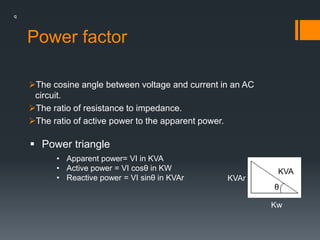
 Power triangle
Kw
KVA
KVAr
q
θ
• Apparent power= VI in KVA
• Active power = VI cosθ in KW
• Reactive power = VI sinθ in KVAr
Effect of low power factor
Large KVA rating of equipment
Greater conductor size
Large copper losses
Poor voltage regulation
FACTS
Flexible AC Transmission System (Facts) is a new
integrated concept based on power electronic switching
converters and dynamic controllers to enhance the
system utilization and power transfer capacity as well as
the stability, security, reliability and power quality of AC
system interconnections.
FACTS technologies improved transmission system
operation with minimum investment, environmental
impact and implementation time compared to the
construction of new transmission line.
BENEFITS OF FACTS
 Regulation of power flows in prescribed transmission routes.
 Reduces the need for construction of new transmission lines,
capacitors and reactors.
 Provides greater ability to transfer power between controlled
areas.
 These devices help to damp the power oscillations that could
damage the equipment.
BENEFITS OF FACTS
 Improves the transient stability of the system.
 Controls real and reactive power flow in the line
independently.
 Damping of oscillations which can threaten security or limit
the usable line capacity.
FACTS Devices
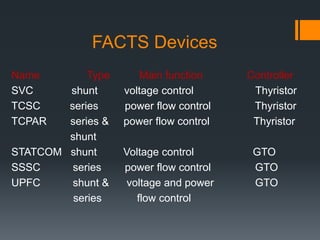
Name Type Main function Controller
SVC shunt voltage control Thyristor
TCSC series power flow control Thyristor
TCPAR series & power flow control Thyristor
shunt
STATCOM shunt Voltage control GTO
SSSC series power flow control GTO
UPFC shunt & voltage and power GTO
series flow control
INTRODUCTION TO UPFC
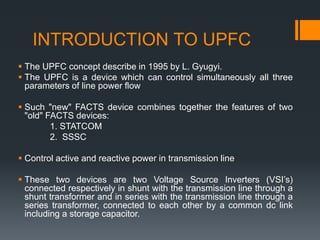
 The UPFC concept describe in 1995 by L. Gyugyi.
 The UPFC is a device which can control simultaneously all three
parameters of line power flow
 Such "new" FACTS device combines together the features of two
"old" FACTS devices:
1. STATCOM
2. SSSC
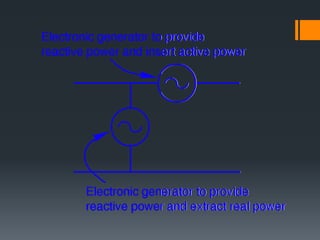
 Control active and reactive power in transmission line
 These two devices are two Voltage Source Inverters (VSI’s)
connected respectively in shunt with the transmission line through a
shunt transformer and in series with the transmission line through a
series transformer, connected to each other by a common dc link
including a storage capacitor.
CIRCUIT DESCRIPTION
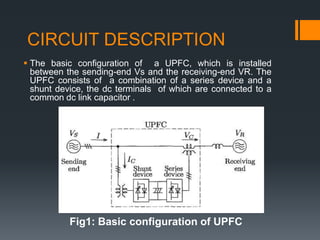
 The basic configuration of a UPFC, which is installed
between the sending-end Vs and the receiving-end VR. The
UPFC consists of a combination of a series device and a
shunt device, the dc terminals of which are connected to a
common dc link capacitor .
Fig1: Basic configuration of UPFC
Operation of UPFC
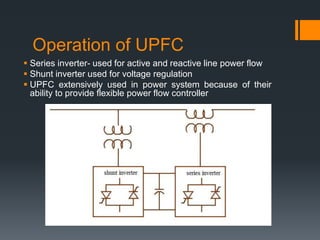
 Series inverter- used for active and reactive line power flow
 Shunt inverter used for voltage regulation
 UPFC extensively used in power system because of their
ability to provide flexible power flow controller
Application
 Using HVDC transmission system
 Use of UPFC for optimal power flow control
 For improving micro grid voltage profile
 For enhancement of voltage profile & minimization of losses
 Increase transient stability of inter area power system
 For damping power system ossicilation
conclusion
UPFC is FACT device used to control active &
reactive power flow. The overall result over the
power system is that it improved the power factor.
So it bring the present power system at better
economy level
Thank you

Upfc & fact

  • 1.
  • 2.
    Content  Introduction ofpower factor improvement  Power factor  Effect of low power factor  FACTS  Benefits of FACTS  FACTS Devices  Introduction to UPFC  Circuit description  Operation of UPFC  Application  Conclusion
  • 3.
    INTRODUCTION  Electrical energygenerated, transmitted, distributed in the form of alternating current. Therefore power factor plays an important role.  Power factor is highly undesirable as it causes an increase in current, result in additional losses of active power in all the elements of power system  For good quality of power supply, it is necessary to have power factor as close as unity.
  • 4.
    Power factor The cosineangle between voltage and current in an AC circuit. The ratio of resistance to impedance. The ratio of active power to the apparent power.  Power triangle Kw KVA KVAr q θ • Apparent power= VI in KVA • Active power = VI cosθ in KW • Reactive power = VI sinθ in KVAr
  • 5.
    Effect of lowpower factor Large KVA rating of equipment Greater conductor size Large copper losses Poor voltage regulation
  • 6.
    FACTS Flexible AC TransmissionSystem (Facts) is a new integrated concept based on power electronic switching converters and dynamic controllers to enhance the system utilization and power transfer capacity as well as the stability, security, reliability and power quality of AC system interconnections. FACTS technologies improved transmission system operation with minimum investment, environmental impact and implementation time compared to the construction of new transmission line.
  • 7.
    BENEFITS OF FACTS Regulation of power flows in prescribed transmission routes.  Reduces the need for construction of new transmission lines, capacitors and reactors.  Provides greater ability to transfer power between controlled areas.  These devices help to damp the power oscillations that could damage the equipment.
  • 8.
    BENEFITS OF FACTS Improves the transient stability of the system.  Controls real and reactive power flow in the line independently.  Damping of oscillations which can threaten security or limit the usable line capacity.
  • 9.
    FACTS Devices Name TypeMain function Controller SVC shunt voltage control Thyristor TCSC series power flow control Thyristor TCPAR series & power flow control Thyristor shunt STATCOM shunt Voltage control GTO SSSC series power flow control GTO UPFC shunt & voltage and power GTO series flow control
  • 10.
    INTRODUCTION TO UPFC The UPFC concept describe in 1995 by L. Gyugyi.  The UPFC is a device which can control simultaneously all three parameters of line power flow  Such "new" FACTS device combines together the features of two "old" FACTS devices: 1. STATCOM 2. SSSC  Control active and reactive power in transmission line  These two devices are two Voltage Source Inverters (VSI’s) connected respectively in shunt with the transmission line through a shunt transformer and in series with the transmission line through a series transformer, connected to each other by a common dc link including a storage capacitor.
  • 11.
    CIRCUIT DESCRIPTION  Thebasic configuration of a UPFC, which is installed between the sending-end Vs and the receiving-end VR. The UPFC consists of a combination of a series device and a shunt device, the dc terminals of which are connected to a common dc link capacitor . Fig1: Basic configuration of UPFC
  • 13.
    Operation of UPFC Series inverter- used for active and reactive line power flow  Shunt inverter used for voltage regulation  UPFC extensively used in power system because of their ability to provide flexible power flow controller
  • 14.
    Application  Using HVDCtransmission system  Use of UPFC for optimal power flow control  For improving micro grid voltage profile  For enhancement of voltage profile & minimization of losses  Increase transient stability of inter area power system  For damping power system ossicilation
  • 15.
    conclusion UPFC is FACTdevice used to control active & reactive power flow. The overall result over the power system is that it improved the power factor. So it bring the present power system at better economy level
  • 16.