OPTIMIZATION-Shuffled Frog
Leaping Algorithm
 It’s a procedure to make a system or
design more effective, especially
involving the mathematical techniques.
 To minimize the cost of production or
to maximize the efficiency of
production.
What is optimization....?
It’s a technique to:
 Find Best Solution
 Minimal Cost
 Minimal Error
 Maximal Profit
 Maximal Utility
Optimization problems are solved by using
rigorous or approximate mathematical search
techniques.
 Mathematical optimization
1) Linear Programming
2) Dynamic Programming
 Evolutionary algorithms- That mimic
the metaphor of natural biological
evolution and the social behaviour of
species.
Methods of Optimization
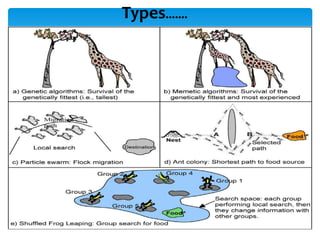
 Genetic algorithms - ‘Survival of the
genetically fittest’
 Memetic algorithms- ‘Survival of the
genetically fittest and most experienced’
 Particle swarm- ‘Flock migration’
 Ant colony- ‘Shortest path to food
source’
 Shuffled frog leaping- ‘Group search of frogs
for food’
Types of Evolutionary algorithms
Types.......
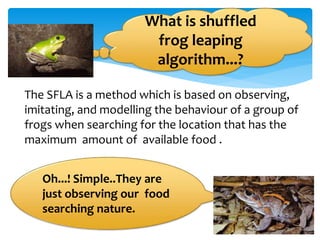
What is shuffled
frog leaping
algorithm...?
Oh...! Simple..They are
just observing our food
searching nature.
The SFLA is a method which is based on observing,
imitating, and modelling the behaviour of a group of
frogs when searching for the location that has the
maximum amount of available food .
 Population consists of a set of frogs
 Partitioned into subsets referred to as memeplexes
 Each memeplexes performing a local search
 After a defined number of evolution steps, ideas
are passed among memeplexes in a shuffling
process
 The local search and the shuffling processes
continue until defined convergence criteria are
satisfied
Process of SFLA
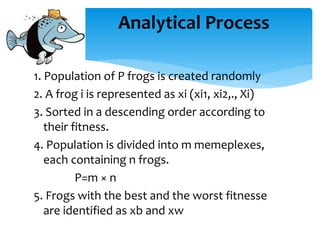
1. Population of P frogs is created randomly
2. A frog i is represented as xi (xi1, xi2,., Xi)
3. Sorted in a descending order according to
their fitness.
4. Population is divided into m memeplexes,
each containing n frogs.
P=m × n
5. Frogs with the best and the worst fitnesse
are identified as xb and xw
Analytical Process
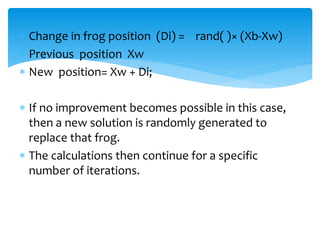
 Change in frog position (Di) = rand( )× (Xb-Xw)
 Previous position Xw
 New position= Xw + Di;
 If no improvement becomes possible in this case,
then a new solution is randomly generated to
replace that frog.
 The calculations then continue for a specific
number of iterations.
 Ac-dc optimal power flow
 Scheduling of construction projects
 Computer-aided design activities
 Water distribution network design
Application of SFLA
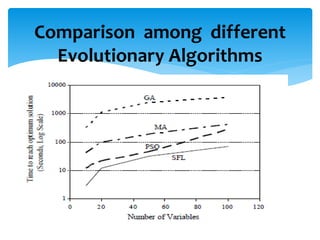
Comparison among different
Evolutionary Algorithms
 SFLA has been used as appropriate tools to
obtain the best solutions with the least total
time and cost by evaluating unlimited possible
options.
 Implementation of evolutionary algorithms in
various field because of their reliability and
simple implementation
CONCLUSION
 Eusuff M. M., Lansey K.E. ,Shuffled Frog
Leaping Algorithm: A Memetic Metaheuristic
for Discrete Optimization, J. Eng.
Optimization, 2006.
 Eusuff, M.M. and Lansey, K.E., Optimization
using shuffled frog leaping algorithm. , 2003
 Elbeltag , T. and Grierson Comparison among
five evolutionary-based optimization
algorithms. J. Adv. Engg. Informatics, 2005.
REFRENCES
THANK YOU

Optimization Shuffled Frog Leaping Algorithm

  • 1.
  • 2.
     It’s aprocedure to make a system or design more effective, especially involving the mathematical techniques.  To minimize the cost of production or to maximize the efficiency of production. What is optimization....?
  • 3.
    It’s a techniqueto:  Find Best Solution  Minimal Cost  Minimal Error  Maximal Profit  Maximal Utility Optimization problems are solved by using rigorous or approximate mathematical search techniques.
  • 4.
     Mathematical optimization 1)Linear Programming 2) Dynamic Programming  Evolutionary algorithms- That mimic the metaphor of natural biological evolution and the social behaviour of species. Methods of Optimization
  • 5.
     Genetic algorithms- ‘Survival of the genetically fittest’  Memetic algorithms- ‘Survival of the genetically fittest and most experienced’  Particle swarm- ‘Flock migration’  Ant colony- ‘Shortest path to food source’  Shuffled frog leaping- ‘Group search of frogs for food’ Types of Evolutionary algorithms
  • 6.
  • 7.
    What is shuffled frogleaping algorithm...? Oh...! Simple..They are just observing our food searching nature. The SFLA is a method which is based on observing, imitating, and modelling the behaviour of a group of frogs when searching for the location that has the maximum amount of available food .
  • 8.
     Population consistsof a set of frogs  Partitioned into subsets referred to as memeplexes  Each memeplexes performing a local search  After a defined number of evolution steps, ideas are passed among memeplexes in a shuffling process  The local search and the shuffling processes continue until defined convergence criteria are satisfied Process of SFLA
  • 9.
    1. Population ofP frogs is created randomly 2. A frog i is represented as xi (xi1, xi2,., Xi) 3. Sorted in a descending order according to their fitness. 4. Population is divided into m memeplexes, each containing n frogs. P=m × n 5. Frogs with the best and the worst fitnesse are identified as xb and xw Analytical Process
  • 10.
     Change infrog position (Di) = rand( )× (Xb-Xw)  Previous position Xw  New position= Xw + Di;  If no improvement becomes possible in this case, then a new solution is randomly generated to replace that frog.  The calculations then continue for a specific number of iterations.
  • 11.
     Ac-dc optimalpower flow  Scheduling of construction projects  Computer-aided design activities  Water distribution network design Application of SFLA
  • 12.
  • 13.
     SFLA hasbeen used as appropriate tools to obtain the best solutions with the least total time and cost by evaluating unlimited possible options.  Implementation of evolutionary algorithms in various field because of their reliability and simple implementation CONCLUSION
  • 14.
     Eusuff M.M., Lansey K.E. ,Shuffled Frog Leaping Algorithm: A Memetic Metaheuristic for Discrete Optimization, J. Eng. Optimization, 2006.  Eusuff, M.M. and Lansey, K.E., Optimization using shuffled frog leaping algorithm. , 2003  Elbeltag , T. and Grierson Comparison among five evolutionary-based optimization algorithms. J. Adv. Engg. Informatics, 2005. REFRENCES
  • 15.