1
A
Seminar Paper Presentation on
1
PRESENTED BY:-
HARENDRA KUKNA
4th year, EE
PCE/EE/11/043
DEPARTMENT OF ELECTRICAL ENGINEERING
POORNIMA COLLEGE OF ENGINEERING
ISI-6 RIICO INSTITUTIONALAREA,
JAIPUR -302022
SUBMITTED TO:-
Mr. Nitin Goel
Dept. Of Electrical Engg.
2011-15
Contents
 Power System Stability Overview
 Power System Stability: A Proposed Definition
 Need of Stability Classification
 Power System Stability Classification
 Rotor Angle Stability
 Voltage Stability
 Frequency Stability
 Fact Devices
 References
2
Power System Stability Overview
 Power system is defined as a network of one or more
generating units, loads and power transmission lines
including the associated equipments connected to it.
 The stability of a power system is its ability to develop
restoring forces equal to or greater than the disturbing
forces to maintain the state of equilibrium.
 Power system stability problem gets more pronounced in
case of interconnection of large power networks.
3
Power System Stability: A Proposed
Definition
• Power system stability is the ability of an electric power
system, for a given initial operating condition, to regain a
state of operating equilibrium after being subjected to a
physical disturbance, with most system variables bounded
so that practically the entire system remains intact.
4
Need of Stability Classification
 Stability analysis is easier. Also it leads to proper and
effective understanding of different power system
instabilities.
 Key factors that leads to instability can be easily
identified.
 Methods can be devised for improving power system
stability.
5
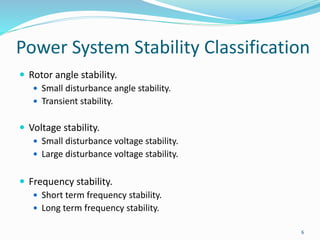
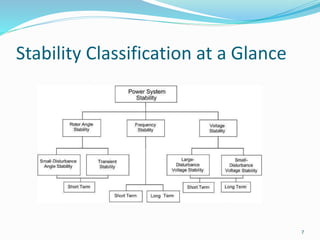
Power System Stability Classification
 Rotor angle stability.
 Small disturbance angle stability.
 Transient stability.
 Voltage stability.
 Small disturbance voltage stability.
 Large disturbance voltage stability.
 Frequency stability.
 Short term frequency stability.
 Long term frequency stability.
6
Stability Classification at a Glance
7
Rotor Angle Stability
 Rotor angle stability refers to the ability of synchronous
machines of an interconnected power system to remain
in synchronism after being subjected to a disturbance.
 Rotor angle instability occurs due to angular swings of
some generators leading to their loss of synchronism with
other generators.
8
Voltage Stability
 Voltage stability refers to the ability of a power system to
maintain steady voltages at all buses in the system after being
subjected to a disturbance from a given initial operating
condition.
 A system is voltage instable if for atleast one bus in the system,
the voltage magnitude decreases as reactive power injection is
increased.
 Voltage instability results in progressive fall or rise of voltages
of some buses.
9
Frequency Stability
 Frequency stability refers to the ability of a power system to
maintain steady frequency following a severe system upset
resulting in a significant imbalance between generation and
load.
 Frequency instability leads to tripping of generating units
and/or loads.
 Frequency stability may be a short-term phenomenon or a
long-term phenomenon.
10
11
Facts
• Flexible AC Transmission System (Facts) is a new integrated
concept based on power electronic switching converters
and dynamic controllers to enhance the system utilization
and power transfer capacity as well as the stability, security,
reliability and power quality of AC system interconnections.
12
• Steady state voltage stability
• Power flow control
• Damping of power system oscillations
• Reducing generation costs
• HVDC link application
• Deregulated power systems
• Interconnection of renewable, distributed generation and
storages.
Applications Of FACT
References
 “Definition and Classification of Power System Stability”, IEEE
TRANSACTIONS ON POWER SYSTEMS, VOL. 19, NO. 2, MAY
2004
 Khan, Asfar Ali, “Determination of reactive power limit for
voltage stability study in a grid system”, September 1999,
M.Tech Dissertation, AMU, Aligarh
 Kundur, P., “Power System Stability and Control”, McGraw Hill,
1994.
13
Thank You
14

Power System Stability And Control Using Fact Devices

  • 1.
    1 A Seminar Paper Presentationon 1 PRESENTED BY:- HARENDRA KUKNA 4th year, EE PCE/EE/11/043 DEPARTMENT OF ELECTRICAL ENGINEERING POORNIMA COLLEGE OF ENGINEERING ISI-6 RIICO INSTITUTIONALAREA, JAIPUR -302022 SUBMITTED TO:- Mr. Nitin Goel Dept. Of Electrical Engg. 2011-15
  • 2.
    Contents  Power SystemStability Overview  Power System Stability: A Proposed Definition  Need of Stability Classification  Power System Stability Classification  Rotor Angle Stability  Voltage Stability  Frequency Stability  Fact Devices  References 2
  • 3.
    Power System StabilityOverview  Power system is defined as a network of one or more generating units, loads and power transmission lines including the associated equipments connected to it.  The stability of a power system is its ability to develop restoring forces equal to or greater than the disturbing forces to maintain the state of equilibrium.  Power system stability problem gets more pronounced in case of interconnection of large power networks. 3
  • 4.
    Power System Stability:A Proposed Definition • Power system stability is the ability of an electric power system, for a given initial operating condition, to regain a state of operating equilibrium after being subjected to a physical disturbance, with most system variables bounded so that practically the entire system remains intact. 4
  • 5.
    Need of StabilityClassification  Stability analysis is easier. Also it leads to proper and effective understanding of different power system instabilities.  Key factors that leads to instability can be easily identified.  Methods can be devised for improving power system stability. 5
  • 6.
    Power System StabilityClassification  Rotor angle stability.  Small disturbance angle stability.  Transient stability.  Voltage stability.  Small disturbance voltage stability.  Large disturbance voltage stability.  Frequency stability.  Short term frequency stability.  Long term frequency stability. 6
  • 7.
  • 8.
    Rotor Angle Stability Rotor angle stability refers to the ability of synchronous machines of an interconnected power system to remain in synchronism after being subjected to a disturbance.  Rotor angle instability occurs due to angular swings of some generators leading to their loss of synchronism with other generators. 8
  • 9.
    Voltage Stability  Voltagestability refers to the ability of a power system to maintain steady voltages at all buses in the system after being subjected to a disturbance from a given initial operating condition.  A system is voltage instable if for atleast one bus in the system, the voltage magnitude decreases as reactive power injection is increased.  Voltage instability results in progressive fall or rise of voltages of some buses. 9
  • 10.
    Frequency Stability  Frequencystability refers to the ability of a power system to maintain steady frequency following a severe system upset resulting in a significant imbalance between generation and load.  Frequency instability leads to tripping of generating units and/or loads.  Frequency stability may be a short-term phenomenon or a long-term phenomenon. 10
  • 11.
    11 Facts • Flexible ACTransmission System (Facts) is a new integrated concept based on power electronic switching converters and dynamic controllers to enhance the system utilization and power transfer capacity as well as the stability, security, reliability and power quality of AC system interconnections.
  • 12.
    12 • Steady statevoltage stability • Power flow control • Damping of power system oscillations • Reducing generation costs • HVDC link application • Deregulated power systems • Interconnection of renewable, distributed generation and storages. Applications Of FACT
  • 13.
    References  “Definition andClassification of Power System Stability”, IEEE TRANSACTIONS ON POWER SYSTEMS, VOL. 19, NO. 2, MAY 2004  Khan, Asfar Ali, “Determination of reactive power limit for voltage stability study in a grid system”, September 1999, M.Tech Dissertation, AMU, Aligarh  Kundur, P., “Power System Stability and Control”, McGraw Hill, 1994. 13
  • 14.