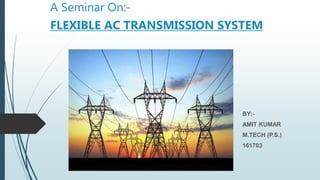
A Seminar On:-
FLEXIBLE AC TRANSMISSION SYSTEM
BY:-
AMIT KUMAR
M.TECH (P.S.)
161703
CONTENTS
■ Introduction
■ History
■ Objectives of FACTS Controllers
■ Power electronic devices for FACTS controllers
■ Types of FACTS Controllers
■ Benefits of FACTS Controllers
■ Disadvantages
■ Projects related FACTS
■ Conclusion
■ Reference
FLEXIBLE ALTERNATING CURRENT
TRANSMISSION SYSTEM (FACTS)
■ FACTS:-
“AC transmission systems incorporating the power
electronic-based to enhance controllability and increase
power transfer capability.”
■ Facts Controller:-
“A power electronic based system & other static equipment
that provide control of one or more AC transmission
parameters.”
HISTORY
■ Dr. Narain Hingorani is a father of FACTS technology.
■ The first FACTS installation was at C . J. Slatt substation near
Arlington, Oregon (U.S.)
■ This is a 500 kv 3 Phase 60 Hz substation and was
developed by EPRI, the Bonneille Power Administration and
general electric component.
OBJECTIVES OF FACTS CONTROLLERS
■ The main objectives of FACTS controllers are the following:
1. Regulation of power flows in prescribed transmission routes.
2. Secure loading of transmission lines nearer to their thermal
limits.
3. Prevention of cascading outages by contributing to emergency
control.
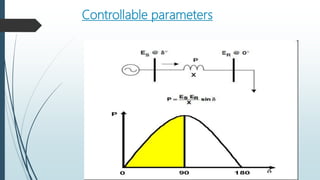
Controllable parameters
1. Control of the line impedance.
2. Control of Power Angle.
3. Control of voltage injected.
4. Control of Real and Reactive Power.
■ Voltage along the line can be controlled by reactance
shunt compensation.
■ Series line inductance can be controlled by series
capacitive compensation.
■ Transmission angle can be varied by phase shifting.
Power Electronics Devices For
FACTS Controllers
1. Thyristors
2. Gate-Turn Off Thyristors ( GTO )
3. Insulated Gate Bipolar Transistors (IGBTs)
4. Integrated Gate Commutated Thyristors ( IGCTs )
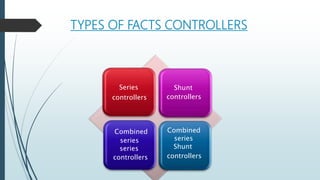
TYPES OF FACTS CONTROLLERS
Cobied
Series Series
Controllers
controllers controllers
Series Shunt
Combined
series
series
controllers controllers
Combined
series
Shunt
SERIES CONTROLLERS
Series Controllers consists of capacitors or reactors which
introduce voltage in series with the line. They are basically
variable impedance devices. Their major task is to reduce
the inductivity of the transmission line. They supply or
consume variable reactive power.
■ Static Synchronous Series Compensator (SSSC)
■ Thyristor Controlled Series Capacitor (TCSC)
■ Thyristor switched series capacitor (TSSC)
■ Thyristor-switched series reactor (TSSR)
■ Thyristor-controlled series reactor (TCSR)
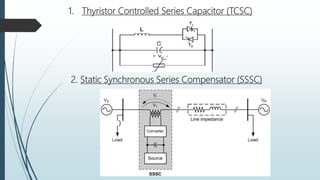
1. Thyristor Controlled Series Capacitor (TCSC)
2. Static Synchronous Series Compensator (SSSC)
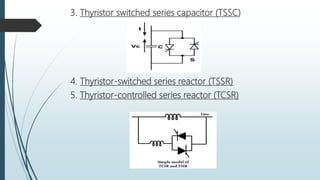
3. Thyristor switched series capacitor (TSSC)
4. Thyristor-switched series reactor (TSSR)
5. Thyristor-controlled series reactor (TCSR)
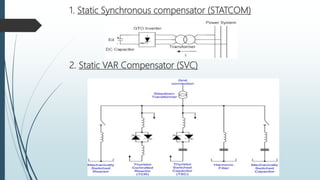
SHUNT CONTROLLERS
Shunt controllers consist of variable impedance devices
like capacitors or reactors which introduce current in series
with the line. Their major task is to reduce the capacitivity
of the transmission line. The injected current is in phase
with the line voltage.
■ Static Synchronous compensator (STATCOM)
■ Static VAR Compensator (SVC)
► Thyristor Controlled Reactor (TCR)
► Thyristor Switched Reactor (TSR)
► Thyristor Switched Capacitor (TSC)
► Mechanically Switched Capacitor (MSC)
► Harmonic Filter
1. Static Synchronous compensator (STATCOM)
2. Static VAR Compensator (SVC)
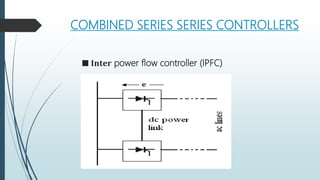
COMBINED SERIES SERIES CONTROLLERS
■ 𝐈𝐧𝐭𝐞𝐫 power flow controller (IPFC)
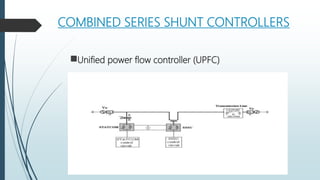
COMBINED SERIES SHUNT CONTROLLERS
■Unified power flow controller (UPFC)
BENEFITS OF FACTS CONTROLLERS
■ A Rapidly Implemented Installations.
■ Increased System Capacity.
■ Enhanced System Reliability.
■ Improved System Controllability.
■ Seamless System Interconnections.
■ Better utilization of existing transmission system assets.
■ Up gradation of lines.
DISADVANTAGES OF FACTS CONTROLLERS
■ High initial costs
■ High repair cost
PROJECTS RELATED FACTS
■ ABB to enhance 400 kV transmission line in India with flexible AC
system solution :-
ABB will build a fixed and thyristor-controlled series compensation
scheme for PGCIL’s 412-kilometer long, 400 kV double-circuit inter-
regional tie line. The line, along with the existing 1000 MW HVDC
back-to-back link in Chandrapur, will ensure reliable power supply
and stable inter-regional transfer of power from eastern to southern
India
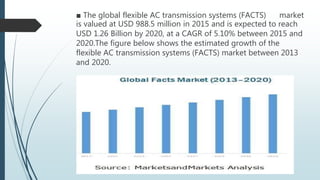
■ The global flexible AC transmission systems (FACTS) market
is valued at USD 988.5 million in 2015 and is expected to reach
USD 1.26 Billion by 2020, at a CAGR of 5.10% between 2015 and
2020.The figure below shows the estimated growth of the
flexible AC transmission systems (FACTS) market between 2013
and 2020.
CONCLUSION
■ The flexible ac transmission system (FACTS), a new
technology based on power electronics, offers an opportunity
to enhance controllability, stability, and power transfer capability
of ac transmission systems.
■ In view of the various power system limits, FACTS provides
the most reliable and efficient solution.
■ It is envisaged that in future FACTS devices could be
installed on wide scale by electrical utilities in an attempt to
control the power flows through their networks.
REFERENCES
■ N. G. Hingorani and L. Gyugyi, Understanding FACTS, IEEE Press, New York,1999.
■ IEEE Power Engineering Society, FACTS Applications, Publication 96TP116-0,IEEE
Press, New York, 1996.
■ www.seimens.org
■ K.R. PADIYAR, FACTS Controllers in Power Transmission And Distribution (second
edition), New age publications, New Delhi, 2016.
■ www.Wikipedia.org
FACTS DEVICES

FACTS DEVICES

  • 1.
    A Seminar On:- FLEXIBLEAC TRANSMISSION SYSTEM BY:- AMIT KUMAR M.TECH (P.S.) 161703
  • 2.
    CONTENTS ■ Introduction ■ History ■Objectives of FACTS Controllers ■ Power electronic devices for FACTS controllers ■ Types of FACTS Controllers ■ Benefits of FACTS Controllers ■ Disadvantages ■ Projects related FACTS ■ Conclusion ■ Reference
  • 3.
    FLEXIBLE ALTERNATING CURRENT TRANSMISSIONSYSTEM (FACTS) ■ FACTS:- “AC transmission systems incorporating the power electronic-based to enhance controllability and increase power transfer capability.” ■ Facts Controller:- “A power electronic based system & other static equipment that provide control of one or more AC transmission parameters.”
  • 4.
    HISTORY ■ Dr. NarainHingorani is a father of FACTS technology. ■ The first FACTS installation was at C . J. Slatt substation near Arlington, Oregon (U.S.) ■ This is a 500 kv 3 Phase 60 Hz substation and was developed by EPRI, the Bonneille Power Administration and general electric component.
  • 5.
    OBJECTIVES OF FACTSCONTROLLERS ■ The main objectives of FACTS controllers are the following: 1. Regulation of power flows in prescribed transmission routes. 2. Secure loading of transmission lines nearer to their thermal limits. 3. Prevention of cascading outages by contributing to emergency control.
  • 6.
  • 7.
    1. Control ofthe line impedance. 2. Control of Power Angle. 3. Control of voltage injected. 4. Control of Real and Reactive Power. ■ Voltage along the line can be controlled by reactance shunt compensation. ■ Series line inductance can be controlled by series capacitive compensation. ■ Transmission angle can be varied by phase shifting.
  • 8.
    Power Electronics DevicesFor FACTS Controllers 1. Thyristors 2. Gate-Turn Off Thyristors ( GTO ) 3. Insulated Gate Bipolar Transistors (IGBTs) 4. Integrated Gate Commutated Thyristors ( IGCTs )
  • 9.
    TYPES OF FACTSCONTROLLERS Cobied Series Series Controllers controllers controllers Series Shunt Combined series series controllers controllers Combined series Shunt
  • 10.
    SERIES CONTROLLERS Series Controllersconsists of capacitors or reactors which introduce voltage in series with the line. They are basically variable impedance devices. Their major task is to reduce the inductivity of the transmission line. They supply or consume variable reactive power. ■ Static Synchronous Series Compensator (SSSC) ■ Thyristor Controlled Series Capacitor (TCSC) ■ Thyristor switched series capacitor (TSSC) ■ Thyristor-switched series reactor (TSSR) ■ Thyristor-controlled series reactor (TCSR)
  • 11.
    1. Thyristor ControlledSeries Capacitor (TCSC) 2. Static Synchronous Series Compensator (SSSC)
  • 12.
    3. Thyristor switchedseries capacitor (TSSC) 4. Thyristor-switched series reactor (TSSR) 5. Thyristor-controlled series reactor (TCSR)
  • 13.
    SHUNT CONTROLLERS Shunt controllersconsist of variable impedance devices like capacitors or reactors which introduce current in series with the line. Their major task is to reduce the capacitivity of the transmission line. The injected current is in phase with the line voltage. ■ Static Synchronous compensator (STATCOM) ■ Static VAR Compensator (SVC) ► Thyristor Controlled Reactor (TCR) ► Thyristor Switched Reactor (TSR) ► Thyristor Switched Capacitor (TSC) ► Mechanically Switched Capacitor (MSC) ► Harmonic Filter
  • 14.
    1. Static Synchronouscompensator (STATCOM) 2. Static VAR Compensator (SVC)
  • 15.
    COMBINED SERIES SERIESCONTROLLERS ■ 𝐈𝐧𝐭𝐞𝐫 power flow controller (IPFC)
  • 16.
    COMBINED SERIES SHUNTCONTROLLERS ■Unified power flow controller (UPFC)
  • 17.
    BENEFITS OF FACTSCONTROLLERS ■ A Rapidly Implemented Installations. ■ Increased System Capacity. ■ Enhanced System Reliability. ■ Improved System Controllability. ■ Seamless System Interconnections. ■ Better utilization of existing transmission system assets. ■ Up gradation of lines.
  • 18.
    DISADVANTAGES OF FACTSCONTROLLERS ■ High initial costs ■ High repair cost
  • 19.
    PROJECTS RELATED FACTS ■ABB to enhance 400 kV transmission line in India with flexible AC system solution :- ABB will build a fixed and thyristor-controlled series compensation scheme for PGCIL’s 412-kilometer long, 400 kV double-circuit inter- regional tie line. The line, along with the existing 1000 MW HVDC back-to-back link in Chandrapur, will ensure reliable power supply and stable inter-regional transfer of power from eastern to southern India
  • 20.
    ■ The globalflexible AC transmission systems (FACTS) market is valued at USD 988.5 million in 2015 and is expected to reach USD 1.26 Billion by 2020, at a CAGR of 5.10% between 2015 and 2020.The figure below shows the estimated growth of the flexible AC transmission systems (FACTS) market between 2013 and 2020.
  • 21.
    CONCLUSION ■ The flexibleac transmission system (FACTS), a new technology based on power electronics, offers an opportunity to enhance controllability, stability, and power transfer capability of ac transmission systems. ■ In view of the various power system limits, FACTS provides the most reliable and efficient solution. ■ It is envisaged that in future FACTS devices could be installed on wide scale by electrical utilities in an attempt to control the power flows through their networks.
  • 22.
    REFERENCES ■ N. G.Hingorani and L. Gyugyi, Understanding FACTS, IEEE Press, New York,1999. ■ IEEE Power Engineering Society, FACTS Applications, Publication 96TP116-0,IEEE Press, New York, 1996. ■ www.seimens.org ■ K.R. PADIYAR, FACTS Controllers in Power Transmission And Distribution (second edition), New age publications, New Delhi, 2016. ■ www.Wikipedia.org